




Abstract
This article is concerned with identifying how contemporary data technology can be used to find and analyse the big amount of case law generated by international courts in a more comprehensive way than that achieved through the traditional manual reading of case law at the core of textbook or doctrinal analysis of judgements. The focus of the article is the European Court of Human Rights (ECtHRs) and its Article 14 + 2 case law, which is studied through the tools of citation network analysis. The resulting findings are then compared to a standard textbook approach in order to show how citation network analysis offers a reliable method in selecting cases for qualitative analysis and drawing information relevant to specific legal issues. The article proposes and eventually advances a new approach to legal research, which integrates quantitative network analysis with qualitative legal (doctrinal) analysis, and shows how this form of analysis enables a study of case law through the recognition of patterns within it that would have otherwise been difficult to identify. Using this approach to advance new insights into the prohibition of discrimination under Article 14 of the European Convention on Human Rights (ECHR), the article ultimately offers a new instrument for scholars and practitioners to put into use when considering the future narrative of discrimination law.
Keywords
Introduction
International courts are increasingly seen as active agents, which do more than simply apply the law 1 – they shape the law through their decisions. In an international law environment, where basic treaties do not change much over time, the courts’ decisions as patterns of precedent hold the key to understanding the law. In this article, we are concerned with identifying how contemporary data technology can be used to find and analyse this case law in a more comprehensive way than what can be achieved through the traditional manual reading of case law that usually lies behind textbook or doctrinal analysis of the most recent and most talked about judgements. We shall do so by focusing on the European Court of Human Rights (ECtHR) and more specifically, with a starting point in some observations we have made regarding a dimension of its Article 14 case law.
Our double aim is to (1) introduce the tools of citation network analysis to the study of the case law of courts (here, the ECtHR) and compare this to a standard textbook approach and (2) show how citation network analysis, if used as an approach to selecting cases for qualitative analysis, can reveal new information – both factual and legal – about the Court’s case law; information that is relevant to specific legal issues. In short we propose and eventually advance a new approach to legal research, which integrates quantitative network analysis with qualitative legal (doctrinal) analysis, and we show how this can be used to advance new insights into the prohibition of discrimination under Article 14 of the European Convention on Human Rights (ECHR).
Case citation network analysis
Method and significance
In legal research, citation network analysis can be used to identify the structure of the whole body of case law (or that part of it which is of interest to researchers), and it may be used to compute how cases cluster together by sharing citations or how specific cases refer to the overall network, groups (clusters) in the network, or to some selected cases. This information may be used to hypothesize about how the law has developed and may even give clues as to how it will do so in the future. The units of case citation network analysis (the ‘dots’ in Figure 1 below, also called ‘nodes’ or ‘vertices’) are cases (judgements), and the connections between them (called ‘edges’ or ‘arcs’ represented by lines in Figure 1 below) are citations. Together they form an interlocked construction, which is an idea that intuitively resonates with the way many lawyers (practitioners as well as legal scholars) think about the law: as a settled web of norms. 2 For instance, Figure 1 presents a small network of cases from the ECtHR.
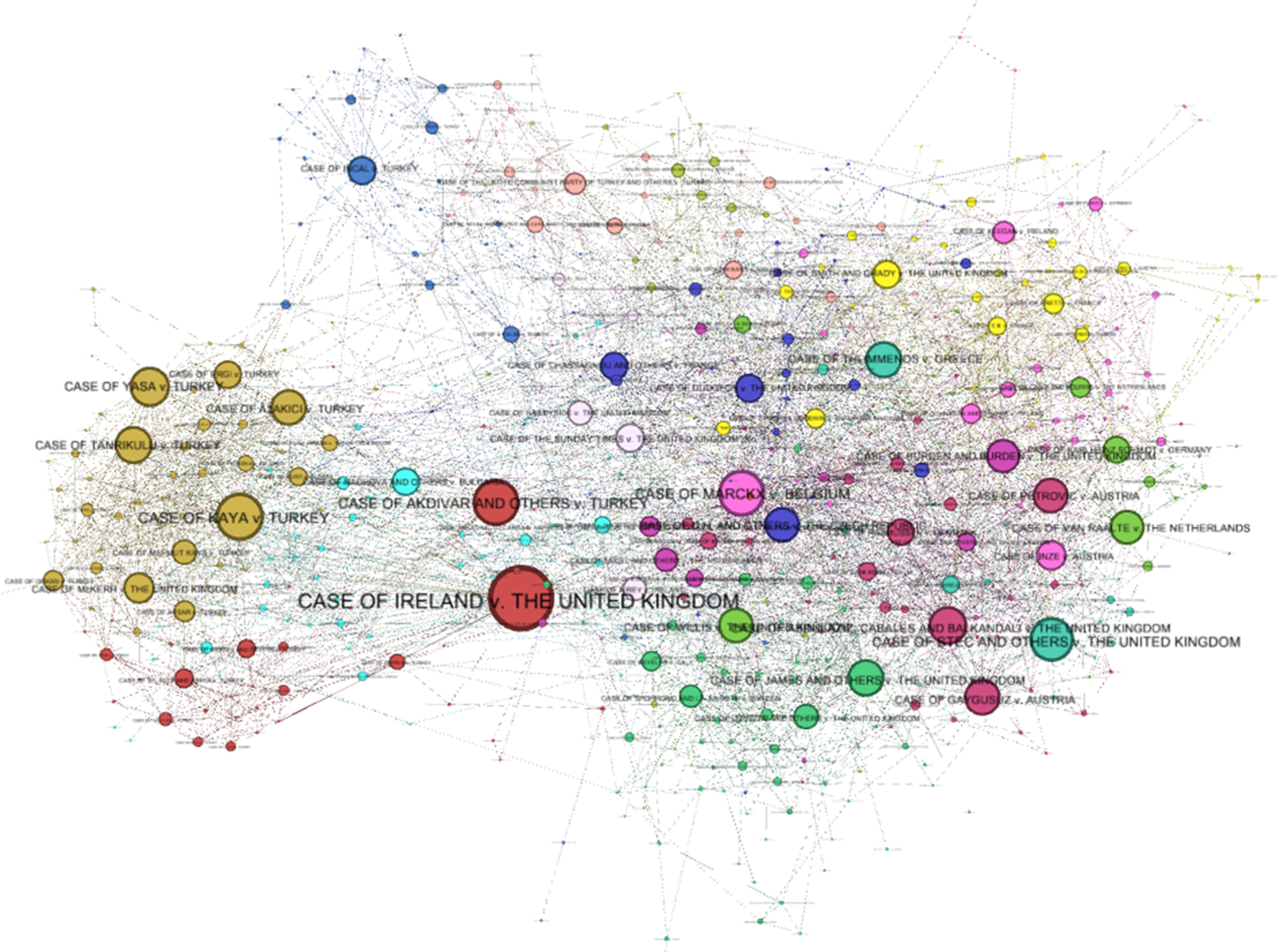
The full Article 14 network (639 judgements); the figure can be accessed as an interactive network at https://www.icourts.dk/networks/sigma/article14/.

The full Article 14 + 2 network (28 judgements) – 10 most cited cases in blue; the figure can be accessed as an interactive network at: https://www.icourts.dk/networks/sigma/article14+2/.
The size of the dots varies in accordance with the number of times the judgement represented by the dot is cited by subsequent judgements. The colours in the illustration indicate how the case-to-case citations cluster together in citation groups.
We take these citation clusters to be indicative of some similarity between those cases that belong to the same cluster. This is based on a more traditional assumption that cases in the network operate as meaningful precedents. Citing the same cases, then, is an indication that reliance on the same precedent is occurring, which in turn is an indication that the cases revolve wholly or partly around the same legal issue.
Therefore, citation network analysis and doctrinal legal studies share the idea of webs and patterns, that is, there is a structural similarity in the way these two types of analysis operate. In seeking more interaction between the two types of analysis (citation network analysis and manual doctrinal analysis), it will be helpful to use Ronald Dworkin’s distinction between three different stages in the process of legal interpretation as a way of showing how citation network analysis can be used in law. 3
Dworkin identifies three stages in the process of legal interpretation: (1) a pre-interpretive stage in which the lawyer collects all the rules and standards that as a whole make up the law on some given point or issue; (2) an interpretive stage in which those rules and standards are assembled into a coherent and justified whole; and (3) a post-interpretive stage in which the underlying justification identified in (2) is used to revisit the original rules and standards identified in (1) and to possibly adjust one’s initial understanding of what these rules and standards say.
Our point is that case citation network analysis renders a more complete mapping of the pre-interpretive stage of legal interpretation; that is, the stage at which one has to identify all the relevant legal material that has to become a part of the interpretive process. By identifying, through a case-to-case citation network, which cases the court itself uses as precedent, how often and when, one gets a more complete understanding of the role of precedent in actual court practice. Moreover, not only may more traditional approaches based on manual reading of cases be both inefficient and for some, perhaps, even impossible, but also even the most careful and capable of readers could miss connections between cases, because the human eye and mind may not absorb all the relevant legal details set out in these texts and may not be tuned into performing the kind of computations that a machine can do. Thus, without a comprehensive overview of relationships between cases through a systematic and exhaustive case-to-case citation analysis, legal scholars working only with manual reading of judgements may neither be able to provide a complete account of what the law is nor empirically test the accuracy of their assumptions about how the body of law under scrutiny is organized.
Furthermore, the categories and concepts used by previous doctrinal scholarship (which often serve as a platform for new doctrinal scholarship/textbooks) may turn out to give a less accurate or less complete representation of the law as it is today. With a steady increase in the number of judgements from the court, it is possible that not all dimensions of these developments would be fully and accurately described by a manual approach. This is especially relevant for the study of the case law generated by active international courts, where precedents and judicial practice are often the main drivers of legal development, 4 and for the study of ECtHR case law in particular, since it is the most prolific international court in the world in terms of number of judgements it produces every year.
To return to Dworkin’s theory of interpretation as a model for generating legal knowledge: if the material selected at the pre-interpretive stage is incomplete, randomly selected or biased, then these deficiencies will influence the two next – interpretive and post-interpretive – stages of interpretation. The result of this will be a representation of legal reality that is likely to become unreliable because it would not properly reflect (Dworkin would say fit) the court’s practice.
One does not have to subscribe en bloc to Dworkin’s theory to see that legal interpretation can never be better than the pre-interpretive materials allow. If the pool of cases that is selected to become part of the process of legal interpretation during the pre-interpretive phase is either incomplete or inaccurate, then the subsequent interpretation is likely to be affected by this bias and result in an inaccurate and, in the worst case, misleading rendering of what the law really is. Using computational technology at the pre-interpretive stage, we claim, can assist the interpretive exercise by making it more complete and helping the interpreter find a more accurate balance point between ‘fit’ and ‘justification’, 5 and thereby identify the best possible answers to legal questions. Moreover, citation network analysis may also aid the legal scholar in identifying otherwise hidden patterns in the citation network, potentially revealing facts in or about the case law that may have implications for our understanding of the law. Ultimately, computers can help to make lawyers and legal scholars more Herculean.
Need for attention and care when inferring from case networks
The network analyses we have carried out for the purposes of this article are based on the total number of citations which each judgement has received from other cases in the network, over the period from the establishment of the ECtHR and up to 2015. It would be possible to create a more refined picture of the citation practice by making more specific reviews of the citation practice, for example, by looking at it on a year-by-year basis. In this way, it would be possible to see which judgements are most cited in each year and thereby to get a more nuanced view of the Court’s citation practice over time. On the other hand, this could create a different form of uncertainty since in a given year, there might be a particularly large or particularly small number of cases relating to a particular issue which might give a distorted picture of the case law. Looking at case law references over a longer period of time, in other words, irons out peaks that can be more or less random. However, if network research were carried a little further, it would be possible to find methods for creating weighted averages to take account of this – it has not been possible for us to do so for this article. It is however possible, with our data set to look up judgements individually to see when they have most recently been cited. For example, one can look at the most cited cases to see the extent to which they are still cited in recent case law. Hence, a relatively new case such as Burden and Burden was cited 10 times in 2014, which is compatible with the case having a high precedent value, since half of the 20 judgements in the network for 2014 refer to it. It is also interesting to see that older judgements, such as Abdulaziz and James and Others, from 1985 and 1986, respectively, are still cited. These judgements were cited eight times and three times, respectively, in 2014, which shows that there are still good grounds for relying on them. But there are also cases which have a high overall in-degree, but with few or no citations in recent years. Incal appears as a leading case in the network, but it has not been cited since 2007 (in cases included in this network – we have not checked whether it has been cited in other contexts). The significance which the case formerly had in Article 14 jurisprudence seems no longer to exist – probably because more recent cases are now considered more relevant by the Court. This underlines the need for a critical approach to the data in the network.
Another issue that needs attention is that the ECtHR may have changed direction in its most recent judgements. In general, in-degree is an accumulated measure that shows the historical use of the case as a precedent in the Court’s case law. But what if the Grand Chamber of the ECtHR has given judgement in 2014 or 2015 which makes the former case law redundant? In such a scenario would not our analysis be misleading? In general, it can be said that, in so far as network analysis is based on statistical results, an individual judgement that changes the case law will not be captured by the method we have used here. On the other hand, it could be argued that there will be some degree of uncertainty associated with whether a new judgement will have such a forceful effect as to change the case law. At least it will be difficult to ascertain such an effect before the new case is authoritatively cited by the Court. Thus, if it is argued that there must be some empirical basis for identifying whether a given judgement has precedent value, one must wait to see the subsequent case law before one can measure whether the significance attributed to the case will be what commentators have predicted on the ground of their assessment of its importance. Conversely, in relation to the need for practitioners to keep up to date with the latest developments of the law, it is clear that this (historical) method is inadequate as it cannot be used to evaluate the significance of a new judgement here and now. Here the choice lies between using discretion concerning the importance of the new case and its use in legal argument, and refraining from relying on the new case on the ground that its value as a precedent is uncertain – a choice that will presumably always be influenced by the intended purpose of a given analysis.
Thirdly, it is possible that the Court’s institutional structure can be a source of error. In our analysis, we do not distinguish between judgements of the Court in a smaller Chamber formation (Chamber judgements) and judgements of the Grand Chamber of the ECtHR. But it could be argued that the judgements of the Grand Chamber are a superior source of law than the Chamber judgements; in the same way, judgements of, say, the Danish Supreme Court are a superior source of law than the judgements of the Danish High Courts. The assumption used in this article is that the value as a source of law of a prior judgement must be assessed by its active application by the ECtHR. Only in those cases where there has been a change of practice will it be relevant to consider which chamber has given the judgement. In this latter situation, however, there will in any case be a need for a more open legal discretion.
In order to check for any possible biases in the network, we have examined whether the judgements that have the highest in-degree ratings have been judgements of the Grand Chamber. The result of this examination shows that the most cited Article 14 cases handed down since the introduction of the bicameral system (introduced under Protocol No. 11 in 1998), which are Incal, D.H. and Others, United Communist Party, Kaya, Stec and Others, Burden and Burden and Nachova and Others, are Grand Chamber judgements. On the other hand, Willis [2002] and Smith and Grady [1999] are not Grand Chamber judgements, but have nevertheless high in-degree ratings and have therefore been identified as leading cases in the network. From this, we estimate that it cannot be concluded that a judgement must have been given by the Grand Chamber for it to be cited by the ECtHR and that Chamber judgements can also be significant. Thus, we believe that it is not the formal status of the Court giving a judgement (Chamber or Grand Chamber) that is decisive, but whether the judgement is used as a precedent in practice.
Exploring the network: From quantity to quality
As can be seen from the graphic illustration of the network above (Figure 1), cases have a tendency of clustering together into various parts of the network. This, as explained, we take as a sign that citations are not random, but meaningful. In a previous discrimination law study, 6 one of us established that while not all clusters are legally meaningful, some clusters are, which makes it worth exploring the network more qualitatively, with a starting point in these clusters. In that study, we used citation network analysis to identify a cluster of citations in the Article 14 case citation network, which showed us how the application of Article 14 in combination with Article P1-1 (protection of the right to property) has gradually evolved from a very basic protection of (mostly gender) equality with regard to inheritance law (inheritance being a legal instrument through which one can acquire property) to a protection of (nationality) equality with regard to state-funded pension rights. In this article, we will use the same technology, albeit exploring another part of the network; we will focus on that part of the network which is singled out in the left-hand side of Figure 1 and coloured in olive green. For greater convenience, we have labelled this cluster of cases the ‘Kaya cluster’ (after the most cited case in the cluster).
From Article 14 cluster to Article 14 + 2 network
As is well known, Article 14 can only be invoked with some other underlying Article. Its appearance in the Court’s jurisprudence has therefore always happened in tandem with an additional ECHR Article, setting the frame for our own examinations, which focus on the combination of Article 14 with Article 2. Using the network programme interactively, we zoomed in on the Kaya cluster and skimmed through the most cited cases to see what legal issues they refer to. Having established that the cases were predominantly about Article 14 being invoked alongside Article 2, we created a new network, consisting of all and only the cases listed in HUDOC (the official database for accessing the case law of the Court) as Article 14 + 2 cases (see Figure 2). From this network, which consists of a total of 28 judgements (all of which belong to the left-hand side olive-coloured cluster as seen in Figure 1 above), we selected the 10 most cited ones as the basis for a more qualitative study.
The 10 most cited cases in the Article 14 + 2 network (i.e. having the highest ‘in-degree’) can be listed chronologically (from oldest to newest) as follows: Kaya v. Turkey, 7 Kurt v. Turkey, 8 Tanrıkulu v. Turkey, 9 Çiçek v. Turkey, 10 Öcalan v. Turkey, 11 Aktaş v. Turkey, 12 Nachova v. Bulgaria, 13 Akkum v. Turkey, 14 Süheyla Aydın v. Turkey 15 and Ognyanova and Choban v. Bulgaria. 16 The purpose behind this chronological study is to investigate and to expose any existing trends of progression or expansion in the Court’s examination of the right under Article 14 taken in conjunction with Article 2.
It is commonly known that ECtHR jurisprudence splits the right under Article 2 into two parts: a substantive limb, concerning the protection of the right to life, and a procedural limb, concerning the investigation of any breaches of the substantive limb that might have arisen. 17 This separation has also been extended to apply to Article 14 whenever that Article is used in conjunction with Article 2. Therefore, the following discussion will flag the limb under which Article 14 is being examined in each case (whether the procedural or the substantive), as this might have an importance for the evaluation of any possible trends in the evolving case law.
Article 14 + 2: The top 10 cited cases
In the case of Kaya, 18 the plaintiff alleged that in Turkey, the lives of Kurdish people are protected to a lesser extent than those of non-Kurdish people. This allegation was constructed as the consequence of inadequately conducted investigations into killings by security forces in south-east Turkey. According to the claimant, the pattern of failing to prosecute further exacerbated the sense of impunity among perpetrators. In ruling that there had been a violation of the procedural aspect of Article 2, the Court acknowledged that the ‘loss of life is a tragic and frequent occurrence in view of the security situation in south-east Turkey’ 19 (emphasis added). Whether or not there was any discrimination involved in the failure to fulfil the procedural duties arising under Article 2 remained unexamined and the Court thereby did not establish any violation of Article 14.
In the case of Kurt, 20 handed down in the same year as Kaya, the applicant, who was submitting a claim in respect of her son’s disappearance, once again called attention to the context of south-east Turkey, claiming that there existed an officially tolerated practice of ineffective remedies for the affected parties as well as a practice of ‘disappearances’ in the region. The significance of this case lies in the evidence brought forward by the parties to support their claims. The applicant relied on the findings contained in the reports published between 1991 and 1995 by the United Nations Working Group on Enforced or Involuntary Disappearances to claim that forced disappearances in Turkey primarily affected persons of Kurdish origin. 21 The government, on the other hand, denied the factual soundness of the applicant’s argument and drew attention to the Turkish Constitutional guarantees of equal treatment within its jurisdiction. The Court dismissed the applicant’s claim for failure to submit enough factual evidence to substantiate her assertions. The context of the picture drawn by the United Nations (UN) reports was not examined. Again, the Court did not establish any violation of Article 14.
The claimant in Tanrıkulu v. Turkey 22 was the wife of a Turkish citizen of Kurdish origin who had been killed in disputed circumstances and whose murder had lacked an effective investigation. Not only was the case one involving a victim of Kurdish origin, but it was also, once again, based in south-east Turkey. While the Court ruled there had been a procedural breach in terms of the lack of effective investigation of the murder, no violation of Article 14 + 2 was found. Despite the applicant’s plea, her reliance on the Susurluk report, 23 and reference to what she saw as a pattern whereby ‘prominent Kurds, particularly in the state-of-emergency region, were targeted as a matter of State policy’, 24 the issue was found to be ‘unsubstantiated’ and was therefore not examined. No violation of Article 14 was found.
The 2001 case of Çiçek v. Turkey was also one of forced disappearances; this time of the applicant’s two sons and her grandson. Distinguishing the case from Kurt, 25 the Court here acknowledged the importance of taking the situation in south-east Turkey into account, ‘[i]n the general context of the situation in south-east Turkey in 1994, it can by no means be excluded that the unacknowledged detention of such a person would be life-threatening’. 26 Moreover, it recognized that ‘defects undermining the effectiveness of criminal law protection in the south-east during the period relevant also to this case, permitted or fostered a lack of accountability of members of the security forces for their actions’ (emphasis added). 27 A breach of the procedural aspect of Article 2 was also established, although there was no discussion of whether the inadequacy of the investigation could have had anything to do with the victims’ Kurdish origin. Therefore, Article 14 was not examined for lack of substantiation. When, in the Court’s own phrasing, there is a lack of accountability for crimes committed by the security forces and those crimes disproportionately, or, as our network analysis shows, almost exclusively 28 affect Kurdish people, it seems difficult not to at least suspect that there might be a pattern of behaviour which would render the issue of discriminatory police practices worthy of further examination. 29
Despite its high in-degree, the case of Öcalan v. Turkey 30 concerned circumstances of a very unusual nature, the defendant standing trial for committing crimes of terrorism to which he had admitted. Therefore, with the case’s idiosyncratic nature in mind, its further examination will not feature in this article.
The case of Aktaş v. Turkey 31 once again engaged an ethnically Kurdish man and the Turkish security forces. His death occurred in custody following an arrest due to suspected involvement with terrorist activities. A ruling establishing the breach of both the substantive and the procedural part of Article 2 was handed down, while the question of Article 14 + 2 breach was, again, left unexamined for lack of evidence.
An interruption in the Turkish narrative: Nachova v. Bulgaria 32 consists of a Chamber and a subsequent Grand Chamber ruling, which elaborately tackle the issues surrounding the application of Article 14 in conjunction with Article 2. It is the leading case within the ECHR jurisprudence, where the Court deemed the evidence before it sufficient to give rise to the duty to investigate the suspected racial motivations behind the murder of two unarmed men of Roma origin by Bulgarian military police soldiers. The incongruence between the Chamber and the Grand Chamber judgements is worth mentioning here because, arguably, the Chamber took a very radical approach to establishing Article 14 violations from which the Grand Chamber then backtracked.
In the Chamber judgement, violations of the procedural and the substantive aspects of both Article 2 and Article 14 were established. However, the findings with regard to Article 14 were the result of a particular way of examining it, consisting of allowing the state’s failure in the procedural limb of the Article to lead to inferences about the state’s culpability in the substantive aspect of the Article. 33 The state’s failure to pursue lines of inquiry into possible racist motives in tandem with the absence of any satisfactory explanations for that action, and the overall context in Bulgaria prompted the Court to conclude there had been an Article 14 violation taken together with Article 2. By implication, racist overtones were deemed to have been part of not only the absence of an investigation (procedural) but also the murder (substantive). This conclusion, therefore, failed to separate the examination of the Article into one concerning its substantive aspect and one concerning its procedural aspect. Such separation was arguably necessary due to the different thresholds of severity of the breach that are set for the two limbs before either one can be established. The Grand Chamber reversed the Chamber’s controversial approach to the question of potential racist overtones of the murder, stating that ‘in the present case it must examine separately the complaint that there was also a failure to investigate a possible causal link between alleged racist attitudes and the killing of the two men’ 34 (emphasis added). While with regard to Article 2 both the procedural and substantive limb of Article 2 were breached, with regard to Article 14 only a breach of the former was established by the Grand Chamber.
Another intriguing aspect of the two Nachova v. Bulgaria judgements was the burden of proof question when it concerned racist motives surrounding a crime. The Chamber stated that the burden of proof could be reversed from the claimant onto the respondent state if evidence of a culture of impunity within the treatment of racial issues could be brought forward. 35 In this case, substantial general evidence of pervasive discrimination against people of Roma origin in Bulgaria as well as reports by institutions such as the Council of Europe and the UN were relied on as such. 36 Therefore, ‘[t]he inability of the Government to satisfy the Chamber that the events complained of were not shaped by racism resulted in its finding a substantive violation of Article 14 of the Convention taken in conjunction with Article 2’. 37
The Grand Chamber, on the other hand, departing from the Chamber’s approach, stated that it did not agree that: the alleged failure of the authorities to carry out an effective investigation into the supposedly racist motive for the killing should shift the burden of proof to the Government with regard to the alleged violation of Article 14 of the Convention taken in conjunction with the substantive aspect of Article 2. The question of the authorities’ compliance with their procedural obligation is a separate issue.
38
8. In Akkum and Others v. Turkey, the Court ruled a violation of both the substantive and the procedural aspect of Article 2, though that decision deemed unnecessary the examination of Article 14. The judgement thereby paid no attention to the aspect of (possible) discrimination raised by the applicants who had drawn attention to a practice of conducting inadequate investigations into police-perpetrated killings of individuals in south-east Turkey and the consequent failure to prosecute those responsible; a practice that disproportionately affected people of Kurdish origin.
9. In the case of Süheyla Aydın v. Turkey, the substantive and procedural Article 2 violation findings similarly led to a dismissal of the need for examining potential Article 14 violations.
10. Ognyanova and Choban v. Bulgaria: This case concerned the death in custody of a Bulgarian citizen of Roma descent after an alleged fall from the third floor of a police station. There was no adequate investigation involved in the matter and the Court ruled there had been a breach of both the substantive and the procedural aspects of Article 2. When it came to the consideration of Article 14, the applicants pleaded with the Court to recognize, in much the same way the Kurdish applicants had done in the abovementioned Turkish cases, that the continued refusal of prosecuting authorities to bring charges against parties who had committed crimes against people of Roma ethnicity created an atmosphere of impunity for the former. They tied together this inaction with ‘the backdrop of a pattern of police abuse and ill treatment of Roma in Bulgaria and of the failure of prosecution authorities to investigate and prosecute racially motivated police violence’. 42 Accompanying their submission with reports by governmental and non-governmental organizations 43 and numbers of the high incidence of police violence against Roma in Bulgaria, the applicants further submitted that the authorities should at least have applied Article 14 to the procedural leg of Article 2 and investigated the potential for racial motivations behind what had happened.
In what almost seems like a complete rebuttal of the progressive suggestions of the Chamber judgement in Nachova, the Court found no breach of Article 14 + 2 in its procedural aspects stating that: [w]hile the Court does not underestimate the fact that there exist many published accounts of the existence in Bulgaria of prejudice and hostility against Roma (see paragraph 76 above), it does not consider that in the particular circumstances the authorities had before them information which was sufficient to alert them to the need to investigate possible racist overtones in the events that led to the death of Mr. Stefanov.
44
Main findings 1: Normative implications
In its current form spanning the years between 1998 and 2014, the Article 14 + 2 network, with its 28 cases, does not seem to contain any important changes in the way cases are dealt with. This is especially noticeable reading through its 10 most cited cases discussed above. Even though the defendant states and the state agents in each scenario continue to be more or less the same, the emerging pattern remains invisible because each case is approached on its own. This highlights the utility of network citation analysis. The absence of a marked development characterizes the overall Article 14 + 2 network, which offers nothing, but a repetitive approach to similar cases. Admittedly, treating similar cases the same way is at the essence of justice. Yet, it is precisely in the specific context of Article 14 + 2 that what is considered just changes when similar cases recur. When it comes to discrimination (i.e. Article 14 + 2 cases – procedural limb), repetitive patterns are of tremendous importance to the Court’s assessment. With every consecutive case, which unveils a scenario similar to the one before, starring the same actors as the ones before, the case for the presence of de facto discrimination becomes stronger, until a point is reached where the new cases can no longer be treated in the same way as the old. If justice is to be upheld, recognition of the case build-up is necessary because repetitive instances of a particular scenario can, and often do, expose a more general context of discrimination. Recurrence should thus feed into the assessment of new cases when it comes to judging whether or not looking into possible racial discrimination should feature as part of the investigation of a crime.
A noteworthy result of our examination of the top 10 cases concerns the role context has played in all of the judgements of the Article 14 + 2 network. In pursuit of appealing to social realities, all claimants have in one way or another mentioned the context surrounding their situation to highlight how their individual case belongs to a greater picture of repetitive instances of discrimination. In the cases against Turkey, claimants have always drawn attention to the emergency situation in the south-east region of Turkey to which they belong, where Kurds seem to be the constant victims. In the cases against Bulgaria, claimants have tried to remind the Court of previous instances of violence against people of Roma origin as part of a widespread phenomenon. In both instances, reports of various kinds have also been adduced as evidence.
Yet, when it comes to engaging Article 14, the Court has been reluctant to do more than acknowledge the existence of the context. It has not resulted in an altered threshold test. In the Turkish cases, the situation in south-east Turkey has meant recognizing that, for the majority of cases, disappearances can be life-threatening, while in the Bulgarian cases, previous violence against Roma has meant nothing, but what we may call a contextual booster for existing strong individual claims. In neither instance has context been a strong enough piece of evidence of its own to trigger a practical Article 14 investigative obligation to arise – the Court still demanding concrete and specific evidence in each case.
A further noteworthy observation is that in all of the 10 cases, the defendant state’s police forces were either allegedly or doubtlessly involved. The significance of this finding, especially in the context of Article 14’s engagement with the investigative limb of Article 2, cannot be overstated. The obligation to conduct a proper investigation into an alleged ECHR breach is much stronger whenever state agents, as opposed to ordinary citizens, have a purported or proven connection with it; when that connection is further tainted with the possibility of racial motives factoring into what are already very serious crimes, that obligation becomes all the more urgent. Therefore, a ‘proper’ investigation is no longer simply a matter of following the minimal standards of an ordinary procedure. It becomes instead one necessitating an additional assessment of the evidence for potential racist motives.
What our research has shown us is that within the 10 most cited cases of the Article 14 + 2 jurisprudence, it is not only the victims’ profile that is constant. The perpetrators also seem to be the same. When a specific group is the repeated target of police-perpetrated violence, doubts about the existence of a racist culture among the police force are no longer unwarranted. Such doubts must oblige an investigation. Being allocated the investigative authority, the police forces need to have an impartial and unbiased attitude towards the victims for justice to be upheld. The risk involved in not preventing a perpetual racist culture in a state’s police force is such that an immediate and uncompromising reaction against it is strongly needed. The issue is not only about the individual crime in the individual case, but also about the legitimacy and effectiveness of a justice system that treats all citizens equally. Representatives of the state, and especially domestic law enforcement agencies, must always be closely scrutinized and surveyed according to higher standards of conduct than ordinary citizens, since the latter do not act collectively under the legitimizing umbrella of a public agency. While racism among citizens can only be fought through soft instruments like information campaigns and to some extent through labour law provisions, criminalization of hate speech and others, much firmer action can be taken in public agencies where the state can directly address the issue in a working environment context using disciplinary sanctions, dismissals and other instruments to keep racism out of the police force.
Problems with racism in the police can in theory occur anywhere. Studying the issue from the point of view of the case law of the ECtHR, however, it seems clear that the problem is more prevalent in some member states than in others. A free-text search of the word ‘Kurdish’ on HUDOC combined with the use of filters to select only those cases that involve Article 14 and only the English-language version of these cases yielded a result of 95 cases. In 92 of them, the respondent state is Turkey and the subject matter varies between Article 14 + 3, Article 14 + 2, Article 14 + 5, Article 14 + 8 and Article 14 + 10 complaints, among others.
This finding is significant for two reasons. Firstly, it reveals that people of Kurdish origin claim Article 14 discrimination in cases against Turkey well beyond the Article 2 context. That is to say, the complainants and the perpetrator continue to be played by the same parties (Kurds vs. Turkey) across a range of issues. Secondly, it once again underlines the utility of the network analysis approach. Had it not been for the initial findings from within the Article 14 + 2 network, a further investigation into whether issues of discrimination transpire beyond the Article 2 context would not have been prompted.
A similar exercise with a free-text search of the word ‘Roma’ instead of Kurdish also prompts familiar results. Alleged cases of discrimination against Roma appear to cover a wide range of ECHR Articles, including Article 14 + 3, Article 14 + 5, Article 14 + 6 and Article 14 + 8, among others. This time, however, the respondent states vary significantly. Bulgaria is a frequent defendant, but appearances by Romania, Greece, Ukraine, the United Kingdom and others also figure. This discovery points towards an observation that anti-Roma sentiments may be spread not only across ECHR Articles but also across ECHR member states.
While these findings do not in themselves support any claims about widespread persecution of Roma or Kurdish minorities, they do, in our opinion, provide a more structured and clear view that the many cases do form a pattern, and each case should therefore not only be assessed individually, but should also be seen as part of a larger pattern. Consequently, the Court’s own practice, when studied through the lens that we have offered here, should prompt the Court to reconsider its negative stance on whether there is enough evidence to suggest that a modified burden of proof ought to be made operational in Article 14 + 2 instances concerning Roma–Bulgarian and Kurds–Turkish cases. The presence of a rebuttable presumption in favour of conducting an investigation into possible racist motives would not pose an unbearable burden on the respondent states. Rather than introducing a blanket obligation, it would be urging states to submit evidence rebutting the presumption that police violence against Roma or Turkish people should be investigated in light of the possible racist motives. It would also be a welcome development for claimants, whose ability to prove the presence of discrimination, in the cases against their relatives currently border on the impossible.
This should of course be weighed against the (in our view unlikely) scenario that the Court will receive a vast number of applications, submitted merely for the purpose of generating more cases. We think that such a situation could be handled through the manifestly ill-founded procedure. This procedure, however, also contains a bias relevant to the types of cases we discuss here. Hence, the Court’s own guide on admissibility
45
refers to the existence of a situation: …where there is settled and abundant case-law of the Court in identical or similar cases, on the basis of which it can conclude that there has been no violation of the Convention in the case before it. (Galev and Others v. Bulgaria (dec.))
46
Main findings 2: Comparison to leading textbook study
In the section above, we showed how case citation analysis provided new input to the way the case law on the obligation to investigate criminal cases involving the right to life, with a view to its possible racial/ethnic or other motives. In this section, in order to more generally outline the use of this methodology, we will look at how citation network analysis compares to more classical textbook approaches to discrimination law.
The usual textbook approach to the study of ECHR jurisprudence involves the division of the book into chapters, each devoted to a separate Article of the Convention. The jurisprudence would therefore be neatly split and distributed according to the main Article each case refers to and examined accordingly. While all textbook studies of the ECtHR jurisprudence we have come across use the familiar structure of grouping cases according to the ECHR Articles they engage with, our network approach has given us a way of investigating the case law in a more visual and holistic way. This has enabled us to notice the emergence of patterns in the case law that go beyond the standard Article-by-Article examination of ECtHR cases. Thus, rather than looking at cases one by one as examples of the application of the Convention Articles, we look for citation patterns and then inquire into the underlying legal context behind those patterns.
The fact that Article 14 can only be invoked alongside another Convention article has often meant that the Court, in cases where Article 14 has been used, has ended up deciding the case relying solely on the main Article, while leaving the plaintiff’s Article 14 pleadings either only superficially examined or wholly unexamined. That has led to its de facto demotion into an Article of secondary importance to the ECHR network – a role that is also supported by the Convention text itself. 47 While a plethora of textbook studies of the Article reflect this trend, the Harris, O’Boyle and Warbrick (Warbrick) textbook entitled Law of the European Convention on Human Rights devotes a significant chapter, in terms of both depth and breadth, to the Article 14 study. We therefore take this book as a reference point for testing the added value of our network-based approach. In this part of our article, we will firstly examine how many of the cases our network analysis has singled out as the most important are also included in Warbrick’s chapter on Article 14, and secondly, investigate the extent to which our findings on Article 14 + 2 are reflected in this.
As mentioned above, our Article 14 network consists of 637 cases covering the period from 1968 to 2014. 48 The total number of the cases mentioned in Warbrick’s chapter on Article 14 is 185. 49 A closer look into the cases mentioned, however, shows that as much as 41 cases, equivalent to 22% of the total cases mentioned in Warbrick, are ‘dead’ 50 ones; an additional 19, or 10%, have an in-degree of 0. This means that one-third of the cases referred to in the chapter are clearly not deemed important enough by any case after them, to be cited. These cases have never been cited by any other ECtHR case, leaving their status as precedent highly uncertain. Moreover, of all the cases the chapter refers to, an additional 48, or 26%, have an in-degree between 1 and 5 (including), when the average in-degree number for the overall Article 14 network is 6. This means that more than half (59%) of the cases that are cited by Warbrick are either below the threshold for what would be considered an ‘average case’, since the chapter discusses cases that do not even reach the average reference threshold, or are ones which have never cited and/or been cited by another case. This leads to the conclusion that half of the cases mentioned in the chapter do not really serve well as an illustration of what cases the Court prioritizes to rely on in its legal reasoning. 51
We also note, however, that of the 32 cases within our overall Article 14 network, which have an in-degree of 30 or above, 52 only 19, or slightly more than half, are mentioned in Warbrick’s chapter on discrimination. This shows, not surprisingly, that the authors do manage to identify many of the most important (measured by in-degree) cases of the Article 14 network and make extensive use of them in analysing what the law is. The chapter mentions the following 6 out of the 10 most prominent (i.e. most cited) cases within our overall Article 14 network: Ireland v. The United Kingdom, 53 Marckx v. Belgium, 54 Stec and Others v. the United Kingdom, 55 Abdulaziz, Cabales and Balkandalı v. The United Kingdom, 56 James and Others v. the United Kingdom 57 and Thlimmenos v. Greece. 58 Yet, looking at the 4 ‘top 10’ cases that are left out of the chapter enables the emergence of a trend: all of them are against Turkey. In fact, among the 13 cases with an in-degree of 30 or above that are left unmentioned: Seven are against Turkey, 59 five are against the United Kingdom 60 and one is against Austria. 61 Unlike with the United Kingdom and Austria, however, whereby other cases with an in-degree of 30 or above against them are mentioned in the chapter, those seven cases against Turkey constitute all of the cases with such a high in-degree against this state. All the ‘most important’ cases against Turkey, then, are left out of the chapter. These cases are the ones that in our network analysis cluster together in the left-hand side of Figure 1. This cluster is a significant and important part of the Article 14 case law, but – it seems – a part that is almost wholly ignored by Warbrick. We can of course only speculate as to the reasons why, but we would assume that since Warbrick – like other textbook authors – follows a very standardized approach in building up textbook presentations, without relying on the use of empirical research tools such as network analysis, patterns in the case law – like this ‘Turkish’ pattern – remain out of sight. Therefore, our suspicion that the classic textbook approach to case law is accompanied by a certain level of blindness to patterns that are only made visible through a more empirical approach is confirmed by our examination of Warbrick’s analysis of Article 14 + 2.
Conclusion
In this article, we have argued that case citation network analysis can provide an important additional component to inquiries into the case law produced by active international courts. This form of analysis enables us to more easily note the emergence and establishment of patterns in that case law that would otherwise have been difficult to identify.
Subsequently, we have illustrated how network analysis can be used to investigate the ECtHR’s case law on the prohibition of discrimination, and we have detected a clear pattern in this case law with regard to Article 14 + 2 cases, which we have then submitted to a more careful qualitative analysis. Finally, we have shown how these findings can be used to establish a revised burden of proof standard in a subset of Article 14 + 2 cases.
The main concern in all of the case law examined, with the notable exception of the Chamber judgement in Nachova v. Bulgaria, is the refusal of the Court to consider, let alone recognize, a breach of Article 14 + 2 in its procedural aspect. The presence of ‘enough objective evidence to suggest the existence of a hostile racist motive’, 62 should at the very least prompt an investigation into whether or not there indeed were any racist motives behind the death of the victim. Instead of inquiring into whether there is evidence to suggest that the presence of such racist intentions is a possibility, the Court seems to think that only concrete and actual evidence suggesting a racist motive should prompt the police to pursue this line of investigation. This high threshold is often extremely difficult to meet, especially when the Court appears to only consider actual proof of recorded racial slurs directed against the victim as sufficient to meet it – a piece of evidence with highly unlikely existence in circumstances where the victim is usually alone, and rarely ever survives.
Obviously, a balance needs to be struck and police and other domestic authorities should not be unduly burdened with unnecessary investigations. When reports of systematic police violence against a minority, coupled with ‘persistent criticism from international bodies’, 63 are not enough, it is perhaps the network analysis that could serve as the final addition to meet the Court’s threshold for deeming an investigation necessary. After all, it is evidence of its very own. Making this pattern available through the network analysis presented in this article, we hope to have offered a new instrument for scholars and practitioners alike to put into use when considering the future narrative of discrimination law.
Footnotes
Declaration of Conflicting Interests
The author(s) declared no potential conflicts of interest with respect to the research, authorship, and/or publication of this article.
Funding
The research in this article has been funded by the Danish Council for Independent Research through the Dogma to Data Grant, and by the Danish National Research Foundation, through Grant no. DNRF105.