




Abstract
How do compliance occupations successfully navigate complex institutional environments characterized by changing policy initiatives, managerial logics, unclear expectations, and competition from other occupational groups? This article examines the work of Title IX Coordinators at U.S. Colleges and Universities, who often hold dual roles, operate at lower levels within the institution, and lack the necessary resources to do their work. Using interviews, surveys, professional association materials, and Title IX job ads, this paper describes how Title IX Coordinators adapt to a complex institutional environment and overcome these obstacles in their efforts to enforce Title IX. Title IX Coordinators develop and create collaborative networks of expertise that develop and build shared institutional influence. Using pre-existing relationships and sharing information and expertise, Title IX Coordinators partner with legal counsel, campus police, human resources, ombuds, student affairs, and other occupations to co-produce Title IX compliance.
In the United States, Title IX of the Educational Amendments of 1972 (20 U.S.C. § 1681 (2012)) promotes equity in academic programs by prohibiting sexual harassment, sexual violence, and hostile environments. The job “Title IX Coordinator” originated with the 1975 Title IX implementing regulations (34 C.F.R. § 106.8 (a) (2016)) requiring U.S. federal funding recipients to “designate at least one employee to coordinate its efforts to comply with and carry out its responsibilities under [Title IX]….” Universities created Title IX Coordinator positions, in order to investigate complaints, determine violations, and develop and oversee policies and trainings.
Title IX Coordinators face multiple challenges to successfully completing their work. Title IX Coordinators typically do not hold high level positions, and often lack the resources and connections that will enable them to succeed within their workplaces. Pressure from advocacy groups and the media creates a high-pressure environment in which to perform the work. Complicated cases require the collaboration of multiple offices but competition regarding resources and jurisdiction often creates conflict between occupational groups. Title IX Coordinators also lack a clearly defined and member-driven professional association, creating a barrier to adequate training and skill development.
A Title IX Coordinator’s authority originates from institutional policies and procedures designed to comply with numerous laws overseen by the U.S. Department of Education’s Office of Civil Rights (OCR). OCR issues Dear Colleague Letters (DCLs), directed to Title IX Coordinators with the greeting “Dear Colleague,” that specify and clarify Title IX’s requirements. The DCL issued by OCR on April 14, 2011 reiterated earlier guidance and made it clear that universities must respond to allegations of sexual misconduct. The DCL prescribed a preponderance of the evidence evidentiary standard and required universities to handle student-to-student sexual misconduct whether on or off campus (OCR DCL, 2011).
The 2011 DCL confronted significant ongoing problems. In 2002, Karjane et al. analyzed 2,438 campus policies and found 54% had no sexual harassment policy and 40% were not training students or faculty regarding Title IX policies. The 2011 DCL, along with increased public attention and an Obama Administration taskforce, contributed to additional awareness, and increased complaints. For example, while the number of annual sexual misconduct complaints filed with OCR ranged from 50 to 125 between 1995 and 2012, complaints spiked to 175 in 2013 (Reynolds, 2019, p. 257). As a result, OCR released a 2014 Question & Answers guidance document to further clarify Title IX requirements (OCR Q&A, 2014).
Today, studies indicate campus sexual misconduct remains a significant problem: Roughly one-third of undergraduate females in their fourth year of college report being a victim of non-consensual sexual contact at least once during college, and only 30% or less of the most serious incidents are reported (Cantor et al., 2019, pp. A7-14, A7-27). In 2017 the Trump Administration rescinded the 2011 DCL and replaced the 2014 Question & Answers guidance document with interim authority (OCR DCL, 2011, p. 4; OCR Q&A, 2014; OCR DCL, 2017a). On November 15, 2018 the administration released a notice of proposed rulemaking and a final rule was issued on May 6, 2020 (OCR DCL, 2017a, p. 6; OCR Q&A, 2017b; OCR NPRM; 34 CFR Part 106). The 2020 final rule makes significant changes to Title IX enforcement, including narrowing the definition of sexual misconduct, limiting investigations to misconduct that occurs only during educational activities, requiring live hearings and cross-examination, and allowing universities to limit the numbers of mandatory reporters. As the Biden Administration intends to review the new rules and conduct informal rulemaking, there exists a lack of a clear understanding of the requirements and the processes and procedures necessary for achieving compliance.
Using interviews, surveys, professional association materials, and Title IX job advertisements, this paper contributes to the literature by examining why some Title IX Coordinators develop the institutional influence necessary to enact stronger compliance mechanisms while others do not. Many Title IX Coordinators manage relationships and develop a network of professionals to “co-produce” the expertise necessary for compliance. Other Coordinators fail to achieve the position’s goals and are fired or leave before they have a chance to develop an “expertise network” that can protect their institutions from legal liability and negative publicity.
Title IX Coordinators are members of a “precarious profession.” Impacted by changing policy initiatives, Title IX Coordinators must develop institutional legitimacy in order to handle sexual misconduct. They must manage relationships in a wider field full of factors and actors on which they are dependent. Successful Title IX Coordinators frequently navigate the institutional environment by cooperating within a collaborative expertise network to develop shared institutional influence. Instead of maintaining silos of expertise in student affairs, legal counsel, human resources, campus police, or Title IX, a network of professionals emerges collectively around a shared institutional problem in order to “co-produce” the expertise necessary for compliance.
Literature review
This paper utilizes a relational perspective to focus on how Title IX Coordinators organize connections with clients, managers, and stakeholders to better perform their work (Anteby et al., 2016; Noordegraaf, 2015). While the threat of legal sanction is a key lever and basis of authority in promoting compliance, Title IX Coordinators also seek to be recognized as professionals in order to have the legitimacy and authority necessary for executing their roles.
The literature on professions is helpful for examining Coordinators’ legitimacy. The idea of a “profession” is a changing historic concept with little distinction between what constitutes a profession versus an occupation (Evetts, 2013, p. 781; Freidson, 1983, p. 22). Professions are socially constructed through patterns of human interaction and provide benefits to the individuals working within them (Berger and Luckmann, 1966). Ritzer and Walczak (1986, p. 62) define a profession as “an occupation that had the power to have undergone a developmental process enabling it to acquire, or convince significant others that it has acquired a constellation of characteristics we have come to accept as denoting a profession.” Similarly, Hodson and Sullivan (2012, p. 260) define professions as a group able to convince audiences they have (1) specialized knowledge, (2) autonomy, (3) authority over clients and subordinate occupational groups, and (4) a degree of altruism.
Professional groups seek legitimacy and attempt to professionalize and homogenize their fellow workers by regulating knowledge (what they know), identities (who they are) and standards (how they work) (Noordegraaf et al., 2014, p. 23). Professionalization develops “from within” as occupations socialize their members into a community of shared cultural values and professional identity. They do so by creating professional associations that development competencies via codes of conduct, publications, and conferences (Noordegraaf, 2015).
Professionalization also develops within organizations “from above” (Evetts, 2013; Noordegraaf, 2015). In order to gain legitimacy as experts, professionals must demonstrate to their superiors how their expertise contributes to organizational goals (Baritz, 1960). Organizational workers face both hierarchical control and external regulations, leading to a complex relationship between the organization and the profession (Larson, 1977). Described as “hybridized” professionals, many workers combine organizational and professional goals and have loyalty to both professional and organizational values and incorporate both into their work (Blomgren and Waks, 2015; Noordegraaf, 2015). Many emerging occupations develop directly from organizational contexts as organizational needs influence worker professionalization (Abbott, 1988; Muzio et al., 2011).
“Precarious professions” face a variety of organizational and environmental factors. Often they engage in ideologically sensitive work and must navigate both economic demands and organizational politics (Noordegraaf et al., 2014, p. 24; Whittington et al., 2011, p. 534). Additionally, precarious professions must navigate a lack of cohesion due to multiple internal and external stakeholders, diverse professional groups, less defined work practices, and a changing regulatory environment (Noordegraaf et al., 2014). Title IX Coordinators are “precarious professionals” because they are a fragmented group with varied educational backgrounds, and they depend on multiple stakeholders to complete their work in a complex organizational and regulatory environment.
Under uncertainty, (e.g. changes in regulation), professionals often seek to prevent rivals from invading their sphere of authority (Wright, 2008). Competition occurs to determine jurisdictional boundaries and decide who can exclusively perform the work (Abbott, 1988; Anteby et al., 2016). For example, in defining compliance with equal opportunity legislation, human resources professionals exerted jurisdiction over lawyers by creating compliance structures based on managerial logics of avoiding uncertainty and liability (Dobbin and Kelly, 2007).
Alternatively, the organizational context can constrain autonomy and loyalty to external professional groups and encourage professionals to seek support from other organizational actors (Noordegraaf et al., 2014). This is due to new, more difficult types of compliance cases presenting multiple problems requiring collaboration from multiple professionals (Noordegraaf, 2011). Occupations use collaboration to coproduce expertise and extend their collective influence (Anteby et al., 2016; Huising, 2015; Okhuysen and Bechky, 2009; Valentine and Edmonson, 2015). Professional expertise is seen as less about internalized occupational knowledge or specialized tasks, but more as the ability to join “connective” organizational teams, collaborate, and work in a functional network of expertise (Anteby et al., 2016; Huising, 2015). What results is a “sociology of expertise” rather than a “sociology of occupations” (Eyal, 2013).
Title IX Coordinators often do not sit high within the authority hierarchy and frequently lack legitimacy to change the system. Daudigeos (2013) found professionals under these constraints use legitimacy building activities, such as developing strategic relationships. This is confirmed in research demonstrating how Title IX Coordinators who use rules-based authority tend to have more institutional influence (Pappas, 2019a). This article seeks to fill a gap in the literature by examining how “precarious professions,” lacking both the ability to professionalize “from within” and an organizational culture that professionalizes “from above,” can develop organizational legitimacy. How do Title IX Coordinators, despite multiple professional barriers to developing influence, utilize those same challenges to more skillfully navigate their institutional environments? This paper focuses on Title IX Coordinators and how they deal with their occupational, organizational, and environmental contexts.
Methodology
This mixed-methods study examines the Title IX occupation during a period of turbulent policy changes and the complex institutional environment in which Coordinators work. By triangulating different data sources and methods, this study establishes corroboration from differing institutional types, time periods, and research methodologies to establish a “more three-dimensional perspective” of the working lives of Title IX Coordinators (Denzin, 2001; Miles et al., 2014, p. 300). Primary data collection includes interviews with Title IX Coordinators conducted by the author between 2011 and 2014. The 2011–2014 interviews were a part of a study that also included 14 university Ombuds and focused on 13 Coordinators working at 22 large U.S. institutions of higher education. Participants were distributed across the U.S., working at five universities in the West, seven universities in the Midwest, six universities in the South, and four universities in the East. Twenty of the 22 universities are doctoral granting institutions, with the other 2 large master’s level universities. The participants included 10 females, 3 males, 7 African-Americans, 4 Caucasians, and 2 Hispanics.
This study collected over 100 narratives (a minimum of 3 per participant). Narratives are important because questioning often elicits more socially or organizational acceptable answers than those revealed in stories (Maynard-Moody and Musheno, 2003, p. 29). Data collection continued to a saturation point of gaining no additional differentiating information (Gaskell, 2000). After transcribing and coding the interviews, textual analysis was used to determine common elements and themes (Chase, 2005; Clandinin and Connelly, 2000; Jones et al., 2014; Polkinghorne, 1995, p. 12). The findings developed from an iterative process of coding, interpreting, and interviewing. Due to the particular nature of each account and the risks of revealing any participant’s identify or altering the interpretation by changing key details, the narratives are not included but quotes are used to support the findings and interpretations.
Additional studies are cited to provide a more well-rounded look at the field. Paul’s 2016 study of 13 Coordinators provides a useful contrast in terms of institution type (small and medium-sized 4-year colleges in the Western U.S.), the data collection time period, and the role. Unlike the present study, all but one of Paul’s interviewees served in their Title IX positions and an additional role (Paul, 2016, p. 42). Six of the 13 held additional roles in Human Resources, 3 in Student Affairs, and 3 in Admissions, as Faculty, or in Equal Opportunity. Paul’s study included nine female and four male Title IX Coordinators.
Title IX Coordinator studies by Van Brunt (2015), Schreiber (2018) and Weirsma-Mosely and DiLoreto (2018) provide an additional means of analysis. Schreiber surveyed 277 Title IX administrators at small private colleges and found national association membership correlated with perceptions of institutional compliance with Title IX (2018, pp. 109, 125–126). Wiersma-Mosely and DiLoreto (2018) surveyed 692 Title IX Coordinators at 2 and 4-year public and private colleges from 42 states. Seventy percent of survey participants identified as female, with 71% identifying as Caucasian (Wiersma-Mosely and DiLoreto, 2018, p. 5). In a 2015 Association of Title IX Administrators (ATIXA) survey, 400 members responded (74% identifying as male and 79% as Caucasian) (Van Brunt, 2015, p. 38). Forty percent reported working at 4-year private schools, with another 25% working at 4-year public colleges or universities (Van Brunt, 2015, p. 35). Comparing the author’s data with these surveys provide additional context and breadth as both surveys examine larger sample sizes.
Data analysis also includes a review of 30 job advertisements collected from higheredjobs.com from late 2013 through early 2015 and another 45 job ads collected during the last 6 months of 2018. 1 Internet searches, Linkedin profiles, and university policy documents and reports were used to determine when each institution first employed a full-time Title IX staff member. For all but 7 of the 75 total ads, it was possible to determine the tenure of the person hired from the 2013–2015 postings, and the tenure of the previous person serving in the role prior to jobs posted in 2018. The analysis also identified the Coordinators’ academic qualifications and the job the person assumed after leaving the university. The Chronicle for Higher Education’s online campus sexual assault investigations tracker provided the data for determining what percentage of schools with a job posting in 2013–2015 and 2018 experienced OCR complaints (Chronicle, Tracking Sexual Assault). Finally, data analysis also includes a document review relating to Title IX and university sexual misconduct. In total, the interviews, surveys, documents, and job postings provide a robust data set by which to analyze Title IX Coordinators, the complex environment in which they work, and their efforts to establish institutional legitimacy and enforce Title IX.
Findings
As noted above, changing regulations and the challenges of interpretation and implementation are a significant challenge for Title IX Coordinators tasked with ensuring a hostility-free campus environment. What differentiates Coordinators who can successfully navigate their institutional environments from those that cannot? Of 13 Coordinators interviewed between 2011 and 2014, 6 currently still work as Title IX Coordinators (with all but Coordinator B working at the same institution) (Table 1). Of the remaining seven Coordinators, three promoted to higher administrative roles where they oversee Title IX, and another four no longer work in Title IX (Table 1). This article finds that Title IX Coordinators who persist or advance are able to develop institutional influence. This section analyzes the following common barriers faced by Title IX Coordinators to establishing institutional influence: No universally understood definition of the purpose and role of a Title IX Coordinator. No consensus regarding Coordinators’ ideal credentials and experience. Insufficient financial resources and staffing levels. Low placement on the institutional hierarchy or reporting to superiors without sufficient institutional influence. High turnover rates. Low institutional knowledge and little prior institutional experience. Conflicting university goals and managerial control. Competition from other occupations and insufficient professionalization.
Each barrier lowers Coordinators’ institutional influence and make it more difficult to execute the role and achieve Title IX compliance.
Title IX Coordinator study participants current roles, years of service, and highest academic degree.

Note: The years as Title IX Coordinator and years of prior service to the same institution are calculated as of 2014. The Coordinators’ current role is accurate as of February 2021.
Unclear purpose and qualifications
A variety of factors limit Title IX Coordinators’ influence within the university. First, in interviews from 2011 to 2014, Coordinators often indicated few administrators or individuals understood their work. Coordinators no longer working in the field were more likely to express their role was misunderstood. For example, one Coordinator noted, “Unless you’re in this work, people don’t know what [a Title IX Coordinator] is…for the average person that doesn’t mean anything” (T3A4:9-14). The lack of knowledge includes upper administrators, as Title IX Coordinators frequently talked about their superiors not knowing how to evaluate them. Another Coordinator stated, “I’m going to mark myself as ‘exceeds expectations’…now, how my boss is going to know in order to evaluate me, we’ll see” (T11A10:20-36).
Second, there is no consensus among Coordinators regarding the credentials and experience needed to be a Title IX Coordinator. A Coordinator noted: “It depends on where you are situated with the work. I think there are some people who are mental health counselors…other people are conducting research and teaching so they have a women’s studies background. There are people involved in athletics…you can have a law background [with] a [law degree] or a background in criminology. If you’re working with regulation, a lot of people have an Equal Opportunity or an HR background….” (T6A4:1-17).
Coordinators are divided on the importance of having a law degree. One noted, “The longer I’ve been here I’ve realized the legal part is really useful, really helpful, kind of crucial I think to this job” (T3A3:1-2). Other Coordinators argued it was possible to do the work without a law degree: “[I]deally I think you should have a [law degree] or like me you should go to lots of classes every year and make sure that you read and stay very attentive to changes in regulation and law” (T12A2:28-3:2). Law and other advanced degrees are influential within the bureaucracy, and many Coordinators said a PhD was helpful for developing faculty buy-in (Paul, 2016, p. 68).
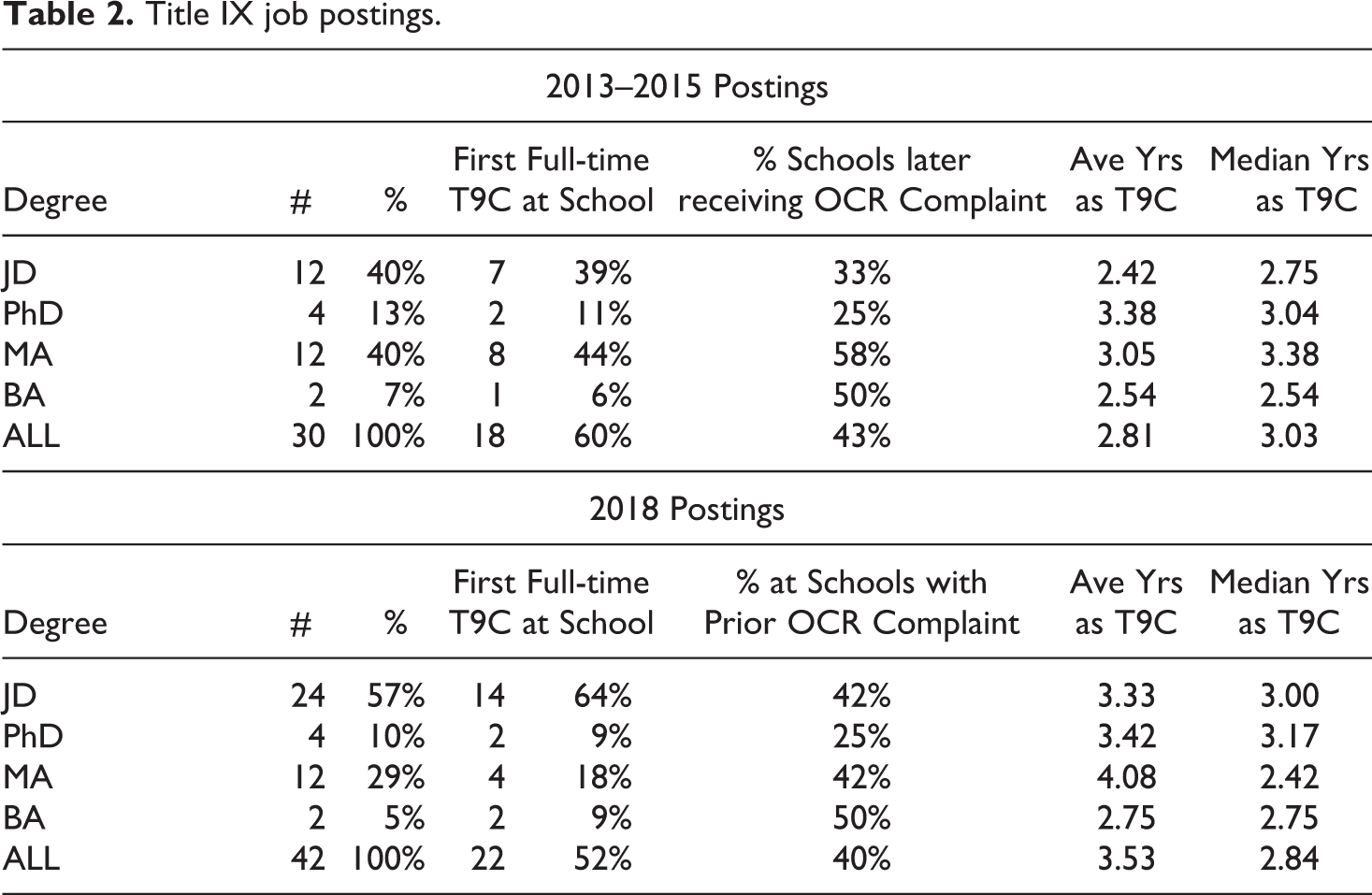
Coordinators hold a variety of academic degrees. In Wiersema-Mosely and DiLoreto’s survey, 47% of Title IX Coordinators held master’s degrees, followed by 22% of Coordinators with law degrees, 20% with Ph.D. degrees, and 8% with a Bachelor’s degree (2018, p. 5). In the ATIXA survey, 47% of Coordinators reported having master’s degrees, 20% doctorates, 16% law degrees, and 13% bachelor’s degrees (Van Brunt, 2015, p. 39). The numbers of Coordinators holding law degrees is on the rise. In analyzing the individuals hired into jobs posted from 2013–2015, 40% held law degrees, 40% Master’s degrees, 7% bachelor’s degrees, and 13% doctoral degrees (Table 2). From the later 2018 job postings, 57% held law degrees, 29% master’s degrees, 5% bachelor’s degrees, and 10% doctoral degrees (Table 2).
Title IX job postings.
Another group of Coordinators indicated experience with investigation and administration as being most important, as indicated by this Coordinator: “You have to have some background on how to conduct an investigation…it is not an advocacy role, it is more of a policy development [and] administrative role…certainly someone who has a Human Resources background or an Affirmative Action background or at least a grievance processing [and] investigative background is necessary” (T10A2:16-39). Yet other Coordinators pointed to their investigation experience in the diversity and student conduct contexts. Given the variety of jobs capable of developing Title IX skills, it is difficult to pinpoint a Coordinator position’s requisite experience and expertise.
Examining the academic qualifications of the 13 Title IX Coordinators studied between 2011–2014, 6 held JDs, 2 earned a PhD, 2 a master’s degree, and 2 a bachelor’s degree (Table 1). Title IX Coordinators with JDs worked an average of 7.85 years as a Title IX Coordinator at the time of the interviews (Table 1). Coordinators with BA, MA, or PhD degrees worked an average of 5.17 years as a Title IX Coordinator at the time of the interview (Table 1). Holding a law degree is not correlated with a greater likelihood of avoiding an OCR complaint. Of the seven Coordinators with a JD, five work or worked at an institution subject to a complaint during their tenure (Table 1). Of the six Coordinators with BA, MA, or PhD degrees, three work or worked at an institution subject to a complaint during their tenure (Table 1).
Legally trained Coordinators presumably have greater subject matter legitimacy from being in the legal profession. That same subject matter expertise, however, may make it more difficult to collaborate with other professions and stakeholders. Of the six Coordinators still employed as a Coordinator, only 33% of Coordinators hold a JD, and only one Coordinator with a JD is still employed by the same university (Table 1). If the Coordinators still employed are included with the Coordinators promoted to other roles, 44% hold a JD, 33% still work for the same institution, and 50% have experienced an OCR complaint. Contrast this with former Coordinators, 75% of whom have a JD degree (Table 1).
Multiple roles, insufficient institutional standing, and inadequate resources
Due to the variety of backgrounds suitable for Title IX work, Coordinators frequently hold dual roles. They also operate at lower levels within the institutional hierarchy, execute their jobs with less than adequate financial resources, and experience high turnover rates. Title IX Coordinator roles are historically either (1) added to other leadership roles in student affairs or human resources divisions or (2) a job function added to other compliance offices overseeing affirmative action, equal opportunity, or sexual harassment. Evidence indicates most Title IX Coordinators serve in dual roles. In the ATIXA survey, Coordinators reported holding simultaneous roles in HR (28%), diversity, equity, inclusion or equal opportunity (17%), Student affairs (33%), and Academic affairs (6%) (Van Brunt, 2015, p. 38). Wiersema-Mosely and DiLoreto (2018) found Title IX Coordinators held dual roles in Human Resources (25%), Diversity or Institutional Equity (16%), or student affairs (22%). In total, only 33% indicated their role was a full-time position (Wiersema-Mosely and DiLoreto, 2018, p. 5). Of 13 Coordinators interviewed by Paul (2016, p. 49), 12 held another full-time university role.
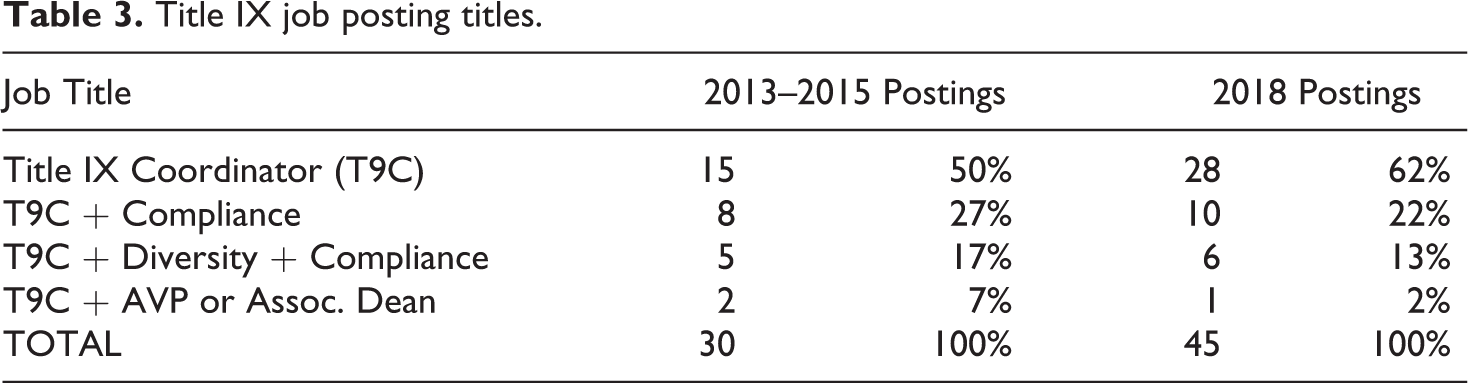
Interviews from both 2011–2014 and Paul’s 2016 study reflect the challenge of holding dual roles. One Coordinator noted, “If Title IX was my full-time position, I’d have time to go to more conferences to get more education and more time together with Title IX Coordinators” (Paul, 2016, p. 61). Job postings indicate an increasing understanding of the full-time nature of the role, as universities are increasingly hiring full-time Title IX Coordinators. Half of postings from 2013–2015 and 62% of postings from 2018 were for full time roles devoted exclusively to Title IX (Table 3). The Coordinators interviewed between 2011–2014 were, by design, in exclusively full-time roles.
Title IX job posting titles.
Another contributing factor demonstrating lower institutional influence is a lack of financial resources. Coordinators frequently described lacking resources: “[I’m] trying to influence people to recognize the importance of what I’m doing. It’s tight budgetary times and I’m not bringing in huge dollar amounts, so the administrators…they want people who are going to bring in big dollars” (T9A15:11-13). Another Coordinator described the impact: “[The School] has been hit terribly…every quarter for the last three years the budget has been shrinking…[and so] we don’t do training…If you do that less, my assumption is you’re sort of allowing a situation to form” (T7A5:20-6:11). In the 2015 ATIXA members survey, only 51% of respondents said they have the funding to ensure compliance, with 43% noting their school has insufficient investigators and 51% inadequate staffing to fulfill the school’s needs (Van Brunt, 2015, p. 40). Notably, 51% of ATIXA members reported having no budget for Title IX, with another 16% unsure of their budget (Van Brunt, 2015, p. 37).
An additional factor relating to influence is Title IX Coordinators’ place within the institutional hierarchy. Title IX Coordinators often expressed frustration at not reporting to the President and instead operating “five levels down within the organization” (T5A5:34-39). One Coordinator articulated it most effectively: I report to the [VP] for Human Resources, who reports to [another VP], so when they moved me in the position without [a law degree], they demoted the position and put it under HR, which is an unusual and uncomfortable place to be…I go home and tell my [partner] I’m going to…go somewhere where they appreciate me and elevate [the position] where it used to be. It’s not even about money or prestige, it’s about the political place that this needs to be, which is as close to the president as possible. (T12A4:37-5:9)
Title IX Coordinator reporting relationships (job postings and interviews).
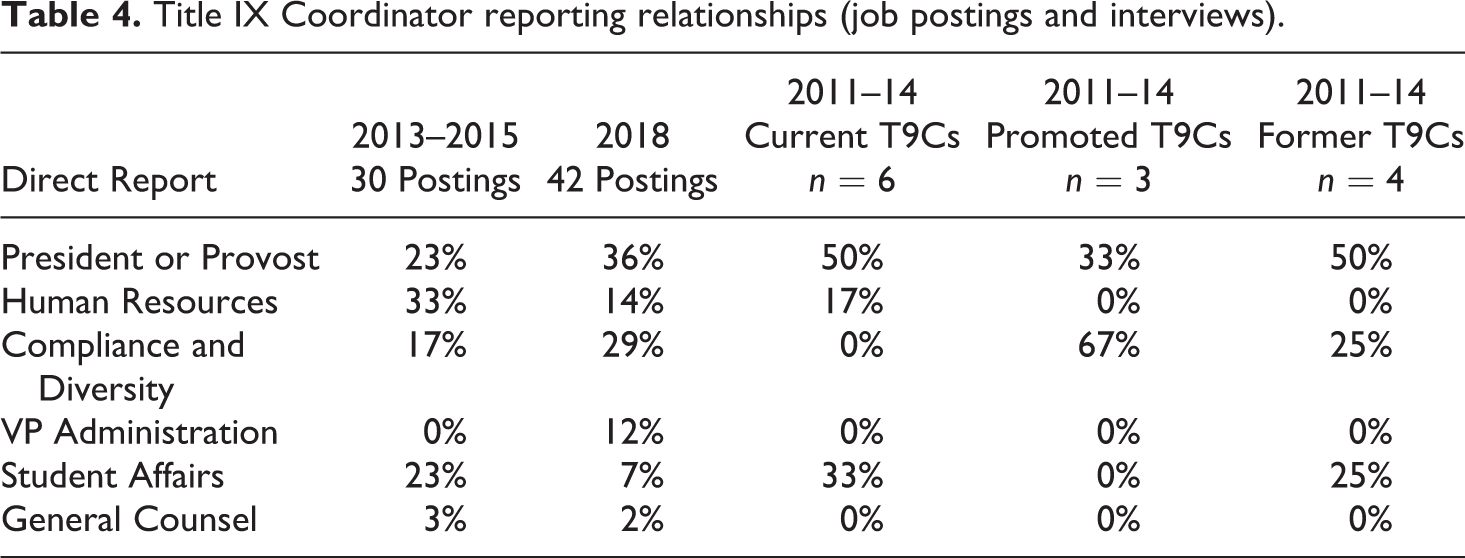
Coordinators use reporting lines and relationships with those in a position of authority as a means of developing greater authority and legitimacy in a large bureaucracy (Pappas, 2019a). One Coordinator noted: [I]t’s really hard to do the case work without the authority because when you [have] a [complaint] you realize sometimes that you’ve got to go forward even though the complainant doesn’t want to. You have the authority to say to someone ‘issue the notice’, but if people are really worried, if it’s been a faculty member, a high profile athlete, you’ve got to have the confidence…of the athletic director or the Provost’s office…[They need to trust that] I know what I’m talking about and to go forward…. (T8A39:76)
High turnover rates and low institutional experience
Title IX Coordinators’ relatively high turnover rates also contribute to lower institutional influence. Title IX Coordinators hired for the 2013–2015 job postings averaged 2.81 years on the job, whereas Coordinators leaving jobs in 2018 averaged 3.53 years in the role (Table 2). In Paul’s study, only 20% of Coordinators served for more than 4 years (2016, p. 50). In the ATIXA survey 39% of Coordinators had less than a year of experience, 40% 1–3 years, 15% 3–5 years, and only 6% greater than 5 years of experience (Van Brunt, 2015, p. 39). Similarly, Wiersema-Mosely and DiLoreto (2018, p. 5) reported 18% of Coordinators had less than 1 year of experience, 47% 1–3 years, 19% 3–5 years, and 17% 5 or more years of experience. The majority of Title IX Coordinators serve less than 3 years in the role, impacting their ability to develop relationships and be influential within the university.
The Title IX Coordinators interviewed between 2011 and 2014 varied in the length of time they served as a Title IX Coordinator, and in the number of years they worked at the institution prior to becoming the Title IX Coordinator (Table 1). The amount of time spent in the role was less important than the amount of experience at the institution prior to assuming their Title IX positions. Overall, the average time spent in the role at the time of the interview was 6.62 years. The Title IX Coordinators currently in the same role averaged 6.5 years, the Coordinators promoted averaged 7.67 years, and Coordinators no longer in the field averaged 6.67 years in the Title IX job at the time of the interviews (Table 1). Notably, what differentiates the three groups is the amount of time they spent working at the institution prior to working as the Title IX Coordinator. Current Coordinators averaged 10.67 years at the institution prior to becoming a Coordinator (Table 1). Promoted Coordinators averaged 14.33 years at the institution prior to becoming a Coordinator (Table 1). Only one of the four Coordinators interviewed whom are now no longer in the field previously worked at the institution, and for only 1 year (Table 1).
Competition from other occupations and insufficient professionalization
A lack of institutional influence also leads to greater competition from other occupational groups. Coordinators who persist or promote discuss these challenges as frequently as Coordinators no longer in the field. One Coordinator described other offices staffed with “young, ambitious professionals who are really more interested in making a name for themselves [than in doing the work]” (T12B48:7). The Coordinator continued, “[I]t’s sort of been interesting politically because some higher ups…you can feel a political tug there where they really want to be in charge of it…it’s a new and scary frontier and that’s a career maker if you’re 35 [years old]…and you’re looking to move up in the organization…” (T12B47:44-48:7).
Title IX Coordinators described conflicts with multiple professional groups. One Coordinator talked about their office getting a lot of Human Resources cases, “because people perceive that we’re doing more than HR is doing in terms of addressing complaints” (T13A13:1-23; 17-7-10). Another Coordinator described tension with the campus counselors, “because they’re only hearing one side of the story…so they’re much more likely to question our process than those who get to see the full picture” (T1B14:12-22). Conflicts between professionals can be vicious, as one Coordinator described: “[I am] constantly having to navigate these bureaucratic waters…and given the kind of job that I do I have to know who my friends and who my enemies are…there are people ready to stab you in the back” (T7A12:4-13:7).
Coordinators also discussed conflicts with the General Counsel. One Coordinator stated it most clearly: “General Counsel said [the student has] a due process right to an adjudicated hearing…in every other way and in every other situation, [I] make decisions and recommendations.…But [now I can’t]…I think it’s a power thing” (T12B4:17-5:12). Often the conflicts are turf-based: “When diversity and [equal opportunity compliance] first hit this campus…it was all housed in legal. [A few years ago] the president had the [department head] choose between being diversity, equal opportunity, or being the president’s legal [advisor]. She chose legal and he split diversity and [equal opportunity] away from her. She’s been pissed ever since. So she spends time undermining [us] on campus” (T11A11:3-24).
Title IX Coordinators’ professionalism is limited because the professional association for Title Coordinators, the Association for Title IX Administrators (ATIXA), is not primarily member driven. A law and consulting firm known as the National Center for Higher Education Risk Management (NCHERM) launched ATIXA as a not-for-profit membership association in 2011, and NCHERM still funds ATIXA’s office space, conference management services, and administrative support (ATIXA, How was ATIXA started?). Instead of an executive director responsible to a membership-elected board, current or former NCHERM employees operate ATIXA. From 2011–2017, Brett Sokolow held both the title of NCHERM CEO/President and the position of ATIXA Executive Director. Sokolow is now the President of ATIXA’s 26-member Advisory Board (ATIXA, Advisory Board). The current ATIXA Executive Director, Ryan McDavis, previously served as NCHERM Vice President for Client and Member Services (PR Newswire, 2017). Of ATIXA’s 26-member Advisory Board, 10 serve as NCHERM principals or affiliated consultants, another 6 work at campuses previously represented by NCHERM, and 2 work at schools currently represented by NCHERM (ATIXA, Advisory Board; NCHERM, Institutions Represented). The 2019 ATIXA Annual Conference’s trainings also illustrates the close ties between NCHERM and ATIXA. 2 The trainings were taught by NCHERM employees and consultants.
Professionalization is also inhibited because ATIXA/NCHERM trainings are expensive. Coordinators complained about trainings’ costs: “I did go to their big money training…but it was good.…I was wondering why are they charging so much? If they’re really for ensuring that everybody knows what’s going on, why are they [charging so much]?” (T4A3:1-24). Coordinators talked about having to make hard financial decisions regarding whether to attend: “That 2-day training is $2,000, which I got a scholarship for, but it still costs a lot of money to fly there, put myself in a hotel, and all that stuff. I kept going back and forth because I don’t have enough money…I’m sure every school is telling you the same thing. The money, I just hate money. It’s my hardest” (Paul, 2016, p. 62).
Despite these limitations ATIXA has grown to provide significant and meaningful support for Title IX Coordinators’ professionalism through activities including publishing position papers and a journal and organizing trainings and conferences. Job postings also reflect ATIXA’s growing influence, as postings preferring Title IX certification or specialized training increased from three to six between 2013–2015 and 2018. Further, job postings describing the importance of continuing education and professional development rose from 37% to 53%. While small in number, these trends indicate a desire for greater professional development. In this study, 69% of Coordinators are ATIXA members and 23% are also affiliated with NCHERM. Schreiber’s study (2018, p. 78) of 277 private schools found much lower levels of ATIXA (33%) and NCHERM (8%) membership and 47% of respondents were unaffiliated with an association. Wiersma-Mosely and DiLoreto’s (2018, p. 6) survey of 694 Title IX Coordinators found 52% belonged to ATIXA.
All Coordinators wrestle with competition from other occupational groups. While ATIXA has developed many programs and opportunities that assist Coordinators in their daily work, Title IX Coordinators face numerous challenges to achieving the underlying aims of their role.
Managerial control and conflicting university goals
Title IX Coordinators operate in a complex institutional environment. The primary university function of education can be in tension with the Title IX responsibility to investigate, punish, and prevent misconduct. While preventing misconduct ideally protects against liability, universities differ in how these goals are emphasized. Protection against liability may encourage zero-tolerance messaging and a greater reliance on formal procedures. Systems geared toward prevention may focus more on reporting, on creating both formal and informal dispute systems, and on developing greater training and outreach efforts. Each of these differing strategies may require Coordinators with different skills and backgrounds.
Title IX Coordinators interviewed in 2011–2014 often experienced managerial control relating to minimizing liability, avoiding negative publicity, and saving money. These managerial logics influence both the work’s content and how it is organized. Title IX Coordinators often expressed the difficulty of convincing the administration of the need to uncover and address issues that could expose the institution to liability. One Coordinator expressed this very clearly: “[S]ometimes the outcome of our investigation is not in the interest of the university’s administration…[i]t’s not necessarily in the university’s liability interests. I do think at the end of the day it’s in the interest of the university, and I think [it’s essential to be] able to stand up and help them see that…” (T1A7:6-12). Another Coordinator described lacking autonomy and credibility: The biggest misconception about the work…is that we’re going to overreact. There’s this belief that the pendulum has swung so far on the side of the victim that we’re just treating these respondents unfairly and that people are just getting one sanction after another imposed harshly…I stopped responding to that emotionally and just kind of use the data…[In the past five years]…we have not expelled a student for sexual misconduct. (T8A19:23-32)
Title IX Coordinators face pressure from managerial logics and lack institutional influence – they often do not report to the top of the organizational structure, they struggle to secure financial resources, and they experience high turnover rates and competition from other professional groups. As the primary professional association for Title IX Coordinators is not member driven, it pressures Coordinators to explore alternatives that will enable them to successfully execute their roles.
Expertise networks
The above barriers lower Coordinators’ institutional influence and make it more difficult to achieve Title IX compliance. Despite these challenges, many Title IX Coordinators develop institutional influence by working to create a collaborative network of expertise that transcends occupational groups to develop shared institutional expertise. A network first develops as occupational groups use pre-existing relationships and experience as a form of institutional influence. Developing relationships is described as the toughest part for Coordinators. Here a Coordinator no longer in the field describes their challenge:
Title IX work is emotionally taxing, and for that reason, Coordinators first seek support and advice from other actors in the face of difficult circumstances and decisions. Further, Coordinators who persist tend to see the role as a calling and not simply as a job. One Coordinator who is still in the role expressed the sentiment most clearly: “I’m so lonely…It’s just tough work…just gut wrenching. Strangely, I still feel like it’s almost a calling for me” (T12B48:32). Often relationships with other professions form due to the shared nature of compliance work. Reaching out to the general counsel, another Coordinator still in the role described feeling supported and understood: “He said ‘how’s it going?’ I said ‘well, no one likes me. If I make a finding but I don’t give them exactly what they want, they don’t like me. If I don’t make a finding, they don’t like me’. He said ‘that means you’re doing your job’” (T10B10:1-12).
Frequently these connections form and become effective as institutional actors communicate and develop a greater sense of purpose than merely rules enforcement. This greater sense of purpose was frequently noted by Coordinators promoted to higher roles: “For me it’s far more than an issue of non-discrimination or that we are following the letter of the law. It is about making sure we are creating an environment that is safe and conducive for people to do their best work, whether that’s academically or professionally” (T5A4:35-38).
Promoted Title IX Coordinators talked about the importance of their work in making a difference: “[I]t just feels better when you’ve actually found something and you’re stopping it. You’re doing something to stop that behavior. That’s a really good feeling” (T13A16:1-9). This is echoed in Paul’s (2016, p. 100) research: “I think it’s an important job, and I don’t think any Title IX [C]oordinator takes [it] on lightly because it’s a beast. That’s my word, and I think to be in this role, it has to be important to you. It’s a job, but it’s more than just a job. It certainly helps to care about it.” This greater purpose leads many Title IX Coordinators to develop collaborative relationships for the purpose of helping institutional decision-makers understand the scope and requirements of Title IX. Coordinators who do not persist struggle to develop these relationships. One Title IX Coordinator no longer in the role lamented: “I really felt like I wanted to make a more concrete impact…I wanted to be in the positive collaborative approach to trying to get people to recognize we’ve got to do something about these issues” (T9A41:1).
Expertise networks often develop because Title IX compliance requires quickly gaining access to information and making coordinated decisions. Coordinators persisting in the role described the number of departments worked with in the course of a day: “[I]t’s not unusual to speak to the Dean of Student’s office staff three to four times a day. The same thing [is] true with the…Equal Opportunity and Diversity office. We also interact frequently with Human Resources, university police, general counsel…the Ombuds office” (T8A8:4-47). The frequent connections enable Coordinators to quickly react to difficult situations by sharing information and collectively reacting. As demonstrated below, Coordinators attributed it to the development of strong relationships: “[Without good relationships] I don’t know if we would have been able to share the information to put all of those incidents together…It would have been in silos and it would have been more like a coincidence that somebody would have recognized the situation [in order to do something about it]” (T8B40:18).
A Coordinator who promoted described multiple offices meeting regularly in order to proactively prevent problems: “We have periodic meetings with general counsel, [Diversity], my office, human resources, Ombuds…just to go around the room and talk about what’s going on, cases in a general sense, just kind of bounce things off just so we’re in the loop on what’s going on” (T13A49:15). Often cases are multi-dimensional and require extensive coordination by multiple occupational groups. What results is a highly functional network: If [a complainant] start[s] at the police department, [the police] have a connection and work very closely with us to make sure we get the information we need once that person makes contact with them…[A]nd my office does the same, [and the] dean of students does the same [for the police]. So we have a very good collaborative working relationship that all of us at some point will be notified of a concern so that we can all do what we need to do to resolve it. (T13A49:35)
Instead of maintaining silos of expertise in student affairs, legal affairs, human resources, campus police, or Title IX, a network of professionals emerges collectively around a shared institutional problem. One of the foremost benefits described by Coordinators is increased institutional influence: “H]aving the support of the [partners] that I already have, like HR and faculty has been really good. It has allowed me a voice with administration” (Paul, 2016, p. 95).
The effort to develop a collaborative network is not without its challenges. One Coordinator said it best: [T]here’s so much at stake for everybody, so…when I hear the concerns that the complaining party is saying, if there’s threats of suicide or homicide, if there’s been self-harming behavior, if there’s drug or alcohol concerns, if there’s mental health concerns, I might say to the dean ‘let’s work closely with housing or with this department, let’s…hand deliver [the] notice of investigation, and at the same time leave that person, him or her, with the [information for the] Ombuds office or the EAP program or university counseling’. This is not how it technically works, but we have to work it into the system. (T8A39:64)
Conclusion
This paper describes how many Title IX Coordinators, facing significant barriers, develop institutional influence to achieve the position’s goals. Title IX Coordinators collaborate to create an expertise network that transcends any one area, expertise, or jurisdiction to comply with Title IX. Evidence indicates Title IX Coordinators are slowly becoming a recognized occupation and increasing in institutional influence – there are increases in job postings for Title IX jobs without other areas of responsibility, and these positions increasingly report to higher levels within the bureaucracy. The amount of time individuals serve as Title IX Coordinators is also rising. Prior years of institutional experience is an advantage that assists Coordinators in developing influence. These findings demonstrate that professionalization is not limited to simply being “below” by the profession itself, or “above” by internal institutional goals. Professionalization can occur “across” professional groups, united under common policy and institutional challenges. Developing professional influence does not necessarily require establishing clear jurisdictional lines of occupational expertise and authority. Instead, establishing an expertise network that can co-produce the work builds authority and influence and can lead to improved enforcement. “Precarious” professionals can increase their professionalization and their legitimacy by developing relationships.
These results have several implications for the field. First, the results can shape conversations about the role of prior institutional experience and the desired professional characteristics necessary for executing the job. Specifically, the ideal Coordinator should have institutional experience and a positive reputation for working with a broad group of stakeholders. Coordinators should have the communications skills and experiences necessary for developing a collaborative network of expertise. In addition to Title IX knowledge and experience with investigations and compliance, job advertisements should also seek individuals who can build broad coalitions and both communicate and educate stakeholders about the importance of the work.
Second, these results can shape conversations about professional expertise and compliance in relationship to the law. The new Title IX rules allow for informal resolution, further complicating the professional expertise needed for formulating campus Title IX systems. Informal systems can hurt the transparency of Title IX efforts, lessen the consequences of committing misconduct, and result in administrators concerned about liability to pressure survivors and alleged perpetrators to bypass formal procedures (Pappas, 2016, 2019b). Informal procedures also provide the possibility of restoration and reintegration for perpetrators and community members, time and costs savings for universities, and may help survivors avoid participating in difficult formal hearings (Karp and Williamsen, 2020; Pappas, 2019b). The mechanisms for achieving Title IX compliance are shifting, as well as the professional expertise needed by Coordinators in order to effectuate those changes. Title IX Coordinators need to shift as well, by working to develop new professional capabilities that transcend traditional notions of competitive professional jurisdiction and control.
Third, these findings go beyond the individual or occupational level and can inform institutional-level goals. The shifting Title IX rules may be used by higher education institutions to advance their organizational goals of educating the campus, encouraging reporting, and preventing and carefully handling misconduct allegations. The new rules necessitate that universities think carefully about how formal and informal systems interrelate (Pappas et al., 2021). For example, are statements made in informal procedures admissible in later formal hearings? How are informal resolutions monitored and are there resolutions that would be deemed unacceptable by the university? These questions require multiple campus stakeholders with expertise that goes beyond Title IX compliance. Understanding the barriers faced by Title IX Coordinators, universities can design their Title IX compliance positions and offices in a way that maximizes coordination between professionals in order to achieve university-wide goals.
This study describes the institutional factors Coordinators must navigate as they seek to execute their roles beyond mere liability avoidance and symbolic compliance. Networks of multiple offices and perspectives provides greater access to information and the ability to solve complicated problems. This research indicates that engaging with other occupational groups, developing shared a shared purpose, and coordinating institutional responses helps Coordinators better secure their campuses against sexual misconduct. By embracing the “Coordinator” title and coordinating with other professionals in a network of expertise, Title IX Coordinators discover greater institutional legitimacy and influence. By understanding the barriers faced by “precarious” professionals in institutional settings, Universities can develop systems to help Coordinators and other professionals achieve Title IX compliance.
Footnotes
Declaration of conflicting interests
The author(s) declared no potential conflicts of interest with respect to the research, authorship, and/or publication of this article.
Funding
The author(s) received no financial support for the research, authorship, and/or publication of this article.
