



Abstract
There are high rates of post-traumatic stress disorder (PTSD) in unaccompanied asylum-seeking minors (UAM) and there is a requirement for feasible, acceptable and evidence-based treatments. Narrative Exposure Therapy (NET) is a short-term treatment for PTSD following multiple traumatic events. This article aims to examine the applicability of NET for UAM in routine clinical practice and to provide preliminary feasibility, acceptability and effectiveness data. The participants were four UAM receiving NET within a dedicated child and adolescent mental health service for refugee children. Semi-structured interviews were conducted to understand the acceptability of this approach and standardised measures of PTSD were used to provide preliminary data regarding the effectiveness of NET for these clients. The clients attended NET consistently with few missed appointments. At post-treatment, two clients’ symptom scores were below the clinical cut-off for PTSD and all three clients who completed NET met reliable improvement criteria. The clients reported improvements in functional outcomes and mentioned that they would encourage other young people with similar difficulties to engage in NET. This study was limited by the small sample size and naturalistic time limitations in clinicians’ contracts. This article highlights that it is possible to implement NET within routine clinical practice and observed improvements in PTSD symptoms and functional outcomes for UAM.
Keywords
Introduction
Within the refugee population, unaccompanied asylum-seeking minors (UAM) are considered to have distinctive psychosocial needs. It is estimated that 41–69% of UAM experience mental health difficulties (Bronstein & Montgomery, 2011; Jakobsen, Demott, & Heir, 2014). The prevalence of mental health difficulties in UAM is estimated to be higher than in children seeking asylum with their families and in children who are not from refugee or asylum-seeking backgrounds (Huemer et al., 2009) and is influenced by a number of individual, family, community and societal risk and protective factors (Fazel, Reed, Panter-Brick, & Stein, 2012).
It is estimated that up to 64% of UAM meet the clinical cut-off on measures of post-traumatic stress disorder (PTSD; Müller, Büter, Rosner, & Unterhitzenberger, 2019) and there is noted to be a significantly higher prevalence of PTSD in UAM compared with accompanied refugee children resident in continental Europe (El Baba & Colucci, 2018; Hodes, Jagdev, Chandra, & Cunniff, 2008; Jakobsen et al., 2014; Müller et al., 2019). Risk factors commonly experienced by UAM, such as increased exposure to traumatic events (Hodes et al., 2008), low social support (Mitra & Hodes, 2019; Trickey, Siddaway, Meiser-Stedman, Serpell, & Field, 2012) and traumatic bereavement (Pfefferbaum et al., 1999), have been shown to increase the likelihood of developing PTSD, particularly chronic PTSD, for which early targeted intervention may be necessary (Hiller et al., 2016). Given the high prevalence rates of PTSD in UAM, there is a requirement for feasible, acceptable and evidence-based treatments. However, despite having a higher risk of PTSD, UAM are less likely than accompanied refugee children to have access to trauma-focused psychological interventions (Mitra & Hodes, 2019). In the treatment of PTSD, trauma-focused approaches have been shown to be superior to alternative approaches (Gillies, Taylor, Gray, O’Brien, & D’Abrew, 2013; Gutermann et al., 2016; Morina, Koerssen, & Pollet, 2016) and systematic review evidence has demonstrated that mental health counselling does not improve outcomes for UAM (Mitra & Hodes, 2019).
Narrative Exposure Therapy (NET; M. Schauer, Neuner, & Elbert, 2011) is a short-term treatment for PTSD designed for people who have experienced multiple traumatic events. NET is based on neurobiological theories of trauma and memory (see Neuner, Elbert, & Schauer, 2018) and uses principles from cognitive behavioural exposure therapy and testimony therapy (Agger & Jensen, 1990; Cienfuegos & Monelli, 1983). NET aims to reduce PTSD symptoms via two mechanisms: exposure to traumatic memories and subsequent habituation of the associated emotional response, and reconstruction of autobiographical memory and a consistent narrative, in line with Ehlers and Clark’s (2000) model of PTSD (M. Schauer et al., 2011; M. Schauer, Neuner, & Elbert, 2017). NET is designed to be a cross-cultural approach and has been successfully implemented across a number of different cultures and settings (Neuner et al., 2018).
NET has a growing evidence base for the treatment of PTSD in people from refugee and asylum-seeking backgrounds, including for children (Onyut et al., 2005; Peltonen & Kangaslampi, 2019; Ruf et al., 2010; E. Schauer et al., 2004) and adults across a range of settings; for example, those who have experienced war and torture (Hensel-Dittmann et al., 2011), those in refugee camps (Neuner et al., 2008) and settled in a receiving country (Neuner et al., 2010), and survivors of human trafficking (Robjant, Roberts, & Katona, 2017). For the treatment of PTSD in children, randomised controlled trial (RCT) evidence has demonstrated that NET is superior to waitlist control for refugee children (Ruf et al., 2010) and to treatment as usual for children who have experienced multiple traumatic events, including refugee children (Peltonen & Kangaslampi, 2019). Both studies demonstrated significant improvements in PTSD symptoms in the NET group, and Ruf et al. (2010), who included a longer term follow-up, demonstrated that these effects were maintained at 12 months post-treatment. Systematic review evidence further supports the effectiveness of NET in treating PTSD in refugees and asylum-seekers (Robjant & Fazel, 2010; Thompson, Vidgen, & Roberts, 2018).
Given the growing evidence base for NET, there is promise for its use in the treatment of PTSD among UAM. There have been no studies published to date examining NET specifically within the UAM population. The need to improve the implementation of evidence-based PTSD treatments for young people has been identified by Smith, Dalgleish, and Meiser-Stedman (2019). Furthermore, systematic review evidence highlights that evidence-based psychological interventions improve mental health outcomes in UAM, although the majority of UAM are not receiving these interventions (Mitra & Hodes, 2019). This article aims to examine the applicability of NET for UAM in routine clinical practice in the United Kingdom and to provide preliminary feasibility, acceptability and effectiveness data.
Methods
Participants and procedure
The participants were clients receiving NET within a dedicated child and adolescent mental health service (CAMHS) for people from refugee backgrounds. Upon entry into the service, clients received a general mental health assessment and were subsequently assessed for PTSD using standardised measures and clinical interview at the start of individual psychological therapy. Therapy was delivered in the clients’ preferred language. Three of the four clients chose to use their native language with an interpreter, and one chose to receive their sessions in English, their second language. Demographic and trauma history data for each client are included in Table 1.
Demographic and trauma history data.

At start of individual treatment.
All the clients agreed to participate in an evaluation of their care and gave written informed consent. The study represents audit findings and therefore ethical approval was not required.
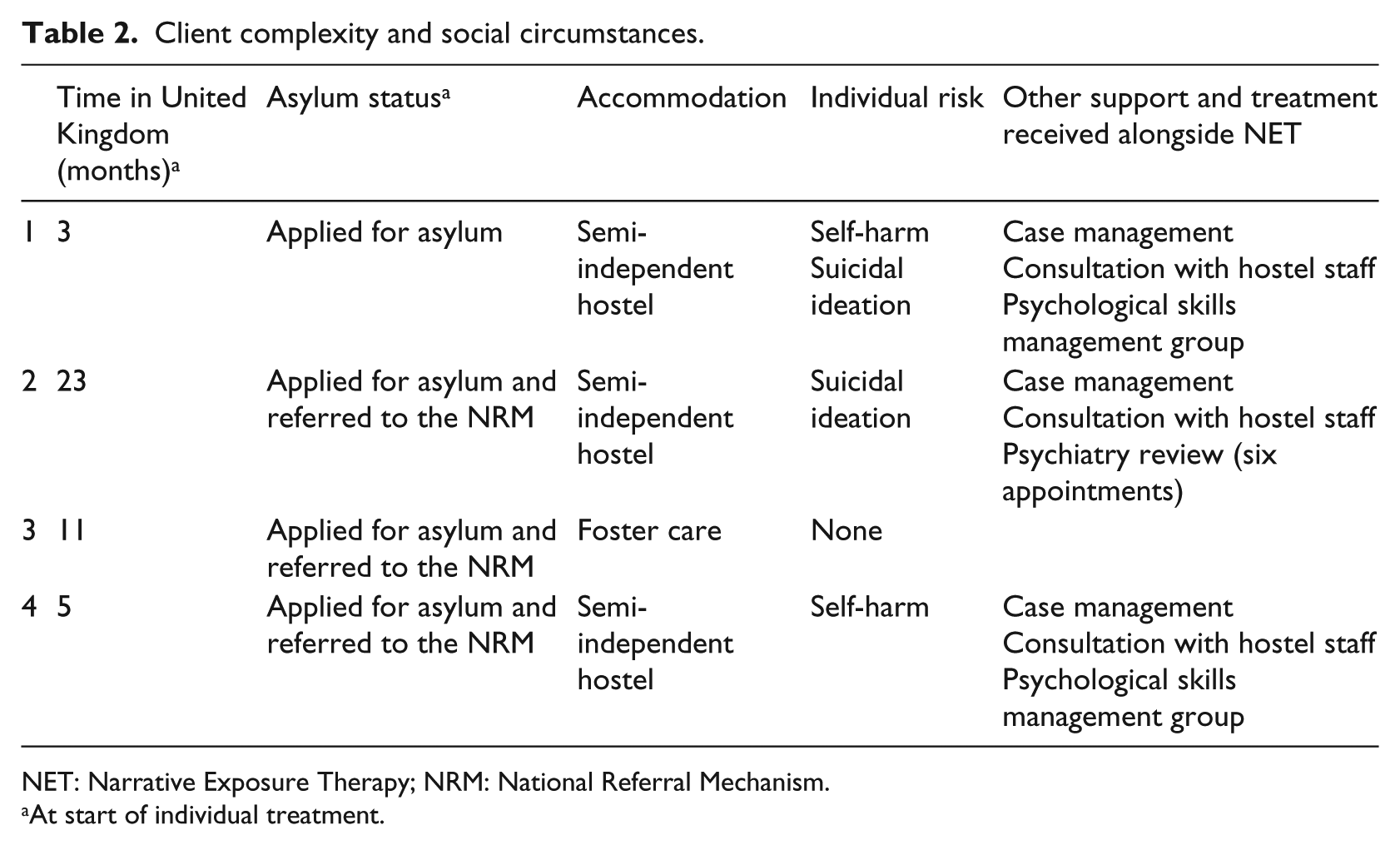
Client complexity
All four clients were in the earlier stages of the asylum process. At the start of their individual psychology treatment, three clients had yet to give a substantive interview with the UK Home Office as part of their asylum claim (Coram Children’s Legal Centre, 2017). One client was granted refugee status within a few weeks of beginning individual therapy, while the remaining three clients continued to wait for a decision on their asylum claim, as well as whether they would be recognised as a victim of human trafficking and modern slavery through the National Referral Mechanism (NRM), throughout their time in individual therapy.
Three of the clients were residing in semi-independent hostel accommodation. One client lived with a foster carer. Hostel staff were offered consultation on clients’ mental health difficulties, the implications of their diagnosis and how to support clients if they were distressed outside of appointments using grounding and distraction strategies. This was also offered to the foster carer for client 3; however, this was declined.
Alongside individual therapy, psychosocial case management formed part of the care offered to all the clients. This included the writing of professional letters to offer psychologically informed understanding of client’s mental health needs and care plans within the asylum process, including challenges to dispersal under the National Transfer Scheme for clients 1 and 4. Individual therapists were active parts of the clients’ professional network as Looked After Children and engaged in inter-agency liaison as required.
Two clients reported suicidal ideation and had at least one attempt at taking their own life in their histories. Two clients were self-harming using burning or punching walls at the start of individual therapy. One client was reviewed by a psychiatrist due to team concerns about risk. The client was prescribed quetiapine and an SSRI (selective serotonin reuptake inhibitor) and received continued psychiatry reviews to monitor this, attending approximately once every 6 weeks over his episode of care in the team. All the clients were invited to attend an open psychological skills group, as outlined in King and Said (2019); two clients attended this regularly. When agreeing therapy goals with all clients, they reported that their PTSD re-experiencing symptoms were the most distressing and what they wanted help with from therapy.
Table 2 provides additional information on client complexity and social circumstances.
Client complexity and social circumstances.
NET: Narrative Exposure Therapy; NRM: National Referral Mechanism.
At start of individual treatment.
Intervention delivery
NET includes four key stages: diagnosis and psychoeducation, constructing a lifeline of key life experiences, narration of the lifeline, rereading the narration and signing the document (M. Schauer et al., 2011, 2017). In constructing the lifeline, a bird’s-eye view is taken of the individual’s autobiography; a string or a ribbon is laid out to represent the course of the clients’ life and their future, stones are used to represent traumatic events and flowers are used to represent positive life events (M. Schauer et al., 2011, 2017).
During the narration individuals talk through their lifeline in chronological order; both traumatic and positive life experiences are narrated however, the narration slows at each traumatic event to allow exposure to and exploration of these events chronologically and in context to complete the autobiographical memory. Both ‘hot’ (sensory, emotional, cognitive and physiological responses) and ‘cold’ (those that focus on the context, e.g., time and place) memories are accessed during the narration (Metcalfe & Jacobs, 1996; M. Schauer et al., 2011). The client is guided through the traumatic event in a directive manner and narrates these events in detail describing the contextual information, sensory, cognitive, emotional, physiological and behavioural experiences alongside the meaning associated with the traumatic event. Attention is paid to both past and present experiences while narrating the trauma and dissociation and emotion regulation are managed and treated during exposure. Following each session, the therapist transcribes the narration and reads this back to the client at the beginning of the subsequent session. At the end of therapy, the narration document is given to the client and is signed by the client, therapist and interpreter, if present, to provide written acknowledgement of their experiences. In NET, the therapist takes a human rights, rather than a neutral, position and the events in the client’s life are understood within the wider sociopolitical context.
Therapists, training and supervision
Therapists providing NET were final-year clinical psychology doctoral trainees who had experience and training in cognitive behavioural therapy (CBT) and PTSD. Specialist training and supervision in NET were provided by experienced clinical psychologists with expertise in NET and working with refugees and asylum-seekers.
Evaluation
Semi-structured interviews were conducted with all the clients to gather their feedback and experience of receiving NET. Interviews were conducted and transcribed by an independent researcher and analysed into themes. In addition to the data described in this article, a full qualitative report on young people’s experiences is being published separately (Said, Al Qadri & King, in submission).
Standardised measures for PTSD used were the Child Revised Impact of Events Scale 8-item version (CRIES-8; Perrin, Meiser-Stedman, & Smith, 2005) and the Child PTSD Symptom Scale (CPSS-5) for the Diagnostic and Statistical Manual of Mental Disorders (5th ed.; DSM-5; Foa, Asnaani, Zang, Capaldi, & Yeh, 2018). Questionnaires were completed through conversation with clients, via interpreters where necessary. Measures were used at assessment, at the start of NET, during treatment and at the end of NET to assess for PTSD symptoms and measure the effectiveness of the intervention.
Measures were analysed on a case-by-case basis to ascertain whether changes in scores were reliable and clinically significant. The reliable change index (RCI; Jacobson & Truax, 1991) was used to determine whether change in scores between pre-treatment and post-treatment was deemed to be a statistically reliable change. It was also reviewed whether scores crossed the clinical threshold. Using normative data for the CRIES-8 with UAM (Salari, Malekian, Linck, Kristiansson, & Sarkadi, 2017), it was calculated that statistically reliable change at the 5% significance level is indicated by a score change of 13.05 or greater. Using normative data for the CPSS-5 (Foa et al., 2018), it was calculated that statistically reliable change at the 5% significance level is indicated by a score change of 14.87 or greater.
Results
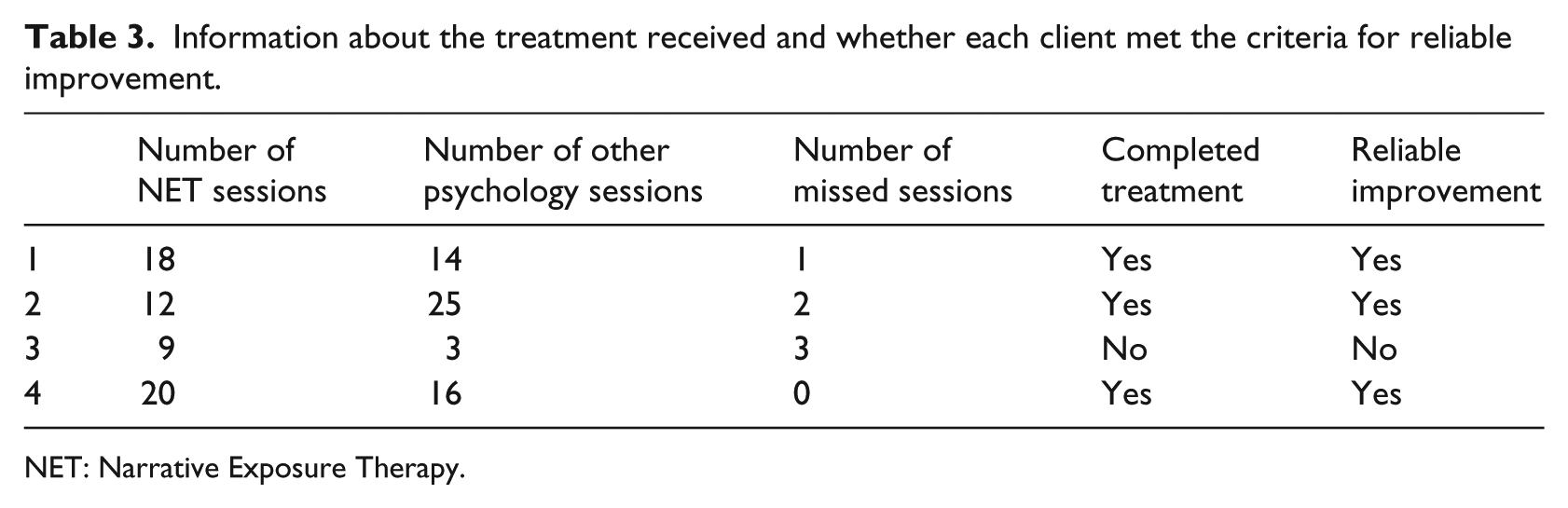
The clients attended NET consistently, and three to completion, with few missed appointments over the course of treatment (see Table 3). The reason for non-completion with client 3 was the ending of the clinician’s fixed term contract. The reasons for non-attendance were attributed to schedule conflicts and illness. An outline of the intervention received by each client alongside NET can be found in Table 2 and information about the number of sessions attended as well as reliable improvement information can be found in Table 3.
Information about the treatment received and whether each client met the criteria for reliable improvement.
NET: Narrative Exposure Therapy.
At the start of treatment, all the clients were assessed to have severe PTSD and all scored above the clinical cut-off for PTSD on the measures used. At the end of treatment, two clients’ symptom scores were below the clinical range for PTSD (see Figures 1 and 2). All the three clients who completed NET met the criteria for reliable improvement. Clients 1 and 4 were no longer engaging in self-harm behaviour at the end of treatment and no clients reported suicidal ideation at the end of treatment.

Graph indicating change in CRIES-8 scores for participant 1 over the course of treatment. The black line indicates the clinical cut-off score of 17 (Perrin, Meiser-Stedman, & Smith, 2005).

Graph indicating change in CPSS-5 scores for participants 2, 3 and 4 over the course of treatment. The black line indicates the clinical cut-off score of 31 (Foa, Asnaani, Zang, Capaldi, & Yeh, 2018).
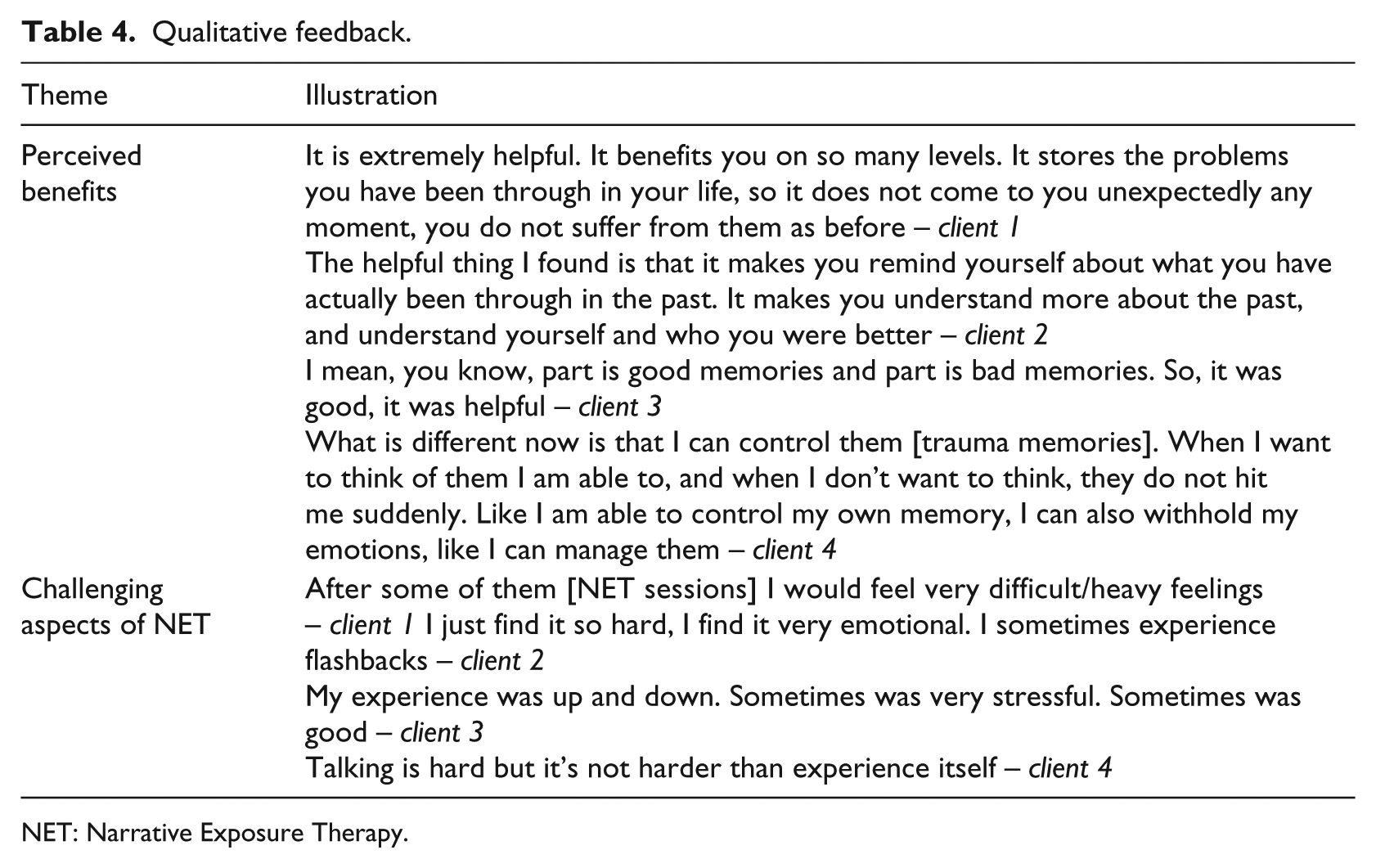
Within the qualitative data, the clients attributed several changes in their reported difficulties to NET, including improved concentration, fewer intrusive memories, less distress caused by traumatic memories and a sense of cohesion and sense-making about their experiences. The clients reported that the process of reliving was challenging, but that they valued the therapy and experienced it as helpful. All the clients felt that NET was something they would encourage other young people with similar difficulties to engage with and noted an improvement in their ability to engage in meaningful activity, such as college. The value of treating problems early, and during adolescence, was highlighted by the clients. The clients named a few things which may improve the process of NET, including considerations relating to the location and physical comfort of appointments, as well as some interactions with their therapist. A few illustrative quotes identifying helpful and challenging aspects of NET can be found in Table 4.
Qualitative feedback.
NET: Narrative Exposure Therapy.
Discussion
This article aimed to examine the feasibility of implementing NET in a routine clinical setting with UAM and to evaluate the acceptability of this approach for this population.
This project illustrated that NET is a viable and effective intervention for PTSD in UAM. Clinicians were able to offer the intervention to clients a few months after arriving and claiming asylum in the United Kingdom, even while clients were in a relatively unstable social situation. Similar findings were identified by Ter Heide, Mooren, and Kleber (2016), who noted that trauma-focused treatments should not be delayed unnecessarily for refugees and asylum-seekers with PTSD. It has also been demonstrated that it is possible to implement NET effectively and safely among suicidal inpatient clients with PTSD (Steuwe et al., 2016). In addition, De Jongh et al. (2016) have outlined that a stabilisation phase is not essential prior to trauma-focused therapy, even among clients with complex PTSD presentations. We noted that additional stabilisation support was required; however, the requirement for this was not a reason to deny trauma-focused therapy. Timely intervention for PTSD in young people is recommended for those with disabling acute responses and those at risk of chronic PTSD, which includes young people bereaved by trauma, those who have experienced multiple traumatic events and those with low social support (Hiller et al., 2016). Avoiding delays in providing treatment for PTSD in UAM may therefore be important.
Reliable improvement was demonstrated for all three clients who completed treatment, with two clients no longer meeting the clinical cut-off for PTSD at the end of treatment. The client unable to complete treatment (client 3) did not show a change in the overall score. However, individual item scores on the CPSS-5 at mid-treatment revealed a reduction in scores on items measuring re-experiencing symptoms, self-blame and negative feelings about the events. The mid-point measure was taken during reliving of the most severe events and an increase in hypervigilance symptoms was noted. During their interview, client 3 attributed a number of positive changes to NET. Due to time restrictions, it was not possible to address each traumatic event in the lifeline for client 2, which may have contributed to this client demonstrating reliable improvement but not reaching below the clinical cut-off for PTSD at the end of treatment. Clinicians and clients noted the value of improved functional outcomes for clients, who reported improved sleep, ability to concentrate in college and increased social engagement, and amelioration of PTSD symptoms.
Implementation was supported using wide-ranging approaches informed by individual client needs and presenting difficulties. This included other psychological interventions such as psychoeducation, emotion regulation, sleep management, cognitive behavioural techniques and other psychosocial support. Similar adaptations have been reported in other projects supporting UAM (e.g. Unterhitzenberger et al., 2015). The importance of flexible and phase-based approaches has been highlighted for supporting UAM, and it has been suggested that this should incorporate skills teaching and memory-focused work (Ehntholt & Yule, 2006; Smith et al., 2019) and consider their wider context (Eruyar, Huemer, & Vostanis, 2018; Fazel & Betancourt, 2018). Phase-based approaches in the treatment of PTSD include establishing safety and trust, trauma-focused treatment and reintegration (Cloitre et al., 2012; McFetridge et al., 2017).
NET was implemented as an intervention for PTSD; however, it did not directly address experiences such as loss and adjustment within the receiving country. Versions of KIDNET which include adding losses to clients’ lifeline, may offer additional benefit for this client group.
Limitations
The clinical sample for this study was small and is therefore not sufficient to generalise to the population. The measures implemented are widely used, valid and reliable measures; however, the CPSS-5 is not translated into languages other than English and neither the CPSS-5 nor the CRIES-8 is psychometrically evaluated in languages other than English.
The outcome data for one client was incomplete, reflecting some of the challenges of evaluating outcomes in routine CAMHS practice (Wolpert & Rutter, 2018). Due to time restrictions within the clinicians’ contracts, it was not possible to gather follow-up data to determine longer term outcomes for these clients. However, it has been highlighted that the most pronounced improvements in NET are often observed at follow-up (Neuner et al., 2018). It, therefore, would have been interesting to review the follow-up scores, particularly for client 3 whose final questionnaires were completed at mid-treatment.
The measures used with these clients assessed only PTSD; it would have been of value to also measure comorbid difficulties such as depression and functional outcomes.
Other interventions and support were implemented alongside NET; therefore, the outcomes shown may not be only attributable to NET. However, evaluation of other psychosocial interventions within this client group did not demonstrate the same improvement in PTSD symptoms (King & Said, 2019).
Summary and recommendations
There are high rates of PTSD in UAM, and PTSD can lead to distressing symptoms and impact social and educational functioning and child and adolescent development. Implementing evidence-based approaches can alleviate significant distress and improve functional outcomes within this vulnerable client group. In this project, UAM found NET to be an acceptable intervention and spoke of its value in treating PTSD symptoms and improving functional outcomes. Implementation was possible within routine clinical practice with a model of standalone NET training and group supervision for therapists. Future delivery would be enhanced by having flexibility in the number and order of treatment components, in response to client need.
When planning trauma-focused work, it is considered advisable by the authors to have sufficient conditions for the client to be able to tolerate and complete reliving within therapy in the short to medium term, and to complete reliving once it has been started in therapy. While acknowledging the power of client avoidance and the clinical temptation to wait for ideal circumstances, a number of factors could be considered when preparing for trauma-focused therapy. These may include preoccupation and distress caused by one’s asylum application or unpredictable housing arrangements, risks to self from others in the young person’s current community, client dependency on drugs or alcohol, and imminent dispersal under the national transfer scheme. Additional factors to consider would be other major events in a client’s calendar such as religious observation involving fasting during Ramadan or Lent and mandatory participation in school examinations, as these may impact emotion regulation and physical well-being.
This study highlighted that it is feasible to implement NET for UAM within routine clinical practice; however, it would be of benefit for future research to extend these findings, for example, through pragmatic trials and identifying strategies to support implementation of evidence-based treatments for UAM. It would also be of benefit for research to evaluate outcomes at follow-up after treatment completion to inform understanding of the long-term impact of NET in treating PTSD in UAM.
Effective screening is essential to identify PTSD and enable timely access to mental health services and effective interventions. It has been identified that 57.8% of UAM perceive a need for support with psychological distress, but only 12.7% access mental health services (Bean, Eurelings-Bontekoe, Mooijaart, & Spinhoven, 2006). In monitoring outcomes, symptom-specific measures are identified to be superior to general measures, which have been suggested as less helpful for the identification of distress within the UAM population (Children’s Society, 2018; Mitra & Hodes, 2019). However, there is also a requirement for improved screening tools to assess symptomatic and functional outcomes in UAM (Mitra & Hodes, 2019).
Barriers to engaging in mental health support should be considered (Majumder, Vostanis, Karim, & O’Reilly, 2019; Mitra & Hodes, 2019) and time should be allowed for young people to develop a trusting relationship with services. It has been demonstrated that UAM may be better able to communicate mental health needs once they are already in contact with mental health services (Sanchez-Cao, Kramer, & Hodes, 2013). King and Said (2019) found that offering a psychological skills group enabled young people to develop their relationship to help and supported young people to engage in trauma-focused therapy.
UAM are considered to be a vulnerable group among children and young people as a whole, with the difficulties resulting from PTSD having a notable impact on well-being and functioning (Mitra & Hodes, 2019). In recent reviews, it has been highlighted that evidence-based interventions are often not offered to most young people with PTSD (Smith et al., 2019) and the majority of UAM (Mitra & Hodes, 2019). This article identifies that NET may be one way of effectively and feasibly responding to these difficulties for this client group within outpatient CAMHS settings.
Footnotes
Acknowledgements
The authors thank the young people for their time, dedication and interest in participating in the interviews described in this article. They thank Ms Yaman Al Qadri for her work in conducting, transcribing and translating the qualitative interviews. They are grateful to Dr Francesa Brady and Dr Eileen Walsh for their supervision, support and guidance in delivering this intervention. They also thank the interpreters involved in the service delivery.
Declaration of conflicting interests
The author(s) declared no potential conflicts of interest with respect to the research, authorship and/or publication of this article.
Ethical Approval
This article discusses work with children who were separated from their parents; however, they had Gillick competence and were able to consent for themselves. All the clients agreed to participate in an evaluation of their care and gave written informed consent. The study represents audit findings and therefore ethical approval was not required.
Funding
The author(s) received no financial support for the research, authorship and/or publication of this article.
