




Abstract
We examined the impact of paternal rejection (based on father’s and children’s reports) on the children’s emotional eating behavior and if child psychological maladjustment mediated this relationship. Three hundred sixty-nine dyads of fathers and children were screened using self-report measures of demographic data, parental rejection, child psychological maladjustment, and disordered eating behavior. Children’s subjective perceptions of relationship with father have more impact on their psychological outcomes and unhealthy dietary patterns than father reported parenting quality. Children’s unhealthy psychological adjustment may be an essential underlying mechanism linking perceived paternal rejection of children’s emotional eating behaviors.
Introduction
Emotional Eating (EE), defined as the tendency to eat in response to negative emotional states and distress (van Strien et al., 2016), already occurs in children (Braet & Beyers, 2009) and it is also related to binge eating (Stice et al., 2002) and overweight (Braet et al., 2008). Since EE might contribute to an unhealthy lifestyle, including obesity, to better understand the potentials factors and underlying mechanisms in the development and maintenance of such disordered is essential.
It is widely accepted that family factors are salient features in the development of both eating disorders and disordered eating behaviors in adolescence (Cella et al., 2020) and childhood (Bruch, 1973). Parents can influence the food intake regulation of their children through specific feeding behaviors and practices, such as restriction (Boots et al., 2015), pressure to eat (Sleddens et al., 2014), and monitoring (Wardle & Carnell, 2007) or, more broadly, through their general parental attitudes and style of interacting with children (Topham et al., 2011).
Recent research in adolescents has demonstrated the influence of parental rejection on EE. Parental rejection refers to the absence of warmth, affection, and acceptance that children perceived from their parents (Rohner & Khaleque, 2005). Rejecting parents are more prone to criticize, neglect, and disapprove their children (Rohner & Khaleque, 2005). Vandewalle, Mabbe, et al. (2017) showed that daily changes in parental rejection were associated with daily changes in adolescents’ EE. Their results were also replicated in a laboratory-based study (Vandewalle, Moens, et al., 2017). Similarly, adolescents’ reports of low maternal support and high control were found associated with EE (Snoek et al., 2007).
In a sample of 6-to 8-year-old children, eating in response to negative emotion was found to be negatively correlated with maternal authoritative parenting style and family affective responsiveness and positively predicted by mother minimizing response to child emotions (Topham et al., 2011). Most recently, low levels of maternal care during infancy have been found to predict EE in young adults (Ergang et al., 2019), and maladaptive emotional regulation acted as mediators in this link (van Strien et al., 2019).
However, to our knowledge, other studies on the influence of low parenting quality in the development of children’s EE are lacking. Furthermore, much of the research in this field has mainly focused on the mother, neglecting the father’s role broadly (Vollmer et al., 2015). Overall, only a few studies have supported the influence of paternal parenting and feeding practices on children’s eating behaviors. Findings of two reviews (Fraser et al., 2011; Khandpur et al., 2014), for example, demonstrated that—independently of mother contribute—disengaged and controlling fathers and an unresponsive feeding approach are relevant to children’s eating behaviors and may impede children’s ability to autonomously regulate their dietary patterns, increasing the risk of weight gain, overweight, and obesity (Penilla et al., 2017). The literature shows that paternal bonding is relevant for the understanding of the development and maintenance of eating disorders (Horesh et al., 2015). Specifically, paternal rejection is a strong predictor of eating psychopathology in clinical samples (Jones et al., 2006). In a wide sample of adolescents, a high drive for thinness was found to be significantly associated with perceptions of low paternal care (Cella et al., 2014).
Furthermore, there is evidence that the quality of the relationship with the father contributes to the child’s psychological adjustment (i.e. Putnick et al., 2015). Albeit less studied than maternal rejection, paternal rejection is strongly associated with a wide array of developmental outcomes, such as cognitive, emotional, and behavioral problems (Khaleque, 2015). Substantial evidence suggests that father rejection is implicated in a constellation of personality dispositions constituting indices of psychological maladjustment, such as hostility/aggression, dependence/defensive independence, negative self-esteem, negative self-adequacy, emotional instability, emotional unresponsiveness, and negative worldview (Rohner & Veneziano, 2001). Specifically, a recent study revealed that children who experience themselves to be rejected by father tend to show more psychological maladjustment (Carrasco et al., 2019).
Psychological maladjustment is also related to dysfunctional eating patterns, as negative dispositions such as impaired self-esteem, and emotional instability have been found as significant predictors of emotional eating (Harrist et al., 2013; Lindeman & Stark, 2001). Theoretically, these dispositions emerge as a consequence of the intense psychological pain produced by perceived rejection (Rohner & Khaleque, 2005).
Although experiencing paternal rejection is involved in establishing a form of psychological maladjustment (Carrasco et al., 2019), and some indices of maladjustment are related to disordered eating behaviors (Harrist et al., 2013; Lindeman & Stark, 2001), no study has explored the role of psychological maladjustment as a mediating factor between paternal rejection and emotional eating.
Overall, there are few findings of the role of the father in the development of child disordered eating, and the underlying mechanisms of these influences need to be explored. Understanding the paternal impact on child’s eating behaviors may provide useful information for the development of treatments and prevention strategies. Hence, more research in this area is needed (Khandpur et al., 2014).
The current study
Although literature suggests that the quality of the parent-child interactions influence the development and maintenance of EE in children and adolescents (Bruch, 1973; Escobar et al., 2014), to date, the father’s role in EE is largely understudied, and the underlying mechanisms are not well known. Our study attempts to address this gap.
Thus, the purpose was to provide a preliminary understanding of the impact of paternal rejection (based on father’s and child’s reports) on the children’s EE and individuate if child psychological maladjustment plays a role in this relationship after accounting for the background variables.
Both fathers and children completed the questionnaires, as gathering information from multiple informants yields to a more accurate assessment and represents a gold-standard approach when examining the emotional and behavioral functioning of children (Renk, 2005). Moreover, evidence suggested that children, even at age 6, can reliably and validly self-report their experiences when using an age-appropriate instrument (Riley, 2004).
Based on the extant literature, it was hypothesized that (a) paternal rejection would be directly and positively related to child emotional eating behavior and (b) this association would be mediated by the level of child psychological maladjustment.
Although the literature on fathers’ child feeding practices and style is scant, a review by Khandpur et al. (2014) has suggested that fathers’ food-related practices vary according to child’s gender, age, and weight status. Specifically, fathers are more prone to engage in pressure to eat with sons rather than daughters (Loth et al., 2013) even though other studies found no difference in paternal feeding practices for girls and boys (Haycraft & Blissett, 2008). Fathers are more responsible for older children feeding (Mallan et al., 2014) and use more food restriction with children with higher Body Mass Index (BMI) (Tschann et al., 2013). Also, since parental education (Rodenburg et al., 2012), fathers’ BMI (Haycraft & Blissett, 2008) and eating disorder psychopathology (Blissett et al., 2006) may influence the quality of relationship and children’s eating, we have statistically controlled all these variables.
Method
Participants
Participants were 369 dyads of fathers and their children. The sample was recruited in six public primary schools located in urban and rural areas of Southern Italy. Children ranged in age from 8 to 11 years old were considered eligible to participate in the present study. There were no exclusion criteria.
Procedure
The research has been divided into two phases. Data from father and children were collected separately. In the first phase, each child has been asked to give their parents a packet with a letter about the study, the written informed consent form, and the father’s questionnaires. In the second phase, the children’s questionnaires were administered under the supervision of the researchers during school hours. After the completion of the questionnaires, each child was measured in height and weight.
The study was approved by the Ethics Board of the Department of Psychology of the University of Campania.
Measures
Father
Demographic data
Fathers were asked to fill in a form with information about age, BMI, race/ethnicity, and education level.
Italian adaptation of the Parental Acceptance–Rejection Questionnaire (PARQ-Father Form; Comunian et al., 2012). The 24-item PARQ was used to assess acceptance and rejection as perceived by the father. It consists of four subscales: Warmth/affection (e.g. “I say nice things about my child”); Hostility/aggression (e.g. “I am irritable with my child”); Indifference/neglect (e.g. “I forget events that my child thinks I should remember”); Undifferentiated rejection (e.g. “I wonder if I really love my child”). The responses for each item range between 1 (almost always true) and 4 (almost never true), with a higher cumulative score, indicates a higher level of paternal rejection. The measure demonstrated sound psychometric properties (Comunian et al., 2012). In our study, the Cronbach’s alpha coefficient was .87.
Italian adaptation of the Eating Disorders Inventory-3 (EDI-3; Giannini et al., 2008). In the present study, only the Eating Disorder Risk Composite (EDRC) scale was administered. It is composed of three scales: Drive for Thinness (e.g. “I eat sweets and carbohydrates without feeling nervous”), Bulimia (e.g. “I feel extremely guilty after overeating”), and Body Dissatisfaction (e.g. “I think my stomach is just the right size”). The participants were asked to rate how much they agreed with answers ranging over a Likert scale from 0 (always) to 4 (never), with higher scores indicating a higher eating disorder risk. The EDI-3 has shown good validity and test-retest reliability (Giannini et al., 2008). In our sample, the reliability coefficient was .87.
Children
Demographic data
The children answered questions about age, gender, and family composition.
Italian adaptation of the Parental Acceptance–Rejection Questionnaire (PARQ-Child short version; Comunian et al., 2012). The father version of the child PARQ was used to assess the children’s perceived paternal acceptance/rejection. It is a 24-items self-reporting questionnaire with four subscales: Warmth/affection (e.g. “My father says nice things about me”); Hostility/aggression (e.g. “My father gets angry at me easily”); Indifference/neglect (e.g. “My father pays no attention to me”); Undifferentiated rejection (e.g. “My father does not really love me”). Items are scored on a 4-point Likert-scale from 1 (almost always true) to 4 (almost never true). The total score is obtained by summing the four scales. A higher total score means a higher perception of paternal rejection. The measure has shown sound psychometric properties (Comunian et al., 2012). In our study, the Cronbach’s alpha was found to be .84.
Italian adaptation of the Personality Assessment Questionnaire (PAQ-Child short version; Comunian & Parisato, 2012). It is a 42-item self-report instrument design to examine seven personality dispositions: Hostility/Aggression (e.g. “I want to hit something or someone”); Dependency (e.g. “I like my parents to give me a lot of attention”); Negative Self-Esteem (e.g. “I feel I am no good and never will be any good”); Negative Self-Adequacy (e.g. “I think I am a failure”); Emotional Unresponsiveness (e.g. “It is hard for me to show the way I really feel to someone I like”); Emotional Instability (e.g. “I get upset when things go wrong”); and Negative World view (e.g. “I see life as full of dangers”). Items are rated on a 4-point Likert scale ranging from 4 (almost always true of me) to 1 (almost never true of me). The sum of the seven scales constitutes a measure of overall self-reported psychological adjustment. High total scores indicate psychological maladjustment. The PAQ has demonstrated sound psychometric properties (Comunian & Parisato, 2012). In the present study, the Cronbach’s alpha was .89.
Dutch Eating Behavior Questionnaire for Children (DEBQ-C; van Strien & Oosterveld, 2008). This instrument is composed of three scales assessing child’s emotional eating (e.g. “Does worrying make you feel like eating?”; 7 items,), restrained eating (e.g. “Do you intentionally eat less to avoid gaining weight?”; 7 items), and external eating (e.g. “Does watching others eat make you feel like eating too?”; 6 items). The responses are rated on a 3-point scale, ranging from 1 (no) to 3 (yes). Higher scores on the scales indicate a higher level of the specific eating style. The measure has demonstrated acceptable internal consistency (α = .74–.81) (van Strien & Oosterveld, 2008). The original version was translated from English to Italian and then back-translated to English. In the present study, only the “Emotional Eating” scale was used. Cronbach’s alpha was .84.
Data analysis
Data were analyzed using IBM SPSS (IBM Corp, 2016) and the R “lavaan” package (Rosseel, 2012). Descriptive statistics were estimated. As preliminary analyses, t-test and several univariate ANOVAs was applied to analyze differences in the background variables. Furthermore, a path analysis was conducted to estimate an integrated model of both the report of father and children. Specifically, using observed variables, the model was defined by the paternal report of paternal rejection, and children report paternal rejection that predicts children’s emotional maladjustment and children’s emotional eating. Furthermore, child psychological maladjustment predicts children’s emotional eating. Paternal reports of paternal rejection and children’s reports of paternal rejection were correlated with each other. Finally, to control for the effect of the background variables (fathers BMI, eating risk, age and education level of fathers, age and gender of children and children adjusted BMI), paths from each background variable was added to all the study variables (paternal report of paternal rejection, children report of paternal rejection that predicts children psychological maladjustment, and children emotional eating). Furthermore, to avoid having a saturated model, without eliminating pathways relevant to this study, a preliminary examination of the correlations among the background variables was conducted and in the model were allowed to correlated only the significance correlated background variables. In contrast, no significant correlations were set at zero in the model. The model fit was evaluated using a combination of fit indices: (a) the Chi-square statistic (χ2); (b) the Root Mean Square Error of Approximation (RMSEA); (c) the Comparative Fit Indices (CFI); (d) Standardized Root Mean Square Residual (SRMR). A model with a non-significant χ2, an RMSEA and SMRM value of less than .08, and a CFI value greater than .90 was considered to have an acceptable fit to the data (Kline, 2016).
To test the total, direct, and indirect effects of the model, the bootstrapping approach with 5000 replications was used.
Results
Descriptive and correlation analyses
One hundred and sixty children were male (43%), and 209 were female (57%) with an age range between 8 and 11 years old (M = 9.21, SD = .95). About 78% (n = 286) had a sibling, with an average number of 1.58 sibling (SD = .99; range = 1–7). Fathers, instead, had an age range between 28 and 64 years old (M = 43.12, SD = 5.80), and most of them were married (n = 303; 82%), 28 were separated or divorced (9%), 12 reported to cohabit with a partner (3%), 15 reported to be a single father (4%), and nine did not report this information (2%). Regarding the education level, most of the fathers reported to have a high school diploma (n = 160; 43%), 148 fathers reported to have a secondary school level certification (40%), 14 fathers (4%) reported to have a post-degree certification, 11 fathers (3%) reported to have a first-level degree, other 11 fathers (3%) reported to have a second-level degree, 10 fathers (3%) reported to have a primary school level certification, five fathers (1%) reported to have obtained other type of educational certification, and 10 fathers do not report this information (3%). Differences in the background variables are presented as Supplemental Material (Table S1).
Mean, standard deviation, and correlations are reported in Table 1. All the study’s variables were correlated in the expected direction.
Descriptive and correlation analyses.
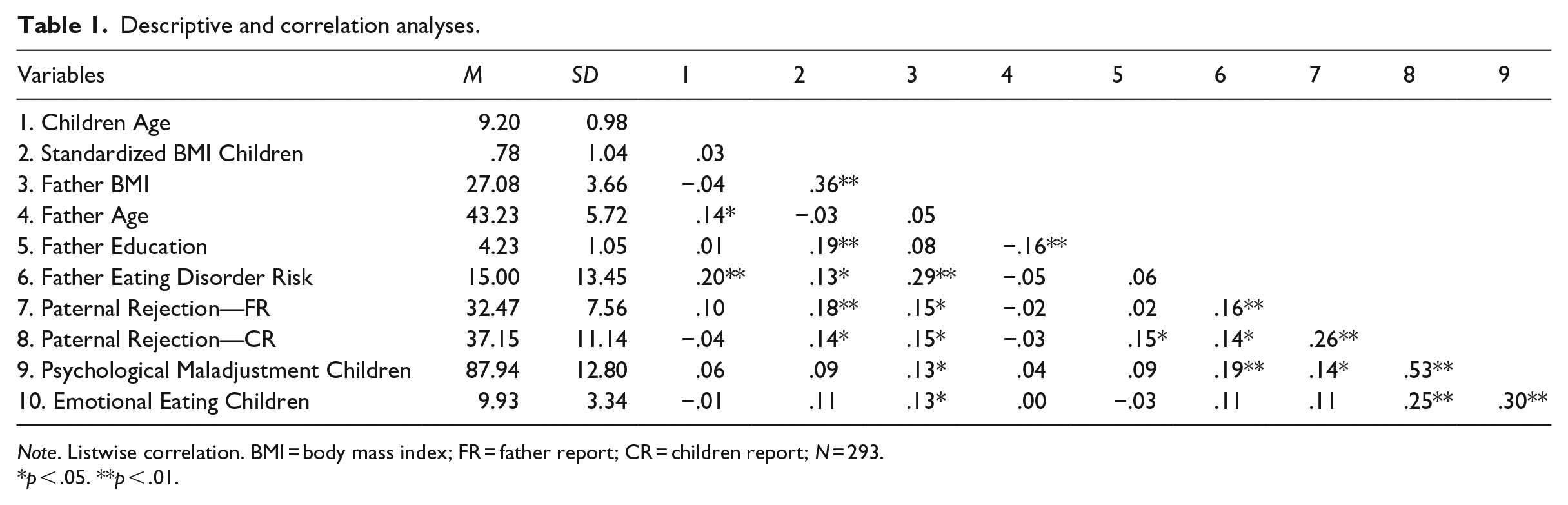
Note. Listwise correlation. BMI = body mass index; FR = father report; CR = children report; N = 293.
p < .05. **p < .01.
Path analysis
The hypothesized model was tested (Figure 1) and results indicated good fit indices, χ2(10) = 10.04; p = .44, CFI = 1.00, RMSEA = 0.01, 90% CI (0.00, 0.06), SRMR = .02, and several significant direct effects (see Supplemental Table S2). Specifically, children report of paternal rejection positively predicted psychological maladjustment of children (b = .60, p < .01, CI (0.44, 0.60), β = .52), psychological maladjustment of children positively predicted emotional eating of children (b = .06, p = .002, CI (0.08, 0.38), β = .23). Examination of total effects and indirect effects showed a significant positive indirect effects from children report of paternal rejection to emotional eating of children through the effect of children psychological maladjustment (b = .04, p = .003, CI (0.04, 0.20), β = .12), and a total effect from children report of paternal rejection to emotional eating of children (b = .07, p = .002, CI (0.08, 0.36), β = .22).

Graphical representation of path analysis.
Discussion
To the best of our knowledge, this is the first study to focus on the relationship between paternal rejection and child emotional eating behavior in a large sample of 8- to 11-year-old boys and girls and investigate whether child psychological maladjustment acts as a mediator of such relationship through a path analysis. Moreover, the cross-informant ratings allowed collecting information from both fathers and children.
The hypotheses of the study were partially supported. As expected, children’s perception of high paternal rejection was associated with higher levels of child psychological maladjustment and emotional eating. In contrast to our expectations, results pointed out a non-significant direct association between father’s report and child emotional eating. We also found that children with higher levels of psychological maladjustment were more likely to eat in response to internal emotional factors.
Overall, these findings support previous research reporting the influence of the parenting quality on the development and maintenance of EE in children and adolescents (e.g. Topham et al., 2011). The novelty aspect of the study is taking into account the father’s perspective: the majority of previous studies have mainly focused on the mother or did not examine the separate contributions of mother and father in the etiology of eating pathologies. A few evidence investigating parents’ perspective separately concluded that maternal rejection is more strongly related to the children’s emotional eating than paternal rejection (Vandewalle et al., 2016). Thus, the present study is the first to point out that the quality of the perceived relationship with the father may be an essential factor in the development of children’s emotional eating. Contrary to available evidence, such a result highlights that it is not just mothers to contribute to the processes related to the emotional word of children, but all the actors who enter into a relationship with the child can make their own contribution. The social organization tendency to favor a family structure in which mothers spend more time with their children must not lead to underestimating the role of other educational agents. The refusal of any social context, even more, if provided by a caregiver (such as father), involves the frustration of the child’s need for relatedness (Ryan & Deci, 2017) and could lead to emotional development problems and compensatory behaviors such as emotional eating as a consequence. Moreover, these findings enhance our understanding of a potential underlying mechanism linking paternal rejection to EE. Children’s psychological maladjustment significantly mediates the path from paternal rejection to child’s EE. More specifically, children who feel ignored or neglected by their fathers are more likely to experience unhealthy psychological adjustment that, in turn, leads to EE. These findings could be explained by the fact that growing up with a rejecting father may disrupt the emotion regulation processes underpinning psychological development. Theoretically, psychological maladjustment has roots in the individuals’ emotional disposition (Eisenberg et al., 2001), and experiencing rejecting parenting is detrimental to the emotional development of children (Rohner & Khaleque, 2005). The pain produced by chronic rejection generates a specific set of emotional dysregulated dispositions (i.e. psychological maladjustment) that may prevent children from learning adaptive emotion regulation strategies and tend to diminish children’s capacity to deal with emotions (Khaleque & Rohner, 2012). Indeed, psychological maladjustment is essentially related to impaired emotion regulation skills (Gross, 2007). Contextualizing our findings, we may conclude that rejecting father can hinder the psychological development of children—impacting the emotional processes—which, in turn, may have a pervasive effect of children’s eating patterns. In this regard, the emotional eating may function as an alternative strategy to escape from negative affects (Evers et al., 2010).
Although both parental rejection and psychological maladjustment have been separately investigated in relation to EE in children, this study is the first to test a model of the relationships among such variables in a community sample of children. As mother-oriented research has created a serious gap in the literature, our findings support a new perspective in the research of emotional eating development, highlighting that fathers are as important as mothers in contributing to dysfunctional eating behaviors. Through this study, attention has been drawn to the role of psychological maladjustment in the occurrence of EE, suggesting a potential underlying mechanism through which parental rejection may operate in child emotional eating development.
Overall, this study suggests that fathers could have an important role as a contextual variable that could obstacle the development of emotional adjustment in children and, as a consequence, creates the condition to use emotional eating as compensatory behavior.
Conclusion
This paper attempts to answer a complex and interesting question related to the influence of fathers on children’s emotional eating behavior. Taken together, our results suggest that significant associations between paternal rejection, children’s psychological maladjustment, and emotional eating were only found when children reported their perceptions about paternal rejection. Thus, children’s subjective perceptions of relationship with father seem to have more impact on their psychological outcomes and unhealthy dietary patterns than father reported parenting quality. Although the cross-informants rating is a useful approach in the research with children, in case of disagreement, the child perspective is more trustworthy as it allows gathering information about the subjective representations of the father-child relationship and the personal interpretation of feeling unloved and unwanted (Rohner, 2016). This is a crucial issue to consider when translating research outcomes into child eating-related behavior programs and clinical interventions. Furthermore, a potential underlying mechanism through perceived paternal rejection is linked to emotional eating in children has been suggested. Children’s psychological maladjustment may be an essential underlying mechanism linking perceived paternal rejection to children’s emotional eating behaviors. More research is needed to validate these results.
The results of the present study have implications for pediatric eating disorder prevention programs and clinical intervention. Specifically, our findings could help design prevention and intervention programs for emotional eating in childhood, targeting both dysfunctional paternal parenting and psychological maladjustment. In particular, increasing the quality of relationships with the father may exert a significant contribution to the child’s outcomes and the prevention of the development of EE in childhood; future studies should evaluate the effectiveness of parenting-focused programs. As EE is a risk factor for binge eating, overweight, and childhood obesity (Braet et al., 2008), understanding vulnerabilities’ factors could help in implementing targeting prevention programs at an early age and avert a potential pathway to obesity. Moreover, this study also provides evidence to support the need to include fathers in child eating-related behavior studies.
Limitations and future directions
This study presents an interesting and unique relationship between parental rejection and EE through child psychological maladjustment. Nonetheless, the study is not without limitations. First, it has a cross-sectional design that does not allow for the establishment of causal relationships between study variables. Overall, it could also be hypothesized that eating pathology may influence family dynamics and the environment, which in turn may affect disordered eating behaviors’ maintenance and evolution. Longitudinal studies are needed to establish the variables’ interplay and the direction of the relationship identified. Second, the study only included a non-clinical sample of Italian youngsters, limiting the generalizability of the results to other samples. It would be interesting to evaluate the model in a clinical sample of eating disorder children. Third, the study is limited by the use of self-report measures that can be biased by recall effects and social desirability. Thus, some caution may be warranted in interpreting results. Fourth, information about cohabitation with father and the amount of time spent with father is lacking, future studies should address such limitations evaluating both child and father perceptions within (no)cohabiting relationships and the fathers’ engagement in interacting time with their children.
Despite these limitations, the present study adds to the research literature shedding new light on the processes that drive children’s emotional eating.
Supplemental Material
Supplemental_Material_Table_S1 – Supplemental material for Paternal rejection, psychological maladjustment, and child emotional eating: Path analysis in 8- to 11-year-old boys and girls
Supplemental material, Supplemental_Material_Table_S1 for Paternal rejection, psychological maladjustment, and child emotional eating: Path analysis in 8- to 11-year-old boys and girls by Stefania Cella, Sebastiano Costa, Annarosa Cipriano and Paolo Cotrufo in Clinical Child Psychology and Psychiatry
Supplemental Material
Supplemental_Material_Table_S2 – Supplemental material for Paternal rejection, psychological maladjustment, and child emotional eating: Path analysis in 8- to 11-year-old boys and girls
Supplemental material, Supplemental_Material_Table_S2 for Paternal rejection, psychological maladjustment, and child emotional eating: Path analysis in 8- to 11-year-old boys and girls by Stefania Cella, Sebastiano Costa, Annarosa Cipriano and Paolo Cotrufo in Clinical Child Psychology and Psychiatry
Footnotes
Declaration of conflicting interests
The author(s) declared no potential conflicts of interest with respect to the research, authorship, and/or publication of this article.
Ethical approval
All procedures performed in studies involving human participants were in accordance with the ethical standards of the institutional and/or national research committee and with the 1964 Helsinki declaration and its later amendments or comparable ethical standards.
Funding
The author(s) received no financial support for the research, authorship, and/or publication of this article.

Supplemental material
Supplemental material for this article is available online.
Author biographies
References
Supplementary Material
Please find the following supplemental material available below.
For Open Access articles published under a Creative Commons License, all supplemental material carries the same license as the article it is associated with.
For non-Open Access articles published, all supplemental material carries a non-exclusive license, and permission requests for re-use of supplemental material or any part of supplemental material shall be sent directly to the copyright owner as specified in the copyright notice associated with the article.
