



Abstract
Background:
Attention-deficit/hyperactivity disorder (ADHD) is associated with increased risk for conduct problems (CP), as well as with callous-unemotional traits (CUt) and lower accuracy in face emotional recognition (FER). It is unclear, however, whether CUt and low accuracy in FER contribute to the risk for CP in ADHD. The present study investigated the possibility of such contribution.
Methods:
This pilot study’s participants included 31 children aged 7–17 years, diagnosed with ADHD, and treated in a psychiatric outpatient clinic. The parents rated their children on the ADHD Rating Scale, Inventory of Callous-Unemotional Traits, and the Child Behavior Checklist-Conduct Problems scale. Participants completed the Hebrew version of the children’s Reading the Mind in the Eyes Test (cRMET)—a Theory of Mind measure. A bootstrapped multiple mediator model was used, adjusting for age and gender.
Results:
ADHD symptoms were associated with CP. This association was not mediated by CUt or cRMET. CUt was associated with CP independent of ADHD symptom severity.
Conclusions:
ADHD symptoms and CUt both should be considered when assessing risk for CP and devising a treatment plan, in children with ADHD. Current results did not confirm the hypothesis that cRMET and CUt mediate between ADHD symptoms and CP. More studies employing larger samples, longitudinal design, and other emotion recognition measures are needed.
Keywords
Introduction
Cross-sectional and longitudinal data suggest that attention-deficit/hyperactivity disorder (ADHD) constitutes a risk factor for the development of conduct problems (CP) in children and adolescents (Danforth et al., 2019). Considering the cost of conduct problems to the individual, the family, and to society at large, identifying mediating and moderating factors for this association is of great value (Berenguer Forner et al., 2017; Foster & Jones, 2005).
Callous-unemotional traits (CUt) comprise the affective dimension of psychopathy and include lack of remorse or guilt, callous lack of empathy, lack of concern over performance, and shallow or deficient affect (Humayun et al., 2014). Studies have demonstrated that high CUt is related to higher levels of aggression, conduct problems, and other negative prognostic implications (Levy et al., 2015). Burns (2000) suggested that due to overlapping symptoms, psychopathy and ADHD may be associated. Indeed, symptoms of impulsivity, stimulation seeking, impaired self-regulation, reduced cooperation and compliance with requests and secondary aggressive tendencies are related to both (Graziano et al., 2016; Kaplan & Cornell, 2004). In addition, both ADHD and CUt tend to develop in early childhood (Willoughby et al., 2015).Nevertheless, data regarding the association between ADHD and CUt is still inconclusive ((Blader et al., 2013; Burns, 2000; Colledge & Blair, 2001; Fowler et al., 2009; Frick et al., 2000; Kaplan & Cornell, 2004; Lee & Hinshaw, 2004; Northover et al., 2015). Moreover, there is very limited data regarding the relative contribution of ADHD and CUt to CP, with preliminary studies suggesting that CUt is associated with CP in later development independent of ADHD symptoms (Babinski et al., 2017; Jezior et al., 2016; Waller et al., 2015).
The ability to discriminate between one’s own mental states, including intentions, beliefs, emotions, and knowledge, and others' mental states is defined as Theory of Mind (ToM) (Decety, 2010; Premack & Woodruff, 1978). ToM is considered to be a multifaceted function that includes both bottom-up and top-down neurocognitive processes (Lieberman, 2007; Samson, 2009). One of the ToM functions is the ability to discern other people’s mood or emotions from their facial expression (Baron-Cohen et al., 2001). Various experimental paradigms demonstrated that the level of accuracy in facial emotion recognition tasks corresponds to deficits in other aspects of ToM functioning (Mary et al., 2016).
Studies indicated that lower ToM functioning was related to conduct problems in children and adolescents (Fairchild et al., 2010; Yilmaz Kafali et al., 2021), suggesting that inability to comprehend others’ states of mind underpins CP (Gillespie et al., 2018).
Lower ToM functioning was also evident in subjects with ADHD, as measured using questionnaires, various emotion recognition tasks, affective responses to vignettes, “faux-pas” scenarios, and computerized ToM tasks (Maoz et al., 2019; Pineda-Alhucema et al., 2018). Moreover, dopaminergic circuits, suggested to be involved in ADHD and constituting the main target of psychostimulants, were found by some studies to be involved in ToM task performance (Abu-Akel & Shamay-Tsoory, 2011; Beyer von Morgenstern et al., 2014; Williams et al., 2008). While the ability to sustain attention on a task and to inhibit a response optimally is impaired in children with ADHD (CwADHD), executive functions may not be fully responsible for difficulties in FER (Berenguer Forner et al., 2017; Noordermeer et al., 2020). Although both ADHD and CUt have been associated with ToM dysfunction, it is unclear whether ToM mediates between ADHD and CP (Kahn et al., 2017). A previous study demonstrated that both the ability to decode facial expressions and social reciprocity are impaired in CwADHD (Ayaz et al., 2013). A recent study showed that the emotion recognition difficulties in CUt may be related to co-occurring autistic traits (Sharp & Vanwoerden, 2014). It is thus likely that CwADHD with high CUt and CP may also have impairments in recognizing emotions in the faces of others.
As indicated above, studies have shown impairment in FER in children and youths with CUt (Dawel et al., 2012). Some evidence suggests that children and youths with a history of maltreatment are superior in recognizing sadness and fear in FER (Leist & Dadds, 2009). Compared to typically developing controls, children and youths with CUt demonstrate less gazing into others’ eyes resulting in “fear blindness” and psychopathic traits (Dadds et al., 2008). Early evidence indicates a specific impairment in the recognition of fear and sadness in individuals with CUt (Marsh & Blair, 2008); however, later findings have suggested that the FER impairment is evident across both positive and negative emotions (Dawel et al., 2012). Thus, cognitive mechanisms involved in possible FER dysfunction in children and youths with CUt may include lower sensitivity to the conveyed social meaning, reduced interest, or avoidance of eye-contact (Bedford et al., 2020). It has been previously reported that in pediatric populations, fear-specific emotion recognition deficits are associated with CU traits leading to low concern for others and punishment insensitivity (White et al., 2016).
The present study aimed to examine the possible contribution of CUt and of ToM to CP in CwADHD, taking into consideration the severity of ADHD. Considering the inconsistent findings regarding the relationship between ADHD and CUt, we hypothesized that CUt is associated with CP in CwADHD, irrespective of ADHD severity. In addition, in view of the relatively consistent evidence for an association between ADHD and lower ToM functioning, and between ToM functioning and CP, we hypothesized that impaired ToM mediates the association between ADHD and CP even when controlling for the effect of CUt.
Methods
Study population and procedure
This pilot study included a clinical sample of 31 participants, 7–17 years old (M = 10.84, SD = 2.73), 84% boys and 16% girls, referred for psychiatric evaluation to a psychiatric tertiary outpatient clinic in Israel. A sample size calculation was used to determine the minimum number of participants needed for this pilot study, which intended to explore the mediating contribution of cRMET to the relationship between ADHD and CUt. Previous studies have demonstrated an adequate test–retest reliability (Van der Meulen et al., 2017) and low to moderate internal reliability for overall task accuracy in cRMET (Girli, 2014; Kittel et al., 2021; Vellante et al., 2013). Its internal reliability in the current study, measured by Cronbach’s α, was 0.63, supporting the possibility that FER modeled by cRMET is not unidimensional (Kittel et al., 2021).
Clinical diagnosis was made by child and adolescent psychiatrists, based on the participants’ and their parents’ interviews, as well as on parent questionnaires. All subjects were recruited after being diagnosed with ADHD. None were diagnosed with conduct disorder or had a known history of delinquency. Three of them were diagnosed with comorbid oppositional-defiant disorder. One was diagnosed with obsessive-compulsive disorder, and one with unspecified anxiety disorder. Subjects with diagnoses of intellectual disability, psychosis, bipolar disorder, or autism spectrum disorder were excluded from this study. At recruitment, none of the participants was receiving medication for a mental disorder. Data related to socioeconomic status or intellectual functioning was not obtained in this study. Five participants did not complete all the questionnaires.
Measures
ADHD assessment
ADHD symptoms were measured by summing up the scores of the parent-reported local-language-version of the ADHD Rating Scale, Version IV (ADHD-RS) (Berger & Cassuto, 2014). The ADHD-RS includes 9 items measuring symptoms of inattention and 9 items measuring symptoms of hyperactivity or impulsivity. All items are rated from 0 (Never or rarely) to 3 (very often), coincide with the DSM IV-TR ADHD “A” criteria (American Psychiatric Association, 2000) and pertain to the participant’s previous 6 months. ADHD-RS has been used in clinical trials, as a measure of ADHD severity in children and adolescents (Collett et al., 2003; DuPaul et al., 2016).
Conduct problem assessment
Conduct problems were measured and the scores of the parent-reported local-language-version of the Child Behavior Checklist-Conduct Problems scale (CBCL-CP) were totaled. The CBCL is widely used in both research and clinical practice and screens for emotional, behavioral, and somatic disorders in children and adolescents aged 4–18 (Achenbach, 1991). The CBCL-CP consists of 17 items rated from 0 (not true) to 2 (very true or often true) Just like the ADHD-RS, it too pertains to the participant’s previous 6 months (Biederman et al., 1996) and matches the DSM IV-TR conduct disorder ‘A’ criteria (American Psychiatric Association, 2000). The score distribution of this scale in our study suggested that a normal distribution was a reasonable assumption (skewness = .233, SE = .46, Kurtosis = −.51, SE = .89, Shapiro-Wilk index of .96, df = 26, p = .34).
Callous unemotional trait assessment
Callous Unemotional Traits were measured using the score totals of the parent-reported local-language-version of the Inventory of Callous-Unemotional Traits (ICU) (Levy et al., 2017). The ICU is a 24-item rating scale based on the following 4 items of the Antisocial Process Screening Device which measures CUt: “Is concerned about how well he/she does at school or work”; “Feels bad or guilty when he/she does something wrong”; “Is concerned about the feelings of others”; “Does not show feelings or emotions”. Each item is rated on a 4-point Likert scale (Munoz & Frick, 2007). The ICU has been shown to have acceptable internal consistency (Viding et al., 2009) and good construct validity both, in community samples and in samples from clinics (Kimonis et al., 2008; Levy, et al., 2017). The score distribution of this scale suggested that a normal distribution is a reasonable assumption (skewness = .49, SE = .45, Kurtosis = .12, SE = .87, Shapiro-Wilk Test of normality W-S = .97, df = 27, p = .47).
Theory of Mind assessment
The test used for this assessment was the Reading the Eyes in the Mind Test. It was selected because it is readily available in Israel in Hebrew, which is the local language and its validity and reliability were approved in similar Israeli populations (Maoz et al., 2019). Recognition of facial emotions was scored by totaling the correct responses on the Children’s Reading the Mind in the Eyes Test (cRMET) (Baron-Cohen et al., 2001; Demirci & Erdogan, 2016). In this task, participants were presented with a series of 28 photographs of the eye region and were asked which of 4 presented words describes best the feelings or thoughts of the person in the picture. Although cRMET was shown to have low to moderate internal reliability (Girli, 2014; Vellante et al., 2013), its test–retest reliability is adequate (Van der Meulen et al., 2017). cRMET was modified for local use in Hebrew, using the original pictures on similar cardboard with culturally adapted wording. The number of correct responses in our study was in the range of 6–22 (M = 16.17, SD = 4.08). Cronbach’s α internal reliability was 0.65. The distribution of correct scores in the sample suggested that again a normal distribution is a reasonable assumption (skewness = −0.84, SE = 0.43, Kurtosis = 0.49, SE = 0.83, Shapiro–Wilk Test of normality W-S = .93, df = 30, p = .063).
Data analysis
A bootstrapped (1000 bootstraps) multiple mediator model was used to assess multiple mediation effects. Age and gender were included as covariates in all regression models. An α-level of .05 was considered significant. Bootstrapped 95% confidence interval (95% CI) of the standardized coefficients was calculated. Multicollinearity was calculated using Variance Inflation Factor and was ruled out unless indicated otherwise. Possible significant differences in the beta weighted effects in a multiple regression model were found by calculating the overlap between their corresponding 95% CIs. An overlap of less than 50% was considered indicative of significant differences between the standardized coefficients at the level of p < .05 (Cumming, 2009). The sum of the direct and the indirect effects was computed, as were the direct effect (after controlling for the mediators) and indirect one (via the mediators) (Mackinnon & Dwyer, 1993). In addition, the presence of a two-way interaction between ADHD symptoms and each of the mediators in contributing to CP was examined to determine if there was a moderated mediation effect (Muller et al., 2005). Interaction was examined using centered and standardized interaction variables. IBM SPSS software version 25.0 for Windows (IBM Corp., Armonk, N.Y., USA) was used for the data analysis. The mediation model was calculated using “PROCESS” macro for SPSS.
A power calculation for a power of over 80% and α = 0.05 was performed in order to detect the following: a 4-point difference (SD = 6) in the ICU total score between non-CP and CP youths (Levy et al., 2015; Sebastian et al., 2012) and a 7-point difference (SD = 2.3) in cRMET scores between non-ADHD and ADHD youths (Maoz et al., 2019). This calculation yielded a computed sample size of ⩽18 participants.
Ethical considerations
Written informed consent was obtained from the children and their parents. The study was approved by the Institutional Review Board. Participation was voluntary, and no incentive was given for participating in this study.
Results
The distribution and internal reliability of ADHD-RS, CBCL-CP, ICU, and cRMET scores are summarized in Table 1.
The distribution and internal reliability of ADHD symptoms, callous-unemotional traits, and reading the mind in the eyes test scores.
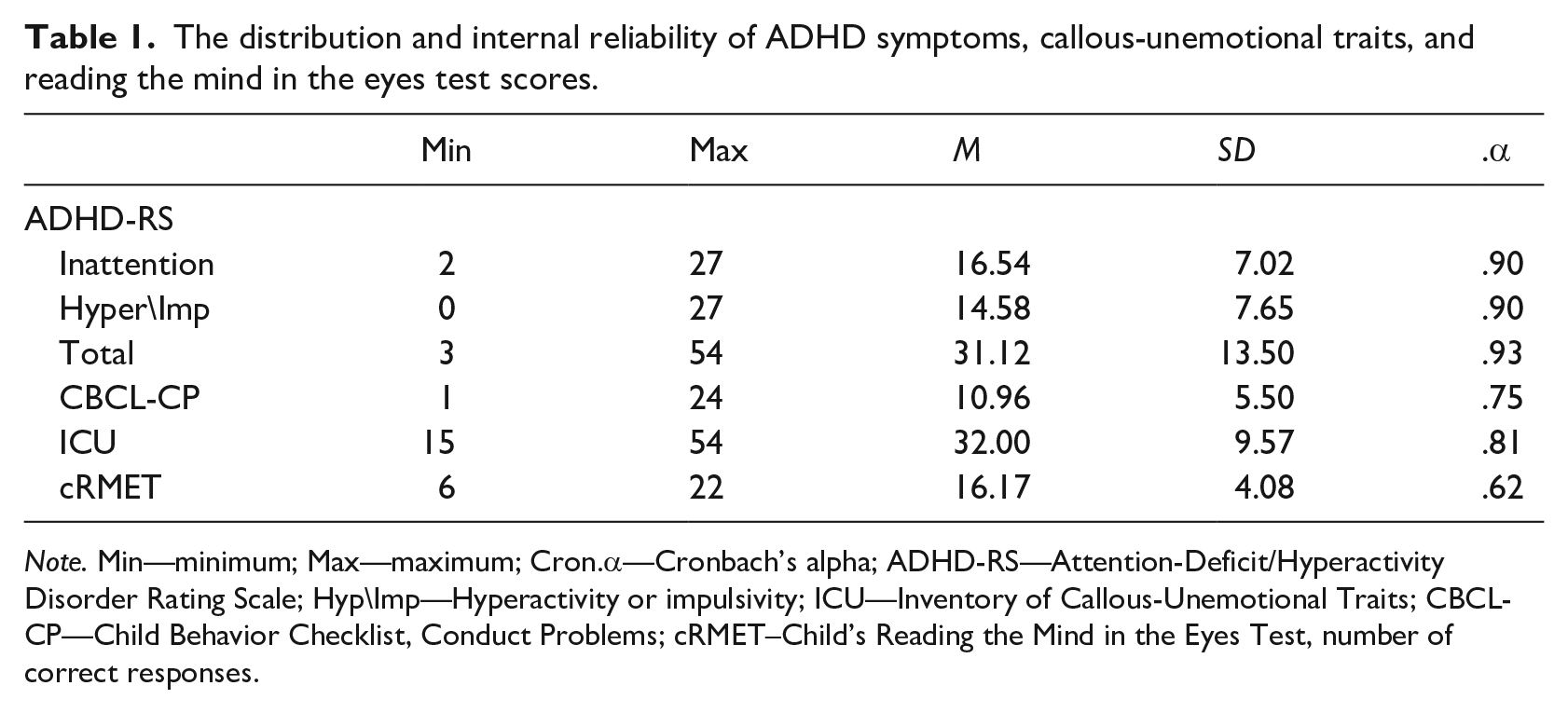
Note. Min—minimum; Max—maximum; Cron.α—Cronbach’s alpha; ADHD-RS—Attention-Deficit/Hyperactivity Disorder Rating Scale; Hyp\Imp—Hyperactivity or impulsivity; ICU—Inventory of Callous-Unemotional Traits; CBCL-CP—Child Behavior Checklist, Conduct Problems; cRMET–Child’s Reading the Mind in the Eyes Test, number of correct responses.
Age (β = 0.08, p = .74) and gender (β = −0.35, p = .56) were not associates with CBCL-CP (Table 2).
Effect of ADHD symptoms and mediating effects of callous-unemotional traits and face affect recognition on conduct problems.

Note. ADHD—Attention-deficit/hyperactivity disorder; CP—Conduct Problems; cRMET—Child’s Reading the Mind in the Eyes Test; CUt—callous-unemotional traits; all models are adjusted for age and gender. Number of bootstraps = 1000.95% CI- bootstrapped CI of beta coefficient. SE and 95% CI were not obtainable for binary variable.
ADHD symptoms and conduct problems
A positive association was found between ADHD symptoms and conduct problems (β = 0.53, p = .012), reflecting the total effect of ADHD symptoms in the multiple mediator model.
Callous-unemotional traits and reading the mind in the eyes test performance as multiple mediators between ADHD symptoms and suicidality
The associations between ADHD symptoms and each of the hypothesized mediators were examined separately. ADHD-RS (β = 0.22, p = .31) was not associated with CUt. In addition, age (β = 0.50, p = .012) but not ADHD-RS (β = 0.03, p = .87) was associated with cRMET.
The combination of ADHD symptoms, CUt, and the functioning on cRMET were examined in a multiple regression model in an attempt to identify their contribution to conduct problems.
ADHD-RS (β = 0.42, p = .022) and ICU (β = 0.52, p = .005) but not cRMET (β = 0.07, p = .75) were associated with CBCL-CP. No significant differences were found between the beta-weighted effects of ADHD-RS and ICU on CBCL-CP as reflected by the overlap of their corresponding 95% CI (Table 2).
No two-way interaction was found between ADHD-RS and ICU (β = 0.25, p = .13), cRMET and ICU (β = −0.03, p = .85), or ADHD and cRMET (β = 0.38, p = .055) with CBCL-CP.
Discussion
The possible association between CUt and CP, in children and adolescents with ADHD, received relatively limited attention so far (Jezior et al., 2016; Waller et al., 2015). This study aimed to explore the possible association between ADHD and CP, using CUt and ToM functioning values (as measured by cRMET) as mediators, in a clinical population of CwADHD.
The study found that ADHD symptoms are positively related to CP severity. In addition, CUt and cRMET do not serve as mediators between ADHD symptoms and CP. Nevertheless, CUt was found to be associated with CP independent of ADHD symptom severity.
Previous studies have suggested that youths with conduct disorder combined with ADHD exhibit high levels of impulsivity and low levels of CUt, thus constituting a distinctive group of youths with antisocial behavior (Frick et al., 2000; Lynam, 1998). The current results suggest that these assumptions should be further investigated, as both ADHD and CUt were associated with CP in non-delinquent youths with a primary diagnosis of ADHD. Moreover, the effect of ADHD symptom severity on CP was similar to that of CUt. These results are congruent with previous reports showing that CUt is associated with CP in later development, independent of ADHD symptoms (Jezior et al., 2016; Waller et al., 2015).
FER is a process in which mental states are attributed to others. Previous research has found that FER already exists at the preschool period and improves with age (Tonks et al., 2007). Consistent with previous findings, the results indicated a relatively strong effect of age on cRMET performance (Golubchik & Weizman, 2020). Given that the performance on cRMET may be affected by executive function development, the age effect on cRMET in ADHD compared to non-ADHD groups should be investigated (Mary et al., 2016).
FER is one of several cognitive functions contributing to ToM tasks (Maoz et al., 2019; Williams et al., 2008). The level of accuracy in FER tasks has been found to correspond with other aspects of ToM functioning (Mary et al., 2016). In the current study we focus on FER accuracy, which has been found to be negatively affected by ADHD. Future studies may examine whether other cognitive functions associated with ToM may be involved in the contribution of ADHD to CUt and whether non-motivational attention control difficulties underpin FER dysfunction evident in CUt.
Strengths and limitations
The strength of this study is the combined assessment of ADHD severity, CUt, and ToM functioning in a population of CwADHD. This approach clarified the role of CUt and ToM functioning in contributing to CP in CwADHD.
Given the clinical nature of the sample, its small size, the attrition of 5 participants, and the large age range of the participants (see more details later in this section), the current results should be interpreted with caution.
Moreover, only few children were diagnosed with CP; thus, the range of severity of this item was very limited. Additionally, as described in the Introduction, numerous studies show that the FER deficits in children with higher CUt pertain only to fear. Future studies consisting of larger sample sizes should analyze separately the impact of strictly fearful faces. Another limitation is the cross-sectional nature of the study that does not allow identification of causal mediators. Moreover, a measured mediator may be a confounder of a true mediator that is unknown and as such not included in this study, but mimicking it. Additionally, given the non-experimental, cross-sectional design, the direction of effect between the mediators and the outcome measure cannot be fully determined (Fiedler et al., 2011). Missing socioeconomic and family-related factors may also constitute confounders. None of the subjects were diagnosed with conduct disorder; thus, this study’s results cannot be generalized to populations with conduct disorder.
The mediation analysis that was used in this study constitutes a major limitation since it is more appropriate for longitudinal studies than cross-sectional ones. It was used to identify the contribution of CUt and ToM functioning to CP in CwADHD. Follow-up studies are needed to identify reliably the contribution of CUt and ToM to CP in this population.
While this study’s results are consistent with those of previous studies, using other language-versions of cRMET psychometric property data of the Hebrew cRMET version is still unavailable. The current sample was highly predominately male, preventing inferences about gender differences. Unfortunately, in the current study, cRMET was the only measure of ToM and cRMET was shown to have only low-to-moderate internal reliability (Girli, 2014; Vellante et al., 2013). Still, its test–retest reliability was found to be adequate (Van der Meulen et al., 2017) and in the current study its internal reliability was acceptable (Cronbach’s alpha = 0.65). In addition, since RMET accuracy is reduced with age (Penuelas-Calvo et al., 2019), in all our analyses we controlled for age so the residual associations would be related to the traits measured. Nonetheless, the large age range of participants limits inference regarding specific age groups. Future studies should include other ToM measures as well.
Conclusions
Since ADHD increases the risk for CP, identifying mediating and moderating factors to explain this association is important. This study aimed to explore CUt- and ToM-related FER dysfunction, assessed using cRMET in a clinical sample of CwADHD, as potential mediators between ADHD and CP. The results of this pilot study confirm that ADHD symptom severity constitutes a risk for CP. In addition, CUt proved to be associated with CP, independent of ADHD symptom severity, suggesting that both ADHD symptom severity and CUt should be taken into account in assessing the risk for conduct behavior disorders in CwADHD. The results do not confirm our hypothesis that cRMET and CUt serve as mediators between ADHD symptoms and CP. Indeed, in a small sample of CwADHD we found an association between higher CUt and higher CP, irrespective of the level of ADHD symptoms. Future studies employing larger samples, longitudinal design, and other ToM measures are needed in order to confirm these results. Clinicians should consider both ADHD symptom severity and CUt when planning a treatment for CP in CwADHD.
Footnotes
Declaration of Conflicting Interests
The author(s) declared no potential conflicts of interest with respect to the research, authorship, and/or publication of this article.
Funding
The author(s) received no financial support for the research, authorship, and/or publication of this article.
