



Abstract
The aim of this study is to investigate the effectiveness of Eye Movement Desensitization and Reprocessing (EMDR) treatment in adolescents with panic disorder (PD). This follow-up study consists of 30 adolescents with PD without agoraphobia, aged 14–17 (15.53 ± .97). They were evaluated with Kiddie Schedule for Affective Disorders and Schizophrenia for School-Age Children Present, also the Panic and Agoraphobia Scale (PAS) and Beck Anxiety Inventory (BAI) were administered at baseline, at the end of the 4th and 12th weeks of treatment. EMDR therapy which is an eight-phase treatment approach composed of standardized protocols and procedures was applied for 12 weeks, one session per week. The baseline mean of the total PAS score decreased from 40.06 to 13.13 at fourth week and 1.2 at the end of 12th week of treatment. In addition, BAI score decreased significantly from 33.67 to 13.83 at 4 weeks and 5.31 at the end of 12th week of treatment. Overall, our results underscore the effectiveness of EMDR in adolescents with PD. Moreover, the current study suggests that EMDR may represent an effective intervention technique for PD in adolescents to protect against relapses and to overcome a fear of future attacks.
Keywords
Introduction
Panic disorder (PD) in children and adolescents is a common and often disabling mental disorder, accompanied by psychosocial and academic difficulties both during adolescence and into adulthood (Stein et al., 2008). DSM-V defines a panic attack as “a discrete period of intense fear or discomfort that has an abrupt onset, reaches a peak in 10 minutes, and is accompanied by at least four of 13 somatic or cognitive symptoms” (APA, 2013). Previous studies showed that panic disorder is more common in adolescence than in other life phases (Beesdo et al., 2009). Panic disorder in adolescence is believed to have a moderately low base rate, with a prevalence of around 1% (Baker et al., 2022). However, in clinical populations, 2–10% of adolescents are referred to outpatient clinics (Diler et al., 2004), and 10–15% of hospitalized adolescents receive a panic disorder diagnosis (Masi et al., 2000). However, panic disorder is experienced by around 1–3% of adolescents, with peak onset between 15 and 19 years of age (Von Korff et al., 1985). Heightened anxiety sensitivity or increased sensitivity to psychological symptoms of PD is commonly reported by adolescents with PD (Pincus et al., 2010) or at risk for PD (Hale & Calamari, 2006). Nelles and Barlow (1998) theorized that adolescents are cognitively able to make catastrophic misinterpretations and attributions about the source of such psychological sensations in a manner consistent with PD. The previous study showed that adolescents have abstract reasoning skills that allow them to mistakenly attribute the cause of distressing sensations to an internal, catastrophic source, thereby increasing the likelihood of developing PD (Doerfler et al., 2007). The lag between panic disorder onset and its treatment may result in the entrenchment of avoidance behaviors and greater consequent impairment among those diagnosed with PD early in life (Weissman et al., 1989). If PD persists into adulthood, the risk increases. Adolescents with PD frequently present with comorbid major depressive disorder, other anxiety disorders, and/or bipolar disorder (Diler et al., 2004; Doerfler et al., 2008; Masi et al., 2007). Moreover, panic disorder symptoms may increase the risk for both suicidal ideation and suicide attempts in late adolescence and early adulthood (Boden et al., 2007). Therefore, treatment of PD is important to prevent risk factors and increase the life quality of adolescents. In terms of sex differences, all anxiety disorders occur more frequently among females than males (McLean et al., 2011; Altemus et al., 2014). In epidemiological studies, the lifetime prevalence of panic disorder is approximately twice as high in females as in males (Kessler et al., 2006). Although sex differences may occur as early as during childhood, they increase with age (Craske, 2003), reaching ratios of 2:1 to 3:1 in adolescence (Pine et al., 1998). A stressful life event can cause the occurrence of panic attacks. A clinical study conducted in Turkey by Bayraktar (2007) observed a relationship between the onset of panic attacks and stressful life events such as bereavement and leaving school.
Traditionally, treatments for PD, with or without agoraphobia, have consisted of pharmacological and cognitive behavioral therapy (CBT) approaches, both of which are considered effective (Sturpe & Weissman, 2002). According to the NICE guidelines (2007), the most effective treatment for PD was CBT, with a significant reduction of symptoms at posttreatment and maintenance of success at 6 months of follow-up (Galassi et al., 2007). According to the CBT model, panic attacks develop from a misinterpretation of bodily symptoms and related catastrophizing (Hofmann et al., 2007). Therefore, CBT for panic attacks uses strategies aimed at overcoming symptoms through a process of deconditioning (relaxation, in vivo exposure) and promoting a more adaptive and cognitively adequate approach (“cognitive restructuring”). However, despite the efficacy of CBT, there are still difficulties for many clients to experience direct exposure to their fear and body sensations during therapy. This could conclude by dropping out of the therapy. Therefore, Eye Movement Desensitization and Reprocessing (EMDR) is emerging as a viable treatment alternative. Moreover, EMDR is the newest and most applicable psychotherapy used in the treatment of anxiety disorders like panic disorders (De Jongh & ten Broeke, 2009; Horst et al., 2017; Leeds, 2012).
EMDR is an integrative psychotherapy method developed by Shapiro that has been extensively evaluated in its approach to trauma and posttraumatic stress disorder (Shapiro, 1989; 2001; 2002). EMDR is widely recognized as a first-line treatment for traumatic stress (APA, 2004; Foa et al., 2008; NICE, 2005; World Health Organization, 2013). It is based on the Adaptive Information Processing (AIP) model, a hypothetical model which posits that much of psychopathology may be because of the maladaptive encoding of and/or incomplete processing of traumatic or disturbing adverse life experiences (Shapiro, 2006; 2007). In brief, the AIP model is based on the idea that all humans have a physiologically based information processing system that maintains a delicate balance and allows information to be processed to an “adaptive resolution.” It assumes that traumatic experiences can disrupt this information processing system, leaving associated sights, sounds, thoughts, and feelings unprocessed and dysfunctionally stored, and that this may later result in a repeated negative pattern of thinking, feeling, and behaving. Therefore, it is hypothesized that the direct reprocessing with EMDR of these memories of etiological events and other experiential contributors can have a positive effect on the treatment of most clinical complaints (Udo & Gash, 2012; Rimini et al., 2016). The objective of EMDR therapy is to restore the natural information streaming to reach an adaptive resolution (Shapiro, 2007). It is particularly suited for the treatment of post-traumatic stress disorder (PTSD) (De Jongh et al., 2002). EMDR is also used for the treatment of other anxiety disorders, e.g., panic disorders (Gielkens et al., 2016). Studies on EMDR for adolescents show that this modality is effective for adolescents who are struggling with a wide range of mental health conditions, including trauma and PTSD, depression, anxiety, and possibly ADHD as well (Karadağ, Gökçen & Sarp, 2020; Gielkens et al., 2016) EMDR therapy can help adolescents in many ways, from providing resources for grounding and stabilizing to reprocessing negative beliefs and traumatic events (Adler-Tapia & Settle, 2009). Adolescents, maybe more than any other developmental age group are navigating so much in their worlds. EMDR can help to improve mood, increase self-confidence, and help the teenager to feel more in control of his or her life (Rodenburg et al., 2009; Adler-Tapia & Settle, 2009).
Panic memories in panic disorder resemble traumatic memories in Post Traumatic Stress Disorder (PTSD) in the sense that the person painfully re-experiences the traumatic incident via recurrent and distressing recollections of the event, including intrusive images and flashbacks (Hagenaars et al., 2010). The AIP theory conceptualizes that the anxiety and fear felt during panic attacks occur when a current situation elicits the dysfunctional memory network, with its negative affect, cognitions, and perceptions (Shapiro, 2001). Since past events are associated with the onset of PD, the processing of these memories is a central feature of the treatment of PD with EMDR. EMDR treatment follows a three-pronged and eight-phase approach. Treatment addresses past, present, and future aspects: (a) resolving the early traumatic experiences, (b) working with current triggers and memories of recent panic attacks, and (c) preparing for future challenges. The eight phases of EMDR are history taking, case conceptualization, and treatment planning, preparation, assessment, desensitization, installation, body scan, closure, and reevaluation (Shapiro, 1989).
Empirical data on the use of EMDR in treating panic disorder are limited. Several studies show that EMDR is an effective treatment for individuals with PD (Goldestein et al., 2000; Faretta, 2012; 2013; Leeds, 2012; Fernandez & Faretta, 2007; Trlin & Hasanović, 2021). More recently, Horst et al. (2017) and Faretta (2013) stated that EMDR was as effective as CBT for treating patients with panic disorder (Horst et al., 2017; Faretta, 2013). A systematic review suggests that when working with a comprehensive case formulation based on the AIP model, 12 up to 19 EMDR sessions can be effective to accomplish a full recovery from PD and agoraphobia (Faretta & Leeds, 2017).
In this study, we aim to investigate the effectiveness of EMDR treatment in adolescents with panic disorder. It is hypothesized that EMDR is an effective therapy for treating adolescents with panic disorder.
Method
Participants
Thirty adolescents who admit by Pediatrics referral were enrolled in the Child and Adolescent Psychiatry Clinic. All children were diagnosed with PD according to the Diagnostic and Statistical Manual of Mental Disorders, the Fifth Edition (DSM-5) criteria by a fellowship-trained child and adolescent psychiatrist. The sample consisted of 30 adolescents, 14–17 years of age (M = 15.53, SD = .97), including nine males and 21 females. The lower end of this age range was selected as studies indicate that panic attacks/panic disorder typically begin in mid-adolescence (Von Korff et al., 1985).
Assessment Procedures
All parents and adolescents were informed about the aim and the process of the study. After informed consent forms were taken from parents, the study begun. During the first psychiatric interview, adolescents were assessed for socio-demographic features, reasons for referral, main complaints of adolescents, detailed developmental and medical histories, and early childhood traumatic events. A formal assessment of psychiatric disorders and symptom severity was conducted with the Kiddie Schedule for Affective Disorders and Schizophrenia for School-Age Children Present and Lifetime version (K-SADS-PL) also the Panic and Agoraphobia Scale (PAS) and Beck Anxiety Inventory (BAI) were administered. The symptoms of panic disorder were defined by the PAS. Also, BAI was used to evaluate the anxiety levels of adolescents. The Clinical Global Impressions-Improvement (CGI-I) Scale [20] and -Severity (CGI-S) were used as the secondary measures. Participants were evaluated at baseline, at the end of the fourth week, and at the end of the 12th week of treatment. Inclusion criteria of the study: participants were (a) aged 14–17 years and (b) had a primary DSM-V diagnosis of PD. Exclusion criteria were: (a) the presence of symptoms other than Panic Disorder in more urgent need of treatment (e.g., suicidal intent/acts, acute psychosis) (b) starting antipsychotic or antidepressants medication within 3 months of trial assessment; (c) currently receiving another form of psychological treatment. The study was approved by the Ethics Committee of Isik University with the number E-32760440-050.01.04-20090.
Therapy Procedure
EMDR was applied to adolescents by a senior psychologist who had completed EMDR training. The details about the therapy procedure are in the supplementary material.
Measures
Demographic Questionnaire
In this study, a questionnaire was constructed to obtain the following data on participants: age, parents’ education, and socio-economic level.
Panic and Agoraphobia Scale
The Panic and Agoraphobia Scale evaluates panic attack features with three scored and one un-scored question, agoraphobia or avoidance behaviors with three questions, anticipatory anxiety with two questions, disability with three questions, and health concerns with two questions (Bandelow, 1995). It consists of 13 items with Likert scale ranging from 0 to four and raw scores ranging from 0 to 63. One example of the question is ‘how frequently did you have panic attacks? A validity and reliability study for the Turkish version has been published by Tural et al. (2000). The internal consistency of the PAS is .86. Test-retest reliability of the scale is .82. Although this scale has not been designed as a diagnostic tool, as a result of the ROC analysis ≥12-point cut-off score is sensitive enough to discriminate panic disorder patients from other population (Tural et al., 2000). In the sample of this study, the internal consistency of the scale was determined as .83.
Clinical Global Impressions-Severity
CGI-S asks the clinician a single question: “Considering your total clinical experience with this particular population, how mentally ill is the patient at this time?”, with the answer given on the following seven-point scale: 1 = normal, not at all ill; 2 = borderline mentally ill; 3 = mildly ill; 4 = moderately ill; 5 = markedly ill; 6 = severely ill; 7 = among the most extremely ill patients (Busner & Targum, 2007). Within the validity of the scale, the admission and discharge CGI-S scores are correlated (r = .40), and the indirect improvement measures obtained from their differences are highly correlated with the direct CGI-I scores (r = .71) (Berk et al., 2008).
Clinical Global Impressions-Improvement
Each time the patient is observed after medication has been initiated, the clinician compares the patient’s overall clinical condition to the baseline. The following single query is rated on a seven-point scale: “Compared to the patient’s condition at admission to the medication initiation, this patient’s condition is: 1 = very much improved since the initiation of treatment; 2 = much improved; 3 = minimally improved; 4 = no change from baseline; 5 = minimally worse; 6 = much worse; 7 = very much worse since the initiation of treatment” (Busner & Targum, 2007). Within the validity of the scale, CGI-I is strongly associated with self-report and clinician-rated measures of anxiety symptomatology and impairment (Zaider et al., 2003).
Kiddie Schedule for Affective Disorders and Schizophrenia for School-Age Children-Present and Lifetime Version
This is a semi-structured interview developed by Kaufman and colleagues (Kaufman et al., 1997) to evaluate present and lifetime psychopathology in children and adolescents according to DSM-III-R and DSM-IV criteria. The reliability and validity study of the Turkish translation was conducted by Gokler et al. (2004). The test-retest reliability of the K-SADS-PL for ADHD is .89; for anxiety disorder is .78. The internal consistency of the K-SADS-PL is .68 for ADHD; .62 for anxiety disorders.
Beck Anxiety Inventory
TheBeck Anxiety Inventory (BAI) is a self-report scale used to determine the severity of anxiety in both adolescents and adults. It was developed by Beck and colleagues (Beck et al., 1988) and consists of 21 items with a likert scale ranging from 0 to three and raw scores ranging from 0 to 63. It was developed in 1988 and a revised manual was published in 1993 with some changes in scoring. The BAI scores are classified as minimal anxiety (0–7), mild anxiety (8–15), moderate anxiety (16–25), and severe anxiety (30–63). ‘How much you have been bothered by that symptom during the past month including today’ is requested to circle for participants in this scale. The Turkish validity and reliability study was conducted in 1993 (Ulusoy et al., 1996). The internal consistency of BAI is .93. The item-total correlation ranged from .45 to .72 (Ulusoy et al., 1996). In the sample of this study, the internal consistency of the scale was determined as .88.
Data Analysis
Statistical analyses were performed using version 18 of the Statistical Package for the Social Sciences (SPSS 22). Descriptive statistics were used for assessing information about cases with PD. All continuous variables were tested for normality and homogeneity of variance. The continuous variables were normally distributed; therefore, Independent T-test was performed. Also, Pearson’s chi-square analysis was performed for categorical variables. To determine the improvement of cases, repeated measure ANOVA was performed. p values less than .05 were accepted to be statistically significant.
Results
Sociodemographic Features of Adolescents With Panic Disorder.
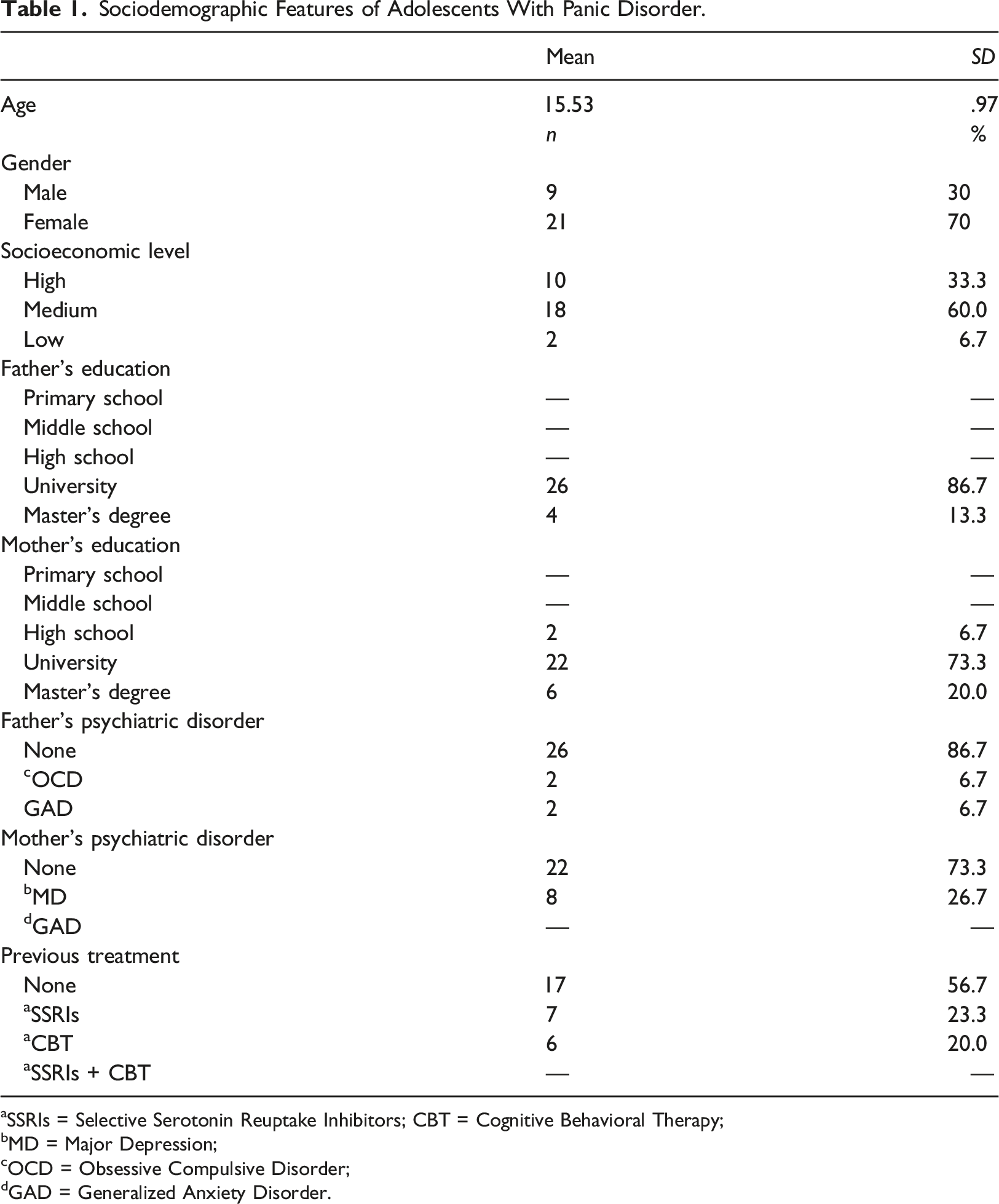
aSSRIs = Selective Serotonin Reuptake Inhibitors; CBT = Cognitive Behavioral Therapy;
bMD = Major Depression;
cOCD = Obsessive Compulsive Disorder;
dGAD = Generalized Anxiety Disorder.
The Frequency of the Symptoms of Panic Disorder.

When the total scores of PAS were assessed, the baseline mean of total PAS scores decreased from 40.07 to 1.20 at the end of the 12th week of treatment. There were statistically significant differences between the means of CY-BOCS scores (F (1, 29) = 1119.80, p < .001; Partial ƞ
2
= .98) (Figure 1). Approximately 98% of the change in total PAS scores was explained by the duration of treatment. In addition, there were statistically significant differences between the baseline mean of total PAS score according to gender (t (21.62) = −4.09, p < .01). The severity of the panic disorder is higher in females (M = 42.72, SD = 4.04) than males (M = 38.76, SD = 4.31). There were no statistically significant differences between the means of PAS scores at the end of the fourth week (t (28) = .21, p > .05) and the 12th week of treatment (t (28) = −.67, p > .05) according to gender. The means of total panic and agoraphobia scale scores. ***p < .001.
When the total scores of BAI were assessed, the baseline mean of total BAI scores decreased from 49.07 to 2.19 at the end of the 12th week of treatment. There were statistically significant differences between the means of BAI scores (F (1, 29) = 1023.73, p < .001; Partial ƞ
2
= .99) (Figure 2). Approximately 99% of the change in total BAI scores was explained by the duration of treatment. In addition, there were statistically significant differences between the baseline mean of total BAI score according to gender (t (22.32) = −4.48, p < .01). The severity of the anxiety is higher in females (M = 51.83, SD = 3.81) than males (M = 47.81, SD = 3.91). There were no statistically significant differences between the means of BAI scores at the end of the fourth week (t (28) = −1.21, p > .05) and the 12th week of treatment (t (28) = .21, p > .05) according to gender. The means of total beck anxiety inventory scores. ***p < .001.
According to Clinical Global Impressions- Severity; 53.3% of children (n = 16) were severely ill and 46.7% of them were extremely ill (n = 14). In addition, there were statistically significant differences between the CGI-S score according to gender (t (58) = −3.41, p < .01). The CGI-S score is higher in females than males. After the 12th week of EMDR therapy, 33.3% of children showed completely improvement, 46.7% of them showed much improvement, and 20% of them showed minimally improved. There were no statistically significant differences between the CGI-I score according to gender (p > .05). As a result, the CGI-S and CGI-I subscales also showed significant changes because of EMDR. Namely, the severity of panic disorder symptoms significantly decreased with the treatment of EMDR.
Discussion
The present study aimed to investigate the effectiveness of EMDR treatment in adolescents with PD. The results of the study confirm our hypothesis that EMDR is an effective therapy for treating adolescents with PD.
The present study and similar to studies in the literature showed that the most common symptoms experienced by more than two-thirds of children and adolescents with PD appear to be shortness of breath (Achiam Tombal, Tibi & Lipsitz, 2013), palpitations, and shaking (Diler et al., I 2004). Around half of the adolescents also report experiencing cognitive symptoms, including fears of dying and of going crazy or losing control (Masi et al., 2000; Achiam Tombal, Tibi & Lipsitz, 2013). The female sex consistently emerges as a risk factor for the development of anxiety disorders. Females are about twice as likely as males to develop anxiety disorders. In line with the previous study, the results of this revealed that the ratio of females with PD was higher than males. The present study showed that a history of psychiatric disorders among mothers was more frequent than among fathers. Our results were consistent with the studies by Karadağ, Gökçen, and Sarp (2020) and Joelsson et al., (2017).
EMDR is often referred to as trauma-based therapy. That is, it has primarily been applied to persons who have been psychologically traumatized. This means that it is effective with PTSD, as well as the anxiety and depression related to psychological traumata (Thinker & Wilson, 1999). EMDR was originally applied to the anxiety associated with traumatic memories (Udo & Gash, 2012). Although EMDR was the primary treatment for PTSD, there has been limited research into EMDR application to children and adolescents with PD. Several studies have investigated EMDR treatment of PD with and without agoraphobia and the results of the present study are also consistent with these studies in the literature (Goldestein et al., 2000; Faretta, 2012; 2013; Leeds, 2012; Fernandez & Faretta, 2007; Trlin & Hasanović, 2021).
The previous studies were preliminary and provided a short course (six sessions) of treatment for panic disorder (Faretta, 2013; Goldestein et al., 2000). The results were promising yet limited by the short duration of treatment, however, the EMDR effects were generally maintained at follow-up. In the present study, EMDR therapy was applied for 12 weeks, one session per week. Also, consistent with previous studies its effects were maintained during the 4th and 12th weeks of the treatment. A review study by Adler-Tapia & Settle. (2009) showed that the range of EMDR sessions is 1–25 and the reported length of each session ranged from .5 hours to 2.5-hour sessions. Also, the 19 studies included in the review, 15 reported providing six or fewer sessions of EMDR (mean = 2.28 sessions), with five of these studies providing only one EMDR session. Consistent with previous studies, there was a significant decrease in PAS and BAI scores in the fourth week of treatment.Finally, according to previous studies, participants suffering from PD with agoraphobia respond well to EMDR. Our results were consistent with previous studies.
Goldstein et al. (2000) stated that EMDR should not be the first-line treatment for panic disorder. They also reported that they only did one session for history-taking and preparation (Goldestein et al., 2000). In the present study, an average of three sessions were conducted after history taking and alliance building, and using psychoeducation, stabilization, and resource exercises to prepare for trauma processing. When working with children and adolescents it is very important to devote much more time to the preparation phase (Korkmazlar, 2020). Consistent with this study, Fernandez and Faretta (2007) highlighted the importance of client preparation and therapist fidelity to the EMDR treatment protocols. Fernandez and Faretta (2007) reported that there was a positive effect, with remission of panic and agoraphobic symptoms and with results maintained through 1-year follow-up study. Also, similar to our results, the study by Faretta (2013) indicated that EMDR treatment resulted in a faster symptom reduction in panic disorder. In addition, a pilot study suggested that EMDR treatment may be helpful for individuals suffering from comorbid anxiety and depression (Grey, 2011).
In the present study, adolescents with PD showed significant improvements in symptom severity, with the mean PAS scores decreasing by at least 90% compared to the baseline. In addition, their anxiety levels decreased. As a result of our study, a 12-week EMDR treatment was observed to be effective for adolescents with PD. In addition, CGI evaluations demonstrated that the majority of adolescents with PD exhibited significant improvements in clinical assessments. At post-treatment, the adolescents with PD who received EMDR demonstrated significantly more improvement in PAS scores, BAI scores, and CGI-I. The result of the study is consistent with the literature (De Jongh & ten Broeke, 2009; Horst et al., 2017; Leeds, 2012; Karadağ, Gökçen & Sarp, 2020; Gielkens et al., 2016; Adler-Tapia & Settle, 2009).
Overall, our results underscore the effectiveness of EMDR treatment in adolescents with PD. Several weaknesses need to be considered when interpreting our findings. The most important limitation of this study is that there was no control group. But, considering the evidence from other studies, and the favorable symptom reductions in adolescents, it could be thought that the treatment of MDR Therapy could be an alternative treatment for adolescents with PD. The other limitation of this study is the small sample size. Although it may undermine the significance of the current study and will affect the generalizability of the results, the results of the current study provided important clinical suggestions about the treatment process for adolescents with PD. Moreover, the current study suggests that EMDR may represent an effective intervention technique for PD in adolescents to decrease the rate of noncompliance because they continued therapy regularly for 12 weeks however they interrupted previous treatments. Also, EMDR is an effective intervention to decrease the frequency and severity of symptoms. Given that panic disorder is largely seen in adolescents rather than children, further research is required specifically with adolescents, to move beyond symptoms to better understand the broader lived experience of panic disorder in adolescents. The present study’s findings underscore the crucial need for randomized controlled studies that investigate the treatment of PD with EMDR. Also, a small number of studies have shown that EMDR is effective in children and adolescents (Adler-Tapia & Settle, 2009; Rodenburg et al., 2009; Horst et al., 2017; Leeds, 2012; Trlin & Hasanović, 2021). Therefore, given the scarcity of research in this area, we believe our study will provide essential information for clinicians considering the use of EMDR in PD adolescents.
Conclusion
Our study aimed to investigate the effectiveness of EMDR treatment in adolescents with PD. Our results showed that the scores of PAS and BAI decreased significantly after 4 weeks of EMDR treatment. In addition, all participants continued showing improvements at the 12-week follow-up, which were evaluated by PAS and BAI, respectively. In addition, CGI evaluations demonstrated that most adolescents with PD exhibited significant improvement in their clinical assessments. It could be thought that EMDR could be an effective treatment for adolescents with PD, Based on the findings of the study, it can be said that EMDR is an effective psychotherapy technique in reducing and treating the symptom severity of panic disorder in adolescents.
Key Points
• EMDR is the newest and effective psychotherapy method. • EMDR can be an effective intervention technique for Panic Disorder • EMDR is also an effective therapy method for children and adolescents.
Supplemental Material
Supplemental Material - Eye Movement Desensitization and Reprocessing Therapy in Adolescents With Panic Disorder: A Twelve-Week Follow-Up Study
Supplemental Material for Eye Movement Desensitization and Reprocessing Therapy in Adolescents With Panic Disorder: A Twelve-Week Follow-Up Study by Sevim Berrin Inci Izmir, Ümran Korkmazlar and Eyüp Sabri Ercan in Clinical Child Psychology and Psychiatry.
Footnotes
Declaration of Conflicting Interests
The author(s) declared no potential conflicts of interest with respect to the research, authorship, and/or publication of this article.
Funding
The author(s) received no financial support for the research, authorship, and/or publication of this article.

Supplemental Material
Supplemental material for this article is available online.
Author biographies
Eyüp Sabri Ercan is the former president of the Turkish Association for Child and Adolescent Psychiatry (2014-2021). Currently, he is the president of the ADHD commission of the Turkish Association for Child and Adolescent Psychiatry and head of the Scientific Working Group of the Turkish Association for Child and Adolescent Psychiatry. He has 137 international publications listed on theWeb Of Science and 56 publications listed in PubMed. Also, the number of citations is 1432 and the h-index is 21. He is the author of the ADHD parent book in Turkish which is a best seller and the first editor of Child and Adolescent Psychiatry Textbook, Child and Adolescent Psychiatry Textbook: Current Approaches and basic concepts, Neurodevelopmental Disorders Textbook in Turkish, and the first translation editor of Mindful Parenting for ADHD.
Sevim Berrin Inci Izmir is the Senior Psychologist and Psychotherapist. She works in a special child and adolescent psychiatry clinic and is a Doctorate candidate student in Child and Adolescent Clinical Psychology at Isik University in Turkey. She has 14 publications listed in PubMed and 4 national publications, 21 national and international poster presentations and 2 verbal presentations. She is the accredited Cognitive Behavioral Therapist and certificated EMDR Therapist. She is the writer of EMDR Through Children’s Eyes, EMDR Practices in Trauma in Pandemic Period with Children and Families, and Emdr in Reflection of Childhood Traumas. She won the Young Psychologists Research Award and Prof. Dr. Atilla Turgay Child and Adolescent Psychiatry National Congress Best Research Award.
Umran Korkmazlar is a psychotherapist, supervisor, and lecturer. She works at the Fide Psychological Counseling Center which was established by her, she gives lectures in universities on child-adolescent-family development, psychopathology, intervention methods, and psychological trauma issues. In 2011, she was given Professional Service Award. She uses Cognitive Behavioral Therapy, Family Therapy, Play Therapy, EMDR Therapy, and Special Education techniques while working with learning, school, adaptation, development, and trauma issues. Her various studies in the field of child-adolescent mental health, developmental neurology, learning disabilities, special education, family therapy, crisis intervention after disasters, trauma therapy, and EMDR therapy have been published nationally and internationally. Since 2000, Korkmazlar is the representative of Turkey in the European Child and Adolescent EMDR Committee, she is the founder and board member of the EMDR Turkey Association, and she is the chair of the Child-Adolescent Subcommittee.
References
Supplementary Material
Please find the following supplemental material available below.
For Open Access articles published under a Creative Commons License, all supplemental material carries the same license as the article it is associated with.
For non-Open Access articles published, all supplemental material carries a non-exclusive license, and permission requests for re-use of supplemental material or any part of supplemental material shall be sent directly to the copyright owner as specified in the copyright notice associated with the article.
