



Abstract
This study examined whether there was an interaction effect of leisure self-determination and leisure competence on older adults’ self-rated health (SRH), controlling for self-efficacy. Three hundred eighty-nine older adults living in Keelung City, Taiwan were systematically selected as participants. Data were collected by a face-to-face questionnaire survey which included measures of self-efficacy, leisure self-determination, leisure competence, and SRH scales. The data were analyzed using multiple regression analysis. The results showed a significant reinforcement interaction effect of leisure self-determination and leisure competence on SRH among the participants after controlling for self-efficacy. Implications of the results are further discussed.
The population of Taiwan, like that of many other nations, is shifting toward older age. The percentage of older adults aged 65 and over in Taiwan was higher than 10 percent in 2009, and it continues to increase (Ministry of the Interior, 2010). With increasing age, unfortunately, many older adults experience functional decline and have a high risk of chronic conditions. Concerns about increased costs for health care services among aging members of the population have led to interest in research on promoting the health of older adults (Chiu and Spencer, 2010; Lue et al., 2010).
Functional status and self-rated health (SRH) are two important indicators of health in older adults (Hoeymans et al., 1997). Although older adults’ functional status may be related to their SRH, the existence of a long-term physical disability does not inevitably lead to a low SRH in this group. Mitchell and Adkins (2009) have recently indicated that ‘disability’ is often a consequence of permanent physical impairments and older adults with such impairments can learn to adapt over time. Despite functional limitations resulting from disability, older adults’ views of health may vary widely, with many even reporting good to excellent health. Furthermore, a large number of studies have shown that older adults’ SRH is more significantly related to their happiness, life satisfaction, psychological health, and survival than is their functional status (Angner et al., 2009; Lee and Shinkai, 2003; Lyyra et al., 2009; Walker et al., 2004). Thus, rather than focusing solely on improving functional status, it may be more important for older adults to find an effective strategy to promote their SRH in order to facilitate their subjective well-being, enhance their quality of life, reduce their depression, and lengthen their life spans.
Numerous studies have demonstrated that participation in leisure activities can serve as a useful way to promote physical health and SRH for many people (Iwasaki et al., 2005), particularly for older adults (Meisner et al., 2010; Sasidharan et al., 2006). However, these previous studies often indicated that leisure improved SRH of older adults merely by providing opportunities to develop exercise-based functional abilities. Just as Mitchell and Adkins (2009) asserted, a higher level of physical ability does not necessarily result in a higher SRH. Moreover, an SRH change is a cognitive process (Walker et al., 2004). Accordingly, it is necessary to examine the effects of leisure-based cognitive factors on SRH of older adults in order to identify more comprehensive and precise mechanisms by which leisure promotes their SRH.
Self-determination theory (SDT), which is broadly applied to the field of health promotion, has gone through several revisions over the years. Previously, SDT was simply a theory of personality development and self-motivated behavior change. Currently, SDT is viewed as a macro-theory that addresses such basic issues as universal psychological needs, self-regulation, personality development, life goals and aspirations, and the impact of social environment on motivation, behavior, health, and well-being (Deci, 1975; Deci and Ryan, 1985, 2008). The sub-theory of psychological needs within SDT relevant to this study proposes that self- determination and competence are two basic human needs. Self-determination refers to the free choice and initiative of the activities one performs. Competence corresponds to the capacities to deal effectively with the activities in which one participates. When satisfied, self-determination and competence will significantly contribute to one’s health (Deci and Ryan, 1985; Ryan and Deci, 2000).
Consistent with the sub-theory of psychological needs, several gerontology-related studies have indicated that self-determination and competence play important roles in promoting the physical health and SRH of older adults. For example, Sikma (2009) proposed that nursing interventions should be targeted to goals and outcomes for enhancing self-determination and competence to promote the health and well-being of older adults. Chou (2005) pointed out that competence was significantly related to older adults’ psychological health. Older adults with a low degree of everyday competence were more likely to report depressive symptoms than older adults with better everyday competence. More relevant to this study, Arnold et al. (2005) demonstrated that competence significantly contributed to SRH in both middle-aged patients and older patients with chronic obstructive pulmonary disease or chronic heart failure. Thus, it is thought that self-determination and competence positively influence SRH among older adults.
The positive relationship between self-determination and health has also been examined in the field of leisure studies. Caldwell (2005) and Iso-Ahola and Mannell (2004) have suggested that leisure activities, in contrast to the necessary tasks of a daily routine and obligatory work, provide participants with more opportunities to exercise self-determination. Such leisure self-determination, which refers to the belief that leisure behavior is freely chosen (Iwasaki and Mannell, 2000), can facilitate a fuller processing of positive emotions that, over time, improve SRH and psychological health in participants (Karademas et al., 2011; Weinstein and Ryan, 2011). A couple of empirical studies have confirmed that leisure self-determination is significantly positively related to either SRH in the adult population in general (Iso-Ahola and Park, 1996) or psychological health in older adults in particular (Craike and Coleman, 2005). According to these studies, it is inferred that leisure self-determination is a cognitive factor that can cost-effectively promote SRH of older adults.
Iso-Ahola and Mannell (2004) and Trenberth (2005) have also suggested that participation in leisure activities can more easily lead to a sense of competence than can engagement in necessary tasks of a daily routine and obligatory work. Leisure competence is further defined as the belief that participants perceive themselves to have the capacities to deal effectively with their leisure activities, and their behaviors are under their own control. Furthermore, the construct of leisure competence includes perceived control that is regarded as being at the core of psychological functioning, creating perceived health. Thus, leisure competence is also considered a cognitive factor that can contribute to perceived health among participants at minimal cost.
Although no direct evidence demonstrates the positive relationship between leisure competence and SRH in older adults, two studies of older adults imply a possible relationship between these two variables. Searle et al. (1995) found that leisure competence significantly contributed to life satisfaction. Lee and Shinkai (2003) showed that SRH was significantly positively correlated with life satisfaction. Therefore, it is inferred that enhancing leisure competence is a low-cost and useful way to promote SRH of older adults.
Furthermore, Deci and Ryan (1985) have proposed an interaction between self-determination and competence when both contribute to health and well-being. More specifically, competence within the context of self-determination can more significantly promote people’s health and well-being although competence can independently influence their health and well-being. On the other hand, self-determination for actions, when people feel competent in the actions, can more significantly promote their health and well-being even though self-determination can also individually affect their health and well-being.
Similarly, Vansteenkiste et al. (2006) have found a significant reinforcement interaction effect of self-determination and competence on college students’ vitality. Specifically, when college students simultaneously perceive self-determination and competence, they will experience stronger vitality in daily life because the reinforcement interaction of these two independent variables can exert an additional positive influence that enhances their vitality. More relevant to this study, Chang et al. (2006) have also shown a significant reinforcement interaction effect of leisure self-determination and leisure competence on older adults’ leisure satisfaction. That is, only when older adults simultaneously feel self-determined and competent in their leisure experiences is their leisure satisfaction facilitated most significantly. According to the above findings, it is hypothesized that there is a significant reinforcement interaction effect of leisure self-determination and leisure competence on SRH among older adults.
In addition, Kutner et al. (2005) have indicated that when researchers try to analyze effects of independent variables on a given dependent variable in a regression model, they can add a control variable that statistically correlates with the dependent variable to see if there is actually a relationship between the independent variables and the dependent variable. Because several empirical studies have shown that self-efficacy is associated with SRH of older adults (Sohng et al., 2002; Umstattd et al., 2006), this study attempted to examine whether there was a significant reinforcement interaction effect of leisure self-determination and leisure competence on SRH among older adults after controlling for self-efficacy.
The percentage of older adults in Keelung City, which is adjacent to Taipei City, the capital of Taiwan, is high (10.5%), as it is in many other nations (Ministry of the Interior, 2010), and study results for this population group in Keelung City may provide a useful reference for health care practitioners in many nations when they consider SRH promotion of older adults. Moreover, in a national investigation, Hsu and Chang (2004) showed that the self-reported health status of older adults in Keelung City was less favorable than that of older residents in other cities in Taiwan. Specifically, older adults in Keelung City have a lower SRH, which needs to be improved. Therefore, older adults of Keelung City were selected as the study population to examine the collective effects of leisure self-determination and leisure competence on SRH in order to provide reference material for designing a cost-effective leisure program that can promote SRH of older adults.
In sum, this study examined the hypotheses that older adults’ leisure self-determination and leisure competence were significantly positively related to their SRH and that there was a significant reinforcement interaction between these two independent variables, controlling for self-efficacy. The results of examining the hypotheses would contribute to a more comprehensive understanding of how leisure helps older adults promote their SRH.
Method
Sampling and recruitment
From the data provided by the Keelung City government (Document No. 0980135105), a systematic sampling frame was constructed which listed all the older adults, aged 65 and over, with their addresses in Keelung City (N = 41,640). Every 100th older adult (n = 417) on this list was then selected for inclusion in this study. To increase the response rates, a face-to-face questionnaire survey was conducted. The research assistants of the study visited older adults’ homes and asked them to respond to this questionnaire without any honorarium. If they were willing to respond to the questionnaire, the assistants read out the questions for them. The assistants eventually coded 389 older adults’ verbal responses to the questionnaire.
Participants
The participants consisted of 182 men (46.8%) and 207 women (53.2%), aged 65 to 89, with a mean age of 73.26 years (SD = 4.19). Sixty-one (15.7%) were illiterate, 256 (65.8%) had finished primary school, 39 (10.0%) had finished high school, and 33 (8.5%) had a university degree. In addition, 16 (4.1%) were unmarried, 10 (2.6%) were divorced, 80 (20.5%) were widowed, and 283 (72.8%) were married and lived with a spouse.
Questionnaire
Self-efficacy
Chen’s (2008) self-efficacy scale was used to measure older adults’ self-efficacy. The scale is a 19-item instrument that measures how well older adults believe they can manage participation in their daily tasks. The scale contains two subscales: general self-efficacy and interpersonal self-efficacy. Examples of statements referring to each subscale are respectively shown: (1) ‘I believe that I have the capacities to manage the necessary tasks of my daily routine’; and (2) ‘I believe that it is easy for me to make new friends.’ The participants were asked to rate the degree to which they agreed with each of the items on a five-point scale, from 1 (never) to 5 (completely). Scores were summed and produced a range from 19 to 95. The higher the scores, the stronger the self-efficacy. The validity and reliability of the scale were reassessed by the pretest (150 pretest participants from the same systematic process of inclusion). The results showed that the scale accounted for 59.7 percent of the variance in a factor analysis model and that the scale had an acceptable alpha reliability coefficient of .95.
Leisure self-determination
Lu’s (2006) leisure self-determination scale was used to measure older adults’ leisure self-determination. The scale contains six items related to how free older adults perceive themselves to be in making choices regarding their leisure activities. Examples of the items are as follows: (1) ‘I freely choose my leisure activities’; and (2) ‘I perceive freedom when participating in leisure activities.’ The participants were asked to rate the degree to which they agreed with each of the items on a five-point scale, from 1 (hardly) to 5 (strongly). The scale has a range of possible total scores from 6 to 30. The higher the scores, the stronger the leisure self-determination. The validity and reliability of the scale were reassessed by the pretest. The results showed that the scale accounted for 58.5 percent of the variance in a factor analysis model and that the scale had an acceptable alpha reliability coefficient of .89.
Leisure competence
Lu’s (2006) leisure competence scale was selected as the third instrument to measure older adults’ leisure competence. The scale contains six five-point items related to older adults’ perceived effectiveness of their ability to perform their leisure activities. Examples of the items are as follows: (1) ‘I feel competent when participating in leisure activities’; and (2) ‘Leisure is what I am best at.’ Answers of 1 (hardly) to 5 (strongly) were entered on their answer sheets. The scale has a range of possible total scores from 6 to 30. The higher the scores, the stronger the leisure competence. The validity and reliability of the scale were reassessed by the pretest. The results showed that the scale accounted for 54.5 percent of the variance in a factor analysis model and that the scale had an acceptable alpha reliability coefficient of .87.
SRH
SRH is typically assessed with a single item: ‘Overall, how would you rate your health at present?’ (Barger, 2006; Martínez-Sánchez and Regidor, 2002; Martos et al., 2010). Participants to the item are often asked to rate their overall health on a five-point scale, from 1 (poor) to 5 (excellent). Nevertheless, such a simple measure is consistently found to accurately predict life satisfaction, psychological health, and survival in older adults (Lee and Shinkai, 2003; Walker et al., 2004). Because the item is also used in studies of older adults in Hong Kong (Chou, 2005) and Taiwan (Lee et al., 2007), it was selected as the fourth instrument for this study.
Data analysis
Descriptive statistics were used to describe the participants’ characteristics. In addition, self-efficacy, leisure self-determination, leisure competence, and SRH in this study are continuous variables. Thus, a multiple regression analysis was performed to examine whether leisure self-determination and leisure competence were significantly positively related to SRH in older adults and whether there was a significant reinforcement interaction between leisure self-determination and leisure competence, controlling for self-efficacy.
Results
The average scores of the participants’ self-efficacy, leisure self-determination, leisure competence, and SRH were 54.62, 16.43, 13.86, and 2.76, respectively (Table 1). The results of the multiple regression analysis showed that (1) self-efficacy was statistically positively associated with SRH of the participants (βC = .10, p < .05); (2) leisure self-determination and leisure competence were significantly positively related to their SRH (βA = .15, βB = .41, p < .01); and (3) the interaction was also significantly positively related to their SRH (βA×B = .09, p < .05). Namely, self-efficacy was found to be an effective control variable for this study. The stronger the older adults’ leisure self-determination, the better their SRH. The greater their leisure competence, the better their SRH. There was a significant interaction between leisure self-determination and leisure competence (Table 2). Furthermore, Kutner et al. (2005) have indicated that when the signs of regression coefficients of two independent variables are the same with that of a regression coefficient of their interaction, the interaction is viewed as a reinforcement type of interaction. Because the signs of the regression coefficients of leisure self-determination, leisure competence, and their interaction are all positive, the interaction is classified as a reinforcement interaction. A plot of the multiple regression analysis also revealed that the interaction was a reinforcement type of interaction (Fig. 1).
Means, standard deviations, and correlation coefficients of variables.

p < .01.
Multiple regression analysis for variables predicting SRH.
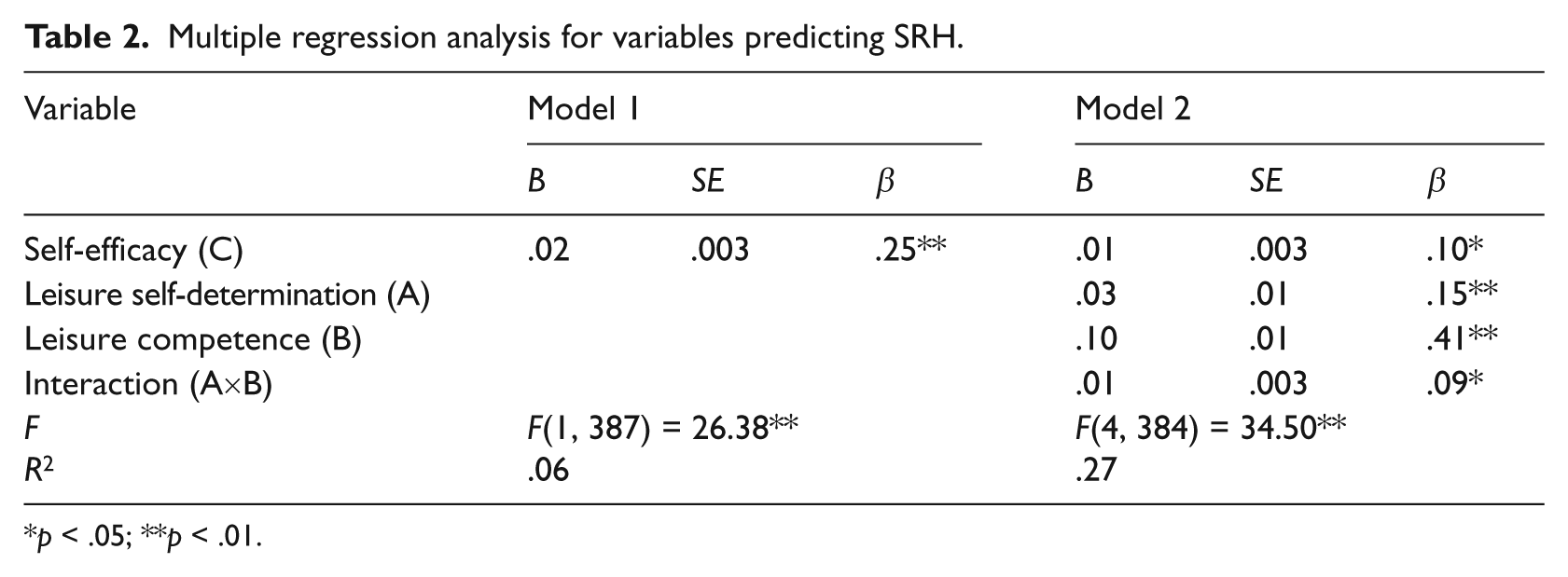
p < .05; **p < .01.
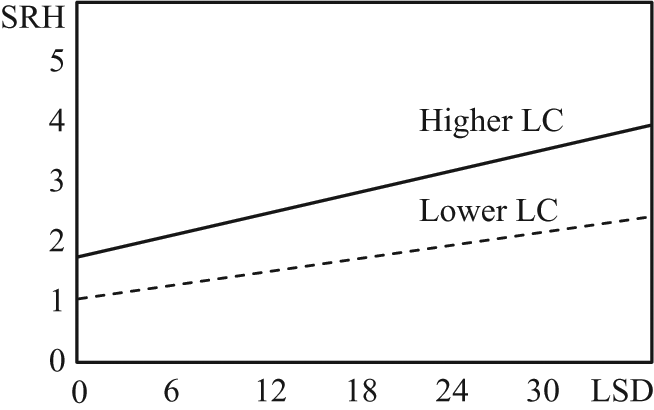
Effects of leisure self-determination (LSD) on SRH on different levels of leisure competence (LC).
Discussion
This study explored the sub-theory of psychological needs within SDT to examine whether leisure self-determination and leisure competence were significantly positively related to SRH among older adults and whether there was a significant reinforcement interaction between leisure self-determination and leisure competence after controlling for self-efficacy.
Not surprisingly, this study showed that self-efficacy was significantly positively associated with SRH among older Taiwanese adults. It is consistent with previous different cultural studies which revealed that self-efficacy was statistically positively correlated with SRH among older Americans and older Koreans (Sohng et al., 2002; Umstattd et al., 2006). Thus, self-efficacy is an effective control variable. When it entered into the regression model of the study, the regression model could be seen more precisely whether leisure self-determination and leisure competence were actually related to SRH among older adults.
As predicted, the results indicated that leisure self-determination and leisure competence were significantly positively related to SRH among older adults, controlling for self-efficacy. The results are consistent with previous studies. For example, Iso-Ahola and Park (1996) found that leisure self-determination was significantly positively related to SRH among Americans. Craike and Coleman (2005) found that a pattern emerged with respect to older Australians’ leisure self-determination and their psychological health. The fewer their opportunities of leisure self-determination, the more severe their depression. Arnold et al. (2005) confirmed that competence significantly contributed to SRH among older patients with chronic obstructive pulmonary disease or chronic heart failure. Accordingly, it is confirmed that both variables are actually related to SRH.
Similar to the empirical studies by Chang et al. (2006) and Vansteenkiste et al. (2006), this study also showed a significant reinforcement interaction effect of leisure self-determination and leisure competence on SRH among older adults, controlling for self-efficacy. Although cause–effect conclusions may not be drawn directly from the correlational data, the results in combination with the sub-theory of psychological needs strongly suggest that leisure self-determination and leisure competence not only individually contribute to older adults’ SRH but that the reinforcement interaction of both variables also exerts an additional positive effect on their SRH.
The above results are important. They not merely elaborate more clearly how leisure self-determination and leisure competence promote SRH of older adults in theory but also provide health care practitioners with more complete references in practice. In addition, it can be understood from the statistical textbook of Kutner et al. (2005) that the reinforcement interaction in this study means that it is only when older adults simultaneously perceive both leisure self-determination and leisure competence that their SRH improves most significantly. Thus, if health care practitioners wish to promote SRH of older adults effectively, they must provide older adults with leisure activities conducive to the enhancement of both leisure self-determination and leisure competence.
It has been reported that a leisure education intervention can significantly facilitate leisure self-determination (Williams and Dattilo, 1997) and leisure competence (Searle et al., 1995) in participants. Consequently, it is important for health care practitioners to provide older adults with leisure education in order to promote their patients’ SRH effectively.
In conclusion, this study has several strengths. For example, the participants were systematically recruited from the communities. The follow-up response rates were also good (over 90%). In particular, little previous research had focused on the older population to determine the collective effects of leisure self-determination and leisure self-efficacy on SRH in a statistical model. Therefore, a finding of a significant reinforcement interaction effect of leisure self-determination and leisure competence on SRH, based on these methodological strengths, would contribute to a more comprehensive understanding of how leisure helps older adults promote their SRH.
This study also has limitations. First, the results of the study may not directly be generalized to very old populations because the citizens of Keelung City who declined to respond to the questionnaire were almost all very old adults. Second, causal relationships between study variables may not directly be drawn from the study because of its cross-sectional design. If one accepts the underlying premise of the study, however, the study will still be valuable with these limitations. It suggests that in the present context, leisure self-determination and leisure competence not only individually promote SRH of older adults, but the reinforcement interaction of both variables also exerts an additional positive influence that contributes to their SRH.
Footnotes
Acknowledgements
This study was funded by National Science Council, Taiwan (NSC 98-2410-H-254-002-SS3). The author wishes to thank the research assistants for their assistance in the data collection and those who kindly participated in this study.
None declared.