




Abstract
Research on warning labels printed on cigarette packages has shown that fear inducing health warnings might provoke defensive responses. This study investigated whether reformulating statements into questions could avoid defensive reactions. Smokers were presented with either warning labels formulated as questions, textual warning labels, graphic warning labels, or no warning labels. Participants’ smoking-related risk perception was higher after exposure to warning labels formulated as questions or no warning labels than after exposure to textual or graphic warning labels. These results indicate that reformulating statements into questions can avoid defensive responses elicited by textual- and graphic warning labels.
Introduction
Although smoking has tremendous health consequences (e.g. Doll et al., 2004), and is one of the leading causes of preventable death (World Health Organization, 2003), people continue to smoke. Therefore, governments attempt to discourage smoking by different means. Warning labels printed on cigarette packages is a popular mean that has been introduced worldwide. Warning labels provide information about the health-damaging consequences through textual statements, and in some countries, the textual information is presented together with deterrent pictures that illustrate the smoking-related diseases graphically. These warning labels are designed to inform people about the negative consequences of smoking (Strahan et al., 2002), and should thereby increase the smoking-related risk perception. Research has shown that current warning labels induce threat, and are perceived as scary even when the arguments are not directly related to death (Hansen et al., 2010). In this way, they operate as fear appeals, which are defined as persuasive communication that should – via the induced fear – lead to self-protective actions (e.g. Rogers, 1983). Thus, the increased smoking-related risk perception is assumed to elicit self-protective actions, which could involve changing attitudes and the corresponding behavior. Attitudes and the corresponding behavior are suggested to change when people perceive a threat, and simultaneously perceive that they are highly efficient in changing their behavior (e.g. Ajzen, 1985; Marks, 1998; Schwarzer, 1992; Schwarzer and Fuchs, 1996; Strahan et al., 2002; Witte, 1992). Thus, warning labels do not only contain negative, fear inducing information concerning the health consequences of smoking, but also information about facilities that can be contacted to get help when trying to quit smoking. In this process of changing attitudes and behavior, outcome expectancies are crucial (Marks, 1998; Schwarzer, 1992; Schwarzer and Fuchs, 1996; Strahan et al., 2002). Therefore, warning labels provide additional information about the positive outcomes of quitting smoking.
The points for current health campaigns mentioned above are combined in present warning labels. However, empirical research has provided inconsistent results about their effectiveness. On the one side, studies suggest that warning labels on cigarette packages are effective (e.g. Borland et al., 2009; Hammond et al., 2003, 2004, 2006; Kees et al., 2010; O’Hegarty et al., 2006). For example, Hammond and colleagues (2004) conducted a telephone survey after the introduction of combined warning labels and found that 20% of the participating smokers reported that they smoked less because of the new warning labels. In another survey study (Hammond et al., 2003), smokers were asked how often they thought about the warning labels, and whether they discussed them with other people. The authors found that smokers who engaged in thinking about the warning labels reported that they were more willing to quit smoking, tried more often to quit smoking or smoked less. However, results of these surveys rely on self-reports and may thus be unreliable, as ‘saying is not (always) doing’ (Ruiter and Kok, 2005). As smoking is forbidden in many public places and a stigmatized behavior (Swanson et al., 2001), it seems plausible that smokers would report to smoke less than they actually do to leave a better impression. Furthermore, the studies outlined above did not use experimental designs; a fact that should be considered before starting health campaigns (Whittingham et al., 2008).
On the other side, experimental studies find evidence for possible negative outcomes like defensive responses (e.g. Glock and Kneer, 2009; Harris et al., 2007; Wolburg, 2006), psychological reactance (e.g. Erceg-Hurn and Steed, 2011; Wiium et al., 2009), or no effectiveness at all (Petersen and Lieder, 2006). There is even some research arguing against fear appeals in warning labels, as they may result in defiance, and decreased probability of changing attitudes and behavior (Hastings and MacFadyen, 2002; Ruiter and Kok, 2005). Thus, it seems that threatening anti-smoking warning labels might have unintended consequences, namely a decreased smoking-related risk perception among smokers. Thereby, it may become less likely that smokers accept anti-smoking messages in warning labels. The present research investigates how these unintended consequences can be avoided.
Defensive responses are well documented in fear appeal research. Research suggests that the combination of fear arousal with high personal relevance is an important determinant of defensive responses (e.g. Jepson and Chaiken, 1990; Liberman and Chaiken, 1992). People who feel fear and perceive high personal relevance might have the motivation to defend themselves against the threat, which is assumed to stem from the need to protect the self-image (Sherman et al., 2000). This may be especially true for smokers, as smoking and the corresponding health consequences are highly important for them, and the negative health consequences and a high risk perception are the number one reasons for quitting smoking (Gibbons et al., 1991; Klesges et al., 1988). Furthermore, risk perception could also be an indicator for defensive responses, as risk perception changes as a function of the need to protect self-image and self-esteem. For instance, risk perception decreases after relapse (Gibbons et al., 1997). Abolishing warning labels might reduce defensive responses because there is no information smokers would have to defend against. Additionally, smoking-related risk perception is already high among smokers (Glock and Kneer, 2009; Hahn and Renner, 1998). Smokers are aware of the fact that smoking increases the risk of cancer (Hermand et al., 1997), and of other negative health consequences (Louka et al., 2006). Forbearing from confronting smokers with fear arousing warning labels makes defensive responses unnecessary. However, abolishing warning labels seems not to be appropriate because this would lead to less informed smokers.
Another and possibly more effective way of reducing threat and fear in warning labels may be to redesign the warning labels that are currently used. Research on persuasion has shown that arguments individuals generate themselves are more convincing than arguments provided by external sources (i.e. information provided from other people), as people tend to trust themselves more than external sources, whose information they are more likely to adjust according to personal views (Mussweiler and Neumann, 2000). Self-generated arguments are often perceived as more accurate (Hoch and Deighton, 1989; Levin et al., 1988) than information that is provided from somebody else. Furthermore, confronting people with external behavior instructions (i.e. another person tells people what they have to do) threatens their freedom to choose, which may result in defiance (Brehm and Sensenig, 1966; Grandpre et al., 2003). Additionally, research on persuasion has provided evidence for different influences on the persuasiveness of an argument depending on whether the argument leads to explicit or implicit conclusions (Kardes et al., 1994). Explicitly stated arguments are not susceptible to interpretations and the perceiver may feel that an external source tells him what to believe. This might lead to resentment, which in turn leads to counter-argumentation (Clee and Wicklund, 1980; O’Keefe, 1997). In contrast, arguments that imply a particular conclusion but give the perceiver the possibility to draw the conclusion himself may reduce feelings of resentment (Kardes et al., 1994). In this sense, arguments provided on current warning labels can be considered as explicit conclusions; an external source tells smokers what they have to believe and to do which leads to counter-argumentations. Contrarily, anti-smoking arguments which lead to implicit conclusions might be more effective, particularly when the knowledge about the health consequences is high (Kardes et al., 1994). Therefore, when developing new warning labels one should pay attention to three important aspects: (1) warning labels should not expose smokers to fear inducing anti-smoking arguments; (2) behavior instructions provided by an external source should be avoided (except if they increase self-efficacy; see Witte, 1992); and (3) warning labels should stimulate smokers to generate anti-smoking arguments themselves. Additionally, we know from self-perception theory that people often observe their behaviors to infer their attitudes, especially in situations in which they are not exactly sure what to believe about a particular topic (e.g. Bem, 1967). Just like an outside observer, people draw conclusions about their attitudes from what they are doing. For example, smokers may evaluate smoking as more negative when they observe themselves finding arguments against smoking.
One way to elicit that smokers generate arguments against smoking could be the use of questions in warning labels. Müller and colleagues (2009), as well as Ritter and colleagues (2012) investigated the role of questions in anti-smoking campaigns and found them to be more effective in influencing short-term smoking behavior than anti-smoking arguments provided from an external source. The present study extends this line of research by investigating smoking-related risk perception after being presented with warning labels formulated as questions compared to warning labels formulated as statements or graphic warning labels.
Based on the previously mentioned theories and empirical findings, we expected that the textual and graphic warning labels, which are designed to induce fear, would lead to defensive responses. In contrast, no warning labels and warning labels formulated as questions should not induce fear and, thereby, should make defensive responses unnecessary. We hypothesized that smoking-related risk perception will be higher among smokers who were not confronted with warning labels, or were confronted with warning labels formulated as questions compared to smokers who were presented with the current textual and graphic warning labels.
Methods
Participants and design
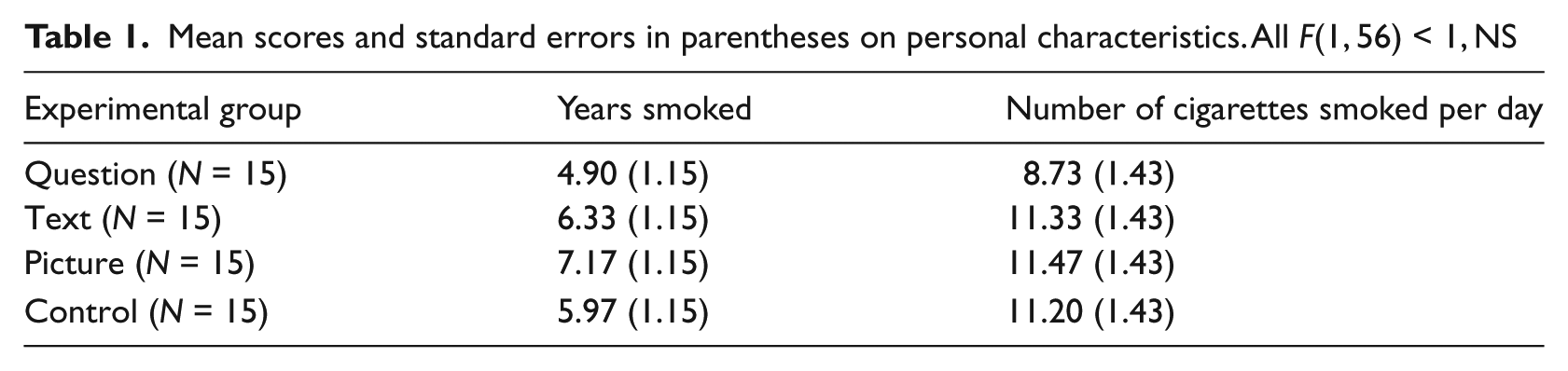
A single factor design (warning label: textual as questions vs control vs graphic vs textual as statements) was used, with warning labels serving as between-subjects factor. Sixty students (14 male, 46 female) from the Saarland University/Germany, participated in this study; their age range was 18–46 (M = 23.03, SD = 4.46). All participants were daily smokers: 23.3% smoked 1–5 cigarettes/day, 36.7% smoked 6–10 cigarettes/day, 38.3% smoked 11–20 cigarettes/day, and 1.7% smoked more than 20 cigarettes/day. They received credit points or financial compensation for participation, and were randomly assigned to one of the four experimental conditions. Furthermore, it was checked whether the four groups differed in personal characteristics (years smoked, mean number of cigarettes smoked per day), no significant differences were found (Table 1).
Mean scores and standard errors in parentheses on personal characteristics. All F(1, 56) < 1, NS
Procedure and materials
Upon arrival, participants were asked to fill in a questionnaire assessing their age, the number of cigarettes they smoked daily, and the number of years since they started smoking. Subsequently, seated in front of a computer screen, participants were presented with the warning labels (see Fig. 1): 15 participants received textual warning labels that were formulated as statements. In the textual warning labels condition, we used the 15 textual warning labels that are used on cigarette packages in Germany. Fifteen participants received graphic warning labels, which were preselected from a set of 32 graphic warning labels. 1 Graphic warning labels were presented without text information to avoid confounding of textual and graphical effects. Furthermore, another 15 participants received textual warning labels that were formulated as questions. To construct the question warning labels, we relied on the current textual warning labels and reformulated them as questions. For instance, ‘Smoking causes fatal lung cancer’ was changed into ‘What are the consequences of smoking for your lung?’
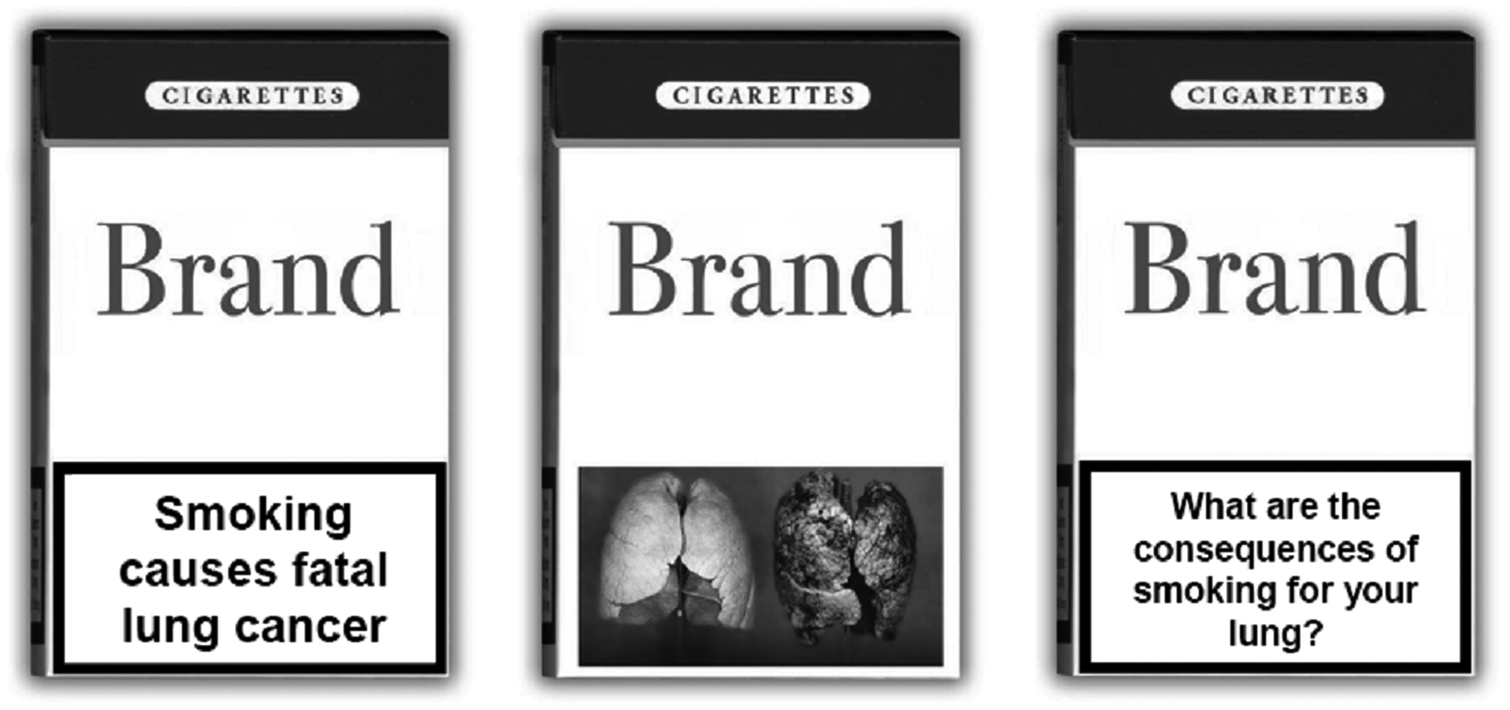
Examples of the used warning labels
Each warning label group was presented with 15 warning labels, each displayed for 3000 ms. A fourth group of 15 participants functioned as control group and received no warning labels. After this first phase, participants were asked to evaluate the likelihood of developing one of six smoking-related diseases during their lifespan, which indicated their smoking-related risk perception. All diseases presented had a clear relation to smoking. 2 In the current experiment, participants could indicate their risk on a scale from 0 (no risk at all) to 9 (highest risk). At the end, participants were thanked, paid, and debriefed.
Results
To assess smoking-related risk perception, a mean score of the answers on the six smoking-related diseases was calculated (α = .88). One participant was excluded from further analysis, as there was no variance in his responses, suggesting that he simply pressed a button without taking the question into consideration. To test our hypothesis that being confronted with questions or no warning labels would lead to a higher risk perception than when being confronted with statements or graphic warning labels, we computed one a priori contrast comparing the question and control conditions with the graphic and statement conditions, using the mean score as dependent variable.
The contrast revealed a significant effect on participants’ perceived smoking-related risk perception, F(1, 55) = 4.32, p = .04, ηρ2 = .07 (see Fig. 2). To test our assumption that neither the control group differed from the question warning labels group, nor the graphic warning labels differed from the statement warning labels group in their smoking-related risk perception, we conducted two single effects tests. There was no difference between the question condition (M = 6.4, SD = 1.70) and the control condition (M = 6.05, SD = 1.44), t(28) = 0.61, d = 0.22, p = .54, nor between the statement condition (M = 5.54, SD = 1.91) and the graphic condition (M = 5.01, SD = 1.95), t(27) = 0.73, d = 0.27, p = .47 (Fig. 2).

Mean score of smoking-related risk perception
Discussion
The warning labels formulated as questions resulted in higher smoking-related risk perception than the warning labels formulated as statements and the graphic warning labels. Thus, asking questions in warning labels seems to have some advantages. The literature shows that self-generated arguments are more convincing than arguments provided by an external source (Mussweiler and Neumann, 2000). Thus, arguments provided by current warning labels may work less effectively because they are provided by an external source. Questions however, result in arguments derived from the smokers themselves. Thereby, defensive responses can be avoided as the answer to the questions can be as fear inducing as the reader allows it to be. Hence, the answer to the question about the consequences of smoking for the lung does not necessarily need to be lung cancer, but could also be a slight cough, which is clearly less fear inducing. Although anti-smoking warning labels should induce fear and research has provided evidence for their threatening content (Hansen et al., 2010), we did not ask our participants whether they perceived the presented warning labels as fear inducing or not. It seems possible that warning labels induce worry, which is positively related to self-protective behaviors (Hay et al., 2006). Further research should introduce a measure of perceived fear and/or worry to answer this question. Nevertheless, given our results, warning labels formulated as questions might have induced worry, and thus reduced possible defensive responses. Furthermore, our results extend recent research showing that thinking about the consequences of smoking prolongs smokers’ short-term abstinence (Müller et al., 2009; Ritter et al., 2012). Our findings could provide an explanation of why questions in warning labels reduce short-term smoking behavior. Warning labels formulated as questions increase smoking-related risk perception, which might in turn lead to short-term abstinence. Risk perception is an important step in building a motivation to quit; however it is of course not sufficient for behavior change (Schwarzer, 1992; Schwarzer and Fuchs, 1996). Thus, we only assessed one factor that seems to contribute to quitting, and that might be an explanation for short-term abstinence as a function of questions. Future research should assess other variables like the intention to quit, or perceived self-efficacy to investigate which type of warning labels has an influence on these variables, and to get further insight into the processes behind risk perception or short-term abstinence.
In the present study, presenting no warning labels had the same effect as presenting questions. We assumed that in our control condition, no fear inducing information was presented and therefore, smokers had not to defend against the information. Thus, the control condition shows the smoking-related risk perception uninfluenced by any kind of information. The question may be asked why we then need questions in warning labels, when no warning labels have the same effect. Abolishing warning labels is not appropriate as this would lead to less informed smokers. Because questions seem to work better than textual and graphic warning labels, they may be seen as a promising alternative that could be added to existing warnings to keep the smoking-related risk perception high, and at the same time making smokers still aware of the negative consequences of their addiction. This combination could be valuable as the reception of anti-smoking arguments provides smokers, and future generations of smokers with information about the negative consequences of smoking. However, anti-smoking messages are unpleasant for smokers and they might seek to avoid this information. Therefore, questions should be added, as being asked about the health risks might induce a deeper cognitive elaboration. Merely providing anti-smoking arguments might prevent people from thinking about the health consequences of their behavior.
Some limitations of the study have to be considered. First, our participants were all undergraduates. Although college smokers might be at risk to become regular and heavy smokers (Simmons and Brandon, 2007), in their college years they smoke at lower rates than older adults (Rigotti et al., 2000). Maybe, health consequences emphasized by current and graphic warning labels may not be relevant for these young smokers as they might know that these health consequences will not become important in the next few years, but just after many years of continued smoking. Thus, future research should focus on smokers who smoke for a longer period than undergraduates to investigate whether warning lables formulated as questions also increase their risk perception. A second point is related to our college smoker sample. As undergraduates, our smokers all had access to higher education. Hence, the question arises whether smokers with lower educational levels are as well informed about the smoking risks as smokers with higher educational levels. Smoking is more prevalent in individuals with low income (e.g. Lee et al., 2008). Although health risk perception seems to be independent of socioeconomic status and educational level (e.g. Lee et al., 2008; Weinstein, 1987), there might be differences among these individuals when it comes to the personal health risk (Ayanian and Cleary, 1999). A study conducted in Germany has shown that smokers with lower education perceive a lower personal smoking-related health risk than smokers with higher education (Pragst, 2011). Thus, smokers with low educational levels may not provide as many arguments against smoking as smokers with higher educational levels. Therefore, questions in warning labels should only be an addition to current warnings providing arguments about the health damaging consequences of smoking. Future research should focus on this issue and take smokers with different educational levels into account.
Second, the information provided on textual and graphic warning labels is well known by now. Hence, reading and looking at current warning labels does not inform smokers about something unknown (Hastings and MacFadyen, 2002). Getting asked questions while looking at and reading warning labels is a new procedure smokers are not familiar with. Thus, an alternative explanation of our findings might be that the novelty of the question warning labels drives the effect, that is, that the questions only work because they are new. However, in Germany, where the experiment took place, graphic warning labels are not yet introduced. This means that the smokers participating in the current study were neither familiar with the graphic warning labels, nor with the questions, which speaks against the novelty explanation. Nevertheless, future research should focus on the influence of the question warning labels in the long run. For example, it would be interesting to investigate possible habituation effects after repeated exposure, and the influence on long-term smoking behavior. Additionally, it would be advisable for a follow-up study to use a larger sample, which would make it possible to explore whether our effects differ between groups (e.g. light vs heavy smokers, people who have just started smoking vs people who have smoked for a couple of years).
Third, we used risk perception as an indicator for defensive responses (Gibbons et al., 1997), and indirectly as a measure of reactance. Thus, our study does not provide insight into the psychological processes during reception of warning labels and risk perception. Further research should use a direct measure of psychological reactance such as negative cognitions, threat to perceived freedom to choice, or anger (Dillard and Shen, 2005; Quick and Stephenson, 2007) to get more insight into the ongoing processes. In addition, it would be interesting to repeat our experiment with think aloud instructions in order to assess smokers’ answers to the question warning labels, and to monitor the cognitive responses to all kind of warning labels.
Last, we selected the graphic warning labels concerning their deterrent content. Thus, graphic warning labels mainly depicted the same issues like the textual and question warning labels. However, there were some questions and statements, which were not covered by the graphics. Thus, the graphic warning labels might have been more fear or threat inducing than the textual warning labels condition because the latter ones also depicted issues like for instance, how to get help when trying to quit smoking. These issues might not be fear inducing, thus the graphic warning labels could have induced more fear than the textual warning labels. Nevertheless, both conditions involved two factors that might contribute to defensive responses: (1) the information provided on both, textual and graphic warning labels, derives from an external source which might not be as convincing as self-generated arguments (Mussweiler and Neumann, 2000); and (2) the information provided on both threatens the freedom to choose (Brehm and Sensenig, 1966; Grandpre et al., 2003). Nevertheless, there was no difference in risk perception between the graphic and the textual condition, but both differed significantly from the question and control condition. Thus, defensive responses might not have been elicited because of the threatening content but because of an external source providing the information. However, we cannot exactly conclude which of the two factors contributed to the differences; hence future research should distinguish between warning labels with and without fear inducing content to separate effects derived from fear, and effects derived from the fact that an external source provides anti-smoking arguments that tell the smokers what they have to do and what they have to believe.
It may also be possible to use the present procedure of asking questions to increase risk perception when it comes to other health issues. However, the negative effects of a behavior have to be known in order to argue against it. For smoking, this seems to be the case, but this may be less true for other health damaging behaviors. Thus, the first step in health campaigns should always be to inform people about the consequences of health-related behavior. Only when this knowledge is well established, is it possible to introduce questions in warning labels as an additional factor that influences health-related risk perception and behavior.
Footnotes
Competing Interests
None declared.