



Abstract
Modern footwear has been associated with the development of foot pain and pathology in the ageing adult. Yet this foot health issue does not seem to alter the footwear purchases made by younger women. In total, 162 teenage girls were questioned regarding shoes purchased over a 6-month period. The results indicated that footwear choices are activity specific and participants chose the style and design of shoes related to the image they wanted to portray. Association of footwear choice to foot function and health was not found to influence choice of footwear.
Women are more likely to present with foot pain when compared to men, and it is suggested that choosing footwear is based on fashion rather than comfort and this may be a primary reason for foot pain (Burns et al., 2002; Hill et al., 2008). The long-term effects of wearing inappropriate fashion footwear can lead to foot joint deformities and associated pain causing an increased impact on health costs and disabilities in the older adult. Various categories of inappropriate footwear that are directly correlated to pain and pathology have previously been identified. These include (1) high-heeled shoes, (2) slip on pumps and (3) slippers (Dufour et al., 2009). These shoes when fitted incorrectly, either being too tight or loose, have also been associated with painful digits and generalized foot pain (Mickle et al., 2011). Footwear shape and dimensions have been shown to play an important role in the development of pain and deformity with a decreased volume of the shoe positively correlating to foot pain with an estimated 70 per cent of elderly females wearing shoes too narrow for the foot width (Chantelau and Gede, 2002; Menz and Morris, 2005; Paiva de Castro et al., 2010).
Outfit choice is considered to be the most significant factors when footwear selection is made by female rheumatoid arthritis population (Goodacre and Candy, 2011). People suffering from rheumatoid arthritis commonly are issued orthopaedic footwear to accommodate painful foot deformities. However, a recent study has shown that when given a choice, only 5 per cent of the participants choose to wear the prescribed footwear. Being faced with wearing unattractive shoes that assist in reducing pain, most participants would prefer to comply with fashion (Silvester et al., 2011). The restriction in choice and appearance of orthopaedic footwear design has a direct impact on the self-esteem and body image in patients who wear the shoes (Firth et al., 2011).
This strong correlation between inappropriate and ill-fitting footwear and poor foot health in the ageing population should alert younger generations to be cautious regarding the shoes chosen particularly as footwear habits during a lifespan can be influential to the onset of pain later in life (Dufour et al., 2009). However, the current trends indicate that the younger population chooses footwear depending on the current fashion rather than fit and function.
Fashion and brands are made attractive and credible to the teenage markets by celebrity endorsement (Temperley and Tangen, 2006). Widespread global phenomena can be linked to popular fashion icons and high-profile personalities. The Ugg® boot being an example, designed initially as a slipper for surfers in Western Australia, the adoption of the boot by Hollywood celebrities soon became a fashion essential (Kuksov and Wang, 2011). It has been reported in the global media that medical practitioners have found an association between foot pain and prolonged use of ‘Ugg’ style boots (Stahl, 2011). This link has yet to be scientifically investigated; however, the boot and the Ugg brand continue to grow. The evolution of a simple warm sheepskin boot has developed into a global brand phenomenon demonstrating how style and image can dominate the younger generations’ choices over the potential physical damage that may occur.
There is, however, a strong scientific link between the development of lower limb pathology and back pain while wearing high-heeled shoes (Lee et al., 2001; Linder and Saltzman, 1998; Mandato and Nester, 1999). Changes in spinal and pelvic motion over a prolonged period as well as increases in plantar foot pressure due to the alteration in the height of the heel have been directly linked to the onset of pain and pathology (Cernekova and Hlavacek, 2008; Cowley et al., 2009). Yet the fashion industry continues to design high heels despite the known association with pain and pathology to promote elegance, style, femininity, power and sexuality (Yorkston et al., 2010).
It is clear that footwear choice has an important role to play in identity, self-awareness and body image of an individual. However, the style and design characteristics of the shoe may play a more significant role in long-term foot health. There appears to be limited research around the role footwear plays in the body image of teenage individuals and what factors are involved in making footwear choices that may be healthy or unhealthy.
The primary aim of this study was to assess what footwear choices teenage girls made while purchasing shoes over a 6-month period, with the following secondary aims:
To investigate the relationship between the fitting and shoe size and
To explore in what way footwear preferences influenced the purchases made.
Method
Participants
Head teachers from sixth-form colleges within the West Midlands, United Kingdom were approached inviting students into the study. Ethical approval was granted through the University Ethics Committee and ethical practice was adhered to throughout the study. In total, 162 females were recruited from the three sixth-form colleges with a mean age of 17 years, mean mass of 56.82 kg (standard deviation (SD) ± 8.48) and a mean height of 163.95 cm (SD ± 7.61). Prior to consenting to the study, participants were given information and the opportunity to ask questions. The study was conducted over a winter period and choices of footwear were reflective of the season.
Questionnaire
The questionnaire was designed and adapted from previous validated studies (Branthwaite and Chockalingam, 2009; Jones et al., 2005) to capture the thoughts and emotions of footwear bought over a previous 6-month period. Data were collected from one session and repeat testing was not completed. The questions included open-ended and closed-ended questions around footwear purchased in the 6-month period and the choices made when purchasing the footwear. The questionnaire incorporated demographic information including measurement of foot length and width as well as details about emotional responses to how footwear choices influenced feelings. The design of the questionnaire allowed for the following themes to be investigated.
Size of shoe
Data were collected on the current shoe size that each participant wore with further information about fitting and measuring of the foot that was undertaken before purchasing the shoe. To consider any changes in behaviour, participants were also asked if sizing changed when making a purchase of a new shoe and what factors influenced the alteration in size. Data were collected for the length of the foot measured on the plantar surface of the foot to the apex of the longest toe and the width or girth of the foot measuring the circumference of the foot starting at the first metatarsal joint. Alterations in footwear sizing correlated to actual foot width, as well as inappropriate dimension and fitting have previously been significantly identified as pivotal in the development of foot pathologies (Mickle et al., 2011; Paiva de Castro et al., 2010).
Type of shoe
Images of eight different shoe designs were included for participants to identify the type of shoe that was purchased within the previous 6-month period (Figure 1). Shoe styles were chosen for varying features, including toe box shape, heel height, fastening, athletic footwear and current style. The shoes included were identified as the general styles currently marketed in footwear high street stores around the United Kingdom by evaluating the trends promoted as new stock.
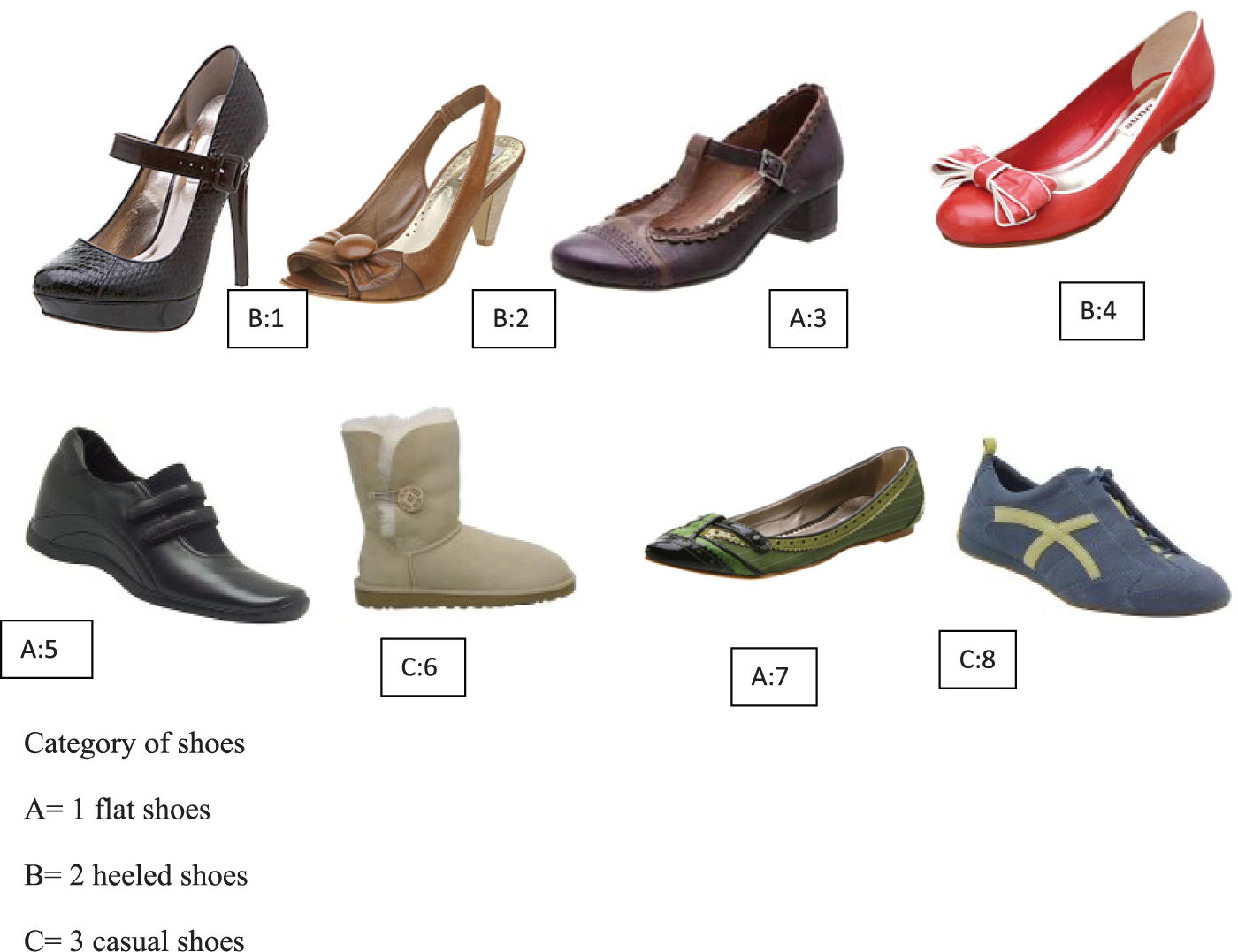
Footwear styles 1–8 used to classify the type of shoe purchased within the previous 6-month period.
Participants were also asked to identify how many pairs of shoes had been purchased, what was the reason for purchasing that specific shoe and how often it was worn over the previous 6-month period. This information was collected to indicate for how long the chosen shoe was being worn for and for what purpose the shoe had been purchased.
Choice of shoe
Participants were then asked to identify one shoe from Figure 1. This shoe was then the focus of a number of questions associated with identity and how that particular shoe made them feel using a numerical rating scale 0–4, with 0 representing no feeling towards the emotion and 4 representing extreme agreement for that emotion. The emotions investigated ranged from a spectrum of negative (embarrassed, sad, self-conscious, disappointed and dejected) and positive (content, happy, proud and cheerful) emotions.
The final section of the questionnaire focused on the importance of the following 10 factors when purchasing the chosen shoe (participants scored each factor 0–5, 0 being poor and 5 being excellent):
Comfort
Fit
Value
Support
Cushioning
Colour
Brand
Fashion
Heel size
Activity
Participants were also asked to rate a generalized feel-good factor as a measure of self-esteem and identify other factors that had not been listed that were felt important when purchasing the chosen shoe.
Data analysis
The shoe styles shown in Figure 1 were categorized into the following three groups:
Flat shoes – low-heel profile with or without fastening
Heeled shoes – medium to high-heel profile
Casual shoes – trainer and boot style with generous width and low heel
Data were categorized into these three groups and were statistically analysed further using SPSS (v19, IBM). Left and right foot measurement data were assessed for multicollinearity. Sequential regression was used to predict the shoe size based on the foot length and width measured. Cochran’s Q test was used to identify the main purpose for wearing the shoes in each shoe group; analysis was performed to identify which shoe was chosen for school, occasions, comfort, fashion, warmth and height. A Kruskal–Wallis test was performed to analyse the significant emotional factors influencing the purchase of the chosen shoe and a further Mann–Whitney U test was used to assess where the variance between the three shoe groups lay.
Results
Size of shoe
Of the participants, 98 per cent (n = 158) did not have the foot measured prior to purchasing shoes and 83 per cent (n = 135) changed the size of the shoe for improved comfort (36%, n = 59), fit (35%, n = 57), to prevent slipping (3%, n = 4) and different sizes of feet (3%, n = 4). Of the participants, 23 per cent (n = 28) who changed the size of the shoes made no comment as to why that choice had been made. Sequential regression was used to assess the ability of a known shoe size to predict the foot width and length. Evaluation of the regression model (foot length and width) including the sequential regression Mastery Scale and Perceived Control of Internal States Scale (PCOISS) showed a total variance of the model as 81.6 per cent(F = 0.872; p = 0.001; R2 change = 0.005). Analysis of variance (ANOVA) to investigate where the significance in the model lay indicated that the overall model was significant (p = 0.005), with left foot length being individually significant (p < 0.003).
Preference of shoe type
Over a 6-month period, a total of 458 pairs of shoes were purchased – 134 pairs of type 1 (flat shoes) were purchased; from this total, 126 of those shoes were ballet shoe A:7 (Figure 1). A total of 168 pairs of type 2 (heeled shoes) were purchased, with 124 of those shoes being a heel shoe B:1 (Figure 1), and 156 pairs of type 3 (casual shoes) were purchased, with 120 of those being Ugg boots C:6 (Figure 1).
Flat shoes were worn every day as were comfort shoes, and heeled shoes were worn 2–3 times a week. Exploration of the data using Cochran’s Q test demonstrated a non-significant association between choice of heeled shoe footwear (Q = 80.16; asymptotic significance = 0.000; p > 0.05), flat shoe footwear (Q = 62.43; asymptotic significance = 0.000; p > 0.05) and casual (Q = 75.90; asymptotic significance = 0.000; p > 0.05). However, further frequency analysis accepted the following footwear choices that heeled shoes were chosen for party and occasion wear, flat shoes were used for school and casual shoes were used for comfort (Table 1).
Frequencies of stated reasons for shoe choices.

Choice of purchased footwear
From the completed questionnaires related to the investigation of whether a significant relationship existed between emotional influence and the purchase of the participants chosen shoe, the percentage of participants who chose to discuss group 1 (flat shoes) was 27 per cent, group 2 (heeled shoes) was 33 per cent and group 3 (casual shoes) was 40 per cent. Kruskal–Wallis test revealed that there were statistically significant differences between the groups with group 3 recording higher median score (Md = 3) for feeling content and cheerful and group 2 (heeled shoe) for feeling cheerful. How the shoe feels and heel height presented with higher median scores in group 3 (casual shoes) for support, cushion, feel of the shoe and activity. Heel height was important in shoe type 2 (heels) with a higher median observed. Principal component analysis (Kaiser–Meyer–Olkin value 0.815 with statistical significance of Bartlett’s test of sphericity) highlighted that a two-component solution explained 55.66 per cent of the variance with strong loadings for comfort, support, cushion and feel (Table 2).
Median score of emotions and shoe quality for each shoe category.
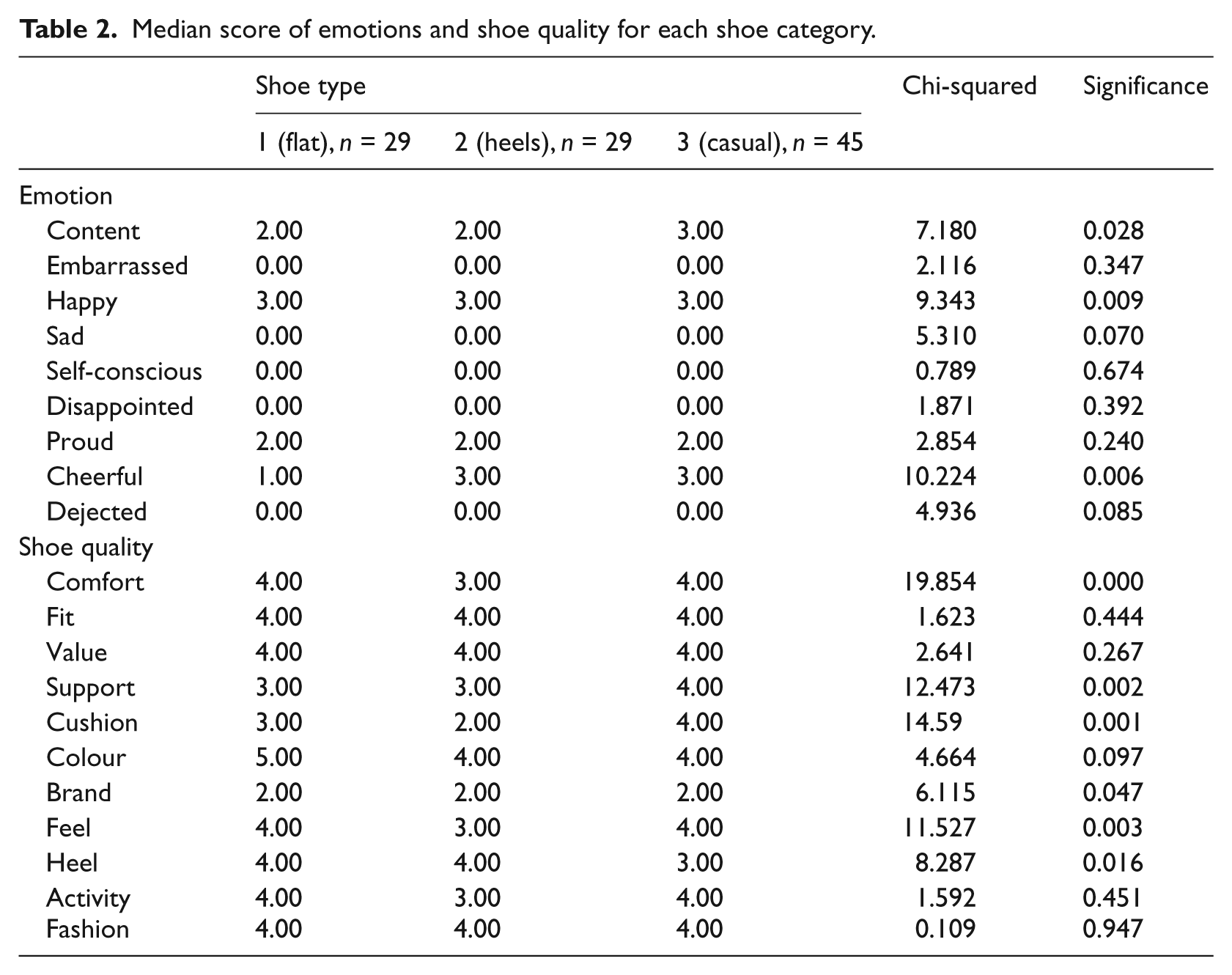
To identify further in which group the significance of the choice lay, a Mann–Whitney U test highlighted that when comparing group 1 (flat shoes) and group 2, subjects felt that group 2 (heeled shoes) made them happy (U = 241.50; p = 0.004), cheerful (U = 219.000; p = 0.001) and feel good about themselves (U = 258.000; p = 0.009). However, participants felt that the flat shoes were more comfortable (U = 237.000; p = 0.003). When comparing group 1 (flat shoes) and group 3 (casual shoes), it was identified that casual shoes were chosen for cushioning (U = 410.500; p = 0.006), brand (U = 438.500; p = 0.016) and support (U = 430.000; p = 0.011). Yet the heel height of group 1 (flat shoes) was found to be more statistically significant (U = 413.000; p = 0.007) than group 2 (heeled shoes) or group 3 (casual shoes). Group 3 was chosen for comfort (U = 277.500; p = 0.000), support (U = 365.500; p = 0.001), cushioning (U = 346.000; p = 0.001) and the feel of the shoe (U = 372.000; p = 0.001) over group 2 (heeled shoes).
Discussion
Footwear plays an important role in the image of teenage girls. This study has highlighted the presence of some interesting and statistically significant factors associated with fashion and style that influence shoe purchases and the positive effect the chosen shoes have on how participants feel when wearing varying shoe styles.
However, one of the aims of this study was to investigate how foot sizing and shoe fitting correlated as poor fitting footwear is considered a strong factor in the development of foot pathology (Paiva de Castro et al., 2010; Mickle et al., 2011). The results from this study indicated that foot measurements were not seen as an important consideration for footwear purchases. Although many of the participants did indicate a fluctuation in the size of the shoe that they choose to give a better fit and improved comfort, having the foot measured prior to purchasing the shoe was not observed as a common practice in the group studied. This could be attributed to the lack of availability of shoe fitting services within the fashion shoe market. Furthermore, satisfaction rates were high regarding fit and therefore self-selection of footwear size is an accepted method of shoe fitting.
Fitting has been identified as region-dependent and segments of the shoe that alter in sizing can alter perceived comfort (Au and Goonetilleke, 2007); therefore, a change in dimension in the arch or toe box may make the same size shoe feel comfortable or not. This observed alteration in shoe sizing could also be correlated with the changes in style and design of the shoe choice made. There is no standard shoe sizing system used in the manufacture of shoes worldwide and last development has been slow to evolve to current populations; therefore, the shoe sizing can vary from brand and manufacturer. It has been shown that toe box shape and dimension can influence fit (Paiva de Castro et al., 2010), and ill-fitting shoes are correlated with foot pain and deformity (Mickle et al., 2011). The styles adopted by designers have varied over time regarding toe box shape. Acute-shaped toe box points were popular as ‘winkle pickers’ in the 1960s and have been correlated to the belief that the pointed shoe can cause joint deformity (Marfat, 2007). Although this study did not investigate the choice of footwear shape, which has been associated with perceived comfort (Witana et al., 2009), at the toe box, the current trend on the UK high street is for a rounded toe box, and this type of shoe style would not cause such pressure on toes, and therefore, a reduction in toe deformities may be seen later in life if the habitual wear of round-toed shoes continues (Al-Abdulwahab et al., 2000).
Foot sizing has already been recognised in the literature as being related to image in different cultures, small feet were considered more desirable in the Chinese population where binding the foot to prevent growth has been current practice for centuries. Elbrey (1999) has reported that there is a theoretical relationship between elegance and virtue associated with a smaller foot, with a larger foot deemed as clumsy and alien like. This study showed no evidence that footwear sizing influenced image in such a way. However, on analysing foot sizing as a predictor of shoe size, there was statistically significant evidence that left foot length was a strong predictor of shoe size. This highlights that the shoe outlets that do not provide a fitting service for customers could assist in better fitting of footwear by displaying the shoes for the left foot, which will enable purchasers a more realistic assessment of comfort and fit.
The participants’ choices of activity for which that the chosen shoes were selected were reflected in the frequency with which each shoe type was worn. Flat shoes were generally chosen for school wear to be used every day and this style of shoe was seen as comfortable and well fitting. Using a shoe as part of a uniform can detract from the positive feelings associated with image; this was seen in the emotion analysis where the casual shoe group did not have any significant emotions associated with its use. Stipulation of school rules may influence the choices that the participants can make regarding uniform and fashion. If the school uniform rules do not have any flexibility to allow for an expression of self-image, then there may be a negative emotion attached to wearing that item. The negative emotions did not score high for this shoe type although there is not a strong trend to rebel against using this style of shoe for school, and the participants have found an acceptable style to wear for school. Style A:7 ballerina pump was the most frequent flat shoe chosen and this style has minimal volume upper, no fastening and limited support for all the factors that have been associated with foot pain and weakness (Menz and Morris, 2005; Mickle et al., 2011; Paiva de Castro et al., 2010). By not supporting the foot, even when flat, with a shoe fastening the foot changes shape to keep the shoe on to the foot. Modifications in shoe volume and style can be seen in slip on shoes to help the wearer keep the shoe on the foot, this style of shoe has already been identified as being directly correlated to pain in the older adult (Dufour et al., 2009), which may be due to a prolonged habitual change in foot function over a life time.
The data from the high-heeled shoe group, however, showed a statistically significant relationship between shoe choice for a specific activity (in this instance, parties and social occasions) and the height of the shoe heel. Heel height has previously been found to be associated with feelings of heightened sexuality, sophistication and power of the wearer (Yorkston, 2010). It is thought that the high-heeled shoe extends the length of the leg and alters the pelvic position to enhance female body shape. As well as increasing the height of a smaller individual, these changes in body position, could it might be argued, empower the individual creating a difference in image and self-esteem. Analyses of the results indicated that the choices the participants made for wearing high heels in this study would suggest that this population of interest use the heeled shoe to enhance sexuality and self-image while engaging in social activities.
This shoe has been strongly related to musculoskeletal pathology and postural complaints (Lee et al., 2001; Linder and Saltzman, 1998; Mandato and Nester, 1999). Frequent and use early in the life cycle of an adult may have negative implications into the long-term development of joint and muscle complaints. The long-term effects of wearing high heels have been shown to change calf muscle length and can be related to long-term stiffness in the Achilles tendon (Csapo et al., 2010). The participants in this study, although choosing the heeled shoe for parties and occasions, indicated that this style of shoe could be worn 3–4 times a week. Searches of the literature have failed, however, to provide any data to indicate how frequently or for how long a heeled shoe needs to be worn for pathological changes to occur. Muscular and skeletal changes that can occur as a result of wearing high heels would not necessarily be important to younger wearers.
Casual shoes were primarily worn over the weekend for a more informal appearance with the Ugg boot being most frequently chosen. Influential popular celebrities as well as commercial marketing and branding can all have a significant impact on purchases made by the teenage population (Yoh, 2005). Although the Ugg boot is not supported heavily by a strong marketing campaign, the popularity of this boot has been a global phenomenon. Comfort was significantly important as a factor when choosing this shoe. Material choice that enhances comfort would help to play a strong role when purchasing this style of boots. Further research into the suggested lack of support this boot style gives the wearer is required to substantiate claims that the long-term use of this boot may be detrimental.
Research limitations
Conducting this research solely via a questionnaire limited the scope of data collected. Interviews and focus groups might have provided more depth of information as to the influential factors and body image considerations when purchasing shoes. The current format, however, did provide an informative base to proceed with future studies on the role footwear plays in the image and identity.
Conclusions
Footwear choices in teenage girls are predominantly activity based and are strongly associated with comfort, feel and cushioning. Results indicated that such shoes were more likely to make teenage girls feel happy and cheerful and have a positive impact on self-esteem. From the shoes studied, the results show that the significant majority of teenage girls like to wear flat ballet style pumps for school, high-heeled shoes for parties and occasions and wool boots for weekend casual wear. Further work is recommended to investigate in greater depth the impact of wearing differing shoe styles has on body image and pathology.
Footnotes
Acknowledgements
The authors acknowledge Prof. David Clark-Carter, Staffordshire University, for help with statistics.
Funding
This research received no specific grant from any funding agency in the public, commercial or not-for-profit sectors.