




Abstract
The relationship of attributed source (commercial or nonprofit) and credibility of exercise advertisements to explicit and implicit exercise-related attitudes and intentions was examined. Male and female participants (N = 227) were randomly assigned to watch health or appearance-related advertisements and then completed an implicit attitudes task and questionnaires. Health advertisements and those attributed to a nonprofit source were rated more credible. Appearance condition participants who attributed the advertisement to a nonprofit source also rated the advertisement as more credible. Participants who rated a commercial advertisement as credible reported higher implicit instrumental attitudes. Implications for exercise promotion are discussed.
There are myriad, often conflicting, messages regarding physical activity and exercise. While many government and nonprofit organizations promote activity for disease prevention, there are many more commercial marketers who sell exercise equipment and apparel, often with a focus on appearance (Maibach, 2007). The relatively small amount of research examining this issue indicates possible positive and negative outcomes. Research published since Maibach’s review showed that implicit (i.e. automatic) believability of health messages significantly predicted explicit attitudes, but the automatic believability of appearance-related exercise messages was related to lower intentions to be active (Berry et al., 2011). Indeed, there is evidence that advertising and media can influence health-related attitudes at implicit and explicit levels in various health behaviors. With respect to exercise, a television program featuring ideal female bodies resulted in greater implicit and explicit appearance-related thoughts (Hall et al., 2011). Magazines such as Fitness and Shape promote health behaviors as a means to enhance appearance and appearance-framed articles from these magazines resulted in greater body shame and appearance-related exercise motives than health-framed articles (Aubrey, 2010). Others have shown that an alcohol-abuse prevention campaign resulted in lower automatic willingness to play a drinking game or drive while drunk, showing the campaign may have an effect on impulsive decisions (Comello and Slater, 2011). Thus, advertising may influence implicit and explicit health-related cognitions, and it is necessary to investigate if different messages about the same behavior might differently influence related attitudes.
For example, exercise may be promoted for health or appearance reasons. Appearance-related exercise advertising may form expectations regarding appearance or exercise and may influence body image in both women and men (Dworkin and Wachs, 2009). Women unhappy with their bodies tend to want to be thinner and are dissatisfied with their hips, thighs, and stomachs while men may want to be either thinner or heavier and focus on the stomach, biceps, shoulders, and chest as areas for improvement (Grogan, 2008). Popular fitness magazines use words such as “sculpt” when touting exercise routines purportedly designed to “transform” one’s body to achieve societal ideals of beauty for women and men (Dworkin and Wachs, 2009).
Message source attribution and their perceived credibility may affect how health and appearance exercise messages are perceived. Highly credible sources are more persuasive than low credibility sources and threats, and counter arguments may increase the influence of a highly credible source, while using evidence can increase the persuasiveness of a low credibility source (Pornpitakpan, 2004). Nonprofit sources of exercise messages are considered more credible than commercial sources (Berry et al., 2009). Highly credible exercise message sources predicted intentions to be active, but not attitudes whereas noncredible sources had little influence (Jones et al., 2003). Conversely, Arora et al. (2006) found a highly credible source of exercise information positively influenced attitudes and intentions toward exercise compared to a low credibility source. These discrepant results require clarification to better understand the influence of source credibility on exercise-related attitudes.
Perceived message source (e.g. a nonprofit organization or a commercial company) can influence responses to messages. For example, incorrectly attributing the source of European Union sponsored antismoking advertisements from the correct government source to commercial companies resulted in increased comprehension of the message and subsequent intentions to quit smoking (Hassan et al., 2007). In exercise-related research, there were no differences between participants who attributed a government sponsored physical activity advertisement to the government compared to a nonprofit organization on intentions to be active (Berry et al., 2009). It is unclear whether these findings extend to commercial companies.
Message variables such as source credibility are included in the elaboration likelihood model (ELM) of persuasion (Wagner and Petty, 2011). The ELM posits a continuum of central and peripheral routes for message processing, and the route taken influences the likelihood of message elaboration. Active thinking about a message results in central processing and possible long-lasting changes in attitude. Peripheral processing may also result in attitude change, but results from less thoughtful processing and may not last as long. Source credibility research indicates that credible sources tend to result in central processing and more elaboration than low credible sources (Pornpitakpan, 2004), but source credibility is more influential when there is a low amount of thinking (Wagner and Petty, 2011). Therefore, Pornpitakpan advocated for research that includes independent variables other than source credibility to investigate possible interactions or moderating effects when examining message processing. For example, source misattribution is a low effort process (Wagner and Petty, 2011) and may influence attitudes when there is little elaboration.
Understanding dual attitudes is also necessary. The metacognitive model of attitude structure posits that implicit attitude measures capture attitude strength and validity, whereas explicit measures capture the extent to which an attitude is endorsed (Petty and Brinol, 2010). Similarly, persuasion can occur through emotion or reason (Petty and Brinol, 2010). Accordingly, exercise-related attitudes have been conceptualized as affective (e.g. fun) or instrumental (e.g. healthy; Rhodes et al., 2006). A person may believe in the benefits of exercise (an instrumental attitude) but nonetheless find exercise unpleasant (an affective attitude). It is also conceivable that one may have an automatic negative association with exercise, but upon reflection of the benefits of exercise indicate a positive attitude. Thus, research should consider affective and instrumental attitudes both implicitly and explicitly.
This research was designed to include this consideration and to address the discrepant findings of Jones et al. (2003) and Arora et al. (2006) regarding the effects of credibility on exercise-related attitudes by also examining the source to which participants attribute exercise-related messages. The purpose is to examine whether the attributed source of health or appearance-related exercise advertisements and the spokesperson credibility are related to explicit and implicit exercise-related attitudes and intentions. Advertisement believability will also be measured. It is hypothesized that (1) attributing the source to a commercial company rather than a nonprofit agency will be related to lower spokesperson credibility and advertisement believability (Berry et al., 2009) and (2) attributing the source to a commercial company will be related to the lowest attitudes and intentions, compared to other groups, after controlling for spokesperson credibility and advertisement believability. Possible covariates include amount of activity and body mass index (BMI). Because appearance-related exercise advertising targeting men and women focuses on different parts of the body (Dworkin and Wachs, 2009), male and female participants were presented with different advertisements. Furthermore, gender of a message source may interact with the gender of the message receiver to influence message processing (Dinoff and Kowalski, 2002). Therefore, males watched messages with a male spokesperson and females watched messages with a female spokesperson.
The relationship of credibility, source attribution and their interaction with attitudes and intentions, independent of type of advertisement will be explored (Hassan et al., 2007).Due to the exploratory nature of this analysis, no hypotheses were made.
Methods
Participants
Canadian university students (N = 227; 67.4% female, mean age = 19.08 (standard deviation (SD) = 1.81) years) were recruited from an undergraduate psychology class and were awarded class credit for participation. No participants were excluded a priori because participating in research is intended as a learning opportunity. However, if participants were not strong English speakers and asked the research assistants for help with translation, a note was made and their data were not included in the analyses.
Advertisements
Four 85-second advertisements were developed and offered information about exercise and strategies to incorporate it into daily routines. Each advertisement was recorded and edited by a professional multimedia producer at a Canadian university for use in an undergraduate course. The advertisements were designed to appeal to university students through the use of branding (“Get Up and Get Active”), energetic music, and shots of students being active (e.g. playing Frisbee and jogging). Each advertisement was the same except for the spokesperson used (male/female), the focus of the message (health based/appearance based), and the attire of the spokespersons (health based: track suit/appearance-based tight-fitting clothing and sometimes no shirt for males). Credibility was established by having the spokesperson identify him or herself as a “Professional Fitness and Lifestyle Consultant.” Both messages highlighted the benefits of being active. In the health-based advertisements, the spokesperson discussed the benefits of physical activity for health (e.g. “adding 30 minutes of activity to your daily routine will improve health”). The health-based message delivered by both spokespersons was the same. A similar presentation format was used in the appearance-based advertisements; however, the male spokesperson talked about activity having benefits for muscle tone, strength, and “killer abs,” whereas the female appearance spokesperson talked about reducing body fat and “excess flab” and getting a nicely toned body. The appearance references were based on commonly used terms in men’s and women’s popular fitness magazines (e.g. Men’s Health and Fitness, and Shape).
Measures
Implicit attitudes
In the go/no-go association task (GNAT; Nosek and Banaji, 2001), participants categorize words that belong to a target category by hitting the space bar (go). If a word does not belong to the target category group, the space bar is not pressed (no go). The target category attribute was exercise and category words were exercise related (e.g. workout and active). The evaluative category was good or bad words. Participants completed two GNATs in which the good or bad words represented affective attitudes (e.g. pleasant–unpleasant) or instrumental attitudes (e.g. healthy–unhealthy). In both, the contrast category was generic (e.g. carpet and month). Across blocks, participants categorized the words related to exercise, generic, good, or bad using the go/no go procedure. For example, in the first block, exercise and good words were “go” words, whereas generic and bad words were “no go” words, and in the next block, exercise and bad were “go” words and generic and good were “no go” words. The block order was counterbalanced across participants. When categories and evaluations are linked (e.g. exercise is positive), participants make fewer errors when categorizing the words as go or no go. Sensitivity scores (d′) for categorizing exercise and good, and exercise and bad, measure implicit attitudes. Thus, a significantly greater d′ good score than d′ bad score indicates a positive attitude. Presentation of the GNAT variants was counterbalanced.
Demographics
Participants self-reported age, height, weight, and perceived body weight (underweight, average weight, and overweight). The height and weight data were used to calculate BMI using the formula: (weight (lbs) / (height (in)2) × 703.
Source attribution
A forced choice question assessed who participants thought sponsored the advertisement (Hassan et al., 2007). The options given were (1) a nonprofit organization (e.g. Heart and Stroke Foundation) or (2) a commercial company (e.g. the Fitness Depot).
Spokesperson credibility
Participants rated the spokesperson on a 7-point scale with the following stems: no knowledge/extremely knowledgeable, not competent/extremely competent, not credible/extremely credible, not likable/extremely likable, and no expertise/extreme expertise (Jones et al., 2003). The internal consistency for this sample was α = .87.
Advertisement believability
The Advertising Believability Scale (Beltramini, 1985) includes nine items that rank the “advertisements they just saw” on a 7-point scale with items such as believable/unbelievable, convincing/unconvincing,and trustworthy/not trustworthy. To aid with interpretation, all items were reverse scored so that a higher score indicated greater believability. An aggregate mean score was used in the analysis (range: 1.22–7). The internal consistency for this sample was α = .92.
Explicit attitudes
Attitudes toward exercise were measured across eight items using 7-point bipolar adjective scales as suggested by Ajzen (n.d.). Participants rated “For me to exercise for at least 30 minutes each day in the forthcoming month” as (1) harmful to beneficial, (2) pleasant to unpleasant, (3) good to bad, (4) worthless to valuable, (5) enjoyable to unenjoyable, (6) healthy to unhealthy, (7) pleasurable to painful, and (8) important to unimportant. The scores of items 2, 3, and 5–8 were reversed so that a higher score reflected a more positive attitude. The mean of items 1, 4, 6, and 8 measured instrumental attitudes, and the mean of items 2, 3, 5, and 7 represented affective attitudes. Scores ranged from 3.8 to 7 for instrumental attitudes (α = .76) and 2.4 to 7 for affective attitudes (α = .85).
Intentions
Intentions to exercise for at least 30 minutes daily over the next month were rated on a 7-point scale as extremely unlikely/extremely likely, definitely true/definitely false, and strongly disagree/strongly agree. The score of the true/false item was reverse scored and the average across items measured intentions. A higher score indicates greater intention to exercise. The internal consistency for this sample was α = .91.
Exercise behavior
The Godin Leisure-Time Exercise Questionnaire (Godin and Shepard, 1985) shows strong validity for measuring leisure-time physical activity across populations and seasons (Godin, 2011). It is also easy to use participants report the number of 30-minute bouts of mild, moderate, and strenuous physical activity in which they engaged during a recent typical week. Test–retest reliability scores of .74 and .81 have been demonstrated in a healthy adult sample (Godin and Shepard, 1985). Weekly metabolic equivalents (METs) were calculated by multiplying the number of strenuous bouts by 9, moderate bouts by 5, and mild bouts by 3 and summing the products.
Procedures
This research received ethical approval from a university research ethics board. All participants completed informed consent procedures prior to participation and had the option of doing an alternative learning activity (no participant chose this option). Participants were randomly assigned to view either the health or appearance advertisement. Participation took place individually in a research lab testing room on a university campus. Participants were told the purpose was to aid in finding out how to make better health promotion advertisements at the start of the experiment and fully debriefed at the end. Male participants watched the advertisement with the male spokesperson and female participants watched the advertisement with the female spokesperson. Participants then completed the GNATs followed by the questionnaires.
Results
Preliminary screening
Data were examined for outliers using the criteria of ±3.29 SDs from the mean. The data from four participants who had difficulty with the English language or with outlying BMI (n = 8, >31) or METs scores (n = 2, >141.5) were excluded. The final analysis sample included 213 participants (68.5% female, mean age = 19.06 (SD = 1.78) years; mean BMI = 21.87 (SD = 2.94), mean METs = 42.21 (SD = 27.78)) with 103 in the appearance condition and 110 in the health condition. The majority of participants were classified as normal weight (n = 169, 79.3%), 23 (10.8%) were underweight, and 21 (9.8%) were overweight according to standard guidelines. There were no differences between advertisement conditions in age, METs, or BMI (all t-test p > .30), nor were there gender or self-reported weight group differences (both chi-square: p > .70). There were no significant gender differences in any of the dependent variables (DVs; all p>.12). Therefore, gender was not examined as a moderating variable. The majority of participants attributed the advertisements to a nonprofit agency (n = 182; 81 in the appearance condition and 101 in the health condition). Of the 31 participants who attributed the advertisements to a commercial company, 22 were in the appearance condition and 9 were in the health condition.
Hypothesis testing
Because of the unequal cell sizes for advertisement by source attribution groups, Predictive Analytics Software (PASW) 18 was used to randomly select nine participants each of the other three groups to match the sample size of the participants in the health/commercial group (Tabachnick and Fidell, 2001). 1
The hypothesis that attribution to a commercial company would relate to lower credibility and believability was tested with a 2 (health or appearance) × 2 (source attribution) multivariate analysis of variance (MANOVA). Bivariate correlations between BMI and METs and credibility and believability ranged from −.05 to .11 (all p > .05). Therefore, no covariates were included. There was no main effect for advertisement, F(2, 31) = 0.56, p = .58, η2 = .04, but a significant main effect for source attribution, F(2, 31) = 4.71, p < .05, η2 = .23, and a significant interaction, F(2, 31) = 5.48, p < .01, η2 = .26. Follow-up tests showed a difference in credibility between source attribution groups, F(1, 32) = 9.34, p < .005, η2 = .23. Credibility was significantly greater for those participants in the appearance condition who cited a nonprofit as the source compared to those who cited a commercial enterprise, F(1, 32) = 11.31, p < 005, η2 = .26. There were no other significant differences. Table 1 shows the means and SDs.
Means and standard deviations for dependent variables.

Same subscripts in a row indicate significant differences (p < .005) between values.
n = 9 for all appearance by source cells for a total of 36 participants in these analyses.
The hypothesis that participants in the health condition who attribute the source to a commercial company would have the lowest attitudes and intentions was tested with a MANOVA with explicit instrumental and affective attitudes and intentions as DVs and a 2 × 2 multivariate repeated measures MANOVA with the d′ scores for good and bad instrumental and affective attitudes as the within-subjects variables (Nosek and Banaji, 2001). Credibility and METs were included as covariates in the multivariate analysis of covariance (MANCOVA) with explicit attitudes and intentions because credibility showed consistent significant differences in the previous analyses, and METs were correlated with attitudes and intentions (r = .25–.56, all p < .01). There was no significant main effect for advertisement, F(3, 28) = 0.55, p = .65, η2 = .06; source attribution, F(3, 28) = 0.96, p = .43, η2 = .09; nor a significant interaction, F(3, 28) = 0.013, p = .99, η2 = .001. Credibility and METs were not significant covariates (both p > .39) (see Table 1 for means and SDs).
No covariates were included in the repeated measures MANOVA with implicit attitudes because of low correlations between possible covariates and d′ scores (range: .02–.14, all p > .05). There was a significant multivariate within-subjects effect for differences between d′ good and d′ bad scores, F(2, 31) = 13.60, p < .001, η2 = .47. There were significant univariate within-subjects differences for instrumental attitudes, F(1, 32) = 27.24, p < .001, η2 = .46, but not affective attitudes, F(1, 32) = 2.45, p = .13, η2 = .07. There were no other significant differences (all p > .08). These results indicate positive implicit instrumental attitudes but no differences between advertisement or source groups (see Table 1 for means and SDs).
Exploratory analyses
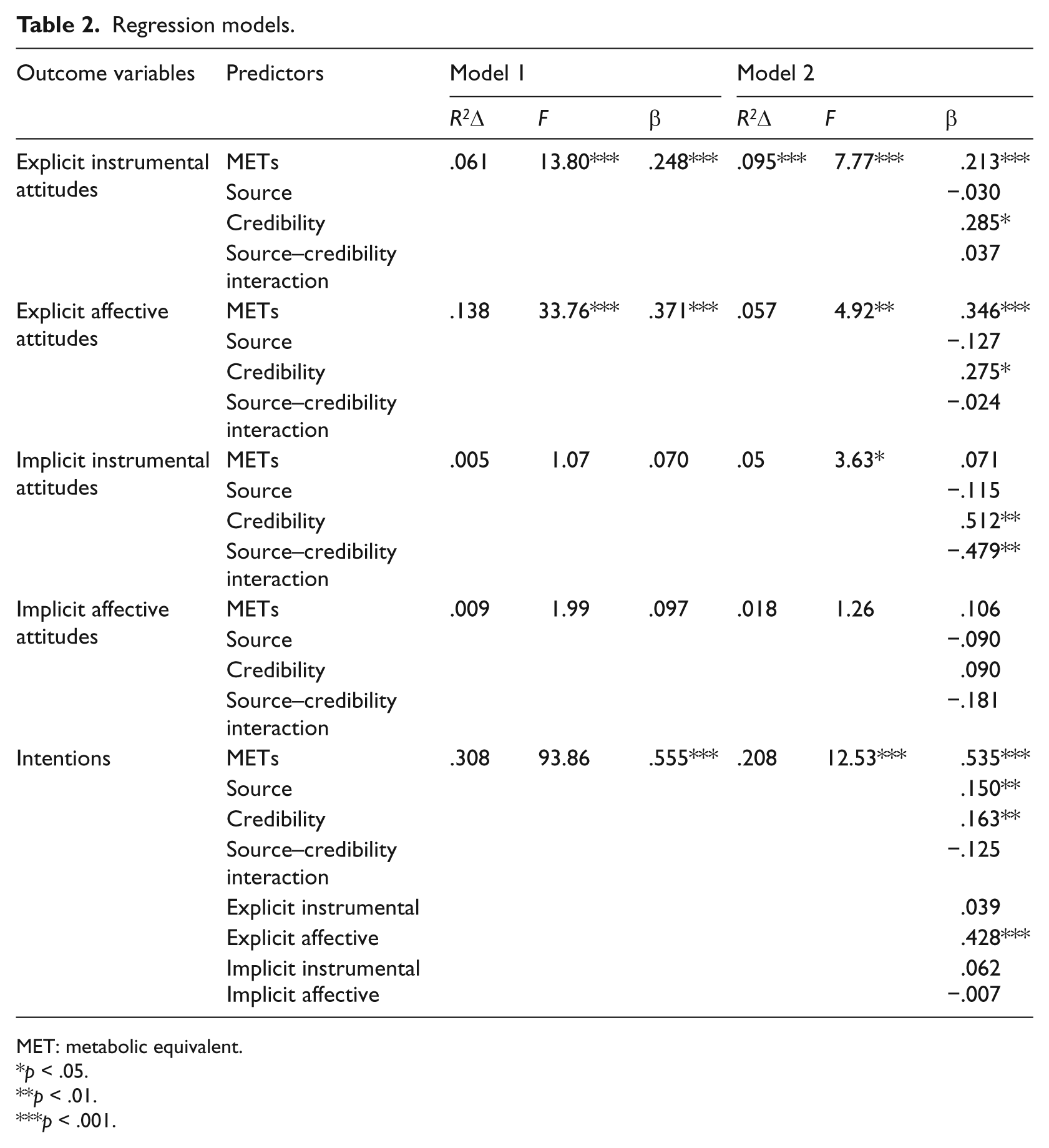
Linear regressions were calculated to determine whether spokesperson credibility interacted with source attribution in influencing explicit and implicit instrumental and affective attitudes and intentions. Implicit attitudes were calculated by subtracting d′ bad scores from d′ good scores. In the first step, the DVs were regressed onto METs (mean centered); in the second step, source attribution group (dummy coded as appearance = 0 and health = 1), credibility (mean centered), and their interaction were added. Significant interactions were followed-up using simple slope procedures (Aiken and West, 1991). The results of the regression models are shown in Table 2. For parsimony of space, only significant results are discussed here. The only variable related to both credibility and source attribution, with no interaction, was intentions. Credibility and the interaction between credibility and source attribution predicted implicit instrumental attitudes. A simple slope analysis showed participants who cited a commercial source and rated the spokesperson as credible had significantly higher implicit instrumental attitudes than other participants.
Regression models.
MET: metabolic equivalent.
p < .05.
p < .01.
p < .001.
Discussion
This research examined the relationships of source attribution and spokesperson credibility of health and appearance exercise-related messages to exercise-related cognitions. As hypothesized, participants who attributed the source of a message, regardless of whether it was health or appearance related, to a commercial company rated the spokesperson less credible than those who attributed the message to a nonprofit source. Participants who viewed the appearance advertisement and cited a nonprofit source rated the spokesperson more credible than participants who viewed the same appearance advertisement yet cited a commercial enterprise as the source. However, these responses may be short-lived. Message sources may result in simple inferences, but over the long term, the idea that a nonprofit source such as the Heart and Stroke foundation highlighted “killer abs” may not remain plausible for those who made this judgment. In the health condition, there were no differences in spokesperson credibility or advertisement believability between commercial or nonprofit sources. Again, this is likely a short-term effect, particularly for the participants who attributed the health message to a commercial company. The health message may have created a “halo effect” wherein positive attributes associated with the health message extended to the source and spokesperson. Thus, commercial companies may benefit from discussing health rather than appearance outcomes in their messages.
The hypothesis that participants in the health condition who attributed the source to a commercial company would have the lowest attitudes and intentions, after controlling for credibility and believability was not supported. The lack of differences may be due to prior exposure to exercise messages, and it is unlikely that a conscious attitude regarding exercise was not already formed. Undergraduate students have likely had multiple occasions (e.g. in high school and in activities while at university) to reflect on the attributes of being active. Source credibility becomes less influential under such conditions (Petty and Brinol, 2010). However, the meaning of “health” to this population may have affected our results. Health, fitness, and appearance were interwoven ideas for active college students (Waldron and Dieser, 2010). For female students, the popular media influenced ideas of health and fitness and related them to appearance standards. The implications for long-term exercise behavior should be explored.
There were no differences in implicit attitudes between health and appearance messages, or between attributed source, although positive instrumental and affective attitudes were implicitly demonstrated across participants. However, participants who cited a commercial company and found the spokesperson credible had higher implicit instrumental attitudes than other participants. Credibility is important under low elaboration conditions (Wagner and Petty, 2011), and implicit measures are sensitive to the valence of the source and thus may reflect the relationship between the message and the source (Petty and Brinol, 2010). Source credibility likely served as a simple associative cue regarding the instrumental benefits of being active and participants who found the commercial source credible may have been automatically more favorable to the benefits of exercise. The explicit measures may have captured the effect of disregarding the source. When given time to think, participants may have questioned the validity of the credibility of the commercial advertisement spokesperson, as shown by no significant effects for explicit attitudes.
A meta-analysis showed that when there is limited ability to think about a message, source credibility is an important variable but only in the absence of prior attitudes (Kumkale et al., 2010). Participants who found the commercial source credible likely had prior exercise-related attitudes but may not have spent much time thinking about the validity of exercise messages from commercial sources. Thus, the novelty may have resulted in a simple association that increased instrumental attitudes. Researchers should investigate commercial advertisements that promote fitness products. The advertisements used in the current research did not feature products that may account for few participants attributing the advertisements to a commercial source. Researchers wishing to replicate these findings may try using already existing commercial advertisements that may be stylistically different than the ones created for this research.
The strengths of this research include a randomized experimental design that used implicit and explicit measures of attitudes and looked at the effects of credibility and attribution together. However, the use of an undergraduate student population limits generalizability. Psychology students may be experienced in research studies that may have affected the results. However, the advertisements used in this research were specifically developed for undergraduate students and thus were the appropriate population from which to sample. Future research should extend this research to other populations with similarly targeted advertisements. Another limitation is the lack of a pretest that precluded us from assessing change in attitudes. This decision was made because pretest sensitization is a concern in media research. The random assignment and lack of demographic differences between conditions mitigate this concern somewhat as there is limited possibility of systematic differences between groups. The use of BMI is also limiting factors such as muscle mass, gender, and ethnicity may influence the relationship between body fatness and BMI; BMI is a good population level indicator but it is less predictive at an individual level (Gallagher et al., 1996). Furthermore, there is a large amount of individual variability in self-reported height and weight (Gorber et al., 2007). Height tends to be over-reported and weight underestimated, resulting in underreporting of BMI.
Caution is also advised with extrapolating these findings to exercise behavior. Although intentions are a common construct in many health behavior theories (e.g. the Theory of Planned Behavior; Ajzen, n.d.), a meta-analysis showed that the “intention-behavior gap” (when intentions do not translate to behavior) is particularly large with exercise behavior (Rhodes and Dickau, 2012). The meta-analysis reviewed explicit intentions, and the authors suggest that future research examine the mediating roles of “self-regulatory, automatic, and affective constructs” (p. 3) between intentions and behavior. Researchers should examine whether explicit intentions better predict behavior when implicit cognitions, such as those measured in the current research, are examined as possible mediators.
This research examined how messages about exercise, and possible sources of exercise messages, may influence exercise-related cognitions. Multiple sources of exercise information may be confusing for consumers (Maibach, 2007). Participants who attributed an appearance message to a nonprofit source found the source less credible. Thus, nonprofit enterprises that discuss appearance may undermine their own credibility. This research can help those wanting to promote exercise increase the likelihood of persuasion by having credible sources who talk about health rather than appearance. Future research should examine the stability of the relationship of source credibility to attitude over time as attitudes are likely to decay quickly if the change is the result of peripheral processing (Kumkale et al., 2010). Researchers should also consider both implicit and explicit attitudes regarding exercise and how they may be influenced by media messages. It would be of interest to further examine the gender-specific nature of exercise-related appearance messages (Dworkin and Wachs, 2009). This was controlled for in the present study by having gender-matched advertisements and participants (and no gender effects were found), but it would be interesting to see whether messages presented by different genders elicit different processing responses in participants. In conclusion, this research provides results that will be of interest to those wishing to promote exercise and is a valuable starting point for future research.
Footnotes
Funding
This research was supported in part by grants from the Teaching Innovation and Improvement Fund at Acadia University and the Social Sciences and Humanities Research Council of Canada. Tanya R. Berry is supported by the Canada Research Chairs Program and by a Population Health Investigator award from the Alberta Innovates - Health Solutions.