



Abstract
This study explored the processes of significance about the risk communication in prenatal/preconception setting within 1 month to the end of genetic counselling intervention. Participants were all attending a programme of Cardiomyology and Medical Genetics in Naples, Italy, for the first time. Transcripts of 18 semi-structured interviews were analysed using interpretative phenomenological analysis. Themes arising included the following: the familiar outcomes of genetic counselling, the risk representation and the impacts on decision-making. The findings suggest the significance of the experience of genetic risk and the implications for the support of individuals and their family after the conclusion of the genetic counselling intervention.
Keywords
Introduction
Post-genomic research has identified a large amount of genetic disorders and facilitated to understand their diagnosis, treatments and contributions. Advances in genetic knowledge have presented the participants with several opportunities to learn more about their genetic risk; they also have led to redefine notions on health and illness and, specifically, the conceptions of life and procreation, which have several implications in ethical issues as well as in clinical practice.
The ‘Ad Hoc Committee on Genetic Counselling’(1975) describes genetic counselling as ‘a communication process which deals with human problems associated with the occurrence, or the risk of an occurrence of a genetic disorder in the family’. Genetic counselling provides medical information to support decision-making processes related to risk diagnosis, with the aim to facilitate family communication and to educate about potential reproductive options.
Therefore, the main goals of genetic counselling are to promote informed choices and to facilitate psychosocial adaptation to the acquired knowledge of a hereditary risk or status (Kessler, 1997; Resta et al., 2006). Specifically, when prenatal or preconception diagnosis is required, genetic counselling may represent a key step for those who deal with reproductive choices (Kessler, 1979; Nusbaum et al., 2008; Uhlmann et al., 2009; Zaccaro, 2011).
This article describes the outcomes of a study on post – genetic prenatal and reproductive counselling as a side of a larger research project conducted within the 3-year period from 2008 to 2010 by a medical genetics team working for the Service of Cardiomyology and Medical Genetics in Naples, Italy, Regional Center for Muscle Diseases and epidemiological observatory for the diagnosis of the diseases in question. 1
The aim is to contribute to our understanding of how participants perceive their experience of being informed about a genetic risk. A phenomenological approach is appropriate in view of the exploratory nature of the study, and since there is a little knowledge about the significance about risk communication in the context of neuromuscular diseases (Emery, 2002; Gargiuloet al., 2008; Jacopini et al., 2006; Mostacciuolo et al., 1998; Parsons and Clarke, 1993), we hope that adopting the qualitative approach of interpretative phenomenological analysis (IPA), this study will complement the existing ones about risk communication in the health psychology literature, concerning this particular genetic field.
Theoretical issues
As it is well known from the literature, the communication of a positive result 2 of genetic risk assessment is often experienced by participants as something leading to a serious difficulty to complete the counselling process.
The practice of medicine is traditionally concerned with the diagnosis and treatment of disease at the point where symptoms are visible and clear (Senior et al., 2002). Decision-making processes can extend across a spectrum from the traditional attitude of ‘doctor knows best’ (Emery, 2001: 81) to the patient acting to make a decision by himself or herself, on the basis of information received.
Within the context of genetic counselling, instead, the counsellor does not communicate the detection of one specific disease, but rather he provides information about the probabilities of one gene to be affected by a disease-causing mutation. Then, the prognosis has implications based on hypothesis of illness, rather than on effective and certain data. ‘Genetic’ diagnosis turns attention from a ‘visible’ and curable disease to the formulation of a hypothesis about the probability for a subject to be affected in future by a specific pathology, involving whole progenies (Baty, 2009).
The nature of genetic risk introduces a dimension of responsibility concerning the health of future generations, which is considered as an important element of empowerment. The belief system of empowerment allows a person to feel in or take control of own life and to have responsibility and autonomy over choices (Lewis et al., 2012; McAllister et al., 2008).
Therefore, taking care of someone who received a risk diagnosis is an emotionally laden experience involving not only at-risk family members but also entire generations. The communication of genetic information within families includes making sense of personal risk, assessing vulnerability and receptivity of the family member, and making a decision about the right time of discussion for the information to be conveyed (Gaff et al., 2007).
Decision-making is not considered as an individual process; family processes are an intrinsic part of decision-making, which opens a sort of discussion between generations (Smith et al., 2002). Some studies indicate that at-risk members are generally informed about a genetic risk condition by one of their parents, rather than the individual in the family who first received genetic counselling (D’Agincourt-Canning, 2001). Forrest et al. (2003) describe this as a tendency towards ‘vertical transmission’ of information. Moreover, in case of breast and ovarian cancer, the women decided to share medical information with members of the family circle, considering it necessary for preventive purposes (Christophe et al., 2009). Also in pretest stage, the feeling of responsibility and cancer burden led women to be tested and to take action to balance their risk, as well as encouraging others to do likewise (Foster et al., 2002). Furthermore, the degree of engagement, reflecting the degree of cognitive and emotional involvement with cancer risk in individuals from these families, can change with the unfolding of time and events in family life (McAllister, 2002).
The psychological response to risk information is influenced, in part, by the gap between what the patient believes and understands about the risks and what is now being presented (Djurdjinovic, 2009). Genetic counsellors who are responsible for informing and educating individuals about genetic testing should be made aware that the way they present first may be more influential than later information (Morrison et al., 2010).
The concept of risk implies a cognitive gap that should be shared between counsellor and consultant, in view of the use of information for decisional purposes. In other words, to focus on the personal meaning that each individual can give to a risk diagnosis is important to understand the subsequent impact this may have in order to provide effective patient-centred counselling (Sivell et al., 2008).
As a matter of fact, one of the main goals of counselling is ‘to facilitate clients’ ability to use genetic information in a personally meaningful way that minimizes psychological distress and increases personal control’ (Biesecker and Peters, 2002: 537). Patient’s autonomy and informed decisions must be supported; in fact, an essential feature is that ‘the patient knows and therefore should be self-directed regarding genetic counselling’ (Veach et al., 2007: 721).
Such information has larger effects concerning decision-making, in which the two sides of the counselling relationship are involved in a dynamic process (Hallowell and Richards, 1997). In fact, it is widely recognized how the geneticist takes part actively in the decision-making process with the patient, being himself or herself an active part of such a process, instead of an ordinary observer (Zanko and Fox, 2010). 3
Goals
The main objective of this article was to explore the consequences of risk communication as was experienced by the participants, in order to understand their perception of their genetic situation. This is strongly related to complicated decision-making processes.
A qualitative approach to this research is appropriate, due to the exploratory nature of the study as well as the intention to set up, in future, research–intervention projects involving both medical and psychological professionals in a joint setting. The goals were of an exploratory nature, and there are no claims of generalization, but their aim is to provide indicative criteria and ideas for further research and studies in this area.
Method
Participants
Eighteen adults accepted to participate in this study. They were all attending the Service of Cardiomyology and Medical Genetics in Naples (Italy) for the first time. The sample consisted of 16 females and 2 males; the average age was 26.8 years; the number of sons per participant is equal to 1 (0–2); the married participants are 12, and of those 3 are unemployed. After the last consultation, a psychologist invited them to take part in a subsequent telephonic interview with informed consent.
Participants attended the genetic counselling intervention programme for a wide range of reasons: first, for their familiarity, due to the presence in the family of a person affected by and/or carrier of Duchenne muscular dystrophy (DMD)/Becker muscular dystrophy (BMD) or spinal muscular atrophy (SMA); second, being partners with a person affected by Steinert’s disease or with a carrier of SMA; third, for a confirmed diagnosis of carrier of a DMD/BMD or SMA or because affected by Steinert’s disease. In this last case, they are already patient taken under the care of the Service and have the desire to become parents for the first time.
Interview
Participants have been interviewed by telephone, while they were at home, within 1 month of being communicated the results of the genetic risk. All the interviews were tape recorded and, subsequently, transcribed. The interviews were semi-structured and lasted from half an hour to 1 hour. The key areas explored are the following:
– The realization and the reconstruction of the moment when the communication of results, and/or of the diagnosis, happened (e.g. Where were you when the results were communicated? Can you remember the doctor who gave you the news? Can you tell me what exactly he or she told you?);
– The understanding of the information (about the disease and the risk status) (e.g. What percentage of risk were you given? What is the meaning of such percentage? How would you define your condition?);
– The communication of the results to the family (e.g. Did you talk to your family about the results? Who did you talk to? What did you exactly say? How did you feel? In your opinion, how did your family members feel? Is there anyone you did not tell about it? Can you tell me the reason why you did not?);
– The impact of the results and/or of the diagnosis and the main decision-making processes (e.g. How do you think such information influenced your decisions about the future and your plans for life and eventually procreation?).
The aim was to guide each individual to talk about, and to explore as fully as possible, the personal meaning of their genetic condition and its consequences on the decision-making processes.
Analysis
The use of a phenomenological methodology enabled a detailed examination of personal experiences with regard to a genetic diagnosis. With its specificity in phenomenology and hermeneutics, IPA allows for a detailed picture of how individuals think and feel about the genetic condition they face. IPA is a qualitative approach to health research, and its aim is to explore in detail the process through which participants make sense of their own experiences (Brocki and Wearden, 2006).
Therefore, studies using IPA typically considered important life-transforming or life-threatening events, conditions or decisions (Smith, 2004). Indeed, this methodology has been successfully applied for examining the psychological aspects of ‘new genetics’ (Chapman and Smith, 2002). In fact, IPA has been used in other qualitative studies of genetic testing and risk perceptions such as in Huntington’s disease (Smith et al., 2002) and hereditary breast and ovarian cancer (Buckmaster and Gallagher, 2010; Etchegary et al., 2009).
Our analysis has been conducted in line with IPA method, according to the recommendations by Smith et al. (2009). The original master tables consist of the individual transcripts in order to define new themes that were explanatory for the original interview data (Braun and Clarke, 2006; Macleod et al., 2002). As suggested by Smith et al. (2009), identifying quotations reflecting each theme were included in order to aid the organization of the analysis.
Three superordinate themes emerged through our analysis of the data. These themes, and associated subordinate ones, are summarized in Figure 1, and they are described in detail in the following.
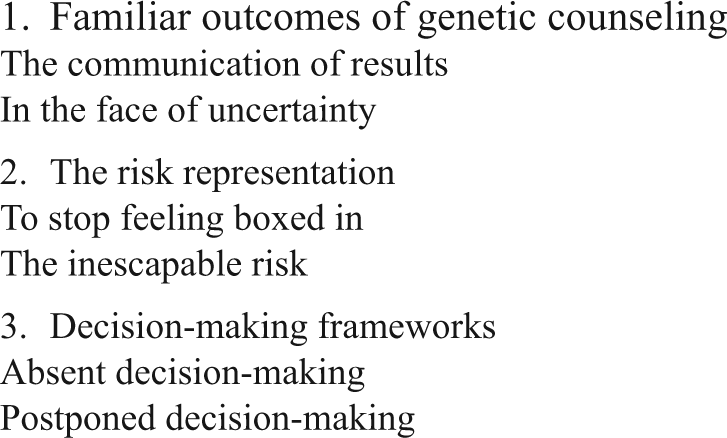
Summary of superordinate and subordinate themes.
Results
Familiar outcomes of genetic counselling
In this first superordinate theme, the participants’ narrative was focused on the familiar implication of the received information. The counselling process may reveal the existence of a hereditary taint; such a detection can represent either something unpredicted or, in some cases, an expected news. Receiving such information was experienced by participants as something to be included in the processes of sense-making concerning their family connections and relationships. Then, the outcomes of these dynamics lying between and into the generations needed to be processed within the relationships with siblings and partners.
With regard to the first emergent category, 4 the communication of results, some of the participants spoke about how important the news, whether good or bad, was in the context of their family life. In particular, it is deduced that the information was helpful for the family in order to promote the well-being of both the individuals and the whole group. The participants often referred to sisters or cousins who were not yet aware of the news. Our hypothesis is that they tried to free themselves from the burden represented by what they had come to know. This was considered as something going beyond the boundaries of the knowledge received. In this phase, they tried to give a definition of inheritance to the risk status and, eventually, to the disease.
Well, at the beginning they were much worried as well, because they had never wondered about it. One of my sisters already has a child. The idea was suggested by the gynaecologist, but we had no intentions. (M.) … I suggested to my sister in law (my husband’s sister), to take the same test and to examine the same gene, in order to know if in her case it was mutated. She is not married yet, but I gave her the advice so that, in case she wants to have a child, she will already know what she will have to face, even though this is not I am wishing her. (A.)
Sometimes, as an impact of the result on the family, the consultants felt guilty about the possibility to transmit the disease and thereby to mark the family with a risk status.
The result flooded over the participants, introducing a need for risk assessment threatening upon their projects on life and procreation. This occurred not only for the two partners but also for the whole family.
Stigma and guilt were projected into the fear of being judged by other people. This was clearly inferable from the description of the reproductive counselling experience reported by two women who abruptly found out to be carriers of the BMD.
As R. narrates:
As far as they (the family) can understand, they will never know exactly how you feel. For example, my mother in law, due to her ignorance, kept saying ‘let’s hope he will pick it up from us rather than from you!’ Maybe she said that just to encourage me, but it didn’t work.
Even V. narrates:
I would have preferred not to have said anything, because people are ignorant,
5
they can’t understand, even when you are telling the truth, describing everything as it is. They are not judging you, they just look at you in contempt, because you will never give them the expected nice and healthy grand-child.
Furthermore, we could observe how the outcomes of counselling generated a conflict between the level of knowledge achieved, thanks to scientific progress, and a cultural model that was not ready to comprehend it. Such a dimension has been revealed, the same way, by a different woman’s story that showed the difficulty to communicate the results to the partner or to other people outside of the nuclear family (even though it was positive). This kind of information is experienced as something that is related to the family and then cannot be understood.
I just told my boyfriend I had to go and see the doctor for a visit and when I came back he simply asked me how it went. Maybe I will tell him in a few years, it won’t make a big difference, we have been together for so long. I don’t know, maybe I was afraid of losing him. He would never ever understand at all. Then, also because it is concerning my family. It is never easy for me to talk about my personal issues. (A.C.)
It seemed like, even when the result was negative, it had to be kept as a secret. It became something unmentionable, to protect the family and the relationships among its members from the difficult feelings that they will have to face along the way.
The content of the unmentionable secret marked a whole generation. The one who dared to reveal the secret could be afraid of being cut-off and stigmatized by the family, affecting his or her social life and relationships. The action of breaking the silence would have been seen as a threat to the integrity of the family.
It is very complicated to understand the presence of a diseased gene, as well as its probability to be transmitted to the progeny: thus, the invisible gene turned into a pragmatic element that is blood. In other words, it became the same object as that of the molecular investigations. We also believe that such emotionally charged dimensions were related to the singularity of the genetic disease. The prognosis was often made when the symptoms had not yet occurred, and this generated the need to predict an uncontrollable future. This aspect, related to the uncontrollability, was observable in the next emergent category, namely, in the face of uncertainty.
The consequences of a genetic counselling intervention, especially in cases of a carrier diagnosis, may include feelings of fear and distress in looking at the future. These kinds of feelings are strongly present in the face of uncertainty related to the probability to have diseased children; this is a possibility taken into account after the communication of the result.
D. narrates: ‘When I was told about the result, I felt terrible. It is frightening. Sometimes I am afraid of facing life; I know, it is painful’.
In a paradoxical way, the information acquired did not provide any advantage. Instead, it caused a feeling of destabilization. The subject felt undefended and strongly uncertain, due to the random probability of the disease to occur to himself or herself and to the progeny.
On the other side, for those who received a negative result, the outcome was represented as a substantial advantage for the future.
The doctor explained it, showing us the values that were anyway normal and good. I mean, there was no possibility for us to have the disease at all and this was a good help to think about the future. Especially for me; I am just married and would like to start a family soon. Regarding me, instead, it enhanced my hope to be able to form this family. (L.)
The subject became able to defeat the uncertainty only when his or her own future was no longer marked by the pathology and then he or she could realize his or her own projects, that is, building a family not ‘sick with risk’.
Risk representation
With regard to this next superordinate theme, we will describe how the participants’ narratives focused on the risk and the way it folded into their life experiences and onto their projects for the future. Such a superordinate theme is connoted by two emergent categories: to stop feeling boxed in and the inescapable risk.
Concerning the first category, some participants were communicated a negative result that metaphorically represented a burden that they had left behind, a kind of a relief and a new birth. Within such dimensions arose the feeling of being free from the genetic defect, from the box represented by the risk and from the choices that should always be made.
It was a good change, obviously. Before, I used to live in doubt about whether to plan a pregnancy or not; I also believed I was supposed to live all my life as a carrier or as an affected person. I used to feel terrible, like an animal in captivity, but now I feel released. (A.C.) When I first heard the news, I was shocked; I just saw my mother crying, then when I went out it felt like as release. I could say it was like I was born again … (R.) Because of the shock, at that moment I was paralysed; I wasn’t even able to speak, because of the joy and, first of all, I felt a great relief. It is not easy to live carrying such a burden. (T.)
Such a result played a significant role in a context characterized by critical confusion, especially when important decisions had to be made concerning procreation projects. The mothers diagnosed with a carrier condition lived a stressful experience, dealing with a complicated decision-making process. Only a negative result could let them finally feel released.
From this point of view, the negative result generated a sense of weightlessness that made the subject feel free from a burden that had characterized at least two generations of his or her own family history. Incredulity, shock or immobilization was described as reactions to such good news. The negative result let the subject experience a very special feeling, making him or her feel born again; the word rebirth brings to mind the idea of starting a new life, or rather a new branch of the genealogical tree, free from genetic deficiencies and subsequently representing the only way to defeat the disease.
On the other side, in the subsequent emergent category, namely, the inescapable risk, some of the participants who received a carrier diagnosis narrated the perception of a permanent risk, meaning that they could never feel free, and this caused a deep wound. In prenatal and reproductive scenarios, the reference was to the reproduction and to the risk of having diseased children.
… at the end the doctor told us ‘we did investigations on this disease, we have done research, but there are a million genes and we cannot do investigations on all of them’. Therefore, until the baby is born, I will be afraid. Until the end. (I.) Everybody has his/her own trouble. We are at this risk, maybe some couples deal with other ones. A young woman living next to us had an abortion threat, so every pregnancy can be at risk. (G.)
In the described cases, on one hand, the risk seemed to be apparently underestimated, corresponding to an overestimation for the population in general; on the other hand, the generalized risk seemed to flood in the individuals’ lives at any moment. Such dynamics relied upon the difficulty to think about and tolerate painful scenarios, outlined by a number, a percentage, remaining something incomprehensible until they become real only concerning the progeny.
In the case of C. and E., disregarding a negative result, the outcome of the counselling seemed to endure, and it was reflected into the experience of the affected, or carrier, relatives to whom the subject felt attached and never completely freed from.
I can say that the 90% of us thought to be carriers, because so are all of my cousins. I was happy though, even if I feel sad for my cousin, who entered that room before me and learnt to be a carrier. I feel upset, because I know that it is not an easy situation. (C.) Before the counselling I was nervous and very stressed out, but after knowing the results I felt more serene. I hadn’t thought about myself any longer, because my nephew (my sister’s son) is the one in trouble now. (E.)
The genetic disease never seemed to drop out of the lives of these people which were marked by an endless series of painful experiences shared with their relatives, especially concerning all the issues related to the disease or to the condition of being a carrier.
Decision-making frameworks
The awareness about the risk condition was strictly related to the use of the received information. The last superordinate theme is a continuum between two kinds of decision-making frameworks: one characterized by an absent decision-making and another characterized by a postponed decision-making.
In the first case, the absent decision-making, some participants answered questions related to the decision they would have made when they knew the results. They described their feelings as related to an overcome question and to the possibility, now real for them, to think about the future. Their narratives focused on their plans for procreation, feasible once they would have found a way out of the ‘eternal present’, in which their energies were entrapped. Until that moment, they used to feel like crystallized into the spheres of the disease, of the risk and its knowledge. They used to convey their energy into a large amount of commitments, medical controls and tests to be taken.
More specifically, it was the case of those patients who had received negative results, which stopped the pathology to their affected relative.
I can say the decision was not influenced by the result. Now I feel more serene, for sure, even because there are no more decisions to be made. (L.) Of course, after receiving such a result, I felt reassured, because anyway one thing is being in doubt about something and another is knowing that everything has come over. You have much more to think about, you think more about the future, while before you used to concentrate on the present, on anything that could happen at that moment. (T.)
The future seemed to find its place into the plans for the subjects’ own lives, throughout the realization of the desire to procreate and to take care of their children, including them into a new generational line without any harmful inheritance.
Instead, for some other participants, irrespective of the positive results, the decision-making process was experienced as something absent since it did not bring a change, and thus, there was nothing to choose from. The following specific case concerned a couple 6 who came to the Service seeking prenatal counselling. Their intention was to go on with the pregnancy in any case, in respect of their religious beliefs and despite the 50 per cent and not a gender-dependent risk of having a diseased child.
According to such a line of thought, they decided on chorionic villus sampling (CVS) because, from their standpoint, they were going to have a special child and they needed to be prepared for a possible birth with problems.
I sought counselling because I had some doubts and I was told it was pointless to do a CVS, which would have represented a risk for the pregnancy, if I had already decided on having the baby in any case. It is the only thing I can remember. But it won’t change our decision about whether to continue with the pregnancy even if the baby is affected. At least though, in case he or she was affected, we would already know what to do. We would be prepared, but our decision will not change. Our plans about the future haven’t been influenced since they are, as they were before, all dedicated to the child. From the moment we did the CVS I think my wife’s pregnancy was reassured; even though we haven’t had the results yet, I saw her becoming more serene and calm. I would say the counselling didn’t give the expected outcomes: it followed a protocol that prescribed not to take a risk (doing the CVS) if there wasn’t a real reason why (since abortion would be contrary to our beliefs). The counselling followed its protocol, its line of conduct, but it doesn’t mean that it must be the same as ours; it doesn’t mean we are forced to do what it advices us to do.
Such motivations, widely discussed within the counselling, seemed to conflict with the medical logic, suggesting that it would be pointless to face a risk (CVS) without thinking about the eventuality to interrupt the pregnancy.
During the counselling, we noticed how the decision was made according to the idea of the partners; the counselling provided the couple with some advice about the procedure to follow. But they just felt as receiving information, instead of being supported, in their decision-making, by the medical team.
We had no claims of condemning or judging neither the participants nor medical professionals; we were presented with the opportunity to reflect upon what we observed in such a specific context. We focused on how difficult it was for the participant to recognize his or her feelings and emotions and consequently to have a clear mindful representation of them. Therefore, we wondered about the reasons explained by the couple in question, regarding the procedure to follow: the verb ‘to prepare’ became central at that point. Concerning the term ‘etymology’, the root derivation from the Latin verb ‘pre-parare’ 7 includes meanings like ‘to defend’, ‘to protect’ and ‘to push away’. The clinical test (CVS) was offered as an external element to mark the distance from the anxiety – provoking result confirming the illness of the foetus. From this standpoint, the test offered the opportunity to feel protected from uncertainty and, in case of inauspicious diagnosis, to contain the pain and the emotional suffering. Then, the fact that a counsellor advised not to take the test made the couple’s defensive mental attitude to fall apart, starting a vicious circle that put a strain on the linear generalization models typical of the medical expertise.
In the subsequent emergent category, namely, postponed decision, it was revealed how in some cases, it was chosen to postpone the significant decisions (e.g. in cases of reproductive scenarios, the decision was suspended until the couple received the result of a prenatal diagnosis or until they made the decision to get married in the future). Some of the participants told their hope was that medical research would improve fast and would soon be able to provide more encouraging results.
I really don’t know! Thinking about a new pregnancy, I will wait, because I must feel ready to have another child. I have to face something unknown. So far I feel lucky I had a girl and she was only a few months old when this thing happened to my sister; they were already investigating it while I was pregnant … (E.) When the moment comes, if it’s God’s will for me to get pregnant, only at that moment I might want to know more, but not now. It is a matter of a few months, but at least I would like to enjoy it for a little while, because we are moving closer to the wedding day. (L.) Anyway this incident might have an influence on the decisions I will make for the future. There are tests to be taken in order to feel more … how can I explain … more prepared. (I.)
To face something unknown, to feel ready, to prepare and to wait: all these states of mind relied upon a complicated decision to be made, especially in the presence of a reliable result of carrier status causing uncertainty about the consequences of the choices made. Reading these stories, a sense of frustration and confusion was perceived, amplified by the failing of medical science that was neither able to suggest solutions nor answers to uncertainty.
The counselling seemed to end when, after knowing the result, the participants alternated between moments of disclosure and feelings of confusion able to paralyse every plan. This confusion turned into a continuous waiting, and every kind of decision-making was just postponed.
Discussion and perspectives
Given the lack of qualitative studies focused on the experiences of individuals and families affected by neuromuscular disease, this study is important in developing our understanding of the psychological issues arising from a risk diagnosis.
In prenatal and reproductive scenarios, we need to consider the implications of the risk assessment for the participants and, above all, for their families. The risk communication implies the involvement, in the decision-making processes, of other family members, who are probably at risk (Daly et al., 2001).
As suggested by other studies, in case of reproductive decision-making processes in families at risk, decisions are the result of the interpretation and negotiation of responsibility in the family context (Downing, 2005). For the participants, making sense of their own risk is pivotal before informing other relatives (Zaccaro and Freda, 2010).
We can infer from the participants’ stories that the conclusion of counselling opens the hard fact of sharing the results with the family. It involves projects on wedding and procreation that might impact on the relationships between the ancestries, as well as on the links with siblings and cousins. The genetic diagnosis does not only provide information about the individual since he or she is a member of a family, and this implicates a first level of decision-making, that is, the choice of ‘who’ to share the ‘new knowledge acquired’ with.
Those who seek counselling take an intentional action, in some cases not even completely aware of its implications. Their relatives, especially siblings and cousins, are involved in a knowledge process that sometimes is not what they opted for. Wondering about ‘when and with whom to share’ arises from the narratives of the participants we have met, who lived a strong life experience concerning their emotions, relationships and decision-making processes. As described earlier, probably, this is a tendency towards a ‘vertical transmission’ of information (Forrest et al., 2003) as well as a feeling of responsibility for health of future generations (McAllister et al., 2008).
Furthermore, the participants seem able to provide a clear description of the received information, but from their narratives arises a sense of confusion concerning the use of the result for decision-making purposes; sometimes, the result represents just a percentage number indicating a risk estimation.
We consider this to be strictly connected with the peculiarity of a genetic diagnosis where the results come out by means of genetic tests and do not identify the presence of a well-defined disease. The prognostic implications are based on categories such as ‘predisposition’ and ‘potential risk’. The knowledge about the risk causes anxiety and uncertainty about the future, as it becomes marked with frighten and distress for the participants and their relatives (McAllister, 2002).
Therefore, they keep perceiving the disease as inescapable since it continues to be the only event able to draw the figure of their life experience. They also seem to feel a heavy sense of guilt towards those family members who were not in the same fortunate condition of having received a negative result. As suggested in case of Huntington’s disease (Smith et al., 2002) or cystic fibrosis (Fanos and Johnson, 1995), it emerges what Kessler (1988) describes as ‘pre-selection’. Some participants refer to think of the possibility for one particular member of the family (at risk or affected) of being the unlucky. In most cases, they are carriers’ sisters, carriers’ cousins or affected nephews. Even good news can have a negative effect; so the individuals may feel the burden to take care of their affected or carrier relatives, and they may experience a profound sense of survivor guilt.
In other cases, instead, a future can finally be planned. In case of a negative result, some participants narrate that being freed from the risk made them feel as if they were born again: to be born again means for the subjects in this study to give life to their own project as well as to the future; to free their families from a diseased gene that is no longer present in their DNA. Then, there is no decision to be made. Counselling seems to work as a regular medical intervention, since the doctor communicates a result that does not cause any personal involvement concerning a decision-making process. There is no decision expected, even when the counselling does not reveal anything new or at least anything helpful to find a solution to a specific problem. Besides providing the information, the geneticist is also expected to suggest a solution, as he would do outlining a medical intervention plan. As underlined earlier (Zaccaro and Freda, 2012), even in a pre-counselling phase, despite the consultants wish to know, arises the difficulty to organize the information as the source of meaning aimed at making an appropriate decision. As a list of object to know, information tend to be crystallized on a plan of reification, as they appear addressed to the purpose of receiving actual answers to the problem. Then, we observe that the consultant approaches the Service with the hope to be freed from doubt and uncertainty, expecting the doctor to give the appropriate solution by answering his or her questions, ‘healing’ him or her from the doubt, as it would normally happen during an ordinary medical visit.
Therefore, the received information does not seem to function as a catalyst to a conscious decision-making process. It emerges from the data that often the knowledge tends to assume, within the context of counselling, a function of filling a knowledge gap concerning a decision-making process already defined, already known. Otherwise, the knowledge tends to start decision-making processes based on the expectation of finding a solution doing what is prescribed by the doctor, once the result is communicated, at the end of the intervention programme.
As other participants describe, there is the tendency to postpone every decision about the future that, within an endless waiting, turns into the saving and illusory expectation that the genetic counsellor could provide them with all the information and solutions allowing to control their projects. By the end of the counselling process, all these dimensions seem to amplify and reinforce the planning of a medical practice aimed to schedule a series of assessment tests that may confound the participants with the disease of which they are carrier. Thus, there seems to be no space and time for a proper relational and containing action, involving the reception and the managing of the uncertainty.
We believe that the risk communication process, within the last counselling session, should be based on the use of information considered as a sense-making element, able to make the uncertainty, embedded into the concept of risk, a suitable context for the development of a shared decision-making pattern. Moreover, we suggest that to achieve such a goal, it is necessary to work in a team. As already discussed (Zaccaro and Freda, 2011), we agree that the psychologist’s role in genetic counselling can be inscribed jointly throughout the whole temporality of the counselling procedure (pretest, test, post-test and follow-up) (Laurent et al., 2006; Léger et al., 2006).
Since there is a limited research about these individual experiences of genetic counselling after its conclusion, the findings of this study will increase the understanding of the impact of a risk diagnosis and may have implications for the support to individuals and their family after the conclusion of genetic counselling intervention.
In the genetic field, the participant is included in a patient–family system, and the peculiarity of the genetic diseases, as well as its risk, requires new and significant decision-making processes. In Italy, 8 there are still a small number of teams that include psychological professionalism into a multidisciplinary perspective of joint work both in the result communication and in the post-communication phases. The specificity of integrated assistance protocols can facilitate the construction, sharing and improvement of the counselling process in its nursing, clinical and diagnostic phases, by means of a joint medical–psychological work, also according to what is defined by national and international guidelines.
Footnotes
Funding
This research received no specific grant from any funding agency in the public, commercial or not-for-profit sectors.