




Abstract
Diverse works have associated externalizing problem behavior with impulsivity, parental styles, and attitudes toward violence. The aim of this study is to analyze the association between these variables and externalizing behavior. A cross-sectional correlational design was used with a sample of 252 adolescents, aged between 12 and 15 years, from the general population. The results obtained indicate a significant association of externalization with high impulsivity, ingrained attitudes toward violence, and inconsistent parental styles, as well as gender and age differences. These results are discussed in relation with the influence of gender stereotypes and their implications in the development of attitudes toward violence.
Introduction
Externalizing behavior problems include clearly maladaptive behaviors such as aggressiveness, psychomotor agitation, disobedience, and delinquent behavior (Achenbach and Edelbrock, 1984), which are very relevant because of the short- and long-term consequences, both for the youths involved and for society in general (Abada et al., 2008). There is a growing body of research indicating that this kind of problem behavior is very common, affecting one out of every five children (Carter et al., 2010).
Problem behavior has great impact on school setting, where it is related to episodes of peer violence (Arseneault et al., 2006). In fact, there is evidence that exposure to this kind of experience can produce the onset of (a) emotional and psychosomatic problems (Gini and Pozzoli, 2009); (b) low self-esteem, depression, and suicidal ideation (Evans et al., 2004); or (c) antisocial behaviors, such as delinquent behaviors or drug abuse, which in turn cause legal, economic, and social problems (Jiménez Barbero et al., 2012).
Impulsivity has been identified as a main predictor of externalizing behavior (Barratt, 1985; Olson et al., 1999). Eysenck (1993) defined it as the tendency to act irreflexively without considering the consequences, and he related it to inhibitory deficits. It has recently been reported that both functional and dysfunctional impulsivity facilitate aggressive behavior, but dysfunctional impulsivity predisposes individuals to mistrust others and to feelings of anger, fostering the expression of aggressive behaviors (Vigil-Colet and Codorniu-Raga, 2004). However, some studies have indicated that impulsivity should be conceived as a multidimensional construct, made up of diverse facets that could be differentially related to violent behavior (Whiteside et al., 2005; Whiteside and Lynam, 2001).
Impulsivity has been associated with the masculine gender (Chapple and Johnson, 2007; Rutter et al., 1998), which in turn is related to gender differences in the onset of externalizing behaviors found in other studies (Bálint et al., 2009; Beauchaine et al., 2008; Jackson and King, 2004; Kjelsberg and Friestad, 2009). Some authors have indicated that the existence of neuroendocrine differences in the sexes justifies a higher level of externalization in males (Shirtcliff et al., 2005), whereas other works have supported the influence of family socialization and parental styles in this phenomenon (Eisenberg et al., 2001; Maccoby and Martin, 1983).
Cognitive–social theory (Bandura, 2001) has had great impact in the past few decades. This theory postulates that diverse variables intervene in the learning of externalizing behavior patterns: environment, personality, and the psychological maturation process must converge to form memory structures and processes that, in turn, influence cognitive strategies used in various social situations (Bandura, 2006; Clemente et al., 2009; Contreras et al., 2011; Crick and Dodge, 1994). According to this model, individuals choose certain strategies as a function of their capacity, self-efficacy, expectations of success, or internal norms, such as attitudes and moral values (Bandura, 2001). Some works have found evidence of an association between violent behavior and tolerant attitudes toward violence (Jiménez Barbero et al., 2012; Josephson and Proulx, 2008), and it has been reported that the modification of youngsters’ attitudes could reduce the risk of such behaviors (Hanish and Guerra, 2002; Zun et al., 2004).
From this cognitive–social approach, it is notable that many child socialization theories have proposed a close relation between parental styles and the onset of externalizing behavior (Brand et al., 2009; Darling and Steinberg, 1993; Rothbaum and Weisz, 1994; Windlin and Kuntsche, 2011). The traditional typology of parental styles elaborated by Baumrind (1991) presents four patterns as a function of affect and control: (a) authoritative, with high levels of affect and control; (b) authoritarian, with high control and low affect; (c) permissive, with high affect and low control; and (d) negligent, with low control and low affect. It has been reported that parental style directly influences school violence. In general, authoritarian parental styles, based on coercion and harshness, have been related to poor cognitive reasoning, which is associated with expressions of aggressive behavior (Dodge and Crick, 1990). In fact, recent studies report that an authoritarian maternal style and exposure to violence are usually associated with this kind of behavior (Mitchell et al., 2009; Santana Paiva, Rocha Bastos and Mota Ronzani, 2012). However, although most authors relate problem behavior to authoritarian styles, significant relations have also been found with inconsistent parental styles (Dwairy, 2008).
The literature reviewed has shown that externalizing behavior is mainly associated with impulsivity, although parental styles and attitudes toward violence could have a modulating effect on these behaviors. Hence, this work proposes the following goals: (a) to study the degree of association of externalizing behavior problems with the above-mentioned predictors, (b) to determine the existence of gender differences in externalizing behavior problems, and (c) to analyze the variables associated with externalizing behavior from two dimensions: problem behavior and verbal aggressiveness.
Method
Participants
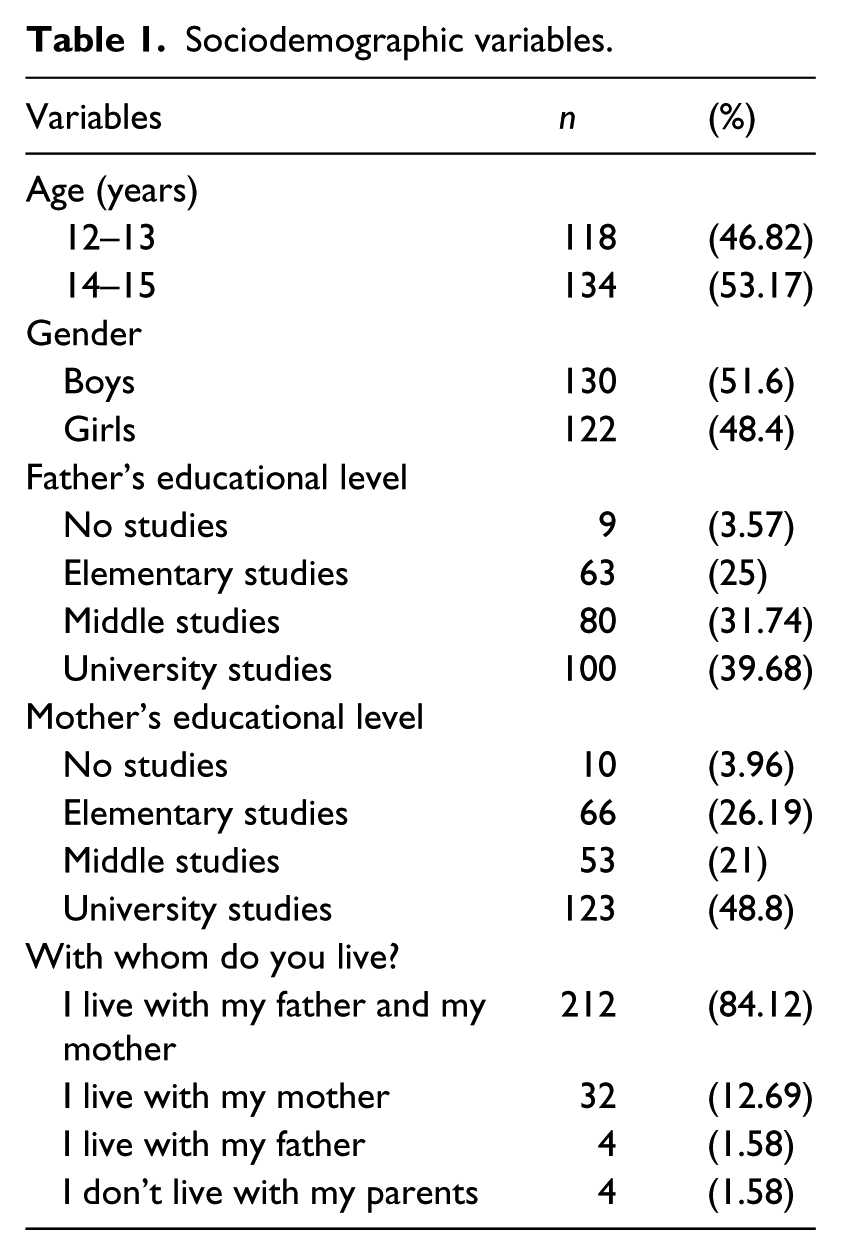
The study comprised students aged between 12 and 15 years. Adolescents who presented special educational needs or who were in psychological or psychiatric treatment were excluded from the study. Participants who did not pass a sincerity questionnaire included in the instrument were also ruled out of the study. Out of 268 potentially eligible students, 16 were eliminated due to diverse exclusion criteria, so the final sample comprised 252 participants: 130 boys (51.58%) and 122 girls (48.41%), with ages between 12 and 15 years. The mean and median ages of the adolescents were 13.54 and 14 years, respectively (standard deviation (SD) = .85 years). Table 1 shows that among the fathers, there was a predominance of those who had university and middle studies (39.68% and 31.74%, respectively), whereas among the mothers, those who had completed university studies predominated (48.8%). Most of the children lived with both parents (84.12%).
Sociodemographic variables.
Procedure and design
We used a cross-sectional design with a sample of nonclinical adolescents from a secondary education institute, assessed during the 2010–2011 school term, within the framework of a research project financed by the regional government. We selected this school because it was in a neighborhood with a population of similar sociodemographic characteristics to those of the rest of the urban population of that area. The protocol employed includes a questionnaire made up of 201 items, which was completed by adolescents sampled, and which requires about 35 minutes in most cases. This instrument collected the sociodemographic variables (age, sex, parents’ educational level, and family structure), as well as the variables of the study. The project was approved by the Ethics and Clinical Research Committee of the University Hospital Virgen de la Arrixaca (Murcia, Spain).
Measures
Sociodemographic variables
This included age, gender, family co-existence, and parents’ educational level. Age was categorized into two groups: I (12 and 13 years) and II (14 and 15 years). Family co-existence was divided into four categories: (a) I live with both my parents, (b) I live with my mother, (c) I live with my father, or (d) I don’t live with my parents. Parents’ educational level was categorized as (a) no studies, (b) elementary studies, (c) middle studies, and (d) university studies.
Externalization
We used the Youth Self-Report (YSR; Achenbach, 1991), a self-administered questionnaire designed to obtain information directly from children and adolescents between 11 and 18 years about diverse competences and behavior problems. It has two parts: the first part assesses sports, academic, and social competences; and the second part is made up of 112 items that assess prosocial behaviors and behavior problems.
For this study, we used the items that measure the factors verbal aggressiveness and behavior problems, due to their greater internal consistency, according to validation studies in Spanish with this instrument (Lemos Giráldez et al., 2002).
Impulsivity
We used the Impulsivity Scale (Barratt, 1985), in its validated Spanish version (Luengo et al., 1991), which has levels of internal consistency of about .90. The motor subscale of this instrument was used because we considered it the most appropriate for the purposes of the study.
Attitudes toward violence
The Cuestionario de Actitud Hacia la Violencia (CAHV-25; in English, the Questionnaire of Attitudes toward Violence; Ruiz Hernández et al., 2009) was used. This instrument has four factors: violence as a form of fun (7 items, Cronbach’s α = .78), violence to improve self-esteem (5 items, Cronbach’s α = .78), violence to cope with problems and social relations (6 items, Cronbach’s α = .68), and violence perceived as legitimate (7 items, Cronbach’s α = .72). The level of total internal consistency of the instrument was .90.
Parental style
To study this variable, the adolescents completed the Cuestionario sobre Estilos Disciplinarios de los Padres (in English, the Questionnaire of Parents’ Disciplinary Styles), elaborated and validated by Torrente Hernández and Vazsonyi (2008). This self-administered instrument is made up of 52 items, which classify educational styles as inductive, authoritarian, permissive, and over-protective, based on the educational patterns described by Baumrind (1991). The reliability analyses of the questionnaire has provided Cronbach’s alpha values of α = .77 for paternal styles and α = .69 for maternal styles.
Sincerity
Due to the problems of sincerity usually present in adolescents’ self-reports, two control methods were included in the instrument: the sincerity subscale included in the Cuestionario de Auto-Control Infantil y Adolescente (CACIA; in English, the Children and Adolescent Self-Control Questionnaire; Capafons and Silva, 1998), which was considered appropriate because it is short (only 14 items), simple, and easy to understand; and one self-reported sincerity question (“How would you rate your sincerity?”).
Data analyses
Student’s t-test was performed to examine the sociodemographic variables. To examine the psychosocial variables, we performed Pearson correlation analysis and, in order to determine a predictive model of externalizing behavior, stepwise multiple linear regression analysis was used with the variables previously identified as relevant. The results of the regression analysis were subjected to a cross-validation, confirming its stability. The level of significance was defined for values of p < .05.
Results
Significant differences as a function of adolescents’ age and gender were obtained. In the case of age, the mean scores in attitudes toward violence were higher in the group of 14- to 15-year-old children (p < .001). Significant differences by age were also found in the permissive maternal parental style, which obtained a higher score among the 12- to 13-year-old children (t(241) = −2.237, p = .026). With regard to the dependent variable externalizing behavior, were obtained age differences in the factor verbal aggressiveness, in which the 14- to 15-year-old children scored higher (t(241) = −2.476, p = .014).
Gender differences in the variable impulsivity were found, with higher scores among the girls (t(250) = −2.31, p = .022). In the dependent variable externalizing behavior, the boys obtained significantly higher scores in the factor behavior problems, (t(250) = 2.948, p = .004), whereas the girls scored higher in verbal aggressiveness (t(250) = −2.043, p = .042).
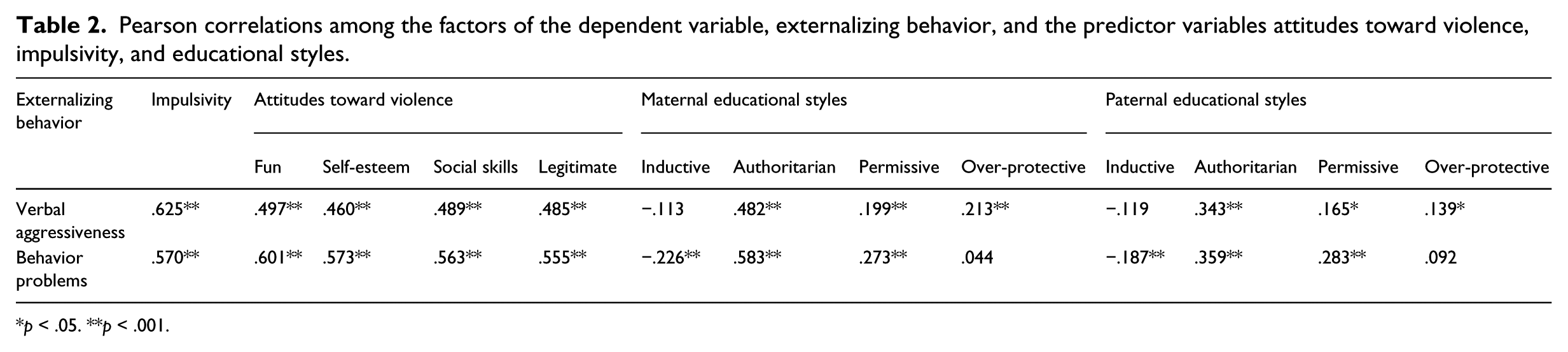
As seen in Table 2, there were significant correlations between verbal aggressiveness and all the factors of the variable attitudes toward violence, range from .460 to .497 (p < .01), as well as with the variable impulsivity (r = .625, p = .000). Verbal aggressiveness also correlated positively with the authoritarian, permissive, and over-protective maternal (range = .199–.482, p < .01) and paternal parental styles (range = .139–.343, p < .05).
Pearson correlations among the factors of the dependent variable, externalizing behavior, and the predictor variables attitudes toward violence, impulsivity, and educational styles.
p < .05. **p < .001.
Moreover, behavior problems correlated significantly with all the factors of attitudes toward violence (range = .555–.601, p < .01), and impulsivity (r = .570, p = .000). With regard to parental styles, behavior problems correlated negatively with maternal (r = −.226, p = .001) and paternal (r = −.187, p = .009) inductive styles, and positively with maternal (r = .583, p = .000) and paternal (r = .359, p = .000) authoritarian styles, and with maternal (r =.273, p = .000) and paternal (r = .283, p = .000) permissive styles.
In the analysis, the variables that were relevant after performing the bivariate correlational analyses were included. The regression model provides the following results for each one of the factors of the variable externalizing behavior, adjusted by gender.
Verbal aggressiveness
In male children, verbal aggressiveness was associated with impulsivity (β = .403, p = .000) and with attitudes toward violence as a way to improve self-esteem (β = .308, p = .000). The goodness of fit of the model (corrected determination coefficient) was adjusted, R2 = .365, p = .000.
In contrast, verbal aggressiveness in females was associated with impulsivity (β = .554, p = .000) and with attitudes toward violence as a form of social skill (β = .334, p = .000), although in this case, the goodness of fit was higher (adjusted R2 = .500, p = .000).
Behavior problems
The regression model of the boys explains 57.5 percent of the variance (adjusted R2 = .575, p = .000), and indicates that behavior problems are associated with impulsivity (β = .334, p = .000), attitudes toward violence as a form of social skill (β = .329, p = .000), and authoritarian maternal (β = .423, p = .000) and paternal (β = −.231, p = .002) parental styles. Similar results were obtained in girls (adjusted R2 = .568, p = .000), although in this case, the variables that best fit the regression model were attitudes toward violence as a form of fun (β = .447, p = .000), impulsivity (β = .296, p = .000), and permissive paternal (β = .179, p = .004) and authoritarian maternal styles (β = .177, p = .013; see Table 3).
Multiple linear regression model for the factors of externalizing behavior: verbal aggressiveness and behavior problems.

ANOVA: analysis of variance; B = nonstandardized regression coefficient; S = standard error; β = standardized regression coefficient; R = multiple correlation coefficient; R2 = determination coefficient; Se = standard estimation error.
Stepwise method was used.
Discussion
This study provides evidence of the importance of impulsivity in the diverse types of adolescents’ externalizing behavior, which is consistent with prior research that concludes that impulsivity foments people’s aggressive reactions, especially anger when dealing with events that are perceived as stressful (Eisenberg et al., 2004). Thus, intervention on this dimension is essential to address externalizing behavior problems, implying an approach focused on enhancing parents’ skills and improving adolescents’ social skills, and even psychopharmacological treatment (Turgay, 2005). However, we found gender differences, both in parental styles and in attitudes toward violence, in the diverse types of externalizing behavior assessed.
First, the results relate verbal aggressiveness to impulsivity and to attitudes toward violence. In the case of the boys, greater influence of attitudes oriented to promoting self-esteem was observed. However, among the girls, this type of behaviors seems to be associated with attitudes toward violence as a way to cope with problems and social relations. These differences in attitudes could be related to the effect of traditional gender stereotypes, transmitted through primary and secondary socialization processes, in which aggressive behavior is identified with domination of others in the case of boys (Cowie, 2000), and the use of indirect violence as a response to situational pressure in the case of girls (Olweus, 2005).
Second, externalization manifested as behavior problems appears in males with a high level of impulsivity, who use violence as a way to solve problems and who have received an authoritarian style from their mothers. With regard to this result, Tolan (2007) found that the use of coercive parental styles is usually associated with violence in the family sphere. Continued exposure to violent patterns could act as a kind of social modeling, favoring greater predisposition to use violence to resolve conflicts. However, our results also indicate that the paternal authoritarian style has an inhibitory effect on this type of behaviors. Apparently, boys show a tendency to rebel against maternal authority, whereas, in contrast, they accept the authoritarian educational customs of the father. This phenomenon could be related to fathers’ lesser involvement in their adolescent children’s socialization: the fact that it is the mother who habitually sets limits on her children’s behavior, with the fathers intervening only occasionally, could make adolescents tend to assign more “value” to paternal disciplinary acts, to the detriment of the maternal ones. To this is added the effect of the above-mentioned gender stereotype, which would induce boys’ rejection of maternal authoritarian acts.
In girls, this type of externalization is related to a higher level of impulsivity, attitudes toward violence as a form of fun, and inconsistent interparental styles. In this sense, the constant reception of contradictory, permissive, or indulgent messages from the father and coercive or authoritarian messages from the mother could decrease girls’ ability to discern the difference between what is or is not socially acceptable. This could reduce their empathic capacity toward their peers and favor the tendency to minimize the negative effects of violence, which is accepted as just another way of having fun.
In general, the models suggested by the results obtained could be understood from the perspective of gender stereotypes and their effect on adolescents’ attitudes, and family socialization, which assigns an active, intrepid, resolute role to males, and a prudent and discrete role to females (Young and Sweeting, 2004). Likewise, our results are in line with other works that relate aggressive behaviors to the maternal authoritarian style (Mitchell et al., 2009) and that underline the role of inconsistent educational styles in the development of behavior problems. The presence of ingrained attitudes toward violence would contribute to the adolescents’ developing externalizing behaviors that could appear impulsively, when adolescents are incapable of anticipating the possible consequences of their acts, or intentionally, when, after appraising the consequences, they consider them acceptable (Dodge and Petit, 2003).
However, this study has some limitations that should be considered. First, although the sample size is suitable, it was not possible to perform probabilistic sampling. To minimize this limitation, a public school located in a neighborhood with sociodemographic and economic characteristics similar to those of the rest of the urban population was selected.
Another limitation concerns the use of self-report questionnaires in adolescents whose information may not be reliable (Kamphaus and Frick, 1996). Therefore, we used a sincerity questionnaire, as indicated in the corresponding section.
A noteworthy fact is that girls obtained the highest scores in impulsivity, which contradicts the literature (Chapple and Johnson, 2007; Eysenck, 1993; Olson et al., 1999). Although this result might be related to gender differences in parenting styles, which is consistent with a study showing the importance of the family in impulsive behavior (Paaver et al., 2008), these data should be treated with caution until they are contrasted in multicenter studies with a larger sample size.
Finally, in view of the relations found between gender and parental style, we think it would be interesting to develop studies aimed at analyzing the differences in the educational patterns practiced by parents as a function of their children’s gender, and the implications in the development of attitudes toward violence. The methodology employed in this work does not allow us to establish causal relations among the variables, so this analysis should be carried out by means of other methodological designs, like randomized clinical trials.
Footnotes
Funding
This research received no specific grant from any funding agency in the public, commercial, or not-for-profit sectors.