




Abstract
This study distinguished constructive (e.g. planning/problem-solving) and unconstructive (e.g. worry) processing in expressive essays and their impact on depressive symptoms, healthcare visits, and physical symptoms. Affect labeling, achievement orientation, and insight utilization were examined as mediators. Essays from 43 medical students were coded; mediators were identified through linguistic text analysis. Outcomes were assessed at baseline and 3 months. Constructive processing predicted declining depressive symptoms (β = −.33, p < .05) and healthcare visits (β = −.61, p < .01). Unconstructive processing predicted increasing healthcare visits (β = .42, p < .05). Higher affect labeling mediated the effect of constructive processing, and lower achievement orientation mediated the effect of unconstructive processing.
Keywords
Regulating emotional responses to stressful circumstances has adaptive potential for protecting and promoting physical and emotional health (Folkman and Moskowitz, 2004). Emotion-regulatory processes can take many forms and include both automatic and effortful strategies that are employed to influence both the generation and experience of emotions (see Gross, 2014). Strategies can include efforts aimed at selecting or modifying aspects of a stressor, directing attention toward or away from stressors, reappraising one’s associated thoughts, or modulating internal or external responses to an experienced emotion (Gross, 2001). These responses are activated in service of either up- or down-regulating negative or positive emotions. Health psychologists have typically considered emotion regulation in the context of coping (see DeSteno et al., 2013).
Research is mounting on the potential benefits of emotion-regulating coping (Stanton, 2011). Coping with stressful circumstances via emotion-regulation efforts, in part, involves two overlapping yet distinct facets: emotional expression and emotional processing (Stanton, 2011). Emotional expression represents active verbal and non-verbal efforts to communicate or symbolize stressor-related emotional experiences, whereas emotional processing includes active attempts to acknowledge, explore, and come to understand one’s emotions. Emotionally expressive coping with specific stressful experiences has significant adaptive potential, particularly when circumstances are uncontrollable, within an interpersonal environment supportive of emotional expression, and when an individual is dispositionally inclined toward emotional experiencing and expression (Frattaroli, 2006; Pennebaker and Chung, 2011; Stanton and Low, 2012). However, findings related to coping through emotional processing have been more varied, showing associations with better adjustment to stress (Hoyt et al., 2013a, 2013b; Manne et al., 2007) as well as with greater distress (Hoyt, 2009; Stanton et al., 2000a) and rumination (Stanton et al., 2000b). Likewise, some individuals do not benefit from emotion-focused writing interventions that are designed to foster emotional processing (Frattaroli, 2006). These equivocal findings regarding one facet of emotion-regulating coping supplicate the question of how one should process emotions toward maximal adaptive utility and benefit to health.
Emotional processing has been identified as a beneficial component of expressive writing interventions (Martino et al., 2013). This study identifies specific attempts at processing via examination of emotionally expressive essays written as part of a randomized controlled trial with a sample of third-year medical students (n = 64) in the midst of a demanding medical clerkship (Austenfeld et al., 2006). Although the original trial, which tested two experimental writing conditions (described below), did not yield significant main effects of writing condition, moderators were identified. For instance, medical students who reported high use of emotion-regulating coping strategies evidenced fewer depressive symptoms over time when writing about their deepest emotions, whereas individuals reporting a relatively lower tendency toward coping via emotion-regulating efforts demonstrated lower depressive symptoms with goal-directed writing. This and other studies (e.g. Lu and Stanton, 2009; Lumley, 2004; Niles et al., 2014) have identified moderators of writing effects, yet more work is needed to identify mediating processes. Identification of mediators will help distinguish adaptive and maladaptive engagement with emotion and serve to sharpen future research on psychological adjustment to stress.
Methods of repetitive or engaged processing of thoughts or feelings can take multiple forms, with varied consequences on psychological and physical outcomes. Methods of engagement have been construed as having a “constructive” or “unconstructive” function (see Watkins, 2008). Based on empirical literature (e.g. Segerstrom et al., 2003; Watkins, 2008), we identified potentially adaptive methods of processing, which include problem-solving and planning, discovery of meaning, values clarification and affirmation, goal-focused reflection, and those more often considered less constructive (i.e. depressive rumination, worry, anger rumination, and self-evaluative reflection) with regard to adjustment to stressful circumstances. The current investigation adds to the limited research aimed at distinguishing the impact of constructive and unconstructive processing, determined by systematic coding of expressive essays, on emotional and physical health.
It will be useful to identify the pathways by which processing efforts might promote or detract from health. Thus, we also were interested in how identified processing methods might confer benefit, with a focus on three possible mechanistic processes identified in the literature: affect labeling, insight utilization, and achievement orientation. Research demonstrates the importance of affect labeling. Identifying emotions might facilitate attention to the emotional state and facilitate habituation (Low et al., 2006, 2008). For instance, converting emotional experiences into words might dampen amygdala activation (Lieberman et al., 2007). Approaching emotions might also provide an opportunity for gaining insight through building a coherent narrative and making meaning of the stressful experience (Pennebaker and Chung, 2011), potentially promoting cognitive and narrative changes (Kaufman and Sexton, 2006; Smyth et al., 2001). For instance, Wagner et al. (2010) noted that making meaning during expressive writing reflected shifts in cognitive perspectives on one’s disease in HIV-positive women. Finally, coping through emotion-regulating efforts might enhance achievement orientation leading one toward focused attention on important life goals (King, 2001, 2002). Attentional efforts toward valued goals have potential to assist individuals to clarify priorities, guide committed actions, and foster the ability to adjust to challenged or blocked goals. Adjustment to goals challenged by stressful circumstances constitutes adaptive self-regulation (Wrosch et al., 2003). Specifically, emotional responses might serve to clarify pathways and potential barriers to goal attainment, which in turn could initiate a cascade of cognitive and behavioral events that contribute to improved navigation of barriers.
The present investigation examined how writing about emotions or successful goal attainment reflects engagement in constructive and unconstructive methods of processing and how these processes affect mood and health indicators in a sample of medical students under significant training demands. Specifically, the essays from Austenfeld et al. (2006) were coded for statements reflecting methods of processing: values clarification, problem-solving/planning, worry, anger rumination, self-evaluation, and depressive rumination. Finally, affect labeling, insight utilization, and achievement orientation have been identified as possible mechanisms by which constructive emotional processing might work to improve adjustment to stressful circumstances (see Stanton and Low, 2012). Thus, these were considered as possible mediators of relationships. The conceptualized relationships are depicted in Figure 1.
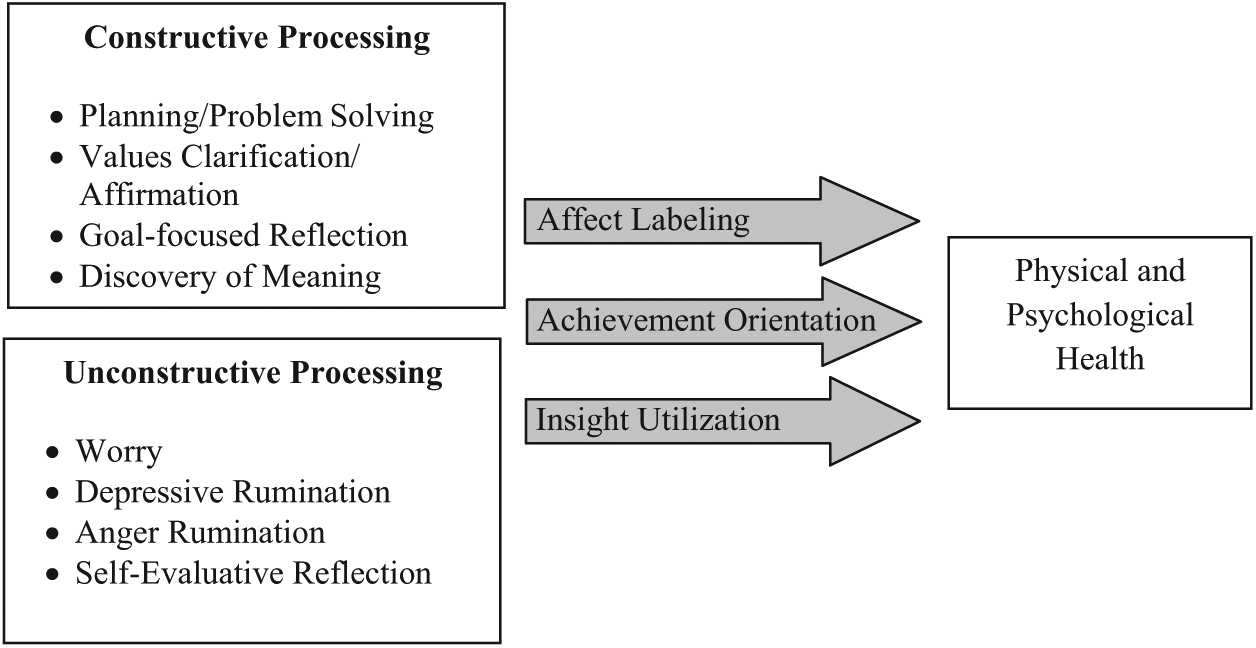
Conceptual model of constructive and unconstructive processing.
Method
Participants
Participants were medical students recruited during their third year who had completed at least 4 weeks of any of six clinical rotations (e.g. surgery, internal medicine, pediatrics). A complete description of study procedures is provided in Austenfeld et al. (2006). In the current investigation, only participants randomly assigned to the experimental conditions instructed to write about their deepest emotions (EMO) (n = 22) or about imagined goal attainment as the “best possible self” (BPS; after King, 2001) (n = 21) were included. 1 These were 24 men (55.8%) and 19 women. Participants were on average 26.47 years old (standard deviation (SD) = 3.95, range: 23–42) and predominantly White (83.7%), with 2.3 percent African American, 4.7 percent Latino, and 9.3 percent Asian.
Procedure
In an initial session, participants provided written informed consent and completed questionnaires. They were randomly assigned to one of three conditions in which they were instructed to write about (a) their deepest thoughts and feelings about their most traumatic or frustrating experiences during their medical clerkships (EMO), (b) imagined future attainment of life goals including a description of how they overcame at least one major obstacle (BPS), or (c) a neutral fact control. Two subsequent writing sessions were scheduled at least 1 week apart, with all three sessions completed within 8 weeks. In each session, participants were instructed to write for 25 consecutive minutes. All writing was completed individually in a classroom at the medical school. All procedures were approved by the institutional review board.
Dependent measures
At baseline and at the 3-month follow-up, participants completed written questionnaires to assess psychological and physical symptoms. Depressive symptoms were measured with the 20-item Center for Epidemiologic Studies Depression Scale (CES-D) (Radloff, 1977), which is a valid measure of depressive symptoms in the general population (Roberts and Vernon, 1983). Cronbach’s alpha was .91 at both administrations. Physical symptoms were assessed with a 9-item version of the Pennebaker Inventory of Limbic Languidness (PILL; Pennebaker, 1982). Participants indicated on how many of the last 30 days they experienced physical symptoms (e.g. coughing/sore throat) unrelated to physical exercise.
Medical care utilization was recorded as the number of medical visits participants had for physical illness (excluding injuries) for 3 months prior to study entry and the 3 months following the final writing session, as counted by health center staff of the treating physicians. The number of appointments for both time periods was available for a subset of 35 participants.
Essay coding
This study called upon methods employed in previous studies to identify methods of emotional processing (Bower et al., 1998; Creswell et al., 2007). However, no coding methods for identifying the specific constructive and unconstructive processes of interest exist. Table 1 contains operational definitions and examples of these processes. A manual was developed with detailed coding instructions. The 129 essays (43 participants × 3 essays) were content analyzed by three groups of three trained coders who were unaware of study hypotheses.
Constructive and unconstructive processing methods.

SD: standard deviation.
Coders examined each essay independently and reached consensus within groups. Essays were coded on a line-by-line basis with a sentence being the smallest unit of text that could be coded to a category, though multiple consecutive sentences could be coded as a single “text unit.” Frequency counts of coded text units (across all essays) were used in the final data analyses and appear in Table 1. Some statements were coded in multiple categories if they were consistent with the category definitions; thus, each category was not considered to be independent. In assessing inter-rater reliabilities among the coders, agreement statistics were calculated between coding pairs. High inter-judge reliability was obtained for constructive (89%–92% agreement across categories) and unconstructive (90%–93% agreement across categories) processing. Following coding procedures, composite measures of “constructive” and “unconstructive” processing were computed by averaging scores. Composite measures were used in all analyses.
Linguistic content analysis
The Linguistic Inquiry and Word Count (LIWC) text analysis program (Pennebaker et al., 2006) was used to identify potential mediational processes. The LIWC program computes the percentage of words judged to reflect specific content categories. Three LIWC content categories were computed: affect labeling (i.e. positive and negative emotion words), insight-oriented words (e.g. think, know, consider), and achievement orientation (e.g. earn, hero, win). Percentage scores for each text category were computed for each writing session, and an average score was computed for each individual.
Results
Preliminary analyses
Table 1 contains frequencies of coded processing methods. Relationships among constructive methods were positive and statistically significant; correlation coefficients ranged from .24 to .57 (ps < .05). Likewise, relationships among unconstructive methods were positive and significant (r = .26–.50, ps < .05). Finally, correlations between constructive and unconstructive methods were in expected directions, though not all individual correlations were significant (r = −.02 to −.44). Relationships between demographic and dependent variables were examined. Participant age, partner status, and sex were significantly related to at least one dependent variable and were therefore entered as covariates, along with average essay word count (to account for variation in essay length).
Preliminary analyses examining effects of experimental condition revealed that writing condition did not interact significantly with methods of processing or with mediating processes on outcomes. Therefore, writing condition was not included as a variable in primary analyses.
Relationships between processing methods and dependent variables
Depressive symptoms, physical symptoms, and healthcare visits at follow-up were separately regressed on constructive and unconstructive processing methods (entered simultaneously), controlling for baseline values of dependent variables and covariates using multiple linear regression.
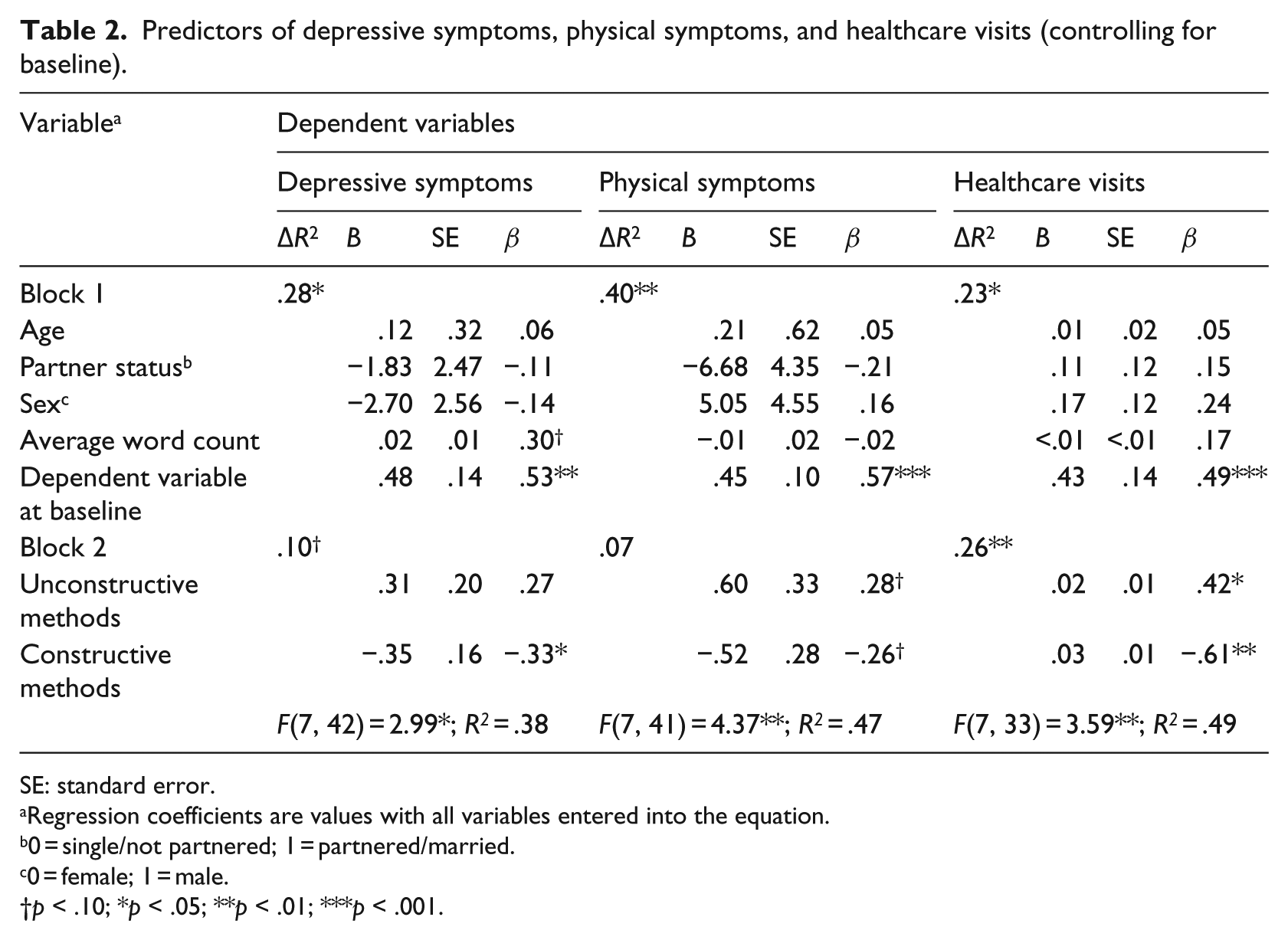
As reported in Table 2, constructive processing was significantly associated with a decline in depressive symptoms (β = −.33, p < .05) and healthcare visits (β = −.61, p < .01). The relationship with physical symptoms was in the same direction and approached significance (β = −.26, p < .10). The use of unconstructive processing predicted an increase in healthcare visits (β = .42, p < .05) and approached significance for physical symptoms (β = .28, p < .10) (but not depressive symptoms). 2
Predictors of depressive symptoms, physical symptoms, and healthcare visits (controlling for baseline).
SE: standard error.
Regression coefficients are values with all variables entered into the equation.
0 = single/not partnered; 1 = partnered/married.
0 = female; 1 = male.
p < .10; *p < .05; **p < .01; ***p < .001.
Mediation models
Mediation analyses were performed using path analysis with individual tests of specific mediational paths to examine whether affect labeling, insight utilization, or achievement orientation mediated each statistically significant relation between processing methods and outcomes (see Table 2). Pearson correlations of processing with putative mediators were not significant for insight utilization with constructive processing or affect labeling with unconstructive processing. Thus, these were not candidates for mediation (Baron and Kenny, 1986).
The mediated effects were tested based on bootstrapped standard errors for indirect paths generated in Mplus 3.0 (Muthén and Muthén, 2004), which makes fewer assumptions about the sampling distribution than other methods for assessing mediation (see MacKinnon, 2008). The mediated effect statistic is the product of the unstandardized path for the relation between the independent variable and the mediator and the unstandardized path of the relation between the mediator and the outcome. Significance of the mediated effect is determined by dividing the mediated effect by the bootstrapped standard error generated in Mplus.
Constructive processing was associated with more affect labeling (β = .49, p < .001), which in turn was related to declining depressive symptoms (β = −.29, p < .05). The mediated effect of affect labeling was significant (−1.97, p < .05). Unconstructive (β = −.44, p < .01) and constructive (β = .73, p < .001) processing also predicted achievement orientation, which in turn was related to fewer healthcare visits (β = −.43, p < .05). The mediated effect of achievement orientation was significant for healthcare visits (−.16, p < .05) in the case of unconstructive processing, but not constructive processing (.03, ns). Achievement orientation was not significantly related to depressive symptoms (β = .16, ns). Insight utilization was not significantly related to healthcare visits (β = −.06, ns).
Discussion
These findings provide insight into the manner in which individuals engage in coping through processing of stressor-related emotions. The multidimensional, inter-related constructive and unconstructive processing methods identified in expressive essays illuminate the qualities of processes that contribute to psychological and physical health during stressful circumstances. The use of constructive processes in essays was related to lower depressive symptoms and healthcare visits even when controlling for baseline values. Unconstructive processing was associated with more medical visits. The observation that both constructive and unconstructive processing accounted for a unique 26 percent of the variance in the objective health indicator of medical appointments for illness is particularly notable. Results for physical symptoms followed this trend, but only approached statistical significance.
Mediation analyses pointed to two potential mechanisms of operation and supported the notion that one way in which constructive processing affects health outcomes is by facilitating affect labeling, whereas unconstructive processing might be constricting orientation toward goal achievement. Putting feelings into words during the act of problem-solving, making meaning, or clarifying goals or values related to stressors might attenuate the intensity of emotional experience or facilitate the constructive nature of these processing methods (Folkman, 1997). Improving an individual’s repertoire of emotional language, ability to identify and describe emotion, and increasing the complexity of emotional awareness may prove to be fruitful therapeutic strategies in adaptation to stress. Labeling emotions may be related to more integrative cognitive processing, which is an identified mechanism of expressive writing (e.g. Bower et al., 1998; Westling et al., 2007; see also Smyth et al., 2012). Constructive processes of engagement have potential to foster thought restructuring or schematic change related to the stressor. Additional work exploring this possibility will likely enhance future expressive writing interventions. Notably, affect labeling was not related to unconstructive processing (e.g. anger rumination, depressive rumination), suggesting that perhaps displays of such affect-laden rumination lack direct identification of emotional experience. To the extent that affect labeling represents cognitive mechanisms of change, unconstructive forms of processing might thwart adaptive cognitive engagement with emotion.
Achievement orientation was also identified as a mediating process of unconstructive processing methods. Worry and ruminative processes might work to direct attention away from important achievement goals and perceptions, which ultimately could result in an impaired ability to accomplish goals. Intentional efforts at effective goal navigation and achievement during stressful periods could confer protection from unconstructive processing (Rasmussen et al., 2006).
This study contributes to the much-needed task of dismantling coping through emotional processing through in-depth analyses of essays from an expressive writing study. Furthermore, identified variables predicted changes in health outcomes over 3 months when controlling for baseline values on the outcomes. Despite these findings, limitations should be considered. This study involved secondary analyses of data from a relatively small and homogenous sample of medical students. Although underpowered, outlier analyses did not suggest results were driven by extreme cases. Future work should explore these processes in larger and more diverse samples. Designs using experimental manipulations of the examined processes are needed to allow causal conclusions. In this study, participants were given one of two different writing instructions. The two groups did not differ on health outcomes or on their use of constructive or unconstructive styles; however, the type of writing task may be influencing results by other means. Furthermore, manipulation of writing instructions might bolster engagement with mechanistic processes (e.g. prompting for focus on goal attainment). Although all coded passages in this study were in reference to an identified stressor, it is possible that some strategies (e.g. goal-focused reflections) occur outside of emotion-regulation efforts. Also, it is important to note that coded processes have potential conceptual overlap (e.g. depressive rumination and self-evaluative reflection). Although considerable overlap of coded processes was not observed in this study, this possibility should be considered in future research. Finally, although the LIWC-measured mediators were identified on a sound conceptual and empirical basis, the temporal order of their occurrence cannot be determined in this study. Also, additional mediational processes (e.g. cognitive reappraisal, physiological habituation) may also be relevant. However, these findings provide useful insight into methods and mechanisms involved in the effectiveness of emotion-directed coping efforts.
This study provides support for a conceptual framework that begins to shed light on the varied empirical findings regarding coping by emotional processing. Targeting specific methods of engaging with emotion may be a useful enhancement for expressive writing interventions. Supplementing traditional expressive writing interventions with psychoeducation about adaptive emotion regulation holds promise (e.g. Horn et al., 2011). Increasing self-awareness of tendencies toward constructive or unconstructive styles coupled with fostering facility with constructive styles might serve to maximize health benefits. The impact of processing styles through other forms of writing (e.g. creative writing) on health should also be considered (see Murray, 2009; Nicholls, 2009). More important, these results inform the growing body of research on emotion-regulating coping efforts. Researchers should consider assessing methods of emotional processing to buttress traditional coping questionnaires (e.g. Emotional Approach Coping Scales; Stanton et al., 2000b). Such research will provide a more complete picture of efforts toward emotion regulation and aid in interpreting the impact of coping by emotional processing on health outcomes.
Footnotes
Declaration of conflicting interests
The author(s) declared no potential conflicts of interest with respect to the research, authorship, and/or publication of this article.
Funding
The author(s) disclosed receipt of the following financial support for the research, authorship, and/or publication of this article: This research was supported in part by the National Institute of Mental Health (5T32MH015750).