




Abstract
We tested the theory of planned behaviour with additional norms to predict the sun-protective decisions of young female beachgoers in Australia. Participants (N = 336) completed standard theory of planned behaviour measures and additional normative factors (group, image and personal norms). Attitude, subjective norm, and both personal and group norms predicted intention. Intention and group norm predicted follow-up behaviour. These findings provide further evidence that it is the more proximal sources of norms reflecting one’s personal and referent group influences, rather than perceptions of broader societal norms about the attractiveness of tanned images, that are important in determining young women’s sun-protective decisions.
Keywords
Skin cancer poses a significant global disease burden with incidence rates steadily increasing in many countries worldwide (e.g. America; American Cancer Society, 2014). In Australia, skin cancer remains the most prevalent cancer (Australian Institute of Health and Welfare (AIHW) and Cancer Australia, 2008) with the state of Queensland holding the highest age-standardised incidence (AIHW and Australasian Association of Cancer Registries, 2012) and mortality rates for malignant melanoma in the world (Queensland Government, 2012). Although sun exposure is the main risk factor associated with melanoma (Armstrong, 2004), sun protection in adults remains low with only 36 per cent of adults using sunscreen when outdoors in peak ultra-violet radiation (UVR) hours on the weekend (Volkov et al., 2013). Women tend to have positive attitudes towards and engage in deliberate sun tanning (Day et al., 2013; Kasparian et al., 2009; Stanton et al., 2004), making them more at risk of negative health consequences of sun exposure. Further-more, Caucasians have lower epidermal melanin levels than darker-skinned people which provides less inherent skin-protective factor (SPF) (Narayanan et al., 2010), and younger adults are less likely to sun protect than older adults (Kasparian et al., 2009). Young Caucasian women, therefore, are a particular at-risk group for developing skin cancer and are the focus of this study. The current research examined the utility of a commonly utilised decision-making model, the theory of planned behaviour (TPB) (Ajzen, 1991), and additional normative influences, for predicting the sun-protective actions of young Caucasian female beach visitors in a high skin cancer risk area.
According to the TPB, the impact of attitudes (i.e. positive or negative evaluations of performing a behaviour), subjective norm (SN; i.e. social pressure to perform/not perform a behaviour), and perceived behavioural control (PBC; i.e. perceived ability to perform a behaviour) on behaviour is mediated by the effects of intention (Ajzen, 1991). PBC is proposed also to influence behaviour directly (Ajzen, 1991). Armitage and Conner’s (2001) meta-analysis of 185 TPB studies found that the model accounts for 39 per cent of variance in intention and 27 per cent of variance in behaviour with more support for attitude (r = .49) and PBC (r = .43) than SN (r = .34) as predictors of intention. More recently, McEachan et al. (2011) reported that the TPB explains 44.3 per cent of variance in intentions and 19.3 per cent of variance in behaviour, again with more support for attitude (r = .57) and PBC (r = .54) than SN (r = .40).
A growing body of research has examined the TPB within the context of sun-protective–related intentions and behaviours. In general, among adult samples, the standard TPB predictors explain a moderate to large amount of variance in sun-protective intentions (23%–38%) and behaviour (25%–46%) and, consistent with meta-analyses across different health behaviours (Armitage and Conner, 2001; McEachan et al., 2011), attitude and PBC/self-efficacy tend to be more strongly predictive of intention compared to SN (Bodimeade et al., 2014; Janssen et al., 2013; Myers and Horswill, 2006; Pertl et al., 2010).
Health promotion interventions using a TPB approach have the potential to lead to substantial behaviour change (Webb et al., 2010) provided that sufficient formative work has been appropriately undertaken (Ajzen, 2014). For instance, White et al. (2010) implemented a TPB belief-based intervention with adolescents and observed a significant improvement in perceived normative support, motivator beliefs, intentions and behaviour for using sun protection 1 week post-intervention. Ongoing campaign (i.e. ‘SunSmart’) messages in Australia have, to a large extent, been presented in the form of skin cancer survivors’ narratives or reminders to use sun protection (e.g. ‘Slip [on sun-protective clothing]! Slop [on SPF 30+ sunscreen]! Slap [on a broad brimmed hat]! Seek [shade]! Slide [on sunglasses]!’) with only a recent acknowledgement of the importance of addressing beliefs underpinning sun-safe decisions (e.g. ‘There’s nothing healthy about a tan’) (see www.sunsmart.com.au). The TPB may, then, be useful in informing sun-safe messages (see Ajzen, 2006) to effectively promote sun protection in this high-risk context although, it should be noted, other approaches could also be useful (e.g. targeted message framing, increasing skin cancer knowledge, enhancing positive body image; Andrew et al., 2016; Day et al., 2014; Hevey and Dolan, 2014).
Although the TPB is a well-known decision-making model, there are varying degrees of support for each of the TPB predictors (Armitage and Conner, 2001). SN has not consistently predicted intentions, indicating a need for a re-conceptualisation or extension of the TPB’s normative component (e.g. Terry and Hogg, 1996; White et al., 2009). Some viable alternatives to the SN construct suggested in the context of sun-protective actions include ‘group norm’ (GN), ‘image norm’ (IN) and ‘personal norm’ (PN), previous research having suggested that these are empirically different from the standard TPB constructs (e.g. Beck and Ajzen, 1991; Terry et al., 1999).
In comparison to the SN construct, which takes into account perceived pressure from important others to perform a behaviour, GN takes into consideration descriptive norms (i.e. perceptions of what important others actually do) and group attitudes (i.e. perceived attitudes of group members). Previous research has found GN to significantly predict people’s intentions as part of an augmented TPB (Terry and Hogg, 1996; White et al., 1994) and a meta-analysis by Rivis and Sheeran (2003) showed that the inclusion of descriptive norms consistently increased the amount of variance explained in intention over and above the standard TPB factors. For sun-safe actions, Terry and Hogg (1996) found support for GN in predicting young females’ sun-protective behaviours while Jackson and Aiken (2000) demonstrated that friendship GN influenced sun-protective intentions. More recently, GN has predicted sun-safe intentions and behaviour directly in a sample of young adults (White et al., 2008) and was shown to influence recreational sportswomen’s sun-safe intentions in an experimental design (Robinson et al., 2013).
‘INs’ are cognitive representations of stereotypical members of particular groups perpetuated by the media and are similar to cognitive prototypes (see Rivis and Sheeran, 2003). INs refer specifically to the influence of media, fashion and entertainment industries and are a more general representation of the values of society as a whole (Jackson and Aiken, 2000). Previous research has shown support for IN as a predictor of intentions to sunbathe but not sun protect (Jackson and Aiken, 2000). Subsequent intervention-based research by Jackson and Aiken (2006), however, has provided some support for IN in sun-protective decisions. More recent investigations have not offered the same support for the role of IN in comparison to GN (Robinson et al., 2013; White et al., 2008). Given the equivocal findings, continued investigation of this construct is warranted.
There is increasing evidence that PN serves as a useful additional construct in the TPB (Conner and Armitage, 1998; Rivis et al., 2009) with PN emerging as an influential factor for a range of health-related behaviours (e.g. Jellema et al., 2013; Kam et al., 2009). PN reflects an individual’s internal values, moral rules and expectations about their own behaviour (Conner and Armitage, 1998). They differ from social norms in that they are represented by internal beliefs about whether or not the individual should engage in a given behaviour, rather than whether others believe they should engage in the behaviour (Parker et al., 1995). In the context of sun safety, PN reflects the feeling of personal responsibility for one’s own sun protection.
Current study
The aim of the current research was to examine the TPB with additional norms for understanding young women’s (aged 17–35 years) sun protection in an at-risk area for skin cancer (i.e. Queensland, Australia) and in a beach setting where sun safety is likely to be salient. Identifying influential factors that could be targeted to impact behaviour may serve to improve approaches to promoting protective behaviours among persons at risk of skin cancer. In addition to the standard TPB constructs (attitude, SN, PBC, intention), the predictive capabilities of GN (Terry and Hogg, 1996), IN (Jackson and Aiken, 2000, 2006) and PN (Conner and Armitage, 1998) were examined. In the present study, women were approached at a beach during the summer when there is likely to be explicit examples of people with tans or trying to obtain tans. In this decision-making context, the key determinants of behaviour may be more salient. Some prior inter-national studies have surveyed non-targeted groups of beachgoers (Eiser and Arnold, 1999; O’Riordan et al., 2008; Pagoto et al., 2010; Robinson and Rademaker, 1998), but these studies have lacked a theoretical basis and focussed mainly on sun-safe practices rather than behavioural determinants. This study used a comprehensive theoretical basis to examine sun-safe intentions and behaviour prospectively.
Consistent with the TPB, it was hypothesised that intentions to sun protect would be predicted by attitude, SN and PBC. For the additional norms, it was predicted that GN, IN and PN would predict intentions to sun protect. Intentions and PBC would, in turn, predict subsequent behaviour. In all analyses, we controlled for objective skin cancer risk: skin tone and family history of skin cancer (see Jackson and Aiken, 2000).
Method
Participants and procedure
The Queensland University of Technology’s Human Research Ethics Committee provided ethical clearance. A field sample of participants added situational relevance and validity given the context in which participants are deciding about whether to sun protect. Accordingly, participants were young adult Caucasian women who were visitors to beaches on the Sunshine Coast, Queensland, Australia and completed Time 1 (main questionnaire; N = 336; mean age = 23.26 years, standard deviation (SD) = 4.91 years) and Time 2 (follow-up behaviour questionnaire 2 weeks later; N = 119) data points.
Data collection occurred during summer where UV levels in Queensland range within extreme levels (i.e. UV Index of 11–14; Australian Bureau of Meteorology, 2012). Potential participants were approached while seated on the beach and were asked to participate in a study of skin cancer safety for the chance to win an AUD$200 sports store voucher. Participants supplied contact details (i.e. phone number or email address) if they consented to be contacted for a brief follow-up questionnaire 2 weeks later.
Measures
Consistent with TPB recommendations (Ajzen, 1991), the standard TPB variables were measured at the same level of specificity in terms of target, action, context, and time. Means were computed for all variables (unless otherwise stated). The target behaviour was: sun-protective behaviour (e.g., using SPF30+ sunscreen, wearing protective clothing such as a hat, long-sleeved shirt and sunglasses, seeking shade at peak hours of the day) every time I go in the sun for more than 10 minutes within the next fortnight (Cancer Council Australia, 2014).
Intention
Two items (r = .78) assessed intention (e.g. I intend to engage in (target behaviour), scored (1) strongly disagree to (7) strongly agree).
Attitude
Attitude was measured using six (α = .70) 7-point semantic differential scales (e.g. My engaging in (target behaviour) would be, (1) unpleasant to (7) pleasant).
SN
Two items (r = .27) measured SN (e.g. Most people who are important to me would approve of me engaging in (target behaviour), scored (1) strongly disagree to (7) strongly agree).
PBC
PBC was measured using four items, reflecting both self-efficacy and perceived control components, scored on a 7-point Likert scale (e.g. I have complete control over whether I engage in (target behaviour), scored (1) strongly disagree to (7) strongly agree. The reliability coefficient was slightly low (α = .48). Please note that all four items were retained given that the inter-correlations between any two PBC items did not exceed the α of .48.
GN
Based on previous research (e.g. White et al., 2008), three items (α = .81) measured GN for friends, with two items reversed (e.g. What percentage of your close friendship group would engage in (target behaviour), scored (1) none to (7) all). An elicitation study of a smaller number of the target population (N = 21; mean age = 24.30 years, SD = 4.71 years) revealed that the close friendship group was an appropriate reference group.
IN
Based on Jackson and Aiken (2000, 2006), five items (α = .71) assessed the IN for tanness (e.g. Young women in the media always seem to have a tan, scored (1) strongly disagree to (7) strongly agree).
PN
Based on Conner and Armitage (1998), two items (r = .53) assessed PN (e.g. I feel I ought to engage in (target behaviour), scored (1) strongly disagree to (7) strongly agree).
Objective risk
Consistent with Jackson and Aiken (2000), two items measuring skin tone (e.g. What is your skin tone, scored (1) very dark to (7) very fair) and family history for skin cancer (e.g. Do you have any family who have suffered from any type of skin cancer, scored 1 = No; 2–5 = Yes, melanoma/squamous cell carcinoma/basal cell carcinoma/unsure which type and 6 = Other, please state) assessed objective risk for skin cancer. Participants answered the latter item for six categories of types of skin cancer. The scores were dichotomised to indicate yes/no. These two items, skin tone and family history for skin cancer, were treated as separate predictors reflecting susceptibility.
Self-reported behaviour
Two weeks later, participants responded to a single item (in the past fortnight to what extent did you engage in sun-protective behaviour such as using 30+ sunscreen; wearing protective clothing such as a hat, long-sleeved shirt and sunglasses; seeking shade at peak hours of the day when you went out in the sun for more than 10 minutes, scored (1) not at all to (7) a large extent). To improve the reliability of the self-report data, participants were asked to provide details about the frequency and extent of their sun-protective behaviours during the 2-week period by stating and recalling in more detail how often they engaged in sun-protective behaviour and what kinds of sun-protective measures they used (open-ended questions).
Results
Mean responses indicated fairly strong intentions, PNs, perceptions of pressure from others and perceptions of control, with average scores slightly above the mean for attitude, GN, IN and behaviour. Two hierarchical multiple regressions were conducted to predict (1) intentions to engage in sun-protective behaviour in the next fortnight and (2) sun-protective behaviour at the 2-week follow-up. Means, SDs and correlations of the study’s variables are reported in Table 1. On average, young women engaged in sun-protective behaviour to a moderate degree (M = 4.23 on a 7-point scale) at follow-up. As shown in Table 1, skin tone, attitude, SN, PBC, GN and PN were significantly correlated with intention. GN and PN were the strongest correlates of intention; intention and GN were the strongest correlates of behaviour.
Means, standard deviations and bivariate correlations for standard TPB constructs and additional norms (N = 282).

TPB: theory of planned behaviour; M: mean; SD: standard deviation.
For behaviour, N = 119.
p < .05; **p < .01; ***p < .001.
A hierarchical multiple regression was performed predicting young women’s sun-protective intentions. After controlling for skin tone and family history of skin cancer at step 1, the standard TPB constructs of attitude, SN and PBC were entered at step 2. GN, PN and IN were entered at step 3. As shown in Table 2, step 1 variables significantly predicted young women’s intentions to sun protect accounting for 3 per cent (2% adjusted) of the variance in intentions, F(2, 279) = 4.09, p = .02. The TPB variables at step 2 significantly increased prediction by 22 per cent, Fchange(3, 276) = 26.09, p < .001, accounting for 24 per cent (23% adjusted) with attitude, SN and PBC as significant predictors. At step 3, GN, PN and IN significantly increased prediction by 22 per cent, Fchange(3, 273) = 36.54, p < .001, so that 46 per cent (44% adjusted) of the variance in intentions was explained, F(8, 273) = 29.07, p < .001. In the final model, the significant predictors were attitude, PBC, PN and GN.
Hierarchical multiple regression analysis with standard TPB constructs and additional norms on intention to engage in sun-protective behaviour in the next 2 weeks and behaviour at 2-week follow-up.
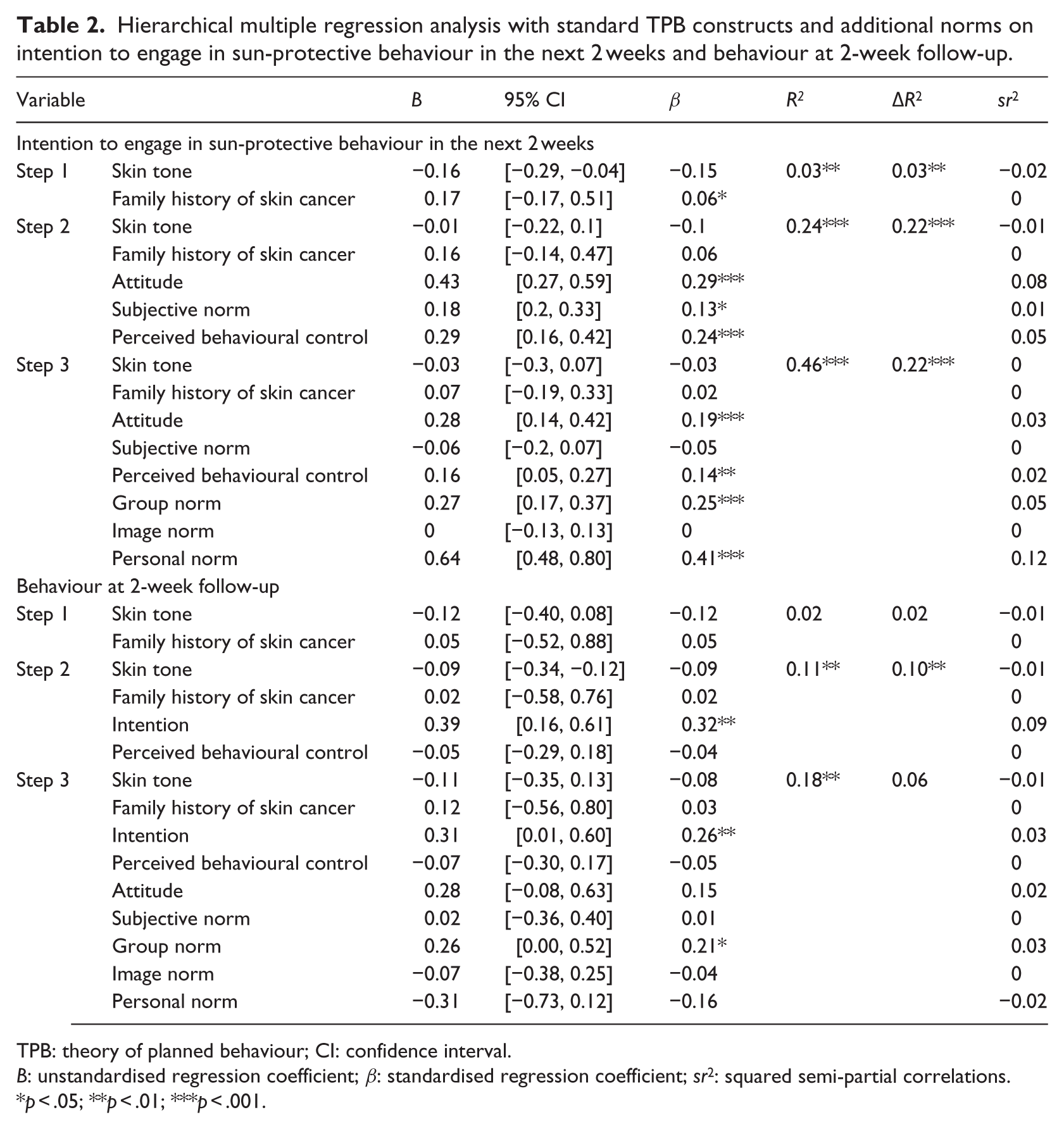
TPB: theory of planned behaviour; CI: confidence interval.
B: unstandardised regression coefficient; β: standardised regression coefficient; sr2: squared semi-partial correlations.
p < .05; **p < .01; ***p < .001.
The second hierarchical multiple regression was performed to predict follow-up behaviour. Skin tone and family history of skin cancer were controlled for in step 1. Intention and PBC were entered at step 2, with attitudes, SN, PN and IN entered at step 3. As shown in Table 2, skin tone and family history of skin cancer did not significantly predict behaviour at step 1, F(2, 116) = 1.10, p = .34. At step 2, intention and PBC accounted for a significant 11 per cent (8% adjusted) of the variance, F(4, 114) = 3.66, p = .003, with intention as the sole significant predictor at this step. Attitude, SN, GN, PN and IN did not account for a significant increase in variance at step 3, F(5, 109) = 1.69, p = .15. Overall, the model accounted for a significant 18 per cent (11% adjusted) of the variance in behaviour, F(9, 109) = 2.61, p = .009. In the final model, the significant predictors were intention and GN.
Discussion
The aim of this study was to examine the utility of the TPB with additional norms to identify influential factors that can be targeted to impact behaviour, enabling more informed approaches to promoting sun-protective behaviours among persons at risk of skin cancer. There was partial support for the TPB in that attitude and PBC predicted intention and intention predicted behaviour. For the additional norms, GN and PN predicted intention and GN predicted behaviour.
After taking into account objective skin cancer risk, consistent with the TPB, intention to sun protect was predicted by attitude and PBC, with SN significant before the additional variables were entered at the final step. The non-significant finding of SN, once the alternative sources of social influence were considered, lends credence to previous sun safety studies (e.g. Myers and Horswill, 2006) and critiques of the role of SN in the TPB (Terry and Hogg, 1996; White et al., 2009). Partial support was found also for the TPB in that intention to engage in sun-protective behaviour, but not PBC, predicted self-reported behaviour at the 2-week follow-up. Compared to research examining the utility of the TPB in sun safety studies, the standard TPB predictors in this study explained a similar amount of variance in intention (22%) but less variance in behaviour (10%) (e.g. Bodimeade et al., 2014; White et al., 2008).
For the normative additions to the model, support was found for the role of alternative sources of norms than SN on people’s intentions. The measures of additional norms were different from the standard TPB constructs of attitude and SN as evidenced by their low inter-correlations. The results showed that GN and PN predicted intentions to sun protect. These findings suggest that the perceived actions and attitudes of a behaviourally relevant reference group (close friendship groups) and perceiving personal responsibility for one’s sun protection inform young women’s intentions to engage in sun protection. These findings are supported by previous research examining the role of GN in people’s decisions to sun protect (e.g. Jackson and Aiken, 2000; Robinson et al., 2013; White et al., 2008) and suggest that sun safety is another health decision where PN may be influential. Surprisingly, GN also emerged as a direct significant predictor of behaviour, suggesting the strong impact of key referent groups on actual decisions, consistent with White et al.’s (2008) sun-safe study among young adults. There was no evidence to support the role of IN predicting sun-safe intentions. IN, as a broader type of norm which incorporates societal media influences, may not be as integral to the prediction of intentions as more narrowly defined norms (GN and PN). Despite surveying young women at the beach where the effect of media-encouraged norms of tanning was expected to be salient, this influence was not important. Beliefs about tanning have been targeted in recent media campaigns in Australia (‘The dark side of tanning’; see http://www.darksideoftanning.com.au/Default.aspx); however, according to our findings coupled with previous sun safety research in Australia (White et al., 2008), messages which focus on the norms of referent groups may be more persuasive for young women.
In addition to increasing positive attitudes through persuasive campaigns (e.g. highlighting sun protection as reducing one’s risk of skin cancer), the study results suggest that increasing one’s control over performing sun protection would be an effective strategy to promote favourable intentions. Initiatives that serve as reminders to sun protect (e.g. sunscreen bangles, eye-catching labels on sunscreen reminding people to apply/re-apply) and emphasise sun safety behaviours as not being overly effortful may help to encourage the message that sun protection is easy. The results suggest also that interventions designed to increase young women’s sun-protective behaviours should target the impact of groups that link strongly to the performance of and positive attitude towards sun-protective behaviours. In this case, the influence of their close friendship group could be addressed by developing skills to handle friends’ negative reactions – for example, opposition to wearing ‘unfashionable’ sun-safe clothing – and by way of guided individual contracts to be sun-safe which can be communicated to friends via email or postings on social media sites to encourage friends’ acceptance and as a means to establish/confirm sun-safe GNs. Interventions should also target young women’s perceptions of personal responsibility for their own sun protection.
Despite the contribution this study makes in testing the TPB with additional norms to explain sun-safe practices in a group particularly at risk of extensive sun exposure and in a salient context of sun-safe decision-making (i.e. a beach setting), the study had limitations. The sample consisted of Caucasian women, who are a group at risk of skin cancer, but the findings may not generalise to other ethnic communities. Future research should test the generalisability of these findings for sun protection in other samples, especially other ethnic samples and groups at risk of sun exposure (e.g. sporting athletes, outdoor workers) and for context-specific behaviours (e.g. assessing decisions to sun protect at the beach among beachgoers). In addition, the four-item PBC measure was not reliable (with attempts to reduce the scale to a two- or three-item measure failing to improve scale reliability); the correlation between the two SN items, although significant, was low; and conclusions about the results for behaviour should be interpreted with caution given the single-item self-report measure which may be subject to self-presentation bias. Furthermore, future research may wish to examine each of the sun protection behaviours separately if the determinants of specific sun-safe measures are of interest. It should be noted also that, although significant, variables in this study’s model accounted for less than 20 per cent of the variance in follow-up behaviour. Thus, it is possible that other post-intentional (i.e. volitional) factors may be required to bridge the intention–behaviour gap including those examined in other sun safety research such as action and coping planning and implementation intentions (e.g. Craciun et al., 2012; Van Osch et al., 2008).
This study identified the major psychosocial predictors of sun-protective behaviours among young Caucasian women in a beach setting where sun-safe decisions are salient. Support was generally found for the TPB, with attitudes and perceptions of control influencing intentions. Furthermore, more narrowly defined norms (personal perceptions of sun protections and the norms of close friends) rather than more broad and general societal norms (i.e. IN as defined by media and SN as defined by cumulative social pressures) were the important sources of social influence. Health promotion activities informed by these findings should focus on fostering favourable attitudes towards sun protection among young women, encouraging the notion that adopting sun-safe measures is easy and that we ‘should’ do them, and emphasise that sun protection can and should be common among friendship groups with friends looking out for each other to be sun-safe. Future research should continue to assess people’s motivations in the immediate contexts of decision-making in attempts to depict more accurately the key drivers of health-preventive action.
Footnotes
Declaration of conflicting interests
The author(s) declared no potential conflicts of interest with respect to the research, authorship, and/or publication of this article.
Funding
The author(s) received no financial support for the research, authorship, and/or publication of this article.