



Abstract
Stress-related growth can occur after various traumas or stressful events. In order to investigate how anxiety and depression relate to stress-related growth, this study was conducted with 443 Chinese army recruits who had just finished a 3-month recruit training program. Path analyses revealed that resilience and positive/negative coping partially mediated the effect of anxiety on perceived stress-related growth, while negative coping fully mediated the relationship between depression and perceived stress-related growth. Moreover, positive coping partially carried the influence of resilience on perceived stress-related growth. Anxiety and depression may be potential targets for intervention to enhance the development of stress-related growth among Chinese army recruits.
Introduction
The Chinese recruit training is a physically and psychologically intense 3-month course designed to transform civilians into soldiers through hardship and arduous military training. During the recruit training, soldiers are confronted with many possible stressors such as developing new interpersonal relationships, adapting to strict military regiments, and strenuous training, as well as rapid role transition (Yan et al., 2008). It was found that the scores of new army recruits on depression and anxiety are significantly higher than those of the normal civilian population (Lieberman et al., 2008; Yan et al., 2001), especially at the initial stage. In the US Air Force, approximately 4–6 percent of trainees developed emotional overreactions to training within the first 6 months of the basic military training (Cigrang et al., 1998). Depression and anxiety have great clinical importance due to their high prevalence, accompanying high recurrence rates. However, the literature suggests that people might experience positive changes from these challenging life experiences (Calhoun et al., 2000; Everly et al., 2008). This new result is typically referred to as posttraumatic growth, often used interchangeably with stress-related growth (SRG) (Park et al., 1996; Tedeschi and Calhoun, 1996). In our study, the term stress-related growth is used to denote positive post-stress changes.
SRG is not a direct result of a stressor, but rather positive psychological changes experienced as a result of the struggle with highly challenging life circumstances (Tedeschi and Calhoun, 2004). Researchers have argued that the positive and negative effects of stressful events can co-exist (Calhoun and Tedeschi, 1998; Tedeschi and Calhoun, 1996). Immediately following a crisis, an individual engages in an automatic and intrusive ruminative process which is characteristic of emotional distresses (Calhoun and Tedeschi, 2006). It was found that depressed individuals tend to engage in more negative and self-critical rumination that can be maladaptive, while anxiety symptoms often lead to an overestimation of threat, underestimation of coping resources, and overuse of compensatory self-protective strategies (Riskind et al., 2006). Positive changes require deliberate and effortful cognitive processing. Since anxiety and depression often lead to rigid and unconstructive ruminative thinking, more anxiety and depression may impede SRG (Caspari, 2011). Recent research has just begun to investigate the psychological mechanisms or pathways that may contribute to SRG (Park and Helgeson, 2006; Schmidt et al., 2012). However, few studies have examined how depression and anxiety are connected to growth which will be explored in our study.
Following the initial appraisal of the situation, coping is implemented (Lazarus and Folkman, 1984). Coping is defined as “constantly changing cognitive and behavioral efforts to manage specific external and/or internal demands that are appraised as taxing or exceeding the resources of the person” (Lazarus, 1999). It has been suggested that coping strategies may influence the extent to which a person experiences positive changes when suffering major stressors (Lechner and Antoni, 2004). The identification of positive and negative coping strategies following stressful life events has been the target of many scientific inquiries and debates (Littleton et al., 2007). The term positive coping generally refers to adaptive or constructive coping strategies. It consists of proactive coping, seeking social support, and meaning-focused coping (Brannon and Feist, 2009). Negative coping strategies can be considered maladaptive, which include dissociation, sensitization, safety behaviors, anxious avoidance, and escape (including self-medication). Positive coping strategies are effective in maintaining psychological well-being, whereas there was increased risk of depression when negative coping strategies were used (Littleton et al., 2007). The idea that resilience influences the type of coping strategies adopted by individuals has also received considerable supports. Resilience has been defined as the ability to adapt to or bounce back from extremely unfavorable circumstances (Carver, 1998; Tusaie and Dyer, 2004). It is found in the average individual, and it can be learned and developed by virtually anyone (Rutter, 2008). People with high resilience are able to utilize their coping skills and social resources to recover from challenges, while those who lack resilience may instead become overwhelmed by such experiences and use unhealthy coping mechanisms, and therefore, they experience slower recovery from setbacks and experience less positive changes (Li, 2004; Yi-Frazier et al., 2010). The idea that positive coping strategies and resilience are important protective factors of SRG has been proven (Bensimon, 2012; Senol-Durak and Ayvasik, 2010; Yu et al., 2014). As the ability to adapt to or bounce back from extremely unfavorable circumstances, resilience can protect individual’s well-being against stressors (Skomorovsky and Stevens, 2013). In addition, previous studies showed that symptoms of depression and anxiety are closely associated with resilience (Connor and Zhang, 2006; Southwick et al., 2005), and high resilience is generally corresponding to lower scores on depression and anxiety (Hjemdal et al., 2011). Recent studies also suggest that the relationship between positive growth and negative outcomes may be influenced by some constructs such as coping and resilience (Li et al., 2012; Shakespeare-Finch et al., 2005). Furthermore, positive coping acts as a mediator in the association of resilience with SRG (Yu et al., 2014). Therefore, we proposed that long-lasting symptoms such as depression and anxiety may have negative impacts on the development of SRG through damaging individuals’ resilience and coping styles. Besides, the mediating role of coping strategies in the association of resilience with SRG was also tested in this study.
To sum up, the aims of our study were threefold. First, this study examined whether anxiety and depression are related to SRG in Chinese army new recruits. Second, we intended to test whether anxiety and depression are indirectly related to SRG through coping resources and resilience. Third, the mediating role of coping strategies between resilience and SRG was also examined. As depicted in Figure 1, we hypothesized that (1) SRG will negatively correlate with anxiety, depression, and negative coping; (2) SRG will positively correlate with positive coping and resilience; (3) positive/negative coping and resilience will mediate the impacts of anxiety and depression on SRG; and (4) positive/negative coping will carry the effect of resilience on SRG.
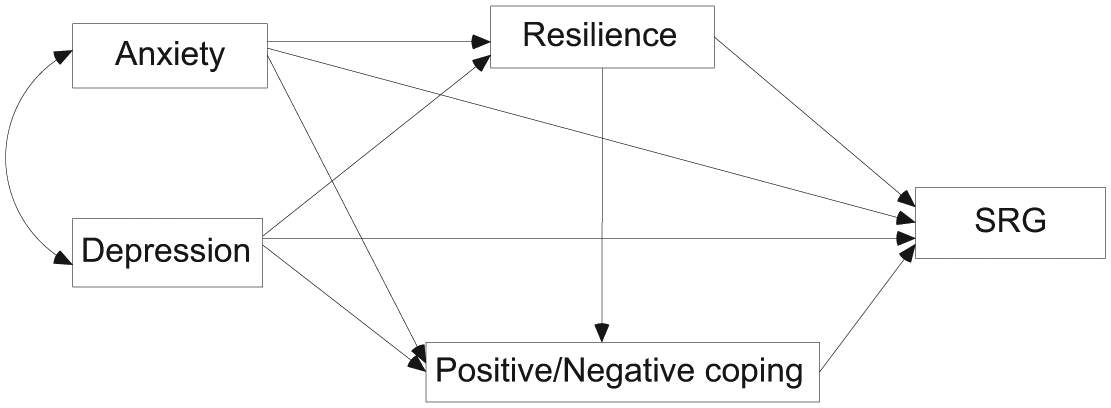
Hypothesized pathways to SRG expected to be moderated by positive/negative coping and resilience.
Methods
Participants and procedures
A convenience sample of 466 participants was selected from one regiment in Chongqing, China, in March 2013. The inclusion criteria were as follows: (1) army recruits who just finished 3-month recruit training, (2) able to read and understand the questionnaires, (3) provided informed consent to participate in this study, and (4) self-reported absence of non-training-related current or recent-past crises.
This was a cross-sectional study, with a research design previously approved by the Ethics Committee of Third Military Medical University. Prior to the initial assessment, all participants were informed about study procedures and were assured of anonymity and confidentiality. Each one was asked to complete a separate response booklet with structured and self-reported questionnaires. They filled out the questionnaires simultaneously and returned to the researchers after completing them. Data from 23 participants were excluded because these participants failed to respond to all of the items on the survey. The final sample for analysis consisted of 443 participants (397 men and 46 women). Participants in our study presented a mean age of 19.18 years (standard deviation (SD) = 1.71). The majority of them came from two-parent family (51.9%), and 87.6 percent has completed college or higher education.
Measures
SRG
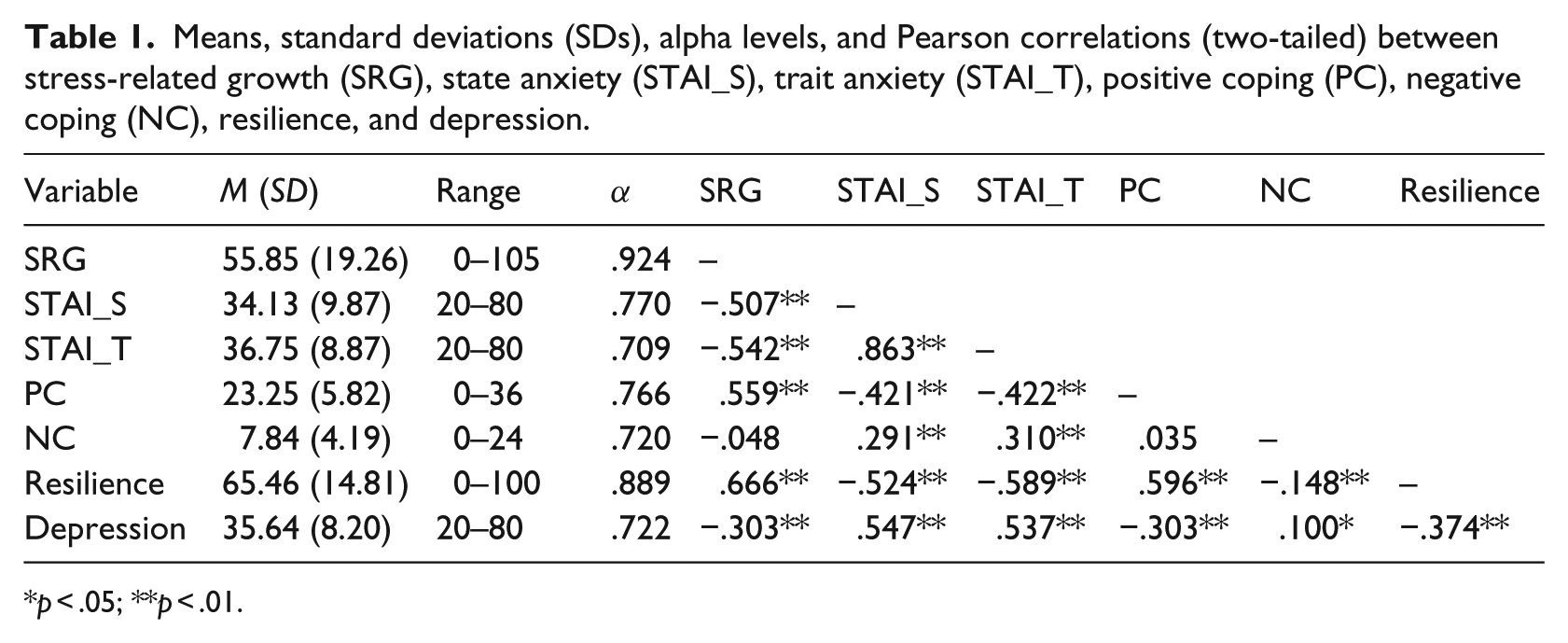
The Chinese version of the Posttraumatic Growth Inventory (PTGI-C) (Wang et al., 2011) was adopted to assess perceived levels of recruits’ SRG. Translated from the original Posttraumatic Growth Inventory (PTGI) (Tedeschi and Calhoun, 1996, 2004), the PTGI-C is a 21-item scale to assess the degree of reported positive changes experienced after a traumatic or stressful event. The measure yields a total score and five subscale scores: new possibilities, changed relationships, appreciation of life, personal strength, and spiritual changes. Participants are instructed to indicate on a 6-point Likert scale ranging from 0 (no change) to 5 (a very great degree of change) if a life change (e.g. “I established a new path for my life”) has occurred as a result of the crisis. High total score means higher level of SRG. The Chinese version demonstrated good psychometric properties. Because the Chinese version of PTGI is a self-reported questionnaire, the term perceived SRG was used in our study. Table 1 presents the means, SDs, and alpha levels of this and other research measures.
Means, standard deviations (SDs), alpha levels, and Pearson correlations (two-tailed) between stress-related growth (SRG), state anxiety (STAI_S), trait anxiety (STAI_T), positive coping (PC), negative coping (NC), resilience, and depression.
p < .05; **p < .01.
Resilience
The Connor–Davidson Resilience Scale (CD-RISC) (Connor and Davidson, 2003) comprises 25 items, with higher scores reflecting higher resilience. For example, a question such as “I can deal with whatever comes” was rated on a 4-point scale, not true at all (0) to exactly true (4). The Chinese version of CD-RISC has a multidimensional construct of three factors: (1) tenacity, (2) strength, and (3) optimism, and it has demonstrated adequate internal consistency, test–retest reliability, and convergent and divergent validity in the Chinese population (Yu and Zhang, 2007).
Positive and negative coping
The Simplified Coping Style Questionnaire (SCQ) (Xie, 1998) was used in this study. It consists of 20 items divided into two groups: positive coping (12 items, for example, “I try to think different ways to solve a specific problem”) and negative coping (8 items, for example, “I relieve distress by drinking, smoking, overeating, or drug abuse”). Participants were asked to respond to each item from 0 (never) to 3 (usually). High total score means higher level of positive coping. It has been demonstrated to have adequate internal consistency, test–retest reliability, and validity (Xie, 1998).
Anxiety
Chinese version of the State-Trait Anxiety Inventory (STAI) (Spielberger et al., 1983; Zheng et al., 1993) was used to assess the level of anxiety. This is a widely used 40-item questionnaire that assesses state anxiety related to the present (e.g. “I am calm”) and trait anxiety, indicating how people generally feel, as well as their tendency to perceive stressful situations as dangerous or threatening (e.g. “I worry too much over something that really doesn’t matter”). Responses were made on a 4-point scale ranging from 1 (none at all) to 4 (very obviously). High total score means higher level of state anxiety or trait anxiety.
Depression
Chinese version of Self-Rating Depression Scale (SDS) (Wang et al., 1999; Zung et al., 1965) is a self-report measure of depression consisting of 20 items. Of these 20 items, 10 are worded positively (e.g. decisiveness, satisfaction, and hope) and 10 are worded negatively (e.g. irritability, tachycardia, and fatigue). Respondents indicate whether each symptom is true of themselves on a scale from little or none of the time (1) to most of the time (4). High total score means higher depression. The Chinese version has good psychometric properties (Wang et al., 1999).
Demographic characteristics
Analyses included the following demographic covariates: age, gender, education level, and family type. Educational level was classified into four categories: (1) less than high school, (2) completed high school, (3) received a junior college degree, and (4) had a bachelor’s degree or higher. Participants reported their family types along a 3-point scale (1 = two-parent family, 2 = one-parent family, and 3 = others).
Data analysis
Pearson correlation analyses were conducted in order to explore relationships between perceived SRG and study variables. Skewness–Kurtosis tests were applied to determine whether the data sets of main study variables (including SRG, resilience, state anxiety, trait anxiety, and positive and negative coping) in this study are normally distributed and the variance inflection factor (VIF) was also used to diagnose multicollinearity. Separate mediational studies for positive and negative coping were conducted. We were interested in testing whether resilience and positive/negative coping can mediate the relationship between anxiety, depression (independent, exogenous variables), and perceived SRG (dependent, endogenous variable). Path analyses were carried out to test the mediator effects aforementioned. A maximum likelihood method was used to evaluate the significance of regression coefficients. The significance of direct, indirect, and total effects was assessed. The significance of the mediational paths was further tested using bootstrapping procedure. This is a statistical resampling method to estimate the standard error for unstandardized or standardized total and indirect effects (Kline, 2005). Several fit indices were employed to assess data–model fit. The comparative fit index (CFI), Tucker–Lewis Index (TLI), and root mean square error of approximation (RMSEA) were used as primary indices given their widespread use, good interpretive guidelines, and sensitivity to a number of estimated parameters. CFI and TLI value of ≥.95 and RMSEA value of ≤.08 were indicative of good fit (Kline, 2005). Effects with p < .05 were considered statistically significant. Data analyses were carried out using SPSS version 18 and AMOS version 18.
Results
Preliminary analyses
Means and SDs for main measures are presented in Table 1. The total mean score of perceived SRG was 55.85 (SD = 19.26), and the mean for the item response on a 5-point scale was M = 2.66, SD = 0.92, which indicated Chinese army recruits reported a moderate degree of positive benefits. The most growth among participants was related to personal strength (M = 3.06, SD = 1.50), followed by new possibilities (M = 2.95, SD = 1.17), appreciation of life (M = 2.90, SD = 1.05), relating to others (M = 2.39, SD = 1.01), and spiritual change (M = 1.72, SD = 0.91). Participants rated resilience lower than that of the general population (M = 80.40, SD = 12.80; t = −21.219, p < .001) described by Connor and Davidson (2003), however, which was significantly higher than the scores reported by Chinese undergraduate students in the same age stage (M = 61.69, SD = 10.55; t = 5.364, p < .001) (Peng et al., 2012). Positive coping was rated higher, while negative coping was rated lower than the middle points on these dimensions. Mean score of state anxiety of Chinese army recruits was lower than that of normative data in the Chinese population (M = 39.34, SD = 8.67; t = −11.101, p = .005), and similar results were observed for trait anxiety (M = 41.21, SD = 7.64 for trait anxiety of normative data; t = −10.577, p < .001; Zheng et al., 1993). In addition, mean score of depression of Chinese army recruits was higher than that of the general population (M = 33.46, SD = 8.55; t = 5.590, p < .001) (Wang et al., 1999), however, which was lower than that of Chinese field army soldiers (M = 38.21, SD = 6.82; t = −6.5960, p < .001; Li et al., 2003). Normality tests showed that values of Skewness varied from −.391 to .713 and those of Kurtosis from −.414 to .466, reasonably close to zero as recommended (Kline, 2005). Hence, they are within the acceptable range, indicating that these data sets of main study variables are normally distributed in this study.
Associations of study variables
Correlation analyses were conducted to assess possible associations between demographic characteristics (age, gender, education level, and family type) and perceived SRG. None of the demographic variables were correlated with perceived SRG (r = −.027, p = .573 for age; r = .089, p = .061 for gender; r = .057, p = .228 for education level; r = .014, p = .772 for family type). The significance of the multicollinearity problems among main study variables was checked. The results showed that VIFs varied from 1.167 to 4.506, well below the cut-off VIF value of 10 as recommended (Neter et al., 1985). Consequently, they are within the acceptable range, indicating that there are no multicollinearity problems in this study. Pearson correlations were performed to explore the relationships between main variables. As presented in Table 1, higher perceived SRG was associated with the higher level of resilience and more positive coping strategies (all ps < .01). Meanwhile, perceived SRG was negatively associated with state anxiety, trait anxiety, and depression (all ps < .01). However, no significant correlation was found between negative coping and perceived SRG (r = −.048, p = .318).
Path analysis
The hypothesized model in Figure 1 was examined in positive and negative coping strategies, respectively, to test the impacts of anxiety and depression on perceived SRG and whether positive/negative coping and resilience mediate these impacts.
For the positive coping strategy, the model explained 51.9 percent of perceived SRG variance and unacceptable fit was found with chi-square of 10.55 (degrees of freedom (df) = 3, p = .014). The goodness-of-fit indices of the mediation model were as follows: CFI = .995, TLI = .974, and RMSEA = .075. In this model, the following paths were not statistically significant: the direct effects of depression on perceived SRG, resilience, and positive coping (β = .065, p = .116; β = −.035, p = .466; β = −.046, p = .325, respectively). For this reason, these three non-significant paths were removed and depression was excluded. In the evaluation of the finally adjusted model shown in Figure 2, an excellent model fit was found with a non-significant chi-square of 5.742 (df = 2, p = .057). Besides, analysis of well-known and recommended goodness-of-fit indices (Kline, 2005) indicated a very good model fit (CFI = .997, TLI = .986, and RMSEA = .065). All the paths were statistically significant, and the significance of indirect mediational paths was further confirmed using the bootstrap resampling method. The model in Figure 2 accounted for 51.5 percent of perceived SRG, 36.4 percent of resilience, and 36.6 percent of positive coping variances. Indirect mediational test results indicated that anxiety predicted less perceived SRG partially through resilience and positive coping (banxiety = −.340) and also revealed a significant direct effect of −.220. Resilience predicted more perceived SRG partially through positive coping (bresilience = .116) but also revealed a significant direct effect of .400. In addition, anxiety revealed lower level of positive coping partially through resilience (banxiety = −.313) and also revealed a significant direct effect of −.129. Further analyses found that the indirect effect accounted for 60.52 percent of the total effect of anxiety on perceived SRG, 70.59 percent of the total effect of anxiety on positive coping, and 22.24 percent of the total effect of resilience on perceived SRG (Figure 2). To summarize, anxiety had direct effect and indirect effect through resilience and positive coping on perceived SRG, while positive coping partially mediated the effect of resilience on perceived SRG. Resilience partially mediated the relationship between anxiety and positive coping.

Results of mediation path analysis showing the relationship between anxiety and SRG, having positive coping and resilience as mediators in positive coping model, with standardized estimates and square multiple correlations.
For the negative coping strategy, the theoretical model in Figure 1 explained 50.2 percent of perceived SRG variance. The goodness-of-fit indices of the mediation model were as follows: chi-square = 7.497 (df = 3, p = .058), CFI = .997, TLI = .983, and RMSEA = .058. In this model, the following paths were not statistically significant: the direct effect of depression on perceived SRG (β = .071, p = .094), the effect of resilience on negative coping (β = .073, p = .208), and the effect of depression on resilience (β = −.036, p = .461). Therefore, these non-significant paths were removed and the model was recalculated. For the adjusted model shown in Figure 3, another excellent model fit was obtained with a non-significant chi-square of 12.506 (df = 6, p = .052). The goodness-of-fit indices of the mediation model were as follows: CFI = .995, TLI = .987, and RMSEA = .049. The model in Figure 3 accounted for 49.4 percent of perceived SRG, 36.7 percent of resilience, and 11.4 percent of negative coping variances. Indirect mediational test results indicated that anxiety predicted less perceived SRG partially through resilience and negative coping (banxiety = −.258) and also revealed a significant direct effect of −.298. Depression predicted less perceived SRG fully through negative coping (bdepression = −.016). Negative coping and resilience only had direct effect on perceived SRG (bnegative_coping = .123, bresilience = .505). Further analyses suggested that the indirect effect accounted for 54.40 percent of the total effect of anxiety on perceived SRG (Figure 3). That is, in the negative coping model, anxiety had direct effect and indirect effect through resilience and negative coping on perceived SRG, while resilience and negative coping only had direct effect on perceived SRG. Negative coping fully mediated the relationship between depression and perceived SRG.
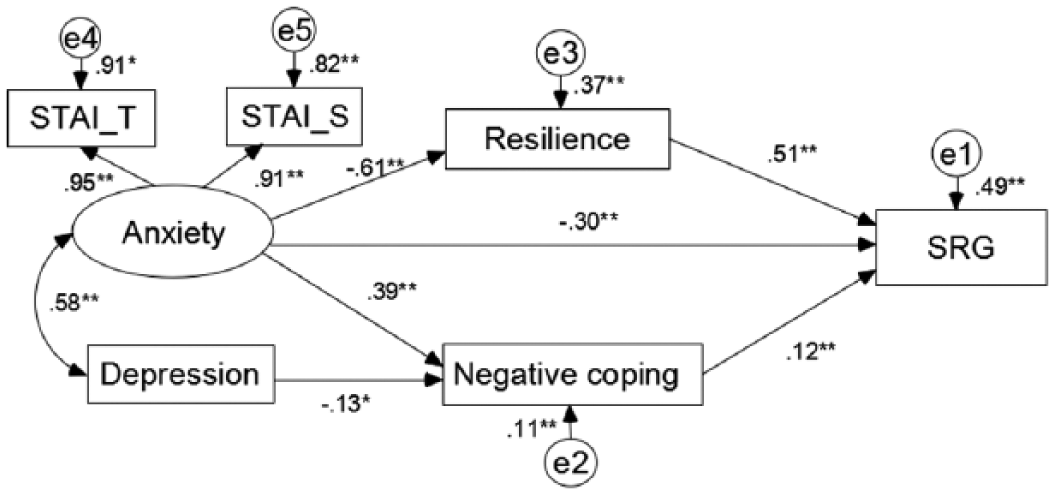
Results of mediation path analysis showing the relationships among anxiety, depression, and SRG, having negative coping and resilience as mediators in negative coping model, with standardized estimates and square multiple correlations.
Discussion
The aim of this study was to examine the relationships of anxiety, depression, and perceived SRG, as well as the mediating roles of resilience and positive/negative coping among Chinese army recruits who just finished their recruit training. Our results showed that all army recruits reported some degree of positive changes as a result of training experience, especially stronger personal strength. This might be interpreted as a sign that the Chinese army training can serve as a catalyst for the development of SRG and army recruits tend to build personal strength. The perceived SRG levels of recruits we observed are similar to the result reported by Lee et al. (2010) that was based on 3537 active duty soldiers exposed to combat in Iraq or Afghanistan (M = 52.04, SD = 22.98). Unlike previous studies (Lieberman et al., 2008; Yan et al., 2001), we found that current Chinese army recruits suffered fewer mental health problems since they had higher level of resilience and less anxiety and depression. There are several possible explanations for this phenomenon. The first one is that selection criteria for Chinese army recruits have become more stringent to exclude persons with poor mental health. The second explanation might be that the severe maladjusted soldiers had separated from army at the earlier stage and we failed to investigate them. The last possible explanation lies in the fact that these participants had gone through an initial difficult period of adjustment and gained positive changes from training-related stress.
In accordance with previous findings, perceived SRG was positively associated with positive coping and resilience (Bensimon, 2012; Swichert and Hittner, 2009; Yu et al., 2014), while negatively related to anxiety and depression (Boals et al., 2010; Caspari, 2011; Helgeson et al., 2006). In this study, there was an absence of association between total score of SRG and negative coping, which is consistent with previous research (Chan and Rhodes, 2013).
Bringing together our hypotheses, we tested two mediator models in which resilience and positive/negative coping were predicted as mediators in the associations between depression, anxiety, and perceived SRG. In the positive coping model, depression was not a significant predictor and was excluded from the best-fit model, whereas in the negative coping model it emerged as a significant predictor in the best-fit model. In the positive coping model, path analysis results revealed that positive coping was a direct predictor of perceived SRG, while the effect of resilience on perceived SRG was partially mediated by positive coping. Furthermore, the effect of anxiety on perceived SRG was partially mediated by resilience and positive coping. In other words, the impact of resilience on perceived SRG relevant to the recruit training operates through positive coping, which adds to the positive impact of resilience. Regarding positive coping, it has direct and indirect impacts on the perceived SRG associated with the recruit training. It is worth noting that this suggests the recruits who had more positive coping strategies may facilitate the positive impact of resilience on the development of perceived SRG. However, the recruits who had higher level of anxiety might have lower level of resilience and adopt less positive coping strategies that would, in turn, hinder the development of SRG.
As for the negative coping model, path analysis results indicated that depression predicted lower level of perceived SRG fully through less negative coping strategies, while anxiety also predicted higher level of perceived SRG partially through more negative coping strategies. Furthermore, anxiety had direct and indirect negative impacts on perceived SRG partially through resilience. Resilience had no significant effect on negative coping. These findings suggest that army recruits who have higher level of anxiety seem to have higher level of resilience and less negative coping, which in turn influences perceived SRG. On the other hand, those who have higher level of depression seem to have less negative coping, while in turn predict less perceived SRG. Interestingly, it seems that negative coping also has positive influence on perceived SRG which is in line with the previous finding that any given way of coping is likely to serve many functions (Skinner et al., 2003). In our study, it was found that negative coping also has positive functions for army recruits. This agrees with the previous literature which highlighted that coping strategies may function differently across time and circumstances (Xie, 1998).
Noteworthy, our results suggest that perceived SRG could be evidently predicted by resilience and positive coping, which is consistent with previous studies (Bensimon, 2012; Pooley et al., 2013; Swichert and Hittner, 2009). It also confirmed our previous result that resilience and positive coping are important protective factors of perceived SRG (Yu et al., 2014). Interestingly, our results suggest that anxiety has positive and negative impacts on perceived SRG. On the one hand, anxious individuals have lower level of resilience and use less positive coping strategies, while on the other hand, they tend to use more negative coping. Accordingly, anxiety has negative impact on perceived SRG. These results suggest anxiety and depression are risk factors of perceived SRG relevant to army training. That is, higher depression and anxiety are associated with less growth. These findings manifest that depression and anxiety have adverse effects on perceived SRG by reducing the level of resilience and positive coping, which provide strong evidence for us to carry out emotion regulation intervention for the army recruits. Nevertheless, perceived SRG is a continuous variable. It reminded us that a longitudinal design should be performed to capture the occurrence timing of perceived SRG and examine the dynamic development of relationships between anxiety, depression, and perceived SRG in future studies. Besides, the semi-structured PTGI-C (Wang et al., 2012) and the Chinese Mental Resilience Scale (Sun et al., 2014) have been specifically developed for Chinese individuals recently. Using these assessment instruments would be helpful to better understand the process of SRG and its influencing factors in Chinese culture.
Some limitations of this study need to be noted. Major limitations are the convenience sample and the small cohort. Thus, caution should be taken upon generalizing the results to other populations. Another limitation of this study is the reliance on self-report measures. Multiple measurement approaches (e.g. informant reports from superior officers or friends and objective measures could be adopted to accurately reflect actual levels of study variables. In addition, the relationships between anxiety, depression, and perceived SRG may change over time. A cross-sectional study cannot rigorously capture more variability, and this limits interpretation of the mediation analysis. It would be both desirable and informative to conduct a longitudinal design to examine the mediating roles of resilience and coping in the relationships between anxiety, depression, and perceived SRG in future studies. Finally, this study was unable to analyze some other important variables (e.g. social support and emotion regulation) which might have impacts on perceived SRG. Consequently, the associations between these variables and perceived SRG remained to be explored.
Despite these limitations, our results demonstrated that anxiety and depression are important risk factors for the development of perceived SRG. In addition, resilience and positive/negative coping serve as mediators in effects of anxiety and depression on perceived SRG. Accordingly, this study fills a part of the present knowledge gap. In this context, how to effectively lessen anxiety and depression, enhance their levels of resilience, and choose more positive coping strategies are crucial for minimizing the negative influences of anxiety and depression on perceived SRG. These findings have significant implications ensuring sound, healthy experiences for army recruits experiencing army training which may offer guidance on professional counseling and psychological interventions for them.
Footnotes
Acknowledgements
The authors extend their deepest thanks to all the individuals who voluntarily participated in this study.
Declaration of conflicting interests
The author(s) declared no potential conflicts of interest with respect to the research, authorship, and/or publication of this article.
Funding
The author(s) disclosed receipt of the following financial support for the research, authorship, and/or publication of this article: This study was financially supported by National Natural Science Foundation of China (31170994), National Social Science Foundation of China (14 CSH072), Projects of Military Research Foundation of the Chinese P.L.A. (CWS11J049, 12XLZ212, and 14QNP088).