



Abstract
Stress-reduction interventions have been linked with enhanced well-being and health. This study examined affect and cortisol in 111 individuals randomly assigned to a single 35-minute guided relaxation or a stress management lecture control group. Positive affect increased more in the relaxation compared to the control group (F = 6.62, p = .01). Dispositional stress reactivity had a moderating influence (R2 = .248, p < .001), such that individuals high in stress reactivity showed highest increases in positive affect to the relaxation. Results indicate that a single guided relaxation intervention improves positive affect among individuals high in stress reactivity.
Introduction
Interventions intended to reduce stress have shown great promise as means to enhance health. There is ample evidence that participation in stress-reduction interventions, including mindfulness-based stress reduction (MBSR; Kabat-Zinn, 1990) and abbreviated progressive relaxation training (APRT; Bernstein and Borkovec, 1973), results in enhanced well-being (Hyman et al., 1989; Murphy, 1996). Among these beneficial changes are decreases in self-reported and biological markers of stress, such as quality of life, depression, anxiety, coping style (Grossman et al., 2004), and cortisol secretion (Matousek et al., 2010; Pawlow and Jones, 2005). Moreover, improvements in physical indicators of health such as medical symptoms, pain, physical impairment, and functional quality of life have been observed (Carlson and Hoyle, 1993; Grossman et al., 2004).
Stress-reduction studies documenting these health benefits have most often relied on interventions consisting of six to eight weekly sessions (e.g. Bernstein et al., 2000; Grossman et al., 2004; Matousek et al., 2010). In contrast, the biobehavioral and health benefits of single-session interventions have not been well-described. However, to better understand the biobehavioral mechanisms through which relaxation interventions exert their effects on health, it is also necessary to study the immediate biobehavioral effects of participation.
There is emerging evidence suggesting that single-occasion interventions result in improved biological and self-reported stress responses. For example, decreases in cortisol from pre- to post-intervention have been demonstrated in response to single exposure to progressive and/or guided relaxation (Kiran et al., 2005; Pawlow and Jones, 2002, 2005; Teixeira et al., 2005; Watanabe et al., 2005), yoga (West et al., 2004), meditation practice or training (Michaels et al., 1979), and stress management training (Chan et al., 2006; Storch et al., 2007; Urizar and Muñoz, 2011), compared to controls. There is also evidence that such interventions can improve subjective well-being, in the form of reduced heart rate and blood pressure, fatigue and confusion, anxiety, and self-reported stress, and increases in physical and mental relaxation (Bershadsky et al., 2014; Chen et al., 2012; Chiesa and Serretti, 2009; Dolbier and Rush, 2012; Manzoni et al., 2008; Melville et al., 2012; Rausch et al., 2006; Robb, 2000; Urech et al., 2010) in comparison to controls. However, some studies showed beneficial changes in self-reported outcomes but failed to produce significant effects in biological measures such as heart rate or cortisol (Bershadsky et al., 2014; Dolbier and Rush, 2012; Matousek et al., 2010).
Moreover, research in this field has focused on individuals with medical conditions (Baer, 2003; Carlson and Hoyle, 1993; Kiran et al., 2005) and psychiatric disorders (Baer, 2003; Conrad and Roth, 2007), although these also vary in terms of the length of the intervention, from single-session to a longer series of daily or weekly sessions. A smaller body of research has investigated the beneficial effects of stress-reduction techniques on healthy individuals including interventions of varying durations (Chiesa and Serretti, 2009) as well as single-dose sessions (e.g. Dolbier and Rush, 2012) in student populations. What has been neglected in this line of work is whether among otherwise healthy individuals, subgroups of individuals who may be at increased risk for stress-related disease may benefit from interventions more than low-risk individuals. One exception is a study by Vinci et al. (2014) who found that a single-session mindfulness intervention was effective at reducing negative affect in students who were at risk of drinking problems. This type of research may provide important evidence for preventive approaches targeting at-risk individuals.
The current study sought to examine individual affective and cortisol responses to a single 35-minute guided relaxation intervention in healthy individuals. We hypothesized that positive affect would increase and negative affect and cortisol would decrease in response to a guided relaxation, compared to a didactic stress management lecture control group. We further hypothesized that individuals high in dispositional reactivity to stress, a construct associated with increased health risk (Schlotz et al., 2011), would benefit from the intervention more, such that they show more pronounced improvements in affect and more pronounced decreases in cortisol.
Method
Participants
Participants included 111 undergraduate students (81% female, 19% male) ranging in age from 18 to 33 years (M = 20.78 years, standard deviation (SD) = 2.75 years) who were randomly assigned to an experimental (n = 54; 85% female, 15% male) or a control group condition (n = 57; 77% female, 23% male). The sample was ethnically diverse: 56 percent reported being Asian, 17 percent Caucasian, 11 percent Hispanic, 2 percent African American, 11 percent Multiethnic, and 3 percent Other. All participants were undergraduate students at the University of California, Irvine. They were recruited through the University’s Social Sciences Subject Pool and could choose between course credit and a modest monetary incentive for their participation.
Individuals who reported regular smoking, medication use including oral contraceptives, pregnancy, or any serious medical condition were excluded because of these variables’ significant influence on salivary cortisol secretion (Kirschbaum et al., 1993). All participants provided written informed consent. The study was approved by the Institutional Review Board of the University of California, Irvine.
Procedure
Study visits were scheduled to start between 11:30 a.m. and 4:00 p.m., to control for the pronounced circadian variations in cortisol. Participants were asked to refrain from eating or drinking (other than water) for 1 hour prior to the study visit. After obtaining consent, participants were randomly assigned to either the experimental or the control group. All study procedures were conducted in small groups of two to six participants rather than individually in order to replicate current cost-effective clinical trends. Dispositional stress reactivity was assessed upon arrival (approximately 15 minutes before the intervention), and positive and negative affect were assessed immediately before and after the intervention. Saliva samples for the later assessment of cortisol were also collected immediately prior to and immediately after the intervention.
Both conditions were conducted in the same room, using the same tables and chairs, and the same facilitator conducted all sessions in both conditions. All participants were seated upright throughout. In the experimental group, a guided relaxation was selected due to its ease in administration in applied settings (i.e. it can be delivered via script with minimal training). The lights were dimmed, and participants listened to a live 35-minute guided visualization accompanied by slow chime sounds. The visualization described a progressive relaxation that was loosely modeled after APRT (Bernstein and Borkovec, 1973) and also included positive suggestions for well-being, self-confidence, and general suggestions for continued cognitive and physical well-being. In the control group, participants listened to a live 35-minute didactic lecture on stress management in order to utilize an intervention related to individual stress coping, but which was not intended to induce relaxation. The lecture presented definitions of stress and stressors, a description of the biological stress response, information about stress appraisals and coping, and a brief example of proactive coping behaviors. At the end of the study session, participants were thanked, debriefed, and issued class credit or provided with a monetary incentive for their participation.
Measures
Stress vulnerability
Stress vulnerability was assessed with the Perceived Stress Reactivity Scale (PSRS; Schlotz et al., 2011), a 23-item scale measuring individuals’ perceived typical responses to potentially stressful everyday situations on a 3-point scale. Each item contains unique response choices that correspond to the individual item’s statement. For example, the statement “When I am unsure what to do or say in a social situation …” is accompanied by responses 0 = “I generally stay cool,” 1= “I often feel warm,” and 2 = “I often begin to sweat”; and “When something does not go the way I expected …” is accompanied by responses 0 = “I usually stay calm,” 1 = “I often get uneasy,” and 2 = “I usually get very agitated.” Previous research has shown good internal consistency for the overall scale with Cronbach’s alpha coefficient of .87 and high test–retest reliability of .85 in US college students (Schlotz et al., 2011).
Positive and negative affects
The Derogatis Affects Balance Scale (DABS; Derogatis and Rutigliano, 1996) is a 40-item scale that measures individuals’ self-report of mood and affect. The DABS asks participants to state how they feel at the current moment by rating adjective items such as “Pleased” or “Hopeless” on a 5-point Likert-type scale, ranging from 1 = “not at all” to 5 = “extremely.” It contains a positive global score and a negative global score, further categorized into eight primary affect dimensions, positive (affection, contentment, joy, and vigor) and negative (anger, anxiety, depression, and guilt). Research has shown good internal consistency with alpha coefficients ranging from .79 to .85 and high test–retest reliability ranging from .79 to .84 (Derogatis and Rutligliano, 1996).
Cortisol
Saliva samples were collected with the Salivette sampling device (Sarstedt, Nümbrecht, Germany), stored at room temperature until completion of the session, and then kept at -70°C until assayed. After thawing for biochemical analysis, samples were centrifuged for 10 minutes at 2000 × g and 4°C. Free cortisol in saliva was determined by a commercially available enzyme-linked immunosorbent assay (ELISA; IBL-America, Minneapolis, MN). All samples were assayed in duplicate. Inter- and intra-assay coefficients of variance are less than 4.9 and 4.1 percent, respectively. The sensitivity of the assay is reported at 0.012 ng/mL.
Statistical methods
All cortisol values were log transformed to reduce skewness. A series of analyses of variance (ANOVAs) with repeated measures on one factor were computed to identify effects of time (cortisol, DABS; before and after the intervention) and group (relaxation vs lecture). Greenhouse–Geisser corrections were applied when appropriate, and only corrected results are reported. Effect sizes (η2) are reported as a measure of explained variance. Moderation analyses were performed using the Hayes (2012) PROCESS macro for SPSS with intervention group as the independent variable, stress reactivity as the moderator, and changes in positive affect, negative affect, and cortisol as the dependent variables. PROCESS automatically calculates the moderation effect of stress reactivity on the dependent variables at mean, high (+1 SD), and low (–1 SD) levels of the moderator. Continuous variables were mean centered, and time of day of the session was added as a covariate in the cortisol analyses.
Results
Intervention effects
Positive affect was higher, main effect group, F(1, 101) = 6.62, p = .01, η2 = .06, and increased more, group by time interaction, F (1, 101) = 19.30, p < .001, η2 = .16, among participants in the relaxation group compared to control group participants (Figure 1(a)). Post hoc comparisons confirmed that positive affect increased among participants in the relaxation group, t(46) = –2.42, p = .02, and decreased among those in the lecture group, t(55) = 4.66, p < .001. Post hoc t-tests further suggest that significant group differences only emerged after, t(102) = 3.87, p < .001, but not before the intervention. When testing the four positive affect subscales (affection, contentment, joy, and vigor) separately, more affection, contentment, and joy (Fs = 5.14–8.86, all ps < .03), but not vigor, F(1, 107) = 1.96, p = .16, were observed in the relaxation compared to the lecture control group. Significant time by group interactive effects, suggesting more pronounced increases in positive affect among participants in the relaxation group, were observed for all four subscales (Fs = 8.80–28.46, all ps < .01). This pattern of findings indicates that this relaxation intervention has immediate benefits to individuals in terms of their positive affects.
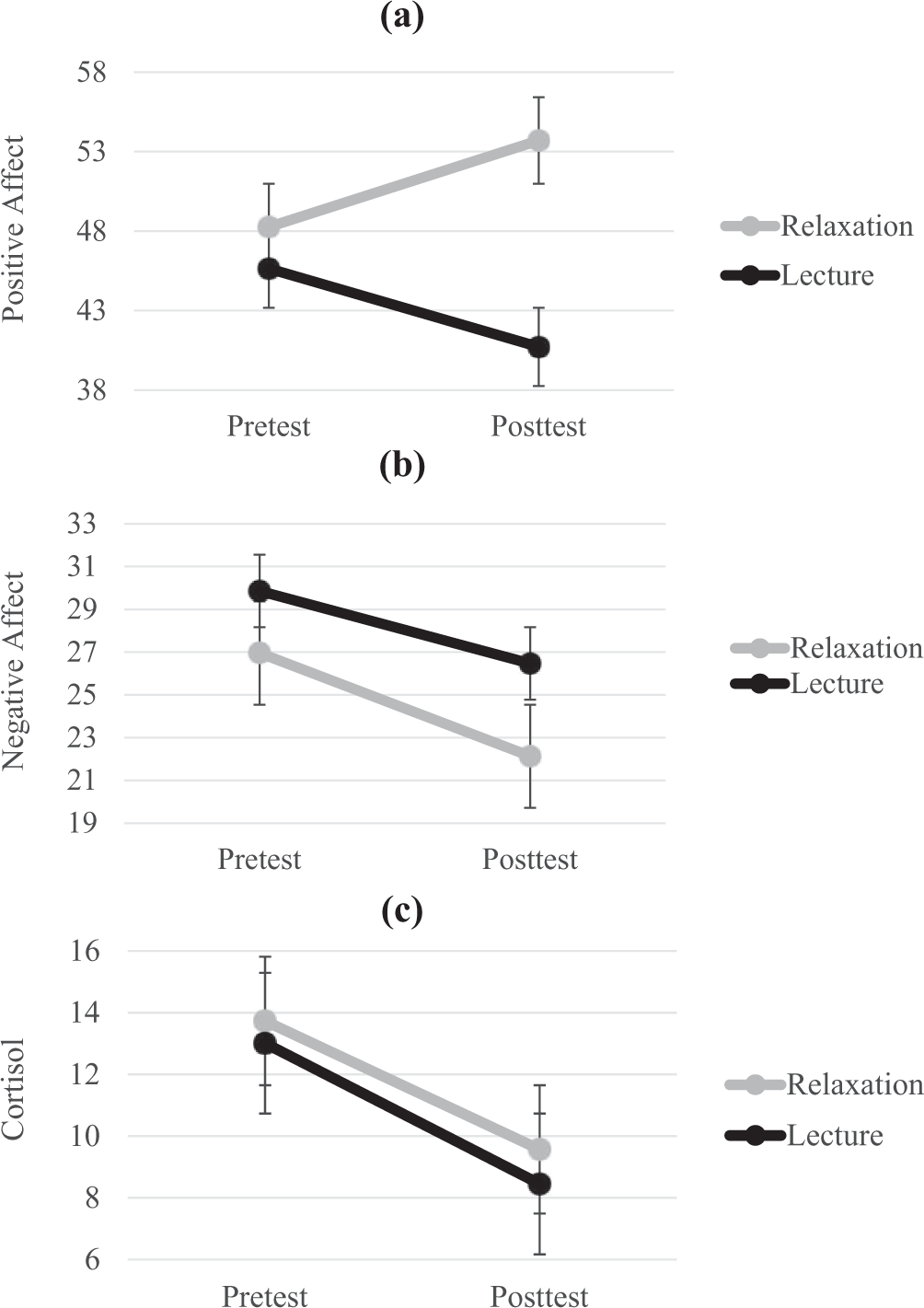
Change in (a) positive affect, (b) negative affect, and (c) cortisol in the relaxation and lecture groups.
Negative affect decreased across time, main effect time, F(1, 107) = 67.24, p < .0001, and was significantly lower in the relaxation compared to the control group, main effect group, F(1, 107) = 8.62, p = .004, η2 = .08 (Figure 1(b)). A nonsignificant trend for a more pronounced decrease in the relaxation group compared to the lecture group was also observed, group by time interaction, F(1, 107) = 3.39, p = .07, η2 = .03. When tested individually, significant decreases were observed for all four negative affects (anger, anxiety, depression, and guilt), main effect time, Fs = 8.09–80.68, ps < .01, η2s = .07–.43. In addition, near-significant group by time effects were observed for anxiety and depression (Fs ⩾ 3.27, ps < .10, η2s = .03), but not for anger and guilt (Fs ⩽ 0.92, ps ⩾ .34).
Neither cortisol levels overall, main effect group, F(1, 89) = 0.19, p = .66, η2 = .002, nor changes in response to the intervention, group by time interaction, F(1.6, 144.1) = 0.54, p = .55, η2 = .006, differed between the experimental and the control groups (Figure 1(c)), indicating a lack of influence of a single intervention on cortisol release. As expected, and in line with cortisol’s well-known circadian pattern, a significant decrease in cortisol across time was observed, main effect time: F(1.6, 144.1) = 28.03, p < .001, η2 = .24.
The moderating role of stress vulnerability
To test the hypothesis that stress reactivity moderates the effect of intervention group on positive affect, the stress reactivity total score, intervention group, and interaction term were entered into the PROCESS macro. These variables accounted for a significant amount of variance in change in positive affect, R2 = .248, F(3, 98) = 10.77, p < .0001. The interaction term between intervention group and dispositional stress reactivity accounted for a significant proportion of variance in change in positive affect, ΔR2 = .07, ΔF(1, 98) = 9.57, b = 1.02, t(98) = 3.09, p < .01. Examination of the interaction plot (Figure 2(a)) showed that individuals characterized by high and mean levels of dispositional stress reactivity benefited the most from the intervention. Additional moderation analyses showed that this finding replicates the individual subscales of positive affect, all R2s = .15–.26, ps < .05. Similar moderation effects were, however, not observed for total negative affect, R2 = .05, F(4, 103) = 1.40, p = .24, the negative affect subscales, R2s = .02–.06, ps = .08–.40 (Figure 2(b)), or for cortisol, R2 = .03, p = .59 (Figure 2(c)).

Change in (a) positive affect, (b) negative affect, and (c) cortisol according to low, mean, and high levels of total stress reactivity and intervention group.
Discussion
In this study, we aimed to investigate the effects of a single-session guided relaxation on cortisol and affect, and the moderating role of dispositional stress reactivity in this relationship. We found that the guided relaxation intervention resulted in increases in positive affect compared to a lecture control group. Moreover, stress reactivity was a significant moderator of positive affect change, with individuals reporting mean to high levels of dispositional stress reactivity benefitting the most from the guided relaxation. For the most part, findings for negative affect mirrored those for positive affect, suggesting mood improvements in the relaxation group, in particular among individuals with higher dispositional stress reactivity; however, findings for negative affect were at trend levels only. In contrast, but in line with recent controlled studies examining the effects of longer term mindfulness- and gratitude-based interventions on diurnal cortisol and the cortisol awakening response (CAR) (Jackowska et al., 2016;
O’Leary et al., 2016), no group differences were observed for cortisol. According to O’Leary et al.’s (2015) systematic review, cortisol effects were observed in within-subjects designs; however, controlled designs showed no effects and only diurnal cortisol and CAR measures were included, leaving pre- and post-session cortisol unexamined.
As predicted, a more pronounced increase in positive affect in response to the relaxation compared to the control group was found. These results confirm our own previous findings of higher self-reported positive affect on days of Hatha Yoga attendance in pregnant women, compared to a usual activity control condition, although the increase in positive affect was not significant in that study (Bershadsky et al., 2014). Moreover, these results are aligned with findings from past reviews indicating improvements in perceived quality of life, improved coping style (Grossman et al., 2004), and increased physical and mental relaxation after stress-reduction interventions (Chen et al., 2012; Chiesa and Serretti, 2009; Dolbier and Rush, 2012; Manzoni et al., 2008; Rausch et al., 2006), although these were not solely focused on single-session interventions. Increases in positive affect alone may imply additional health benefits. Positive affect is associated with constructs of mindfulness, vitality, life satisfaction, self-esteem, optimism, self-actualization, and general well-being (Brown and Ryan, 2003) as well as improved physical health via the amelioration of life-event stress (Pressman and Cohen, 2005). Multiple studies have found that longer term mindfulness-based training is associated with improved physiological, immunological, and cognitive outcomes (Egloff et al., 2003; Kabat-Zinn, 2003).
Our results further suggest that individuals high in dispositional stress reactivity, a trait related to health outcomes (Schlotz et al., 2011), may benefit more from a guided relaxation than individuals low on this trait. High levels of perceived stress reactivity have been associated with greater levels of depressive symptoms, more sleep disturbance, and lower sleep quality (Schlotz et al., 2011). Thus, and with regard to clinical applications of this intervention, it may be most useful to target interventions toward highly stress-reactive individuals.
When individual positive affects were analyzed separately, affection, contentment, and joy changed in accordance with overall positive affect. This was, however, not the case for vigor, which was not affected differentially between the two conditions. This may be a characteristic of specific facets of positive affect that are influenced by the guided relaxation intervention. Barrett and Russell’s (1998) bipolar model classifies affect in terms of activation and pleasantness. Alternative theories include a dichotomy of effort (i.e. high vs low) as an accompaniment to pleasantness and activation (Smith and Ellsworth, 1985), engagement as an aspect of affect (Watson et al., 1999), or Fontaine et al.’s (2007) four-factor model adding potency control and unpredictability to pleasantness and activation, whereby potency defines sympathetic responses and action tendencies in contrast to parasympathetic, or passive, forms of activation. A guided relaxation may produce increases in affection, contentment, and joy, but not in vigor, due to the intervention’s promotion of more passive forms of positive affect while deemphasizing action-oriented results.
We found trend-level decreases in negative affect, including in individual affect subscales of anxiety and depression, in the relaxation group compared to the control group. Emerging literature has shown a significantly more pronounced decrease in negative affect in pregnant women participating in a single Hatha yoga session compared to a within-subject comparison group (Bershadsky et al., 2014). Multiple studies have also shown decreases in self-reported stress and anxiety after stress-reduction interventions (Chen et al., 2012; Chiesa and Serretti, 2009; Dolbier and Rush, 2012; Manzoni et al., 2008; Rausch et al., 2006). In investigating overall affect changes, beneficial health changes may accompany stress-reduction interventions by way of their influence on both positive and negative affects (Pressman and Cohen, 2005). Particularly notable are the associations between high positive affect and immunity to colds, protection from cardiovascular disease, pregnancy rates as a result of fertility treatments, long-term survival in individuals with chronic disease, lower pain levels, endocrine health, and a higher quality of social attachment (Cohen and Pressman, 2006). Pressman and Cohen (2005) suggested that the induction of unactivated positive affect showed particular immune and neuroendocrine benefits.
In contrast to our hypotheses and the results of most previous studies (Kiran et al., 2005; Pawlow and Jones, 2002, 2005; Teixeira et al., 2005), this study did not result in more pronounced decreases in cortisol for the relaxation compared to the control group, and stress reactivity did not moderate cortisol responses to the intervention. These results are in line with our previous findings that cortisol did not decrease differentially in response to a yoga session compared to usual activity in pregnant women (Bershadsky et al., 2014). In two independent studies, Pawlow and Jones (2002, 2005) found decreases in cortisol in response to a relaxation intervention in comparison to a control group that sat quietly. Our study differed from Pawlow and Jones’ work in that we utilized a shorter session duration (35 minutes vs 1 hour), an afternoon versus a morning study visit time, and a stress management lecture rather than a no-intervention control. In addition, and in contrast to Pawlow and Jones’ studies, our study utilized a group-based intervention rather than individual solitary guided relaxation and did not strictly adhere to the APRT model. In an experiment similar to this study, Teixeira et al. (2005) also found that both experimental (active relaxation) and control (passive relaxation) groups’ cortisol decreased in their study, with only trend-level findings. Green and Green (1987) found no decreases in cortisol across a brief 20-minute relaxation or visualization session, although they did not utilize a control group. Likewise, in a study of cortisol outcomes across a meditation intervention, Michaels et al. (1979) noted an initial increase in cortisol in a rest-only control group. In light of these findings, it is possible that group sizes, characteristics of control conditions, and the short-term nature of the intervention may have disguised cortisol effects that have been shown in longer term stress-reduction interventions (Bernstein et al., 2000; Grossman et al., 2004; Matousek et al., 2010). Furthermore, adding a self-report measure of acute stress in future studies may help to illuminate the full nature of stress reduction (or lack thereof) in response to the intervention.
In conclusion, the results from this study indicate that a guided relaxation intervention may be useful in increasing positive affect in individuals with higher levels of self-reported reactivity to stress. This finding has clinical implications, suggesting that highly stress-reactive individuals may be a group that could be targeted for stress-reduction interventions. Future research should examine the effects of multiple single-session interventions over time, with accompanying assessment of physical and mental health outcomes, and extend these findings into more diverse populations, in order to contribute to their usefulness in clinical settings.
Footnotes
Declaration of conflicting interests
The author(s) declared no potential conflicts of interest with respect to the research, authorship, and/or publication of this article.
Funding
The author(s) disclosed receipt of the following financial support for the research, authorship, and/or publication of this article: This study was funded by an Individual Faculty Research Grant from the University of California, Irvine.