




Abstract
Several studies have shown the influence of personality in risky sexual behaviors. This work has sought to establish which personality variables favor or hinder condom use in Spanish youth. A total of 408 young heterosexuals were assessed, divided into risk group (60.8%) and no-risk group (39.2%), according to systematic condom use. The results show statistically significant differences in Openness to Experience (p = .039), Conscientiousness (p = .047), Actions (p = .001), Competence (p = .024), and Self-discipline (p = .046). The regression analysis revealed that Compliance explained about 14 percent of the variance in condom use. The tendency to behave in a cooperative, peace-making, and indulgent manner influences in HIV prevention.
Introduction
Personality represents the structural and dynamic characteristics of individuals as reflected in their responses which are more or less specific in different situations. These permanent properties have given rise to several approaches in relation to personality traits and types, as well as to theoretical and empirical developments in the sphere of public health (Moreno-Jiménez et al., 2005). It is believed that personality could be one of the factors that should be taken into account when devising intervention and prevention programs aimed at reducing the risk of HIV infection, sexually transmitted diseases (STDs), or unplanned pregnancies (Brook et al., 2006).
As early as 1976, Eysenck (1976) had already put forward a number of hypotheses as to the influence of personality in risky sexual behaviors. Over the past 15 years, interest has grown in the five-factor model, originally based on an approach that combined lexical and statistical elements to provide a framework explaining risky sexual behaviors in different populations and cultures (Schmitt, 2004; Shafer, 2001). It must be stressed that this model has attracted much criticism, particularly in the decade of crisis sustained by the trait theory. McAdams (2001), for example, recommended a cautious approach in considering traits as the basis of personality. On one hand, this author saw traits as akin to brief and limited overviews of personality and hence being too general, superficial, and decontextualized when attempting to deeply define people and that, furthermore, were separate understandings of what makes up a person as there is no consideration of the overall and joint organization of the whole person. On the other hand, Pervin (1996) argued that there had been undue emphasis placed on the genetic influence of traits, their long-term stability, and their predictive value. Moreover, Pervin (1996) questioned the specificity of the concept of trait, given that some authors refer to open behaviors, while others include thoughts, feelings, and motivations. There is still no common agreement as to whether traits are descriptions or explanations. This is compounded by the fact that many authors use the term “trait” with quite varying meanings. We can conclude that the theory of trait, although quite validated, focuses on individual differences but does not capture the intra-individual dynamics of personality; it focuses on static structures but does not delve into the workings and dynamics of human behavior (but see Romero, 2005: 244–258).
In the meta-analysis performed by Hoyle et al. (2000), the direction of the relationships between the dimensions that make up this theory and sexual behavior is established. These authors identified a negative relationship between Agreeableness and risky sexual behavior, a negative relationship between Conscientiousness and unprotected sexual relations, and a positive relationship between Neuroticism and unprotected sex with multiple partners. A study carried out on the Spanish population established that persons with high scores in the latter dimension tend to be more permissive and also engage more often in risky sexual behavior (Lameiras and Rodríguez, 2003). Other studies with persons who have engaged in high-risk behaviors for HIV infection, STDs, or unplanned pregnancies have confirmed that persons with high levels of chronic negative emotions (high Neuroticism) and who are less organized and persistent (low in Conscientiousness) tend to engage more frequently in risky sexual practices (Hagger-Johnson and Shickle, 2010; Trobst et al., 2002). The domain Conscientiousness and two of its facets (Competence and Self-discipline) also gave significant correlations with positive effects in a behavioral modification program (Trobst et al., 2000) and with condom use in most recent sexual relations (Hagger-Johnson et al., 2011). Conscientiousness and Agreeableness have appeared as the two most empirically supported variables when they have been linked to risky sexual behavior. Some studies show that high scores act as protective variables, diminishing the frequency of risky behavior through an increase in the incidence of safe sexual practices (Ingledew and Fergunson, 2007), and lower scores tend to predict the incidence of risky sexual behavior (Markey et al., 2003; Trobst et al., 2000). Higher scores in Extraversion and Openness to Experience are associated with greater sexual risk. However, this effect seems to be more solid in relation to having multiple sexual partners, rather than to specific condom use (Bourdage et al., 2007; Hoyle et al., 2000; Markey et al., 2003; Schmitt, 2004; Schmitt and Shackelford, 2008).
The study carried out by Miller et al. (2004) on young people probed more deeply into the dimensions and facets of personality measured by the Revised Neuroticism-Extraversion-Openness Personality Inventory (NEO-PI-R), as well as their relationship with some risky sexual behaviors. The results showed that high scores in Extraversion and low scores in Conscientiousness correlated with a greater number of sexual partners at the age of 20 years. These dimensions, together with low scores in Agreeableness, also explained drug or alcohol use before or during sexual relations. Openness to Experience was the only dimension linked to having sexual relations without using a condom. However, low Agreeableness also correlated with having other relationships outside the one with the partner, and together with Openness to Experience, appeared as associated to an earlier start in sexual relations. The facets identified with each of the risk situations were as follows: (1) greater number of partners at the age of 20 years correlated with low Warmth and high Gregariousness (E) and with low Straightforwardness (A); (2) drug or alcohol use before or during sexual relations correlated with high scores in Activity, Gregariousness, and Excitement Seeking (E) and low Straightforwardness (A); (3) number of sexual relations without a condom correlated with low Aesthetics (O); (4) having sexual relations outside the relationship with the partner correlated with low Trust and Straightforwardness (A); and (5) early start in sexual relations correlated with high Excitement Seeking (E) and low Fantasy (O).
Personality development is characterized by stability and change, concepts understood as being complementary in the sense that “we change all the time, but experience ourselves as the same person; in that way we preserve a sense of continuity and stability despite the fact that our identities are in a state of constant flux” (Huhtala, 2014). The G-factor personality hypothesis (called the General Factor of Personality (GFP)), similar to the G-factor of intelligence, has gained ground in recent years. In fact, Digman (1997), in undertaking factorial analyses on the Big Five indicators, showed that two factors of a higher order can be identified: one factor (called alpha) grouped together the dimensions of Agreeableness, Neuroticism, and Conscientiousness, and another factor (called beta) included the dimensions of Extraversion and Openness to Experience. Both factors, conceptualized as stability (factor alpha) and plasticity (factor beta), are associated with socialization processes as well as with personal growth processes (DeYoung, 2006; DeYoung et al., 2001). Hence, differences in risky sexual behavior exist, and it is possible that these may be predicted in a reasonable manner through, among others, the inter-individual differences in personality. Notwithstanding this, risky sexual behavior cannot be understood in a merely static, typical, or decontextualized fashion; instead, we must see such behavior as a complex product of simultaneous interaction and interrelationship that involves the person, the situation, and the context of the sexual relationship (Cooper, 2010; MacDonald et al., 2015). The aim of this work is to examine how influence personality factors are on condom use behavior, in order to apply these results to the development and implementation of preventive strategies.
Method
Participants
A sample of 408 young heterosexual people were evaluated (59.5% were women and 40.5% were men). All participants had tertiary-level studies and a mean age of 20.71 years (standard deviation (SD) = 2.16 years). At the moment of evaluation, 64.2 percent of the sample were having sexual relations with a stable partner and had had a mean of three sexual partners (SD = 9.54) in their lives. Given that the only safe practice to prevent HIV infection entails the systematic use of the condom and that the remainder of response options would imply a certain amount of risk, it was decided to form two dichotomous groups with an equivalent distribution by sex and the mean age:
The no-risk group (NRG), with participants who “always” used a condom: 39.2 percent, 60.8 percent were women and 39.2 percent were men (Mage = 20.38 years; SD = 2.09 years).
The risk group (RG), made up of participants who did not systematically use condoms: 60.8 percent, 59.1 percent were women and 40.9 percent were men (Mage = 20.92 years; SD = 2.21 years).
Materials
AIDS prevention questionnaire
This instrument was made up of 65 items that attempt to gather up the various components considered to be relevant in various HIV prevention models (Ballester et al., 2007). In keeping with the objective of this study, an item is concerned with the use of condom behavior (how often have you used a condom in vaginal penetration?). The response always based on a Likert-type scale could be never, sometimes, quite often, or always.
NEO-PI-R
The questionnaire contains 240 items that are answered on a 5-point Likert-type scale ranging from strongly agree (1) to strongly disagree (5) (Cordero et al., 2008). The questionnaire is structured on the five dimensions of the five-factor model (Neuroticism, Extraversion, Openness to Experience, Agreeableness, and Conscientiousness), as well as 30 specific facets that are included within the dimensions (6 facets in each dimension). The original version by Costa and McCrae (1985) was published in 1985 by Psychological Assessment Resources (PAR). In this work, the adaptation into Spanish of the questionnaire was used. The S-form or self-administered method was used when applying the evaluation instrument. Computer-assisted correction was applied to establish the scores and each profile. The version used obtained an internal consistency that oscillated between 0.83 and 0.92 for dimensions and between 0.49 and 0.82 for facets. Its reliability and validity have been demonstrated in various studies carried out on a Spanish sample of adults and young people (Aluja et al., 2005, 2008; Boehm et al., 2002).
Procedure
The painstaking composition of the sample took approximately 2 years. The guidelines for the carrying out of this study fell within a broader research framework aimed at attaining HIV preventive strategies that are appropriate to the population they are directed at; this is an attempt in obtaining more efficacious and effective interventions to bring about a desired behavioral change in young people.
All of the necessary information from the sample was compiled at the Sexuality and AIDS Research Unit, called Unisexsida. The first step involved approaching youth who had shown interest in being given information about the objectives and procedure envisaged in the project. After communicating their agreement to participate by e-mail or telephone, participants filled out the questionnaires individually as they sat in groups. Approximately 90 minutes were given to each group for the filling-out of the questionnaires. Similarly, a request for informed consent was made to all participants, and they were also informed of the content of the Spanish data protection law known as Ley Orgánica de Protección de Datos (LOPD) to guarantee the confidential nature and treatment of the data obtained.
Analysis of data
To select the criterion variable and to carry out the statistical analyses, the biological risks of the practices evaluated were taken into account (oral sex, vaginal penetration, and anal penetration), as well as their frequency. Anal penetration was excluded despite being the highest risk factor, as it gave a low frequency (27.1%) and low condom use (26.5%). Similarly, oral sex was excluded; it is the lowest risk practice of the three on which questions were asked, a 63.7 percent of young people practice it, but only 3.8 percent engaging in it systematically used a condom. Vaginal penetration represents one of the highest risk sexual behaviors with regard to HIV infection. A high percentage of young people engaged in it (92.9%) and 39.2 percent used condom systematically. Given these data, we decided that condom use in vaginal penetration was the best criterion in calculating the risk profile in young people. Hence, we limited the differential analyses to this sexual practice as the criterion variable.
The item that evaluated self-reported behavior concerning condom use in sexual relations was subsequently recodified as a dichotomous variable to define the dependent variable of the study. Hence, we established a given participant belonging to or not belonging to the HIV infection RG. We consider as RG inclusion criteria, not using a condom systematically in sexual relations (never, sometimes, or quite often). However, the NRG included persons who systematically used a condom (always). Initially, differences in the variables of personality as a function of group were evaluated. This comparison between independent samples (risk vs no-risk) was carried out using the t-test on quantitative variables and Cohen’s d-test.
Following the differential study, a multivariate analysis was carried out using a multiple logistic regression analysis; this enabled us to predict or estimate the probability that a subject might find himself or herself in the situation of interest (belonging to a RG) as a function of certain individual characteristics. Logistic regression was the chosen analytical method for two reasons: (1) the conditions of multivariate normality, homoscedasticity, and linearity are not required, and (2) the model may incorporate independent variables of different types (Hair et al., 1995).
Results
In general, both groups (NRG and RG) presented a mean level of Neuroticism (N), Extraversion (E), and Openness to Experience (O), as their T-score is between 45 and 55. Furthermore, there was a low level of Agreeableness (A) and Conscientiousness (C), as their T-score is between 35 and 45. The mean scores obtained in the N, E, and O dimensions were greater in the RG, whereas the scores in the A and C dimensions were greater in NRG. Statistically significant differences were observed in O (p = .039) and C (p = .047; see Table 1).
Mean differences; Cohen’s d- and t-tests in the NEO-PI-R five factors and facets as a function of group.

SD: standard deviation; CI: confidence interval.
Facet analysis showed significant statistical differences in the behavioral propensity of trying different, new, and varied activities (Actions, O facet, p = .001), with average scores higher in RG. Similarly, in the emotion of feeling capable and effective (Competence, C facet, p = .024) and in the ability of self-motivation to finish a specific task or activity (Self-discipline, C facet, p = .046), the average scores were higher in NRG (see Table 1). Furthermore, Cohen’s statistical d-test showed that the magnitude of the effect size between groups is low in all of the dimensions and facets, except in Actions (O4) that obtains a mean score.
Following on from this, a multiple regression logistic analysis was performed with the enter method. The value of Nagelkerke’s R2 indicates that the proposed model accounts for 13.9 percent of the variance of the dependent variable. This equation generated only one explanatory variable which was the facet Compliance, Agreeableness facets, which appears as a protective factor (see Table 2). Hosmer–Lemeshow test did not obtain statistical significance (χ2 = 3.936; p = .139), indicating a goodness of fit of the model. In general, a good classification result is obtained with an average of 65.6 percent of classifications being correct. The results are better with regard to sensibility, given that in the RG, 84.3 percent of the subjects are correctly classified; the results are considerably worse in relation to specificity, as here there is a correct classification of 36.6 percent of the participants who belonged to the NRG.
Multiple logistic regression analysis.
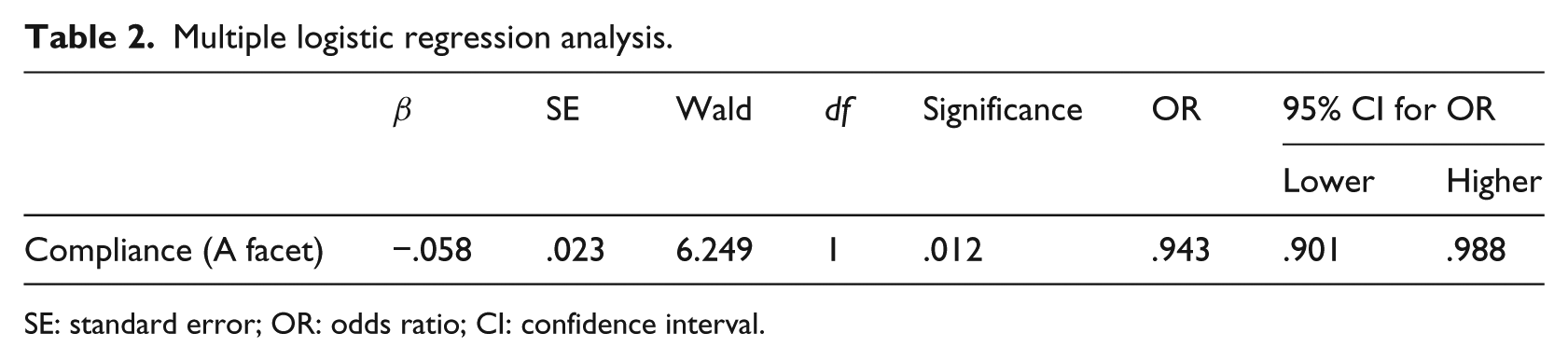
SE: standard error; OR: odds ratio; CI: confidence interval.
Discussion
The individual or psychological characteristics of the persons are relevant in understanding the processes involved in the acquisition, maintenance, or deterioration of their own health. They tend to be more sexually active, have multiple sexual partners, and have sex under the effects of alcohol and other drugs, as indicated in Arnett (2000), Espada et al. (2015), Fromme et al. (2008), or McBride et al. (2008). Different studies in Spain have shown that there is still a significant percentage of youth who have unprotected sex (Ballester et al., 2013; Bimbela et al., 2002; Espada et al., 2013; Lameiras et al., 2006; Planes et al., 2012; Santín et al., 2003).
With the aim of establishing whether personality has an influence in the predisposition of systematically using the condom, the five-factor model was used as it is a commonly used personality approach in scientific research and because it has generated valid results in different populations and cultures in the sphere of risky sexual behavior as reported by Shafer (2001) or Hoyle et al. (2000). The Big Five, considered by McCrae and Costa (1984, 1994) as traits of temperament, with an origin and development independent of the environmental influence, has shown the consistency of traits, genetic history, stability over time, and the universal structure in several studies.
Starting with the evaluation instrument designed under the scope of personality traits, we believe that the caution and prudence expressed by McAdams (2001) or Pervin (1996) should not be dismissed. The personality profile of the sample analyzed in this study reflects average levels of Neuroticism (N), Extraversion (E), and Openness to Experience (O), and low levels of Agreeableness (A) and Conscientiousness (C), in relation to the general population. This suggests that perhaps sexual risk behaviors do not necessarily imply extreme personality scores. Second, we have to take into account that there are individuals within the same score level who have differing condom use frequencies. This result, together with the scant number of traits with statistical significance, might entail an initial piece of evidence pointing to the existence of other elements involved in a given risky sexual behavior.
Our findings in this regard do not offer us many significant differences. Does this mean that individual differences in personality have no bearing on the decisions taken by young people on their own behavior? The answer is likely to be negative. Even though there is considerable scientific evidence as to the association between personality and various health behaviors, the evidence is both less available and more ambiguous with regard to the possible role of personality variables in the decision-making process for performing or otherwise a given behavior (Conner and Abraham, 2001). A second possible explanation suggests that there is possibly a limited predictive function in the global dimensions of personality in relation to specific behaviors unless due consideration is given to the psychological process and contextual dimensions that come into play in the interaction between general dispositional variables and behavior (Ballester et al., 2015).
In our study, we nevertheless wanted to find out which personality characteristics were directly associated with behavior. The young people in our study who did not use condoms systematically in their sexual relations have obtained higher scores in N, E, and O. However, the young people who reported that they always used a condom obtained higher scores in A and C. These results are coherent with those obtained by Ingledew and Fergunson (2007), Miller et al. (2004), and Trobst et al. (2002) in their respective studies. Of all the dimensions examined, the biggest statistically significant differences between groups were found in O and C and the facets Actions (O), Competence (C), and Self-discipline (C).
The question was then: Which are the main personality characteristics that distinguish the people who take risks by not using a condom in sexual relations from the young people who use a condom in a consistent manner? The former may be open-minded young people who seek and value new experiences; seemingly, they like exploring the unknown and are daring. It is also possible that they disregard the social standards for condom use. The latter group is prudent; they think before they act and are, therefore, likely to have more self-control. They comply with their own standards and use condoms in their sexual relations. Furthermore, using a condom is more or less pleasurable for them; they act according to their beliefs and motivate themselves to keep acting in this way. Broadly speaking, these profiles show us that risk seems to be connected with the need to engage in activity, newness, and stimulation. It follows that preventive behavior has been linked to a more rational and reflexive mind-set in young people. On a practical level, it may seem more appropriate to work on the level of risk awareness in the portion of young people who obtain higher scores in O, as well as in decision-making.
Even though there were no significance levels, general tendencies observed are worth describing at a clinical level because they may carry clues as to the different personality profiles present in young people. On one hand, we find higher levels of N and E in the young people not using a condom. It seems that these young people view having sex as a difficult situation that must have a “successful outcome”; even so they do not perceive themselves as having the ability to accomplish sexual relations satisfactorily. It is likely that if the sex did not prove to be as what might have been expected, they may feel anger and hostility as a response to their own low tolerance to frustration. Perhaps, they refrain from using a condom because they prefer to give free reign to sexual desire, and they may, in turn, have poor self-control. As Lameiras and Rodríguez (2003) pointed out, they have more permissive attitudes toward sex even though they may experience concern and regret after engaging in a risky behavior. Furthermore, these young people like to look for sensations, need stimulation, and require a minimum level of intensity of activation; these aspects—or the degree of activation needed—may be reached in the perception of risk represented by not using a condom or by the belief that not using it offers heightened sexual pleasure. They also tend to form more intimate bonds and experience positive emotions such as optimism. Both of these characteristics have an influence on not using a condom because priority is given to placing trust in the other person, while also perceiving less risk in their own behaviors. The opposite is the case of the dimension A which obtained higher scores in persons who used a condom. This portion of young people seems to be more pragmatic and is more concerned about the welfare of others and, as a consequence of this, of themselves.
Finally, an attempt was made to predict the behavior of condom use in young people and a predictive variable, a compliance attitude was identified; this is the tendency to behave in a cooperative, peace-making, and indulgent manner. This facet appeared as a protective factor in our study and was the reverse of findings by Trobst et al. (2002) or Ballester et al. (2015) in their study. These characteristics are linked to cognitive processing that may include a predisposition toward a positive resolution of situations as well as the use of more effective interpersonal skills; this predisposition may also facilitate the use of assertive strategies in communicating and negotiating condom use with a sexual partner. A recent study carried out by Longman-Mills and Carpenter (2013) on Jamaican adolescents demonstrated the influence of interpersonal skills when deciding not to participate in risky sexual behaviors.
The findings of our study also point to the need to consider other theoretical models that seek to explain the relationship between personality and risky sexual behavior. As McAdams (2008) states, beyond dispositional and characteristics adaptations, human lives vary with respect to the integrative life stories and personal narratives that individuals construct to make meaning and identity. Just as Mischel (2004) points out, there is a need to look at other models that consider the specific reactions of persons in the face of specific situations. This implies focusing on personality as a process where there is interaction of the person with the environmental and social variables surrounding him or her. Just as Cooper (2010) argues, differences in sexual behaviors can be reasonably predicted through individual differences in personality. However, sexuality and behaviors that are associated with it cannot be understood in a static and decontextualized way, rather as a constantly dynamic and complex process that involves the interplay of the person, the situation, and the context of the sexual relationship (Amaro et al., 2005; MacDonald et al., 2015).
Let us consider that the results obtained may bring us closer to an understanding of sexual behavior among young people and, more specifically, to the question of condom use in the primary prevention of infection by HIV. Nevertheless, the conclusions of this study are constrained by certain limitations that future research will need to overcome.
Following from this, in our study, we made two decisions on methodology that may have had an effect on the findings obtained. First, we have assumed as the criterion condom use in vaginal penetration. The reasons for this choice, as was set forth earlier herein, is that it is one of the highest risk practices while also being the commonest sexual practice in young people. It would, nevertheless, be important to establish if the same results and the same explanatory model obtained for different practices and risk situations, such as oral sex, anal sex, a steady partner, or a casual partner. Second, we have established two categories as a function of systematic use of condoms. We decided to appeal to the biological criterion of risk of infection; in other words, the idea that only the systematic use of condoms could guarantee not getting infected. We would, nevertheless, need to analyze what the outcome might have been if we had considered this behavior (using a condom) as a progressive continuum with differing degrees of condom use (sometimes, quite often, etc.). Perhaps, the psychological profile of the young adult who never uses it compared to the profile of one who uses it inconsistently may be different. Finally, cross-sectional studies are carried out on time point and do not indicate the sequence of events. That is why there are some limitations to infer causality.
As a concluding remark, there is a need for further research to obtain the prediction that is as close as possible to the behavioral reality when designing effective intervention programs geared at health-promoting behaviors in young people.
Footnotes
Acknowledgements
This article has been translated by John Joseph Vélez, BA, University of Melbourne, Australia.
Declaration of conflicting interests
The author(s) declared no potential conflicts of interest with respect to the research, authorship, and/or publication of this article.
Funding
The author(s) disclosed receipt of the following financial support for the research, authorship, and/or publication of this article: This work was supported by Universidad Jaume I-Fundación Bancaixa (P1 1B2006-19) and the Spanish foundation for AIDS research and prevention known as Fundación para la Investigación y la Prevención del Sida en España (exp. 36639/07).