



Abstract
This research investigated the differential effects of sociocultural pressures from media, peers, and parents on the thin ideal internalization and body dissatisfaction of 472 Korean female college students using structural equation modeling. Results indicated that after controlling for body mass index and exercise, media pressure exerted the largest effects, followed by peer pressure and parental pressure, on thin ideal internalization, and in turn, body dissatisfaction. Furthermore, parent and media pressures were found to exert direct effects on body dissatisfaction as well as indirect effects through thin ideal internalization. The results and implications of the study are discussed.
Introduction
An individual is frequently exposed to the message of the thin ideal by mass media, parents, and peers (Anschutz et al., 2008; Rodgers et al., 2011; Yamamiya et al., 2008). Previous studies have reported that the sociocultural pressure from images of an unrealistic body ideal fosters body dissatisfaction (Paxton et al., 2006; Rodgers et al., 2011) and the internalization of thin bodies (Rodgers et al., 2015). Internalization of the slim body figure is the psychological process of taking sociocultural body ideals as one’s own personal standard (Vartanian et al., 2005). Slim body internalization and body dissatisfaction have been found to negatively affect outcomes such as abnormal eating behaviors (Heinberg et al., 2008; Lokken et al., 2004), depressive mood (Paxton et al., 2006), low self-esteem (Pearl et al., 2014), and decreased life satisfaction (Muñoz and Ferguson, 2012). Therefore, research on the impacts of sociocultural pressure on thin body internalization and body dissatisfaction can help with the prevention and intervention of the development of negative outcomes.
Body dissatisfaction, particularly among women, has been identified as a serious concern by researchers and policymakers (Ferguson et al., 2011). Research suggests that approximately over 40 percent of women in Western societies express some level of body dissatisfaction (e.g. Bearman et al., 2006; Monteath and McCabe, 1997). Body image concerns increase rapidly in early adolescence (Abebe et al., 2012) and become highly prevalent among university-aged women (Berg et al., 2009). For example, Spitzer et al. (1999) found that over 80 percent of women in university settings reported body dissatisfaction. The high prevalence of body dissatisfaction is an issue of concern because negative body image has been associated with unhealthy behaviors and feelings (Son, 2008). Marks (2015) suggested that there are reciprocal causal relationships between body dissatisfaction, obesity, negative affect, and consumption of high-density foods and beverages. In light of the detrimental effects of body dissatisfaction, understanding the diverse factors influencing and resulting in body dissatisfaction is crucial.
Cross-cultural studies reported greater body dissatisfaction among college students in Korea than college students in the United States (Jung et al., 2009; Jung and Forbes, 2006) suggesting variable levels of cultural influences in attitudes and behaviors toward body ideals. Furthermore, previous literature focused on the impacts of media pressure on body dissatisfaction and thin ideal internalization, while overlooking peer and parent pressures (Ferguson et al., 2011). In recognition of these limitations, this study aims to provide a more comprehensive view of the relationship between three types of sociocultural pressures (i.e. parents, peer, and media) and body dissatisfaction among South Korean female college students. Additionally, this study examines the mediating role of thin ideal internalization within the relationship in order to provide a more comprehensive understanding of the development of body dissatisfaction.
Sociocultural pressure of the thin ideal
One of the most influential factors affecting internalization of the ideal slim body figure is the presence of sociocultural pressure. Among numerous sources of sociocultural pressure (e.g. mass media, parents, and peers), media pressure on women to be thin has been found to be associated with increased body dissatisfaction (Johnson et al., 2015). Parental attitude is another important sociocultural factor that has been found to be related to body image and dissatisfaction. However, discussions about parent influences are scarce (Lev-Ari et al., 2014). A few studies have reported that appearance-related teasing by parents is a predictive factor for the internalization of the ideal slim body figure and body dissatisfaction. For example, according to the study by Keery et al. (2005) on 372 middle school girls, 23 percent experienced appearance-related teasing by a parent. Frequency of teasing was associated with higher levels of negative outcomes such as body dissatisfaction, comparison, thin ideal internalization, self-esteem, bulimic behaviors, and depression.
Peer pressure is also an important sociocultural factor in predicting body dissatisfaction, but is less studied. Ferguson et al. (2011) emphasized the importance of understanding peer influence on body dissatisfaction by pointing out that comparisons to peers might be more influential than comparisons to the images portrayed in the media. Results of Sheldon’s (2013) study conducted on 283 college students also supported that peer influence is more significant than parent influence on body image perceptions.
Several studies have suggested that depending on ethnicity, even when exposed to the same sociocultural pressure, the level of internalization may differ. In a study by Warren et al. (2009) on 94 female Mexican-American college students, results indicated that the level of active cultural adaptation by taking part in activities related to American culture changes the level of internalization of the ideal slim body figure. Those with more active cultural adaptation showed more internalization than those who were less involved in active cultural adaptation. A study by Warren et al. (2005) on a sample of 100 female Spanish, Mexican, and European-American college students residing in the United States found that female Spanish and Mexican-American students internalized the American sociocultural value less than female European-American students. All three groups did not show notable differences in the recognition of the sociocultural value of idealizing slim figures; however, European-American students showed the highest level of internalization.
Given that ethnicity can play a significant role in the relationship between sociocultural pressure, internalization, and body dissatisfaction, this study investigated the relationships between these three factors using a sample of Korean female college students in order to provide a culturally appropriate framework to understand these relationships. Specifically, this study specified distinct types of sociocultural pressures to provide a more detailed understanding of the process as to how each pressure relates to the internalization of the ideal slim figure. Moreover, the study examined whether the internalization of the ideal slim figure acts as a mediator between sociocultural pressures and body dissatisfaction.
Methods
Sample and study design
The data were collected during the Spring semester of 2015. The participants in this study included female college students who were recruited from three private universities in Seoul, Korea. Of the surveys distributed, 96.1 percent were completed and returned. A total of 472 students provided usable surveys. The mean age of the sample was 23.52 years (standard deviation (SD) = 5.60 years). The demographic information and exercise behavior of the current sample are reported in Table 1.
Participants’ demographic characteristics and exercise behavior.
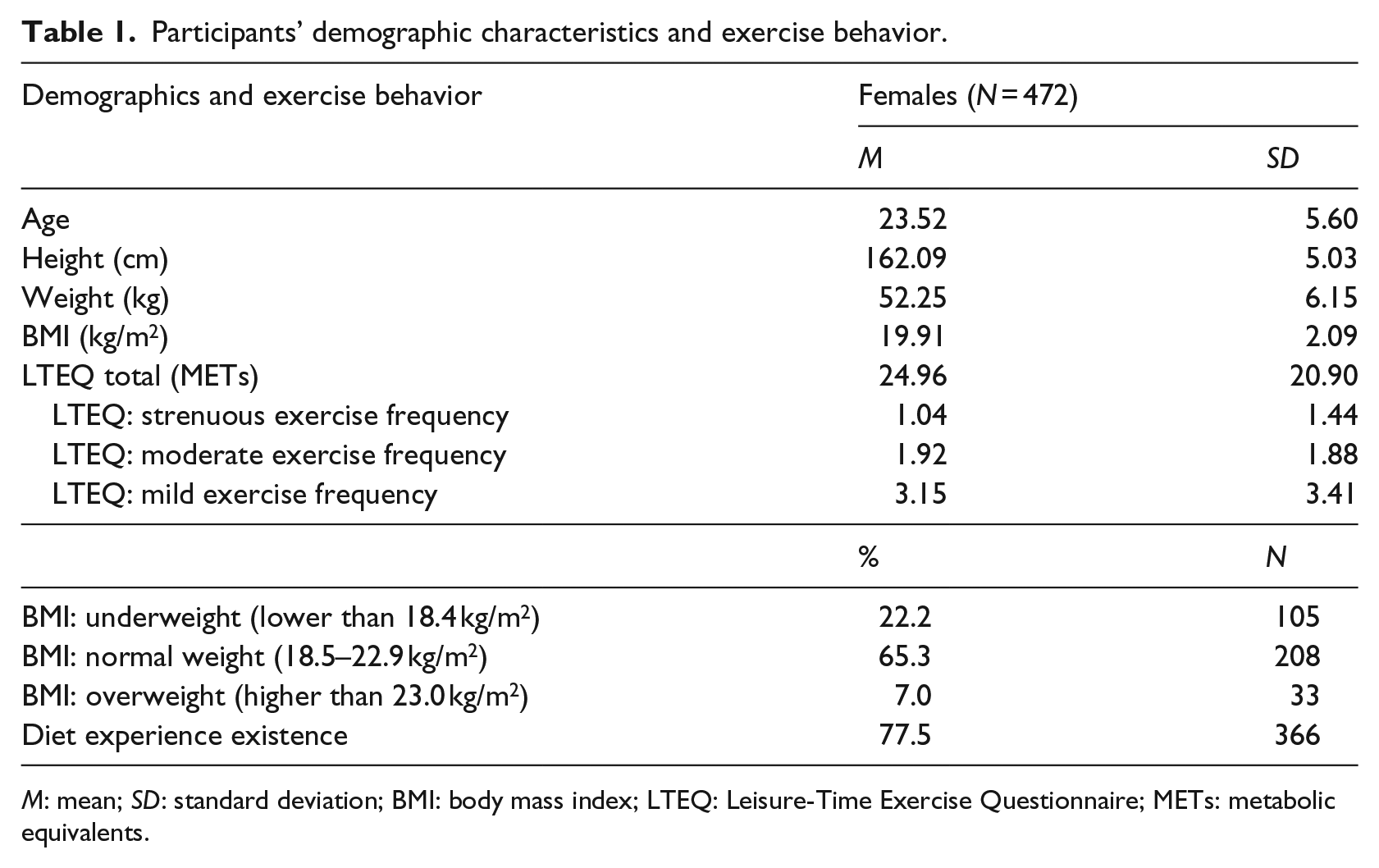
M: mean; SD: standard deviation; BMI: body mass index; LTEQ: Leisure-Time Exercise Questionnaire; METs: metabolic equivalents.
Procedures
Instructors from the College of Health Sciences were contacted to obtain permission to recruit the study’s participants from their classes. Once approval was granted, trained researchers distributed an information letter that included a description of the study. Students who opted to participate were administered the survey, in paper and pencil format, during class.
Measures
Body dissatisfaction
The Korean Overall Body Esteem Scale (KOBES) (Gim and Cha, 2006) was used to measure body dissatisfaction. The scale consisted of nine items, which respondents rated on a scale ranging from 1 (never true of me) to 5 (always true of me).
Internalization
The Sociocultural Internalization of Appearance Questionnaire (Thompson et al., 2004) was used to assess internalization. Seven items represented the incorporation of media images and messages of attractiveness into one’s own self-identity.
Sociocultural influence
To measure peer and parental influence, 15 items were selected from the Sociocultural Influences on Body Image and Body Change Questionnaire (McCabe and Ricciardelli, 2001). To measure media influence, five items were selected from the Sociocultural Attitudes toward Appearance Scale-3 (SATAQ-3) (Thompson et al., 2004).
Exercise behavior
The Leisure-Time Exercise Questionnaire (LTEQ) is a self-report instrument used to assess the frequency of mild, moderate, and strenuous exercise that is conducted for 15 minutes or longer during a typical week (Godin et al., 1986). The weekly frequency of mild, moderate, and strenuous exercise is converted into a measure of energy expenditure called “metabolic equivalents” (METs) using the following formula: (3 × mild) + (5 × moderate) + (9 × strenuous).
Analysis
Structural equation modeling (SEM) was used to assess the hypothesized structural relationships between latent variables. SEM was selected because it represents an appropriate analytic approach for dealing with the issues of specifying directionality in the variables of interest and generating the flexibility with which to test causal relationships. Two mediational models were tested in order to compare and derive the best model. The model fit was assessed based on several criteria: the comparative fit index (CFI; Bentler, 1990), non-normed fit index (NNFI; Bentler and Bonett, 1980), and the root mean square error of approximation (RMSEA; Steiger and Lind, 1980). Values lower than .06 for the RMSEA and values close to .95 for the NNFI and CFI were used to determine a good-fitting model. Because our data contained missing values, we conducted our analyses using the full-information maximum likelihood (FIML) estimation available from AMOS 17. The missing rates of the variables ranged from .1 to 1.5 percent.
Results
Descriptive statistics
The correlations, mean, and SD of the variables in the study are provided in Table 2. Significant correlations were found among the study variables. This is in accordance with a previous study (Keery et al., 2004), and it is evident that sociocultural pressure (mass media, parents, and peers) is an important non-personal factor in personal change that is associated with internalization.
Correlations and descriptive statistics for study variables.
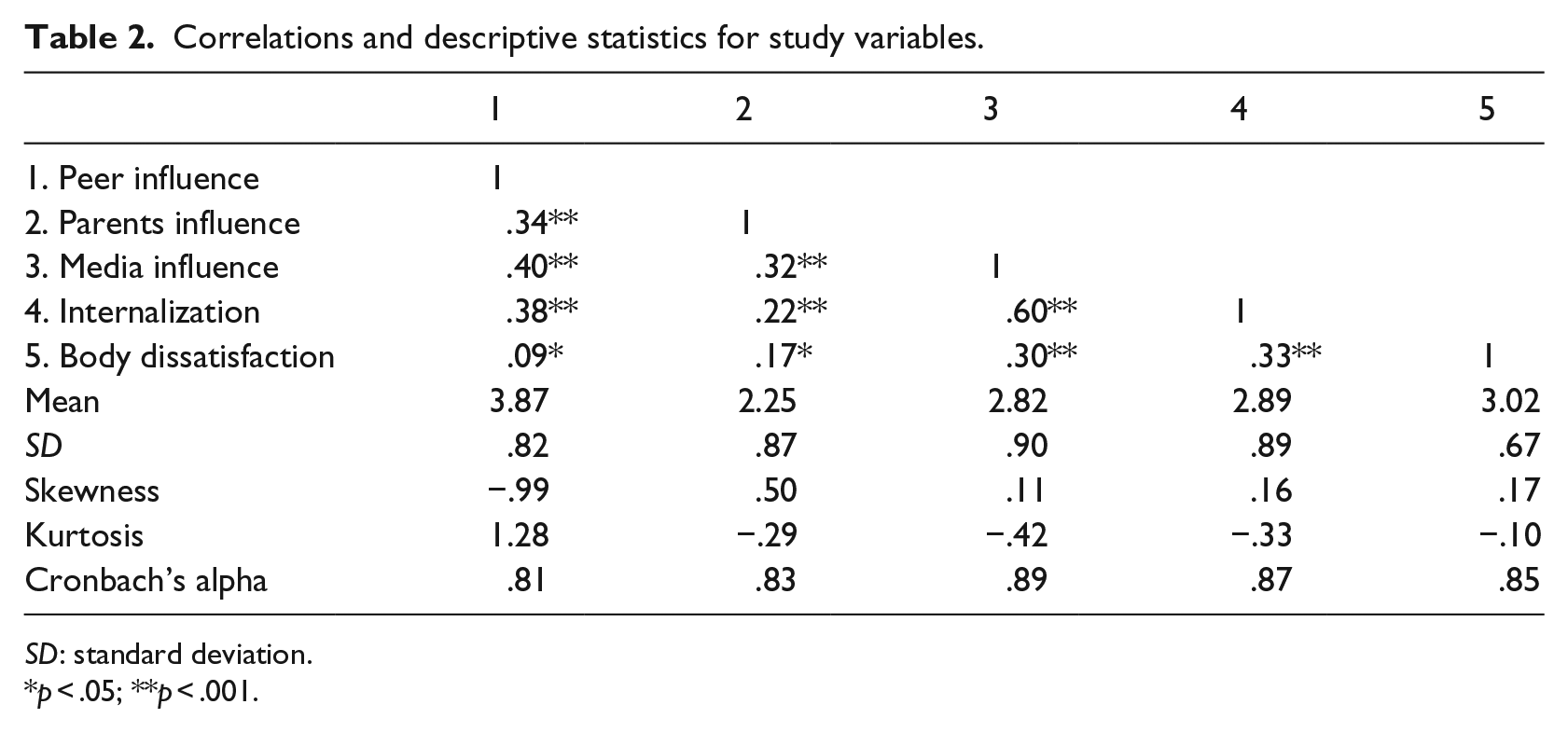
SD: standard deviation.
p < .05; **p < .001.
Testing the mediational models
In the examination into whether the relationship between sociocultural pressure and body dissatisfaction is mediated by students’ internalization, the partial mediational model yielded an overall χ2(78) value of 200.034, with CFI = .956, NNFI = .962, and RMSEA = .058 and the full mediational model yielded an overall χ2(81) value of 211.181, with CFI = .953, NNFI = .930, and RMSEA = .058. A chi-square difference test supported the partial mediational model. Thus, we chose the partial mediational model as the final model (see Figure 1). The bootstrap results indicated that the indirect effects of all three sub-factors within sociocultural pressure on body dissatisfaction through a mediating variable were all significant.
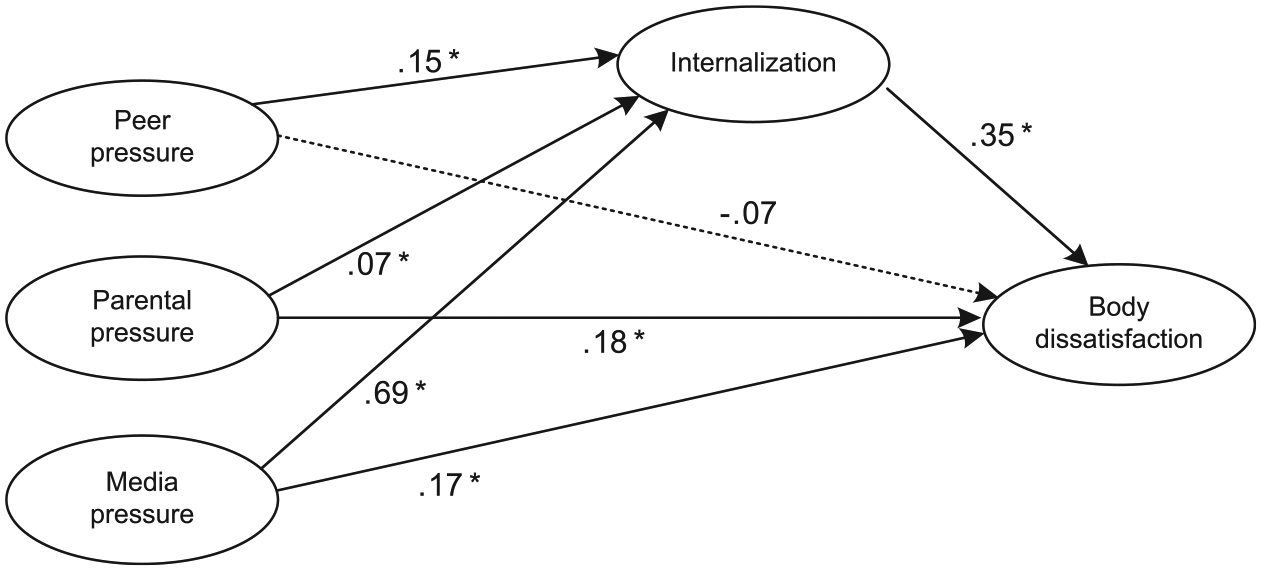
Final model estimation with standardized coefficients.
Results indicated that parental and media pressure had significant direct relationships with body dissatisfaction among Korean female college students, while peer pressure had no significant direct relationship with body dissatisfaction. In regard to the mediating effects of the internalization of the thin ideal, all peer, parents, and media pressure had significant indirect relationships with body dissatisfaction by way of the thin ideal internalization. Specifically, all three sources of sociocultural pressure had significant impacts on the thin ideal internalization of Korean female college students, which in turn affected their levels of body dissatisfaction. Furthermore, among the three types of sociocultural pressures, media pressure had greater impacts than peer and parental pressure on the internalization of the thin ideal.
Discussion
The purpose of this study was to extend the literature on body satisfaction by examining the relationship between each domain of sociocultural pressure (mass media, parents, and peers) and body dissatisfaction and the mediating role of internalization of the ideal slim body figure in these relationships using a non-western sample. Most of the previous studies on body dissatisfaction that examined the effects of sociocultural pressure on body dissatisfaction among women assessed only media pressure or combined all media, peer, and parent pressure to measure social influence on body dissatisfaction. For example, Hong (2010, 2011) surveyed female college students from three countries (i.e. Korea, China, and Germany) and found that social pressure influenced both internalization of the thin ideal and body dissatisfaction. Although these studies found significant relationships between social pressure and body dissatisfaction, they did not explain how each type of social influence was associated with body dissatisfaction. Thus, this study was conducted to verify the differential influences of mass media, parents, and peers on internalization for a sample of Korean female college students by examining distinct relationships of pressure from media, parents, and peers in the analyses. Results of this study were consistent with previous findings (Johnson et al., 2015; Keery et al., 2005) that both parental and media pressures were directly associated with body dissatisfaction. However, this study’s finding that peer pressure had no direct relationship with body dissatisfaction was inconsistent with previous studies reporting a significant relationship between the two factors (Sheldon, 2013).
Findings of this study explained that although parental and media pressures have direct influences on body dissatisfaction, all three types of sociocultural pressures had indirect influences on body dissatisfaction through thin ideal internalization, thus lending support to the significant relationships between thin ideal internalization and body dissatisfaction among Korean female college students. Furthermore, the degree of internalization due to pressure from mass media was found to be greater than those from parents and peers, confirming the immense influence that mass media has on the internalization of the ideal slim figure and body dissatisfaction. This is in correspondence with a previous study that asserts mass media causes internalization (Keery et al., 2004) and implies that within Korean society, mass media is a significant factor in the development of body figure internalization. Specifically, media pressure was found to have a direct relationship with body dissatisfaction as well as an indirect relationship through internalization of the thin ideal. That is, when exposed to media pressure to be thin, female college students tend to develop negative perceptions of their body figure and accept the media ideals as their own ideal, which may further develop instances of body dissatisfaction.
Findings of this study may suggest the need for changes focusing on building a media culture that respects various body shapes. Jang and Kim (2006) reported that participants who viewed media content that portrayed being fat through a positive perspective had a decrease in body cognition difference and increase in body esteem. It may be beneficial to improve body satisfaction by reducing media content that idealizes slim figures and forming cultural media resources that provide a positive perspective toward different body shapes. Thus, shifting the emphasis toward accepting diverse body types can help young people foster positive body esteem. More importantly, programs are needed to provide education on critical consumption of media to reduce the internalization of the media ideals; these programs can help young people resist comparing themselves to unrealistic body figures portrayed by media.
Parent and peer pressures also exerted significant influences on thin ideal internalization among Korean female college students. Although pressure from parents and peers were less influential than mass media, they still hold potentially important roles in helping young people overcome negative outcomes. Specifically, parental pressure was found to directly and indirectly influence body dissatisfaction, while peer pressure was found to only indirectly influence body dissatisfaction through internalization. That is, when exposed to pressure to be thin from peers, Korean female college students were not likely to develop negative perceptions of their body figure. However, when exposure to peer pressure leads them to take the thin ideal as their own belief, they were likely to have an unfavorable perception of their body. These results may indicate that female college students tend to directly respond more to parents’ judgment than peers’ judgment about their bodies. Thus, there is a need for interventions that target appearance-related teasing and attitudes toward ideal thin bodies and unhealthy diets. Particularly, parent education/training on the impacts of their words and behaviors on their child’s perception of his or her body can be influential in both prevention and treatment. Additionally, education programs can provide parents and their children with information emphasizing health and nutrition rather than appearances and media prescribed standards of beauty. Furthermore, results suggest a need for programs that educate women to be aware of sociocultural influences on thin ideal internalization and body dissatisfaction and how to critically evaluate these influences to develop healthy attitudes and perceptions of diverse body figures.
This study has notable strengths such as an adequate sample size for the analyses used and the use of a culture- and gender-specific sample. Furthermore, the inclusion of different sources of sociocultural support and the examination of the mediating effects of internalization of the thin ideal addressed the limitations of previous body dissatisfaction studies. However, there are several limitations that offer avenues for future research. The current sample was recruited from well-known universities in which only students with high Korean Scholastic Aptitude Test (SAT) scores could attend. Furthermore, all these universities were located in Seoul, the capital city of South Korea. Thus, the characteristics of the sample may affect the generalizability of the study results in other Korean samples, suggesting the need for including and examining more diverse groups. Additionally, because many other factors such as age, height, and pregnancy may affect a female college student’s body satisfaction and thin ideal internalization, it is recommended that future research considers and controls for these factors when examining the relationships between sociocultural pressure, thin ideal internalization, and body dissatisfaction.
Conclusion
Using a Korean female college student sample, this study examined the direct and indirect relationships between sociocultural pressure, body satisfaction, and thin ideal internalization. Results partially supported the significant direct relationship of sociocultural pressure with body dissatisfaction; while parental and media pressures were directly associated with body dissatisfaction, peer pressure was not. In addition, among Korean female college students, thin ideal internalization was found to mediate the relationships between all peer, parental, and media pressures and body dissatisfaction. As body dissatisfaction has been reported to exert considerable impacts on an individual’s mental and physical health, future research should seek to identify influential factors and the paths to body dissatisfaction.
Footnotes
Declaration of Conflicting Interests
The author(s) declared no potential conflicts of interest with respect to the research, authorship, and/or publication of this article.
Funding
The author(s) disclosed receipt of the following financial support for the research, authorship, and/or publication of this article: This work was supported by Hankuk University of Foreign Studies Research Fund.