



Abstract
Binge watching is a relatively new behavioural phenomenon that may have health implications. The aim of this study was to estimate the frequency of, and identify modifiable factors associated with, TV binge watching. A total of 86 people completed an online questionnaire assessing self-efficacy, proximal goals, outcome expectations, anticipated regret, automaticity, goal conflict and goal facilitation, and self-reported binge watching over the last week. Participants reported binge watching a mean 1.42 days/week (standard deviation = 1.42). Intention and outcome expectations accounted for variance in binge watching, and automaticity, anticipated regret and goal conflict each separately accounted for additional variance in binge watching. Binge watching is commonplace and associated with both reflective and impulsive factors.
Keywords
Background
With the emergence of online streaming television services, watching television has never been so easy and a new behavioural phenomenon has arisen: television binge watching, that is, viewing multiple episodes of the same television show in the same sitting.
Watching television is the most widespread leisure-time sedentary activity in adults (Wijndaele et al., 2010), involving little metabolic activity (Hu et al., 2003). In the United Kingdom, over one-third of adults spend at least four hours a day watching television (Stamatakis et al., 2009).
Up to 33 per cent of men and 45 per cent of women in the United Kingdom fail to achieve recommended physical activity levels (Craig and Mindell, 2014). As lack of physical activity is the fourth leading mortality risk factor (World Health Organization, 2010), identifying factors that prevent achieving health-protective levels of physical activity remains important. Furthermore, sedentary behaviour is linked with adverse health outcomes independently of physical activity (Veerman et al., 2012). Time spent watching television is also linked with obesity and reduced sleep time (Vioque et al., 2000). Understanding the factors that lead to watching television at ‘binge’ levels may help to target interventions to reduce sedentary activity and obesity rates and improve sleep hygiene.
Little is known about the extent that television watching reaches binge levels, and there has not yet been any attempt to define it or assess its frequency in the literature. The aims of this study were to propose a preliminary definition of binge watching, provide a first estimate of binge-watching frequency and identify modifiable behaviour theory-based correlates of binge watching.
Theory development: building on what we know
Social cognitive theory (SCT; Bandura, 1997) proposes that within a framework of reciprocal determinism between behaviour, the person and their environment, behaviour is proximally determined by outcome expectations, self-efficacy and proximal goals (Bandura, 1997). SCT has many strengths separating it from similar theories: it describes predictors of behaviour and their inter-relations while providing techniques for fostering behaviour change. Nevertheless, there are least three factors not included in current applications of the theory that may be important to understanding binge watching: dual processing, anticipated regret and multiple goal pursuit.
Dual processing
Most social cognition models describe the conscious reflective process involved in enacting and changing behaviour. Increasingly, the role of an impulsive process has been proposed, operating outside of awareness and intentionality, alongside the reflective process and contributing to behaviour (Dombrowski and Luszczynska, 2009; Hofmann et al., 2008; Presseau et al., 2014; Strack and Deutch, 2004). The impulsive process may be particularly salient in binge watching. Initially, a reflective intention may be formed to watch television, yet the binge-watching experience can be characterised as involving continueous cueing of subsequent episodes and an in-built contingent reward mechanism, without need for conscious decision-making thus leading to more automaticity-driven behaviour.
Anticipated regret
Binge watching may generate feelings of regret, such as when extending into the early hours of the morning, impacting on sleep and the day ahead. Anticipated regret predicts behaviour over and above constructs from well-established social cognition models (Sandberg and Conner, 2008). Given that prolonged binge watching may lead to regret, the anticipation of this emotion prior to binge watching might be a relevant explanatory factor.
Goal conflict and goal facilitation
Predominant behavioural theories focus on a single behaviour in isolation. Despite their prominence, such perspectives are not consistent with everyday experiences of multiple goal pursuit, where pursuit of each goal competes for limited resources of time and energy. A number of studies have shown that goal conflict and goal facilitation, that is, the negative and positive impact that the other goals pursued alongside a target behaviour, have a direct relationship with health behaviours (Presseau et al., 2010, 2013; Riediger and Freund, 2004). Equally, binge watching may itself have a conflicting and/or facilitating impact on the pursuit of other personal goals (e.g. facilitating socialising and/or preventing household chores or work).
Automaticity, anticipated regret, and goal conflict and facilitation represent potentially useful constructs to help understand binge watching beyond factors from traditional theory. We hypothesised that when controlling for constructs from SCT, variance in binge watching will be further accounted for by: automaticity (Hypothesis 1), anticipated regret (Hypothesis 2) and goal conflict and goal facilitation (Hypothesis 3).
Methods
Pilot
We conducted an elicitation and think-aloud pilot with five participants (two men, three women; age range = 19–32 years, involving master’s students and young professionals) to inform questionnaire development.
Design and recruitment
Approved by the local ethics committee and using a cross-sectional design, participants were invited through social media using a snowball method to complete an online questionnaire and provided informed consent prior to participation. Participants completing the study were entered into a draw for a £50 voucher.
Measures
Demographics
We assessed age, sex, body mass index (BMI), marital status and number of children.
TV binge-watching behaviour
We defined binge watching as ‘watching more than two episodes of the same TV show in one sitting’. Participants self-reported TV binge watching using the following three items (Cronbach’s alpha = 0.72): ‘In the past 7 days, on how many days did you watch more than two episodes of the same TV series in the same sitting (one immediately after the other)? (0–7 days)’; ‘Thinking of the last time you watched more than two consecutive episodes of the same TV show in the same sitting, how many consecutive episodes of the same TV show (one after the other) did you watch?’; ‘Thinking of the last time your watched more than two consecutive episodes of the same TV show in the same sitting, how many hours did you spend watching the TV show? (in hours, rounded to nearest half hour)’.
To understand the environmental cues that may drive binge watching, we asked participants to report how many box sets they owned and how many online streaming services they used in the past month. We also asked how often they let the service automatically continue to the next episode. In addition, participants were asked to describe when, where and how they typically watched television in the last month.
SCT constructs
Intention (proximal goals) was assessed using one item: ‘On how many days do you intend to watch more than two episodes of the same TV show in the same sitting over the next 7 days?’ (0 to 7 days).
Outcome expectations were assessed using six items scaled 1 = strongly disagree to 5 = strongly agree (Cronbach’s alpha = 0.79), each with the common stem ‘Watching more than two episodes of the same TV show in the same sitting over the next 7 days will lead me to …’ covering physical outcomes (‘… be physically healthier’; ‘… feel more relaxed’), affective outcomes (‘… feel happier’; ‘… reduce my stress’) and social outcomes (‘… spend time with someone important to me’, ‘… have something to talk about with other people’).
Self-efficacy was assessed using five items scaled 1 = strongly disagree to 5 = strongly agree (Cronbach’s alpha = 0.79), using the common stem ‘I am confident that I can stop myself from watching more than two episodes of the same TV show …’ followed by five items ‘… if I wanted to’; ‘even when I have a lot of time on my hands’; ‘… even when I am bored’; ‘… even when it is late at night’; ‘… even when I am watching TV with someone else’.
Additional theoretical constructs
Automaticity was assessed using the self-report automatic index (Gardner et al., 2011). We adapted the scale by clarifying environmental cues involved in binge watching in the item stem: ‘Watching more than two episodes of the same TV show in the same sitting at my typical time and location is something …’ (where time and location were identified earlier in the survey), followed by the four standard items: ‘… I do automatically’; ‘… I do without thinking’; ‘I do without having to consciously remember’; ‘I start doing before I realise I’m doing it’ (Cronbach’s alpha = 0.93).
Anticipated regret (Cronbach’s alpha = 0.92) was assessed with two items adapted from O’Carroll et al. (2012). ‘If I watched more than two episodes of the same TV show in the same sitting in the next 7 days, I would … (“… feel regret”; “… would later wish I had not”)’.
Goal conflict (Cronbach’s alpha = 0.93) was assessed with two items sharing the stem ‘How often does it happen that because of watching more than two episodes of the same TV show in the same sitting, you do not invest …’ followed by: ‘… as much time in other pursuits as you would like to?’; ‘… as much energy in other pursuits as you would like to?’.
Goal facilitation (Cronbach’s alpha = 0.77) was assessed with three items: ‘Watching more than two episodes of the same TV show in the same sitting sets the stage for me to pursue other important goals in my everyday life (five-point scale, strongly disagree to strongly agree)’; ‘How often does it happen that watching more than two episodes of the same TV show in the same sitting is simultaneously beneficial for pursuing other important goals in your everyday life? (five-point scale, Never to Very Often)’; and ‘Watching more than two episodes of the same TV show in the same sitting in the next 7 days will help/facilitate my participation in regular physical activity’.
Analysis plan
To test the hypotheses, we ran four separate linear regressions, each involving two steps. Across all four analyses, the first step involved assessing which constructs from SCT were jointly associated with binge watching. In step 2, automaticity, anticipated regret, goal conflict or goal facilitation were each separately added to test their added contribution to explaining variance in binge watching. Additional details of the questionnaire development and items are available from the corresponding author (J.P.).
Results
Participants
A total of 110 people responded to the online questionnaire, with 86 providing complete data (age: mean = 30; standard deviation (SD) = 12; 67% women; BMI: mean = 24.39, SD = 4.08). Most (78%) reported no children, 64 per cent reported being single, 19 per cent married and 5 per cent divorced.
Binge-watching frequency
Participants reported binge watching a mean of 1.42 days (SD = 1.42) in the previous week and reported watching a mean of 2.94 episodes (SD = 2.23, range = 0–14) and 2.51 hours (SD = 2.23, range = 0–14) in their last binge-watching session. Participants reported owning mean = 6.97 box sets (range = 0–100). Most reported using an online streaming service in the past month, with BBC iPlayer (n = 56), Netflix (n = 42), 4OD (n = 38), YouTube (n = 36), iTV Player (n = 33) and Sky (n = 30) being the most frequently reported streaming services. Half reported at least ‘sometimes’ letting the service automatically begin the next episode. Regarding when and where they generally watch TV, most indicated watching from 5 p.m. onwards and 74 per cent watched in their living room, 53 per cent in their bedroom, 16 per cent at someone else’s house, 14 per cent in the kitchen, 6 per cent at a hotel and 5 per cent at work. The typical method of watching television was a standard television (75%), but many also watched on their laptop (41%), tablet (32%) and smartphone (8%).
Descriptives and correlations
Binge watching was correlated with intention (mean = 2.47, SD = 1.65, r = 0.40, p < 0.01), outcome expectations (mean = 2.74, SD = 0.65, r = 0.43, p < 0.01), automaticity (mean = 2.63, SD = 1.21, r = 0.44, p < 0.01), anticipated regret (mean = 2.07, SD = 1.02, r = −0.25, p < 0.05), goal conflict (mean = 2.21, SD = 0.98, r = 0.44, p < 0.01) and goal facilitation (mean = 1.94, SD = 0.75, r = 0.23, p < 0.05) but not self-efficacy (mean = 3.78, SD = 0.71, r = −0.20, ns). The full correlation matrix is available from the corresponding author.
Explaining variance in binge watching
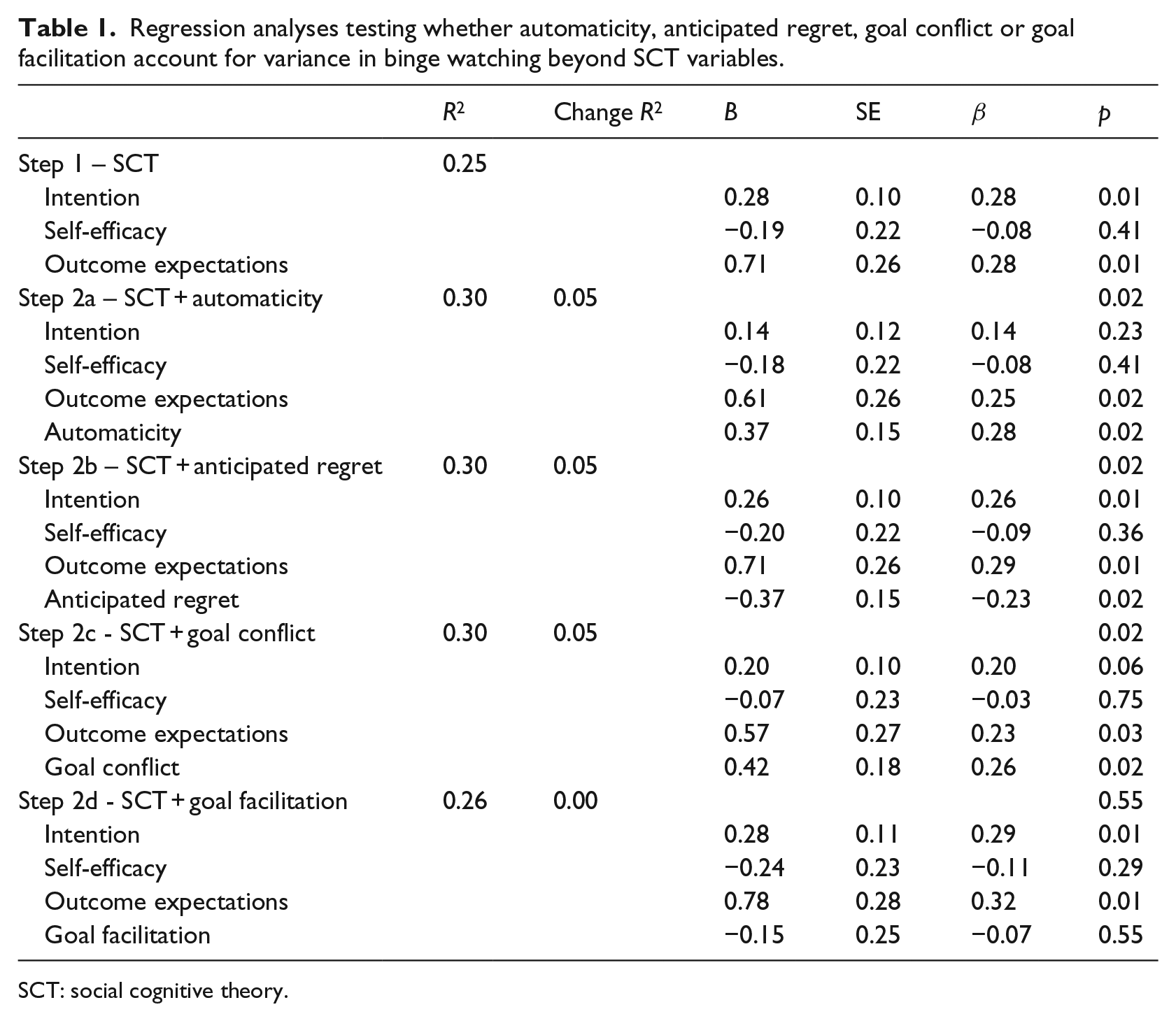
Factors from SCT accounted for a quarter of the variability in binge watching, with intention (B = 0.28, standard error (SE) = 0.10, p = 0.01) and outcome expectations (B = 0.71, SE = 0.26, p = 0.01) but not self-efficacy (B = −0.19, SE = 0.22, p = 0.41) driving this association (Table 1).
Regression analyses testing whether automaticity, anticipated regret, goal conflict or goal facilitation account for variance in binge watching beyond SCT variables.
SCT: social cognitive theory.
Adding automaticity to the model explained a further 5% of the variability in binge watching (B = 0.37, SE = 0.15, p = 0.02). In adding automaticity, intention was no longer a significant correlate.
Adding anticipated regret also accounted for an additional 5% variability in binge watching (B = −0.37, SE = 0.15, p = 0.02). Both intention and outcome expectations remained associated with binge watching.
Adding goal conflict accounted for 5% additional variability in binge watching (B = 0.42, SE = 0.18, p = 0.02). However, goal facilitation (B = −0.15, SE = 0.25, p = 0.55) was not associated with binge watching when seperately added to the model
Discussion
This study was the first to estimate binge-watching frequency, to propose a formal definition and to identify modifiable correlates of this behaviour. The findings suggest that our respondents binge watched at least once a week. The findings highlight that automaticity, anticipated regret and goal conflict all contribute to accounting for variance in binge watching beyond standard social cognitive factors.
We proposed defining binge watching as watching more than two consecutive episodes of the same television show in the same sitting. We deemed that the move from two to three episodes to be the cut-off for when a standard watching of a television show began to be a ‘binge’. This definition seemed appropriate for this first study into binge watching, but further research identifying degrees of binging would be beneficial. A remaining challenge for binge-watching research is accounting for television shows that in their nature are long duration, such as sport events. Nevertheless, we propose that the definition of binge watching should consider the consecutive watching of multiple episodes of the same show, thus distinguishing binge watching from standard sport watching. Further refinement of the definition would benefit from achieving consensus within the field on cut-offs of time and/or number of episodes that constitute a bout of binge watching.
The findings have implications for theory development and intervention. While providing a foundation of necessary factors, SCT constructs could be augmented to include automatic processes, anticipated regret of engaging in binge watching or goal conflict. The role of automaticity suggests that interventions aiming to address problematic binge watching (e.g. due to increased sedentary activity) could consider techniques that address automaticity. For example, some online streaming services include in-built interruptions after a number of consecutive episodes have been viewed. There would be opportunities to harness these interruptions.
Prompting anticipated regret has proven to be a simple yet effective intervention technique in other settings (O’Carroll et al., 2011) and given its predictive role, may provide opportunities for limiting bouts of binge watching.
Goal conflict findings indicated that participants who reported more binge watching also reported that binge watching undermined other goal pursuits. Linking such findings to an intervention addressing anticipated regret could provide a useful opportunity.
As the new behavioural phenomenon of TV binge watching grows in prominence, this study also suggests potential areas of future research. Drawing upon the addiction literature in relation to other types of binge behaviours may further refine potential appetitive and loss of control features that may extend from addictive behaviours with a binge potential, such as eating, sex and drugs, to binge watching. However, a distinctive element of binge watching involves the human–technology interface inherent with this behaviour, and drawing upon human factors literature may be a further avenue of research.
Strengths, limitations and future research
This was the first study to investigate theoretical correlates of binge watching and suggests numerous opportunities for future research. Nevertheless, there are limitations to be considered. The data were cross-sectional; future research should apply a prospective or ideally experimental design. Binge watching was self-reported, which may bias reporting. Future research could consider how more objective measures of binge watching could be collected. We also recognise the limits of self-reported automaticity (cf. Sniehotta and Presseau, 2012), and future research on automaticity and non-reflective processes would benefit from objective measures of automaticity; binge watching may present an ideal behaviour for developing such a tool. Finally, we imposed a definition for what constitutes binge watching or not; future research should aim to further refine the cut-offs for what constitutes a binge. As the first study in this area, the findings provide insight into potential correlates of binge watching to inform future research. Further more in-depth and rigorous research into binge watching is warranted. This could include using objective measures of binge watching including ecological momentary assessment, ambient sound detection, recording and/or partnering with streaming firms or software-based monitoring. Further insight into binge watching could make a distinction between television show-specific factors, such as genre, length, real-time versus on-demand services, as well as contextual factors (e.g., where binge watching occurred, with whom and when) and assess the association between binge watching and health outcomes including physical activity, eating and sleep hygiene.
Conclusion
TV binge watching is a new behaviour that many engage in at least once per week. Binge watching is associated not only with standard social cognitive factors but also anticipated regret, automaticity and perceptions of goal conflict. Interventions targeting binge watching to reduce time spent being sedentary would benefit from targeting reflective and impulsive pathways to behaviour change.
Footnotes
Declaration of Conflicting Interests
The author(s) declared no potential conflicts of interest with respect to the research, authorship, and/or publication of this article.
Funding
The author(s) disclosed receipt of the following financial support for the research, authorship, and/or publication of this article: The research reported was financially supported by internal funding from the School of Psychology at Newcastle University (UK).