




Abstract
This study was designed to examine the relationships between problem-solving skills, hardiness, and perceived stress and to test the moderating role of hardiness in the relationship between problem-solving skills and perceived stress among 500 undergraduates from Malaysian public universities. The analyses showed that undergraduates with poor problem-solving confidence, external personal control of emotion, and approach–avoidance style were more likely to report perceived stress. Hardiness moderated the relationships between problem-solving skills and perceived stress. These findings reinforce the importance of moderating role of hardiness as an influencing factor that explains how problem-solving skills affect perceived stress among undergraduates.
Introduction
Stress has been recognized as a hindrance for concentration, problem-solving skills, and other abilities indispensable for student learning (Uehara et al., 2010). The varieties of social, personal, and academic demands are commonly reported as sources of stress affecting undergraduate students, such as academic challenges, finding new friends and getting along with friends, adjusting to new educational environment, changes in eating or sleeping habits, and perceived pressures for academic achievement (Ahern and Norris, 2011). These personal, academic, and social demands create a stressful developmental period for undergraduate students, which, if left unaddressed or unprevented, may contribute to poor psychological and physical health and ill-being (Ahern and Norris, 2011). One study reported that depression and anxiety that resulted from stress related to attending a university are common psychological problems among students, especially among female students (Iqbal et al., 2015). This highlights the idea that undergraduate students constitute an at-risk population.
Individuals differ in their perception, response, and ability to cope with stressful conditions (Lazarus and Folkman, 1984). The cognitive-transactional stress theory (Lazarus and Folkman, 1984) proposes that there are differences in everyone’s reaction to the same potential stressors and that these differences affect both the level of appraisal and the ability to problem solve. Problem-solving skills have a great influence on the university students’ experience of stress, an idea that originates from studies suggesting that effective problem-solving skills reduce the detrimental effects of stress and improve mental health (Braun-Lewensohn et al., 2014). Maddi et al. (2012a) suggest that university students move through three developmental phases in their new role in society as they make decisions about their academic, occupational, and other affairs, which will affect their future and identities. The movement through the developmental phases are labeled complacency, idealism, and realism, which lead problem solving in three ways: complacently approaching problems the way they have always done them (possibly ineffectively); idealistically approaching problems with mere hope of a positive outcome; and addressing problems from a more realistic perspective, knowing that they can be challenged to grow by learning from failure, beginning to influence and control outcomes, and making progress as they commit to an alternative and better future. Maddi et al. (2012a) suggest that as university students express psychological hardiness attitudes, their attitudes can buffer against the strains and stresses found during their time as a university student.
According to Maddi et al. (2012a), psychological hardiness comprises three interacting attitudes labeled as follows:
Challenge—an attitude that continuing to learn from experience is more fulfilling than expecting easy comfort and security;
Control—an attitude that the struggle to influence outcomes is more advantageous than passivity and powerlessness;
Commitment—an attitude that involvement is more advantageous than detachment.
University students employ a variety of problem-solving skills as they encounter difficult life circumstances. They may experience a struggle with their developmental growth, moving from a more idealistic to a more realistic perspective on their choices, increasing the hardiness attitudes of commitment, control, and challenge (Maddi et al., 2012a). When problem-solving skills are underdeveloped or underutilized in a university setting, students may suffer from psychological disorders, such as depression, anxiety, and stress (D’Zurilla and Nezu, 2007). The construct of “problem-solving skills appraisal” has been described by D’Zurilla and Nezu (2007) and is defined as one’s perception about one’s personal problem-solving style and the identification of one’s abilities and skills to solve problems (D’Zurilla and Nezu, 2007). Their conceptualization of problem-solving skills appraisal comprises three facets: problem-solving confidence (PSC), approach–avoidance style (AAS), and personal control of emotion (PCE). PSC is defined as having self-assurance in the face of a wide range of problems and trusting in one’s own ability to solve the problems. AAS is defined as the tendency to approach or avoid facing problems. PCE is defined as one’s ability to control his or her emotions and behavior while facing problems (Heppner et al., 2004). Several studies have shown that ineffective problem-solving skills were associated with perceived stress (Heppner et al., 2004). Conversely, effective problem-solving skills were associated with effective emotional awareness and mental health (Heppner et al., 2004). For most individuals, their problem-solving skills have an impact on the increase or decrease in their stress experiences. Therefore, in order to understand perceived stress among undergraduate students, the priority must be given to understand problem-solving skills that influence perceived stress. Therefore, this study has employed problem-solving skills as an independent variable to explain perceived stress among undergraduate students.
Hardiness enables individuals under stress to feel committed versus alienated, to have a greater sense of control versus powerlessness, and to view change as a challenge versus a threat to remain healthy (Maddi et al., 2012b). Hardiness has been developed into a theoretical framework known as the hardiness construct (Maddi et al., 2012b), which examines the reasons why some individuals, even under stressful conditions, are able to deal with problems (Maddi et al., 2012a). According to Maddi’s definition, two mechanisms have been proposed to explain the moderating influence of hardiness attitudes on the relationship between problem-solving skills and perceived stress: hardy individuals have the motivation to carry on hardiness during stressful situations (Maddi et al., 2012a) and appraise stressful conditions as being more challenging and controllable and less threatening. In addition, hardy individuals attempt to gain experience from stressful conditions (Maddi et al., 2012a). Maddi et al. (2012b) concluded that individuals with high levels of hardiness applied effective managerial strategies to reduce stress, and they are more flexible in facing problems. Hardy individuals prefer to use effective coping styles rather than ineffective coping styles in facing stressful conditions (Abdollahi et al., 2015).
Hardiness as an interacting set of positive attitudes has been found to predict other positive outcomes. For example, one study has reported that individuals who are high in hardiness are more likely to report happiness, life satisfaction, and mental and physical health (Delahaij et al., 2010), while other studies have reported that individuals who are low in hardiness are more likely to report mental disorders, such as depression, anxiety, and stress (Abdollahi et al., 2014b; Eschleman et al., 2010). According to the hardiness theory, hardiness plays an important role as a moderator to buffer against stress. The hardiness theory (Maddi et al., 2012b) postulates that situational appraisal is important when the situation is assessed as a threatening and uncontrollable situation. In this threat appraisal circumstance, the likelihood of stress increases, and a hardy assessment of the events may be a protective factor against stress. The model shows that a hardy assessment of a stressful condition positively impacts the problem-solving skills. This study investigated the extent to which hardiness attitudes may moderate the relationship between problem-solving skills and perceived stress. This study aims to expand the hardiness theory on stress in Malaysian undergraduate students. Our literature review highlights the importance of hardiness as an influencing factor for health behaviors, although not specifically toward stress among Malaysian undergraduate students. In addition, our literature review highlights the lack of research about problem-solving skills, perceived stress, and hardiness, which is considered to be vital for the improvement of student health in particular and public health in general.
Explanations of why individuals with poor problem-solving skills experience high levels of stress are unclear. This is because most of the studies in this area only addressed the association between poor problem-solving skills and stress without considering the other variables such as psychological attitudes influencing the association (Abdollahi et al., 2014c; Braun-Lewensohn et al., 2014). Therefore, this study may be useful in clarifying the association between the appraisal of problem-solving skills and stress and the variables influencing the association. It postulates that hardiness moderates the relationship between problem-solving skills and stress. This argument has two parts: first, hardy individuals undergoing stressful life events are more likely to employ effective problem-solving skills, and second, this pattern of hardiness results in less stress. A substantial body of research evidence supports the first part of this argument: effective problem-solving skills have been shown to be positively related to hardiness. In addition, a substantial body of research evidence supports the second part of this argument: hardiness has been shown to be negatively related to stress (Phillips, 2011; Vidrine et al., 2013). This study provided a further test of the hypothesis that the relationship between problem-solving skills and perceived stress is moderated by hardiness among undergraduate students. Based on the hardiness theory (Maddi et al., 2012a), it is conceivable that hardiness allows individuals to appraise stressors in a way that minimizes the level of threat perceived and limits the amount of negative arousal experienced (Phillips, 2011; Vidrine et al., 2013).
Gender differences in perceived stress have been recorded in the literature (Abdollahi et al., 2014a; Abdollahi and Talib, 2015). For example, many studies have shown that women experience more stress than men (Bangasser et al., 2010). Although existing results reveal that gender differences in perceived stress exist, most stress research has been performed in Western countries, and no study has researched the impact of gender differences between hardiness, problem-solving skills appraisal, and perceived stress among Malaysian undergraduate students. Thus, the study aims to determine whether gender and hardiness moderate the effect of problem-solving skills on perceived stress among Malaysian undergraduate students. Subsequently, findings on the moderating roles of hardiness and gender differences in the relationship between problem-solving skills appraisal and perceived stress may contribute toward the development of stress prevention and intervention programs that are also sensitive to gender differences and different levels of hardiness.
Study hypotheses
This study sought to examine a number of hypotheses between variables and stress among Malaysian undergraduate students. First, poor problem-solving skills (including the three components—PSC, AAS, and external PCE) will be positively associated with perceived stress. Second, hardiness will be negatively associated with perceived stress. Finally, hardiness and gender can moderate between the problem-solving skills and perceived stress in undergraduate students.
Method
Participants
A total of 500 undergraduate students from two Malaysian public universities participated in this study (male = 48%, n = 235, and female = 52%, n = 265, aged from 18 to 24 years, mean = 19.28, standard deviation (SD) = 2.58). The ethnicity of the participants included Malay (43.7%, n = 218), Chinese (28.2%, n = 141), Indian (20.3%, n = 102), and others (7.8%, n = 39).
Procedures
Researchers obtained permission from the Malaysian Ministry of Science for collecting data from two public universities. The ethical issues concerning human subjects in research (UPM/TNCPI/1.418.1) were considered by Universiti Putra Malaysia in this survey. It was made clear that participation was strictly voluntary and anonymous, and they could withdraw from the study at any time. The signed consents had been obtained before the questionnaires were completed by the undergraduate students. Data were gathered during February to May 2013. The faculties were categorized according to three fields (science, social sciences, and technical). Then, a faculty was randomly chosen from each field and a class from each faculty according to student’s year grade (freshman, sophomore, junior, and senior) was randomly selected, and data were collected during class time. The inclusion criteria for the participants were that they should be undergraduate university students and that their ages should be between 18 and 24 years. The packages of questionnaires were distributed among the undergraduate students. Each package contained an introductory letter concerning the aims of the study and four measures in the booklet (one of them was a demographic questionnaire). A total of 576 questionnaires were distributed among the undergraduate students, of which 500 (90%) usable questionnaires were returned; 36 (6%) refused to complete the questionnaires, and 18 (3%) students were removed from analyses due to the age above 24 years.
Measures
Perceived Stress Scale
Perceived Stress Scale (PSS) scale (Cohen et al., 1983) comprises 10 items that measure the degree of stressful conditions and assess the beliefs of undergraduate students about how situations are unpredictable, uncontrollable, or excessive. All the questions are based on a 4-point Likert scale from 0 (never) to 4 (very often). Cohen et al. (1983) reported that PSS-10 was a reliable psychological questionnaire for assessing the perception of stress and reported that it had a good reliability with α = 0.84. It has been widely used in research on stress and health status among undergraduate students (Abdollahi et al., 2014c). Therefore, this questionnaire was used to assess perceived stress in undergraduate students. In this study, the convergent validity (average variance extracted (AVE)) was 0.69, the construct reliability (CR) was 0.81, and Cronbach’s alpha was 0.76.
Personal Views Survey, Third Edition Revised
Personal Views Survey, Third Edition Revised (PVS III-R) scale (Maddi et al., 2006) comprises 18 items that measure the three components of hardiness: commitment, control, and challenge. The sum of these three components is hardiness. The scores range from 0 to 54. A 4-point Likert scale was used for all items ranging from 0 (not at all true), 1 (somewhat true), 2 (true), and 3 (very true). The study has shown an acceptable internal consistency (test–retest coefficient, interval between 2 and 4 weeks) for total hardiness 0.80–0.88 (Maddi et al., 2006). In addition, the construct validity of PVS III-R reported α = 0.70–0.84 (Maddi et al., 2006). In this study, the convergent validity (AVE) was 0.60, the CR was 0.75, and Cronbach’s alpha was 0.81.
Problem-solving inventory
Problem-solving inventory (PSI; Heppner et al., 2004) comprises 32 items that measure the perceptions of one’s problem-solving beliefs and skills in facing problems and difficulties in one’s daily life (Heppner et al., 2004). All the questions were based on a 6-point Likert scale from 1 (strongly agree) to 6 (strongly disagree). This questionnaire consists of three factors: (a) PSC, (b) AAS, and (c) PCE. Heppner et al. (2004) suggested that the factors were interrelated and independent; therefore, in this study, the three factors were evaluated separately. The PSI had a good internal consistency with an average α = 0.80 for PSC and AAS and α = 0.75 for PCE (Heppner et al., 2004). Based on a wide range of studies, this questionnaire showed a good validity (Abdollahi et al., 2014b; Heppner et al., 2004). This study showed a good convergent validity for PSC, AAS, and PCE (AVE: 0.58, 0.53, and 0.51, respectively) and a good CR for PSC, AAS, and PCE (CR: 0.77, 0.74, and 0.71, respectively), as well as an acceptable internal consistency for PSI with α = 0.82.
Pilot study
A pilot study was conducted on 60 undergraduate students to determine the reliability of the tools. Cronbach’s alpha coefficients for the questionnaires in the pilot study were as follows: (a) PSS α = 0.73, (b) PVS III-R α = 0.78, and (c) PSI α = 0.79. In general, the respondents of the pilot study gave positive feedback toward the general structure and presentation of the questionnaires. In order to assess the face validity and content validity, and to ensure its adaptability to the local cultural context, the instrument was reviewed by three members from the Faculty of Human Ecology, Universiti Putra Malaysia. They did not delete any of the items from the questionnaires.
Data analysis
Structural equation modeling (SEM) analysis was used to examine the relationships between problem-solving and perceived stress as moderated by psychological hardiness. According to Kline (2010), the advantages of employing SEM are that it (a) improves the statistical estimation by taking into account the measurement error in the estimation process; (b) enables the testing of multiple relationships simultaneously; (c) tests much more complex models, such as testing mediation and moderation effect; and (d) provides goodness-of-fit indices (GFIs) for the model tested.
Data preparation
The multiple imputation method was applied to address the missing values, because other variables which exist in regression imputation are able to predict the missing value; in other words, missing values are replaced by the predicted values (Byrne, 2013). The missing range of items was from 1.81 to 3.81 percent. Outliers of 4 percent (n = 22) were identified by Mahalanobis d2/degree of freedom values and excluded from the analyses because Mahalanobis d2/degree of freedom values were >3 (Byrne, 2013). The outlier cases were deleted for deviating farthest from the center of distribution (Byrne, 2013). The data were distributed normally because the skewness values were from −1.77 to 1.68, and the kurtosis values were from −2.61 to 2.11 for all variables. Kline (2010) argued that if the skewness value is between −2 and +2, and the kurtosis value is between −7 and +7, then multivariate normality of the data could be assumed.
For model fit, Kline (2010) suggested using model fit indices, including the chi-square/degree of freedom ratio (CMIN/DF), the comparative-fit index (CFI), the GFI, root mean square residual (RMR), and the Tucker–Lewis Index (TLI). A rule of thumb for the fit indices is that values ≥0.90 are an acceptable fit (Kline, 2010). Furthermore, the model may be classified as acceptable if the root mean squared error of approximation (RMSEA) is between 0.03 and 0.08. The AMOS 20 software was utilized for analyzing the data.
Results
Descriptive statistics
Table 1 reports the intercorrelations between hardiness, perceived stress, PSC, AAS, and PCE for male and female students, as well as the SDs, actual range, and the means (Table 1). As shown in Table 1, stress was negatively associated with hardiness and positively associated with ineffective PSC, AAS, and external PCE for both groups. In addition, Table 1 shows that the obtained mean of hardiness for male students was higher than female students, and the obtained mean of perceived stress for female students was higher than male students.
Correlation between study variables for male and female students and the mean, SD, and actual range.

SD: standard deviation; PSC: problem-solving confidence; ASS: approach–avoidance style; PC: personal control.
Results for male are presented first, and results for female are presented in parentheses.
p < 0.01; **p < 0.001.
Measurement model
This model included problem-solving skills, hardiness, and perceived stress, as the latent variables depicted good fit indices: chi-square = 3.95, p < 0.01, CFI = 0.943, GFI = 0.913, TLI = 0.940, RMSEA = 0.068, and RMR = 0.061. According to Kline (2010), the model provides an acceptable fit for the model.
Structural model
The model included PSC, AAS, PCE, and hardiness as exogenous variables; perceived stress was an endogenous variable. As can be seen from Figure 1, PSC, AAS, PCE, and hardiness had significant relationships with perceived stress. It can be seen from the data in Figure 1 that ineffective PSC, AAS, and external PCE were positively associated with perceived stress, and a negative association existed between hardiness and perceived stress among undergraduate students. These variables explained 62 percent of the variance in perceived stress among undergraduate students.
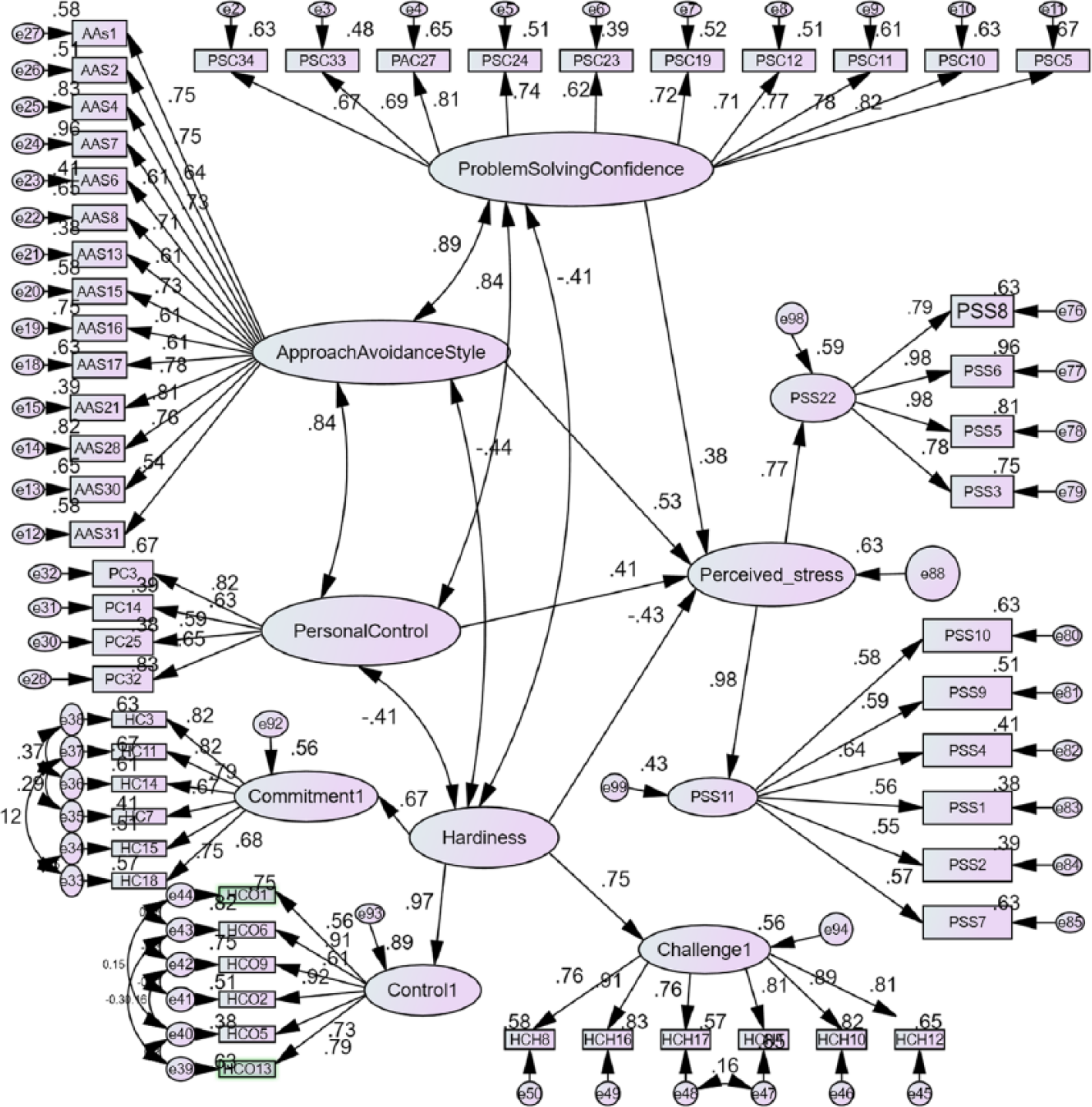
Structural model of perceived stress (standardized coefficient).
Moderation test of hardiness
A multigroup analysis was conducted to examine the impact of moderation effect of hardiness. To do this, the sample was divided into subgroups of the low hardiness group versus the high hardiness group based on hardiness’ mean value (M = 31.16). A comparison between “the unconstrained model” and “the fully constrained model” showed that the unconstrained model (chi-square = 2.54, p < 0.01, RMSEA = 0.033, CFI = 0.954, GFI = 0.956, normed fit index (NFI) = 0.926) and the fully constrained model (chi-square = 2.59, p < 0.01, RMSEA = 0.033, CFI = 0.943, GFI = 0.946, NFI = 0.911) were significant; however, the unconstrained model was better than the fully constrained model, because the chi-square was smaller and other measurement indices were larger (Byrne, 2013). Therefore, the findings showed that the impact of likely differences for hardiness on the proposed model was significant.
The results show that there are significant relationships between PSC, AAS, and PCE with perceived stress for undergraduate students with low levels of hardiness (standardized regression coefficients (β) = 0.41, 0.59, and 0.481, p < 0.01), while the paths for undergraduate students with high levels of hardiness are not significant (standardized regression coefficients (β) = −0.19, p < 0.05, β = −0.116, p < 0.03, and β = −0.09, p < 0.05). Therefore, the moderating effects of hardiness on the paths between PSC, AAS, and PCE with perceived stress are supported.
Moderation test of gender
A comparison between “the unconstrained model” and “the fully constrained model” showed that the fully constrained model (chi-square = 3.64, p < 0.01, RMSEA = 0.048, CFI = 0.912, GFI = 0.913, NFI = 0.911) was better than the unconstrained model (chi-square = 3.89, p < 0.01, RMSEA = 0.055, CFI = 0.902, GFI = 0.882, NFI = 0.891) because the chi-square for the fully constrained model was larger and other measurement indices were smaller (Byrne, 2013). Therefore, the findings showed that the associations between PSC, AAS, PCE, and perceived stress were not moderated by gender. This finding is inconsistent with previous studies on gender differences in perceived stress, which demonstrated that females experience more stress than males (Bangasser et al., 2010).
Discussion
In general, our findings demonstrated that lower hardiness and poor PSC, AAS, and external PCEs significantly predicted perceived stress among undergraduate students. The empirical findings showed that hardiness moderated the relationships between PSC, AAS, PCE, and perceived stress. This means that hardy individuals were less likely to experience stress even at the highest levels of ineffective problem-solving skills. The results of this study, which support previous research, showed that hardy individuals were less likely to experience stress. Recently, interest concerning the concepts of resilience in the face of stress has increased, but most of the studies only examined resilience factors as a linear relationship with stress (Abdollahi et al., 2014b), and hardiness has not been studied as a buffering effect for these associations among Malaysian undergraduates. Therefore, hardiness needs to be understood as an influencing factor that can decrease perceived stress. By finding a relationship between hardiness and problem-solving skills in a sample of university students, the present findings confirmed the previous results and improved them in three main ways.
First, the present findings showed that hardiness may constitute as an influencing factor against perceived stress in undergraduate students. Poor problem-solving skill was positively associated with perceived stress (Abdollahi et al., 2014b). Although an understanding of the stressors can improve the prediction of stress and develop intervention and prevention programs, it is still not comprehensive. The results of this study indicated that hardiness acts as an influencing factor, and when studied in relationship with perceived stress, it can enhance predictive validity. Furthermore, it can be helpful in identifying individuals with high levels of stress and in reducing the amount of stress.
Second, this study used the hardiness theory (Maddi et al., 2012b), which indicated that a positive appraisal of events may provide a source of resilience. The findings showed that hardiness could be useful against ineffective problem-solving skills and stress. Hardiness facilitates resilience under pressure by turning stressful circumstances from potential disasters into opportunities to grow in wisdom and performance (Maddi et al., 2012b). Maddi et al. (2012b) also found that hardiness was a protective factor against stress in a sample of among cadets at the United States Military Academy (USMA), the present research expands this by finding hardiness as an influencing factor among Malaysian undergraduate students. The findings of this study suggest that hardy undergraduates who tend to believe that the outcomes are promising and positive may provide a sense of resilience during difficult situations and decreased symptoms of stress. Hardy individuals are more likely to use effective problem-solving skills rather than ineffective problem-solving skills to cope with stress. In nutshell, hardiness renders positivity and resiliency to people experiencing stressful changes.
Third, the majority of stress studies have been performed in Western European and American samples as individualistic countries (Maddi et al., 2012a). There is a need to replicate the study in other parts of the world due to cultural and geographic variation to explore the generalizability of the findings. Theories and research findings about perceived stress can be more fruitful if they can be applied to different cultures. In Malaysia as a collectivistic culture, however, perceived stress has been relatively not studied in terms of its association with problem-solving skills and hardiness. Therefore, this study suggests that despite differences in cultural perspectives, relationships among certain core variables (e.g. problem solving, hardiness, and stress) hold up across cultures.
Implications of practice
There are two significant implications for prevention and intervention. When assessing the risk of stress in individuals. It is important to account for the presence of hardiness in addition to other risk factors, such as ineffective problem-solving skills. Regarding undergraduate students, these results provide preliminary evidence that problem-solving skill is not only a factor that plays a role in student’s perceived stress, but hardiness plays an important role as a buffer in the relationship between problem-solving skills and perceived stress. Although causality cannot be determined, it is possible that hardiness training enhances resilience factors such as commitment (e.g. what they do in different areas of their lives), control (e.g. own behavior can influence the outcome), and challenge (e.g. see obstacles as opportunities) that function as a resistance resource in the encounter with stressful life events. It may be a significant factor to incorporate into stress intervention or prevention programs. Reducing stress in individuals is the main part of any intervention or prevention programs. The hardiness training procedure was used in previous hardiness training studies (Maddi et al., 2012a) that included narratives on hardiness, inspirational examples, exercises, and periodic checkpoints. Its emphasis was on exercising and developing the hardy skills of coping, social support, and self-care and using the feedback obtained through these efforts to deepen the hardy attitudes of commitment, control, and challenge.
Limitations
One important limitation of this study is its reliance on self-report questionnaires. Although the measures used in the study are psychometrically adequate, objective measures (e.g. simulated stressors and tests of problem solving) would be superior and lend incremental validity to this study. In addition, the results of this study cannot be generalized to the whole population of university students in Malaysia since it was conducted in the Selangor state. A larger and diverse sample from other geographical locations should be recruited to further confirm the results. Future research could investigate the effectiveness of hardiness training on stress, problem-solving skills, and hardiness.
In conclusion, the findings of this study showed that undergraduates with poor PSC, external PCE, and AAS were more likely to report higher levels of perceived stress. Multigroup analysis provided evidence that hardiness emerged as a significant moderator in the link between problem-solving skills and perceived stress among undergraduate students.
Footnotes
Declaration of Conflicting Interests
The author(s) declared no potential conflicts of interest with respect to the research, authorship, and/or publication of this article.
Funding
The author(s) received no financial support for the research, authorship, and/or publication of this article.
Research involving human participants and/or animals
All procedures followed were in accordance with the ethical standards of the Islamic Azad University where the study was conducted. No animal studies were carried out by the authors for this article. Informed consent was obtained from all individuals participating in this study.