



Abstract
Research has emphasized the important role of recalling childhood experiences on adult mental health, and also the benefits of self-compassion on well-being. This study explored self-compassion as a mediator between early memories with family and peers and quality of life, on a wide age range female sample (N = 645). Path analysis revealed that self-compassion mediated the impact of both types of memories on women’s perceived quality of life. Overall, results revealed that the recall of early positive memories, either with family and peers, associate with a more compassionate self-to-self relationship, and the perception of greater psychological and social well-being.
Introduction
Over the last decades, a growing body of research has emphasized the important role of early affiliative relationships on subsequent well-being (e.g. Gilbert and Perris, 2000). In fact, childhood and early adolescence’s social interactions, when associated with warm, loving, and affectionate feelings, seem to hold positive impact on emotional maturation and regulation, well-being, and mental health (e.g. Baldwin and Dandeneau, 2005; Bowlby, [1969] 1982; Gerhardt, 2004). This positive impact on general welfare has been partially explained by several studies which explored the role of early affiliative memories in adults, and found an association between the recall of such experiences and the development of self-accepting and self-reassuring abilities, particularly useful when facing setbacks or failures (Gilbert et al., 2006; Irons et al., 2006). Specifically, regarding the positive influence of recalling early nurturing, loving, and protective memories, Richter et al. (2009) have demonstrated a negative association between these positive memories and psychopathology, namely depressive symptoms. Additionally, the study of the mechanisms through which early experiences can operate in long-term well-being has suggested that rearing experiences can function as conditioned emotional memories (Gilbert and Irons, 2008) with substantial impact on self-identity, relational patterns, and emotional regulation (Baldwin and Dandeneau, 2005; Mikulincer and Shaver, 2005; Pinto-Gouveia and Matos, 2011; Schore, 2001). As a matter of fact, the recall of warm and safe experiences with close relatives seems to be associated with a greater disposition to experience positive affect (e.g. safeness, warmth, and security; Richter et al., 2009), and also to the development of more trusting, prosocial, and peaceful attitudes toward others in the context of social interactions (Gilbert et al., 2006; Irons and Gilbert, 2005).
Literature suggests that not only early relationships with parents and close relatives have a crucial impact on the subsequent social and emotional physical and psychological adjustment (e.g. Gilbert et al., 2006; Richter et al., 2009), but also that peers (e.g. friends, colleagues, team members) constitute relevant developmental agents with significant impact on one’s later well-being and mental health (e.g. Gilbert and Irons, 2008). In fact, research generally shows that being in positive peer relationships is linked with better psychological adjustment among adolescents (Rubin et al., 1998), and also that greater support from peers is associated with lower levels of depressive symptomatology, lesser thoughts of suicide, and higher levels of self-esteem (Rodgers and Rose, 2002).
Research focused on early negative relationships have shown that experiences not associated with warm and safe feelings (e.g. shame and threat-related adverse experiences) within family and peer relationships may activate emotional states and defensive behaviors associated with defeat and threat (Cunha et al., 2012; Gilbert, 2003). More specifically, not only the experience of adversity within close relationships but also the way individuals defensively respond to such difficulties, may have harmful effects on emotional regulation processes (Baldwin and Dandeneau, 2005; Cunha et al., 2012; Gilbert, 2003; Matos and Pinto-Gouveia, 2010; Mikulincer and Shaver, 2005; Pinto-Gouveia and Matos, 2011; Schore, 2001) which, subsequently, reflects on a higher proneness to psychopathology and maladjustment. For instance, recent data highlighted the role played by internalizing early shame and early negative memories in the construction of a globally self-condemning sense of self, which, in turn, appears to lead to a higher susceptibility to depressive symptomatology (Matos et al., 2013).
Based on an evolutionary approach, researchers have attempted to explain the association between early adverse experiences and higher vulnerability to psychopathology, by suggesting a link between childhood maltreatment experiences, such as abuse, rejection, criticism, and neglect, and the excessive development of the threat affect regulation system (Dickerson and Kemeny, 2004) and the insufficient stimulation of the affiliative-soothing system (Irons et al., 2006). Moreover, unbalance in affect regulation systems is consistently highlighted as being a key factor contributing to mental difficulties (e.g. depression; Gilbert, 2003; Matos and Pinto-Gouveia, 2014; Stuewig and McCloskey, 2005; Taylor et al., 2006; Webb et al., 2007).
Linked to the affiliative-soothing system, which involves feelings of warmth, contentment, and connectedness and is capable of regulating threat through its calming and reassuring properties, self-compassion (SC) has been underlined by growing research as an important source of happiness and, therefore, psychological well-being (e.g. Barnard and Curry, 2011; Duarte et al., 2015). SC can be operationalized as involving three main components: self-kindness, common humanity, and mindfulness, which interact on the creation of a SC ate frame of mind (Neff, 2003). Self-kindness refers to the adoption of a caring and soothing attitude toward the self, instead of being harshly self-critical in times of suffering; common humanity is conceptualized as the recognition of a shared human flawed condition, that is, that all humans, including oneself, are imperfect and fail, which allows the consideration of a greater perspective toward personal setbacks and failures; and, finally, mindfulness implies the clear and balanced awareness of the present moment experience, without ignoring or ruminating about one’s own disliked characteristics (Neff, 2003). Regarding the benefits of cultivating a compassionate attitude toward oneself, extensive research emphasized its positive association with various aspects of healthy mental functioning and well-being, namely greater life satisfaction, the use of adaptive coping strategies, and social connectedness, highlighting its valuable role in face of personal shortcomings and difficulties (Barnard and Curry, 2011; Neff, 2009, 2011). Concerning its association with psychopathology, higher levels of SC have been liked to lower presence of depressive and anxiety symptoms, rumination, shame, and self-criticism (Neff et al., 2007). Regarding gender differences, as men seem abler to be self-compassionate (e.g. Yarnell et al., 2015), and women tend to reveal more depressive and anxiety symptoms, rumination over past events and self-criticism (e.g. Johnson and Whisman, 2013), it may be relevant to specifically investigate the role of SC in women.
Taking into account previous research focused on the importance of recalling warm and safe early interactions with close figures, and also the positive impact of SC on mental health and well-being, this study aimed at testing an integrative model which explored the relationship between early positive memories with parents and peers, SC, women’s psychological well-being, and relational quality of life. In fact, although the role of parent-related early relationships and its posterior recall is widely studied (e.g. Gilbert et al., 2006; Richter et al., 2009), research remains scarce regarding the effects of early peers-relationships’ memories, which may justify some investment on this subject. In this study, it was hypothesized that SC may act as a significant mediator of the relationship between early positive memories and quality of life. Using an all-female sample, this study’s relevance may be justified if considering some particularities of women’s tendency to experience negative affect (Johnson and Whisman, 2013), leading to the possibility that SC can have a particular impact on women’s quality of life, especially in the context of a scarce recall of early warm and caring memories of past relationships.
Method
Participants
In all, 645 women (N = 645), with ages ranging from to 18 to 68 years, participated in this study. This wide range sample presented a mean age of 28.95 (standard deviation (SD) = 11.83) and a mean of 14.02 (SD = 3.06) years of education. Concerning marital status, 71.8 percent of the participants were single, 23.7 percent were married or living together, 4 percent were separated or divorced, and 0.5 percent were widowed.
Measures
Early Memories of Warmth and Safeness Scale
Early Memories of Warmth and Safeness Scale (EMWSS) is a self-report scale which explores early positive affiliative memories, that is, the recall of feeling cared for, protected, and accepted within relationships established with attachment figures during childhood (Matos et al., 2012; Richter et al., 2009). Respondents are asked to rate on a 5-point scale (0 = “No, never”; 1 = “Yes, but rarely”; 2 = “Yes, sometimes”; 3 = “Yes, often”; and 4 = “Yes, most of the time”) the frequency in which each statement applied to them as children (e.g. “I felt secure and safe”; “I felt that I was a cherished member of my family”). This 21-item scale has shown to be very reliable, with a high Cronbach’s alpha (α = .97) both in the original and the Portuguese versions.
Early Memories of Warmth and Safeness Scale—Peers version
Adapted from the EMWSS (Richter et al., 2009), Early Memories of Warmth and Safeness Scale—Peers version (EMWSS_Peers) is 12-item self-report scale which specifically evaluates early positive memories of warmth, love, safeness, and affection with peers, that is, the recall of positive early experiences with friends and colleagues (Ferreira et al., 2016). Using a 5-point scale, ranging from 0 (“No, never”) to 4 (“Yes, most of the time”), respondents are asked to indicate the frequency of the experiences stated (e.g. “I felt understood by my peers/friends,” “I felt safe and secure with my peers/friends”), with childhood and early adolescence as time references. The Portuguese validation studies have recently shown that EMWSS_Peers is a robust instrument with good psychometric qualities, revealing a Cronbach’s alpha of .97 and a good convergent and discriminant validities.
Self-Compassion Scale
This well-known self-report instrument, used to measure SC, specifically assesses the respondents’ attitudes toward themselves when facing difficult times (e.g. “I try to be loving toward myself when I’m feeling emotional pain,” “When times are really difficult, I tend to be tough on myself”) (Castilho and Pinto-Gouveia, 2011; Neff, 2003). Self-Compassion Scale (SCS) comprises 26 items rated in a 5-point scale which ranges from 0 (“Almost never”) to 5 (“Almost always”). It comprises a positive main component, which includes the self-kindness, common humanity, and mindfulness subscales; and a main negative one, comprising the self-judgment, isolation, and over-identification subscales. In this study, the mean of the three positive subscales’ items was calculated in order to be used as a global measure defined as SC (Costa et al., 2016). Both the original version of SCS and the Portuguese version presented good internal reliability, with Cronbach’s alphas of .92 and .89, respectively.
World Health Organization Quality of Life-BREF
The World Health Organization Quality of Life-BREF (WHOQOL-BREF), developed by the World Health Organization, is used as an international and cross-cultural measure of quality of life (Canavarro et al., 2007; WHOQOL Group, 1998a). This instrument is a short version of the original WHOQOL-100 (WHOQOL Group, 1995, 1998b) with 26 items measuring a set of specific quality of life’s domains: physical health, psychological health, social relationships, and environment. Respondents are asked to state about their feelings regarding their quality of life, health, and other areas of their lives, using a 5-point scale which ranges from 0 (e.g. “Very dissatisfied”) to 5 (e.g. “Very satisfied”), with higher scores indicating a higher perceived quality of life. According with the purposes of this study, only the psychological health (QOL_Psic) and social relationships’ (QOL_SR) domains were used. The WHOQOL-BREF has shown to be a valid, consistent, and reliable measure, in both the original and the Portuguese versions.
The Cronbach’s alphas for each variable in this study are presented in Table 1.
Cronbach’s alphas (α), means, standard deviations, and intercorrelation scores on self-report measures (N=645).
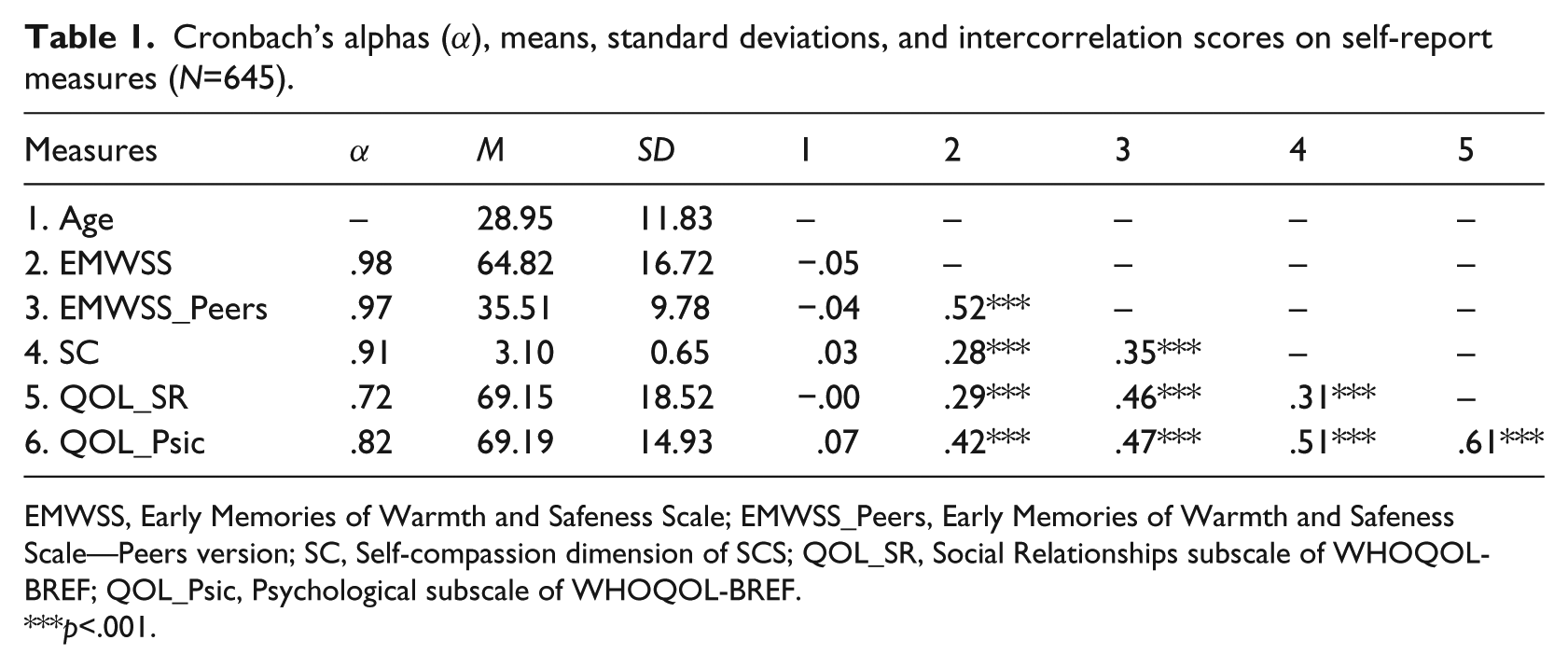
EMWSS, Early Memories of Warmth and Safeness Scale; EMWSS_Peers, Early Memories of Warmth and Safeness Scale—Peers version; SC, Self-compassion dimension of SCS; QOL_SR, Social Relationships subscale of WHOQOL-BREF; QOL_Psic, Psychological subscale of WHOQOL-BREF.
p<.001.
Procedure
This study is part of a wider research about female well-being and mental health in the Portuguese population. This wider research involved the participation of 738 women from the general population, recruited from distinct organizations, namely higher educational institutions, private companies, and retail services. The required approval was obtained from the respective institutions’ boards and all ethical requirements were respected: participants were fully informed about the study’s nature and purposes, the voluntary character of their participation, and data’s confidentiality. Women who agreed to participate in the research provided their written informed consent, and only then a battery of self-report questionnaires was administered during approximately 15 minutes. Participants completed the self-report measures during a break authorized by the institution’s boards in the presence of one of the researchers.
According to this study’s purposes, data were cleaned in order to exclude female participants younger than 18 and older than 70 years old, and the cases in which more than 15 percent of the responses were missing from a questionnaire. This process resulted in the final sample of 645 female participants.
Analysis
All data analyses were performed using the software IBM SPSS (v.22; SPSS Inc., Chicago, IL), and path analysis were conducted resorting to the software AMOS (Analysis of Momentary Structure, v.22, SPSS Inc., Chicago, IL).
In order to explore the sample’s characteristics regarding the studied variables, descriptive statistics (means and SD)) were used; product-moment Pearson correlation analysis were conducted to study the association between age, early warmth, and safeness memories with attachment figures (EMWSS), early positive memories with peers (EMWSS_Peers), SC, and social relationships’ and psychological domains of WHOQOL-BREF (QOL_SR and QOL_Psic).
The software AMOS was used to conduct a series of path analyzes, exploring assumed structural relations (direct and indirect effects) between the variables contemplated in the proposed theoretical model (Figure 1). This theoretical model tested whether the association between early memories with attachment figures and peers (EMWSS and EMWSS_Peers, endogenous variables), and the social relationships’ and psychological domains of quality of life (QOL_SR and QOL_Psic; exogenous variables), would be mediated by SC (endogenous mediator variable). In these analyses, the maximum likelihood estimation method was selected to test for the significance of the regression coefficients and to compute fit statistics. Also, several goodness-of-fit indices were used to examine the adequacy of the model, namely chi-square (α2), the Tucker–Lewis index (TLI), and the comparative fit index (CFI), and Chi-square tests assessed the significance of all direct, indirect, and total effects. Moreover, the bootstrap resampling method was used to test the significance of the mediational paths, with effects with p values below .050 considered statistically significant.

Final path model.
Results
Preliminary data analysis
In order to allow the assumption of univariate and multivariate normality, skewness and Kurtosis’ values were analyzed. These values indicated the absence of severe violation of the normal distribution (Kline, 2005).
Descriptive statistics
The means and SDs of the study variables, presented in Table 1, were similar to those obtained in previous studies with non-clinical female samples (Duarte et al., 2015; Matos et al., 2015).
Correlations
The results of the correlation’s analysis revealed the absence of any significant associations between age and the study’s variables.
The measures of the recall of early positive memories, with attachment figures (EMWSS) and peers (EMWSS_Peers) revealed a positive and strong correlation with each other. Also, EMWSS and EMWSS_Peers showed significant and positive associations with SC and also with social relationships’ and psychological domains of quality of life (QOL_SR and QOL_Psic).
Concerning SC, significant, positive, and of moderate to high magnitude associations were found with QOL_SR and QOL_Psic, respectively. Finally, the correlation between both domains of quality of life revealed to be significant, positive, and strong.
Path analysis
The theoretical model was first tested through a fully saturated initial model which consisted of 20 parameters, and explained 13 percent of SC’s variance and 24 and 39 percent of, respectively, social relationships’ and psychological quality of life’s variances. According to the fact that one of the paths was not significant, specifically the direct effect of EMWSS on QOL_SR (bEMWSS = .05; SEb = .05; Z = 1.16; p = .25), this path was eliminated and the model was readjusted.
The readjusted model also explained 13, 24, and 39 percent of the SC, QOL_SR, and QOL_Psic’s variances, respectively (Figure 1). All path coefficients were statistically significant (p < .05), and model fit indices revealed an excellent fit to the empirical data (χ2(1) = 1.34, p = .25, minimum discrepancy divided by its degrees of freedom (CMIN/df ) = 1.34; TLI = 1.00; comparative fit index (CFI) = 1.00; normed fit index (NFI) = 1.00; root mean square error of approximation (RMSEA) = .02, p = .55, 95% confidence interval (CI) = .00–.11).
First, concerning EMWSS, results showed a direct effect on SC (α = .13; bEMWSS = .01; SEb = .00; Z = 3.06; p < .01). The effect of EMWSS on QOL_SR was indirect, mediated by SC (α = .03; 95% CI = .01–.05). Moreover, EMWSS presented a total effect of .22 on QOL_Psic, with a direct effect of .17 (bEMWSS = .15; SEb = .03; Z = 5.40; p < .001), and an indirect effect of .05 (95% CI = .02–.08) mediated by SC.
Concerning the second endogenous variable, EMWSS_Peers results revealed a direct effect of .28 on SC (bEMWSS_PEERS = .02; SEb = .00; Z = 6.46; p < .001). Regarding QOL_SR, EMWSS_PEERS showed a total effect of .45, with a direct effect of .40 (bEMWSS_PEERS = .76; SEb = .07; Z = 11.01; p < .001), and an indirect effect of .05 (95% CI = .02–.08) mediated by SC.
Finally, the mediator variable, SC, showed to have direct effects on both QOL_SR (α = .17; bEMWSS_PEERS = 4.87; SEb = 1.04; Z = 4.69; p < .001) and QOL_Psic (α = .38; bEMWSS_PEERS = 8.63; SEb = .76; Z = 11.42; p < .001).
In summary, the model accounted for 24 and 39 percent of the variances of both quality of life’s domains analyzed, revealing that the impact of early affiliative memories with parents and close relatives on social relationships’ quality of life is fully mediated by SC, and its effect on psychological quality of life is partially mediated by the effect of SC. Regarding early positive memories with peers, results showed that its effects on social relationships’ and psychological quality of life are partially mediated by SC.
Discussion
This study intended to explore the relationship between early positive memories of either family and peer relationships, SC, and social relationships’ and psychological quality of life. This approach was mainly based on several studies which established the preponderancy of early interactions on human emotional development, and posterior mental health (e.g. Baldwin and Dandeneau, 2005; Bowlby, [1969] 1982; Gerhardt, 2004) and well-being (e.g. Gilbert and Perris, 2000). Part of these previous research relied on explorations of adults’ recollections of early warm and safe interactions with close figures, and reached the conclusion that the ability to recall these positive memories is positively associated with both higher disposition to experience positive affect (e.g. Richter et al., 2009) and the development of a more adaptive social schema (Gilbert et al., 2006; Irons and Gilbert, 2005). Not only parents and close relatives have been referred in literature as key references of relationships occurring during childhood and adolescence (e.g. Gilbert et al., 2006; Richter et al., 2009), but it has also been demonstrated that early interactions with peers may have critical impact on one’s subsequent emotional stability and comfort (e.g. Gilbert and Irons, 2008). Nevertheless, the recall of early warm and safe interactions with peers has not been widely studied. Moreover, regarding SC, extensive investigation has pointed out its beneficial character, given its association with several aspects of healthy mental functioning and well-being, namely a superior life satisfaction and the use of adaptive coping strategies when facing adversity (Barnard and Curry, 2011; Duarte et al., 2015; Neff, 2009, 2011). In this line, the proposed model hypothesized that SC would mediate the impact of early positive memories either with close figures and peers on quality of life, that is, that a higher evocation of childhood positive memories with peers would predict higher psychological and relational quality of life, through the increase in SC ate attitudes. To the best of our knowledge, the association between the recall of positive early relationships with relatives and peers and the subjective perception of one’s own quality of life has not been addressed in previous research.
The tested model accounted for 24 and 39 percent of social relationships’ quality of life and psychological quality of life, respectively. This result corroborated our hypothesis, showing that SC partially mediates the relationship between early affiliative memories with peers and social relationships’ quality of life, and fully mediates the association of the evocation of these early memories and psychological quality of life.
First, the tested model showed that both the recall of early warm and safe memories with family figures and peers seem to predict more self-compassionate attitudes. Regarding the recall of early positive memories with close figures (e.g. parents, family figures), this result is in line with previous research, which showed an association between the evocation of these memories and the development of nurturing attitudes toward the self, namely self-accepting and self-reassuring abilities (Gilbert et al., 2006; Irons et al., 2006). On the subject of early warm and safe memories with peers, these findings seem to extend literature, suggesting that its evocation may have a positive effect on the capacity of presenting a kind and understanding attitude toward the self, even if in the face of stressful events or personal defeat situations, later in life. Literature has shown an association of the scarce recall of early warm and safe memories with relatives and close figures with higher levels of shame, and with the adoption of a harshly condemning attitude toward the self (Matos et al., 2013). In this line, it may be conceivable that the ability to recall memories of being cared for and protected within family and peer relationships may lead to the perception of being capable of promoting others’ positive attention and affect, and thus to the conception of the self as being worthy of compassion, and the adoption of a kind and forgiving attitude toward the self.
Moreover, both early memories of warmth and safeness with close figures and with peers seem to be directly associated with psychological quality of life; nevertheless, this association was partly explained through the mechanisms of SC. This result suggests that, although the recall of both types of memories may contribute, by themselves, to higher psychological quality of life, which can be understood by resorting to previous research (e.g. Baldwin and Dandeneau, 2005; Bowlby, [1969] 1982; Gerhardt, 2004), SC may be relevant in this association, incrementing psychological well-being of females who scarcely recall positive memories of relationships from childhood and adolescence. Regarding social relationships’ quality of life, although early affiliative memories with peers are directly and indirectly associated with this variable, early memories with relatives and close figures and only showed an indirect association, mediated by SC. A possible explanation of the absence of a direct association between early memories with parents and close figures and relational quality of life may be the empirically found high relevance of peer relationships on the subsequent social psychological later adjustment (e.g. Gilbert and Irons, 2008; Rubin et al., 1998).
The present results, although promising, should be considered along with some limitations. First of all, this was a cross-sectional study and therefore causal conclusions are limited. In this line, future research should be prospective, in order to allow the exploration of the nature and direction of the tested model. It should also be noticed that self-report measures may compromise the generalization of the data. Second, the tested model was purposely limited to test the specific relationships between early positive memories, SC, and quality of life. Nonetheless, other variables may be involved, given the multidimensional character of female well-being. For instance, although retrospective recall data have been stated as relatively reliable and stable (Brewin et al., 1993), upcoming studies could explore if the quality of present relationships (e.g. peer and romantic relationships) can influence the way one recalls past relationships with close figures and peers. Also, although this study is part of a wider study about female mental health and well-being, the exclusive use of a female sample constitutes a limitation. It would expectable that a male sample would reveal similar associations between the studied variables; however, future studies would be necessary in order to confirm this hypothesis. Moreover, considering the use of a non-clinical sample, future research should replicate these findings in different samples, namely clinical samples. Finally, it would be interesting to conduct experimental studies to test the efficacy of compassion-based interventions on the promotion of female quality of life, especially among individuals with a marked recall of early adverse relationships.
In conclusion, this study offers a new perspective on the roles of early relational memories and SC on various dimensions of female perceived quality of life. Specifically, important investigational implications may derive from the present findings, which also seem to suggest the relevance of targeting early adverse experiences either with family or peers, and promoting the adoption of more self-compassionate attitudes, on the development of mental health promotion programs among females.
Footnotes
Acknowledgements
ORCID; Joana Marta-Simões: orcid.org/0000-0002-7807-8575; Cláudia Ferreira: orcid.org/0000-0002-7020-9606; Ana Laura Mendes: 
Declaration of Conflicting Interests
The author(s) declared no potential conflicts of interest with respect to the research, authorship, and/or publication of this article.
Funding
The author(s) received no financial support for the research, authorship, and/or publication of this article.