



Abstract
Public health campaigns to reduce expectations for antibiotic treatment for respiratory tract infections have shown little or no effect on antibiotic prescribing and consumption. We examined whether such messages can increase respiratory tract infection symptom reporting. Participants (N = 318) received one of four campaign messages, a combination of all four messages, or no message. Respiratory tract infection symptoms increased for those who received information that emphasized the ineffectiveness of antibiotic treatment for respiratory tract infections. As symptom severity is associated with greater contact with primary healthcare and receiving antibiotic prescriptions, campaigns to encourage antimicrobial stewardship should consider the side effects of antibiotic ineffectiveness messages.
Introduction
Public health messages are a common and ubiquitous method aimed at reducing public expectations for antibiotic treatment for respiratory tract infections (RTIs) (Pinder et al., 2015). However, despite increasing public health messaging to educate about (1) the ineffectiveness of antibiotic treatments for viral illness, (2) the link between inappropriate antibiotic use and antimicrobial resistance (AMR), and (3) the possible side effects of antibiotic treatment, the impact of public health messages in reducing antibiotic prescribing and consumption is uncertain (Finch et al., 2004; Huttner et al., 2010). Indeed, most trials show small or zero effects (Pinder et al., 2015).
Evidence for the effectiveness of public health messages to reduce antibiotic expectations for RTIs
In the United Kingdom specifically, evaluations of public education campaigns have revealed that public health messages do not reduce antibiotic prescribing in primary care (McNulty et al., 2010). While this lack of effect may appear counter-intuitive, there are several established theoretical reasons why messages targeted at reducing people’s expectations for antibiotic treatments for RTIs may not be effective. For example, individuals’ concern about the possible threat to their freedom to obtain antibiotics for RTIs may result in “boomerang” effects whereby the observed effects of public information campaigns are opposite to those intended (Behm, 1972; Burgoon et al., 2002). Furthermore, data suggest that public beliefs about antibiotic effectiveness for RTIs run counter to current evidence—people believe they are effective for the treatment of RTIs (Cals et al., 2007). This is pertinent because recent work shows that evidence-based information that contradicts commonly held beliefs may have a detrimental effect relative to belief-confirming information (the evidence-based counter-normative (EBCN) effect) (Ferguson and Lawrence, 2013). Specifically, with respect to non-specific symptoms (NSS) in response to stress, Ferguson and Lawrence (2013) showed that those receiving belief-challenging health information subsequently reported more severe NSS than those receiving belief-confirming material.
There is suggestive data that information about antibiotic ineffectiveness, in particular, may result in a boomerang effect. In a large-scale, but cross-sectional, study of the public across 27 European Union (EU) member states (European Commission, 2013), 46 percent of those who had received information about the ineffectiveness of antibiotics in the preceding 12 months had taken antibiotics during this period, compared to 30 percent of those who had not received this information. It is possible that those who received information about antibiotic ineffectiveness did so in a medical context (e.g. pharmacy or primary care) therefore increasing the base-rate for antibiotic treatment for this group. To establish a causal link for this effect, this study experimentally manipulates the impact of existing antibiotic public health messages on the reporting of symptom severity—a principal reason for contact with primary care (Rosendal et al., 2013).
The current study
This study examines the impact of public health messages regarding antibiotic treatment for RTIs on the reporting of both RTI-specific symptoms and NSS. Antibiotic public health messages typically focus on four components: (1) non-antimicrobial means to treat RTIs (e.g. paracetamol, fluids, rest) that do not mention the use (or non-use) of antibiotics for RTIs, (2) the ineffectiveness of antibiotics in the treatment of RTIs (colds and flu), (3) the possibility of antibiotic side effects (including diarrhea, thrush), (4) the link between the over-use of antibiotics and AMR (Pinder et al., 2015). These messages are usually presented individually in the form of leaflets or posters, or in combination. As a result, this study examines the impact of each message and all four messages in combination on RTI-specific and NSS perceptions, resulting in five “message” conditions, compared to a no message control. Consistent with an EBCN, we predict that messages focusing on the ineffectiveness of antibiotics for RTIs will be related to increased symptom reporting, compared to the no message control, for RTI-specific symptoms only, as this message more directly challenges existing beliefs about antibiotics than other messages.
Method
Participants and design
A sample of 318 undergraduate students from a large university in the United Kingdom were randomly allocated to receive one of the four standard health messages (see above), a message comprising a combination of all four messages or no message (control). Sample sizes per message group and control group were equivalent to those in Ferguson and Lawrence (2013). Data collection took place in December 2015 and so the study was conducted during the RTI season (October–March 2015–2016; Public Health England, 2015).
Materials and procedure
Participants independently recorded whether they currently were experiencing any of the following RTIs: common cold/influenza (37%), bronchitis (0.6%), and sinusitis (2.8%). In the health message conditions, participants read one of the four messages or the combination of the four messages. All participants then completed a 14-item measure of RTI specific symptoms (blocked nose, sore throat, headache, fatigue) and NSS (e.g. bloating) developed from Ferguson and Lawrence (2013). The 4-symptom RTI index was reliable (α = .75) as was the 10-symptom NSS index (α = .76). Participants were required to indicate the severity they had experienced on each symptom in the preceding month (0 = did not experience the symptom, through to 5 = experienced the symptom very severely). A severity index was created for NSS and RTI symptoms by calculating the total responses across the 10 NSS symptoms and the 4 RTI-specific symptoms. All participants gave informed consent before they participated in the study. The study was conducted in accordance with the Declaration of Helsinki and was approved by the Ethics Committee of the School of Psychology, University of Nottingham.
Results
Participants did not differ across message conditions in terms of their age (mean = 20.39, standard deviation (SD) = 1.85, F = .23, p = .95, partial η2 = .004), sex (χ2 = 2.13, p = .83), or current RTI (cold/influenza: (χ2 = 2.13, p = .83), sinusitis: (χ2 = 8.58, p = .13), bronchitis: (χ2 = 3.85, p = .57)).
To examine the impact of messages on the severity of reported symptoms, ordinary least squares regression was carried out using Stata version 13.1. We entered participants’ sex and whether the participant reported currently having a cold/influenza 1 and message dummies. Results are shown in Table 1.
Results of regression examining the impact of message (against control) on severity of RTI and non-RTI symptom reporting.
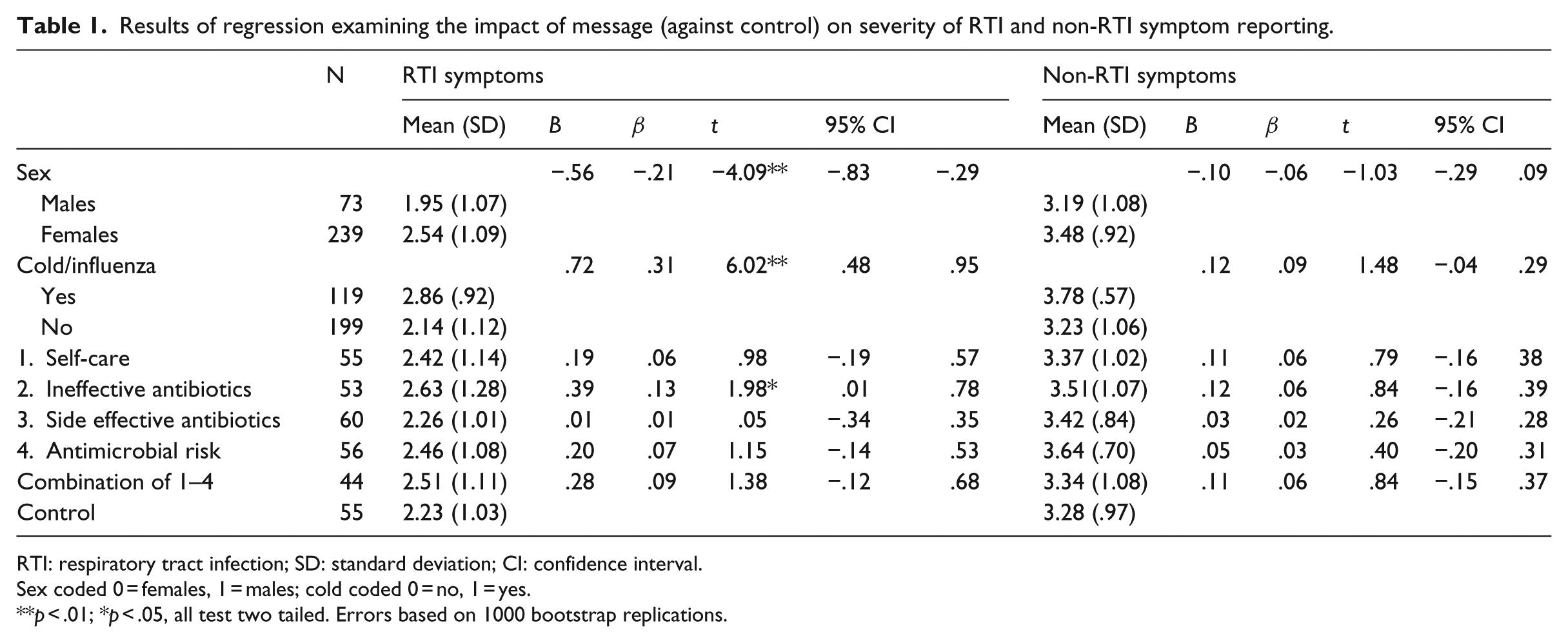
RTI: respiratory tract infection; SD: standard deviation; CI: confidence interval.
Sex coded 0 = females, 1 = males; cold coded 0 = no, 1 = yes.
p < .01; *p < .05, all test two tailed. Errors based on 1000 bootstrap replications.
Female participants and those currently with a cold/influenza reported more severe RTI symptoms. Crucially, those who had read messages relating to the ineffectiveness of antibiotics in treating RTIs reported more severe RTI symptoms compared to those in the control condition. Cohen’s d for this effect was small (d = .34). This effect was seen for RTI symptom severity and not for NSS severity.
Discussion
This study offers some initial support to the hypothesis that an EBCN effect may be occurring in relation to messages aimed at reducing antibiotic use for RTIs. The perceived severity of RTI symptoms increased following the receipt of a message relating to the ineffectiveness of antibiotics for RTIs. As expected, those who reported suffering from a cold or influenza at the time of data collection reported more severe symptoms. However, despite accounting for this in the analyses together with the typical higher level of symptom reporting among females (Barsky et al., 2001), the data revealed a boomerang effect of the antibiotic ineffectiveness message. Other messages appeared to be more “benign.” That is, while their effectiveness in reducing expectations for antibiotics was not assessed here, giving messages about (1) the dangers of AMR, (2) self-care without antibiotics, and especially (3) potential antibiotic side effects did not increase perceived symptom severity.
Mass communications to reduce public expectations for antibiotic treatment for RTIs have had little impact on the amount of antibiotics being prescribed (McNulty et al, 2010; Pinder et al., 2015). Similarly, in a European-wide study (European Commission, 2013), receiving information about the ineffectiveness of antibiotics for treating RTIs was associated with greater consumption of antibiotics. Evidence elsewhere points to widespread lack of knowledge that antibiotics are ineffective against RTIs or a lack of belief in that message. For example, in a survey of 1767 adults conducted by Public Health England in 2011, 69 percent of participants agreed with the statement “antibiotics work on most coughs or colds.” We proposed that one reason for the lack of effectiveness of antibiotic stewardship messages may be the EBCN effect, whereby health messages that run counter to commonly held beliefs increase symptom perceptions relative to belief-confirming messages. Messages to encourage antimicrobial stewardship should consider the possible side effects of antibiotic ineffectiveness messages.
Footnotes
Declaration of Conflicting Interests
The author(s) declared no potential conflicts of interest with respect to the research, authorship, and/or publication of this article.
Funding
The author(s) received no financial support for the research, authorship, and/or publication of this article.