




Abstract
We examined the comparative effectiveness of the Dove Evolution commercial and disclaimer labels as media literacy interventions. Women (N = 287) viewed thin-ideal images by themselves, preceded by the Dove Evolution commercial, or containing specific or generic disclaimer labels. Participants completed pre- and post-test measures of body satisfaction, post-test social comparison, and media literacy. Interventions were not effective in mitigating drops in body satisfaction, reducing social comparison, or increasing media literacy, despite women understanding their purpose. A 2-week follow-up showed no delayed effects on media literacy. None of these interventions were effective in counteracting the negative effects of media exposure in women.
Media depictions of health and well-being are of concern to health psychologists (e.g. Hodgetts and Chamberlain, 2006; Lyons, 2000). Sociocultural theory identifies mass media as one of the most influential transmitters and reinforcers of ideals regarding appearance (Morrison et al., 2003). Repeated exposure to an unrealistic female body shape has arguably contributed to the growing rates of body dissatisfaction in women across Western societies (Groesz et al., 2002). Meta-analyses of studies across various mediums (television and magazines) have found moderate but consistent links between thin-ideal exposure and body dissatisfaction in women (Grabe et al., 2008; Groesz et al., 2002). However, mere exposure does not always result in negative outcomes. Festinger’s (1954) social comparison theory argues that individuals make evaluations about their appearance through comparisons with similar others. Body dissatisfaction can occur if the target of comparison is perceived as more desirable on an important dimension (Myers and Crowther, 2009).
Researchers have begun to explore ways to mitigate negative media effects. Media literacy training teaches women to be more critical and aware of the modifications commonly used by advertising companies, reducing social comparison, challenging the uniform body size/shape portrayed in advertisements, and supporting women to appreciate their body beyond appearance (Ata et al., 2013). Structured individually tailored programs are undoubtedly useful in contexts where the participant has sufficient time and access to resources. However, there is also a need for brief interventions which may be used on a larger community-based scale. These universal prevention strategies may help address cultural practices which normalize the idealized (and often unachievable) imagery used by the media. Two such approaches are labels on media images (in the form of warning/disclaimer/information labels) and the Dove Evolution advertisement.
Disclaimer labels have been used on magazine images to inform the viewer about digital enhancements (Slater et al., 2012; Tiggemann et al., 2013). Early work (Slater et al., 2012) found that women who viewed fashion spreads with either generic disclaimer labels (“WARNING: these images have been digitally altered”) or specific disclaimer labels (“… digitally altered to lengthen legs and trim inner thighs”) had significantly better post-test body satisfaction compared to women who viewed no labels. However, most research has showed that the inclusion of some type of label to fashion magazine advertisements has no beneficial effects on body image (Ata et al., 2013; Bury et al., 2016a, 2016b; Tiggemann et al., 2013, 2014) or mood (e.g. confidence; Tiggemann et al., 2014).
Of concern, in some instances labels advising of digital retouching can produce poorer outcomes (compared to no labels), such as objectified body consciousness and lower physical self-esteem (Harrison and Hefner, 2014; images of college-aged students) and greater negative thought accessibility (Selimbegović and Chatard, 2015; image of models only). The work of Tiggemann et al. (2013, Study 1) showed that women who viewed thin-ideal fashion magazine advertisements with disclaimer labels rated the images as more self-relevant and reported more state social comparison compared to the no-intervention condition. Viewing specific disclaimer labels also produced particularly high levels of body dissatisfaction in women with high levels of trait social comparison (Tiggemann et al., 2013, Study 2). Disclaimer labels may actually result in increased attention to the image which then may trigger social comparison and body dissatisfaction (e.g. Tiggemann et al., 2013). Indeed, eye tracking studies revealed that young adult women who viewed thin-ideal fashion magazine advertisements with specific disclaimers directed their gaze to the region of the model’s body referred to in the message (Bury et al., 2014). This increased attention was then associated with increased appearance comparison, which in turn predicted an increase in body dissatisfaction (Bury et al., 2016b). Thus, it appears that labels with a general message do no harm (or good), and there is growing evidence that labels that point to the specific alterations of the image are ironically triggering the same effects they were designed to reduce. Collectively, these findings suggest that disclaimer labels are an ineffective means to protect against body dissatisfaction when viewing idealized images commonly found in advertising.
One of the benefits of disclaimer labels is the potential for widespread use without the need for time and expertise from trained healthcare workers. Another such media literacy approach, having received over 18 million views on YouTube, is the 75-second Dove Evolution commercial which shows a makeup-free woman of average appearance undergoing digital alteration. This education about postproduction enhancement of media images may be useful as it directly demonstrates the amount of digital manipulation during the transformation process, which is not evident with disclaimer labels (Harrison and Hefner, 2014). Consumers have noted that this approach may be more beneficial than simply viewing the “finished” product (Paraskeva et al., 2017). Only two studies have examined the impact of this commercial and both found it was successful in mitigating the negative effects of thin-ideal exposure in young adult women (Quigg and Want, 2011) and adolescent girls (Halliwell et al., 2011a). For example, Quigg and Want (2011) found that women who viewed the Dove Evolution commercial as well as a set of music video clips depicting idealized singers reported greater appearance satisfaction than the women who viewed the same clips with a neutral commercial. Although limited, findings do suggest that this brief intervention may be protective against media-induced body dissatisfaction, at least in the short-term. Further research is warranted to examine whether effects are similarly found with exposure to multiple idealized images, as would be common when reading fashion magazines. Furthermore, both studies only examined the immediate effect of commercial exposure, and more research is needed to test the longevity of any effects (Halliwell et al., 2011a; Harrison and Hefner, 2014; Quigg and Want, 2011). Finally, there is no research to date which has tested the comparative effectiveness of the Dove Evolution commercial as compared to the disclaimer labels.
For some women, social comparison processes are almost inevitable, occur rapidly, and are relatively automatic (Botta, 1999). Furthermore, magazine usage has been associated with self-objectification and tendency to engage in social comparison (Fardouly et al., 2015). Interventions such as the Dove Evolution commercial may therefore be effective if they increase media literacy and give women a reason to question the validity of their comparisons to artificial media images, which, in turn, may lead to proactive strategies to reduce comparisons (Durkin et al., 2005; Quigg and Want, 2011). The primary aim of media literacy campaigns is to create more critical consumers. Therefore, we included brief measures of the extent to which participants thought that media depictions were realistic, achievable, and desirable. Only limited research has included similar literacy dimensions. Slater et al. (2012) found that women rated the perceived realism of models in the label conditions as significantly lower than the no-intervention condition. However, Bury et al. (2016a) found no effects, although for a sub-group of women high on trait appearance comparison, the addition of a pre-exposure message resulted in the images viewed as more realistic. Thus, more research is needed to address these inconsistent findings.
The current study
We examined the comparative effectiveness of the Dove Evolution commercial to the more widely studied disclaimer labels in mitigating negative effects of exposure to young, thin, and attractive female models (i.e. the thin ideal) as presented in fashion magazines. If successful, these interventions are brief, with high-quality production, and are able to be widely disseminated with minimal specialist involvement (e.g. Halliwell et al., 2011a; Quigg and Want, 2011).
We expected that women who viewed Dove Evolution plus thin-ideal imagery would experience a protective effect (i.e. no changes to body satisfaction and confidence from pre- to post-test) while women in the other three conditions would show a drop in scores (H1). Second (H2), we expected that viewing Dove Evolution would result in less state social comparison compared to the other conditions. Third (H3), we expected there to be more evidence of media literacy (i.e. lower scores on rating the models as realistic, desirable, and achievable) in women who viewed the images in all intervention conditions compared to women in the no-intervention condition, both at immediate post-test (H3a) and at 2-week follow-up (H3b), as all interventions share the message about modifications to the images. Finally, an open-ended question asked about the purpose of the intervention, to add to the literature about women’s understanding of these interventions.
Method
Participants
Female participants (N = 287) age 17–30 years (M = 22.15 years, standard deviation (SD) = 3.57 years) with an average body mass index (BMI) of 23.03 (SD = 4.51) were recruited from the university (n = 224) and the general community (n = 63). A total of 95 participants provided follow-up data 2 weeks later. Participants were predominantly Caucasian (89.50%) and completing tertiary education (63.80%). Most participants spent up to 1 hour per week reading magazines (54.0%) and most (98.30%) also reported using social media.
Materials
Visual stimulus material
Images of posed, young, thin, and attractive models with no advertisements were sourced from the Internet and selection was guided by previous research (e.g. Tiggemann et al., 2013), where the model’s face and at least three quarters of her body was visible. Highly sexualized images or celebrities were not used. Twenty-five potential images were rated by five females age 22–28 years (Mage = 24.2 years) for perceived attractiveness and thinness. Images with the highest ratings were used. Three images of fashion items (e.g. shoes) were interspersed between the thin-ideal images to reduce the likelihood of hypothesis-guessing.
The Dove Evolution commercial
The 2006 Dove Evolution commercial by the Dove® brand was part of their “Campaign for Real Beauty.” The 75-second commercial showed time-lapsed footage of a regular woman having her hair and makeup professionally done before the photograph was digitally enhanced. The clip demonstrated techniques such as airbrushing, thinning the face, lengthening the neck, and removal of freckles. The clip ended with the image on a billboard and fades to the message “No wonder our perception of beauty is distorted” (Piper, 2006).
Disclaimer labels
Guided by past research (Slater et al., 2012; Tiggemann et al., 2013), the specific labels provided information regarding the use and nature of digital alterations (e.g. “Warning: This image has been digitally altered to lengthen and slim waist and trim thighs”). The authors developed variants of this message which was used on each image (e.g. Slater et al., 2012) as a mechanism to reduce habituation and improve realism of the message by showing a variety of modifications. The generic disclaimer labels stated the images had been digitally altered (e.g. “Warning: This image has been digitally altered”). Both types of labels were in size 17 Calibri font located at the bottom corner of each image. Disclaimer labels were not used on the neutral images of fashion items.
State body satisfaction, confidence, and social comparison
Before and after viewing the images, participants completed three items assessing state body satisfaction and confidence (e.g. “Currently, how fat do you feel/how satisfied do you feel with your overall shape and weight/how confident do you feel?”) with higher scores indicating greater satisfaction. Participants also completed a single-item social comparison question after viewing the images (“How much did you compare yourself to the models in the clips?”) with higher scores indicating greater comparison. Due to software limitations, the continuous visual analog scale (Heinberg and Thompson, 1995) was adapted to a 10-point Likert scale anchored from not at all to very much. Previous research has reported strong test–retest reliability using similar measures using a continuous scale (Birkeland et al., 2005).
Media literacy
Three questions assessed the extent to which participants could critically reflect upon the artificial nature of idealized images in the media. These questions were as follows: “Models in the media are realistic depictions of what women should look like”; “I wish to look like the models that are depicted in the media”; and “I think it is achievable to look like the models depicted in the media.” Participants indicated their response on a 10-point Likert scale anchored with not at all and very true.
Reflection question
Participants responded to the open-ended question: “What do you think is the point of the [Dove commercial/warning labels/neutral commercial]?” to assess perceived purpose of the interventions.
Demographic information
Participants self-reported age, gender, height, weight, highest education, whether they were from the university or general community, and typical media use.
Procedure
Ethical approval was granted from the home institution. Participants from the university were recruited via university-wide email while participants from the general community were recruited via social media and snowballing (i.e. asking colleagues/friends/participants to also pass on the study). To reduce demand characteristics, participants were only told that the research was examining women’s health and the media. In phase 1, participants reported on demographic information and pre-test body satisfaction before being randomly assigned to one of the four conditions. Participants in the Dove condition viewed the 75-second Dove Evolution advertisement while the other conditions viewed television commercials of similar length but with neutral content (e.g. an advertisement for electronics). Women in all conditions then viewed the same slideshow of 12 images, 9 of which contained thin and attractive fashion models. For women in the disclaimer label conditions, the thin-ideal images contained either the specific or generic disclaimer labels overlaid on the image. Each image was presented for 15 seconds and the entire slideshow lasted 5 minutes. Toward the end of the slideshow, a number was displayed which participants had to later report. Incorrect responses were excluded from the data set. After the slideshow, participants completed immediate post-test body satisfaction and social comparison scales, media literacy questions, and the condition-relevant reflection question. Finally, they were invited to leave their email (via a separate link) for the 2-week follow-up phase. The total participation time was 15 minutes.
Participants were emailed a 5-minute survey 2 weeks later. The survey consisted of the same body satisfaction scales (to control for current levels) followed by the same media literacy questions. Participants who completed both phases were placed in a draw to win one of two AUD40.00 vouchers.
Results
Preliminary analyses
According to G*Power (Faul et al., 2007), the obtained sample size of 287 was considered adequate for a small effect size (.25) with a probability level of .05 and a power of .80. Assumption testing revealed no breaches.
No significant differences were found between the conditions on age, pre-test body satisfaction, and confidence. BMI was used as a covariate due to group differences between the generic label condition (M = 24.92) and other conditions (Dove Evolution M = 21.80, specific labels M = 22.76, control M = 22.98). The groups also differed on pre-test feelings of fatness with the general disclaimer label condition having higher feelings of fatness than the other conditions (see Table 1). This variable could not be used as a covariate as analyses were focused on change across time. Although this variable showed changes from pre- to post-test (as described below), the magnitude of the change was the same across all conditions, and therefore it does not appear that this difference affected the overall pattern of the results.
Covariate-adjusted body satisfaction, confidence, comparison, and media literacy scores across condition and time.
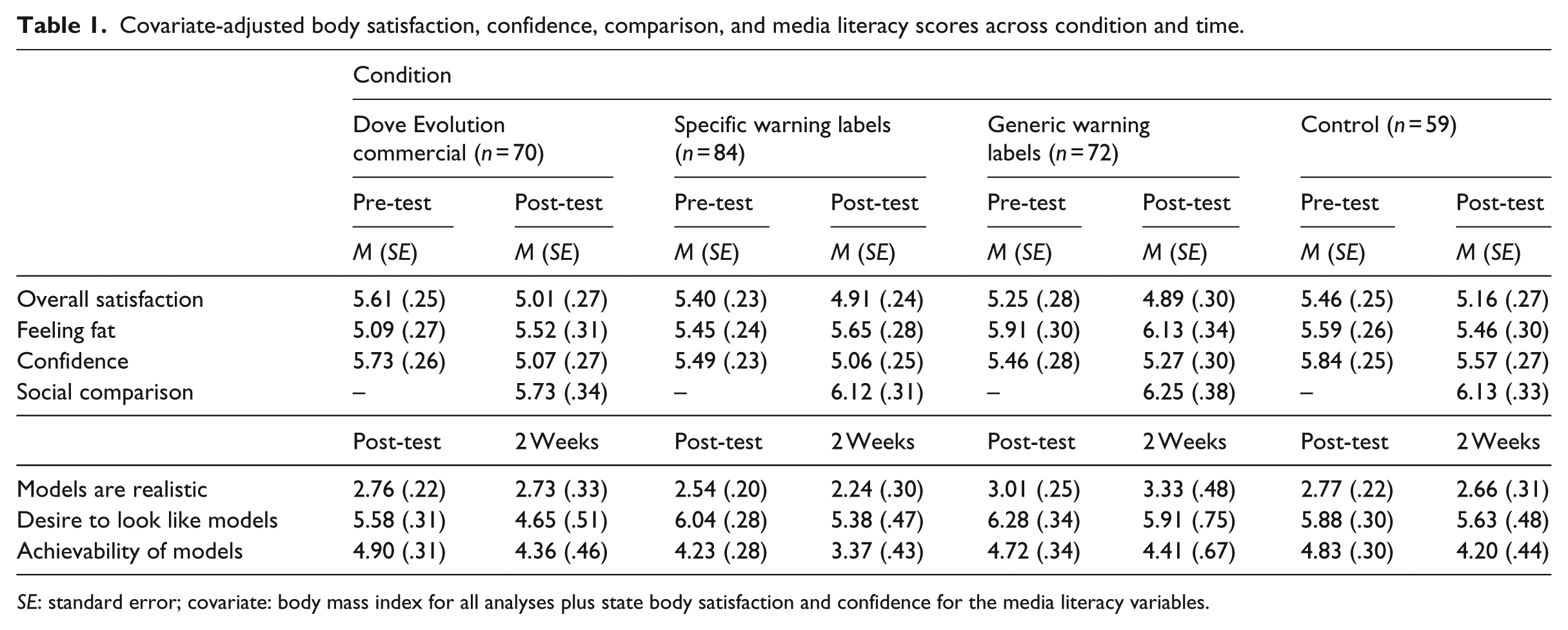
SE: standard error; covariate: body mass index for all analyses plus state body satisfaction and confidence for the media literacy variables.
Main analyses
Mixed design analyses of covariance (ANCOVAs) were conducted for each outcome measure. The between-group independent variable (IV) was intervention type (Dove Evolution, specific disclaimer labels, generic disclaimer labels, and no intervention) and the within-group IV was time (pre-test and immediate post-test). The three dependent variables (DVs) were participants’ scores on state measures of overall satisfaction with shape and weight, feeling fat, and confidence.
Body satisfaction and confidence changes across condition
Support for H1 would be found from a significant time × condition interaction. Table 1 shows the pre- and post-test body satisfaction scores across each condition.
For overall satisfaction with shape and weight, there was no significant time × intervention interaction, F(3, 280) = 1.08, p = .35, partial η2 = .01, and no significant main effect of intervention F(3, 280) = 0.25, p = .86, partial η2 = .003. The significant main effect of time, F(1, 280) = 4.50, p = .03, partial η2 = .02, showed that women, regardless of condition, experienced a reduction in their overall satisfaction with shape and weight from pre-test (M = 5.43, SD = 0.12) to post-test (M = 4.98, SD = 0.13).
For the feeling fat variable, there was no significant time × intervention interaction, F(3, 280) = 1.03, p = .37, partial η2 = .01, or main effect of intervention F(3, 280) = 1.05, p = .37, partial η2 = .01. There was a significant main effect of time, F(1, 280) = 9.92, p = .002, partial η2 = .03, indicating that women across conditions experienced an increase in feelings of fatness from pre- (M = 5.51, SD = 0.13) to post-test (M = 5.69, SD = 0.15).
For confidence, there was no significant time × intervention interaction, F(3, 280) = 1.59, p = .19, partial η2 = .01, no main effect of time, F(1, 280) = 0.29, p = .58, partial η2 = .001, or intervention condition, F(3, 280) = 0.57, p = .63, partial η2 = .006.
Social comparison
An ANCOVA was conducted to test H2. There was no significant difference in the levels of state social comparison between the conditions, F(3, 280) = 0.40, p = .84, partial η2 = .004 (see Table 1 for means).
Media literacy
A series of ANCOVAs were conducted to test H3. The IV was condition, the DVs were scores on the three media literacy questions, with BMI, and the state scales completed within the same session were entered as covariates. Separate analyses were conducted for each time period to maximize the sample size. Table 1 shows descriptive statistics.
At immediate post-test, there were no significant differences between conditions on participants’ perceptions of whether models were realistic, F(3, 285) = 0.68, p = .56, partial η2 = .007, participant’s reported desire to look like the models depicted in the media, F(3, 285) = 0.80, p = .49, partial η2 = .009, or perceived achievability of looking like the models depicted in the media, F(3, 285) = 1.10, p = .34, partial η2 = .012. At the 2-week follow-up, there were also no significant differences between conditions across the three questions (realistic: F(3, 94) = 1.22, p = .30, partial η2 = .04; desire: F(3, 94) = 0.87, p = .46, partial η2 = .02; achievability: F(3, 94) = 1.22, p = .30, partial η2 = .04).
Qualitative analyses
A basic thematic analysis (Braun and Clarke, 2006) was used to identify themes in responses to the open-ended question assessing the intervention purpose. The first author completed the initial thematic analysis which was then examined by the second author. Any discrepancies were discussed until full agreement was reached. Three broad themes were identified across the three interventions.
Within all interventions, the most common theme was the perception that interventions highlighted the artificial/unrealistic nature of media images (Dove Evolution = 80% of responses, specific disclaimer = 78%, generic disclaimer = 76%). Less commonly, but consistently, women reported that the messages were designed to increase confidence and positive self-image in viewers (Dove Evolution = 10%, specific disclaimer label = 8%, generic disclaimer label = 8%). Finally, women in all conditions also reported that the interventions were designed to discourage comparisons with idealized images in the media (Dove Evolution = 5%, specific disclaimer label = 18%, generic disclaimer label = 11%). Table 2 (Supplementary file) contains example quotes.
Discussion
Overall our findings show that despite being aware of the key message behind the interventions, this awareness did not translate into a protective effect. No benefits to body satisfaction, confidence, social comparison, or media literacy were found.
H1 was not supported as women, regardless of condition, experienced a significant reduction in satisfaction with shape/weight and greater feelings of fatness from pre- to post-test. None of the interventions was able to mitigate these effects, although none increased negative effects either. These findings are inconsistent with previous research showing that the Dove Evolution commercial was effective in protecting body satisfaction when viewed with music video clips in young adult women (Quigg and Want, 2011) or thin-ideal fashion images in adolescent girls (Halliwell et al., 2011a) and add to the research base which generally suggests that disclaimer labels may not be effective (Ata et al., 2013; Bury et al., 2016b; Tiggemann et al., 2013, 2014). There was no evidence that either type of disclaimer label was detrimental to body satisfaction although our outcome measures were different to some other researchers who found effects across physical self-esteem (Harrison and Hefner, 2014), negative thought accessibility (Selimbegović and Chatard, 2015), or eye tracking (Bury et al., 2014, 2016b). In essence, the results show that generic and specific disclaimer labels do not elicit greater body dissatisfaction than no-label conditions.
In terms of the Dove Evolution commercial, which was the primary intervention of interest, methodological differences between our study and past research may account for the findings. Halliwell et al. (2011a) exposed adolescent girls to the Dove Evolution commercial twice prior to viewing a single thin-ideal image from a fashion spread, which may have strengthened effects. Quigg and Want (2011) used 17 minutes of music television for their idealized depictions within a sample of adolescent girls. Therefore, differences in sample (we used young adults), medium (we used images with no advertisements), or number of presentations (we used multiple images) may account for the findings. Alternatively, effects may not be found in the current outcome measures which focused on overall body satisfaction, whereas the Dove Evolution commercial focuses on modifications to the facial area. Quigg and Want (2011) used a measure of facial satisfaction analyzed as part of a composite appearance satisfaction scale, and therefore it is not clear whether the results differ across outcome measures. Future research may wish to explore the utility of a commercial showing the process of a woman’s entire body being digitally enhanced as well as the addition of a larger selection of outcome measures. Finally, the Dove Evolution commercial may not be effective, or effective under certain conditions, to be further elucidated.
H2 was not supported as women engaged in similar, moderate levels of social comparison across conditions. We expected the media literacy interventions would demonstrate the artificial nature of the images which are inappropriate sources of comparison (Quigg and Want, 2011; Slater et al., 2012). Descriptively, the Dove Evolution commercial was the only intervention to have slightly lower comparison scores compared to the disclaimer label and no-intervention conditions. Neither of the previous studies examining the Dove Evolution commercial explored social comparison so this may present a useful avenue for future research. However, the qualitative theme “to prevent comparison processes” was listed by the smallest percentage of women in the Dove Evolution condition. The qualitative element is important in addressing queries by other researchers about consumer perspectives of such interventions (e.g. Ata et al., 2013) and confirms that women are indeed aware of the purpose of such techniques.
The interventions were not effective in modifying women’s perceptions about whether the model’s appearance was realistic, achievable, or desirable in either the short-term or after a 2-week delay. Thus, H3 was not supported. Despite women realizing that the idealized depictions were not realistic, they still reported moderate scores on desire to emulate the look and believe that it is somewhat achievable, even after viewing the interventions which demonstrate the extensiveness of image modifications. Repeated exposure to these interventions or more intensive programs may be needed to compensate for the frequent exposure to thin-idealized imagery that is common in many Western cultures. Our findings are similar to that of Bury et al. (2016b) who also found no effects on perceived realism but inconsistent with Slater et al. (2012) who did find a benefit, although neither study included a baseline measure. Interestingly, Bury et al. (2016a) found that the inclusion of another general warning message before women viewed the thin-ideal models actually resulted in greater perceived realism by women who were high on trait appearance comparison tendencies. The authors suggested that the message may have primed women toward appearance cues. Future research should investigate a way to bridge the gap between message comprehension and changes to media literacy, perhaps by targeting women’s desire to look like models depicted in the media. It seems unlikely that flow-on effects can occur until women are able to question the sociocultural ideal and one’s ability to achieve such a look.
Finally, women were able to identify the purpose of the interventions and recognized the artificial nature of thin-ideal media imagery. It is possible that women across all conditions viewed the images as artificial, and therefore the interventions had no further impact. Alternatively, instead of protecting participants from the harmful effects of the media, the interventions may have drawn attention to the images and served as a reminder that the images are the type of body shape that society idolizes, and therefore, a similar level of dissatisfaction was evident. Future research could examine how familiarity with the interventions could affect the results, especially given that the Dove Evolution commercial was released in 2006 and therefore participants may have been familiar with it.
Several limitations are noteworthy. First, the online nature of the study meant a lack of control over the participants although it did allow for a greater reach of participants and ensured anonymity. Demand effects are also a potential with media research and our study did not include any “distractor” items. Second, the study’s findings are restricted to magazine images without advertisements within a sample of primarily Caucasian young adult women. Future research could extend these findings in other populations or mediums. For example, research has shown that women can experience poor outcomes after viewing images of models in more active, fitness-focused pursuits (Mulgrew and Tiggemann, 2018) or sexually agentic models (Halliwell et al., 2011b) as well as traditionally posed models. Finally, our outcome variables were limited to weight and shape. Future research should include a more diverse range of body image domains (e.g. importance of appearance, body confidence, self-esteem, satisfaction with body parts).
Future research could examine how viewer characteristics interact with the messages. Within the disclaimer labels’ research, thin-ideal internalization (Ata et al., 2013), trait body dissatisfaction (Ata et al., 2013), and social comparison (Bury et al., 2016b; Tiggemann et al., 2013) have been noted as important. More generally, research on adolescent girls (Durkin et al., 2005) found that higher scores on a range of vulnerability factors (e.g. greater comparison tendencies, poorer body satisfaction) were correlated with more positive views about body dissatisfaction prevention messages. Consumer perception of interventions is critical as viewers are aware of the unrealistic nature of media images but vary in their opinions on the use of preventative strategies (Diedrichs et al., 2011). A large-scale qualitative study reported the majority of adult women believed that the labeling would not be effective in protecting against body dissatisfaction as the idealized nature of the image still remained and the degree of alteration was not known (Paraskeva et al., 2017). It is interesting that even the Dove Evolution commercial, which does show the magnitude of change, was still not found to be effective in this study. Finally, future research would benefit from consistent nomenclature around whether a label is a warning, disclaimer, provides information, or a combination of all, as well as the wording within each of these categories (e.g. Ata et al., 2013; Bury et al., 2016b).
In summary, this study showed that disclaimer labels and the Dove Evolution commercial did not mitigate the negative effects of exposure to the thin ideal. These findings have important implications, particularly for policy makers, who may wish to implement these media literacy interventions nationally. Given the brief nature and easy implementation of the studied interventions, further research is needed into the ways in which they can be used to encourage women to be more resilient when exposed to thin-ideal depictions in the media.
Footnotes
Declaration of Conflicting Interests
The author(s) declared no potential conflicts of interest with respect to the research, authorship, and/or publication of this article.
Funding
The author(s) received no financial support for the research, authorship, and/or publication of this article.
References
Supplementary Material
Please find the following supplemental material available below.
For Open Access articles published under a Creative Commons License, all supplemental material carries the same license as the article it is associated with.
For non-Open Access articles published, all supplemental material carries a non-exclusive license, and permission requests for re-use of supplemental material or any part of supplemental material shall be sent directly to the copyright owner as specified in the copyright notice associated with the article.
