



Abstract
This study explores the mediating effects of repetitive negative thinking in the relationship between perfectionism and adolescent sleep quality. A sample of 1664 Chinese adolescents with a mean age of 15.0 years was recruited, and they completed four measures relating to perfectionism, sleep quality, worry, and rumination. The results showed that maladaptive perfectionism was positively correlated with poor sleep quality in adolescents, which was mediated by both worry and rumination. However, adaptive perfectionism was not significantly associated with adolescent sleep quality, and this relationship was suppressed by rumination (but not worry). The implications of these results are also discussed.
Poor sleep quality is a widespread health problem in adolescents. It manifests itself in insufficient sleep duration, insomnia, irregular sleeping–waking schedules, daytime sleepiness, tiredness, and so on (Gradisar et al., 2011; Lin et al., 2010). For instance, insufficient sleep duration in adolescents has become a major international health concern. Research has indicated that the average sleep duration for adolescents is significantly shorter than the recommended amount of time, estimated as 8.1 hours in Europe (Perez de Heredia et al., 2014), 7.6 hours in the United States (National Sleep Foundation, 2006), and 7.3 hours in China (Chung and Cheung, 2008). Moreover, symptoms of insomnia are also prevalent in adolescents, with estimates ranging from 10 to 30 percent (Roberts and Duong, 2013; Wang et al., 2016).
Perfectionism is a very important personality factor in adolescent health and has attracted much attention (Ashby et al., 2011; Gutiérrez et al., 2015; Larsson et al., 2016; O’Connor et al., 2010; Wade et al., 2015). It is characterized by striving for flawlessness, setting exceedingly high standards of performance, and evaluating one’s behavior in an overly critical fashion (Egan et al., 2011). From the multidimensional perspective, perfectionism includes adaptive and maladaptive perfectionism (Egan et al., 2011; Slade and Owens, 1998; Stoeber and Otto, 2006). Adaptive perfectionism is characterized as toward the achievement of a high-level goal in order to obtain positive consequences and driven by both positive reinforcement and a desire for success (Slade and Owens, 1998). However, maladaptive perfectionism is characterized as toward the achievement of certain high-level goals to avoid or escape from negative consequences (Slade and Owens, 1998; Stoeber and Otto, 2006). The effects of perfectionism on sleep quality have been addressed in the literature. Lundh et al. (1994) found that patients with persistent insomnia scored higher on measures of perfectionism than did normal adults. Similarly, Vincent and Walker’s (2000) study indicated that adults with chronic insomnia were more likely to endorse features of maladaptive perfectionism relative to healthy controls. Furthermore, some longitudinal studies have shown perfectionism to be a reliable predictor of sleep disturbance (Azevedo et al., 2010; Jansson-Fröjmark and Linton, 2007).
To our knowledge, most empirical studies on this topic have considered only the effects of perfectionism on sleep disturbance. However, the mediating factors in this relationship continue to be empirically unclear. As suggested in a three-factor model of sleep disturbance, the role of perfectionism may be mediated by precipitating and perpetuating factors such as psychiatric illness, stressful life events, and repetitive negative thinking (Harvey et al., 2014). Moreover, previous studies have mostly explored the relationship between perfectionism and sleep disturbance with adult samples, but little is known about the association in adolescents. This study will explore the mediating role of repetitive negative thinking in the relationship between perfectionism and adolescent sleep quality.
The mediating role of repetitive negative thinking
Repetitive negative thinking, which is one of the critical perpetuating factors of sleep disturbance (Pillai and Drake, 2015), refers to a process of thinking attentively, repeatedly, or frequently about one’s self and the world (Watkins, 2008). The typical forms of repetitive negative thinking include worry and rumination. Both have been demonstrated as potential underlying causes of sleep disturbance (Carney et al., 2010). Worry, which mainly concerns “how” the current mood will come to be, and rumination, which involves “why” the feeling of fatigue endures throughout the day (Pillai and Drake, 2015), trigger physiological hyperarousal and emotional distress, which lead to sleep problems and genuine sleep deficits (Harvey, 2002).
In addition to the three-factor model of sleep disturbance, the mediating role of repetitive negative thinking may also be explained from the cognitive-behavioral model of perfectionism. It concerns the effect of performance-related behavior and cognitive biases in maintaining a cycle of perfectionism and psychopathology, which proposes that perfectionists become selectively attuned to any negative aspect of their performance, no matter how small the perceived flaw may be; they constantly monitor and think repetitively about their self-presentation (Egan et al., 2011). Therefore, it is suggested that repetitive negative thinking may be a mediator in the relationship between perfectionism and psychopathology. In recent years, there has been an increasing number of studies validating the positive relationship between perfectionism and repetitive negative thinking (Desnoyers and Arpin-Cribbie, 2015; Lin et al., 2013).
Furthermore, the mediating effect of repetitive negative thinking has been empirically validated in the relationship between perfectionism and certain psychopathologies. For instance, Harris et al. (2008) found that brooding and reflective pondering, two main aspects of rumination, mediated the relationship between perfectionism and depressive symptoms. Also, Short and Mazmanian (2013) proposed that both worry and rumination mediated the relationship between socially prescribed perfectionism and negative affect.
This study
This study explored the mediating role of repetitive negative thinking in the relationship between perfectionism and adolescent sleep quality via a sample of 1800 Chinese adolescents. Considering that perfectionism includes both adaptive and maladaptive perfectionism (Slade and Owens, 1998), this research tested the association from a multidimensional perfectionism perspective. Based on previous research in this area, this study hypothesized that (1) perfectionism is positively correlated with poor adolescent sleep quality and (2) the relationship between the two is mediated by both worry and rumination.
Method
Participants
Using a cluster sampling, the participants were recruited from 12 middle schools in Fuzhou, a coastal city in southeast China. A class was seen as a cluster; nine classes per grade were selected. Since students in the 9th and 12th grades were preparing for the high school and college entrance exams, respectively, they were not enlisted for this research. In total, 1800 students from 36 classes participated. Written informed consent was obtained from each participant, as well as from his or her teacher and guardian. All procedures were approved by the Academic Ethics Committee of Fujian Normal University. If more than half of the items were left unanswered or answered in a similar fashion, they were deemed invalid. Subsequently, 1664 participants’ answers were validated, which accounted for 92.4 percent of the total. These 1664 participants presented a mean age of 15.0 years (standard deviation (SD) = 1.6, ranging from 11 to 18). In total, there were 729 males, 883 females, and 52 participants who did not report their gender. There were 495, 354, 447, and 368 participants from the 7th, 8th, 10th, and 11th grades, respectively.
Measures
Perfectionism
Perfectionism was measured by the Almost Perfectionism Scale-Revised (APS-R) measurement system (Slaney et al., 2001; Yang et al., 2007). In the APS-R, the sub-scales of High Standard and Discrepancy are used to measure adaptive and maladaptive perfectionism, respectively (Ashby et al., 2011; Rice et al., 2011). High Standard includes 7 items, and Discrepancy includes 12 items. All items are rated on a 7-point Likert-type rating scale ranging from 1 (strongly disagree) to 7 (strongly agree). For the Chinese version of the APS-R, Cronbach’s coefficient alphas were 0.76 for High Standard and 0.85 for Discrepancy. The re-test reliability after 7 weeks was 0.72 for High Standard and 0.83 for Discrepancy (Yang et al., 2007). In this study, Cronbach’s coefficient alphas were 0.82 for High Standard and 0.92 for Discrepancy.
Sleep quality
Sleep quality was measured by the widely used Pittsburgh Sleep Quality Index (PSQI; Buysse et al., 1989; Liu et al., 1996). The PSQI is used to measure an individual’s sleep difficulties during the previous month and includes seven sub-scales: (1) Subjective Sleep Quality, (2) Sleep Latency, (3) Sleep Duration, (4) Habitual Sleep Efficiency, (5) Sleep Disturbance, (6) Used Sleep Medicine, and (7) Daytime Dysfunction. Items are rated on a 4-point Likert scale between 0 and 3, with higher scores indicating poorer levels of sleep quality. The Chinese version of the PSQI showed acceptable psychometric characteristics; its internal consistency reliability was 0.84, split-half reliability was 0.87, and re-test reliability (after 2 weeks) was 0.81 (Liu et al., 1996). In this study, its internal consistency was 0.78.
Rumination
Rumination was measured by the Nolen-Hoeksema Ruminative Responses Scale (RRS; Han and Yang, 2009; Nolen-Hoeksema and Morrow, 1991). The RRS includes 22 items describing responses to a depressed mood that are focused on the self, depressive symptoms, and possible consequences and causes of the mood. It consists of three sub-scales: (1) Symptom Rumination, (2) Brooding, and (3) Reflective Pondering. Items are rated on a 4-point Likert scale ranging from 1 (almost never) to 4 (almost always), with higher scores indicating greater rumination. For the Chinese version of the RRS, the internal consistency reliability was 0.90 and the re-test reliability (after 2 weeks) was 0.82, which validated the psychometric characteristics of this scale (Han and Yang, 2009). In this study, the internal consistency was 0.93.
Worry
Worry was measured by the Worry Tendency Questionnaire for Chinese Adolescents (WTQ-CA; Lin et al., 2012). The WTQ-CA is used to measure Chinese adolescents’ level of worry about future events and situations. It consists of 32 items rated on a 5-point Likert scale ranging between 1 (full disagreement) and 5 (full agreement), with higher scores indicating higher levels of worry. It includes five sub-scales: (1) Learning Worry, (2) Health Worry, (3) Relationship Worry, (4) Uncertainty about the Future, and (5) Lack of Confidence. In samples of adolescents and young adults, the WTQ-CA has shown excellent internal consistency (α = 0.92) and test–retest reliability (r = 0.74; Lin et al., 2012). In this study, its internal consistency was 0.95.
Statistical analysis
The statistical analysis was conducted using SPSS 16.0 and Mplus 7.0. A preliminary analysis was performed using descriptive statistics such as mean values, SDs, and zero-order correlations for each of the studied variables. Adaptive perfectionists (High Standard ≥ 35 and Discrepancy < 44), maladaptive perfectionists (High Standard ≥ 35 and Discrepancy < 44), and non-perfectionists (High Standard < 35) were clarified by the clarifying criterion proposed by Rice et al. (2011), and differences in the measuring variables were compared with a one-way analysis of variance (ANOVA).
Structural equation modeling with Mplus 7.0 was employed to examine the direct and indirect relationships. According to the standards for producing mediating analyses (MacKinnon, 2008; Wen and Ye, 2014), we first constructed a direct effect model of adaptive perfectionism and maladaptive perfectionism to examine the direct effect of both adaptive and maladaptive perfectionism on adolescent sleep quality and then constructed an integrated mediating model of worry and rumination to test the mediating effect of worry and rumination. In these models, adolescent sleep quality, worry, and rumination were considered as latent variables, and their measuring indicators were their sub-scales, respectively. Although adaptive perfectionism and maladaptive perfectionism were latent variables, considered they are measured by only a factor, they were directly considered as measuring variables. Evaluation of the models took the estimation values into consideration, and certain model fit indices were recommended: chi-square test of model fit (χ2/df, values should be <5.0), root mean square error of approximation (RMSEA, values should be <0.08), comparative fit index (CFI, values should be >0.90), and Tucker–Lewis index (TLI, values should be >0.90). A 95 percent confidence interval (95% CI) for the direct and indirect effects was estimated by the bootstrap method with 1000 bootstrap samples. If the 95 percent CI did not include zero, the effects were considered significant at the 0.05 level.
Results
Primary analyses
A total of 174 Chinese adolescents were identified as maladaptive perfectionists (accounting for 10.5% of the sample), 41 were adaptive perfectionists (2.4%), and 1449 were non-perfectionists (87.1%). Maladaptive perfectionists scored significantly higher than both non-perfectionists and adaptive perfectionists on the PSQI, WTQ-CA, and RRS scales (ps < 0.001), and non-perfectionists scored significantly higher than adaptive perfectionists (ps < 0.001, see Table 1).
Descriptive statistical of PSQI, WTQ-CA, and RRS among non-perfectionists, adaptive perfectionists, and maladaptive perfectionists, M (SD).
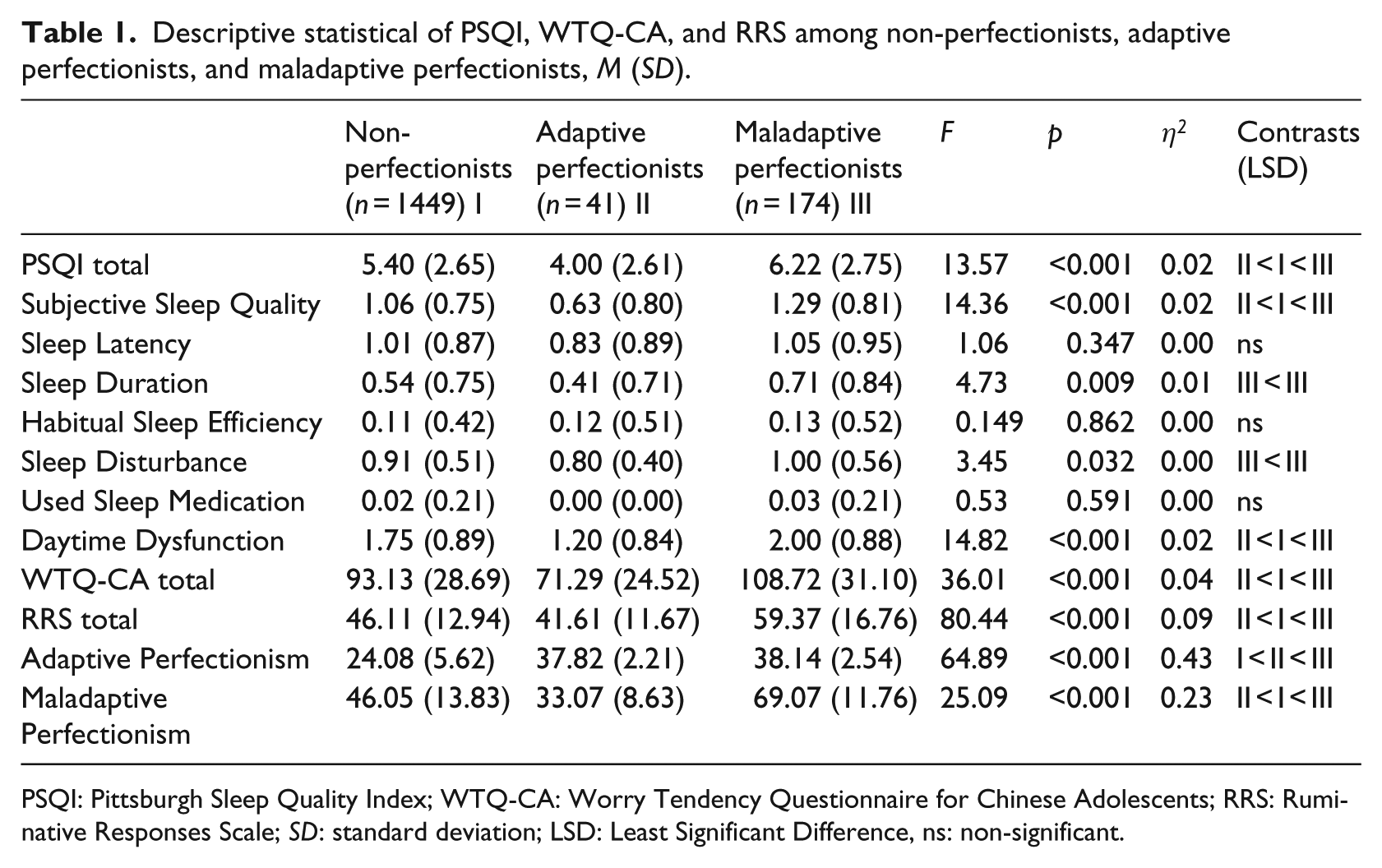
PSQI: Pittsburgh Sleep Quality Index; WTQ-CA: Worry Tendency Questionnaire for Chinese Adolescents; RRS: Ruminative Responses Scale; SD: standard deviation; LSD: Least Significant Difference, ns: non-significant.
The Pearson correlations showed that maladaptive perfectionism was positively correlated with the PSQI (p < 0.001) and its sub-scales, excluding Habitual Sleep Efficiency and Used Sleep Medicine (p < 0.001). However, adaptive perfectionism was not significantly correlated with the PSQI or its sub-scales (see Table 2).
Inter-correlations of the variables.
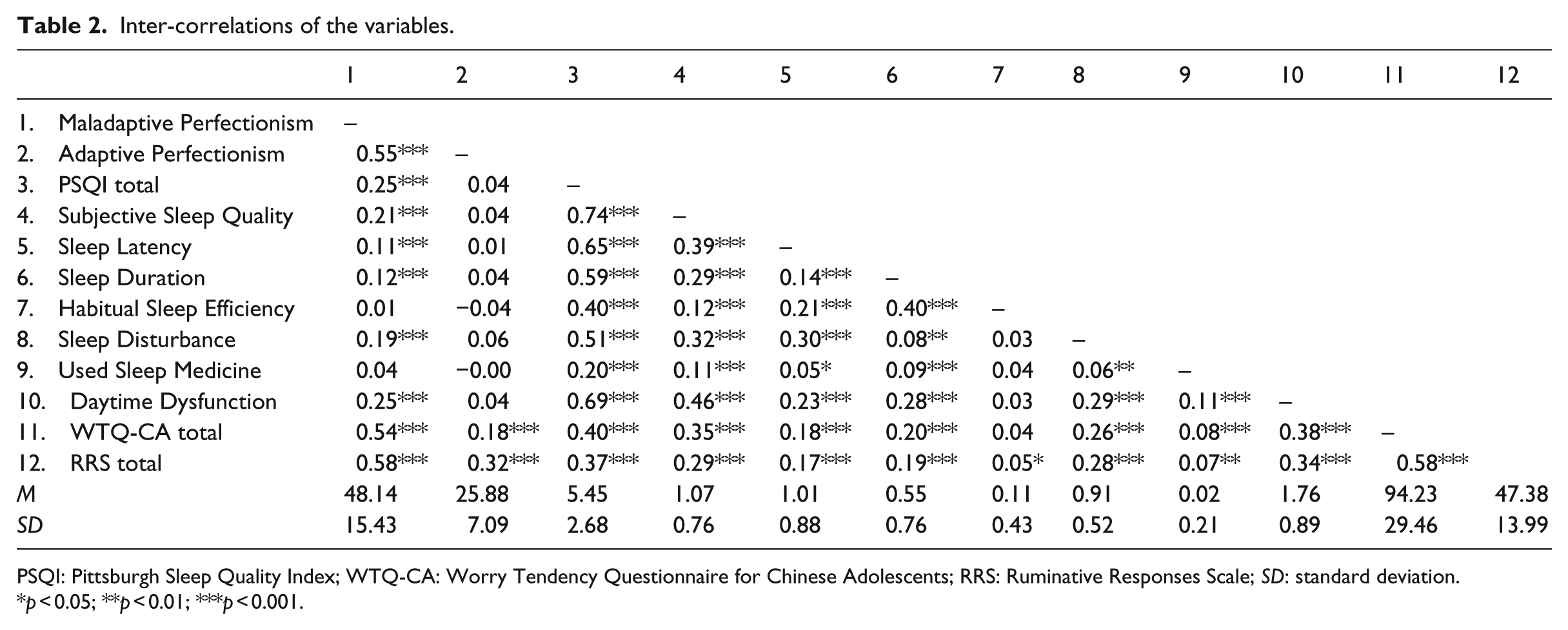
PSQI: Pittsburgh Sleep Quality Index; WTQ-CA: Worry Tendency Questionnaire for Chinese Adolescents; RRS: Ruminative Responses Scale; SD: standard deviation.
p < 0.05; **p < 0.01; ***p < 0.001.
Test for direct relationships
First, a direct effect model of adaptive and maladaptive perfectionism was constructed to test the direct effects of both on adolescent sleep quality. The fit indices for this model were as follows: χ2/df = 6.511, RMSEA = 0.061, CFI = 0.911, TLI = 0.876. In the model, the path from adaptive perfectionism to the PSQI was not significant (β = −0.02, p = 0.380). For this reason, the direct effect model was modified by removing adaptive perfectionism. The fit indices for the modified model were as follows: χ2/df = 5.504, RMSEA = 0.055, CFI = 0.948, TLI = 0.919. Due to the large number of participants in the study, the χ2/df value for this model was larger than 5. However, the other fit indices indicated that the model fits the data well. Thus, this modified model was considered acceptable. In the model, the standard path coefficient from maladaptive perfectionism to the PSQI was 0.16 (standard error (SE) = 0.02, p < 0.001, 95% CI = (0.13, 0.20)), indicating that the direct effect of maladaptive perfectionism on the PSQI was significantly positive. The final model explained 8.9 percent of the total variance of PSQI in adolescents.
Test for mediating relationships
A mediating model of worry and rumination was constructed to test the mediating effects of both. Based on the results of the direct relationships, the direct path from adaptive perfectionism to the PSQI was not specified. The fit indices for the mediating model were as follows: χ2/df = 8.217, RMSEA = 0.070, CFI = 0.918, TLI = 0.899. In this model, the two paths from maladaptive perfectionism to the PSQI and adaptive perfectionism to worry were not statistically significant (β = 0.01, p = 0.738; β = −0.04, p = 0.104). For this reason, an adjusted mediating model was constructed with the two paths remaining unspecified. Compared with the original mediating model, the added values of the chi-square test for the adjusted mediating model were not significant (Δχ2 = 3.830, Δdf = 2, p = 0.852), the RMSEA value was smaller (0.069VS0.070), and the TLI value was larger (0.900VS0.899), which showed that the adjusted mediating model fits the data better. Although the value of χ2/df for the adjusted mediating model was still larger than 5, which may have resulted from the large sample in this study, the other fit indices showed this model to fit the data well (χ2/df = 8.098, RMSEA = 0.069, CFI = 0.918, TLI = 0.900). Thus, the adjusted mediating model was accepted. The final model explained 68.9 percent of the total variance of PSQI in adolescents, which was more than the direct effect model by 60.0 percent.
As indicated in the adjusted mediating model (see Figure 1), the positive relationship between maladaptive perfectionism and the PSQI was fully mediated by both worry and rumination. The results by the bootstrap method with 1000 bootstrap samples showed that the standard mediating effect of worry was 0.11 (SE = 0.02, p < 0.001, 95% CI = (0.08, 0.13)), and the standard mediating effect of rumination was 0.05 (SE = 0.01, p < 0.001, 95% CI = (0.03, 0.08)). A comparison of the two mediating effects indicated that the mediating effect of worry was significantly larger than the mediating effect of rumination (mean of discrepancy = 0.06, SE = 0.03, p = 0.017, 95% CI = (0.01, 0.10)).

The mediating model of repetitive negative thinking.
In the relationship between adaptive perfectionism and PSQI, only the indirect effect of rumination was significant (standard effect = 0.02, SE = 0.01, p = 0.001, 95% CI = (0.01, 0.03)). Considering that the direct effect of adaptive perfectionism on PSQI was negative but not statistically significant (β = −0.02, p = 0.380), the indirect effect of rumination should be explained as a suppressing effect (Wen and Ye, 2014).
Discussion
This study explored the relationship between perfectionism and adolescent sleep quality and the mediating effect of repetitive negative thinking from the perspectives of both adaptive and maladaptive perfectionism. First, this research found that 174 adolescents could be classified as maladaptive perfectionists (accounting for 10.5% of the total) and 41 as adaptive perfectionists (2.5% of the total). The relatively low number of perfectionists among these Chinese adolescents may be the result of growing up in a uniquely collectivist culture in which most adolescents inherit high standards from their parents and/or teachers, rather than developing them on their own (Yang et al., 2007, 2013). Thus, Chinese adolescents self-reported relatively low scores for adaptive perfectionism, a pre-condition for being classified as perfectionists. This study also found that maladaptive perfectionists had the poorest sleep quality and the highest levels of worry and rumination (see Table 1). Maladaptive perfectionists with high levels of adaptive and maladaptive perfectionism are driven by negative reinforcement and a fear of failure (Slade and Owens, 1998) and tend to be self-critical in their self-evaluations; they perceive themselves as inadequate to meeting their own high standards (Rice and Stuart, 2010). At bedtime, they may become attentive to and critical of their behaviors related to school and interpersonal relationships, which would negatively impact their sleep quality (Azevedo et al., 2010; Van de Laar et al., 2010).
This work also found that maladaptive perfectionism was positively correlated with poor adolescent sleep quality. This result is consistent with previous studies that also validated the effect of maladaptive perfectionism on sleep disturbance (Azevedo et al., 2010; Jansson-Fröjmark and Linton, 2007; Lundh et al., 1994; Vincent and Walker, 2000). A plausible reason for the positive relationship is that maladaptive perfectionism is linked with heightened distress and arousal (Egan et al., 2011), which leads to a latent delayed onset of sleep and reduced overall sleep time (Harvey, 2002).
This study supported the mediating effects of worry and rumination on the relationship between maladaptive perfectionism and poor adolescent sleep quality. As shown in the results of the adjusted mediating model, the mediating effects of worry and rumination were 0.20 and 0.10, respectively. Adolescents with higher levels of maladaptive perfectionism were excessively concerned with meeting unrealistic goals and never feeling “good enough” in that pursuit (Rice and Stuart, 2010); such feelings may trigger psychological (mainly, rumination and worry) and physiological responses (Egan et al., 2011) and in turn inhibit normal sleep-related de-arousal and result in transient sleep disturbances (Harvey et al., 2014). Considering that ruminative thinking is past-oriented and worrisome thinking is future-oriented (Pillai and Drake, 2015), their mediating roles may be different. The mediating effect of rumination most likely reveals the mechanism by which individuals focus on “why” they are feeling fatigued during the day and look to the past to explain their exhaustion (Carney et al., 2010). However, the mediating effect of worry may be individuals’ focusing on “how” their current mood will come to be, which could prohibit good sleep later on in the night and lead to fatigue that interferes with normal functioning (Carney et al., 2010). This research also indicated that the mediating effect of worry is significantly more substantial than that of rumination. The reason for this difference may be that normal adolescents primarily worry about the possibility of future sleep problems and their consequences, rather than engage in ruminative think about existing sleeplessness (Yan et al., 2014).
In the relationship between adaptive perfectionism and poor adolescent sleep quality, however, this study found that the direct effect of adaptive perfectionism was negative but not statistically significant, whereas the indirect effect of rumination was significantly positive and thus should be explained as a suppressive effect. Through the indirect path of rumination, adaptive perfectionism was positively correlated with poor adolescent sleep quality. Adolescents with higher levels of adaptive perfectionism set high standards and expectations for their personal performance and pursue perfectionistic excellence; this leads to their placing an unhealthily high value on their goals and causes them to self-focus or ruminate on self-identity (Stoeber and Otto, 2006). However, overly ruminating on their goals and self-identity may trigger an emotional arousal that results in latent difficulties with sleep (Harvey, 2002). The role of rumination may be different in the relationship between adaptive/maladaptive perfectionism and adolescent sleep quality. In terms of adaptive perfectionism, it may be “reflection” that shows the primary suppressive effect because “reflection” is a purposeful turning inward to engage in cognitive problem-solving in order to achieve a high personal standard (Watkins, 2008). However, with regard to maladaptive perfectionism, it may be “brooding” that plays the primary mediating effect, for “brooding” is a passive comparison of the current situation with some as-yet unachieved standard (Watkins, 2008).
In summary, this study found that maladaptive and adaptive perfectionism played different roles in adolescent sleep quality. Maladaptive perfectionism was positively correlated with poor adolescent sleep quality, which was mediated by both rumination and worry; however, the relationship between adaptive perfectionism and adolescent sleep quality was not significant and was suppressed by rumination. There are several implications of these findings. First, adolescent sleep quality may not simply be associated with physical illness and negative cognitive processes and affects; it may also be linked to trait factors such as perfectionism. To better intervene in adolescent sleep problems, the different roles of maladaptive and adaptive perfectionism should be considered. Second, repetitive negative thinking is an important aspect of adolescent sleep disturbance. It not only directly influences adolescent sleep quality but also bridges the relationship between perfectionism and sleep. Mindfulness-based techniques of stress reduction and cognitive therapy should be considered; recent studies have revealed them to be effective in alleviating both rumination and worry (for a review, see Pillai and Drake, 2015).
Although this study has strong implications concerning the relationship between perfectionism and sleep quality in adolescents, there are several notable limitations. First, this study measured adolescent sleep quality only with the PSQI, which is a self-reporting questionnaire covering a subjective evaluation of sleep over the past month. It is unable to capture day-to-day sleep and objective sleep quality and may be associated with a retrospective recall bias. More ecologically valid methods such as a daily sleep log or polysomnography (PSG) would more fully capture the adolescent sleep quality. Second, our sample consisted solely of normal Chinese adolescents. Considering that functional differences may exist in perfectionism and repetitive negative thinking between clinical and nonclinical samples, it would be essential to examine whether the present results can be replicated in adolescent patients who have been clinically diagnosed with sleep disorders. Moreover, due to the cross-sectional design employed in the work, this study only found correlations between perfectionism, repetitive negative thinking, and adolescent sleep quality, but not causality. A longitudinal approach and/or randomized control design should be used in future studies to investigate the causal relationship.
Footnotes
Declaration of conflicting interests
The author(s) declared no potential conflicts of interest with respect to the research, authorship, and/or publication of this article.
Funding
The author(s) disclosed receipt of the following financial support for the research, authorship, and/or publication of this article: This research was supported by a grant from the Humanities and Social Science Foundation of Ministry of Education, China (no. 13YJA190016).