



Abstract
There is a growing recognition of the sexual and reproductive rights of people with disabilities, and since the World Health Organisation’s World Report on Disability, increased international attention has been given to these issues. Past research, however, suggests that this group encounter barriers to sexual and reproductive rights, which are both physical and attitudinal. Against this backdrop, this article employs a sequential mixed qualitative methodology to explore the practical and subjective experiences of 13 people with physical disabilities in South Africa, with regard to their sexual lives and experiences of sexuality. These experiences were marked by concerns about their ‘fitness’ as sexual beings and indicated that social forces were key in shaping their expectations for their own sexual life.
Background
The disability rights movement has fought for equality, access and recognition for people with disabilities (Hurst, 2003), with issues of education and employment forming a key focus of activism (Addlakha, 2007). Recently, however, issues of sexual and reproductive health (SRH) have arisen as key concerns (Gibson and Mykitiuk, 2012; McKenzie, 2013; Shuttleworth and Mona, 2002), as noted in the United Nations Convention on the Rights of Persons with Disabilities and highlighted in the World Report on Disability (World Health Organization (WHO), 2011). Disabled people have in the past been excluded from sexual health services due to attitudinal barriers such as service providers assuming that they are asexual, or physical barriers, such as inaccessible clinics. Furthermore, disabled people are often stereotyped as either sexually voracious and perverse or, more commonly, as lacking sexuality (Grabois, 2001; Kim, 2011; Milligan and Neufeldt, 2001).
The societal desexualisation of people with disabilities may pertain particularly to people with physical disabilities (Kim, 2011; Milligan and Neufeldt, 2001; Nario-Redmond, 2009) who may be seen to experience a ‘relative absence or insufficiency of sexual interest, biologically and socially described function, and interpersonal sexual engagement’ (Kim, 2011: 480). The reasons for this erroneous ascription stem, first, from an assumption that physical difference excludes one from sexuality and, second, from a discomfort with the idea of differently abled sexuality (an enforcement of normalcy). Cultural ideologies surrounding disability (Anderson and Kitchin, 2000), as well as the hegemony of heteronormative sexuality (Esmail et al., 2010; Siebers, 2012), play a role in the tenacity with which this fallacy of the desexualised person with a physical disability endures.
Social constructionist theory provides a useful paradigm for understanding the uncertain sexual status which disabled people hold in the eyes of non-disabled others, specifically sexual script theory (Simon and Gagnon, 1969, 1971). Sexual script theory proposes that sexuality and sexual behaviour among humans are social processes, determined by an individual’s internalisation of prevailing ways of ‘doing’ gendered performances of erotic behaviour (Carpenter, 2010; Gagnon and Simon, 2005; Simon and Gagnon, 1986, 2003; Wiederman, 2005). It constitutes an important lens through which to frame any inquiry into human sexuality, albeit an incomplete account of it (Sakaluk et al., 2014).
Sexual scripts instruct members of a society as to appropriate behaviour and the meanings to attach to certain courting and sexual behaviours (Wiederman, 2005). When internalised, sexual scripts may also constitute a force through which gendered performances of sexuality are played out, and these have a bearing on gendered understandings of disability (Baumeister, 2001; Okami and Shackelford, 2002; Oliver and Hyde, 1993). For instance, male sexual scripts depend on male physicality (Muehlenhard and Shippee, 2010; Sakaluk et al., 2014), and there is an ever-present emphasis on sex as a site of achievement (Gilfoyle and Wilson, 1992). Women, in line with traditional notions of appropriate feminine behaviour, are held to sexual scripts which require that they embody attractiveness and desirability (Eaton and Rose, 2011; Ménard and Cabrera, 2011), rather than overt sexual desire (Wiederman, 2005). This places an implicit primacy on men’s ability to display physical prowess and sexual skill (centred on penetrative sex), and women’s capacity to embody normative standards of feminine beauty. Men and women with physical disabilities may not be seen to conform to norms for their gender and thus be seen as less gendered than non-disabled people (Hunt, Swartz et al., 2017; Hunt et al under review).
Powerful sexual scripts, underpinned by medicalised understandings of sexuality, have led to an unprecedented emphasis on ‘curing’ disability or illness induced ‘sexual dysfunction’, as evidenced by the rise of sex medications such as Viagra (Marshall, 2002; Tiefer, 1995, 1996). Medicalised framings of ‘abnormal’ sexual behaviour as dysfunction have led to a further valorisation of re-attaining heteronormative standards of sexual ability post-disability (Hawkes, 1996: 71). This is particularly for men whose experiences of disability and illness are heavily influenced by definitions of masculinity, characterised by stoicism and sexual prowess (Gordon and Cerami, 2000; Huggins, 1998), characteristics at odds with embodied experiences of, for instance, spinal cord injury. Thus, in the case of people with physical disabilities, who may not conform to normative standards of ability or embodiment, the enactment of such scripts can be frustrated, and the desire for medical assistance in achieving ‘normality’ fuelled.
Within this context, the growing empirical literature concerning societal attitudes towards the sexuality of people with physical disabilities has found that individual members of societies view people with physical disabilities as less sexual than able-bodied people (Hunt, Swartz et al., 2017). Indeed, in recent work that we (the authors of this article) have undertaken, a large survey of nearly 2000 non-disabled South Africans revealed a range of problematic attitudes towards the sexuality of people with physical disabilities (Hunt, Carew et al., 2017; Hunt et al., 2017; Hunt et al., under review). Non-disabled respondents were more likely to support the idea that people without disability were deserving of sexual rights compared to people with physical disabilities and to rate the degree to which people with physical disability benefit from sexual and reproductive health care as less than that for people without physical disabilities.
These findings provide some of the first empirical support that non-disabled people perceive people with physical disabilities as enjoying fewer sexual and reproductive rights (even in a society like South Africa where, officially, non-discrimination against disabled people is enshrined in the constitution), and deriving less benefit from SRH services, than the population without disability (Hunt, Carew et al., 2017).
Discriminatory beliefs and attitudes held by non-disabled persons have consequences for the lives and experience of people with physical disabilities (O’Dea et al., 2012; Sakellariou, 2006; Sakellariou and Algado, 2006; Siebers, 2012). The latter are excluded from SRH education (Cheausuwantavee, 2002; Seidel et al., 2014), and SRH services (Rohleder and Swartz, 2012) experience barriers in their sexual development (Howland and Rintala, 2001; Stohl, 1996) and are at increased risk to be victims of sexual violence (Astbury and Walji, 2014). In sub-Saharan Africa in general, and South Africa in particular, negative attitudes towards the sexuality of this group of persons – largely negating that any such sexuality exists – have been suggested to put people with physical disabilities at increased risk for HIV, hinder their accessing SRH services, hamper their sexual expression and diminish their sexual self-esteem (Groce et al., 2013).
Yet, in past research with people with physical disabilities, most have identified as sexual beings (Bahner, 2012), with a sexual orientation (Ostrander, 2009); sexual needs (Bahner, 2012; Siebers, 2012); and the desire for intimacy, intimate relationships (Li and Yau, 2006) and children (Nosek et al., 2001). There are exceptions, and we are not suggesting that asexuality is not a valid sexual orientation – it is. But the imposition of a non-sexual identity onto people with physical disabilities is problematic and potentially damaging.
Among people without disabilities, multinational, aggregate data have shown that all aspects of the sexual experience are important to men and women (Mulhall et al., 2008) and that the importance of sexual activity endures into middle age and beyond (Nicolosi et al., 2004). Sexual dissatisfaction, among non-disabled people, is greater among women (Haavio-Mannila and Kontula, 1997). There is an established relationship between sexual satisfaction and marital satisfaction. Fewer studies have examined the association between sexual satisfaction and relationship satisfaction among unmarried people. However, those which have have also found a link between sexual satisfaction and relationship satisfaction (Sprecher, 2002), as well as other indicators of relationship well-being, including love (Yela, 2000) and commitment (Sprecher et al., 1995; Waite and Joyner, 2001).
However, there is a dearth of norms and understanding regarding the experiences of sexual activity among people with physical disabilities. In the Global South in particular, little work has examined the experiences of SRH, and sexual relationships, of people with physical disabilities. If the vision of SRH rights to be shared equitably by all (WHO, 2006: 5) is to be realised, then the voices of those whose sexuality is seen to be marginal must be heard. Indeed, disability activism is also about the politics of voice – it is important that disabled people speak back to the dominant discourses of the able-bodied which have for too long portrayed people with disabilities unfavourably. With this imperative in mind, our aim in this article is to explore the practical and subjective experiences of people with physical disabilities in South Africa, with regard to their sexual life (including experiences of sexual intimacy, intercourse, and other sexual activity).
Method
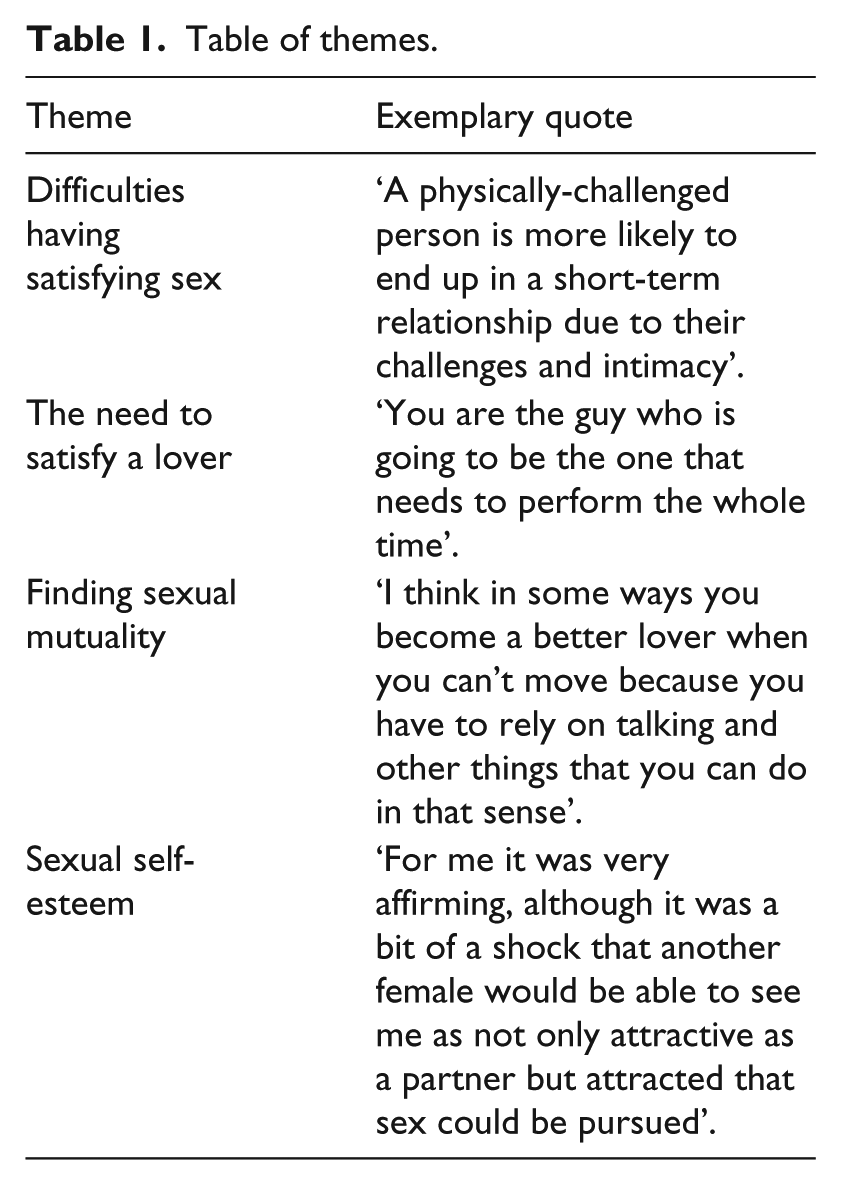
This article analyses qualitative interview data collected from 13 adults with acquired or congenital physical disabilities. The qualitative interviews were conducted as part of a photovoice 1 project with the same group of adults. We present here our analysis of the interviews which were guided by a semi-structured interview guide exploring SRH. The analysis of photographs and some of the accompanying narratives are presented elsewhere (Hunt et al., under review). However, some photographs, pertaining to SRH, are included in this article, as illustrative instances of themes we address (Table 1).
Table of themes.
Sample
A sample of 13 people with physical disabilities (demographics described in Table 2) were recruited via the networks of the Southern African Federation of Disability Organizations and the South African authors (X.H. and L.S.), as well as through mailing lists of local disability networks. All participants were identified as heterosexual and cisgender.
Participant demographics.

The term ‘Coloured’ refers to a South African census racial group. Historically of mixed European, African and Asian ancestry, self-identifying Coloured people constitute about 8.9 per cent of the population (Statistics South Africa, 2011).
Procedure
All individuals who responded to the advert were invited to a workshop held in Cape Town, South Africa. During this meeting, the theme of the project, its goals and methods were discussed with all participants. Participants were trained in the photovoice element of the project, each participant being provided with a digital camera and asked to take photographs which symbolised his or her experiences of sexual relationships and sexual and reproductive health care. 2 Participants were given at least 3 months to collect photographs. If participants were not able to use the digital cameras themselves, they were invited to ask a friend or carer to take the photographs under their instruction. Participants could take as many photographs as they chose.
Following this process, all participants were asked to take part in an individual interview. Participants could select up to five photographs which they felt most represented their experiences. These photographs were then used as discussion prompts in one section of the interview, and a semi-structured schedule guided the second section. The interviews were conducted by X.H., S.H.B. or P.R. The semi-structured section explored participants’ experiences of their sense of sexual self, intimate relationships, sex and SRH. Interviews were voice-recorded for transcription by a professional transcriber. This article includes three of the photovoice photographs in order to illustrate themes; however, the present analysis centres on textual qualitative interview data. We focus in this article on themes related to the actual sexual lives of participants (including experiences of sexual intimacy, intercourse and other sexual activity). Themes related to stigma, identity, relationships and dating will be presented in a forthcoming article.
Analysis
The qualitative responses in this study were analysed using thematic analysis (Braun and Clarke, 2006). As described by Namey et al. (2008), in their chapter on the subject, ‘thematic analyses move beyond counting explicit words or phrases and focus on identifying and describing both implicit and explicit ideas within the data, that is, themes’ (p. 140). Thus, this method proved useful for arriving at a textured understanding of the interview responses.
The aim in the present analysis was to provide a rich thematic description of the entire data set. Braun and Clarke (2006) note that such a method is usually employed when the research topic is one for which there is little existing research, such as is the case in this study. This goal – to provide a clear overview of the experiences of the sample of the sexual lives of participants, while not neglecting detail and nuance within these accounts – guided the present analysis.
In this study, coding proceeded through two rounds. First, P.R. read and re-read all the transcripts, highlighting salient transcripts. Thereafter, these codes were named, examined and coalesced into broader themes by P.R. and X.H. The themes in the present analysis represented patterns of meaning – cohering or contrasting – which recurred throughout the coded data set. These themes were then discussed with the team, who were familiar with the data set. The themes were then refined and are presented below.
Ethical considerations
Ethical approval for this study was obtained from Stellenbosch University and the University of East London. Written informed consent was obtained from all participants, and all participation was entirely voluntary.
Results
From our analysis of the data, we present four overarching themes related to sex and the sexual life of participants. These are difficulties having satisfying sex, the need to satisfy a lover, finding sexual mutuality and sexual self-esteem.
A detailed discussion of each theme is presented below. Thereafter, we reflect on the overarching ways of making sense of the sexuality in the context of disability reflected in these themes.
Difficulties having satisfying sex
Among the respondents, men more often commented on the physical limitations which they encountered in trying to sustain a sexual relationship. For Nick, a male with an acquired disability, this was perceived to strain intimate relationships: ‘A physically-challenged person is more likely to end up in a short-term relationship due to their challenges and intimacy’, he explained.
In some cases, these challenges were often met with ingenuity and creativity. Nick explained that he ‘use[d] equipment or I have to use some medication to give me that stamina, that feeling back, that energy back, to be intimate with a partner’. However, such a reliance on mediation was met with ambivalence. As Nick explained, ‘Sometimes, for example, I can’t afford to get that specific treatment, then I’m stranded, which makes my partner stranded, and that same strandedness will make the partner look for someone else to fulfil her wants and needs’. On one hand, Nick describes medication and equipment (sexual aids), to make him feel ‘energised’, which is framed here both as literal sexual stamina and perhaps as confidence to perform sexual acts for longer durations. Meanwhile, in the latter quote, the term ‘stranded’ describes his dependence on medication to engage in sexual activity in the manner which he desires: when the medication is not available, he felt powerless and unable to satisfy his partner.
However, finding a solution to the ‘problem’ of their sense of sexual incapacity was described as a great relief by the male respondents. As Edward, a male with an acquired disability, explained,
[When] I started trying the Lavitra [a medication for erectile dysfunction]. I followed the dosage. It worked for me. It worked for me from the first time. I used it once for the first night and it worked for me. Then I felt like, okay, I’m back to normal now because it’s working now for me.
For some of the participants, the difficulties which they experienced with sexual activity, fear of others’ negative appraisals of them as partners and flagging sexual self-esteem led to diminished sexual expression and unsatisfactory sex.
For Nick, this was due to his frustration at having a limited capacity for engaging in the kind of sex which he would like to. He explained,
Sometimes you get bored. You get frustrated. Then the next partner also wants a different position or a different type of tactic [way of engaging in sex], if I can say that, to go about and make it more exciting as a relationship. It can be boring, like I mentioned, for him or for her. Partners. Problems. That’s when it can become a problem at the end of the day. That is what I have experienced in life.
Nick explained that the limitations on ingenuity in the bedroom which he felt to be engendered by his disability, not only made him fear that his partner would get bored but also that they frustrated and bored him.
For Erica, a female with an acquired disability, the loss of sensation associated with her impairment was responsible for the initial diminishment of her sexual expression post-injury. Recalling an incident with a past partner, she explained,
We had sex very occasionally … but we were having sex and it was going on, and I remember saying to him, no, just get it done, get it over with. I could see he was totally put off. But I mean, I was not a sexual being, I was a dead piece of body, you know, lying there like a piece of meat, and it seemed almost sacrilegious to do that!
Despite these feelings, Erika’s desire for inclusion in the sexual order of things led her to continue to engage in sexual activity despite her diminished inclination to do so. Erica explained that her diminished sexual expression stemmed from the fact that she was only just beginning to adjust to her impairment. ‘I was also very … I would say much more disabled than I am now. So sex was terrible’.
The need to satisfy a lover
A prominent theme among our male participants was the emphasis which they placed on sex as a site of achievement; a space in which they could prove their worth as a lover by satisfying their partners. The satisfaction being referenced, in the main, implied ‘pleasuring a female partner’ – often in the form of penetrative or oral sex (a fact which can be derived from the men’s focus on needing Viagra or similar medications in order to be able to sustain an erection during penetrative heteronormative intercourse). Further to this, the men simply expressed a desire to be able to engage in unspecified but somehow unattainable levels of sexual ingenuity and variety. Part of this may simply reflect an amplification of existing sexual scripts for men among disabled men: in light of not being able to engage in all manner of sexual acts at will, the men were perhaps more inclined to view such sexual ingenuity as necessary to a healthy sex life. As noted in the introduction to this article, male sexual scripts, and contemporary thinking about male sexual performance, centre on male physicality (Sakaluk et al., 2014). Sex is framed as a site of achievement (Gilfoyle and Wilson, 1992). The participants might thus be more concerned about exclusion from performances of sexual prowess.
Some respondents expressed frustration at feeling unable to access as wide a range of sexual positions and techniques as they wanted to. However, for the majority of the men, their experiences of satisfaction with their sex lives centred on their sense of having to prove themselves as worthy partners. ‘You are the guy who is going to be the one that needs to perform the whole time’, explained Simon, a male with an acquired disability, adding that he perceived this need to be imposed on him in order to ‘compensate’ for his disability. ‘What I have found, there’s this thing of trying to prove yourself in trying to satisfy your partner. Ja, it’s a strange issue’, he added. Simon also related a similar concern, linking it to ideas around gender. ‘You know males, they have this problem of will I be able to satisfy [my partner]? That is the male mind in our society’.
For many of the men, their thinking about sexual pleasure centred on the pleasure of their partners. Liam, a male with an acquired disability, explained that ‘feeling like a man’, for him, centred on being able to satisfy his partner sexually, again, echoing broader research concerning male understandings of erotic behaviour. Discussing a photograph (Figure 1) of himself and his girlfriend sitting on his bed, he explains,
You can see I feel like a man. You can see the amount of confidence and satisfaction that I have on my face there. You can also see how happy she is there, so we people with disabilities, we can also make our women feel good sexually. You can bring out the best in them. We can still be romantics as well if we want to.

Photograph of Liam and his girlfriend (we have blurred the image to protect identity, although permission was granted to use the photograph).
Ryan, a male with an acquired disability, quite succinctly explained the relationship between this reframing of his conceptions of sexual pleasure and his sense of ‘coming into’ feelings of sexual competence. Here, again, we see echoes of prior sentiment, with his conception of sexual activity centring on his capacity to pleasure a woman. Ryan links this explicitly to the idea of sex as a site of achievement:
To give a woman pleasure, I can really do that and that’s fantastic. You know, that to me is fantastic. Because I think sex is about achievement. It’s quite a complex thing, but I think a part of it is about achievement.
‘Overcoming’ and accommodation
This theme encompassed participants’ responses regarding post-disability sexual functioning and their adaptation to it. Initially, several of the participants, particularly the men, spoke about the ways in which their physical impairments could be ‘overcome’ in sexual relationships or even conferred advantages which non-disabled people might not experience.
For Nick, this was the result of his own limited sexual sensation during intercourse. He explained,
I think mostly about my partner. You know why I’m saying so? Part of my body has got no sensation, it’s got no feeling, so if I have intimacy with my partner I don’t feel anything. But I have to think about her needs. I have to fulfil her needs. I don’t feel anything, nothing, but she needs to feel. I’m working in her terms now.
Two other male respondents, Ryan and Liam, related a similar sentiment:
I think in some ways you become a better lover when you can’t move because you have to rely on talking and other things that you can do in that sense. I don’t know if that makes sense. You become better, but you become more sensitive to what’s important and try and understand women I guess, which is still an anomaly for any kind of partner. (Ryan, a male with an acquired disability)
Ryan discussed his becoming disabled as spurring him to focus less on his own sexual needs than on those of his partner. He saw this in a positive light, making him an unusually unselfish lover (‘an anomaly’).
However, despite taking pride in their capacity to focus on their partners’ needs during sex, some respondents noted that they did feel their endeavours towards sexual mutuality and pleasure to be more skewed than mutual:
I have to make time to give pleasure for my partner to feel at ease and to feel free to do what is necessary for her to do. From my perspective, from my side, I have to go with the flow. Yes, I am feeling free, but not as free as my partner. (Nick)
The men’s accounts not only inevitably reflect the lack of mutuality between them and their partners but also focus on heterosexual men’s attention to their female partners’ sexual pleasure.
Two female respondents, Erica and Ange, both recounted predominantly positive experiences of intimacy within sexual encounters. For Erica, this was achieved through a learning process, in which she and her partner jointly navigated their respective abilities and desires during sex:
We just had to learn what worked and what didn’t work sexually, you know, different positions, what he liked, what I liked, and we were open to be able to explore.
Similarly, for Ange, a female with a congenital disability, communication and openness to express her needs and the accommodations necessary to enable sex to be enjoyable for her were central to her enjoyment of sexual activity. She explained,
There were times … because remember, I’m cerebral palsy and the muscles contract … then I would say to [my husband] how I want it, how to pack the pillows, how to do it. He would do exactly what I told him.
Ange went on to explain that this allowed sexual intercourse to be something which she enjoyed. She felt more able to fully engage in sexual activity which her physical limitations might otherwise have precluded, were it not for the assistance of an accommodating partner.
Central to several of the respondents’ discussions of sexual pleasure in relationships was the process of coming to understand and adjust to one’s sexuality after acquiring a disability. As Ryan explained,
When your body starts adjusting to your disability and that type of thing, it changes, and your sensation changes and all those things. Like if you kiss me on my neck or on my ear, I go nuts. It’s like, fucking don’t do that. Yes, no, no, yes – that type of thing.
Centrally, though, this knowledge needed to be shared. ‘It’s good for you to know [what you enjoy sexually] and it’s good for your partner to know that’. Central, also, to the respondent’s discussions of sexual activity was a focus on intimacy, broadly defined, rather than penetrative sex. Liam related that the fact that he had ‘very, very little feeling’ when having sexual intercourse made him refocus his attention on intimacy in physical relationships. ‘I can’t feel when I ejaculate, but for me it’s about intimacy, about still being able to have sex and to please your female friend’. Exemplary of this sentiment was Ryan’s discussion of an image he took of water droplets on sand (Figure 2). He explained,
I feel that black and white is more open to interpretation, suggestion and imagination. And I think sex is like that, it’s an individual thing linked to our desires and imagination … I think a lot of sex is about what’s going on in your head at the time. I think a lot of it is imagination. I can touch you in a certain way and it will mean nothing. But I can touch someone else in that certain way and it will mean a lot. At the same time, you might touch somebody else and it will be nothing, but they can touch you and it will mean something as well. So sex isn’t just about intercourse but more about intimacy.
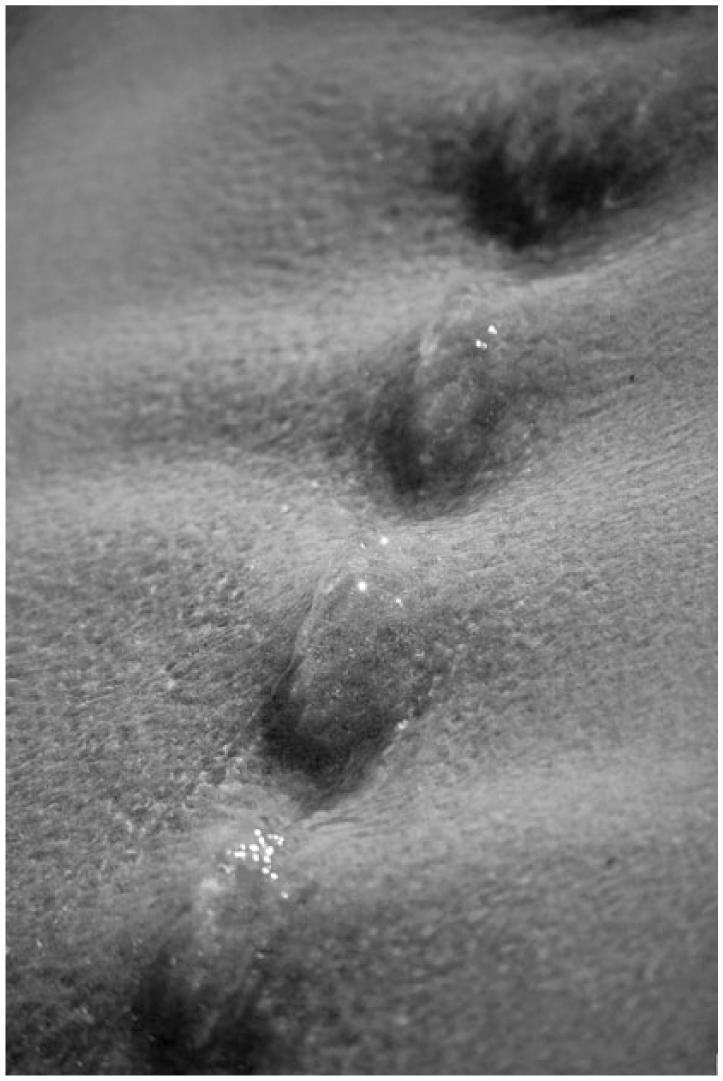
Ryan’s photograph: water droplets on sand.
Such relational conceptions of sexuality were common in the participants’ accounts.
Sexual self-esteem
Self-esteem is a superordinate theme which transects almost all other themes discussed here. In many cases, as will be evident in the foregoing sections, self-esteem and sexual self-esteem were intertwined, with the former being buoyed when the latter was affirmed. As Ian, who acquired a disability at a very young age, explains, being seen to be a sexual being positively influenced his body image, as well as his sexual self-esteem. Speaking about a sexual encounter with a woman he said,
She was forthcoming and things like that. For me it was very affirming, although it was a bit of a shock that another female would be able to see me as not only attractive as a partner but attracted that sex could be pursued. It’s almost like it wouldn’t be bad to be nude or naked, and basically explore without being held back by what society says.
He framed this as a moment in which he came to question some of his assumptions about himself, ‘I found that very awakening, the fact that I might be insecure about it, but not everyone thinks of myself like that’, he explained.
Erica spoke about how her experience of becoming disabled was marked by a constant fear about how she would be seen. Being treated differently by people only served to confirm her fears and fuelled her inner sense of herself as somehow irreparably altered:
Not only are people treating you differently, but you yourself are … you know, you see yourself as different. You have a perception of something that’s outside your normal environment, and you’re having to deal with this change all of a sudden internally as well.
For her, this spurred an interrogation of a previously unexamined assumption about the importance – even primacy – of physical appearance. ‘[It made me question] What are the values? What are my values? What are people’s values and why is physical appearance so very important?’
Participants with congenital disabilities spoke of how growing up with a disability and constantly feeling that ‘normal’ sexual society was ‘not for them’ impacted on their sense of self. Ange explained,
When you are young you need to make love and all of those things. But for me, although I had those aspirations and desires, deep-down I had doubt. How was I going to be accepted? Will it be possible? Will I get hurt?
The impact of the participants’ perceptions of others’ reactions to their disabilities did not only affect their sense of themselves as attractive but also cut to the very core of their sense of worth as a prospective partner. ‘I also didn’t have confidence in myself. Because you know when people say negative things about you, you also lose confidence’, explained Olivia, a woman with a congenital disability, while Ryan noted that he
felt like a burden. I’m very attracted to women. I love that idea. But I felt that I didn’t want to be a burden to a partner. So I managed for about six years, that’s all. I just kind of cut myself off from that.
Finally, Erica, discussing a black and white image she had taken of herself by a photographer (Figure 3), described how reclaiming her sexual identity, after feeling that it had been lost post-injury, marked a moment of self-acceptance:
I sent [a man I met] a very sexy picture, just of my legs, and these pictures I took many years ago in a competition because I wanted to depict disability as being sexy in a way … I can’t hide my flaws and imperfections like other people can. Mine is there for the world to see. In the process of rediscovering my sexuality, I have learned to use what I have to seduce and entice. The silent battles I have fought of self-acceptance and validation has left me with the realisation that I no longer have to hide the naked beautiful truth of who I am … a woman in every essence of the word.
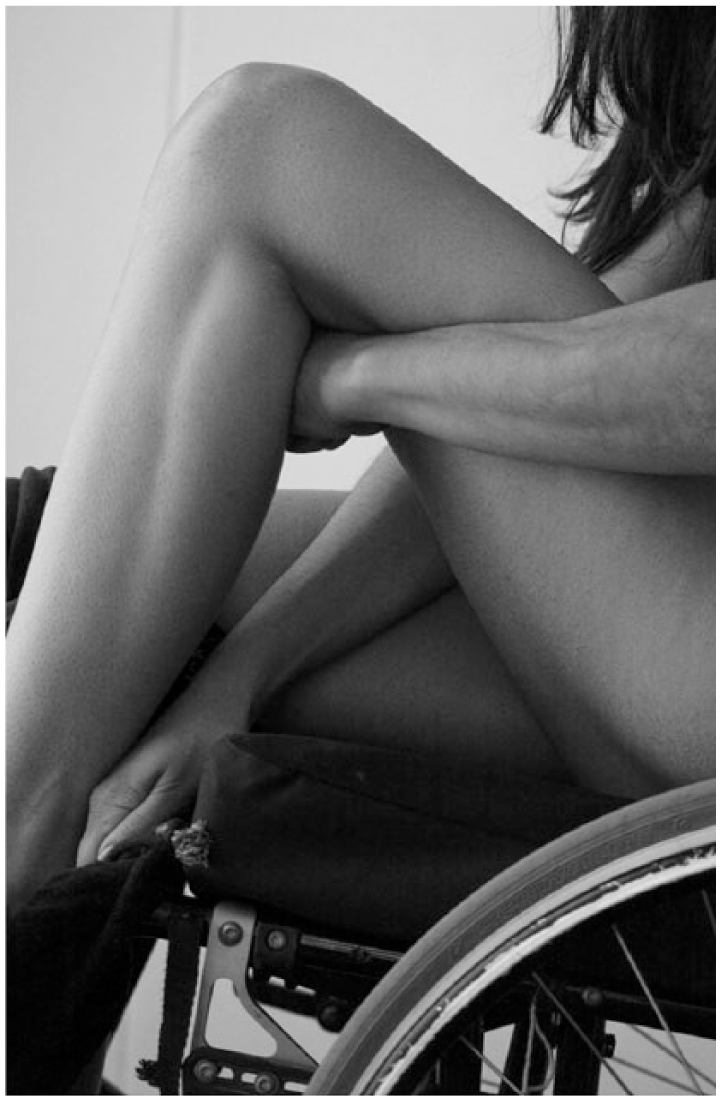
Erica’s photograph: femininity.
Discussion
Despite the immense depth and diversity of experience evident in the foregoing discussion of themes, three facets of the data are particularly salient. The first concerns the difference between respondents with congenital disabilities’ experiences of self-esteem and sexual self-esteem and those of respondents with acquired disabilities. The second concerns the intersection of ways of talking about normalcy, recovery, gender identity and sexuality. The third concerns the gendered differences in the respondents’ discussions of sexuality.
Among respondents with congenital disabilities, it is apparent that their self-esteem, particularly their sexual self-esteem and sense of themselves as sexual beings, differed from those of their non-disabled peers, due to undergoing their socialisation as a person with physical disabilities. This impacted on their discussion of sub-themes such as desirability and attractiveness.
Consistent with these findings, MacDougall and Morin’s (1979) early study on the subject indicated that young adults with congenital disabilities were limited in their expression of their sexuality. Nearly all the individuals studied were unmarried, and very few had had a serious long-term relationship (MacDougall and Morin, 1979).
The findings of this work are consistent with the notion that there are many factors that seriously limit the expression of sexuality among individuals with congenital disabilities and that when sexual identity development occurs in the context of disability (as opposed to before its onset), the result can be inhibitory on sexual development.
For our respondents with acquired disabilities, their experiences seemed to progress through a predictable pattern of (a) being sexualised in the context of a typical embodiment; (b) having this embodiment disrupted, and with this disruption, feeling their sexuality to be damaged or diminished; and then (c) reclaiming and redefining their sexuality in light of their disability (often with their first sexual encounter marking their re-entry into sexual society). However, a prominent part of these accounts included concerns over their attractiveness following becoming disabled, and doubt over their romantic prospects, mirroring findings from past work (Li and Yau, 2006).
Second, as is clear, for many of the respondents, becoming sexually active was regarded as something which made them feel ‘normal’. When probed about this way of seeing sex, ‘becoming normal again’ seemed to be participants’ way of talking about reconnecting with a part of themselves which they had feared lost due to being disabled. Ideas about normality were also intertwined with feeling like a ‘real woman’ or ‘real man’, and being initiated (or reinitiated) into sexual society was regarded as something which affirmed their gender identities and sense of themselves as ‘normal’.
Indeed, for many of the respondents, there was immense overlap in their discussions of normality, sexual achievement (pleasing a partner) and their gender identity, particularly among men. Authors such as Oliffe (2005) have drawn attention to the manner in which penis-centric conceptions of sexuality held among men can create confusion between men’s personhood and their sexual organ, in the sense that when they are unable to maintain an erection and engage in penetrative sex, men experience a subjective loss of their manhood. As physical performance forms the basis for one’s construction of sex, men who are unable to perform sexually are affected in deeply gendered ways (Flood, 2002; Tiefer, 1994, 2006).
Past theoretical work has reflected extensively on the overlap in ideas of normality and sexuality, and bodily difference and sexual difference among men and women. Essentially, this work states that according to societal norms, sex is for ‘normal’ bodies, and the bodies of people with physical disabilities do not conform to a prescriptive definition of ‘normal’ (Kumari-Campbell, 2009; McRuer, 2011). Therefore, they are assumed to be unfit for sexuality. Esmail et al. (2010), for instance, have found that members of the public as well as service providers used concepts of ‘naturalness’ to describe sexuality and that such narrow descriptions of sexuality (in heteronormative, genital terms) excluded people with physical disabilities. This observation affirms a comment made by Tepper in 2000 that sex is too often taken to be the sole purview of White, heterosexual, young, single, non-disabled people. Thus, it is understandable that the respondents would feel that initiation into one of these (sexuality) would signal an initiation into ‘normality’, something which many of them had felt excluded from, from the outset. This initiation into normalcy took on a gendered tone, with males focussing on developing a capacity to please women, while women focussed on regaining feelings of attractiveness.
Male respondents tended to focus on heteronormative performances of sexual prowess as ‘compensating’ for what they might lack in physical ability. Inclusion in sexual society for men centred on their ability to please a partner, as has been found in other work (Tepper, 2000). However, we would go further and suggest that this is largely to do with the men’s expressions of needing to compensate for what they ‘lack’ in normative conceptions of masculinity, by becoming proficient lovers and drawing on women’s enjoyment of their sexual behaviour as a source of pride.
It is thus important to note the manner in which discourses and scripts, which are clearly circulating among the non-disabled majority, are accentuated among men with disabilities. It is not that the emphasis on achievement, or as Simon put it, ‘performance’, is unique to men with physical disabilities. However, Liam’s words, ‘feel like a man’, can be read as implying an experience of prior emasculation. Thus, for men with physical disabilities, performance and pleasing a woman become the benchmark by which they evaluate the majority of their sexual functioning (a normative discourse, exacerbated by the question placed over their general physicality by virtue of having a physical limitation).
Finally, it is worth considering what broader implications such findings as these have for research and practice regarding sexuality and physical disability. The WHO has developed a broad definition of sexual health as encompassing more than just the absence of disease or dysfunction, but as being a positive state of well-being. In the medical sector certainly, and perhaps generally in rehabilitation work with people physical disabilities, the focus and concern is typically on sexual dysfunction, how to ‘cure’ it and how to restore pre-disability sexual functioning in very normative terms. Less emphasis is placed on the interpersonal, intimacy, mutuality and sexual self-esteem aspects of sexuality in the context of disability. Powerful forces shape what is desired, how desire is expressed and make sexual pleasure and its pursuit not only normative but also compulsory (Karlsen and Villadsen, 2016). Sexuality in the context of disability could provide a dynamic arena in which new conceptions of pleasure, intimacy, mutuality and what it means to be sexual could be explored, and dominant ideas around what is and is not necessary to live a sexual life could be expanded.
Limitations
The limitations of this work exist in the fact that we drew on a volunteer sample; thus, it is possible that those people interested in participating had already given thought to, or were affected by, experiences relating to sexuality. It is possible that the ideas reflected here are not characteristic of the experiences of people with physical disabilities in general, although the fact that many of our findings mirrored those of past work seems to suggest that this is not the case.
Conclusion
This study found evidence that people with physical disabilities’ experiences of SRH and sexual relationships were marked by concerns about their ‘fitness’ as sexual beings, a concern which seemed to find its origins in their ideas about how non-disabled people might view their different-than-average embodiment. Those participants with congenital disabilities described how the attitudes of non-disabled people had impacted on their expectations for their own sexual lives, and future relationships, largely casting a pall on both. Participants with acquired disabilities described having to re-negotiate their sexual functioning in light of their altered embodiment, with many framing their sexual experiences post-disability as moments of ‘regaining’ a bit of normality.
As noted, past research has suggested that the societal desexualisation of people with disabilities might be particularly the case of people with physical disabilities. A recent study from South Africa suggests that people with physical disabilities are seen as less sexual than non-disabled people. Theoretical work has suggested that the erroneous ascription of asexuality to people with physical disabilities seems to stem, first, from an assumption that physical difference excludes one from sexuality and, second, from a discomfort with the idea of differently abled sexuality (an enforcement of normalcy).
Our respondents seemed to both accept and resist such assumptions. In the first instance, the fact that many saw their re-initiation into sexual society, as it were, as a moment of ‘becoming normal again’ points to their implicit assumption that there is something abnormal about not being sexual but also that they had feared that disability would negate their sexuality and, with it, their normality. However, the respondents also seemed to resist the desexualising beliefs and ascriptions of others, taking pride in their capacity to engage in different kinds of sexual behaviour and negotiating sexual relationships. This experience, we found, was gendered, with men emphasising sexual activity as a site of achievement.
On one hand then, research suggests that people with physical disabilities are regarded as less sexual than non-disabled people. On the other hand, this work suggests that people with physical disabilities are sexual and sexually active. Advocacy around the SRH rights of people with disabilities is imperative if this disjuncture between attitudes and ascriptions, and lived experience, is to be bridged, particularly given that our work shows that people with physical disabilities’ experiences and conceptions of SRH and sexual relationships are actively impinged on by the desexualising attitudes of non-disabled others.
Footnotes
Acknowledgements
This paper was conducted as part of the applied research ‘The myth of asexuality? Disability stigma as a barrier to sexual relationships in South Africa’ led by the University of East London, in partnership with the Southern African Federation of the Disabled, SINTEF Technology and Society and Stellenbosch University.
Declaration of Conflicting Interests
The author(s) declared no potential conflicts of interest with respect to the research, authorship and/or publication of this article.
Funding
The author(s) disclosed receipt of the following financial support for the research, authorship, and/or publication of this article: The financial assistance was provided by the International Foundation of Applied Disability Research (FIRAH) and the National Research Foundation (NRF) of South Africa. Opinions expressed and conclusions arrived at are those of the authors and are not necessarily to be attributed to FIRAH or the NRF.
