



Abstract
Constructions of masculinity have shifted and changed but the central role of the penis has remained firm. Yet, despite the implications for sexual health, there has been very little research on discourses around penises. The messages men receive about their manhood is apparent in articles in men’s magazines. We conducted a discursive analysis of the ways in which penises were discussed in four market leading UK titles: Loaded, Men’s Health, GQ and Attitude. Two broad discourses were identified, termed Laddish and Medicalised, both of which create fear-ridden spaces where men are bombarded with unachievable masculine ideals and traumatic examples of mutilated members. We discuss how health psychologists could use the findings to communicate with men about their sexual health needs using this channel.
Penises are the symbolic and literal essence of male sexuality; they are masculinity made flesh (Brubaker and Johnson, 2008; Schneider et al., 2008). Yet, relative to the amount of social science research which has been conducted on vaginas, there is surprisingly little analysis of penises (Stephens, 2007). Some research exists which focusses on the abstract idea of the penis, the so-called phallic ideal, but hardly any is to be found on the weighty issues attached to the corporal appendage (Flowers et al., 2013). This is a strange omission since penises are bound up with the construct of masculinity to the extent that there is a sliding scale: the bigger the penis, the more masculine the owner (Drummond and Filiault, 2007). Perhaps, this is why there have been so few studies – the stakes are too great. This is a serious lapse since there are important health implications. Research is emerging that shows that orthodox beliefs about masculinity contribute to men’s avoidance of healthcare (Himmelstein and Sanchez, 2016). Adherence to traditional masculine norms of stoicism, self-reliance, risk-taking and the denial of vulnerability reduces men’s willingness to seek help (Addis and Mahalik, 2003; Noone and Stephens, 2008; O’Brien et al., 2005). Indeed, it is argued that whereas dominant discourses of femininity encourage women to scrutinise their own bodies and thus recognise subtle signs of change (Moore, 2010; O’Brien et al., 2005), traditional discourses of masculinity encourage men to do the reverse and avoid such scrutiny.
Men are significantly less likely than women to seek out medical advice (Addis and Mahalik, 2003) to a large extent because they see healthcare spaces as feminised environments (Yousaf et al., 2015). This effect is exacerbated when it intersects with sexual health (Kalmuss and Austrian, 2010), and thus men are particularly reluctant to approach medical practitioners about genital concerns such as erectile dysfunction (Ansong et al., 1998; Shabsihg et al., 2004), premature ejaculation (Porst et al., 2007), sexually transmitted infections (STIs; Shoveller et al., 2010), penile carcinoma (Skeppner et al., 2008, 2012), and testicular cancer (Singleton, 2008). The inevitable effects are poorer health outcomes: men who avoid discussing their sexual health have an increased risk of contracting an STI and other health-related consequences (Alt, 2002; Courtenay, 2000; Pearson, 2003). Lindberg et al. (2006) and Shoveller et al. (2010) attribute men ducking their sexual health issues to a lack of meaningful discussion that considers the role of masculinity in relation to sexual health.
In response, health psychologists have developed various non-traditional ways of engaging men (Robinson and Robertson, 2010), taking health services into traditionally male spaces, such as sports clubs or barber’s shops, and targeting advertising campaigns at male toilets (Robertson et al., 2016; Robinson and Robertson, 2010). These interventions acknowledge the importance of, and cater to, men’s concerns about their masculinity and how that affects their health-seeking behaviour. One virtual male ‘space’ that conveys sexual health messages that relate to masculinity, but which has little attention, is the pages of men’s magazines. It befits health psychologists to consider the types of messages that men are receiving about their sexual health in these spaces and to consider how they might target their interventions in this arena. We present a social constructionist analysis of representations of penises in men’s media as a way of examining men’s hopes and fears about their penises and, by extension, their masculinity, with a view to aiding health psychologists’ understanding of these spaces as sources of information.
Penis as masculinity made flesh
The penis is under the microscope as the seminal site of masculinity. The very word ‘manhood’ is synonymous with both the penis and masculinity. In our image-focussed society (Hall, 2015) where there is an explosion of images of gendered bodies (Flowers et al., 2013), masculinity, sex, and self-image are bound up and put on display for critical inspection as never before (Attwood, 2009). Men are encouraged by the media to express their identity and their masculinity through a capitalist model of work upon their bodies, work upon their seduction techniques, work upon their emotional literacy and, ultimately, work upon the penis, which acts as a fulcrum for many of these endeavours and concerns (Duncan and Dowsett, 2010; Tyler, 2004). As Flowers et al. (2013) state, ‘A man’s relationship to his penis …, is now simultaneously exposed and under real, and critically imagined, surveillance’ (p. 128).
That surveillance is not felt benignly. There is a vein of anxiety which runs through contemporary sexual culture (Levy, 2006). Fear is seen as a driver of Western heterosexual masculinity (Cook, 2005). Men report fears around being perceived as not ‘man enough’ (Seidler, 1997), and sex, and by extension the penis, is where many of those fears about sexuality are rooted (Mooney-Somers and Ussher, 2010).
There needs to be an alternative to this phallocentric view of sexuality. Many researchers (e.g. Brubaker and Johnson, 2008; Schneider et al., 2008) lament the concentration on the physical aspects of sexuality, to the exclusion of psychological or emotional dimensions which might allow for greater variability. Sadly, media representations of penises and masculinity tend to reproduce this problematic worm’s eye view (Mooney-Somers and Ussher, 2010).
Media representations of penises
Twenty years ago, Lehman (1998) wrote that most ‘traditional men’ were comfortable with silence surrounding the penis (cited in Stephens, 2007) but since then there has been an explosion of media representations of penises (Maddison, 2011). This exposure of the penis is never done casually. Penises may be valorised, medicalised, pitied or scorned, but there is an absence of a relaxed matter-of-factness, in other words, there is typically an accompanying anxiety (Hall, 2015).
Penis-related anxiety is sometimes manifest as a blunt refusal to acknowledge variability. This is seen in porn where the penis is valorised as always large and always erect (Maddison, 2011). Maddison (2011) calls this ‘a homosocial fantasy of phallic prowess’ (p. 46). Sometimes, sources of penile anxiety are acknowledged explicitly but in the same breath, the consumer is offered medical solutions (Hodgetts and Chamberlain, 2006). Thus, erectile dysfunction is constructed as a physiological event (Maddison, 2011) and erectile enhancement adverts promise to restore masculinity (Brubaker and Johnson, 2008). Finally, almost as a last resort, anxiety is dealt with by attempts to diminish the importance of penises by laughing at or scorning them, often using freak show spectacularisation (Stephens, 2007).
All these discourses act to commodify the penis, penile anxieties and masculinity itself (Flowers et al., 2013). And the field of concern is constantly expanding, where once size was the only salient factor; men are increasingly being directed to concern themselves with the aesthetics of their genitals: shape, proportions, and pubic hair topiary (Flowers et al., 2013; Hall, 2015).
Media is a key resource for work on identity (Attwood, 2009), and men’s magazines are an influential site where masculinity is particularly (re)produced and commodified (Gauntlett, 2008). Anstiss and Lyons (2014) note that men’s magazines actively encourage hegemonic masculinity, and thus, they are not only a passive site but also an active source of ideas about maleness (Gill, 2009). These magazines act as cultural signposts for men, telling them how they should feel about their penises and their masculinity. That they are so popular, and contain so many relevant articles, tells us that there is a thirst for their accounts (Ménard and Kleinplatz, 2008) from confused men who are gathered into this virtual community (Rogers, 2005). But Mooney-Somers and Ussher (2010) note that men’s magazines have tended to ignore the diversity of men’s sexuality, thus perpetuating limited ideas of masculinity.
With these concerns in mind, this study analyses the ways in which penises are talked about in four of the most popular UK men’s magazines: GQ, Men’s Health, Loaded and Attitude. This is more than simply a media critique. As Hall (2015) says, ‘examining men’s penis concerns and activities offers the potential to identify valuable insights in which to help men (and boys) deal with the demands of modern society’ (p. 1012). By examining these discourses, we aim to further understand the ways in which masculine ideals are inevitably and incessantly let down by the everyday fallibilities and ineptitudes of the material penis.
Methods
Materials
Reflecting the move in the magazine industry towards online publications (Rowlands, 2013), we analysed the representation of penises in the online editions of Loaded, Men’s Heath, GQ and Attitude magazines, which are the UK market leading titles.
Loaded
Presented as a magazine dedicated to the pursuit of sex, alcohol and football, Loaded is widely viewed as the archetypal ‘Lad’s Mag’ (Gauntlett, 2008). Aimed primarily at single men in their late teens and early twenties, Loaded’s tabloid approach reinvigorated the men’s magazine market in the mid-1990s (Whelehan, 2000). However, in 2015, Loaded ceased print publication due to falling readership and feminist pressure (García-Favaro and Gill, 2016 ) but relaunched later that year in an online format (www.loaded.co.uk).
Men’s Health
Men’s Health magazine claims the status of the UK’s best-selling quality men’s magazine and the biggest men’s lifestyle website in the United Kingdom (www.menshealth.co.uk). With a target market consisting of affluent, educated, middle-class males, aged 25–45 years (Hearst Magazines, 2016), Men’s Health has been characterised as the ‘new man’s’ magazine (Boni, 2002). The articles typically focus on workouts, fitness, nutrition, weight loss, style, sex and relationships.
GQ
GQ is the leading fashion magazine for men in the United Kingdom (www.gq-magazine.co.uk). With a tagline ‘The men’s magazine with an IQ’, its target readership are said to be ‘sophisticated, discerning, affluent men’ (Conde Nast Publications, 2016). The articles are typically concerned with fashion, culture, grooming and lifestyle issues.
Attitude
Attitude is the UK’s best-selling magazine aimed at gay men (www.attitude.co.uk). Again, it boasts a readership of affluent, fashion-conscious, but specifically gay men (Attitude Media Ltd, 2012). The articles cover topics including entertainment, style, travel and physical activity.
To identify relevant articles, the authors used the search engines provided on the magazine websites and used the search terms ‘penis’, ‘dick’, ‘cock’ and ‘erection’. All articles published online where the penis was the primary focus were included. In total, the data corpus included 94 articles, 31 from Loaded (published from February 2016 to November 2016), 20 from Men’s Health (October 2006 to December 2016), 10 from GQ (June 2011 to September 2016) and 33 from Attitude (March 2014 to December 2016).
Analytical approach
Our analytical approach was underpinned by social constructionist assumptions, namely, that ‘normal’, ‘natural’ and ‘ideal’ uses, shapes, sizes and meanings associated with the penis, are produced within specific social, cultural and historical contexts. Thus, Foucauldian discourse analysis was deemed the best method to critically interrogate how penises are represented in magazines. We sought to identify how the articles collectively produced particular ways of speaking, representing and thinking about the penis. This is important because discourses have very real, hands-on implications for how men interact with their penises.
While there is no one right way to conduct Foucauldian discourse analysis (Wiggins and Riley, 2010), Willig’s (2013) six steps provide useful guidelines for how to approach the texts. The first step we undertook was to divide the data corpus between us and through reading, re-reading and coding the data, we sought to identify the main ‘objects of discourse’, that is, the common ways in which the penis and its related issues were discussed. Step two was to share our initial analyses and identify the competing, and potentially contradictory, ways in which penises were represented both within and across different magazines. The next step was to discuss the potential functions, effects and consequences of these representations, in terms of masculinity, sex and sexual health. Next, we analysed how these different representations made particular subject positions available for the writer and reader. The final two steps involved looking at practice and subjectivity, in other words, what actions and emotions were available to the subjects. This included attending to the roles, characters and types of person the reader was able to inhabit or connect with in the text, and what could legitimately be said, done and felt from these positions.
Analysis
Two distinct and equally prominent discourses were found across the four publications, we label them ‘laddish’ and ‘medicalised’, and within each is evidence of omnipresent fear.
Laddish discourse unsurprisingly permeated every article in Loaded magazine, itself an initial front runner in the promotion of Lad culture in the 1990s. However, laddish discourse also predominated in Attitude articles. Men’s Health articles were distinctively different, constructing what we referred to as a ‘medicalised’ discourse, underpinned by neoliberal and healthist principles. GQ articles engaged with both approaches, some articles distinctively laddish and some medicalised. Both discourses are used to either celebrate or traumatise the penis, thus men are framed as either a ‘Superman’ or an ‘Everyman’ (Bordo, 1999) (Table 1).
Structure of analysis.
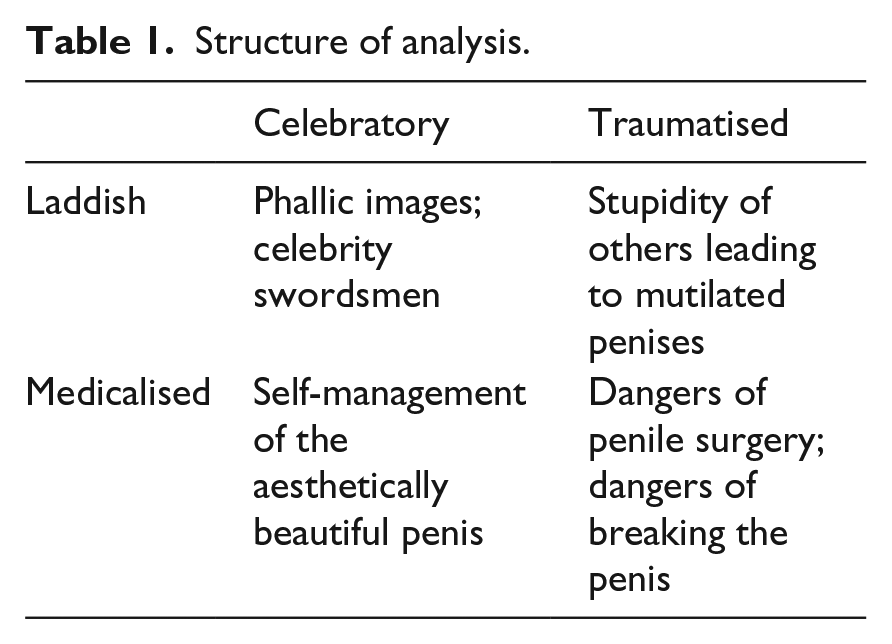
Laddish discourses build the penis up by celebrating and giggling at large and detailed phallic images and worshiping at the altar of well-endowed ‘celebrity swordsmen’. Medicalised discourses seem to offer a critique of laddish standards, promoting a more serious ‘scientific’ approach that challenges the ideal of a big penis. But this is not as radical as it first appears, and the aspirational goal of having a large penis is replaced by the ideal of a beautiful one. Both discourses indirectly increase fears by putting pressure on men to meet particular standards, and both discourses explicitly increase fears by highlighting extreme examples of traumatised, mutilated and non-functioning penises.
Celebratory discourses
To the well-endowed out there, congratulations. Elegantly applied, large penises are infinitely better than small. Extract 1: How to have sex with a bigger penis (GQ, June 2015).
Unsurprisingly, size was a focus for a large number of articles. Size was seen as the key to dominance, reinforcing traditional ideas of masculinity where the phallus demands respect and stands for generic male superiority (Bordo, 1999). In the quote below, talking about a piece of graffiti on the Tour de France, the penis is seen as something huge and in your face, something that cannot be avoided, that has to be looked at:
And not just any dick either: this dick was huge, so huge in fact that the cameras really couldn’t do anything to avoid it. Drawn onto the road using what looked like a white-spray paint, the offending member was also presented in marvellous detail. Penis head complete with life-like bell end? Check. Veiny, throbbing shaft? Of course. Hairy balls? You betcha. All in all, it was a superb effort and could even eclipse the achievements of the riders themselves, for sheer artistry and endeavour. Then again, maybe Loaded is getting carried away. It was just a dick drawing, after all. Extract 2: Did you spot the giant dick graffiti on the Tour de France? (Loaded, July 2016).
This graffiti is valorised to such an extent that the author of the piece thinks it could even ‘eclipse the achievements of the riders themselves’. Real-life large penises are celebrated too. In Loaded, Attitude and GQ, a number of articles focus on celebrities renowned for having a big penis:
Celebrities who apparently have major schlongs include David Beckham, whose wife Victoria publicly stated that his large organ ‘looks like a tractor exhaust pipe’. In the new book Bowie: The Biography, a female groupie who got a good look during a one-nighter in 1972 describes him as ‘massively endowed’. Michael Fassbender, Ralph Fiennes, Colin Farrell and Jon Hamm are all reported to be well-hung. And upon seeing Daniel Craig’s manhood while filming Skyfall, Dame Judi Dench said: ‘It’s an absolute monster’. Extract 3: Penis size doesn’t matter: Physical compatibility is more important (GQ, March 2015).
There is a certain cheekiness pervading these articles where the authors use humour to enable them to be childish. Walsh (2007) notes that the link between laddism and male infantilisation ‘functions as a stratagem that licences a range of anti-social behaviours, extending the boundaries of acceptable behaviour’ (p. 22). This juvenility is also demonstrated by the use of metaphors (such as ‘monster’ and ‘tractor exhaust pipe’ as in the quote above). Bordo (1999) notes that euphemisms for the penis are often tools, dangerous weaponry, mythical creatures or employ mechanical metaphors. This turns the flesh and blood human organ into something that is strong and would never let one down. Of course, this sets men up for failure because the penis is not a resilient piece of mechanical equipment, but a tender body part.
It was particularly common to see discussion of celebrity penises in Attitude magazine. As a magazine targeted at gay men, issues of homophobia and masculinity are decoupled and it is possible to talk about other men’s penises without threat to masculinity (Kimmel, 1997). In the following extract, a celebrity lauds another celebrity’s penis:
‘I don’t think Ewan is as proud of his penis as most men who are as well hung would or should or could be’, said Farrell. ‘I think that’s the greatest demonstration of his innate humility, that he doesn’t wear it like a badge of honour’. Extract 4: Colin Farrell says Ewan McGregor is well hung (Attitude, January 2015).
Here, the big penis is a form of masculine capital (De Visser and McDonnell, 2013) that Ewan McGregor has in such abundance he does not need to spend, and can keep it in the bank.
We now turn to medicalised discourse which actively critiques this idealisation of big penises. In all the articles in Men’s Health, the function of the penis is constructed as primarily to please the female partner via penis in vagina hetero-sex. And thus, a powerful critique of the laddish focus on size was to present research that shows large penises are not, in fact, desired by women:
Only the first inch of a woman’s vagina has many nerve endings in it – most are housed in her vaginal lips and her clitoris. The further inside you go, the less localised sensation she has. ‘By focusing your efforts in the shallow part of her vaginal canal you’ll maximise stimulation to her nerve endings’, says Spurr. ‘This is the area that gives women most pleasure’. Extract 5: Get a Bigger Penis? (Men’s Health, October 2009).
If, in the face of this critique, an obsession with size remains, the reader is exhorted to make a more realistic appraisal of their anatomy. These medicalised discourses all address the reader as a concerned friend (Stibbe, 2004) with the ‘sexpert’ using statistics to tell them what they need to do in order to be better men (Attwood, 2009). For example,
… a pioneering study claims to have definitively established the average size, and it’s shorter that you thought. Titled ‘Am I Normal?’, the collaboration between King’s College London and the NHS collated the penis length and girth of 15,521 men in 20 worldwide projects where measurements were professionally made … 85% of women are happy with their partner’s penis size. Extract 6: Some interesting facts about the average penis size (GQ, July 2016).
Crawshaw (2007) says that Men’s Health magazine epitomises neoliberal discourses of healthcare where the individual is positioned as responsible for their well-being. Having informed men that women have no desire for large penises, and statistics show theirs is probably ‘normal’ anyway, any remaining penis concerns that men have is thus their own individualised problem. Having dismissed size as a legitimate focus of concern, medicalised discourse instead offers alternative requirements for men to follow which are centred on valuing beautiful penises:
Scientists asked female participants to rank which factors they considered most important in an attractive penis … Turns out women don’t love any particular penis trait. They rated overall genital appearance as the most important factor, followed by pubic hair. Researchers from Indiana University found that 75 percent of women say they would like their guy to trim down below. Sprucing up your schlong can also make you feel more attractive, boosting your confidence both in and out of the sack, the study says. Extract 7: Is your penis good looking? (Men’s Health, August 2015).
This example is an illustration of healthism and neoliberalism at work, where any problems are constructed in an individualised, psychological manner and where individual men’s lack of confidence is to blame (Dworkin and Wachs, 2009). Failures of the body are positioned as individualised failures that require continual bodily self-surveillance. One possible medical intervention in response to this is ‘obviously’ penis surgery:
A big cock has become a desirable commodity, and at £6,000 is on a par with an expensive watch or a cheap car. We buy hair clay for the perfect coif; moisturiser for silky smooth skin; fragrances, clothes, accessories, all to look good and feel great. So why not make alterations to the very essence of your manhood? If £6,000 is all that stands between you and a lifetime of self-confidence, who can argue against it? Extract 8: Is penis surgery worth it? (Men’s Health, December 2016).
The reader is now positioned as having more neoliberal choice to construct the penis through consumptive practices. Penis reconstruction is presented as merely an accessible and logical commodity option, no different from other aesthetic products and practices the postmodern man can now engage with. With the penis constructed as the centrepiece of men’s masculinity, yet again, these calls to action come back to individual men increasing self-confidence in their penis.
Traumatic discourse
Discussion of penis augmentation surgery was not usually so breezy, however. The vast majority of articles that addressed the topic were full of graphic details of violated, mutilated penises:
The augmentation process can be ineffective, however, so the newly injected fat must be massaged around the penis for up to 12 weeks following surgery. Disdain this part of the routine at your peril: without it you risk a misshapen, distorted or squat penis … Throw in regular penis stretches (by dint of a traction-operated penis extender) that your doctor will prescribe post-surgery, plus the inevitability of wounds reopening due to involuntary erections, and it suddenly feels like a very big deal indeed. Extract 9: Is penis surgery worth it? (Men’s Health, December 2016).
Most articles in Men’s Health magazine dealt with a potential affliction of the penis and followed a medicalised sequence of symptom, diagnosis, cause and finally cure. This creates a certain distance from the body, it becomes a sexual machine which must be updated and serviced (Boni, 2002). It also adds to the neoliberal approach to health by generating insecurity and then providing an individualised product or answer (Alexander, 2003).
There was a pervading fear of damage to the penis, specifically as a result of blunt trauma. The most common potential ailment discussed was ‘breaking’ the penis during penetrative sex (always) with a woman:
Stop ramming your penis into hard objects. And that includes her pelvic bone. Just one vigorously misplaced thrust is all it takes to rupture the corposa cavernosa, the elongated ‘erectile chambers’ that run the length of your penis. A complete rupture will require surgery within 24 hours to stanch internal bleeding and reduce the risk of permanent damage. A partial tear isn’t as serious, but it may cause problems later on. As the linings of the corposa heal over with scar tissue, they lose their elasticity – leading to curvature, pain, and eventually impotence. Extract 10: Get a healthy penis (Men’s Health, August 2014).
By providing the reader with explicit scientific descriptions of how the damage could occur, how to avoid it and what dire consequences would ensue if it was not avoided, the onus is laid at the feet of the reader to regulate their sexual behaviour. The responsibility for management of well-being is once again delegated to the individual (Crawshaw, 2007).
The distressing descriptions of damage that could occur to penises were replicated in Laddish modes of discourse. Laddish discourses were full of talk about ‘others’ (often foreign others) who had experienced penis pain or mutilation as a consequence of stupidity. For example, ‘Famous footballer scalds the penis of team-mate with hot spoon in childish prank’ and ‘American rapper cut off his penis while trying to perform a self-vasectomy on cocktail of crystal meth, PCP and MDMA’:
A man from Honduras has had to have his penis amputated after getting it stuck in a plastic bottle for an astonishing FOUR days … By then, it was too late, as eventually the ‘strangulation’ created by the bottle caused his penis to turn black and start to decay. Extract 11: Doctors forced to amputate a man’s penis after he got it stuck in a bottle (Loaded, October 2016).
Again, humour and banter are heavily utilised and here they function to displace the fears of penis pain onto stupid others whom the reader and writer can laugh at together.
What does the traumatic discourse say about masculinity? On the one hand, Jordan and Fleming (2008) regard these types of stories as tests of masculinity, in that they challenge the reader to be man enough to read them. Walsh (2007) also says that playing with the threat of castration in this way is a mark of masculine prowess, but being confronted by it could evoke the spectre of vulnerability in the mind of the reader. Both readings challenge the reader to manage these different imagined threats.
Discussion
This research responds to the call to provide critical insight into the recent explosion of media representations of penises and the attendant implications for health (Flowers et al., 2013). Our analysis highlights two prominent discourses about penises which we call laddish and medicalised and, within each, celebratory and traumatising talk.
When Loaded was launched in the early 1990s, laddism was in the ascendant. Since then, there has been public and academic critique of laddism (García-Favaro and Gill, 2016; Lewis et al., 2016) and sales of Loaded and other ‘Lad’s Mags’ have declined. However, our findings suggest that laddish discourse has not only persisted but diversified. Instead of being confined to the pages of lad’s mags, it is found in the relatively high-quality publication GQ and, having shed its homophobic trappings, can even penetrate the pages of Attitude. An old-school, working class, heterosexual male discourse, which celebrates traditional ideas of orthodox masculinity appears, repackaged, in 21st century media forms. Alongside these well-worn ideas of masculinity, we found medicalised discourses. There is no relief for men here, however. The pendulous weight of orthodox masculinity (Anderson, 2009) is replaced with vulnerable and pervasive individualism (Gill et al., 2005; Stibbe, 2004). The medicalised discourse is a perfect illustration of healthism and neoliberalism at work on the body, which positions the penis as a site men are required to self-surveil.
Although ostensibly different, both discourses present aspirational goals for men, whether it is having a large penis or a beautiful penis (laddish and medicalised discourses, respectively), and both also exposed men to traumatising imaginings of what could go wrong. Ultimately, this leaves male readers wrestling with physical and psychological vulnerabilities and having to turn to the articles for the recuperation and protection of their literally fragile manhoods. Consequently, the theme that ran through all the articles, be they medicalised or laddish, celebratory or traumatic, was fear, a fear of not being ‘man enough’ (Seidler, 1997). Prioritising the spectacularized representations of huge, beautiful, diseased or mutilated penises, the magazines offer narrow accounts of masculinity (Mooney-Somers and Ussher, 2010) and leave little space for men to cultivate more relaxed, every day and fun relationships with their penises. This is consistent with the literature on masculinity and male bodies (Cook, 2005; Hall, 2015). It also has direct implications for health outcomes, wherein Yousaf et al. (2015) and Kalmuss and Austrian (2010) note that one of the biggest barriers to men’s healthcare help-seeking is anxiety and fear. Thus, it is important to challenge any representations which might have a harmful effect on sexual self-esteem or sexual well-being.
There was one potentially uplifting finding, namely, that the assumption that a fear of homosexuality is central to the construction and performance of heterosexual masculinities (Kimmel, 1997) was not borne out: there was not a whiff of homophobia. However, although there was no overt homophobia, as noted in previous analyses of men’s magazines (Boni, 2002; Stibbe, 2004; Tyler, 2004), with the exception of Attitude, the content and context in which penises were discussed remained resolutely heterosexual.
It is important to note that these findings are only representative of a specific UK-based media format, and wider sample of media sources, such as online men’s health discussion forums and formal media provided by health services, may offer alternative discourses and representations of the penis. In order to build on this research, further audience reception studies, such as focus groups with readers or the analysis of men’s discussions in online forums, are needed to explore how these discourses are negotiated and resisted through everyday practice.
Advice for health practitioners
For sexual health practitioners and health psychologists working closely with boys and men, an understanding of the dominant media representations that males are exposed to in mainstream media publications will be valuable when structuring interventions, therapies and sex-education classes.
This study highlights the over-arching need to focus on critical health literacy. Chinn (2011) says that we need to get men to the point where they are ready to critique information, particularly by understanding the context in which it is presented. Higgins and Begoray (2012) state that men need a high skill set to be able to negotiate media and deconstruct messages, that they almost need media ‘survival skills’. Men reading the magazines we analysed here are likely passively absorbing the celebratory and traumatising discourses. Targeting efforts on improving men’s critical health literacy skills would not alter the messages being distributed, but would alter the way in which those messages are received. Begoray et al. (2010, cited in Higgins and Begoray, 2012) suggest that targeting this work at adolescents is likely to be most fruitful, while at the same time acknowledging that it is a long-term aim.
Our paper is of direct use to health psychologists, teachers, sex educators and others involved in client work with men around their penis-related issues. In order to communicate with clients effectively, it is necessary to be aware of the socio-cultural context in which those clients are immersed. Men’s magazines are a primary resource for men seeking information about their penises and thus form part of the soup in which they swim. Practitioners must be aware of these potentially harmful discourses in order to counteract them. It would be ideal to have these findings condensed into a user-friendly, myth-busting resource for practitioners to use as a prop to open up difficult conversations with clients, and it is our intention to take our work forward in this direction. We also suggest that being aware of the main discourses presented in men’s magazines highlights the opportunities for resisting and countering those discourses with direct action – by writing articles for those magazines. There are subtle considerations to be weighed when embarking on this sort of media engagement, however. Peerson and Saunders (2009) noted that Men’s Health magazine delivers health information in a stereotypically ‘male’ context which reinforces ideas of hegemonic masculinity. This observation is also true of Loaded, GQ and Attitude; they all tap into stereotypical ideas of masculinity to talk to men about penises, and rarely venture beyond the discourses we identified. The question for health psychologists, who might be thinking of exploiting men’s magazines as a channel of communication, is to what extent they are willing to capitulate to the existing discursive templates and how much they feel they will be able to resist them. Men who are reading these magazines are learning to be afraid, and there is an obvious need for alternative discourses, but their total absence suggests that it will take considerable ‘push’ to bring those into the discussion.
It may be that health psychologists writing for these magazines will need to engage, at least superficially, with the existing house ‘styles’. One potential way of using the format to disrupt the dominant discourses is to piggy-back on the use of humour and banter. It is used to great extent in Loaded and Attitude and in a more tongue-in-cheek way in GQ and Men’s Health. But care needs to be taken that this does not result in reaffirmation of restrictive hegemonic masculinity (Kehily and Nayak, 1997).
In summary, if, having read this article and observed the dominant discourses presented in men’s magazines, health psychologists are considering using them as a formal channel of communication, with an aim of resisting or presenting alternatives to those discourses of fear, it should be with their eyes open. Writing for Men’s Health will almost certainly mean fitting within their neoliberal agenda, and writing for Loaded will mean collusion with a culture of heteronormativity. Nevertheless, young men using these magazines as guides to masculinity and sexual health are learning to be afraid. The body as a source of pleasure, non-heteronormativity and everyday matter-of-factness, these are all discourses which are absent from articles about men’s sexual bodies, and health psychology as a discipline has a responsibility to expose men to these ideas.
Conclusion
Our analysis provides insight into the contemporary cultural messages surrounding the penis and masculinity in the United Kingdom. The message from the magazines is that penises are important, that they have to meet certain standards, and that men should be constantly vigilant and fearful of what might befall their penises. In short, the magazines reproduce the age-old fears that men’s masculinities are bound up with the achievements and failures of their penises, but presented these fears in new, repackaged ways. The range of things to be afraid of is expanded as a result of the medicalised discourse. Health psychologists are urged to use this knowledge to focus their resistance to these messages and instead promote critical health literacy and a discourse of everyday matter-of-factness about the penis.
Footnotes
Acknowledgements
The authors confirm that they have agreed to the submission and that the article is not currently being considered for publication by any other journal. The authors would also like to thank the three anonymous reviewers in addition to Karen Rodham for their insightful and helpful comments on an earlier version of this article.
Declaration of Conflicting Interests
The author(s) declared no potential conflicts of interest with respect to the research, authorship and/or publication of this article.
Funding
The author(s) received no financial support for the research, authorship and/or publication of this article.
