




Abstract
Based on the Chinese General Social Survey of 2005–2013, with a sample of 41,242 people, this study carried out a hierarchical age–period–cohort cross-classified random-effects model on anxiety scores. The results indicated a U-shaped relationship between age and anxiety with increased anxiety from young to the middle age and a decline in the old. Population disparities showed cumulative advantage/disadvantage and age-as-leveler effects in different groups. Anxiety declined in earlier cohorts but emerged as a rising trend in more recent cohorts born in peaceful social contexts. Anxiety resulting from modernity is distinct in different social and historical environments.
Introduction
Most countries are experiencing a form of modernization that is historically and globally unique. For China, the First Opium War was the beginning of modernization (Zhou, 2014). The peaceful and autocephalous contexts in China after 1949 contributed to modernization, and the Chinese economic reform after 1978 further accelerated the process. The instability of the value system in China results substantially from the structural development of modernization in various social areas. Modernity is an inevitable by-product of modernization, and with the development of modernization and modernity, the fixed or solidified system of beliefs and values has collapsed in the secular world. Modernity not only causes a positive mentality but further contributes to individual anxiety and fickleness (Zhou, 2017), which leads to a mental crisis in our daily life (Zhang, 2012). Unlike psychological anxiety, anxiety caused mainly by modernity is a type of structural anxiety that is attributable to social factors at the macro level. For example, housing prices in China have been rising rapidly, and this has led to the prevalence of anxiety across China; also, China’s unreasonable talent evaluation system has resulted in a fickle atmosphere filled with anxiety.
Modernization can naturally cause feelings associated with modernity: a kind of mental crisis, in Bell’s opinion (Zhang, 2012), and a disordered state of mind with vagrancy (Liu, 1998). Since the 19th century, modernization and modernity have been discussed widely. Examples include Bauman’s (2001) study on modernity and massacre and Giddens’ view on the reflexivity of modernity. In Simmel’s opinion, individualization, liberalization, decentralization, and marginalization are all consequences of modernity. As modernity is the result of modernization, with the rapid development of society, residents’ daily life is glutted with modernity, thereby leading to a mental crisis in China (Zhang, 2012). In modern China, profound social transition and socialized mass production have caused social disorders, which lead to the loss of core culture and values; a major crisis is also imminent (Zhou, 2005). The market economy and increased social risk after the reform in 1978 resulted in the lack of a sense of meaning or value, thus bringing about a type of anxiety unique to Chinese contexts. However, the concept and essence of modernization and modernity come from developed countries, and the applicability of modernization and modernity to unique Chinese contexts still needs to be further discussed (Said, 1995).
Anxiety as a feeling of modernity: theoretical basis
Anxiety as a feeling of modernity 1 is closely related to macro factors, so analysis at the group level and focus on the interaction effects between the micro- and macro levels are necessary. Sociologists were the first to treat anxiety as a feeling of modernity, and Simmel and Giddens are two outstanding representatives.
Simmel 2 thought that anxiety, in its nature, was a feeling of modernity, and he paid close attention to the experiences or feelings of individuals in the midst of social development and the disruption of tradition at the micro level (Wang, 2003; Zhou, 2013). He treated modernity as a concept of psychologism, that is, he treated modernity as a concept characterized by fragmentation, occasionality, fluidity, and incoherence (Zhao, 2009; Zhou, 2013). Modernity is a type of cultural tragedy that results from social differentiation and a monetary economy, and the latter is the social root of modernity (Frisby, 1988), leading to the loss of life values (Simmel, 2001, 2010), the loss of core culture, the imbalance or fracture between objective and subjective cultures, a crazy or indifferent atmosphere of social development, and thus depression (Zhao, 2009; Zhou, 2013). Rationalization and liberalization result in a psychological feeling of boredom and emptiness, and the loss of life values and powerlessness in a fast-paced society finally lead to anxiety. Similar to Simmel’s view, the pessimistic view of Weber that modernity and rationalization bring about powerlessness (Wang, 2004) is similar to the opinion that modernity leads to anxiety and other negative emotions.
Giddens (1984) thought that contemporary society was full of crises that people could not avoid and that these crises were mainly caused by modernity, which is characterized by reflexivity, disembedding, discontinuity, and liberty. A combination of fracture and continuity embedded deeply in one’s identity and experience leads to the meaninglessness of one’s life. This can be treated as a kind of psychological problem (Zhang, 2012) that produces anxiety (Fromm, 1990; Giddens, 1984). Thus, Giddens treated anxiety as a type of existential anxiety and argued that the tendency of individualization in modern society would bring ontological security and self-identity crises, thus leading to anxiety (Giddens, 1984).
Trust is a key inhibitor and the antithesis of existential anxiety (Giddens, 1984, 1991b). The protectiveness of trust derives from reliable information acquisition, but this protectiveness system is fading away in contemporary society, as one cannot obtain all-sided information (Mol and Spaargaren, 1993). Giddens considered babyhood as the genesis of anxiety, according to Erikson’s theory (Erikson, 1963; Giddens, 1984, 1991a, 1991b). Lacking the sense of trust and security caused by experiences in childhood will become the hidden danger of anxiety in one’s adulthood (Giddens, 1991b). If the customary trust abnormally disappears, anxiety will emerge (Giddens, 1979). Therefore, it is necessary to examine the cohort effects or the growth environment from the perspective of life course. However, Giddens (1984) also proposed that the life circle is a trajectory that one’s self-identity exposes to modernity; this reveals the impact of the life circle on anxiety from an age perspective. That is to say, anxiety that results from modernity can not only be presented in the social development in one’s life course, but can also be observed in the socialization in one’s life circle. With the accumulation and spread of modernity, the meaning and values of life fade away (Fromm, 1990), and the sense of puzzlement, nihility, and wandering appear, thus producing anxiety as a feeling of modernity naturally.
Anxiety as a feeling of modernity in China
A risk society is approaching and extending around the world under the background of globalization (Beck, 1986; Hier, 2003), and China is also influenced by it. China has successively experienced the war era (before 1949), the planned economy era (1950–1977), and the early reform and opening-up era (after 1978) in the 20th century, and each era had distinct development characteristics. Before the establishment of new China in 1949, China experienced an unstable social context, witnessing several wars such as the Northern Expedition (1926–1927) and the Anti-Japanese War (1931–1945), so modernization developed slowly during this period. After 1949, China began to conduct a planned economy system. Although the social economy developed a lot during this period, such as the remarkable development of heavy industry during 1953–1957, some faulty aspects of social development also existed, such as the Great Cultural Revolution during 1967–1977, which greatly destroyed social economic development. As the planned economic system was proven to be a failure, a market economy was introduced into China after the reform and opening up in 1978. The labor force was liberated greatly, and the social economy and modernization developed rapidly during this era.
Zhou (2014) proposed that the psychological anxiety of Chinese residents is one of the social psychological characteristics or mental experiences accompanying rapid social change. This unique Chinese feeling is a combination of historicity and reality that can be traced back to the middle 19th century (Zhou, 2012). Before the establishment of new China in 1949, invasions from other countries caused deep anxiety among the Chinese people, including displeasure about the foreigner’s superiority (Xie, 2008) and anxiety about the undeveloped state of themselves (Zhou, 2012, 2014). During the peaceful era after 1949, the fracture of tradition and the rapid development of modern society resulted in an identity crisis and anxiety among Chinese residents (Zhou, 2012, 2014). Specifically, the former is a kind of survival anxiety, while the latter is a kind of existential anxiety.
Unlike endogenous modernization in certain developed countries, modernization in China is exogenous and acquired (Yang, 1998). Because of experiences in the first half of the 20th century, China treats industrialized countries as the role model for development. Due to the existence of these countries, Chinese society is filled with fears of marginalization and longing for modernization and modernity. Many Chinese think that the achievement of modernization or modernity is to be the same as these developed countries in various social development fields (Xie, 2008). Thus, modernity in China may be a little different, and anxiety as a feeling of modernity is also distinct in its preference and source in China (Zhou, 2014). With the impact of both capitalism and socialism, modernity in China is fractured. The order dilemma and the loss of accompanying beliefs make most Chinese people anxious (Liu, 1998).
The anxiety of Chinese residents is not only similar to the anxiety produced by modernity but also has its unique characteristics and elements. Modern life is usually full of elements of modernity, such as fast-food culture symbols (Ritzer, 2000), uniform building styles, and formalized behaviors (Xie, 2008). The elements of modernity all have unique modern features, such as efficiency, computability, predictability, and monotonicity. The large-scale internal migrants and certain social catchwords are unique elements of modernity in China. An unprecedented scale of internal migrants accompanied the development of the social economy. For those migrants, the relocation of self-identity is necessary for them to blend in where they move, but disparities in income, education, and values between migrants and the locals are major challenges. So the anxiety that results from possible failures in the relocation of self-identity spread among this unique group (Zhang and Tong, 2006). However, unique social catchwords are reflections of social mentality; words such as silver-spoon kids are not only the linguistic expression of social inequality but also the reflection of social mentality, especially anxiety and dissatisfaction (Wang et al., 2014). Social inequality intrinsically leads to anxiety (Hua and Weng, 2013; Xia, 2009), and individuals with certain disadvantages, such as poverty, little education, or unemployment, tend to experience more of the dark side of modernization (Yang, 1998).
Although many studies have discussed the anxiety caused by modernity, they are all qualitative studies rather than quantitative studies based on Simmel’s or Giddens’ theory. However, limited to data and methods, Chinese anxiety before China’s reform and opening up have not been comprehensively discussed in quantitative studies yet. Therefore, based on a repeated cross-sectional survey during 2005–2013, this study used a hierarchical age–period–cohort cross-classified random-effects model (HAPC-CCREM) to quantitatively analyze the change trend of anxiety from age and cohort perspectives in China. This study is also a re-examination of previous qualitative research on this topic and an examination of the applicability of modernity theory, which comes from developed countries, to unique Chinese contexts.
Data and methods
Data source
The data used in this study came from the Chinese General Social Survey (CGSS) from 2005 to 2013, containing four surveys conducted in 2005, 2010, 2012, and 2013. Launched in 2003, the CGSS is the first comprehensive, continuous, large-scale investigation project, which was organized by the National Survey Research Center (NSRC) in Renmin University of China. Based on the probability-proportional-to-size sampling method, more than 10,000 households or individuals in 400–500 villages or urban neighborhoods from 100–125 countries/districts are sampled in each survey (e.g. in CGSS 2013, 100 counties/districts and 5 big cities were the primary sampling units; each county/district included 4 villages/communities, each big city included 16 communities, and each village/community contained 25 households. One randomly selected respondent in each household completed the survey.) The history of the CGSS reflects the radical transition of Chinese society and change in Chinese behaviors and attitudes (Official website of the CGSS, 2017), as it contains family information, work and income, lifestyles, social networks, political participations, social cognitions and attitudes, as well as some demographic variables. In this study, after missing data handling with a list-wise deletion method, the valid sample size was 41,242.
Samples and coding
This study selected gender, age, age2, hukou, political status, marital status, education, and work status as independent variables at the individual level; period, birth cohort, and peace maintaining were treated as independent variables at the contextual level; and anxiety was selected as a dependent variable. In the questionnaire, anxiety was referred to by one single question: “in the last 4 weeks, to what degree have you felt anxious?” Some more details can be seen in Table 1.
Encodings, means, and notes of variables.
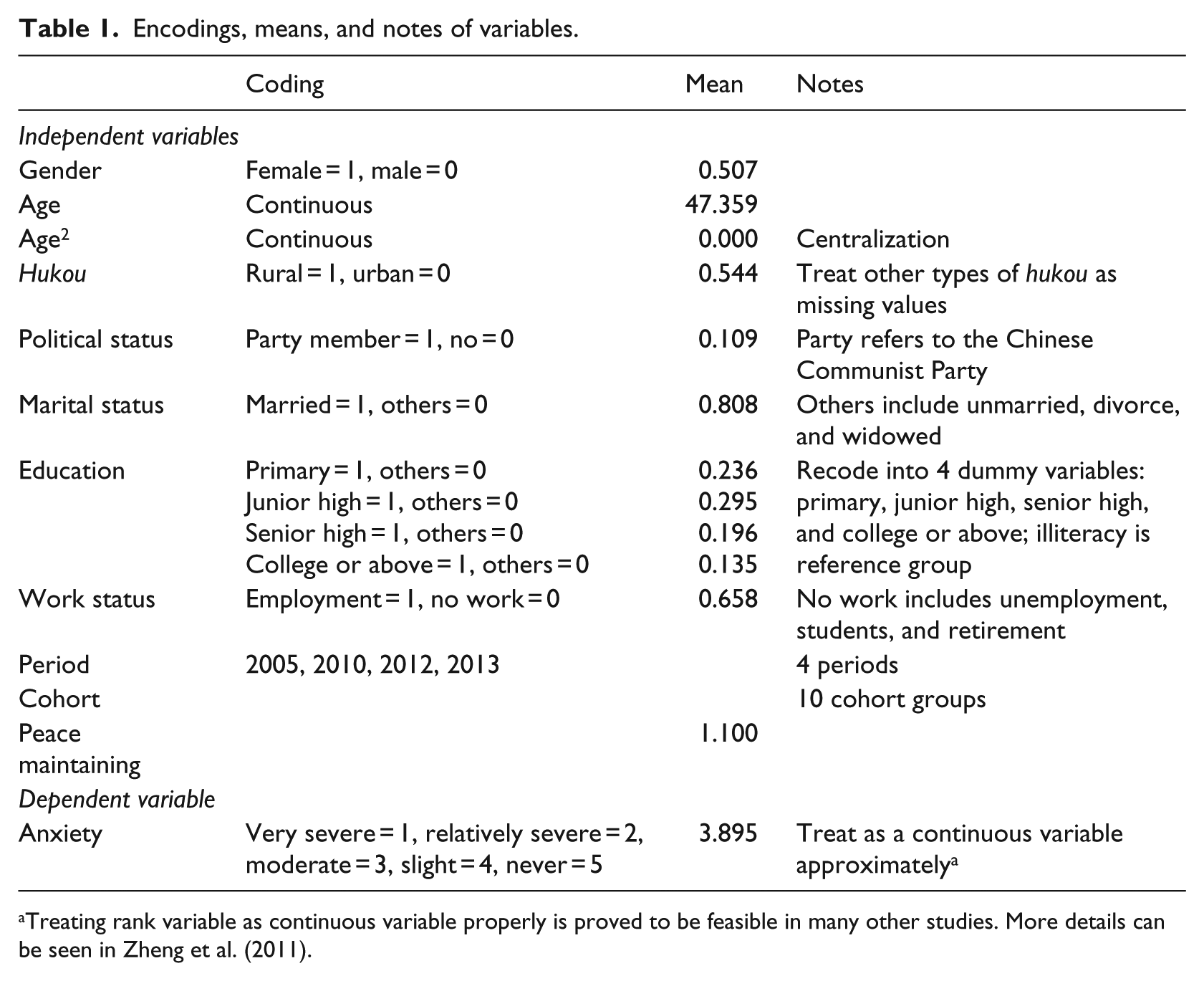
Treating rank variable as continuous variable properly is proved to be feasible in many other studies. More details can be seen in Zheng et al. (2011).
Birth cohort was the time when individuals were born. In this study, the birth cohort was divided into 10 groups according to unique periods in Chinese history in the 20th century: Warlord dogfight cohort (1915–1926), Country struggles cohort (1927–1936), Anti-Japanese War and Liberation War cohort (1937–1949), Power consolidation cohort (1950–1957), the Great Famine cohort (1958–1961), Policy adjustment cohort (1962–1966), the Cultural Revolution cohort (1967–1977), Early reform cohort (1978–1984), City reform cohort (1985–1991), and Market reform cohort (1992–1999). This category method may make it easier to understand the impact of social development on anxiety in China, as well as provide a better understanding of how anxiety can be treated as a feeling of modernity.
In addition, it should be noted that two variables could not be measured directly and accurately: modernity and peace maintaining at the cohort level. Based on the continuity of transition and the history of China in the 20th century, this study assumed that later cohorts experienced higher modernization and deeper modernity (the linear development hypothesis) and that each transition played the role of catalyst (the transition boost hypothesis). Thus, the level of modernization and modernity improved with cohort globally, and social transition was a direct reflection of modernization. Peace maintaining denoted the degree that a peaceful environment was sustained at the cohort level, and this study assumed that it had the feature of linear accumulation. Treating the earliest cohort as the reference with a value of zero, this study added or subtracted one unit in the next cohort according to what kind of social environment or stage it represented. As a result, estimates of this variable were obtained as 0, −1, −2, −1, 0, 1, 2, 3, 4, and 5 in turn in each cohort group.
Methods
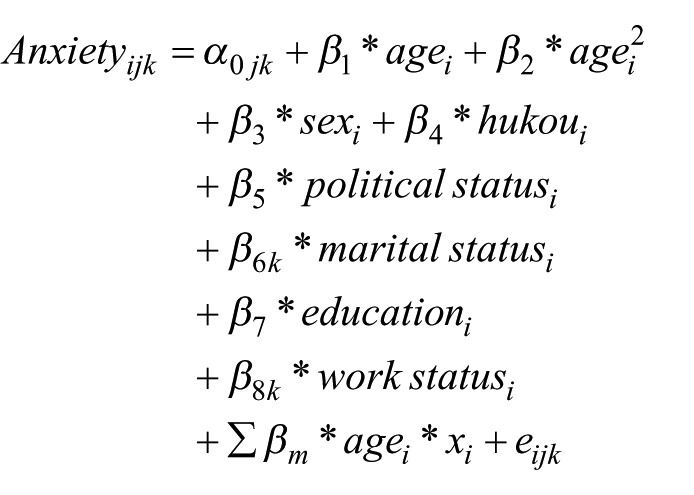
When the age–period–cohort model was first introduced in 1973 (Mason et al., 1973), there was an exact linear dependency: period = age + cohort, and this dependency was called the APC problem and was hard to address. Based on many previous APC methods, Yang and Land (2006) developed the HAPC-CCREM, which could well solve the identification conundrum. The HAPC-CCREM can be applied when the data come from repeated cross-sectional surveys; the model treats both period and cohort as contextual level variables, and they cover all samples as cross-overs. In addition, Giddens’ statements on the impact of childhood experience, life course, and life circle on anxiety (Giddens, 1984, 1991b) provide for us a good theoretical basis. Therefore, this study used HAPC-CCREM to discuss how social change was reflected in one’s life course and life circle, as well as under what circumstances modernity could produce anxiety. In this study, age and other demographic variables were added to a fixed-effects model, and period and cohort were treated as random-effects variables. Model specifications are as follows:
Level-1 model
Level-2 models
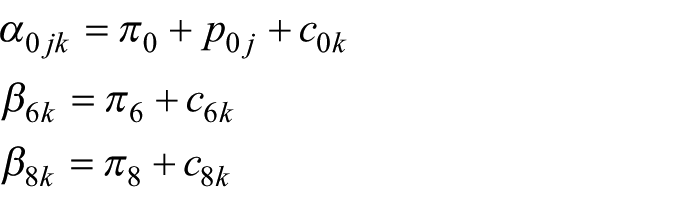
where
Results
Table 2 shows that the intraclass correlation coefficient (ICC) was 4.9 percent in the empty model (model 1), suggesting that the cohort could explain 4.9 percent of the variation of anxiety. Cohort effects were significant in most models, indicating the necessity of using HAPC-CCREM. The results showed that gender, age, hukou, political status, marital status, education, and work status significantly influenced an individual’s anxiety: being male, an urban resident, a party member, being married, having more education, and being at work were associated with less anxiety. There was a nonlinear association between age and anxiety, and middle-aged individuals experienced more anxiety. 3 The peace maintaining was a cohort-level contextual variable, and the results showed that anxiety became stronger when peace was maintained for a longer time.
HAPC-CCREM results of the anxiety among Chinese residents: CGSS 2005–2013.

HAPC-CCREM: hierarchical age–period–cohort cross-classified random-effects model; CGSS: Chinese General Social Survey; ICC: intraclass correlation coefficient; BIC: Bayesian information criterion.
p < 0.05; **p < 0.01; ***p < 0.001; +p < 0.1.
Age effects
Figure 1 displays the results of model 2 and model 5 in Table 2. Model 2 was the basic APC model, while model 5 contained some demographic variables (including age, age2, sex, hukou, political status, marital status, education, and work status) and some of their interactions with age. Figure 1 shows that population characteristics moderated anxiety: without other covariates being controlled, people had the highest level of anxiety at the age of 67 years; with other covariates being controlled, people experienced the highest level of anxiety at the age of 57 years. Anxiety as a feeling of modernity should accumulate with age according to Giddens’ view, but the results indicated that anxiety declined in the elderly, and when other covariates were controlled, this trend was more significant.
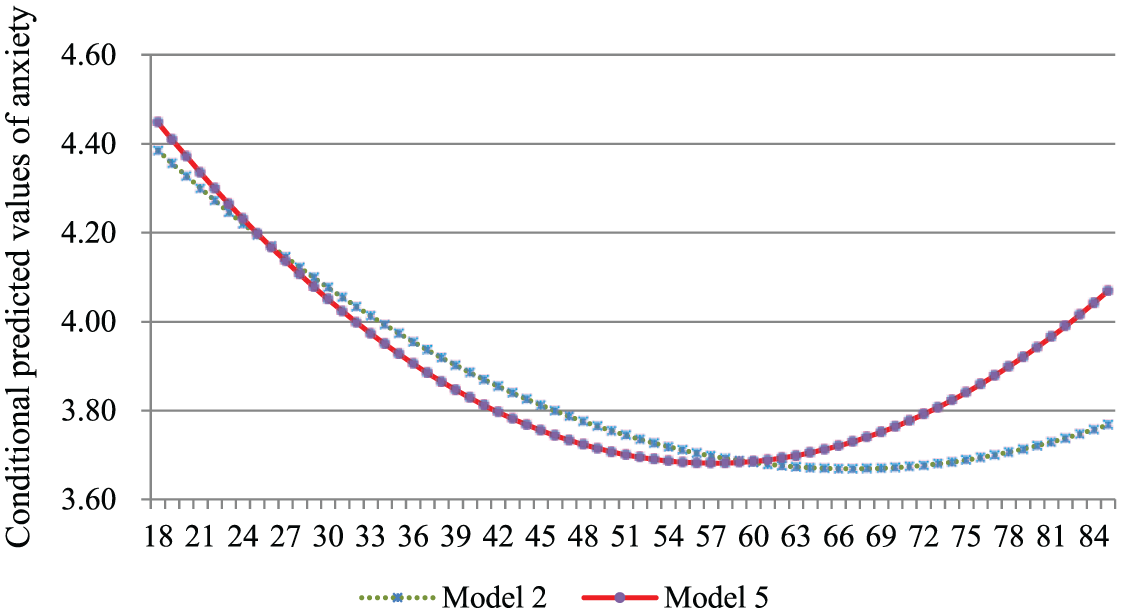
Age effects of anxiety.
In addition, this study also examined the age effects of anxiety in different groups. To interpret the results more conveniently, this study introduced two theories that were widely used in longitudinal studies on health or happiness: cumulative advantage/disadvantage effects theory and age-as-leveler effects theory (Chen et al., 2010; Yang and Lee, 2009; Zheng and Zeng, 2016). The cumulative advantage/disadvantage effects theory proposes that disparity increases with age, while the age-as-leveler effects theory proposes just the opposite. Based on Figure 2, the age-as-leveler effects theory was supported by gender and marital status disparities in anxiety, while the cumulative advantage/disadvantage effects theory was supported by hukou, political status, and education disparities in anxiety. These two effects had some substantial distinctions. Gender and marital status disparities in anxiety narrowed with age, as the maturity of psychological adaptation or affection with age eliminated the original disparities (Yang and Lee, 2009). Different genders have distinct social roles and social expectations. Females are usually treated as a disadvantaged group due to their lower income or other disadvantages, but psychological adaptation that grows with age often offsets this disadvantage gradually. However, hukou, political status, and education disparities in anxiety increased with age, as these resources (whether they were an advantage or disadvantage) accumulated gradually with age. Individuals with these resource advantages usually obtain a greater sense of security and have a stronger ability to prevent various risks, so they have less anxiety.

Population disparities with age in anxiety: (a) disparities of gender and hukou; (b) disparities of political status and marital status; and (c) education disparity.
Cohort effects
Based on model 5, the cohort effects of anxiety, including its change trends and population disparities, are displayed in Figure 3. Generally, the Power consolidation cohort (1950–1957) was the turning point: before the 1950 cohort, anxiety declined with each successive cohort, while after the 1950 cohort, anxiety increased with each successive cohort, with a slow-down trend after the 1980 cohort. Different cohorts with different marital and work statuses experienced distinct levels of anxiety. In the transition from earlier cohorts to more recent cohorts, the proportions of people in different marital statuses were different. Concretely speaking, cohorts before 1950 were in their old age during 2005–2013 in which being widowed, in the single/divorced/widowed group, occupied the major proportion. Cohorts who were born in the planned economy era were in their middle age in which divorce, in the single/divorced/widowed group, occupied the major proportion, while cohorts who were born in the market economy era were in their youthful days in which being single, in the single/divorced/widowed group, occupied the major proportion. Divorce, which has a unique social implication, is a valid indicator that well predicts the degree of stability of individuals’ daily life or even the whole society. Therefore, cohorts born in the planned economy era showed the largest marital status disparity in anxiety.

Cohort effects of change trends and population disparities on anxiety.
For work status, war cohorts (born before 1950) were mostly in retirement during 2005–2013. In other words, most of them were retired, not jobless, and those who still had jobs were mainly farmers or had other special careers, so the work status disparity of war cohorts in anxiety was relatively small. Planned economy cohorts (born during 1950–1977) were mainly in their work age during 2005–2013, and most of them had rich work experience and were the cores in their workplace. Those who had no work were indeed unemployed, but they were in their work age. Therefore, compared to those who had jobs, the unemployed had more anxiety on account of social comparison. Market economy cohorts (born after 1978) started to seek jobs in the early 21st century. Although their anxiety was influenced by their work status, many of these cohorts were students, and they were usually not negatively influenced by joblessness. Thus, the work status disparity of market economy cohorts in anxiety tended to be small.
Actually, population disparities in anxiety were also greatly impacted by social order. Social disorder happened not only in war contexts but also in the turning point of social transition in peaceful contexts. According to Giddens, if marital status or work status is treated as a criterion of social disparity, then social disorder can therefore narrow the disparity in trust or anxiety from the perspective of the cohort. Certainly, the cohort effects of anxiety should be examined from a dynamic perspective. That is to say, what one has experienced since his or her birthday should be examined; unique experiences and social events encountered by the same cohort in unique life stages indeed matter (Elder, 1975). For instance, when war cohorts encountered a peaceful period after 1949, they cherished social stability more, and they also shared reform achievements when they were in their old age. That is, they received better treatment and social insurance after they retired. Therefore, war cohorts experienced a decline in anxiety. However, most planned economy cohorts encountered the reform in the 1980s in their impressionable years (18–25 years of age). Due to the existence of impressionable year effects, their values and social cognitions were influenced mostly by external contexts (Chinese economic reform since 1978) in their impressionable years (Giuliano and Spilimbergo, 2014). The dark sides of social transition just reached their peaks in the 1980s, so this unique life experience brought the 1980 cohort more anxiety.
The macro state is usually a reflection of its micro state (Giddens, 1991b). At the turning point of social transition (the establishment of new China in 1949 and the beginning of reform and opening up in 1978), traditional values collapsed but the new values were not mature (Zhou, 2017), so the anxiety of Chinese residents was characterized by fracture, turning, and aggregation. Two general propositions could be summarized from the results: (1) Anxiety as a feeling of modernity had different forms and performances in different social development stages. In a war context, anxiety declined with each successive cohort, while in a peaceful context, it increased with each successive cohort (or with the development of modernity). (2) The degree of social stability had an impact on population disparities in anxiety: the disparity narrowed in a context of social disorder, while it widened in a context of social stability. Further discussion on these two propositions was presented thereinafter.
Effects of modernity on anxiety and the role of social order
According to the analysis above, social contexts, especially the degree of social stability, significantly influenced the change trend and population disparities in anxiety as a feeling of modernity. Accordingly, this study further examined whether and how peace maintaining at the cohort level influenced anxiety. In model 6, peace maintaining was added at the cohort level to estimate the effect of social stability on anxiety in unique Chinese settings.
The results indicated that modernization and the transition indeed had catalytic effects on anxiety, but modernity under different social environments had distinct impacts on anxiety. The increase in modernity did not evidently improve anxiety in war cohorts (born before 1949), while the peace cohorts (born after 1949) experienced increasing anxiety with increased modernity. Model 6 suggested that peace maintaining significantly improved the level of anxiety (β = −0.0517, p < 0.001). The component variance of random intercept at the cohort level became non-significant in model 6; this also proved to be the key role of peace maintaining. Since peace maintaining was a prerequisite for social development, the third general proposition could be summarized as thus: social development usually had a catalytic effect in a peaceful context. However, we should note that the measurement of peace maintaining was not accurate, so this result should be treated carefully.
Conclusion and discussion
According to Giddens, the lack of trust or security that mainly results from terrible experiences in childhood may lead to a feeling of anxiety in later life, and a high level of trust during childhood can prevent anxiety (Giddens, 1984, 1991a, 1991b). This provides for us a good theoretical basis for the cohort analysis regarding anxiety. Based on a HAPC-CCREM analysis that followed this theoretical framework, three main results were observed. First, anxiety as a feeling of modernity varied according to social context. In a context of war or disorder, modernity might not cause anxiety in those cohorts. In a peaceful context, however, anxiety that resulted from modernity increased with each successive cohort. Second, the degree of social stability had an impact on population disparities in anxiety: the disparity decreased in the context of social disorder, while it increased in the context of social stability. Third, social development had a catalytic effect in peaceful contexts, and the level of anxiety gradually improved with each successive cohort.
According to Giddens, modernity is the product of capitalism in developed countries (Giddens, 1991b). However, under globalization, modernity has gradually pervaded people’s daily life all over the world, and China is also profoundly influenced. Since the impact of modernity is based on modernization, industrialization or democratization can be used to estimate the level of modernization or even modernity from a narrow perspective. In this way, due to the social nature of a semicolonial and semifeudal society and a social economy that was damaged severely by wars before the establishment of new China in 1949, modernization in China has stayed at a relatively low level and has also developed slowly. Thus, the anxiety in war cohorts may not be caused by modernity. The mainstream form of anxiety is distinct in different societies and development stages: survival anxiety is more typical in a war context, and existential anxiety is more typical in a peaceful context. Therefore, survival anxiety in war cohorts in China may not be able to be interpreted in terms of modernity that developed deficiently, or at least modernity is not the main reason for anxiety in war cohorts. So why does anxiety decline in war cohorts? The following two interpretations may be plausible. First, based on social comparison theory, after experiencing social disorder or wars, members of war cohorts are more likely to cherish their peaceful life and tend to be more optimistic in comparison with their earlier life experiences (Yang and Lee, 2009). Second, according to Coser’s (1964) theory on social conflicts, war against aggression is a type of social conflict with some positive functions, so war against aggression brings a sense of identity and belonging to most Chinese citizens. This sense of identity is similar to the sense of acquiring social position and existence, which indeed reduces anxiety.
However, when considering modernization or modernity in the first half of the 20th century from the perspective of culture or ideology in China, things will be slightly different. Since the establishment of the Republic of China in 1912 and the May Fourth Movement in 1919, Chinese residents have become gradually civilized in the cultural and ideological spheres. According to Inkeles and Smith (1992), modernization mainly refers to a state of mind and ideological or cultural conception. At that time, the ideology of Chinese residents was liberated greatly, and social moves had also changed gradually. These can be treated as a transition of cultures or values, which can lead to effects similar to the effects of socio-economic transition. The overlap of modern and traditional cultures, as well as the mixture of cultures from China and other countries, led to the germination of the modern citizen’s consciousness, which became a common psychological feeling held by all Chinese citizens (Zhou, 2017). From this point of view, the modernity developed indeed during that period, which had a historical impact on the anxiety of Chinese citizens. Thus, propositions 1 and 3 have certain inspiring values.
The difference in the levels of anxiety among different groups is almost in line with Yang’s (1998) opinion that different response modes in different groups emerge when facing modernization. Individuals with certain advantages (such as being male, more educated, and employed) are less likely to be anxious, while disadvantaged groups tend to be more anxious. Comparatively speaking, this study focused on the temporal trend of these disparities in anxiety from the perspective of age and cohort. For proposition 2, some supporting evidence can also be found from previous studies. In social stages with good social orders, the cumulative advantage/disadvantage effects usually lead to an increase in population disparities in anxiety. However, social disorder breaks this solidified form of cumulative effects in resource distribution. Unlike in the United States, which is characterized by international migrant mobility, a small-scale peasant economy and nostalgic values are typical elements of traditional China (Fei, 2006). These traditional values have great impact on people’s daily life in China. In a relatively solidified social framework, advantages and disadvantages tend to be accumulated, and the household registration system (hukou system) in China further limits citizens’ mobility in space or across vertical classes (Norstrand and Xu, 2012; Wu and Treiman, 2004). Thus, the cumulative advantage/disadvantage effects are more evident in a peaceful and stable era, and the population disparities in anxiety are hard to narrow, while in an era of social disorder, such as war periods or transition points, vertical mobility across vertical classes is more likely to happen, so population disparities in anxiety tend to decline during periods of disorder. Similarly, the decline in anxiety seems to slow down and population disparities in anxiety are smaller in reform cohorts (born after 1978); this can be treated as a consequence of increasing horizontal and vertical mobility after the reform and opening up. Socialization is indispensable for everyone, and individuals usually internalize social norms constantly in their daily life, so modernity is accumulated with age or in one’s life circle. However, modernity is essentially a macro social attribute that accompanies modernization, and the process of its generation and accumulation is underlying and slow, so the cumulative effects are not so obvious in one’s life circle, from the young to the old. That is, the role of modernity may not be dominant and direct in the age effects of anxiety. Factors related to individual age, such as one’s specific social positions and social roles during one’s unique life stages, are more important. Although a stronger sense of social position usually leads to a stronger sense of social presence in the middle-aged generation, the accompanying stress often results in more anxiety. From another perspective, modernity tends to produce anxiety at a macro level, and individual advantages usually alleviate this anxiety at the individual level horizontally.
In summary, the form of modernization and modernity that originates from developed countries has profoundly influenced the world in the context of globalization, and China has not escaped from this influence. The budding and development of modernization and modernity contribute greatly to China’s social development, but some adverse effects of modernity also emerged in China. Compared to developed countries, China has its unique social contexts, so the theory that anxiety is a feeling of modernity that originates from developed countries should be examined carefully and properly. For example, the overlap of colonial history, wars, and the low level of development before 1949 are unique contextual factors that are vital to understanding anxiety in China. The double effects of social transition that China has experienced in the 20th century lead to the result that anxiety, a feeling of modernity, is moderated by specific social contexts. Therefore, modernity theories based on the experience of developed countries can only partly explain anxiety changes in unique Chinese settings; it is also necessary to remold these theories based on China’s conditions.
This is the first study to discuss anxiety as a feeling of modernity quantitatively, and there are still some limitations. It is necessary to further develop these sociological conceptions and statements as well as the analysis results. For example, the measurement of modernity, which is only a primary attempt, is based on cohort or social development and social transition. Limited to the complexity and disputation of modernity itself, modernity is estimated only through cohort development according to the linear development hypothesis and the transition boost hypothesis. Although the results are inspiring, there might inevitably be certain errors. Similarly, the measurement of peace maintaining is also attempted in this study, though the concept of peace maintaining is not as difficult to operationalize as modernity. Therefore, further research on the operationalization of modernity and related concepts is needed in the future. Finally, according to modernity theory, anxiety that results from modernity is more likely to be structurally underlying or at the collective level, so further discussion of whether the self-rated anxiety data collected by questionnaires can accurately reflect the concept of anxiety produced by modernity is still needed. However, we assert that further discussion on this topic is imperative.
Footnotes
Declaration of conflicting interests
The author(s) declared no potential conflicts of interest with respect to the research, authorship, and/or publication of this article.
Funding
The author(s) received no financial support for the research, authorship, and/or publication of this article.
