



Abstract
Self-regulation is widely considered as a relatively stable trait, and the extent to which it can be improved through training is unknown. This randomized controlled investigation found dramatic and enduring increases in self-regulation among college students, as measured by experience sampling, nightly journaling, and questionnaires. Participants encountered stable levels of temptations throughout the intervention but became better at resisting them over time. Increases in self-regulation were accompanied by improvements across a diversity of additional outcomes like mood, stress, focus, mindfulness, emotional regulation, and life satisfaction. Collectively, this points to higher levels of plasticity in self-regulation and wellbeing than is widely assumed.
Self-regulation is often described as the ability to direct your attention, thoughts, and behavior in line with your goals. Perhaps unsurprisingly then, self-regulation predicts a wide range of positive outcomes like health, wealth, and happiness (De Ridder et al., 2012; Tangney et al., 2004). Yet self-regulation is not a single skill. Effective self-regulation requires that we set goals, get motivated, stay focused, resist temptations, form good habits, and monitor progress (Carver and Scheier, 1982, 1998; Zimmerman, 2000). Like interconnected gears, these skills must work together for us to achieve our aspirations.
Despite general agreement that self-regulation is highly predictive of important outcomes, there is still no scientific consensus regarding how much self-regulation can improve or how exactly those improvements unfold (Friese et al., 2017). Research has begun to reveal effective methods for enhancing specific skills that contribute to self-regulation (Anguera et al., 2013; Berkman et al., 2014; Duckworth et al., 2018; Galla and Duckworth, 2015; Gallant, 2016; Gollwitzer, 1999; Latham and Locke, 1991; Milyavskaya et al., 2015; Mrazek et al., 2018). For example, individuals can proactively form healthy habits by deliberately specifying the cue, action, and reward that underlie habitual behavior (Wood and Neal, 2016). In addition, individuals can strengthen their goal pursuit by setting clearly defined directions for action, otherwise known as implementation intentions (Oettingen and Gollwitzer, 2018). Collectively, this research demonstrates the malleability of specific self-regulatory skills.
However, self-regulation—which depends on many intersecting skills—is still widely considered as a relatively stable dimension of an individual’s personality (Hampson et al., 2016). Arguably, current scientific understanding may significantly underestimate how much an individual’s overall self-regulation can improve. This misappraisal stems from the central logic of experimental design, which is to isolate the effect of a targeted manipulation through either control or randomization of all other factors. This approach has indisputable value in establishing casual relationships between individual variables, but it also neglects how multiple influences may combine to have greater effects than when they are studied in isolation (Mrazek et al., 2016). In the present investigation, we created a multifaceted 6-week intervention intended to enhance numerous skills relevant to self-regulation. By targeting the entire set of interconnected gears, we aimed to better characterize the extent to which self-regulation can improve.
Although critical at any age, self-regulation may be particularly important for young adults because this stage of life is often characterized by rapid change and increased independence. Considerable research indicates that self-regulatory skills, such as impulse control and emotion regulation, assist in navigating the challenges of young adulthood. For example, research has shown that college students with high levels of impulse control tend to struggle less with binge drinking and eating (Rush et al., 2009). In addition, studies show that young adults with greater emotional regulation tend to be less prone to test anxiety (Davis et al., 2008). Given the importance of promoting self-regulation among young adults, the present investigation assessed the impact of intensive training of self-regulatory skills among college students.
Self-regulation is associated with a tremendous variety of positive outcomes (Baumeister and Tierney, 2011), so training self-regulatory skills could be one of the most efficient ways to elicit a wide variety of other benefits. Accordingly, we also measured a variety of additional variables—ranging from conscientiousness to life satisfaction—to better understand the changes that could transpire as a consequence of an intervention targeting the development of self-regulation.
By providing extended training over a 6-week period, we were able to investigate how such improvements unfold over time. We specifically examined the role of impulse control, which involves resisting temptations. 1 Previous research shows that individuals who score high on trait measures of self-regulation actually resist fewer temptations in daily life, perhaps because they develop healthy habits that reduce their exposure to temptations (De Ridder et al., 2012; Hofmann et al., 2012). This finding suggests that individuals can learn to avoid temptation, but little is known about the path to achieving this level of self-regulation. Accordingly, we examined the frequency and intensity of temptations throughout 6 weeks of intensive self-regulation training. Using experience sampling during daily life, we aimed to characterize patterns of impulse control in real time and in natural settings. Based on our prior work (Mrazek et al., 2019), we predicted that participants would continue to encounter temptations but would become more skilled in resisting them.
Materials and methods
Overview of methods
Prior research using a similarly intensive intervention has found numerous outcomes with large effect sizes (Mrazek et al., 2016). Yet given the lack of precedent for estimating the effect size for many of the present investigation’s outcomes, we aimed to power the study to be able to detect a medium effect size. An estimated total sample size of 38 was needed to detect a between-group interaction from pretest to posttest for a medium effect size (d = 0.5) on a single outcome variable with 90 percent power, two-tailed p < 0.05, two assessment points, and 0.58 average test–retest measure reliability drawn from the previous training study (computed with G*Power software) (Mrazek et al., 2016).
A total of 41 college undergraduates (20 male and 21 female; mean age: 20.98 with standard deviation (SD): 2.14) from a public university were recruited to participate in what was described as an intensive training program focused on self-regulation, mindfulness, and health. Recruitment flyers and emails were distributed across the college campus, and all eligible volunteers were included in the sample. The intervention (N = 21) and waitlist control (N = 20) conditions were balanced for age, gender, and college GPA using covariate adaptive randomization. Inclusion criteria were (1) availability for all training and testing sessions, (2) a capacity to engage in physical exercise, and (3) no contraindications for functional magnetic resonance imaging (fMRI) scanning. 2 All applicants who met these criteria were included in the study. Recruitment ended when the target sample size was reached. One participant from the intervention condition dropped out after the first day of training for personal reasons, and the remaining 40 participants completed testing before and after the 6-week intervention. The 20 participants from the intervention condition returned for follow-up testing an additional 6 weeks later. With minor exceptions for temporary illness, all participants attended every session of the intervention.
All participants completed nightly journals and experience sampling throughout a 2-week baseline period and the 6-week training period. Experience sampling allows for assessment of how behavior unfolds over time while minimizing retrospection biases (Dohle and Hofmann, 2018). Participants also completed a series of validated self-report instruments in the laboratory at pretest, posttest, and 6-week follow-up. The program was offered cost-free, and participants received US$75 for completing the research assessments. To encourage engagement with the experience sampling, participants were informed that they would receive an additional 10 cents for each experience sampling ping they completed for a total of up to US$15. At the end of the study, all participants received the full US$15 bonus regardless of completion rate.
This research and consent procedure was approved by the University of California Santa Barbara’s Human Subject’s Committee. Informed written consent was obtained from each participant at the beginning of the study.
Intervention
The objective of the intervention was to provide participants with the knowledge, skills, and experiences that would allow them to more consistently act in ways that would promote their overall wellbeing. The intervention convened for 5.5 hours each weekday (10:00 a.m.–12:30 p.m. and 1:30–4:30 p.m.) over a period of 6 weeks. Each day, the group of 20 participants experienced a variety of lectures, discussions, and activities pertinent to self-regulation led by two instructors. The topics that were covered were curated from the scientific literature on self-regulation and included growth mindsets, goal-setting, motivation, habits, time management, attentional control, emotional regulation, and healthy lifestyle factors like exercise, diet, and sleep. Participants learned strategies to enhance these self-regulatory skills. For example, participants were taught (1) ways of reinterpreting their challenges through cognitive reappraisal (McRae et al., 2012), (2) motivational strategies, such as evaluative conditioning, to associate impulse control with desired affective experiences (De Houwer et al., 2001; Levey and Martin, 1975), and (3) approaches to automatize goal pursuit through implementation intentions (Gollwitzer, 1999). The format of this curriculum was largely modeled off a previous intervention conducted by the instructors (Mrazek et al., 2016; Mooneyham et al., 2017). Participants also received guidance on developing a regular exercise program and completed exercise sessions each day under the direction of a fitness instructor.
To support participants in directing their attention and thoughts in line with their goals, participants received detailed instruction on how to train attention and use it to relate more effectively to thoughts and emotions (Mrazek et al., 2017). Participants engaged in daily mindfulness practice, during which they practiced focusing attention on a single aspect of sensory experience (e.g. the physical sensations of breathing or walking).
Participants received numerous opportunities to engage in health-promoting behaviors during the intervention sessions, but they were also advised to apply what they were learning to their lives outside the program. Participants were encouraged to practice self-regulation by limiting alcohol intake to no more than one drink per day, refraining from recreational drug use, eating a diet of primarily whole foods, and sleeping 8–10 hours each night while keeping a regular sleep schedule. Participants kept a daily log of hours slept, alcohol and drug usage, workouts completed, and food consumed. These logs were reviewed by instructors and returned to participants each week with comments and suggestions for improvement. Twice during the intervention, each participant met privately with an instructor for 20 minutes to discuss personal challenges and opportunities. Following the 6-week intervention, participants received no additional instruction or support.
Waitlist control
An inevitable limitation of any investigation that utilizes an even slightly multifaceted intervention is the inability to definitively specify which aspects of the intervention produced the observed effects. Strictly controlled experiments with extremely well-matched active controls are therefore essential even though they must inevitably neglect the complex interactions that often underlie how changes occur in people’s lives. Yet for the present research question of determining the extent to which self-regulation can be improved using an intensive and multifaceted intervention, a waitlist control is the most appropriate choice. A waitlist control effectively addresses effects due to developmental maturation, repeated exposure to assessments, and self-selection of participants based on pre-existing characteristics. A waitlist condition therefore controls for only those factors that are unrelated to the intervention, providing an accurate estimate of the effect size of the intervention as a whole. Given that the motivation for this investigation was to explore how multiple influences combine to improve self-regulation, effects due to expectation of improvement or therapeutic alliance—which are sometimes considered confounding effects—represent meaningful elements of the intervention. It would not only be impossible to create an active control condition precisely matched in participants’ expectations of change or interaction with an effective teacher but doing so would misguidedly attempt to control for a meaningful element of the intervention and thereby bias the effect size estimate.
Experience sampling methodology
To assess daily self-regulation and impulse control, we utilized a mobile app called MetricWire to collect experience sampling methodology (ESM) data. Data collection began 2 weeks prior to the intervention and continued throughout the entire 6 weeks of training. During each of these 8 weeks, participants received alerts twice per day, 7 days a week, between 5:00 and 9:00 p.m. One alert was sent randomly within each of two windows: 5:00–7:00 p.m. and 7:00–9:00 p.m. If the survey was not completed after 15 minutes, a reminder alert was sent. If no response was provided within 20 minutes, then no data were recorded.
Each ESM survey first asked the following three questions: (1) How are you feeling right now? (1 = very bad to 10 = very good); (2) Just now, was what you were doing good for you or bad for you in the long run? (very bad, bad, moderately bad, moderately good, good, very good); and (3) Just now, was what you were doing enjoyable in the moment? (very unenjoyable, unenjoyable, a little unenjoyable, a little enjoyable, enjoyable, very enjoyable). Questions 2 and 3 were counterbalanced in their presentation order. These variables will be referred to as momentary positive mood, momentary self-regulation, and momentary enjoyment, respectively.
Next, adapted from Hofmann et al. (2014), participants were asked: Within the last 30 minutes, did you at any point experience a desire or impulse to do something that would not be good for you? (Yes/no). If participants responded yes, they were then asked the following three questions: (1) How strong was the desire or impulse? (1 = I hardly felt it at all to 10 = it was irresistible); (2) Did you attempt to control the desire or impulse? (yes/no); and (3) Did you successfully control the desire or impulse? (yes/no). These four variables will be referred to as temptation presence, temptation intensity, control attempt, and control success, respectively. If participants answered no to experiencing a desire or impulse, they were asked four filler questions regarding their present experience. These four questions were included so that the response time would be approximately similar for participants, regardless of whether they said yes or no to experiencing a recent desire.
Nightly journals
To assess the overall daily experiences, we used MetricWire to administer nightly journals throughout the same 8-week period. Participants received an alert once per evening, 7 days a week at 9:15 p.m. Each nightly journal stayed active until 3:00 a.m. If the survey was not completed by this time, then no data were recorded.
Participants were asked eight questions each evening, and the questions were presented in a random order each night. All response options were on a scale from 1 to 10, and response anchors are included in Table 2. The questions included the following: (1) Overall, how wisely did you use your time? (2) Overall, how motivated did you feel? (3) Overall, how much energy did you have? (4) Overall, how stressed did you feel? (5) Overall, how happy did you feel? (6) Overall, how healthy did you feel? (7) Overall, how connected to other people did you feel? (8) Overall, to what extent did you experience a high level of demands that required your time or energy?
Self-report instruments
All the administered instruments included are widely used and have undergone prior validation. The order of instruments was randomized.
Self-regulation was assessed using the Self-Control Scale (Tangney et al., 2004). This 10-item measure (e.g. “People would say that I have very strong self-discipline”) was assessed on a 1 (not at all like me) to 5 (very much like me) Likert-type scale. Although this scale includes some items specific to impulse control (e.g. “I am good at resisting temptation”), many of the items target a broader conceptualization of self-regulation (e.g. “I am able to work effectively toward long-term goals”).
Life satisfaction was assessed using the Satisfaction with Life Scale (Diener et al., 1985). This 5-item measure (e.g. “In most ways my life is close to ideal”) was measured on a 1 (strongly disagree) to 7 (strongly agree) Likert-type scale.
Grit was measured using the Grit Questionnaire (Duckworth et al., 2007). This 12-item measure (e.g. “I have overcome setbacks to conquer an important challenge”) was assessed on a 1 (not at all like me) to 5 (very much like me) Likert-type scale.
Lay theories of willpower were assessed using the Lay Theories of Willpower Questionnaire (Job et al., 2010). This eight-item measure (e.g. “After a strenuous mental activity, you feel energized for further challenging activities”) was assessed on a 1 (strongly disagree) to 6 (strongly agree) Likert-type scale.
Lay theories regarding intelligence were measured using the Lay Theories of Intelligence Scale (Hong et al., 1995). These eight items (e.g. “You can always substantially change how intelligent you are”) were measured on a 1 (strongly disagree) to 6 (strongly agree) Likert-type scale.
Emotion regulation, as indexed by the use of cognitive reappraisal, was measured using the Emotion Regulation Questionnaire (Gross and John, 2003). The five items of the cognitive reappraisal subscale (e.g. “I control my emotions by changing the way I think about the situation I’m in”) were measured on a 1 (strongly disagree) to 7 (strongly agree) Likert-type scale.
Mood was assessed using the Positive and Negative Affect Schedule (Watson et al., 1988). The questionnaire consists of two scales measuring positive and negative affect. Participants were presented with words representing either positive or negative moods and asked to rate to what extent they felt a certain way over the last 2 weeks. This 10-item measure was assessed on a 1 (not at all) to 5 (very much) Likert-type scale.
Stress was measured with the Perceived Stress Scale (Cohen et al., 1983). This four-item measure (e.g. “How often have you felt that you were unable to control the important things in your life?”) was assessed on a 1 (never) to 5 (very often) Likert-type scale.
Mind-wandering was assessed with the Mind-Wandering Questionnaire (Mrazek et al., 2013). This 5-item scale (e.g. “While reading, I find I haven’t been thinking about the text and must therefore read it again”) was assessed on a 1 (almost never) to 6 (almost always) Likert-type scale.
Mindfulness as non-distraction was assessed with the Mindful Attention and Awareness Scale (Brown and Ryan, 2003). This 5-item measure (e.g. “I find myself preoccupied with the future or the past”; reverse scored) was assessed on a 1 (almost never) to 6 (almost always) Likert-type scale. This questionnaire measures attention to what is occurring in one’s present experience.
Mindfulness as non-judging of inner experience was assessed using the non-judgment subscale of the Five Facet Mindfulness Scale (Baer et al., 2006). This non-judgment subscale included 8 items (e.g. “I make judgments about whether my thoughts are good or bad”; reverse scored) on a 1 (never or very rarely true) to 5 (very often of always true) Likert-type scale.
The Big Five personality dimensions of conscientiousness, openness, agreeableness, extraversion, and emotional stability were measured using the Personality Inventory (Gosling et al., 2003). This 10-item measure (e.g. “I am dependable”) was assessed on a 1 (strongly disagree) to 7 (strongly agree) Likert-type scale.
Finally, a single, non-validated item was used to measure beliefs in freewill, “To what extent do you agree with the following statement: I have free will” on a scale of 0 (no agreement) to 100 (total agreement).
General analytic approach
Data from validated self-report instruments were analyzed using mixed-model analysis of variance (ANOVA) with condition as a between-subjects factor and time as a within-subjects factor. Follow-up paired t-tests were performed on pretest and posttest scores within each condition to interpret any significant interaction between condition and time. To assess persistence of effects after the training was complete, paired sample t-tests compared scores from pre-test and the 6-week follow-up among the intervention participants.
To assess changes in experience sampling and nightly journals throughout the intervention, we divided data into four quarters. Q1 corresponded to the 2 weeks before the intervention began and is also referred to as the baseline. Q2 was the first 2 weeks of the intervention, Q3 was weeks 3–4, and Q4 was weeks 5–6.
Because experience sampling data are nested (observations within persons), all analyses—except descriptive raw data calculations on response rates—were conducted using multilevel models to account for within-person dependence in observations. Dependent variables were left in their original metrics. Because temptation presence, control attempt, and control success were binary variables, logistic multilevel regression analysis was applied.
Results
Baseline equivalence of conditions
One-way ANOVAs showed that only two dependent variables were significantly different from one another in the treatment versus waitlist control conditions (p > 0.05): the Mindful Attention Awareness Scale, F(1, 37) = 4.51, p = 0.04, and temptation presence during daily life, F(1, 37) = 4.08, p = 0.05. Participants in the treatment condition reported being less mindful and experiencing fewer temptations at baseline. Due to failure of random assignment on these two variables, we ran all analyses controlling for pretest MAAS and baseline temptation presence and confirmed that no findings changed in their statistical significance. We therefore report results from analyses not including these covariates.
Descriptive statistics
One participant in the waitlist control condition failed to complete the experience sampling and nightly journals. The average experience sampling response rate was 60.3 percent (SD = 21.14). Participants across both the treatment condition (M = 71.5 pings, SD = 16.79) and the control condition (M = 63.42 pings, SD = 24.22) responded to a similar number of pings, F(1, 37) = 1.40, p = 0.24. The average nightly journal response rate was 81.5 percent (SD = 8.54), and participants in the treatment condition (M = 48.05 pings, SD = 4.99) responded to marginally more nightly journals than those in the control condition (M = 43.05, SD = 10.53), F(1, 37) = 3.46, p = 0.07.
The malleability of self-regulation
Relative to the waitlist control, the intervention elicited large increases in trait self-regulation from pretest to posttest, F(1, 38) = 19.07, p < 0.001, d = 1.41 (Table 1).
Means and standard deviations (SDs) for pretest and posttest self-report instruments.
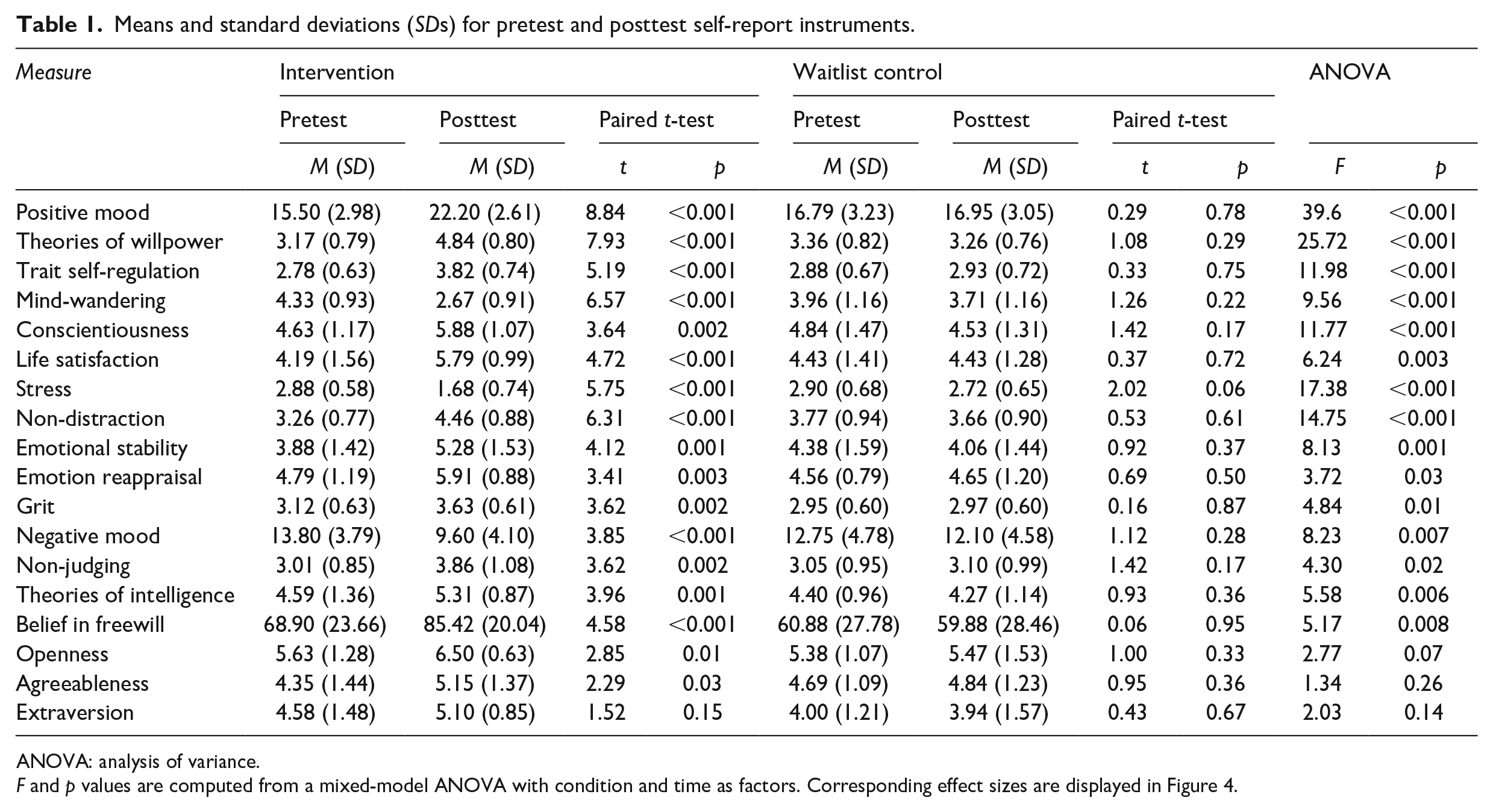
ANOVA: analysis of variance.
F and p values are computed from a mixed-model ANOVA with condition and time as factors. Corresponding effect sizes are displayed in Figure 4.
Means, standard deviations (SDs), and interaction effects for ESM and Nightly Journal Measures.
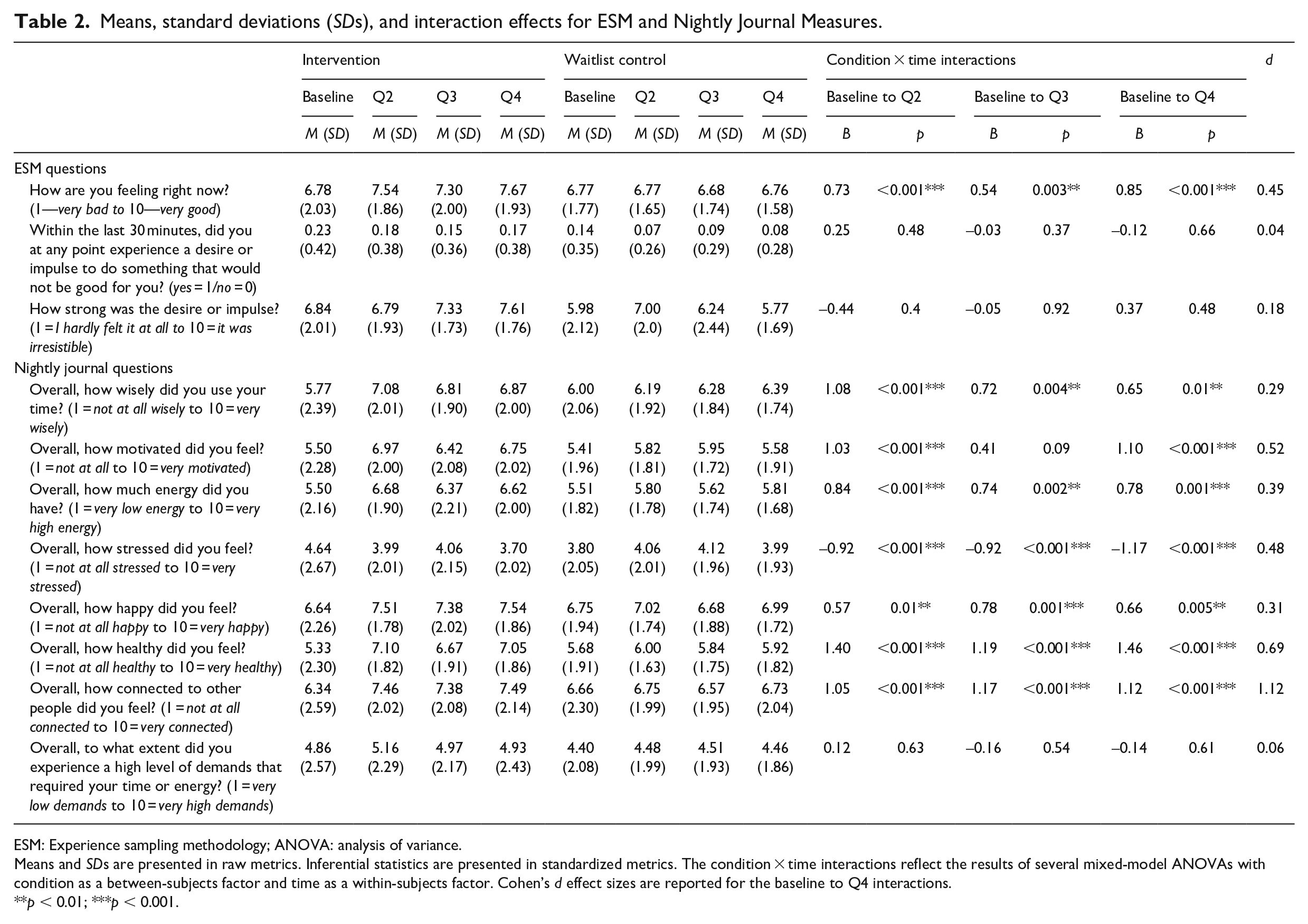
ESM: Experience sampling methodology; ANOVA: analysis of variance.
Means and SDs are presented in raw metrics. Inferential statistics are presented in standardized metrics. The condition × time interactions reflect the results of several mixed-model ANOVAs with condition as a between-subjects factor and time as a within-subjects factor. Cohen’s d effect sizes are reported for the baseline to Q4 interactions.
p < 0.01; ***p < 0.001.
Momentary self-regulation, as measured by experience sampling, increased substantially as well (Figure 1). The increase in momentary self-regulation emerged over time, first becoming statistically significantly higher than baseline during the third and fourth weeks of the training. This time-course is consistent with the notion that self-regulation is a skill that requires time and practice to develop. Although daily practice of self-regulation may seem like it would be aversive, results revealed simultaneous increases in momentary enjoyment over the 6 weeks (Figure 1).

Doing more things that are good for you in the long run (and enjoying them too). Experience sampling data for momentary self-regulation and momentary enjoyment across the four time periods. (1) Average rating of whether participants were “doing something good or bad for them in the long run”—a measure of momentary self-regulation. (2) Participants’ average enjoyment of what they were doing—a measure of momentary enjoyment. For both panels, betas and p values represent the interaction between time and condition from baseline to the designated point in time (Quarters 2, 3, and 4). Error bars represent ±1 SE.
A mediational analysis provided evidence consistent with the hypothesized model that improvements in momentary self-regulation would partially explain improvements in trait self-regulation (Figure 2). For this mediational analysis, nested observations were collapsed within each participant to create a subject-level summary variable of momentary self-regulation. This significant indirect effect also suggests that improvements in trait-level self-regulation may emerge as a product of daily practice.
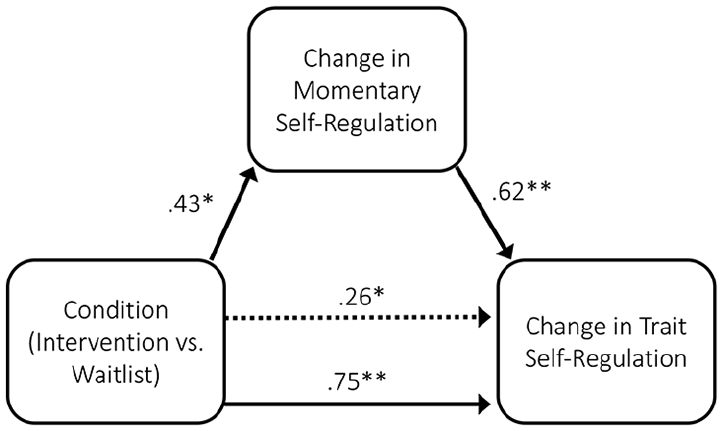
Self-regulation during daily life mediates changes in trait self-regulation. The effect of condition on changes in trait self-regulation was partially mediated by changes in momentary self-regulation. CI = (0.08, 0.60). Standardized betas reported. Change scores represent responses from the first 2 weeks of baseline (Q1) subtracted from the last 2 weeks of post-testing (Q4). Change in momentary self-regulation is a subject-level summary statistic that averages across nested observations. Bootstrapping with 5000 resamples was used to calculate a 95 percent confidence interval around the indirect effect. *<0.05, **<0.01.
The intervention elicited improvements in trait self-regulation that persisted to the 6-week follow-up despite no continued instruction or support (Table 3). Specifically, participants showed no decline in their trait self-regulation from post-test to 6-week follow-up, F(1, 19) = 0.58, p = 0.46. Relative to their initial baseline, participants showed dramatic improvements in trait self-regulation at the 6-week follow-up with a Cohen’s d effect size of 1.52.
Persistence effects for self-report instruments.

To allow for direct comparison with Figure 4, effect sizes were calculated as the mean difference between the 6-week follow-up and pretest measures divided by the pooled standard error from pretest and posttest.
p < 0.05; **p < 0.01; ***p < 0.001.
The relationship between self-regulation and impulse control
Participants in both conditions experienced a similar frequency of temptations over time, and these temptations did not differ in their intensity across conditions (Table 2). This suggests that cultivating self-regulation does not necessarily reduce the number of temptations one experiences nor how challenging these temptations will feel, at least during the period of time in which self-regulation is being trained. Yet over the course of training, participants in the intervention condition began attempting to resist temptations more frequently and became more successful at doing so (Figure 3).
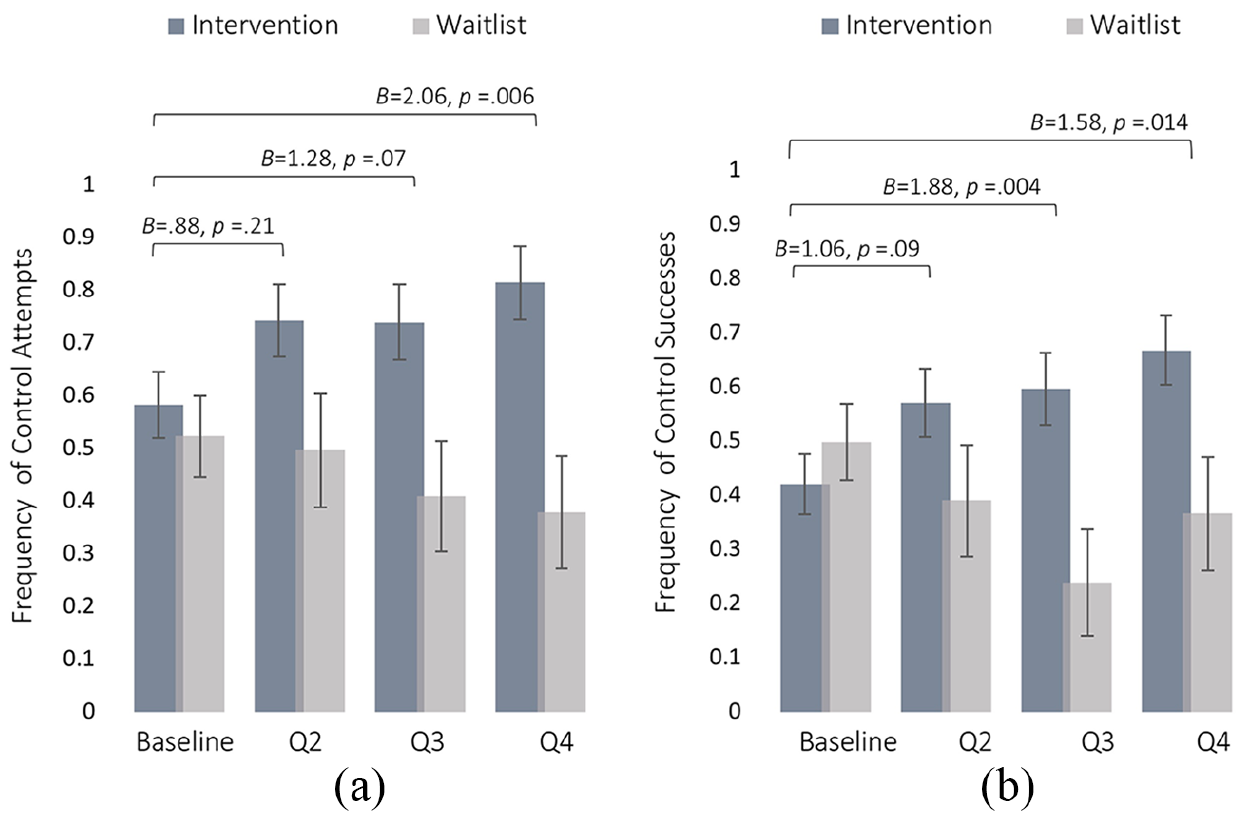
Increased attempts and success at resisting temptations during daily life. Experience sampling data for impulse control attempts and impulse control successes across the four time periods. (1) Control attempts to resist a temptation that was present within the last 30 minutes. (2) Control successes in resisting a temptation within the last 30 minutes. For both panels, betas and p values represent the interaction between time and condition from baseline to the designated point in time during the intervention (Quarters 2, 3, and 4). Error bars represent ±1 SE.
Changes in additional outcome measures
Participants experienced dramatic improvements across a broad set of meaningful outcomes in just 6 weeks (Figure 4; Table 1). Relative to the control condition, those in the treatment condition reported being happier, healthier, more energetic, more motivated, less stressed, and more connected to others via the nightly journals (Table 2).
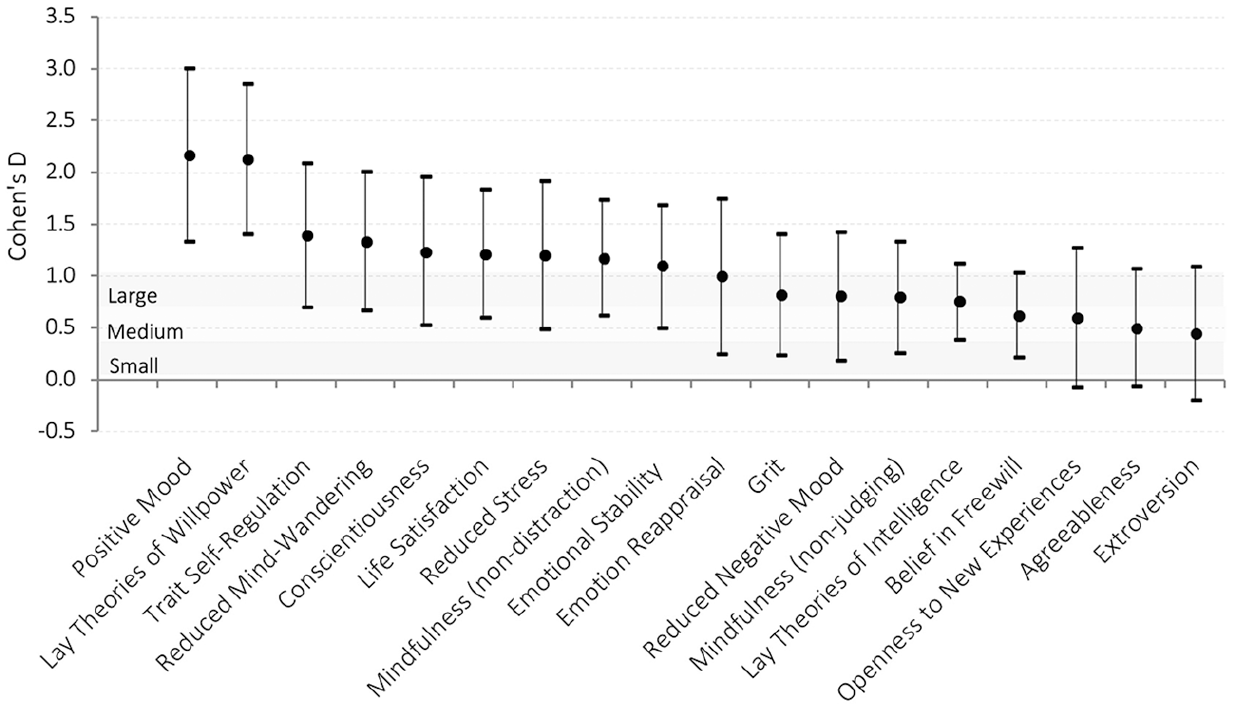
Effect sizes of improvements observed in the intervention condition compared to the waitlist control condition. Effect sizes for each dependent measure were calculated by computing the difference in change from pretest to posttest for the intervention relative to the waitlist control and dividing by the pooled standard error across testing sessions. Error bars represent 95 percent confidence intervals. Shaded sections demarcate traditional effect size descriptions. Variables are organized by the largest to the smallest effect size.
Even certain aspects of personality that have long been considered relatively stable traits—including conscientiousness and emotional stability—significantly increased as a consequence of the intervention. These widespread improvements were accompanied by an increased appreciation among participants of their capacity to change; specifically, the intervention elicited adaptive mindsets with respect to intelligence and willpower.
With the exception of increased belief in freewill—which exhibited a medium effect size (d = 0.63)—all improvements were of large to very large effect size. All of these improvements persisted to the 6-week follow-up (Table 3). Some outcomes continued improving even after the intervention ended despite no additional instruction or support. This continued improvement from posttest to the 6-week follow-up was the case for mindfulness (non-judging) (t = −3.92, p < 0.001, d = 0.76), grit (t = 2.08, p = 0.05, d = 0.27), and emotional regulation (t = 2.36, p = 0.03, d = 0.43).
General discussion
High levels of self-regulation seem to hold the promise of a better life, yet most people struggle to consistently align their attention, thoughts, and behavior with their long-term goals (Baumeister and Tierney, 2011). This struggle is accompanied by a prevalent belief that self-regulation is a stable ability across the lifespan. After all, how well someone resists temptations as a child predicts many of their outcomes later in life, implying that one’s level of self-regulation is to some extent a stable trait (Shoda et al., 1990; Watts et al., 2018). Yet the present research shows that an individual’s level of self-regulation can improve dramatically in just 6 weeks and be accompanied by wide-ranging improvements in personal capacities and quality of life. These changes included not only improvements in emotional regulation, stress, mood, and life satisfaction, but also increases in conscientious and emotional stability—two dimensions of the Five Factor model of personality that are considered relatively stable characteristics of an individual (Digman, 1990).
In the present research, experience sampling characterized changes in momentary use of self-regulation throughout the intervention. More frequent use of momentary self-regulation partially mediated the increase in trait self-regulation that emerged across the 6 weeks. This mediational effect supports the training hypothesis of the strength model, which suggests that repeated use of self-regulation strengthens one’s underlying self-regulatory capacity much like how a muscle is strengthened with training (Baumeister et al., 2007).
Over the course of the intervention, participants reported finding greater enjoyment in the things they did. In nightly journals, participants reported using their time more wisely while also feeling happier. The juxtaposition of higher self-regulation and higher enjoyment is notable given that (1) self-regulation often involves foregoing pleasure for the promise of long-term benefit and (2) the effortful nature of self-regulation is often experienced as somewhat aversive (Baumeister and Heatherton, 1996). Yet at least in the context of this intervention, the process of cultivating self-regulation was accompanied by greater enjoyment and improved affect. Participants also began viewing the use of willpower as something that was energizing rather than fatiguing, and they reported higher levels of energy in the nightly journals.
Prior correlational work shows that individuals with high levels of self-regulation experience fewer temptations (Hofmann et al., 2012). Our findings help contextualize this work by revealing that during 6 weeks of intensive self-regulation training, there was no decrease in the frequency or intensity of temptations. Instead, we observed an increase in how often individuals attempted to resist temptations (e.g. refraining from eating unhealthy foods, abstaining from drinking alcohol, down-regulating a negative emotional reaction) and how frequently they were successful in doing so. These increases emerged over time throughout the intervention, consistent with the interpretation that participants were developing the self-regulatory skill of impulse control through repeated practice.
Improvements in self-regulation and other outcomes persisted to a 6-week follow-up, and some outcomes continued to improve during that time despite no additional instruction or support. Speculatively, this continued improvement may have unfolded in part because participants had self-regulatory skills that allowed them to continue engaging in skillful behaviors. However, this longitudinal assessment had no control group to which it could be compared because the waitlist control had received the intervention by this time. Future research should consider spacing out the delivery of the intervention to the experimental and waitlist groups so that the stability of these changes can be assessed in a more rigorous manner.
In addition, the generalizability of these findings to other populations is limited. This study included a highly intensive intervention that presumably appeals to a self-selecting demographic. Although the waitlist control design ensured that the two conditions were matched in this respect, the effectiveness of this intervention for other populations is unknown. Although generalizability to a truly random sample would be interesting, recent claims have also argued that understanding behavioral intervention effects may be most worthwhile in the subpopulations that would actually enroll in such interventions (Rosenkranz et al., 2019). The present research helps estimate the effect sizes of self-regulatory change for a population of individuals who would initiate participation in an intensive behavioral intervention.
The purpose of this research was not to identify the specific mechanisms responsible for improvements in self-regulation. By design, we utilized a highly multifaceted intervention to better characterize the extent to which self-regulation could improve through intensive training. Although this prevents definitive claims regarding the specific aspects of the intervention that were most potent, this investigation nevertheless reveals that self-regulation is highly malleable through training. Speculatively, it may be the multifaceted nature of the intervention itself that is key to achieving dramatic improvements in self-regulation. Given that numerous skills contribute to our ability to self-regulate, the most strategic approach may be to simultaneously address all the interconnected skills that make it possible for us to pursue and achieve our goals. Although the precise mechanisms underpinning the gains observed in this study remain speculative, the present findings demonstrate that one’s self-regulatory capacity can be dramatically and endurably enhanced.
Footnotes
Acknowledgements
The authors thank Eddie Ellner for his role in delivering the intervention.
Declaration of conflicting interests
The author(s) declared no potential conflicts of interest with respect to the research, authorship, and/or publication of this article.
Funding
The author(s) disclosed receipt of the following financial support for the research, authorship, and/or publication of this article: This research was supported by the John Templeton Foundation, Grant 52071.
