



Abstract
A better understanding of Continuous Positive Airway Pressure (CPAP) adherence is a priority in improving patient care. To Identify adherence typology with a longitudinal approach, and explore the early determinants of lower adherence to CPAP. Obstructive sleep apnea patients (N = 204). Prospective and longitudinal study.A classification into four profiles was observed: “Regular Adherents,” “Non-Regular Adherents,” “Persistent Non-Adherents,” and “Non-Persistent Non-Adherents.” Specific biopsychosocial factors make it possible to evaluate the risk of belonging to a lower adherence profile. We propose a novel approach of CPAP treatment adherence. Several pre-determinants have been identified.
Keywords
Introduction
Obstructive Sleep Apnea syndrome (OSA), a chronic respiratory disease, impacts on the health and quality of life of patients (American Academy of Sleep Medicine, 2001), but it is unfortunately still under-diagnosed (Fuhrman et al., 2012), and is little known by the general public (Arous et al., 2017). Continuous Positive Airway Pressure (CPAP) therapy is a baseline treatment for OSA, due to its significant and immediate health benefits as compared to its side effects (American Academy of Sleep Medicine, 2001; Franklin et al., 2007; T. L. Giles et al., 2006; Marin et al., 2005; Weaver et al., 2007). However, as it is a palliative treatment, patients must be autonomous, in maintaining it for the rest of their lives. Sufficient and regular use of CPAP therapy, for a minimum of 4 hours daily, is recommended to avoid cardiovascular complications, and to clinically reduce daytime sleepiness (Franklin et al., 2007; T. L. Giles et al., 2006; Marin et al., 2005; Weaver et al., 2007). Nevertheless, a significant portion of patients, approximately 30% according to a prior study (Franklin et al., 2007) struggle to adhere to this treatment.
In order to improve adherence to CPAP treatment, several studies since the early 1980s have aimed to identify the socio-demographic and medico-technical factors involved. The results have been non-constant, and sometimes contradictory (Crawford et al., 2014). Some biomedical factors are interested to understand non-adherence, such as through the Apnea Hypopnea Index (Borel et al., 2013); but their explanatory potential remains low. More recently, research has focused on psychosocial factors and results relating to patients’ beliefs, either regarding the disease or treatment, and has generated new perspectives (Crawford et al., 2014). Some of these beliefs are particularly relevant in predicting adherence, such as self-efficacy (Sampaio et al., 2014; Sawyer et al., 2011), while others are less conclusive, such as the perceived risks of OSA (Bakker et al., 2011; Sawyer et al., 2011). However, some factors require further exploration, such as illness representations proposed by Self-Regulatory Leventhal’s model (1997, 2008). Sampaio et al. (2014) used the IPQ-Brief, which provides an overall score of the perceived risks, while the questionnaire recommended to assess each attribute of the representation of the disease is the IPQ-R, Illness Perception Questionnaire, by Moss-Morris et al. (2002) (Leventhal, 2008). Some studies have also highlighted the importance of patients’ first experiences with treatment, as these could directly determine not only their beliefs but also their behavior (Sawyer et al., 2011). The majority of studies have used a dichotomous approach to adherence, distinguishing adherents from non-adherents via a minimum threshold of use. Nevertheless, several studies have found that the group of non-adherents is heterogeneous (Poulet, 2009; Wild et al., 2004): as such this group is difficult to characterize, but it is precisely this patient population that has to be identified and understood in order to improve adherence to CPAP treatment.
In order to move beyond the limits of the dichotomous approach, several research teams have studied new behavioral indicators and proposed different typologies of adherence (Aloia et al., 2008; Babbin et al., 2015; Wohlgemuth et al., 2015). The typology approach makes it possible to take into account the different degrees of adequacy between the behaviors of patients and the medical recommendations. In consequence, it seems more possible to better understand the adherence difficulties of patients (Sawyer et al., 2015). To our knowledge, three studies have proposed typologies, but their number of profiles varies. The following observed typologies have been reported: three groups (Wohlgemuth et al., 2015), four groups (Babbin et al., 2015), or seven groups of patients (Aloia et al., 2008). These three typologies each highlight the importance of regularity of adherence, but the average usage time of each group varies between typologies. Moreover, Babbin et al. (2015) observed only one form of behavioral dynamism, which was the decline in use, unlike Aloia et al. (2008), who also observed a group of patients who improved their observance over time. With this lack of consensus, it is difficult to determine which typology is the closest to clinical reality, which is why it seemed necessary to renew the study of adherence behavior.
Among those three studies, two explored the explanatory factors of the adherence profiles (Babbin et al., 2015; Wohlgemuth et al., 2015). The typology used by Wohlgemuth et al. (2015) distinguishes between patients who are “Non-Adherers,” “Attempters,” and “Adherers.” According to their results, “Non-Adherers” have significantly lower feelings of self-efficacy than “Attempters” and “Adherers” patients, and belief of control is the same among “Attempters” and “Adherers.” The risk of belonging to the “Attempters” profile rather than the “Adherers” profile is reduced when the AHI and the titrated pressure are high, and increases when patients show more insomnia-like sleep disorders. Babbin et al. (2015) established a four-group classification after 6 months of treatment: “Great Users,” “Good Users,” “Low Users,” and “Slow Decliners.” These authors observed more black Americans among the “Low users” than among the “Slow Decliners.” In addition, the “Low Users” reported lower self-efficacy and lower perceived benefits than “Slow Decliners” did. The results of Babbin et al. (2015) gave little indication of what distinguishes “Slow Decliners” from the other two classes of patients. It would, however, be interesting to understand why these patients, observed at the start of treatment, reduced their use over time. So, regarding the explanatory factors studied, not only do their results not match, but some psychosocial factors have not been studied, such as the beliefs of social influences.
Thus, in order to achieve a better follow-up for patients with OSA, this study has two objectives: (1) °Determine a sensitive typology of CPAP adherence which takes into account inter-individual differences while at the same time being parsimonious for clinical applications; and (2) Explore the early biopsychosocial determinants which may explain the lower adherence of some patients.
Methods
Ecological validity corresponds to the postulate that the behaviors observed during a study reflect the behaviors that actually occur in a natural environment. In order to ensure the ecological validity of the present results, we conducted an observational, prospective, and longitudinal study. This methodology allows the collection of data on the natural behaviors of patients. The Committee for the Protection of people South East V (Grenoble, France; n°: 13-RNI-03) approved this observational study.
Population
Between October 2013 and December 2014, participation in the study was proposed to patients aged between 30 and 80 years, who had been diagnosed with OSA and were not covered by the following exclusion criteria: patients already included in a clinical study, those following an associated oxygen therapy; those who already had experience with OSA treatments, those with a history of stroke with aphasia; and adults under trusteeship. Pregnant or breastfeeding women can also be less compliant because of sleep disturbance and awakening for babies. We therefore also excluded them because these non-compliance factors are situational. Recruitment took place over 1 year and 3 months, via two agencies of medico-technical provider AGIR à dom. Assistance (Grenoble and Chambéry, France).
Procedure
After their diagnosis of OSA, we recruited patients who were starting CPAP treatment after reading and signing informed consent in accordance with the World Medical Association Revised Declaration of Helsinki. We met the patients before their first appointment with providers. We collected socio-demographic and medical data from them and the participants each completed a set of self-administered questionnaires. As CPAP cessation has mainly been observed during the first year (Sucena et al., 2006), we studied the treatment use of 204 patients during the first 10 months of treatment.
Measurements
We collected the following socio-demographic data: age, gender, marital status, bed sharing, and employment status. We studied the following medical data: apnea-hypopnea index (AHI, the number of times a patient has apnea or hypopnea during one night, divided by their hours of sleep), oxygen desaturation index (ODI : the number of times per hour of sleep that the blood’s oxygen level drops by a certain degree from the baseline), body mass index (BMI) sleepiness via the Epworth Sleepiness Scale (Johns, 1991), family health history of OSA, alcohol consumption (units per week) and tobacco consumption (units per day) and smoking history.
A set of psychosocial factors was studied before use, as factors of acceptability of the CPAP therapy: these comprised recall capacity, perceived social support, and beliefs relative to the OSA and the CPAP.
In order to assess the recall capacity of patients, we transmitted information about OSAS and PPC treatment, using an elaborate information document (Bros et al., 2018). Then, the patient took a knowledge test consisting of six multiple choice questions. This test was elaborated for this study and was related to the content of the information document. To study social support, we used the Perceived Social Support Questionnaire by Bruchon-Schweitzer (2002). This tool investigates the perceived availability of, and satisfaction with, four types of support (esteem, emotional, instrumental, and informative) and supportive actors (family, friends, colleagues, and health professionals).
In order to explore the participating patients’ beliefs about OSA, we used the conceptualization by Leventhal et al. (1997), who proposed that patients’ representations of illness are based on distinct components. We adapted the reference questionnaire (Leventhal, 2008): Illness Perception Questionnaire Revised (IPQ-R) developed by Moss-Morris et al. (2002) in French, on the base of the only available tool (Chateaux and Spitz, 2006). We adapted the IPQ-R, as recommended by Moss-Morris et al. (2002), by indicating the name of the disease (Obstructive Sleep Apnea Syndrome), and by proposing inventories of symptoms and causes adapted to the clinical context.
In order to explore patients’ beliefs about CPAP, we used the Theory of Planned Behavior (TPB) by Ajzen (1985, 1991), who proposed that behavioral intention is determined by attitudes, subjective norms, and perceived behavioral control. We constructed a questionnaire from the results of 15 interviews, according to the methodological instructions of Fishbein and Ajzen (2010): the ACCEPTNEA Questionnaire. We conducted an exploratory study, involving semi-structured interviews with 15 patients to define the indicators of this tool. The tool allows investigation of the behavioral, normative, and control beliefs of patients, as well as the anticipated affects if not performing behavior (the additional variable allows the TPB to have greater potential predictive power (Rivis et al., 2009).
We conducted a pre-experiment for all the tools which had two stages: a first qualitative step, in order to assess the readability of the questionnaires (six patients), and a second quantitative step (30 patients), in order to gather the first results concerning the reliability and sensitivity of the tools.
To study behavioral evolution over time, we used a memory card placed in the CPAP device. We performed 10 adherence reports, regularly spaced over time (over 28 days). This adherence report, collected the following: average use per 24 hours period (duration), number of days of CPAP used <4 hours (regularity), number of days of CPAP non-use (persistence) and the date of CPAP cessation.
Analysis
We performed a cluster longitudinal analysis, in order to determinate the optimal number of adherence profiles. We used R software with the “kml” package, developed by Genolini et al. (2015). The analysis was conducted in the following five steps. Step 1: to evaluate the evolution of the behavior over time, we traced a trajectory from the ten measures of duration for each patient. Step 2: the missing values (1.6% of the data) were treated via an interpolation method to take into account the specific measurements for each patient’s trajectory. Step 3: we identified five partitions—to two at six profiles, more than six subgroups seems inefficient for a clinical application—of these patient trajectories by opting for Euclidean distance. Step 4: we compared four quality criteria for these partitions (Calinski & Harabasz criterion; Calinski & Harabask, Kryszczuk variant; Calinski & Harabasz, Génolini variant and Davis & Bouldin criterion). A “good” partition is one where the profiles are compact and well separated from each other (Genolini et al., 2015). However, as Genolini et al. (2015) also pointed out, there is no perfect quality criterion, so using several of them enhances the reliability of the results. The optimal number of profiles is determined when these criteria are concordant. With the “klm” package, it is possible to compare criteria using a graph: the four criteria were standardized between 0 and 1 to facilitate comparison and identify the most compact cluster. Concordance is observable in the form of a compact cluster. And most compact clustering determines the optimum number of profiles. Step 5: we performed an a posteriori probability analysis to verify that each patient would be classified in the correct profile group.
Once the number of profiles was determined, we compared the duration (at 1 and at 6 months), regularity, persistence and cessation of treatment in order to characterize them more precisely. A measure of the regularity of behavior was obtained from the average number of days in which CPAP was used for less than 4 hours during the first 10 months. Patients who exceeded the average of 8 days of insufficient use in 28 were considered “non-regular” (Wohlgemuth et al., 2015). The persistence variable was obtained from the average number of days of CPAP non-use during the 10-month treatment, and patients were considered “non-persistent” if the mean was greater than 7 days of non-use in 28 (Pépin et al., 1999).
In order to explore the early biopsychosocial determinants of lower adherence, we used a generalized linear model (Geyer, 2003). Analysis of the odds ratio (OR) allows identification of the risk, and risk protection factors, of belonging to a profile of lower compliance profile. The reference group was the group with the most observant patients. We preselected the factors to be included in the model using an algorithm based on Akaike’s Information Criterion (AIC). This algorithm allows the selection of those variables that are the most important in modeling (Akaike, 1974). In order to reduce the risk of type 1 error (Hair et al., 2015), we fixed the alpha at α = 0.01. Then, the predictive equations of each of the profiles obtained via the regression coefficients (Beta, β) made it possible to compare the theoretical prediction with the actual data of classification of the patients. We were then able to calculate the correct prediction rates and error rates for each of the profiles.
Results
Patient population
During the inclusion period, 325 patients were eligible for this study and 204 agreed to participate (62.7%). The participants were all treatment naïve. Most of them were patients with severe OSA (AHI >30) and moderate sleepiness (ESS >8). Patient demographics and clinical data are detailed in Table 1. No significant differences in adherence were evident at 4 months between the patients included in the study (N = 204) and those who refused to participate (N = 121). This result reinforces the representativeness of our sample, by ruling out the presence of potential biases such as the effect of volunteering or the Hawthorne effect.
Patient demographic and clinical data (N = 204).

At 1 month, over the entire sample, the adherence rate (mean >4 hours) is 67.6%; the regularity rate (>70% of days of use >4 hours) is 59.3%; and the persistence rate (>75% of days of use) is 86.3%. Of the total of 204 patients, 2.9% abandoned treatment during the first month of treatment. At 6 months, of the remaining total of 198 patients (with 2.9% missing data), the adherence rate was 68.7%; the regularity rate was 60.6%, and the persistence rate was 77.3%. From a total of 204 patients, 10.8% abandoned treatment within 6 months. At 10 months, for 196 patients (3.9% of missing date), the adherence rate was 64.8%, the regularity rate was 55.1% and the persistence rate was 69.9%. Out of 204 patients, 13.7% patients abandoned treatment within 10 months.
Determining the optimum typology of adherence
In order to determine the optimum typology of adherence to CPAP, we observed the four quality criteria for partitions of two at six classes. Figure 1 illustrates the score obtained for each criterion. The optimal number of profiles is determined when these criteria are concordant, and as has been explained, concordance is observable by a compact cluster. Figure 1 shows that the partition into four groups of patients appears to be the most relevant.
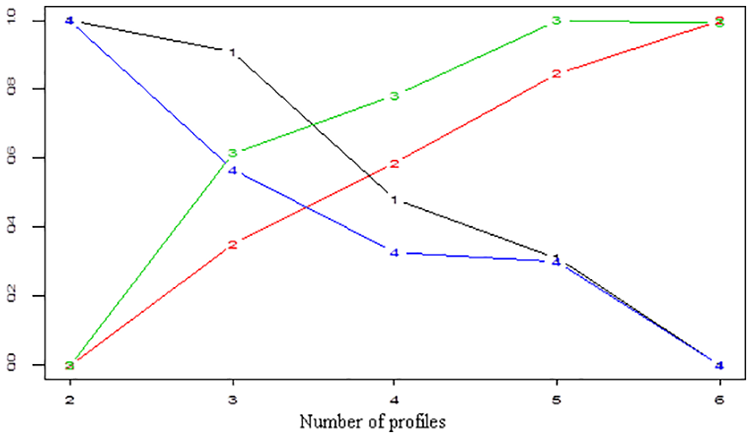
Graphic projection of the quality criteria to determine the optimum number of profiles.
Figure 2 represents the partition of trajectories over time for the four profiles of CPAP adherence. We categorized 27.5% of the patients in our study as Profile A, 34.8% as Profile B, 23.5% as Profile C, and 14.2% as Profile D. The a posteriori probabilities are satisfactory, with a mean of 0.98 ± 0.07 for profile A; 0.97 ± 0.09 for profile B; 0.98 ± 0.08 for profile C; and 0.92 ± 0.13 for profile D. Only seven out of 204 patients have a probability of grading below 0.70.

Partition of trajectories of CPAP use over time: 4 profiles.
Characterizing of the profiles
In order to characterize these four patient groups’ adherence, we compared the indicators of CPAP use over the 10-month period (see Table 2). Profiles A, B, and C did not show significantly different therapy cessation rates. However, after the first month, these three profiles were significantly different in terms of duration of CPAP use. In profiles C and D, the difference in CPAP use was non-significant at the beginning of treatment, and 6 months later. Both profiles differ regarding the persistence of the behavior and CPAP cessation, profile D being less persistent than profile C—and also than profiles A and B. For profiles A and B, a distinction also appears in terms of the regularity of more than 4 hours treatment. There were significantly more irregular patients in profile B. Because of these results, we labeled the four profiles as follows: A = “Regular Adherents”; B = “Non-Regular Adherents”; C = “Persistent Non-Adherents”; and D = “Non-Persistent Non-Adherents.”
Comparison test of four adherence profiles.

Significant difference with Profile A.
Significant difference with Profile B.
Significant difference with Profile C.
Significant difference with Profile D.
ddl = 3; Pairwise comparison (adjusted p value <0.05).
Exploring the early biopsychosocial determinants of lower adherence
In order to characterize the four adherence profiles, we used a generalized linear model, which included 27 variables. Based on the AIC criteria (AIC: 526.94), twelve variables were selected: employment status, AHI, BMI, smoking history, recall capacity, perceived family support, timeline of OSA (acute/chronic), treatment control on OSA, emotional representations of OSA, the physiological attributions of OSA, the anticipated affects if not using CPAP and the subjective norms to use CPAP.
In Table 3, we present the biopsychosocial factors showing a statistically significant results (with p value <0.01), as well as those presenting a statistical tendency (with p value <0.05). We did not observe the same significant factors for each profile. One factor was significant for Profile B: the physiological attributions of OSA. According to our findings, when patients do not explain their OSA with reference to physiological factors—such as either overweight or age, consistent with medical knowledge—then they are more likely to belong to Profile B, that is, to become non-regular (+18%). For Profile C, we did not observe any significant factor. For Profile D, two factors were significant: AHI, and emotional representations. According to our results, the less severe the OSA, the more likely the patients were to belong to this profile (+6%). The more the patients showed strong emotional reactions to OSA, such as either anger or anxiety, the more likely they were to belong to Profile D, and thus to become non-persistent (+15%).
Results of generalized linear models (reference group = Regular Adherent (A); N = 204).

α: Cronbach’s alpha; SE: standard error; OR: odds ratio; CI: confidence interval.
The predictive potential of the adherence factors was also assessed. Table 4 summarizes the crossing of the actual and theoretical adherence profiles. Looking at the diagonal in Table 4, 107 patients (52.5%) are predicted in the right profile from adherence factors of 52.5%. The effectives below the diagonal are predictions that we can regard as “false positives” since the patients are identified in profiles with greater difficulties than the actual profile. The “false positives” rate is 18.1%, and is mainly found in the crossing of Profiles B and A. The rate of “false negatives” is more important, at 29.4%.
Crossing of the actual with the theoretical adherence profiles.

A: regular adherents; B: non-regular adherents; C: persistent non-adherents; D: non-persistent non-adherents.
Discussion
A new characterization approach to measuring CPAP adherence among patients
We approached adherence to CPAP therapy through a new and original approach based on a typology comprising four distinct profiles: Regular Adherents (A), Non-Regular Adherents (B), Persistent Non-Adherents (C) and Non-Persistent Non-Adherents (D). According to our results, those patients who qualified as Regular Adherents very regularly use CPAP for more than 4 hours nightly (M = 7.00), do so every day, and do not give up their treatment. The Non-Regular Adherents have a less regular sufficient use, with a mean duration of 5 hours. However, they also use CPAP every day and do not give up their treatment. Thus, these groups of adherents are differentiated by the duration and regularity of their CPAP use. The two groups of non-adherents (Profiles C and D) have low duration of use from the beginning of the CPAP treatment (approximately 3 hours). Nevertheless, these two groups can be differentiated by the persistence of their CPAP use and the cessation rate. One group (Profile C) persists and does not stop the treatment, whereas the second group (Profile D) either periodically discontinues treatment or stops it altogether. After 6 months of treatment, the duration of use becomes highly insufficient for Non-Persistent Non-Adherents (1 hour).
Compared to the other typologies of adherence found in the literature (Aloia et al., 2008; Wohlgemuth et al., 2015), this typology is more sensitive as it proposes four profiles that are distinct in terms of duration, regularity and persistence, while at the same time remaining sufficiently simple for effective clinical applications. A continuous approach to compliance behaviors would add additional richness to our results which were obtained on the basis of 28-day reports. However, the four profiles observed and described here show the interest in studying different behavioral indicators. Thus, in the clinical context, it seems necessary to take into account the duration, but also the regularity and the persistence of the use of the treatment, in order to best patients’ adherence profile.
We observe the same numbers of profiles as Babbin et al. (2015): a typology of four groups. Their groups are the « Great Users », the « Good Users », the « Low Users » and the « Slow Decliners ». We also acknowledge similarities between the first two profiles of each typology. Regular Adherents (A) have the same usage profile as “Great Users”: in each group, treatment with PPC is used very regularly and for a long time. Non-Regular Adherents (B) are similar to “Good Users,” with moderate duration and regularity. However, the profiles diverge for less adherent patients’ groups. First, the average duration of use of these two groups are lower in our study than in Babbin et al. (2015). This deviation was probably induced by the integration of therapeutic abandonment in our statistical analysis, unlike Babbin et al. (2015) who thus underestimate the difficulties of adherence. On the other hand, the “Slow Decliners” were described by Babbin et al. (2015) as patients with moderate use, decreasing over time. This decreasing use seems similar to the non-persistence found in Non-Persistent Non-Adherents (D). However, the duration of use is greater at the start of treatment for “Slow Decliners” than for the Non-Persistent Non-Adherents (D) of our study. These differences may have been caused by the sampling method. Indeed, Babbin et al.’s (2015) sample was drawn from a randomized clinical trial examining the influence of titration on compliance, thereby reducing the ecological validity of the observed adherence behaviors. Indeed, the longer periods of use observed in “Slow Decliners” and “Low Users” may have been influenced by greater clinical monitoring during randomized trials. Our observational and prospective methodology avoided this bias.
Several authors have found that non-adherent patients are heterogeneous (Poulet, 2009; Wild et al., 2004). The division into three profiles of lower adherence is one response to this. In fact, an examination of adherence profiles reveals a proportion superior of patients in difficulty to the data found generally in the literature. As we presented in the introduction, a 30% non-adherence rate has been reported when the 4-hour threshold is used (Franklin et al., 2007). However, in our results, 38% of patients had insufficient use. In addition, most of the patients (35%) use CPAP moderately and intermittently. Thus, it appears that only 27% of patients are fully integrating their CPAP treatment into their routine. In consequence, the behavioral typology approach suggests new recommendations in support of adherence. For example, we can suggest a different intervention response depending on the individual patients’ profile: the management of group D should be particularly fast in order to avoid a complete cessation of CPAP treatment in the first months.
Pre-use biopsychosocial determinants specific to CPAP adherence profiles
We identified pre-use biopsychosocial determinants for each behavioral profile. Specifically, they are as follows: for Profile B, causality of OSA perceived; and for Profile D: AHI and emotional reactions. This specificity may explain the lack of consensus in the prior literature about adherence factors in relation to CPAP therapy. These biopsychosocial factors make it possible to correctly predict the behaviors of more than half of patients before use (53%). The incidence of AHI seems to be a protective factor for regarding the risk of belonging to Profile D. This finding id consistent with the clinical logic verified by the majority of previous studies (Crawford et al., 2014), emphasizing that the more severe the disease, the more the patient is adherent. Nevertheless, our results make it possible to specify that the severity of the OSAS more particularly determines the persistence of use of the treatment by patients.
The conceptualization of the representation of the disease, according to the model proposed by Leventhal (1997, 2008), demonstrates the interest in exploring factors of impacting upon CPAP adherence. Indeed, it is mainly the beliefs relating to OSA that have a significant direct impact on the risk of belonging to one of the three CPAP adherence groups. For Profile B, we perceived that an incorrect causality, a subjective etiology, remote from medical etiologies, can affect adherence behaviors, as has previously been suggested by Leventhal et al. (1980). During the first care interview, the exploration and correction of false beliefs regarding the possible causes of OSA may be the first lines of intervention for non-regular patients. Regarding Profile D, understanding the patient’s emotions about their illness seems essential to understanding them in order to anticipate the risk of non-persistence. According to Kucukarslan (2012) the negative impact of emotional representation on adherence is a result that has already been observed in relation to other pathologies, such as hypertension. Listening to complaints and worries, but also empathically hearing the anger of these patients about their OSA diagnosis, may form the first strategies to defuse the risk of abandonment and improve adherence (Broström et al., 2017)
Nevertheless, these first exploratory results have some limitations which lead to new research perspectives. Firstly, due to an insufficient Cronbach’s alpha (<0.60) (DeVellis, 2003), some psychosocial variables were excluded from the modeling analyzes: perceived behavioral control, and normative and control beliefs. Consequently, the impact of these factors on the three profiles of lower CPAP adherence remains to be determined. In addition, some variables showed strong statistical trends for certain profiles: employment status (Profile B), BMI and recall capacity (Profile C), and smoking history and perceived family support (Profile D). These factors should therefore be re-evaluated within a larger population of patients. Secondly, our work has revealed that certain beliefs relating to OSAS, taken independently, have a direct impact on behavior. It would be interesting to test Leventhal’s model as a whole. Finally, our results make it possible to characterize the four profiles. The predictive potential of these determinants must be prospectively evaluated using a new sample. To do this, we will develop a new screening questionnaire on the basis of our results, and will study its predictive validity. This screening questionnaire could be used in practice to give targeted education at the start of care.
To conclude, the dichotomous approach has some limitations in defining CPAP adherence, since it relies on biomedical arguments and not on behavioral indicators per se. The typology of CPAP adherence is an attempt to operationalize complex behavior. This approach is more effective than the dichotomous approach, as it is based on the “real” and spontaneous behavior of patients. The longitudinal typology in the four adherence profiles which we propose in the present study shows that there is no single form of non-adherence behavior, rather, there are several behaviors of lower adherence. Clinically, as in the context of biomedical and/or psychosocial research, this typology opens new perspectives predicting and intervening in patients’ difficulties by proposing targeted interventions and thus avoiding complications, in order to improve the health and quality of life of patients with OSA.
Footnotes
Acknowledgements
The authors thank Mohamed El Methni for their advice for the analyze plan.
Declaration of conflicting interests
The authors declared the following potential conflicts of interest with respect to the research, authorship, and/or publication of this article: This study is part of a research protocol on the psychosocial factors of non-adherence with CPAP treatment, the ACCEPTNEA protocol promoted by AGIR à dom. Assistance, medical-technical service providers at home, with CIFRE funding from the National Association of Research Technology. Julie Bros benefited from the CIFRE grant (2012-2015). Chrystèle Deschaux is an employee of AGIR à dom. Assistance.
Funding
The authors disclosed receipt of the following financial support for the research, authorship and/or publication of this article: This study is part of a research protocol on the psychosocial factors of non-adherence with CPAP treatment, the ACCEPTNEA protocol promoted by AGIR à dom. Assistance, medical-technical service providers at home, with CIFRE funding from the National Association of Research Technology. Julie Bros benefited from the CIFRE grant (2012-2015). Chrystèle Deschaux is an employee of AGIR à dom. Assistance.
