



Abstract
We aimed to assess the interplay between dietary restraint and emotion regulation (ER) difficulties as well as other well-known risk factors of binge eating in a community sample of women. Altogether 96 women (mean age 21.5 years; mean BMI 21.7) participated in the study using ecological momentary assessment. Structural equation modeling indicated that restraint and ER pathways are related yet operate independently in predicting binge eating in a unified model. ER difficulties moderated the effect of negative affect and fluctuations in negative affect in predicting binge eating while Neuroticism and preoccupation with body weight predicted binge eating indirectly.
Introduction
A large number of people experience binge eating (BE) at a subclinical level (Hudson et al., 2007) increasing their risk of developing an eating disorder or other health concerns (Kessler et al., 2013). Some of the most cited risk factors of BE are dietary restraint, negative affect, emotion regulation difficulties, preoccupation with body weight (Burton and Abbott, 2017), and neuroticism (Lee-Winn et al., 2016), however these have not been integrated into one model. The current study aims to explore the interplay of these well-established risk factors in predicting BE in a community sample of women.
Negative affect and emotion regulation
Negative emotions have been consistently found to precede (Haedt-Matt and Keel, 2011) and correlate with BE (Smith et al., 2018). Similarly, affective instability (e.g. rapid changes in affect) has been associated with bulimic behaviors, including BE (Berner et al., 2017). These associations have evoked discussions whether BE serves an emotion regulation (ER) function, that is, to alleviate one’s negative emotions. Concurrently, ER difficulties (e.g. not being aware or accepting of one’s emotions or the use of maladaptive methods to cope) have been found to be associated with BE in both clinical and non-clinical populations (Prefit et al., 2019) and ER difficulties seem to increase as the eating pathology increases (Racine and Horvath, 2018). Moreover, ER difficulties are thought to play a role in both development and maintenance of disordered eating (Agüera et al., 2019).
Further, Kenny et al. (2017) found in a cross-sectional study that depressive mood interacted with ER difficulties in predicting BE among individuals with binge eating disorder (BED). Similarly, we have previously reported that fluctuations in negative affect interact with ER difficulties in predicting BE (Kukk and Akkermann, 2017). However, less is known about the interplay between these affective variables in relation to ER difficulties in predicting binge eating. It is plausible that negative affect and emotional instability are associated, as frequently fluctuating emotions can lead to overall increase in negative affect. Furthermore, ER difficulties could lead to negative affect and fluctuations in affect while these in turn exacerbate ER difficulties. In line with this theory, Bodell et al. (2019) recently found that negative affect and ER difficulties covary within an individual.
Dietary restraint
Studies have shown that individuals who exhibit dietary restraint report more frequent BE (Elran-Barak et al., 2015). Restrained individuals are thought to be more vulnerable to BE as the cognitive control applied to regulate their eating can be easily disrupted (Herman and Polivy, 1984). Negative affect and ER difficulties have also been found to play a role in eliciting BE in restrained eaters. Indeed, individuals who restrain their eating have been found to increase their food intake in response to negative emotions (Evers et al., 2018). An experimental study indicated the association between restraint and ER difficulties in a non-clinical population suggesting that dietary restraint could be used as a strategy to regulate one’s emotions (Haynos et al., 2018). However, to our knowledge, there are no studies addressing specific interactions between restraint and affective variables as well as ER difficulties.
Preoccupation with body image and bodyweight
Eating disorder specific risk factors associated with both binge eating and restraint are overvaluation of bodyweight, body dissatisfaction, and preoccupation with food and body image (Brytek-Matera and Czepczor, 2017; Fairburn et al., 2003). Indeed, overvaluation of bodyweight is associated with eating disorder symptom severity in both clinical and subclinical levels (Grilo et al., 2009). Overvaluation of bodyweight and body dissatisfaction have been found to drive restrained eating (Brechan and Kvalem, 2015; Mitchison et al., 2017) but are associated with BE as well (Andrés and Saldaña, 2014; Mitchison et al., 2017). In this study, we conceptualize these cognitive-affective components of disturbed eating in a broader term—preoccupation with body image and bodyweight (from now on preoccupation)—comprising overvaluation of bodyweight and -shape, body dissatisfaction and concern about others’ evaluation of one’s appearance. There is evidence that higher body mass index (BMI) is associated with both preoccupation (Yates et al., 2004) and restraint (Dietrich et al., 2014). However, some studies suggest that the effect of BMI on restraint could be mediated by preoccupation or body dissatisfaction (Mason and Lewis, 2015), while others have not found such a link (Allen et al., 2012).
Neuroticism
On a dispositional level, neuroticism is found to be associated with many mental disorders (Jeronimus et al., 2016) including eating disorders and related symptoms (Ellickson-Larew et al., 2013; Lee-Winn et al., 2016). Moreover, neuroticism is directly linked to above mentioned eating disorder risk factors such as negative affect, ER difficulties (Baranczuk, 2019; Stanton et al., 2016), preoccupation with food (Ellickson-Larew et al., 2013), and body dissatisfaction (Allen and Walter, 2016), and may thus predispose an individual to BE indirectly. In this study, neuroticism is viewed as a predisposing trait level risk factor of BE and is included in the integrated model for better understanding of the underlying mechanisms of BE.
Study aims
Taken together, there is extensive evidence that negative affect, fluctuations in negative affect, dietary restraint, ER difficulties, preoccupation with body image, and neuroticism play a role in BE on different levels. However, there is a need to specify their interrelations in predicting BE within a joint model. Most BE models focus on either restraint or ER pathways thus it is unclear whether they both remain significant in an integrated model as well and how they are related to one another. Understanding the various underlying processes of BE in a community sample can aid in the development of better prevention strategies. In this study, we aim to integrate these well-studied risk factors of BE using real-time data from EMA in addition to self-report questionnaires.
More specifically, we aim to specify the interrelations between different state affective variables (negative affect, fluctuations in negative affect) and ER difficulties and their associations with BE. Since ER difficulties have been proposed to be both a risk and a maintenance factor of BE, we expect it to affect multiple variables and aim to test its role as a moderator in a unified model. Further, we aim to assess the relationship between the abovementioned affective variables and restraint. Specifically, we aim to test whether interactions between ER difficulties and affective variables predict restraint and further whether interactions between restraint and affective variables predict BE. Additionally, we wanted to test whether preoccupation predicts BE directly or via restraint and specify the role of BMI in these relations.
Method
Sample characteristics
The sample consisted of 96 women with an average age of 21.5 years (range 17–39, SD = 6.7) and BMI 21.7 (range 17.4–32.7, SD = 3.2). Participants were recruited via mailing lists, social media, advertisements in local campuses, and libraries. We included all healthy adult women, an exclusion criteria was the presence of a current psychiatric disorder. Participants were Caucasian, 66% of the participants were university students. The study was approved by the Research Ethics Committee. The data were collected from 2013 to 2015 in two waves. The results on the role of fluctuations in negative affect in predicting BE using the same sample have been published previously (Kukk and Akkermann, 2017). A subsample of the study was used for another paper validating Positive and Negative Emotional Eating questionnaire (Sultson et al., 2017).
Measures
Body Mass Index (BMI) was calculated based on self-reported weight and height by standardized procedures.
Difficulties in Emotion Regulation Scale (DERS; Gratz and Roemer, 2004) is a self-report questionnaire designed to assess multiple aspects of ER difficulties. The Estonian version consists of 34 items. The scale yields six subscales but the total score was used in this study. The internal consistency of DERS total scale for this sample was α = 0.89, previous findings suggest that the DERS has high internal consistency, good test–retest reliability, and adequate construct and predictive validity (Gratz and Roemer, 2004).
Eating Disorders Assessment Scale (EDAS) (Akkermann, 2010) is a 29-item self-report scale with four subscales measuring eating disorder symptoms: Restrained eating, Binge eating, Purging, and Preoccupation with body image and bodyweight. The scale was designed to screen individuals with ED from the population. Only the preoccupation subscale was used in the present paper. The preoccupation subscale measures the cognitive-affective component of eating disorder symptoms that comprise overvaluation of bodyweight, body dissatisfaction and concerns with potential negative judgments from others. The subscale contains items such as “I am bothered by the thoughts that people may criticize the way I look” assessed in a 6-point Likert-type scale. Construct validity of the scale was confirmed by strong correlations with the EDI-2 subscales that measure ED symptoms (Akkermann, 2010). The internal consistency of the preoccupation subscale for the current sample was α = 0.94.
“Short Five” (S5; Konstabel et al., 2011) is a 60-item questionnaire constructed for measuring 30 facets of the Five-Factor Model for personality. The neuroticism subscale (containing items such as “I am often nervous, fearful, and anxious, and I worry that something might go wrong” assessed in a 7-point Likert-type scale) was used in the current paper. The internal consistency of the neuroticism subscale for the current sample was α = 0.89.
Ecological momentary assessment
EMA was used to assess BE, restraint and emotional experience in the natural environment. The EMA study was programmed and conducted with handheld computers using the freeware software iESP (Feldman Barrett & Daniel Barrett, http://www.experience-sampling.org/esp/). The devices signaled randomly seven times a day (from 8:30 am to 23:05 pm) for a 3-day period. The study period was limited to Tuesday–Thursday to minimize the effects of day of the week. Upon signal, the participants were asked to fill in the EMA questionnaire regarding their situational aspects (not used in the current study) followed by questions about their emotional experience (emotions were chosen based on PANAS-X scale) and eating behavior. Participants were asked to indicate on a 4-point Likert-type scale (1 = not at all to 4 = to a large extent) to what extent they experienced particular emotions at that moment.
The occurrence of
EMA compliance was rate was 79%.
Procedure
Participants first completed self-report questionnaires in an online survey center followed by a meeting with a research coordinator. Participants signed the informed consent and were given palmtop computers for the 3-day EMA part of the study. Participants were then instructed on the use of the palmtop computers. The definitions of BE (i.e. a significantly large amount of food eaten during a brief period of time) and loss of control (i.e. a feeling that one could not stop eating when she wanted) were also provided.
Data analysis
Five participants (5.2%) had one or two missing data points on the self-report questionnaires and these were replaced with series mean. Due to not normally distributed residuals and skewed data log transformation (for NA, NA MSSD, and restraint) or root square transformation (for the number of BE episodes) was applied for regression-based analysis. The dependent variable was the number of BE episodes registered via EMA.
Structural Equation Modeling (SEM) with maximum likelihood estimator was used to test multiple associations. SEM was conducted using R package “lavaan” and “semtools.” Model parameters were assessed using chi square (χ2; good fit p > 0.05), Comparative Fit Index (CFI; good fit ⩾0.95), Tucker-Lewis Index (TLI; good fit ⩾0.95) and Root Mean Square Error of Approximation (RMSEA; good fit <0.08) (Hu and Bentler, 1999). IBM SPSS version 23 was used for bivariate correlation analysis and regression analyses (not included in the paper for concision) to test some of the proposed associations prior to SEM.
Results
Descriptive statistics
Overall, of the 96 participants, 21 participants reported altogether 37 BE episodes during the 3-day study period. On average 0.41 (range 0–5) BE episodes were reported in the whole sample. BE was correlated with all of the variables except BMI. Correlation coefficients between the number of BE episodes, DERS total score, preoccupation, BMI, NA, NA MSSD, restraint, and neuroticism as well as their mean values are presented in Table 1.
Bivariate correlation coefficients between DERS, preoccupation with body image, BMI, negative affect, fluctuations in negative affect, restraint, binge eating, and neuroticism.

DERS: difficulties in emotion regulation scale; BMI: body mass index; N: Neuroticism; NA: negative affect; NA MSSD: fluctuations in negative affect; Preoccupation: EDAS subscale preoccupation with body image and bodyweight. Binge eating, NA, and restraint were measured via EMA. NA MSSD was computed based on EMA ratings.
p < 0.05, **p < 0.01.
Structural equation modeling
We compared different models for obtaining the best fitting model, the specifications of the models are presented in Appendix 1 and fit indexes are presented in Table 2. First, we tested a baseline model with neuroticism, preoccupation, restraint, ER difficulties, and BMI (Model 1). Then, to assess the role of NA and NA MSSD, we added them to the baseline model as variables covarying with ER difficulties and each other (Model 2), which improved the model indices (see Table 2). Next, we added an interaction between NA and restraint predicting BE (Model 3). As the interaction was not significant and the model indices did not improve it was then removed from the model. Further, we tested two models with a path from DERS to both NA MSSD and NA, and a path from NA MSSD to NA (Model 4), and a model with a path from NA to NA MSSD (Model 5). Again, as the model parameters were not sufficient, we added ER difficulties as a moderator variable. We tested two separate models: a model with the path from the interaction between NA MSSD and ER difficulties (DERS) to NA (Model 6) and a model with the path from the interaction between NA and DERS to NA MSSD (Model 7). Finally, we tested whether adding the interaction between negative affect and ER difficulties to predict restraint improved the model fit (Model 8). Further, the removal of insignificant paths such as from DERS to BE or from BMI to restraint (Model 9) resulted in slight decline in model fit indices, however these were still within the suggested range. Thus, for parsimony, the final revised model (Figure 1) was selected. The model explained 29.6% of the variance in BE (see Table 3).
Fit indexes of the tested models.

CFI: Comparative Fit Index; TLI: Tucker-Lewis Index; RMSEA: Root Mean Square Error of Approximation.
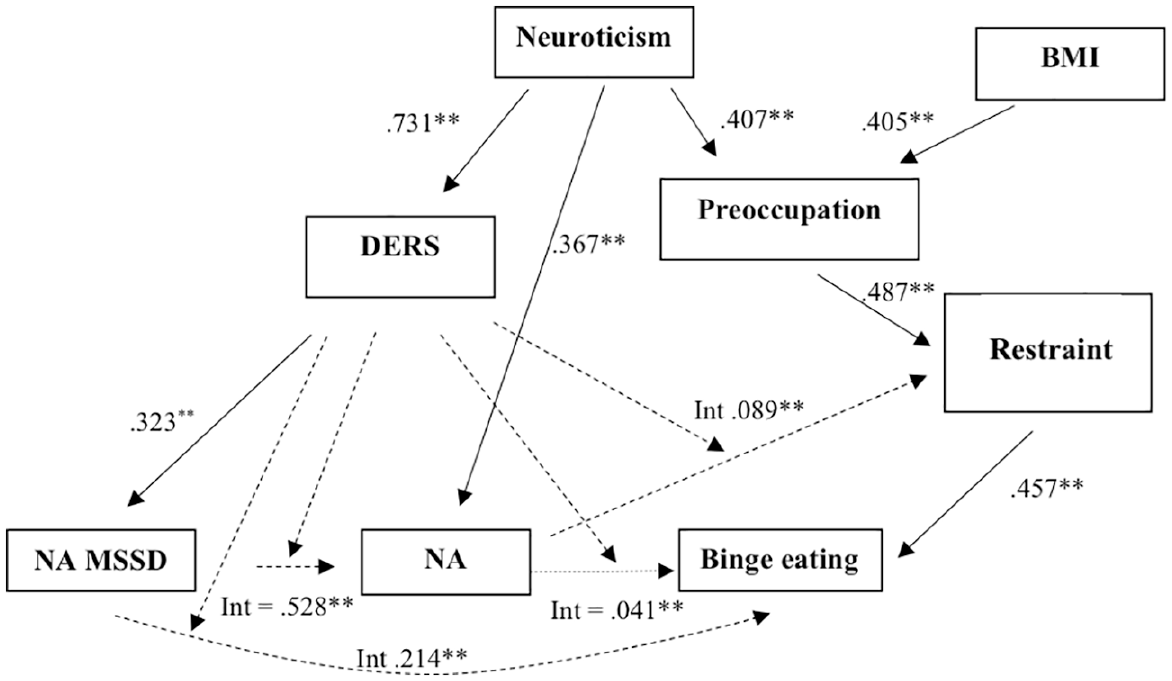
Structural model of emotional experience, emotion regulation difficulties, neuroticism, preoccupation with body image, and momentary restraint in predicting binge eating. Note: Standardized coefficients. Dashed lines represent moderation, int = interaction effect. *p < 0.05, **p < 0.01. DERS: Difficulties in Emotion Regulation Scale; NA: negative affect, measured via EMA; NA MSSD: fluctuations in negative affect, based on EMA measures.
Regression coefficients of the structural equation model predicting binge eating.

DERS: difficulties in emotion regulation scale; BMI: body mass index; N: Neuroticism; NA: negative affect; NA MSSD: fluctuations in negative affect; Preoccupation: EDAS subscale preoccupation with body-image and bodyweight. Binge eating, NA, and restraint were measured via EMA. NA MSSD was computed based on EMA ratings.
Discussion
The current study assessed the interplay of ER difficulties, dietary restraint, negative affect, fluctuations in negative affect, BMI, and preoccupation with body image in predicting BE.
We expected ER difficulties to have a multifold role in the model as it has been considered both a predisposing and a maintenance factor of psychopathology (Prefit et al., 2019). Starting from the state level, we aimed to specify the interrelations between fluctuations in negative affect, negative affect and ER difficulties. We found that the interplay between ER difficulties and fluctuations in negative affect predicted mean negative affect with a large effect size. Meaning that women with high ER difficulties and high fluctuations in negative affect reported high overall negative affect. It is plausible that without adequate ER skills rapid changes in emotions can lead to overall increase in negative affect. Similarly, ER difficulties did not have a significant main effect on negative affect while controlling for the interaction. We also tested the association between ER difficulties and restraint as it has been discussed that dietary restraint may be used as a strategy to regulate one’s emotions (Haynos et al., 2018). We found that the interaction between negative affect and ER difficulties, but not ER difficulties independently, predicted restraint. Thus, restraint may also serve as a strategy to regulate one’s emotions by providing distraction from distressing emotions and increasing sense of control.
Further, we found that women with high ER difficulties and high negative affect, and women with high ER difficulties and high fluctuations in negative affect reported more BE episodes. Again, ER difficulties did not have a significant main effect while controlling for the other variables. Our results are partly in accord with previous studies showing that negative affect and ER difficulties are associated with BE (Haedt-Matt and Keel, 2011; Prefit et al., 2019) but not independently. Moreover, our study suggests that negative affect alone does not lead to BE but can lead to maladaptive behavior when a person does not have sufficient skills to regulate them. Likewise, ER difficulties require an emotional disturbance to manifest into behavior. These findings support the notion that ER difficulties present a vulnerability factor that can enhance the effect of other risk factors such as negative affect. Additionally, our results suggest that in addition to overall negative affect, the affective instability needs to be considered regarding eating behavior as it can also set off maladaptive behavior in susceptible individuals (i.e. those with ER difficulties) (Berner et al., 2017; Kukk and Akkermann, 2017).
In addition to emotion-related aspects, we found that restraint significantly predicted BE. This corroborates with previous studies that restrained eating is a risk factor of BE (Fairburn et al., 2003) in the non-clinical populations as well. It has been discussed that restrained eaters are more vulnerable to BE due to rigid rules that lead them to all-or-nothing thinking when violating these rules (Herman and Polivy, 1993). Interestingly, although we assessed the intention to restrain rather than actual dietary restriction we still found that it was associated with BE. However, intention has been found to predict BE even better than self-reported restrictive behavior (Rodgers et al., 2018) indicating more of a cognitively mediated mechanism rather than just a physiological one. We also tested whether the interaction between restraint and negative affect predicted BE as it has been found that intensive negative emotions may trigger BE in restrained eaters (Evers et al., 2018) but the interaction was not significant. Therefore, restraint and ER pathways seem to be related yet operate independently in predicting BE.
We were also interested in what affects restraint itself. Namely, we wanted to assess how preoccupation was associated with BMI and restraint to get more insight on possible underlying mechanisms of BE. Preliminary analysis indicated that BMI predicted restraint (not shown in the paper) but not when controlling for preoccupation with body image. These results suggest that higher BMI itself is not directly associated with restraint but is mediated by the preoccupation. Preoccupation with bodyweight has been considered a core factor in maintaining eating disorders but our results indicate that it plays a role in BE at a subclinical level as well. However, our results are somewhat contrary to previous studies showing the association between BMI and dietary restraint (Dietrich et al., 2014) and restraint intention (Rodgers et al., 2018). It might be that the effect of BMI on restraint did not manifest due to our predominately healthy weight sample. Conversely, it has been discussed that the association between body weight and cognitive restraint is non-linear, meaning that the association is positive in healthy-weight individuals yet negative in overweight individuals (de Lauzon-Guillain et al., 2006). Longitudinal studies are necessary for specifying these associations but it is plausible that the relationship is bidirectional.
On the trait level, our expectation that neuroticism was linked to ER difficulties, mean negative affect and preoccupation was met. This is in line with the general knowledge that neuroticism is associated with general psychopathology including disordered eating (Jeronimus et al., 2016; Mills et al., 2018). Neuroticism has been found to be associated with various psychopathological indices such as low mood, maladaptive behavior, dysfunctional thinking styles (Mills et al., 2018). Although neuroticism is highly associated with ER difficulties it has been found that these are nevertheless distinct constructs and have predictive power beyond each other and other personality traits (Stanton et al., 2016), and thus both need to be acknowledged for a comprehensive understanding. Personality can influence the development of eating disorder symptoms as well as dysfunctional coping strategies that can amplify and/or maintain maladaptive behavior (Lee-Winn et al., 2016). These dysfunctional coping strategies related to personality traits can be a subject of intervention.
Strengths, limitations, and future directions
The strength of our study was that we integrated multiple risk factors to specify the potential underlying mechanisms of BE in the healthy-weight community sample. Also, we used structural equation modeling which enabled us to assess the applicability of multiple associations simultaneously. We used EMA data to assess real-life negative affect and fluctuations in negative affect as well as restraint and the occurrence of BE resulting in more reliable data without relying on retrospective recall.
However, our study had some limitations as well. We used cross-sectional data thus hindering causal inferences. It is plausible that the associations between these variables are bidirectional. For instance binge eating could lead to restraint and restraint, in turn, could lead to binge eating. Thus, the model depicts general associations rather than etiology. Our sample consisted of mainly young women so the results may not be applicable to general population or clinical populations. Still, young women are considered to be most at risk for BE (Erskine and Whiteford, 2018). The model should be tested in larger samples including men and various age groups. Another limitation is that we relied on the participants’ assessment regarding eating behavior that might not reflect binge eating objectively. Also, we did not ask participants whether they have had an eating disorder in the past potentially biasing the sample. However, the prevalence rates of binge eating are in line with other studies conducted in similar samples (Vanderlinden et al., 2001). Another future direction is to assess the role of specific emotions as aggregating them into mean negative affect could lose some valuable information.
In addition to neuroticism, other predispositional factors, such as impulsivity and reward sensitivity, should be addressed in further studies. Moreover, a facet of impulsivity—negative urgency—has been shown to be associated with BE over and above negative affect (Racine et al., 2017). However, we did not find significant associations between BE and impulsivity among community women in our previous study (Kukk and Akkermann, 2017). Given that impulsivity is a multifaceted construct a careful selection of variables is necessary. Lastly, a few recent models have highlighted the role of eating-related beliefs (e.g. “eating enhances my mood”) (Burton and Abbott, 2019) which role could be further tested in an integrated model.
Conclusion
We aimed to assess possible underlying mechanisms of BE by integrating well-studied risk factors in a non-clinical sample using EMA. Our results show that difficulties in regulating emotions may lead to BE when paired with emotional disturbances. Our study supports the role of emotion dysregulation as a transdiagnostic factor affecting different aspects of disordered eating (i.e. restraint and BE). Further, we specified the role of state level emotional variables in predicting BE. Additionally, our study suggests that restraint and ER pathways are related yet operate independently in predicting BE. These results have important practical implications for prevention highlighting the need to address both emotion regulation difficulties and restraint. Teaching ER skills such as being aware of ones emotions and having adequate strategies for regulating emotions can aid in preventing disordered eating (i.e. BE and dietary restraint). Also, implementing regular and balanced eating could prevent binge eating.
Supplemental Material
Appendix1 – Supplemental material for The interplay between binge eating risk factors: Toward an integrated model
Supplemental material, Appendix1 for The interplay between binge eating risk factors: Toward an integrated model by Katrin Kukk and Kirsti Akkermann in Journal of Health Psychology
Footnotes
Acknowledgements
We thank Hedvig Sultson for the help in data collection and all of the participants for their contribution. The authors received no financial support for the research, authorship, and/or publication of this article.
Declaration of conflicting interests
The author(s) declared no potential conflicts of interest with respect to the research, authorship, and/or publication of this article.
Funding
The author(s) received no financial support for the research, authorship, and/or publication of this article.
Data availability statement
Data will be available upon request.

Supplemental material
Supplemental material for this article is available online.
References
Supplementary Material
Please find the following supplemental material available below.
For Open Access articles published under a Creative Commons License, all supplemental material carries the same license as the article it is associated with.
For non-Open Access articles published, all supplemental material carries a non-exclusive license, and permission requests for re-use of supplemental material or any part of supplemental material shall be sent directly to the copyright owner as specified in the copyright notice associated with the article.
