




Abstract
This study investigated whether perceived physical activity norms moderated the effects of physical activity-related social interactions on intentions to engage in physical activity among community-residing older adults (N = 217). Structural equation modeling tested whether two types of social support and social control interacted with personal norms in predicting intentions to be active. Emotional and informational support were associated with higher intentions, and negative social control was associated with lower intentions to engage in activity. Each of these effects was more prominent in the context of weak personal norms, suggesting future research and interventions should consider joint effects of support and norms.
Physical activity is one the most important behavioral determinants of health and has been linked to cardiovascular disease, type 2 diabetes, and stroke (U.S. Department of Health and Human Services, Office of Disease Prevention and Health Promotion, 2018), which are among the most prevalent chronic conditions in later life and the most common causes of mortality. In addition to the positive physical health effects, physical activity is related to overall subjective well-being (Panza et al., 2019). Although it is recommended that older adults engage in 150 to 300 minutes of moderate physical activity each week (U.S. Department of Health and Human Services, Office of Disease Prevention and Health Promotion, 2018), inactivity, or infrequent moderate or vigorous physical activity (Gomes et al., 2017), may be particularly likely among this age group (Shaw et al., 2010), as declines in physical activity typically occur in older adulthood (Varma et al., 2017). This inadequate level of activity among older adults warrants renewed efforts to understand the social and psychological processes that may underlie physical activity behavior. Both social norms that favor physical activity and social exchanges with network members that encourage physical activity have been key factors of interest in understanding what may impact physical activity (Hagger and Chatzisarantis, 2009), but research thus far has not investigated their combined, interactive effects.
As proposed in the Theory of Reasoned Action (Fishbein, 1967; Fishbein and Ajzen, 1975), social norms are thought to work alongside attitudes to drive behavioral intentions, each weighted in importance according to the specific circumstances (Fishbein, 1967; Fishbein and Ajzen, 1975). That is, our beliefs about what others value help guide our decisions about whether or not to adopt certain lifestyle behaviors. Researchers have distinguished between descriptive normative beliefs, which provide information about what others tend to do, and injunctive normative beliefs, which provide information about what others think that we should do (Cialdini et al., 1991; Deutsch and Gerard, 1955). Although there has been considerable debate and research on which of these two types of norms is most important, research seems to suggest that both descriptive and injunctive norms play a significant role in understanding individuals’ behaviors (Rimal and Real, 2005). Although debate continues about their relative importance, behavioral intentions and health behaviors are more likely to occur when both types of norms are present (Kitayama and Burnstein, 1994).
Social network members also may affect an individual’s engagement in activity by providing social support (Heaney and Israel, 2008; Mendonça et al., 2014); support is expected to be a more important determinant when the support is specific to physical activity (Cohen, 2004; Newsom et al., 2018; Sallis et al., 1987). Network members not only provide support, such as emotional support and informational support, but they also may engage in direct attempts to influence an individual’s health behavior through social control (Franks et al., 2006). Network members may use positive social control strategies, which involve encouraging more activity in a constructive manner, or they may use negative strategies, known as pressure, which are generally expressed as criticism of inactivity (Lewis and Rook, 1999; Rook et al., 2011). Even though negative social control may be exerted in an attempt to encourage more activity, it may backfire, leading to behavioral resistance toward the healthy behavior, resulting in a tendency to disregard or engage in an unhealthy behavior intentionally (Tucker and Anders, 2001). For example, Berzins et al. (2019), found that pressure from a spouse was related to less frequent and shorter duration activity.
These studies have documented how social interactions, including support and control, can influence physical activity and other health behaviors, but research to date has not examined whether an individual’s response to social interactions may depend on the normative context. Several researchers have noted that observed social behavior provides important information to the individual about the appropriate actions in a given situation. Cialdini and colleagues (1991), for example, manipulated the level of ambiguity of norms about littering through alteration of environmental or social cues. The same process, in which social cues reduce the ambiguity of norms, is likely to occur for norms about physical activity. When a social network member clearly signals an attitude about physical activity through direct support or control behaviors, normative ambiguity should be reduced, acting as a trigger for the health behavior. By providing support or engaging in social control, the perceived importance of physical activity may also be increased, another factor that has been mentioned as a potential behavioral trigger (Cialdini et al., 2006; Burger and Shelton, 2011). Both salience and importance of social network norms are likely to be heightened when network members are closest to the individual, and thus, some network members are more likely than others to influence behavioral intentions and behaviors (Fishbein and Ajzen, 1980). Norms held by those who are closest or most central in one’s network are known as personal norms (Lapinski and Rimal, 2005). Personal norms should be more influential than societal norms because they are held by others who are perceived to be similar, who are perceived to be of the same group, and whom are more liked (Korcuska and Thombs 2003; Paek and Gunther, 2007; Rimal and Real, 2005; Yun and Silk, 2011). Thus, close network members should increase both the salience and the importance of norms that favor physical activity, having the most impact when norms are ambiguous. Such a dynamic process implies a statistical interaction between social support or control and perceptions about physical activity norms.
Although some research has focused on whether norms or social exchanges that encourage physical activity are more influential, no studies have examined how physical activity-related support or control interact with perceived physical activity norms. Courneya and colleagues (2000), studying adults under age 65, and Okun and colleagues (2003), studying college students, investigated social support and physical activity-related social norms together with the aim of comparing their relative importance. Both of these studies found that social support was more important than norms in predicting intention to engage in physical activity. The study by Okun and colleagues included a wider ranging assessment of social interactions, such as emotional support (activity affirming statements), companionship support (reports of joint participation in activities), informational support (statements about the benefits of exercise), and social negativity (comments that discourage engagement in physical activity). Esteem support was the only predictor of activity among these variables. Neither study assessed social control or examined the moderating effects of social norms on social interaction measures, and neither study investigated these factors among older adults.
The current study
The purpose of this study was to investigate the impact of physical activity-specific social support and social control on intentions to engage in physical activity. A primary concern was how domains of social support and social control that impact intentions to engage in physical activity may depend on the perceived norms regarding physical activity. Based on prior research and theory, we would expect that when it is less clear that personal norms are in favor of physical activity, social support and positive social control will increase behavioral intentions to engage in physical activity. In contrast, when personal norms are perceived to be clearly in favor of physical activity, social support and positive social control should have less of an impact on behavioral intentions because normative ambiguity is reduced. For negative social control, personal norms perceived to be clearly in favor of physical activity should buffer or counteract behavioral resistance (i.e. negative social control would be related to greater intentions to engage in physical activity). In the absence of clear personal norms, negative social control should act to discourage behavioral intentions because the individual is motivated to do the opposite, or it will have no impact because it leads the individual to disregard the criticisms or advice. This study goes beyond prior work by investigating these phenomena among an older adult population, one that may be particularly at risk for sedentary behavior and its serious effects on the development of chronic disease. Understanding how social support and social control operate in conjunction with social norms will be important for developing approaches to increase older adults’ engagement in physical activity.
Method
Sample
Participants included 217 older adults (
Participants were 58.5% women and mostly White (6.7% minority: .5% African-American 1.0% Hispanic, 1.9% Asian or Pacific Islander, and 2.9% other or mixed race/ethnicity); 47.9% were married, and 92.8% were college educated. Participants were 72.54 years old on average (SD = 5.28).
Procedure
Participants responded online to a survey after receiving an email invitation to participate in a survey about how individuals interact with family and friends about health, exercise, and nutrition. Of the 600 individuals contacted, 217 (36.2%) responded. The survey took approximately 20 minutes to complete and included questions regarding social interactions, health, physical activity, and sociodemographics. The study was approved by the Institutional Review Board for Human Subjects and all participants signed an informed consent form before participating. Participants were compensated with a $10 gift card in exchange for agreeing to complete the survey.
Measures
Sociodemographic
Sociodemographic items probed participants’ gender (male = 0, female = 1), marital status coded as two dummy variables with unmarried as the referent (unmarried = 0, married = 1; unmarried = 0, widowed = 1), race/ethnicity (White/non-Hispanic = 0, minority = 1), education level (1 = did not complete high school to 6 = doctoral degree), and age. These items were used as covariates in the analyses.
Physical activity-related social interactions
We expanded upon previous work (e.g. Lewis and Rook, 1999; Stephens et al., 2009) by adapting existing measures to be geared towards physical activity related to social interactions (Newsom et al., 2018). Specifically, we focused on social support and social control relating to physical activity. We included four items for each of the four domains of interest (16 items total): informational support, emotional support, positive social control, and negative social control. These were included based on our review of the literature and were added to existing items from measures used in prior work. Each question began with “During the past month, how often did someone you know . . .?” and participants rated their responses on a 7-point response scale (1 = never, 2 = less than once a month, 3 = once a month, 4 = 2–3 times a month, 5 = once a week, 6 = 2–3 times a week, and 7 = daily). Physical activity-related emotional support (α = .89) was assessed with questions such as “show they appreciated your efforts to do something active?” Physical activity-related informational support (α = .80) was assessed with questions such as “give you useful information about the benefits of physical activity?” Positive strategies of social control (α = .76) were assessed with questions such as “encourage you to be more physically active?” Negative strategies of social control (α = .95) were assessed with questions such as “criticize you or make you feel bad about not being active enough?” Newsom et al. (2018) conducted confirmatory factor analyses on the present sample and a four-factor model for the measures (emotional support, informational support, positive social control, and negative social control) fit the data well.
Physical activity intentions
Physical activity behavioral intentions (α = .85) were measured using five items based on previous work (e.g. Prochaska and Velicer, 1997). Participants responded to items such as “I am strongly committed to increasing my level of physical activity or maintaining an already active life- style” and “I intend to be physically active in the next 6 months.”
Personal norms
Participants rated the extent to which others have beliefs that approve of physical activity on six items adapted from Park and Smith (2007). Personal injunctive norms were measured using two items: “Most people who are close to me approve of being physically active” and “Most people whose opinion I value approve of being physically active.” Personal descriptive norms were also measured using two items: “Most people who are close to me are physically active” and “Most people whose opinion I value are physically active.” Lastly, subjective norms were measured using two items: “Most people who are important to me think that I should be physically active” and “Most people whose opinion I value think that I should be physically active.” All items were rated on a 7-point scale, ranging from “very strongly disagree” to “very strongly agree.”
Analysis overview
Structural equation modeling (SEM) was used for all analyses. SEM has the advantages of latent variable estimation that accounts for measurement error, allowing for more accurate regression estimates and ease of high-quality missing data estimation. All analyses were conducted with Mplus version 8.3 (Muthén and Muthén, 1998–2017). Full information maximum likelihood for missing data was included in the analyses. There was no more than 3% of cases with univariate missing values and no more than 6% of cases with bivariate missing data. There were 10 different patterns of missing data, each with under 3% cases missing, suggesting no important systematic reasons for missingness. For confirmatory factor analyses, robust standard errors and scaled chi-square values were used due to mild to moderate skewness and kurtosis (MLR estimator in Mplus; Yuan and Bentler, 2000). The sample size for all models was 217. Figure 1 summarizes the steps in the analysis.

Block diagram of analysis steps.
Latent variable interactions were included in the final predictive models to investigate whether personal norms would moderate the association of physical activity-related social support and control on behavioral intentions to engage in physical activity. Estimation of latent variable interactions was conducted using maximum likelihood estimation with integration (Klein and Moosbrugger, 2000). This approach, a full information maximum likelihood approach, sometimes referred to as simply “latent moderated structural equation (LMS) modeling,” has been shown to have unbiased parameter estimates, correct Type 1 error rates, have high statistical power (Cham et al., 2017), and to be the most efficient when predictors are not highly nonnormal (Cham et al., 2012). Latent variables were scaled using effects coding (Little et al., 2006), which creates latent variables with means equal to zero and variances based on all items loading on the factor. Traditional fit indices are not available with the LMS estimation approach, only information criteria (e.g. Bayesian Information Criteria; BIC), which are designed only for relative model comparisons and do not provide interpretable information about the overall fit of a particular model. Moreover, because the models tested are saturated in the structural portion of the model (all correlations among exogenous predictors and all paths predicting the outcome were included), fit information would not provide useful information about the validity of the causal structure.
Because our focus was on the interactive effects of social norms and social support/control rather than on their independent effects, we examined separate models for each of the social support and social control constructs. In a prior study (Newsom et al., 2018), although we found that social support and control constructs were distinct, they were highly correlated and we found few independent effects of support and control in their prediction of physical activity intentions, even though together and separately the variables accounted for a substantial portion of the variance in intentions.
Results
Confirmatory factor analysis of personal norms
An initial three-factor model of personal norms, with injunctive, descriptive, and subjective specified as correlated factors, indicated a good fit to the model, Comparative Fit Index (CFI) = .987, Standardized Root Mean Square Residual (SRMR) = .011, according to recommended cutoffs proposed by Hu and Bentler (1999), although the chi-square was significant, χ2YB(6) = 14.119, p = 0.028. All standardized loadings were high (
Latent variable interaction models
Four latent variable interactions, each between one of the domains of physical activity-related support or control and the second-order personal norms factor, were tested to investigate the moderating effect of personal norms in the relationship of social interactions and physical activity intentions. All models included gender, marital status (married and widowed dummy variables), race/ethnicity (minority vs White non-Hispanic), education level, and age as covariates, which were grand mean centered to improve plot interpretability. Table 1 provides means (prior to centering), standard deviations, and correlations among all variables used in the model.
Correlations and means among study variables (N = 217).

Note. All values are based on full maximum likelihood estimation for missing data. ± The referent group for married and widowed was unmarried. Effects coding to scale the latent variables produces factor means equal to zero (Little, Slegers, and Card, 2006). *p < 0.05, **p < 0.01, ***p < 0.001.
Informational support × personal norms
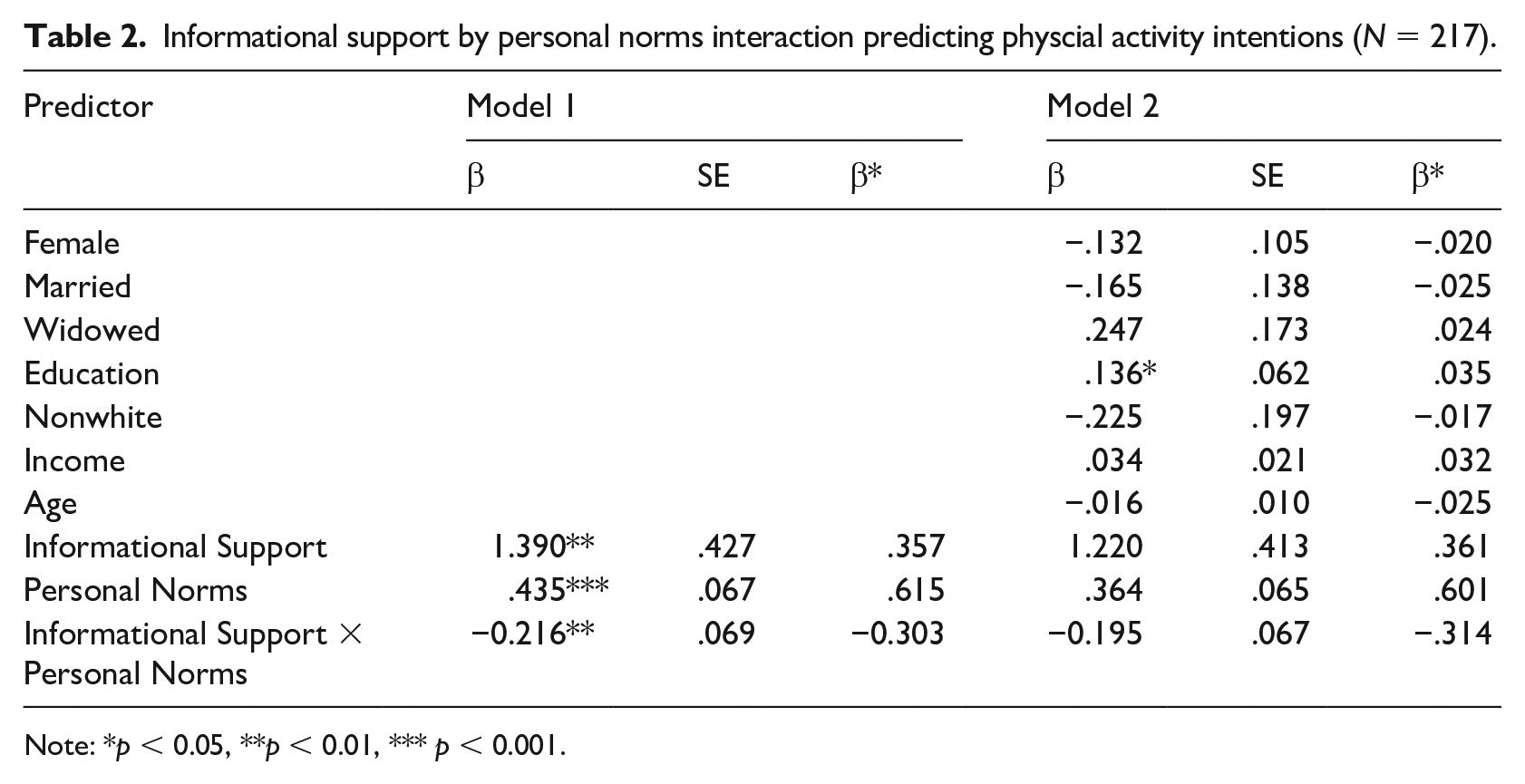
Results from the model with informational, support, personal norms, their latent variable interaction and covariates are shown in Table 2. Unstandardized coefficients are indicated by β and standardized coefficients are indicated by β*. Among the covariates, only education was a significant predictor. There were significant main effects for the second-order personal norms factor, informational support, as well as their interaction. Those who perceived norms to be more favorable of physical activity and those who reported more information support related to physical activity were more likely to report intentions to engage in physical activity. Figure 2 plots the interaction and indicates that informational support for physical activity had a stronger relationship to intentions when perceived norms were low and a weaker relationship to intentions when norms were high. Simple slopes analyses tested the association between informational support and physical activity intentions, at low (−1 SD), moderate (mean), and high levels (+1 SD) of personal norms. Results revealed a positive association between informational support and physical activity intentions that was strongest at low levels of personal norms, β = .465, SEβ = .174, β* = .422 p < 0.01, followed by mean levels of personal norms, β = .275, SE β = .113, β* = .250, p < 0.05, and was not significant at high levels of personal norms, β = .084, SE β = .075, β* = .076, ns.
Informational support by personal norms interaction predicting physcial activity intentions (N = 217).
Note: *p < 0.05, **p < 0.01, *** p < 0.001.

Informational support by personal norms interaction predicting physical activity intentions.
Emotional support × personal norms
A similar model was tested investigating a latent variable interaction between the personal norms second-order factor and emotional support, with results presented in Table 3. Both the second-order personal norms factor, and emotional support, had significant main effects predicting physical activity intentions. Adults with stronger social norms and greater emotional support reported the highest intentions for physical activity. The interaction between personal norms and emotional support was also significant. Additionally, education was the only significant covariate such that participants with greater education reported greater intention to exercise. The interaction is plotted in Figure 3 and suggests that when social norms relating to physical activity are low, it is most beneficial, for behavioral intentions, to have greater emotional support. Simple slopes were also computed to investigate the association between emotional support and physical activity intentions, at low (-1 SD), moderate (mean), and high levels (+1 SD) of personal norms. At low, β = .312, SE β = .089, β* = .595, p < 0.001, and mean levels of personal norms, β = .185, SE β = .055, β* = .353, p < 0.01, the association between emotional support and physical activity was significant and positive, but was not significant at high levels of personal norms, β = .059, SE β = .044, β* = .113, p = ns.
Emotional support by personal norms interaction predicting physcial activity intentions (N = 217).

Note: *p < 0.05, **p < 0.01, ***p < 0.001.
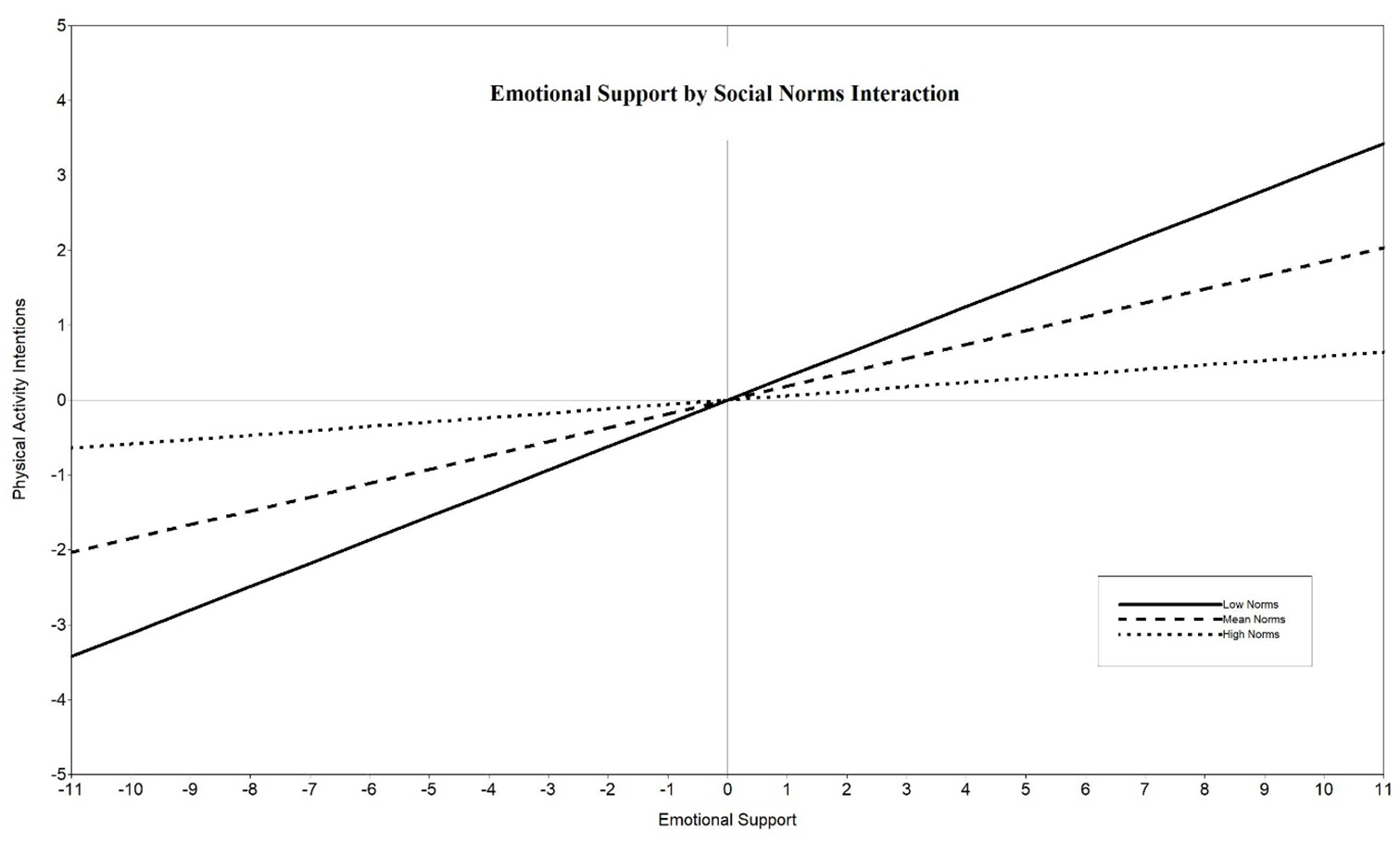
Emotional support by personal norms interaction predicting physical activity intentions.
Positive social control × personal norms
Results from a model with positive social control predicting physical activity intentions, moderated by personal norms are displayed in Table 4. The second-order personal norms factor had a significant and positive main effect predicting physical activity intentions, such that those who reported the greatest personal norms also had the greatest intentions to engage in physical activity. Positive social control and the interaction term were not significant predictors of physical activity intentions. Similar to previous models, education was the only significant covariate.
Positive social control by personal norms interaction predicting physical activity intentions (N = 217).

Note: *p < 0.05, **p < 0.01, ***p < 0.001.
Negative social control × personal norms
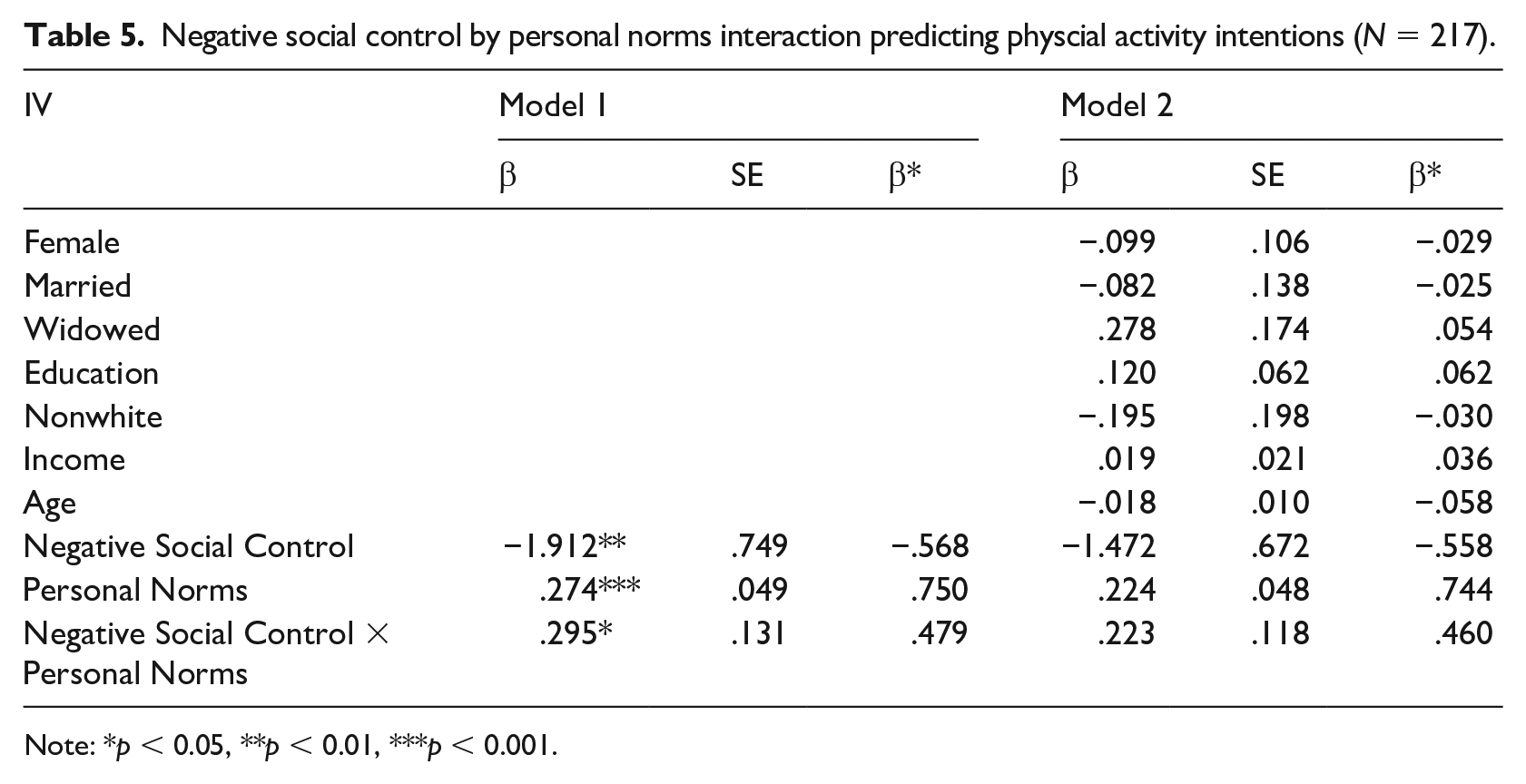
Results from a model testing the interaction between negative social control and the second order personal norms factor are presented in Table 5. There were significant main effects for negative social control, personal norms, and the interaction term. Greater negative social control was related to decreased physical activity intentions. Personal norms were associated with increased physical activity intentions. The interaction term was also significant. The interaction is plotted in Figure 4 and was further investigated using simple slopes analyses to examine the association between negative social control and physical activity intentions, at low (−1 SD), moderate (mean), and high levels (+1 SD) of personal norms. At low, β = −.741, SE β = .260, β* = −.440, p < 0.01, and mean levels of social norms, β = −.455, SE β = .145, β* = −.270, p < 0.01, there was a significant, negative association between negative social control and intent to exercise. When social norms are high, the association between negative social control and intent to exercise was not significant, β = −.169, SE β = .092, β* = −.100, p = ns.
Negative social control by personal norms interaction predicting physcial activity intentions (N = 217).
Note: *p < 0.05, **p < 0.01, ***p < 0.001.
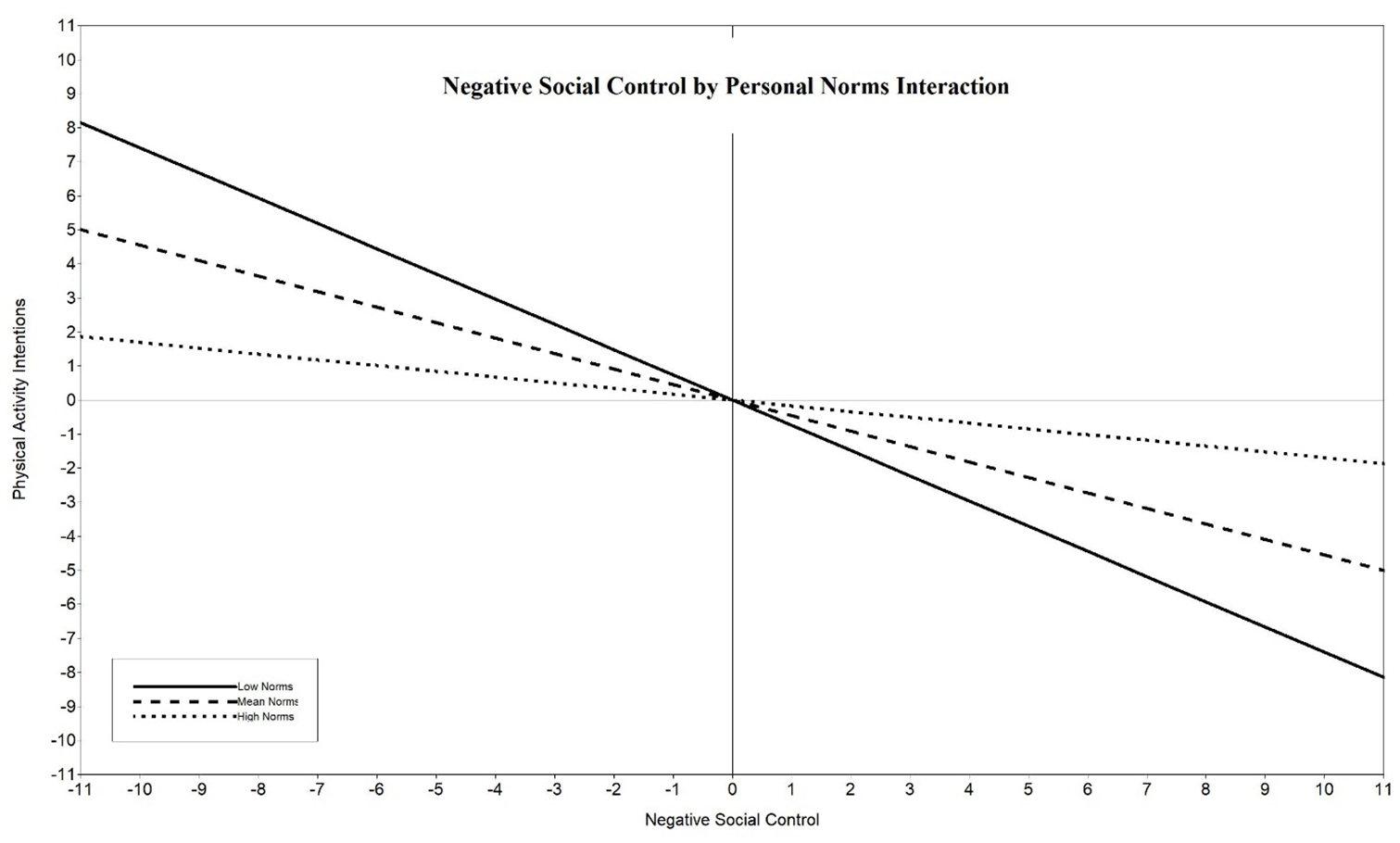
Negative social control by personal norms interaction predicting physical activity intentions.
Discussion
Physical activity is an important health behavior that has been linked to a variety of health conditions in mid to late life (U.S. Department of Health and Human Services, Office of Disease Prevention and Health Promotion, 2018). Previous work has suggested that the social context, including social norms and social interactions like social support and social control, are important for health behaviors generally (e.g. Heaney and Israel, 2008; Mendonça et al., 2014). The present study moves beyond prior work by focusing on both social interactions and social norms that are specifically related to intentions to engage in physical activity and, in particular, by investigating interactions between these factors in predicting behavioral intentions to engage in physical activity. The results provide evidence for the importance of considering both social norms and social support and control in conjunction when developing approaches to increase older adults’ engagement in physical activity.
We specifically focused on personal norms relating to physical activity, comprised of personal injunctive, personal descriptive, and subjective norms, and how personal norms interacted with four different aspects of social support and control. In separate models, informational support, emotional support, and negative social control all significantly interacted with the second-order personal norms factor, indicating that the effects of these kinds of social interactions on intention to exercise depend on the personal norms relating to physical activity. This was not the case for positive social control, which was not related to physical activity intentions. Additionally, simple slopes analyses indicated that when there were strong personal norms in favor of physical activity, the association between the three significant social interaction variables (informational support, emotional support, and negative social control) and physical activity intentions was no longer significant, suggesting that efforts to support older adults’ physical activity are less effective for those who already have high social norms relating to physical activity. It appears to be that, in the presence of greater ambiguity about normative beliefs held by social network members regarding physical activity, social interactions that clearly signal approval of physical activity have an impact on intentions to engage in that behavior. Interestingly, however, negative social control attempts, which reflect criticism or less constructive attempts to influence behavior, appear to be detrimental in the absence of clear norms favoring physical activity.
The results are generally consistent with prior work from two separate streams of research by indicating that received support is related to physical activity and intentions to engage in physical activity and that social control impacts health behaviors. In our models, we found support for the beneficial effects of both informational and emotional support on physical activity intentions, such that those who reported receiving greater support also had greater intentions to engage in physical activity. These finding are consistent with previous work on the benefits of social support on health behaviors (e.g. Heaney and Israel, 2008; Mendonça et al., 2014) and specifically on physical activity (e.g. Newsom et al., 2018; Sallis et al., 1987). The findings indicate that both emotional and informational support encouraged intentions to engage in physical activity and that these two types of support may have an impact through different mechanisms. Emotional reactions may be key for motivational pathways through increasing self-efficacy (Bandura, 1977) or increasing optimism about positive outcomes (Schwarzer, 1999), whereas informational support may have effects through cognitive pathways, either by providing new information (Fisher and Fisher, 2000), making health benefits more salient (Pligt and De Vries, 1998), or by reducing perceived barriers (Becker, 1974).
The social support findings are in contrast to the social control findings in the present study, however, because positive social control was not related to physical activity intentions, and greater negative social control was associated with reduced physical activity intentions. Prior work has found that social control can have complex relationships to behaviors, as some researchers have found positive effects (e.g. August and Sorkin, 2010; Hughes and Gove, 1981) and others have found negative effects (e.g. Franks et al., 2006; Helgeson et al., 2004). Part of the puzzle can be solved by distinguishing between negative and positive control attempts. Negative control often involving intentions to encourage behavior may sometimes have detrimental impacts on preventive health behaviors, may increase health risk behaviors (Tucker and Anders, 2001), or may only lead to negative emotional responses with little impact on behavior (Lewis and Rook, 1999). The effect on negative mood, however, may indirectly affect intentions to engage in healthy behavior, perhaps through reduced motivation (Salovey and Birnbaum, 1989; Salovey et al., 2000). Negative social control also may reduce an individual’s intentions to engage in physical activity through reactance (Brehm, 1966; Butterfield and Lewis, 2002; Logic et al., 2009) or avoidance (Berzins et al., 2019; Lochbaum and Gottardy, 2015).
Most interesting, and of primary concern, was that support and control depend on the context of perceived norms. Support or control actions seem to be interpreted differently by the individual depending on the perceived favorability or ambiguity (Cialdini et al., 1990) of the network’s beliefs about the value of physical activity. Supportive or control exchanges from particular individuals in the network do not have effects in a vacuum but depend on how the network is perceived in general. Where norms are already clear, support does not add much to motivation to engage in physical activity, potentially because motivation to engage in physical activity is already high. When social norms are weaker or less favorable toward physical activity or ambiguous, support from a network member for engaging in physical activity may increase the salience of norms (Fishbein and Ajzen, 1980) that favor physical activity and, thus, increase the individual’s motivation to engage.
The pattern of results for social control in the presence of perceived norms differed from the pattern of results for social support. Negative social control was only associated with less intention to engage in physical activity when perceptions of favorable physical activity norms were less clear. It may be that when a network member is critical or hurtful in attempting to influence behavior that the recipient reflects on perceptions about normative beliefs held by other members of the network, in which clear norms favoring physical activity mitigate the otherwise detrimental effects of negative social control. Regardless of the mechanism for reduced intentions, direct attempts by network members to influence behavior are either ineffective, in the case of positive control attempts, or harmful, in the case of negative control attempts. This pattern of results further underscores the need to consider positive and negative social control as separate constructs with differing consequences.
Although the present study adds important information to existing knowledge about social relationships and physical activity, there are several potential limitations. Support, control, and norms measures concern perceptions about interactions and others’ beliefs. These perceptions may not accurately reflect actual behaviors (e.g. Perkins et al., 2005) or behaviors held by others, but it is an individual’s perceptions that is theorized to guide motivations and behaviors (Fishbein and Azjen, 1975). Our analyses focused on intentions rather than behavior, but intentions are viewed a key component and initial step toward behavior in the Theory of Planned Behavior (Ajzen, 1991). Intentions are not always converted to behaviors but prior work suggests a strong relationship between intentions and behaviors (Webb and Sheeran, 2006). Further, the analyses in the present study involved a global measurement of personal norms and did not distinguish between injunctive and descriptive norms as other researchers have done (e.g. Park and Smith, 2007). Psychometric analyses, however, indicated that these subfactors are highly related in this sample and, even though the constructs may be distinct, they would have been unlikely to be distinguishable in their effects. The participants in this study were mostly White and highly educated, which may limit generalizability of the findings. Another important limitation is that this study is based on cross-sectional data and experimental and longitudinal research is needed to help determine directionality of the observed relationships. This study collected data with an online survey, which has advantages for convenience of delivery and data entry, but can reduce response rates (Fan and Yan, 2010). The survey response was typical for online surveys among older adults (Quinn, 2010), but not high (32%), likely due, at least in part, to the extensive questionnaire used. Lower response rates may reduce generalizability, and there is some evidence, but often mixed evidence, that lower response rates reduce sociodemographic representation among males, those with lower income, and those in ethnic and racial minority groups (Holbrook et al., 2008).
The limitations outlined above notwithstanding, these findings also have implications for influencing behavior change in older adults specifically relating to physical activity. Due to the importance of physical activity in relation to physical health and well-being, future interventions should understand the importance of both social norms relating to physical activity, and of informational and emotional social support, while discouraging negative social control. Existing interventions have shown success with providing support (e.g. Cavallo et al., 2014), for example, but they have yet to incorporate more complex processes of the interdependence of support and norms that seem to be evident in the results from the present research. While network members engaging in negative social control with older adults may have the best intentions in motivating older adults to be physically active, our findings provide evidence that negative social control not only is ineffective but can have the opposite effect by being related to decreased intention to be physically active. Encouraging friends and family of older adults to be supportive of their physical activity may be more beneficial than focusing on efforts to engage in influencing their behavior through the use of positive or negative social control. It is necessary to understand that the effects of support and control appear to depend on the perceived norms around physical activity for older adults, as our findings suggest that norms regarding exercise also have a strong influence on intention to engage in physical activity.
