




Abstract
Most Mexican-Americans do not meet current physical activity recommendations. This paper uses the ORBIT model of obesity intervention development as a framework to outline the process of establishing three employer-based walking challenges in El Paso, Texas, a predominantly Mexican American community. The walking challenges were planned and implemented through the Border Coalition for Fitness and participating partnering organizations. Over 2000 participants and several employers took part in the walking challenges. Results from this ORBIT Phase 1 design intervention suggest that walking challenges are a feasible approach to increase physical activity in Mexican-Americans.
Introduction
Physical activity among Mexican Americans is suboptimal, as about half do not meet current physical activity guidelines (Vidoni et al., 2019). Commonly cited barriers include inadequate built environment to support leisure-time physical activity (Perez et al., 2019; Rutt and Coleman, 2005; Salinas et al., 2018), socioeconomic barriers that prevent low income Mexican Americans access to gyms and other venues that support physical activity (Parra-Medina et al., 2011), and cultural norms around gender roles and familial responsibilities (Chang et al., 2018). To address these barriers, interventions to promote physical activity among Mexican Americans and other Latino groups have primarily delivered programming with broad educational components and attempted to address barriers related to culture (Carr, Leonhard et al., 2016a; Vidoni et al., 2019). However, these programs have not had the success as hoped to change persistently low physical activity engagement among Mexican Americans overall. Therefore, new innovative programs that address culture, as well as, other environmental barriers are needed to increase physical activity engagement in this population.
Mexican Americans have high workforce participation and tend to work in occupational sectors that are associated with long periods of sedentary time such as in offices or the education sector (US Census Bureau, 2018). Few studies have taken into account employment status or occupation as additional barriers to physical activity for Mexican Americans (Gay et al., 2017), despite the growing pervasiveness of work-based wellness programs in other groups (Pieper et al., 2019). Additionally, although there is a growing body of literature that has assessed the effectiveness of wellness programming on sustained physical activity and on employer-level barriers to wellness program offerings, studies have largely occurred outside of the United States, and none have been conducted on any Latino group (Bailey et al., 2018; Garne-Dalgaard et al., 2019; Holly & Swanson, 2019; MacEachen et al., 2010; Michaels and Greene, 2013; Sedani et al., 2019; Stankevitz et al., 2017; Taylor et al., 2016).
Pasos Para Prevenir Cancer (PPPC) is a multilevel obesity-related cancer prevention program in El Paso, Texas. The program has three components: (1) Provide community outreach and education to increase health literacy, (2) offer training to healthcare professionals on addressing obesity in the clinic setting, and, (3) finance infrastructure to support a coalition to promote physical activity in El Paso. Members of the coalition represent both public and private organizations, as well as El Paso residents who have a special interest in physical activity. From the coalition collaborations, three employer-based walking challenges were established with over 2000 participants. The purpose of this paper is to provide evidence of feasibility of a walking challenge program in El Paso, Texas, a predominantly Mexican American community. This study will provide the basis for a subsequent study to assess effectiveness.
Methods
This paper makes use of the Obesity-Related Behavioral Intervention Trials (ORBIT) model (Czajkowski et al., 2015) as a framework to plan and implement three BCF-PPPC-sponsored employer-based walking challenges to increase physical activity engagement in Mexican Americans living in El Paso, Texas. El Paso, Texas is predominantly Mexican American (82%) (U.S. Census Bureau, 2019), and therefore provides the ideal location to test an intervention to increase physical activity engagement. The ORBIT model provides similar process structure as a randomized clinical trial to test drug efficiency, using phased objectives and milestones. We report on objectives and achieved milestones for Phase 1: Design of our walking challenge programs.
ORBIT Phase 1a: Define
In the ORBIT model Phase 1a: Define stage, the primary objectives are to identify the basic behavioral elements of the intervention and hypothesized relationships between the behavior and direct or indirect benefits to health (Czajkowski et al., 2015). In this section, we describe the evidence that we used as rationale for our challenges and the process of establishing the three challenges.
Objective 1: Examine the scientific evidence on the benefits of physical activity on health
There is substantial evidence that regular physical activity improves quality of life (Grant et al., 2017; Kelly et al., 2018; Song et al., 2018; Zapata-Diomedi et al., 2019), reduces the risk of cancer and other chronic diseases (Aune et al., 2015; Carr, Dunsinger et al., 2016b; US Census Bureau, 2018; Duvivier et al., 2017; Lanier et al., 2016; Oja et al., 2018; Zapata-Diomedi et al., 2019) and can also help manage existing chronic conditions (Gay et al., 2017). The general guidelines of 30 minutes of moderate to vigorous physical activity 5 days a week has been accepted by governmental agencies and special interest groups (American Heart Association, 2018; Division of Nutrition, Physical Activity, and Obesity, 2020) and walking regularly is one option to achieve these set of recommendations (Zapata-Diomedi et al., 2019). Nevertheless, current estimates indicate that 27.2% of El Pasoans do not engage in any leisure-time physical activity (Texas Department of State Health Services, 2020). Of concern is the high prevalence of uncontrolled hypertension, diabetes and obesity-related cancers in Mexican Americans that live in the city (Paso del Norte Health Foundation, 2020).
Objective 2: Assess walking interventions as promising approaches to increase physical activity in El Paso, Texas
The benefits of walking on health have been well studied and there is a general consensus that walking significantly reduces the risk of chronic disease and mortality (Zapata-Diomedi et al., 2019). A 3-year follow-up study on a pedometer-based walking intervention noted that both postal and nurse advice groups continued to improve their steps per day by roughly 600 steps in comparison to a usual care group, (Harris et al., 2018). The same study found that patient aged 60-75 in a nurse intervention group continued to walk an extra 400 steps per day in a 4-year follow-up, (Harris et al, 2018). Given the established benefits of walking, there have been a number of successful intervention approaches that involved group walking clubs, competitions, and employer-based incentive programs (Adams et al., 2017; Macmillan et al., 2018; Hunter et al., 2019; Pillay et al., 2012; Walker al., 2017). Employer-based programs have incorporated physical activity into larger comprehensive programs based on a point system to encourage employees to adopt better health behaviors (Carr, Leonhard, et al., 2016a; Hunter et al., 2019; Pillay et al., 2012; Pedersen et al., 2009; Song and Baicker, 2019). Some have included walking challenges to increase walking during the workday and to create a walking work-culture (Al-Mohannadi et al., 2019; Corbett et al., 2018; Freak-Poli et al., 2011; Mansi et al., 2015; Mathew et al., 2019; Walker et al., 2017). Given the evidence that employer-based walking programs are feasible approaches to increasing physical activity engagement, we began planning a program in El Paso with the establishment of a coalition.
Objective 3: Establish the Border Coalition for Fitness as a driver of a walking agenda
We established the Border Coalition for Fitness in 2015 to address the low levels of physical activity engagement in El Paso, Texas. We recruited members from city, county and private organizations, as well as, interested private citizens. We met regularly with members to identify barriers and potential solutions to low physical activity engagement. We provided members with the scientific evidence and assessed existing opportunities and resources in the city to increase physical activity among residents. While consensus building was initially challenging because of specific stakeholder interests (e.g. biking, racing, park use) the members were able to agree on walking challenges, due to their increasing popular in other parts of Texas and the compelling scientific evidence presented in meetings (It’s Time Texas, 2020) . This agreement among all members was the first step in implementation of the employer-based walking challenges tested in this study.
Objective 4: Develop three walking challenges based on scientific evidence
To expand our reach and appeal to varying fitness levels, we opted to offer more than one themed competition. Offering walking challenges of varying lengths and degree of difficulty provided participants with multiple choices to meet their target goal, (Grindell et al., 2018). Each of the three challenges utilized step-counting technologies (Fitbit, Apple Watch, pedometer, etc) to measure an individual’s daily step activity during the challenges. Several studies found a significant correlation between consumer level step-counting technologies steps/day with research-grade step counting technology, (Tully et al., 2014; Ferguson et al., 2015; Grindell et al., 2018). Fulk et al (2014) used a Two-Minute Walk Test (2MWT) to determine the accuracy for step counting of the Fitbit Ultra and the Nike+Fuelband in comparison to two research-grade pedometers, the StepWatch Activity Monitor (SAM) and the Yamax Digi-Walker SW-701 pedometer (YDWP). Results indicate that the Fitbit Ultra performed similarly to the SAM and superior to the YDWP, (Fulk et al., 2014). REDCap and Microsoft Excel were used to facilitate registration and reporting surveys. Some form of incentive was offered when available, ranging from t-shirts and water bottles to cash prizes. Below is a brief description of each challenge and incentives.
Walk the Walk Team Challenge: A group approach
There is a vast literature on the effectiveness of walking groups on regular individual engagement in walking (Hanson et al., 2016) The available evidence suggests that group walking provides social support and motivation for regular engagement (Hallam et al., 2018; Hanson, et al., 2016; Loya, 2018). The Walk the Walk Team Challenge was therefore intended to offer participants a group-based experience consistent with scientific evidence and to offer social support for physical activity as a cultural element that is important in implementing physical activity programming in Latino groups (Marquez et al., 2016).
The challenge occurred in April of each year (2018, 2019) and was the largest and most competitive of the challenges. Participants formed teams of 10 people to take part in this month-long, team walking competition. Teams reported most overall steps weekly, and standings were reported to all participating teams through email. Three winning categories were created to keep teams motivated regardless of their standings. Three prizes were awarded to teams who (1) had the most overall steps, (2) had the most improved steps, and (3) correctly answered a list of physical activity-related trivia questions. We added the trivia questions rather than a raffle to provide a challenge, since the reward was $1000. For the final standings, teams were ranked from greatest to least with their total steps for the entire month. Most improved steps was measured as an average increase in team’s steps from week-to-week, without ever decreasing in steps. Finally, teams that remained in the challenge until the end were eligible to participate in a trivia contest that was also associated with a cash prize. In 2019, $1000 were awarded to each of the 3 winning teams, and t-shirts were purchased for top contending teams.
Step Bootcamp: Tailored goal setting to incrementally increase weekly averages
Individualize prescriptive physical activity regimes have largely been studied in clinical settings (Cox et al., 2017; Geidl et al., 2017; Murawski et al., 2019; Polgreen et al., 2018; Rossen et al., 2015). In most cases physicians and other healthcare professionals prescribe patients a physical activity plan that might include regular activity or gradual increases in intensity over time. (Bycura et al., 2019; Polgreen et al., 2018; Bycura et al., 2019; Murawski et al., 2019; Cameron et al., 2018).
This 9-week long challenge was based on an individualized prescription of weekly step goals. As the name implies, Step Bootcamp “trained” participants of all abilities to reach their full potential in daily steps. At registration, the participant inputs a baseline step average from that moment in time; by the end of the challenge, individuals reached three times their baseline average, determined by the month prior’s average step count. Participants received points each week for reaching their step goals and were also given bonus points if they joined offered hikes at local parks or trails. The participant with the highest points at the end of the challenge received a donated prize package. In 2019, a t-shirt, water bottle, and certificate of completion were awarded to every individual who successfully finishes the challenge.
10,000 Steps for 100 Days: Reaching the recommended steps everyday
While the national physical activity guidelines do not specifically state steps per day, (Oja et al., 2018) there has been substantial literature approximating the step equivalent (Pillay et al., 2012; Walker et al., 2017; Hallam et al., 2018).
The 10,000 Steps for 100 Days challenge required participants to reach 10,000 steps every day for over 100 days (over 3 months), creating long-term increased walking habits from October 1st to January 9th. The autumn-winter season was deliberately chosen to challenge individuals to remain physically active regardless of major holidays and events. Participants were not given cheat days in the 2018 challenge and were given one cheat day in the 2019 challenge. This strict rule was enforced to push participants into consistent and sustained physical activity. Participants reported on Monday of each week. In 2018 and 2019, a t-shirt, water bottle, and certificate of completion were awarded to every individual who successfully finishes the challenge.
Milestone: Walking challenges identified as a strategy to increase physical activity engagement and improve health among Mexican Americans in El Paso, Texas
Using scientific evidence of the health benefits of walking as a basis, we partnered with community stakeholders in our coalition to create a plan to increase physical activity in El Paso, Texas. The Border Coalition for Fitness served as a neutral place to find common ground for walking challenges. Three walking challenges were designed to offer variation in approach based on scientific evidence that could be later tested to determine the most effective approach in increasing and sustaining walking engagement.
Phase 1b: Refine
In the ORBIT model Phase 1b: Refine, efforts were made to assure efficiency and key components will be successful (Czajkowski et al., 2015). Activities in this phase included identifying the best mode of delivery and addressing problematic protocols and procedures before advancing to formal intervention testing.
Objective 1: Create a sustainable mechanism to recruit challenge participants
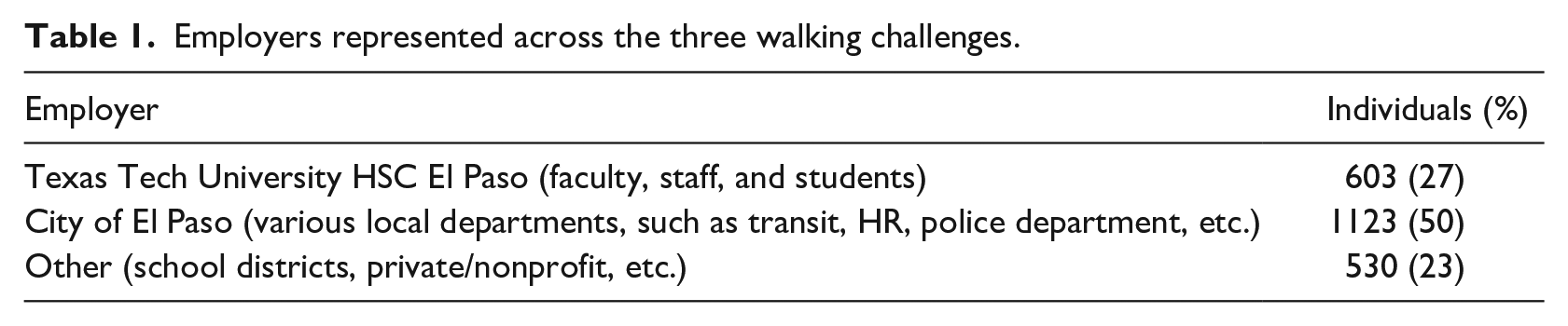
Participants were primarily recruited through the Border Coalition for Fitness (BCF) members. As we continued the challenges we developed a listserv of Border Coalition for Fitness members, previous participants, area employers, and school district parent engagement coordinators, which expanded our reach and increased registrants. Announcements were also posted on the Texas Tech University Health Sciences Center El Paso weekly newsletter and on the coalition Facebook page. As we offered multiple challenges, employers began to offer wellness credits and other benefits to employees who participated. Table 1 shows a breakdown of participating employer sites across challenges. The City of El Paso and Texas Tech University Health Sciences Center El Paso had the highest number of participants followed by other employers that included private businesses and school districts. Figure 1 displays the number of participants who participated in multiple challenges, followed by other employers. Similarly, the City of El Paso had the most participants in more than one challenge. Of note, the City offered wellness credit for participation. Despite the lower numbers of overall participants, other employers were therefore more likely to have repeating participants than the Texas Tech University Health Sciences Center El Paso.
Employers represented across the three walking challenges.

Participation in multiple challenges.
Objective 2: Assess trends in registration and challenge completion
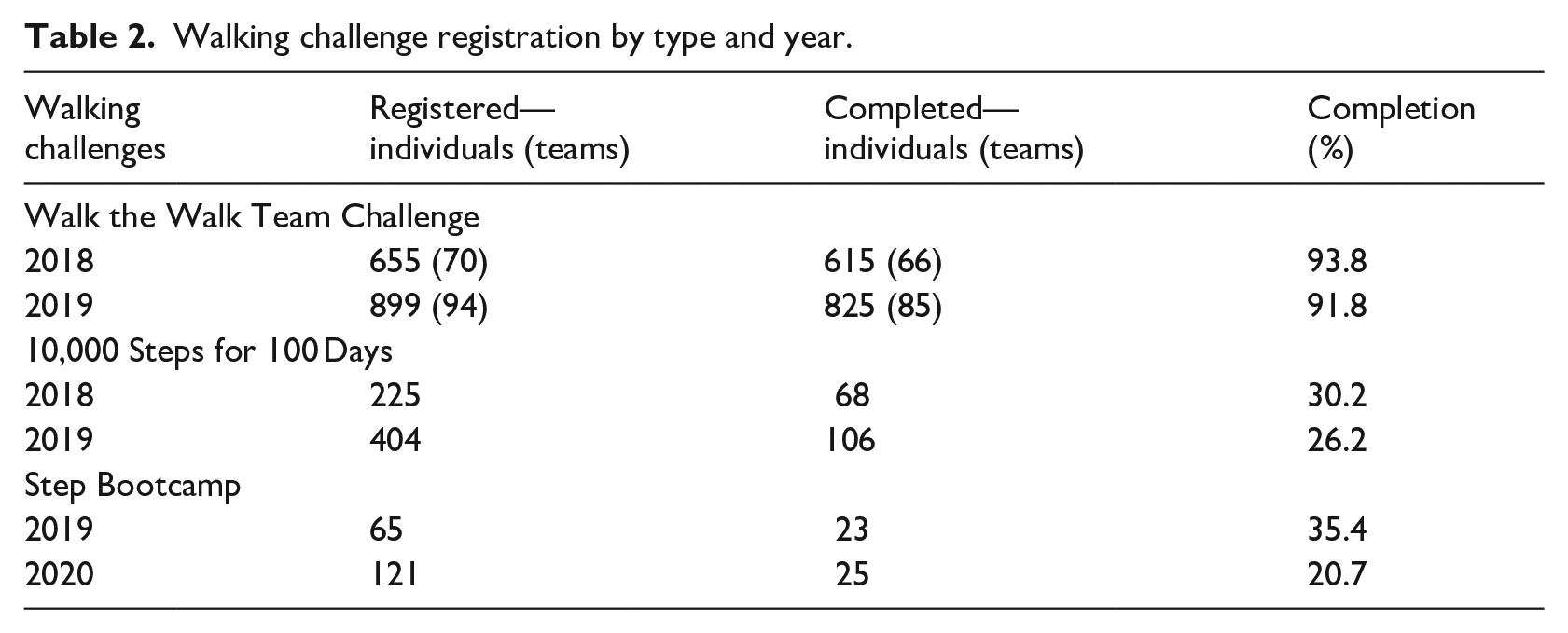
Challenge completion varied substantially. The Walk the Walk Team challenge had the greatest number of registered and completed (see Table 2). High completion of this challenge may be a result of group aspects of the challenge or the monetary incentive ($1000) to the three winning teams. The 10,000 Steps for 100 Days challenge had the second highest registration and a large initial dropout of about half of the registered participants within the first week, followed by a steady decline over the course of the challenge. Step Bootcamp had low registration and a high attrition, although dropout was more evenly dispersed over the course of the competition compared to the 10,000 Steps for 100 Days.
Walking challenge registration by type and year.
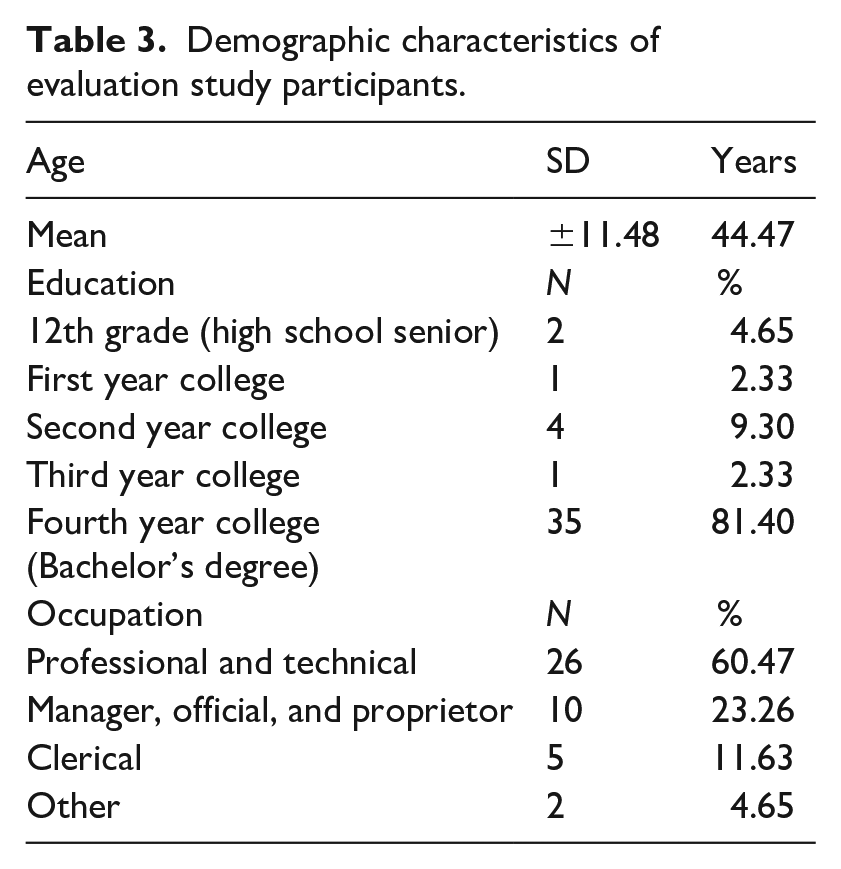
We have begun to collect data on participants who are recruited from the walking challenges. Demographic characteristics (Table 3) and pre and 2-week post challenge average steps (Figure 2) have been generated for 43 participants with complete data to date. Participants are on average 44.5 years of age, have at least a bachelor’s degree (81.4%) and are in professional or office positions (83.7%). These statistics likely represent the participant base and where we recruit from and not necessarily El Paso, Texas in general.
Demographic characteristics of evaluation study participants.
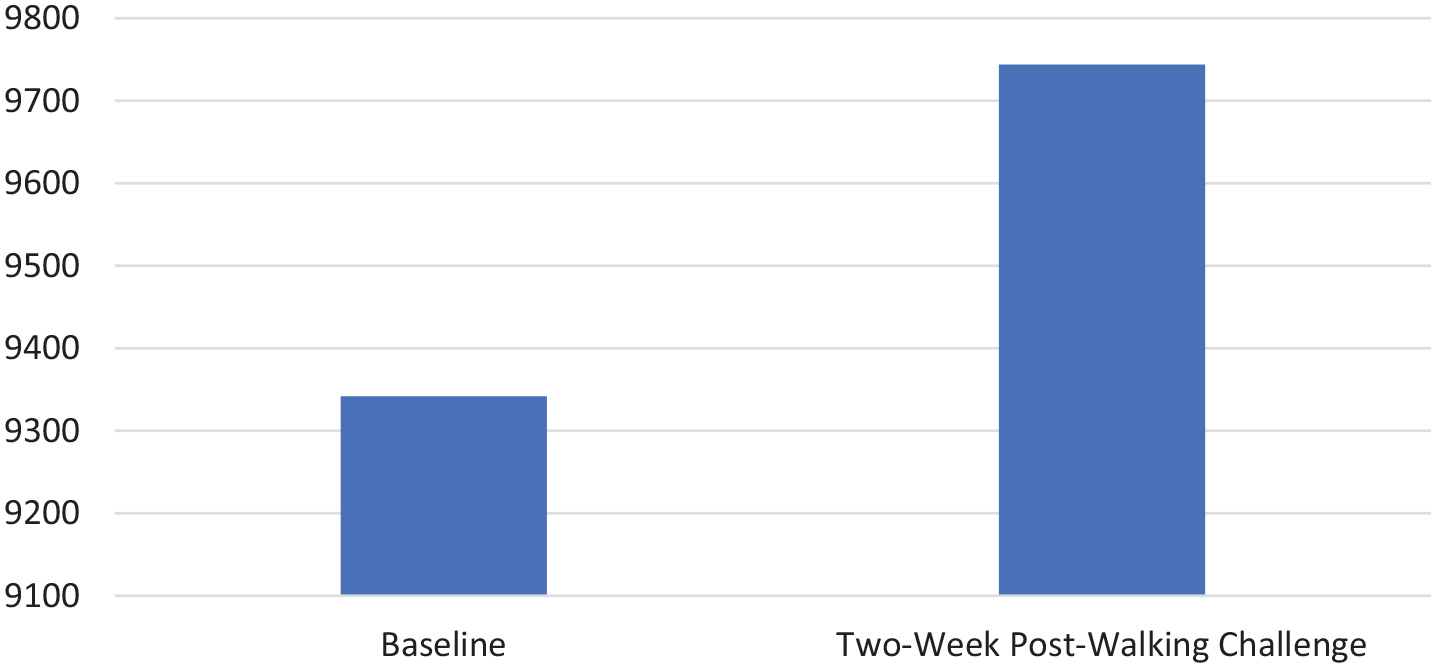
Overall step average of participants from 10 K 2019 and Bootcamp 2020.
Figure 2 demonstrates a modest change in average steps per day of about 500 2 weeks after the challenge is complete. However, during our challenges we have observed increases between 10,187 and 13,159. Initial evidence therefore indicate increase in daily steps, however, we will need to longer-term data to establish sustained change, which we are in the process of collecting.
Objective 3: Adapt challenges based on lessons learned
Modifications were made based on feedback from participants or to streamline processes. Below is an overview of some of the changes that were made as we progressed with the challenges.
Incentives
Offering incentives and prizes were a key motivator for individuals to join the Walk the Walk Team Challenge. However, we did not guarantee incentives during recruitment. Nevertheless, participants appreciated being awarded the t-shirt, water bottle, and certificate in the 10,000 Steps for 100 Days Challenge. Though smaller than Walk the Walk Team Challenge $1000-prizes, participants in other challenges showed enthusiasm for being acknowledged for their accomplishments. There were a few complaints from the Walk the Walk Team Challenge 2019. Some individuals felt that the prize divisions were unfair ($1000 for each of the three winning team categories), giving an equal amount of money to the most improved and trivia-winning teams as the team with the highest overall step counts. Though the latter certainly did the most “work” on paper, the purpose of this challenge was to motivate individuals of all physical abilities to engage in more walking activities. To achieve this equality, we purposefully divided the prize money evenly to also award the team that improved the most, not just the team that has the better athletes. The trivia contest itself does not involves physical work; however, it still required teams to complete the entire walking challenge and accurately report their steps to qualify.
Trivia questions and group activities to maintain engagement
We introduced trivia questions initially as a way to keep participants engaged during the 10,000 Steps for 100 Days challenge, but realized that they should be incorporated across challenges. The trivia contests were offered either weekly, periodically or as a final challenge to our team challenge. Participants were very engaged in this aspect of the challenge and gave them an opportunity to know more about other participants. Also, in an attempt to provide more social engagement, during the Step Bootcamp we introduced weekly group hikes. Participants would meet up at different trails or parks for bonus points, which provided another opportunity for participants to meet and engage with others.
Milestone: Achieving feasibility and evidence of sustained participation
The primary milestone for Phase 1b: Refine in this study was to establish feasibility in recruitment and participation of three walking challenges across multiple employer sites. Success of this phase is evidenced by number of participants and the increase in registration from year to year.
Discussion
In this ORBIT model Phase 1: Design study, we established rationale, feasibility and evidence of sustainability of three walking challenges to address physical inactivity among Mexican Americans living in El Paso, Texas. Over the course of 2 years, we engaged over 2000 participants across the three challenges, with increased participation each year. We devised a registration and reporting protocol that streamlined data collection and added to the feasibility of administration of the challenges. Moreover, we have shown evidence of regular walking during the challenge that show signs of potential for long-term sustainability give the trend of increase in participation over time. At least over the short term we anticipate being able to recruit participants yearly to each challenge. We continually learned and adapted our program based on participant feedback and identified opportunities to improve the challenges for efficiency and enjoyment.
The group challenge (Walk The Walk) had the least attrition compared to the other challenges. These tendencies may be the result of the group aspect to provides social support or social influence that contributes to individual participants’ desire to ‘stick it out’ to the end (Hanson et al., 2016). Alternatively, the cash prize or the short duration (1 month) may also explain the differences. In addition, teams in 2018 and 2019 increased overall step outputs when comparing Week 1 to Week 4, most likely attributed to the competitive nature of this challenge. In Phase II, it will be necessary to tease out both the inter- and intra-challenge nuances to provide better insight to what aspects may be important to completion of each walking challenge.
There appeared to be a high level of attrition in the initial week of both the 10,000 Steps for 100 Days and Step Bootcamp challenge, followed by a gradual decline in participation. Both activities are individual and goal-based, which may explain the initial attrition. Participants may have the will to participate in the challenge but may realize that the goals set for them are too difficult. Even if they are tailored to them individually, as is the case of the Step Bootcamp, individualized goals may not be sufficient motivate to continue in the challenge. We may still need to make adjustments to the challenge so that participants are able to continue engage if they are unable to reach a certain level on the outset. Some participants in the 10,000 Step for 100 Days Challenge had indicated that they dropped out because they missed 1 day. Further examination in Phase 2 is needed to better understand precipitants to attrition and to explore solutions.
Incentivized participants are more likely to participate, hence the large participation from City of El Paso employees and their wellness program (50% of our participants). The development of more wellness programs for both small and large businesses/organizations will likely increase the interest in joining and committing to our walking challenges. In addition, acquiring sponsorships and donors will aid the Border Coalition for Fitness in providing rewards (i.e. cash prizes) and incentives (i.e. participation prizes such as t-shirts and water bottles) to winners and participants.
In this Phase 1: Design ORBIT model stage, three walking challenges were developed in partnership with community members through the Border Coalition for Fitness and supported by the evidence that regular walking supports good health and is an activity that help individuals reach recommended levels of physical activity engagement (Zapata-Diomedi et al., 2019). The challenges were based on previous scientific evidence or approaches that were tested in other populations (Al-Mohannadi et al., 2019; Corbett et al., 2018; Freak-Poli et al., 2011; Mansi et al., 2015; Mathew et al., 2019; Walker et al., 2017). Despite the successes of each of our walking challenges, we still faced a number of limitations that we will continue to work out as we move to Phase 2: Preliminary Testing. First, our program has depended on self-report of daily steps. Although we do require screenshots from winning teams and individuals, we do rely on an honor system for reporting. To address this shortcoming, we are looking into web-based platforms paired with tracking devices that could automatically interface with our tracking systems. These systems may not be readily available to lower SES employees and therefore a funding mechanism may need to be created to supply all employees with tracking devices. Second, while most people are able to participate in this walking challenge, there continues to be barriers for those with ambulatory issues or older adults. We are exploring the inclusion of other types of activity into our challenges or to offer sub-challenges for older adults to participate separately from younger participants who may be more athletically capable. On the other hand, there may be selection bias toward participants working more active job roles (e.g. non-desk jobs), as it’s more favorable for those individuals to complete our walking challenges.
Next steps
This study was the first phase in a series of phases to establish an effective intervention to increase physical activity as a measure to decrease the obesity burden among Mexican Americans living in El Paso, Texas. In Phase 2, we will conduct an assessment of the efficacy of each challenge. During this phase we will assess walking behavior during and after the challenge is completed, as well assess obesity markers such as body fat, waist circumference and Body Mass Index (BMI). We will also assess injury and illness as predictors of challenge completion, as well as, assess their relationship with continued walking behavior. Findings from this phase will guide planning for subsequent phases.
Conclusion
This ORBIT Phase 1: Design study has provided rationale for and evidence that walking challenges are a feasible approach to increase physical activity in Mexican Americans living in El Paso, Texas. More data is needed to determine which challenge is optimal for increasing walking engagement, as well as meeting recommended levels of physical activity.
Footnotes
Declaration of conflicting interests
The author(s) declared no potential conflicts of interest with respect to the research, authorship, and/or publication of this article.
Funding
The author(s) disclosed receipt of the following financial support for the research, authorship,and/or publication of this article: This research was funded by the Cancer Prevention and Research Institute of Texas (Grant # PP180026).
