



Abstract
Ostracism is associated with poor outcomes, but it is unclear if online versus in-person ostracism elicits divergent psychological and physiological responses. Participants (N = 54) were randomly assigned to online or in-person ostracism, and provided pre- and post-ostracism measures of affect, self-esteem, self-feelings, and salivary cortisol. No significant changes in negative affect, self-esteem, or self-feelings emerged, nor were there differences by ostracism condition. Both ostracism conditions decreased positive affect (stronger online) and lowered cortisol. Extending prior work, ostracism appears to reliably decrease positive affect (especially online) but may not be threatening to the self; moreover, ostracism may reliably elicit acute cortisol declines.
Humans have a fundamental need to belong to and interact with larger social groups; fulfilment of this need to belong – generally through interpersonal relationships and social interaction – is theorized to be necessary for optimal health and wellbeing (Baumeister and Leary, 1995). Technological advances over the last several decades have fundamentally changed the way we interact, with more communication occurring via electronic devices (e.g. by phone, SMS/text, online). Although humans are relatively resilient and adaptive to multiple communication mediums, we may be inclined towards in-person communication to fulfil this need to belong, as it affords more natural and interpersonal elements than current online methods (Hantula et al., 2011; Kock, 2004). Consistent with this premise, online interaction has been rated as less enjoyable and seems to have a lesser capability to satisfy belonging needs than in-person interactions (Sacco and Ismail, 2014). Although in-person communication is both preferred and provides belonging and health benefits, it is unclear whether the method of communication influences psychological and physical reactions when belonging attempts are thwarted (i.e. when individuals are ostracized; Baumeister and Leary, 1995). If humans are indeed inclined towards in-person communication, it is plausible that in-person ostracism would be more threatening and hence more detrimental to health and wellbeing, compared with an online ostracism medium. However, given the increasing importance and prevalence of online communication, it is also possible that online ostracism exhibits similarly detrimental effects as in-person ostracism.
Psychological and physiological reactions to ostracism
Being ostracized (i.e. being rejected, ignored or excluded by others) (Leary, 2001; Williams et al., 2002) has generally been associated with relatively unpleasant psychological outcomes, ranging from decreases in positive affect (PA), feelings of belonging, control and meaningful existence (Williams et al., 2000b; Zadro et al., 2004), to reductions in self-regulation (Baumeister et al., 2005), cognitive abilities (Baumeister et al., 2002) and increased aggressive responses (Twenge et al., 2001). Research further suggests that, to the extent that ostracism provokes threats to the self, there may be acute physiological responses to ostracism (Dickerson and Kemeny, 2004) in ways that may lead to poorer health outcomes, including the maintenance of psychological disorders (Powers et al., 2016; Reinhard et al., 2020). One biomarker of interest is cortisol, which is produced and released as part of the stress response (Kirschbaum and Hellhammer, 2000). According to social self-preservation theory, cortisol is released in response to increases in stress and negative emotionality, and responses are particularly strong under threats to the social self (Dickerson et al., 2008), of which ostracism is potentially viewed (Dickerson and Zoccola, 2013). Despite fairly consistent evidence that ostracism worsens affect, previous research investigating acute cortisol responses to ostracism have exhibited mixed results: Although some work is suggestive of elevated cortisol levels among participants who had been ostensibly rejected by individuals following ‘get acquainted’ ostracism paradigms (e.g. Blackhart et al., 2007; Stroud et al., 2000), the majority of studies have reported null results or even acute decreases in cortisol levels following ostracism (Bass et al., 2014; Gaffey and Wirth, 2014; Helpman et al., 2017; Linnen et al., 2012; Seidel et al., 2013; Zoller et al., 2010; Zwolinski, 2012). We suggest that one potential factor in psychological and physiological reactivity following ostracism may be the medium by which the ostracism occurs, that is, whether the ostracism occurs in-person or online.
Online verses in-person ostracism
Prior research has demonstrated that stressors that are threating to the self or that are characterized by lower feelings of control are associated with higher cortisol responses (Dickerson and Kemeny, 2004). Although in-person and online ostracism elicit similar reports of low inclusion, high exclusion and decreases in PA (Filipkowski and Smyth, 2012; Williams et al., 2002), online ostracism seems to buffer against the loss of self-esteem and feelings of control more than in-person ostracism (Williams et al., 2002). It is possible that the medium of ostracism affects both psychological and physiological responses; namely, that whether ostracism occurs online or in-person may moderate cortisol reactivity. For example, it could be that in-person ostracism (e.g. as in ‘get acquainted’ ostracism paradigms) poses a greater threat to belonging and to the self, eliciting increases in cortisol (Blackhart et al., 2007; Stroud et al., 2000) to actively engage with the threat. To the extent that threats to the self are less potent in online mediums, however, this may account for the null (no change) or even decreased cortisol responses often reported in online ostracism paradigms (Bass et al., 2014; Gaffey and Wirth, 2014; Seidel et al., 2013; Zoller et al., 2010; Zwolinski, 2012). On the other hand, it may be that ostracism in general (i.e. regardless of medium) is associated with a decreased cortisol response because it triggers freezing behaviour rather than fight-or-flight (see Taylor et al., 2000; Williams, 2007). Consistent with this view, decreases in cortisol have been associated with disengagement (Tops et al., 2006) and ostracism is linked with decreased interaction with others, and increases in feelings of helplessness and loneliness (Ren et al., 2020; Williams, 2009). To the extent that in-person ostracism triggers freezing, we would expect in-person ostracism to elicit a greater decline in cortisol than online ostracism (Helpman et al., 2017).
In line with study aims, we investigated self-report measures of affect, self-esteem, self-feelings and salivary cortisol in response to ostracism as it occurred either during in-person or online mediums. We expected that both mediums would lead to worsened affect, self-esteem and self-feelings. We anticipated, however, that the in-person ostracism would elicit an elevated cortisol response, when compared to online ostracism (which we expect to demonstrate no change in, or even decreased, cortisol levels).
Method
Ethical approval was granted for the study protocol by Misericordia University’s Institutional Review Board (approval number: 24-13-T3). Participants provided written informed consent and were informed that they could withdraw from the study at any time.
Participants
Fifty-four students (33 female; 93% Caucasian; Mage = 19.36, SDage = 1.42) from a small liberal-arts university participated in this study. Participants were randomly assigned to either the in-person (N = 25; 15 female) or online (N = 29; 18 female) condition. There were no significant differences in demographics by the randomly assigned conditions (gender: t(52) = −0.15, p = 0.879; age: t(51) = −1.39, p = 0.170; Caucasian race: t(53) = −1.19, p = 0.240).
Procedure
The ostracism protocol used in the current study was based on previous research (Filipkowski and Smyth, 2012; Williams et al., 2002). Exclusion criteria included current pregnancy and taking prescription steroid medications (Blascovich et al., 2011; Kirschbaum and Hellhammer, 2000). To minimize the impact of the normative diurnal rhythm of cortisol, sessions were scheduled on weekdays between 3:00 and 5:30 pm (Blackhart et al., 2007; Blascovich et al., 2011). During scheduling, participants were informed that they would interact with two other participants (confederates) for 5 minutes and then provide their impressions of the interaction and provide saliva samples to assess hormonal responses. To enhance validity of the salivary cortisol assessment, participants were asked that prior to their session they avoid: food/beverages (other than water, 3 hours prior); tobacco and nicotine-related products (2 hours prior); brushing their teeth (1 hour prior), and consuming alcohol and engaging in strenuous exercise (day of their session) (Blackhart et al., 2007; Blascovich et al., 2011). Non-compliance with study directions (n = 7) was not related to any cortisol measure (p’s > 0.07) and results for cortisol were unchanged when non-compliance was incorporated as a covariate.
Upon coming to the lab, participants were brought to private rooms, provided informed consent and completed baseline psychological measures. Approximately 20 minutes after arriving, participants provided their baseline saliva sample, and were prepared for their interaction session. In the online condition, participants remained in their private room for the chatroom conversation. In the in-person condition, participants were brought to a separate room for a face-to-face conversation. In both conditions, conversations were designed such that the first minute of conversation consisted of basic introductions and inclusion of the participant. During this introduction, the two confederates (who had previously memorized scripts) discovered a common interest in a fabricated band. The rest of the time was devoted to a discussion relevant to this band (e.g. songs, concerts, etc.), and any attempt made by the real participant to include themselves was ignored. After the conversation ended, participants completed post-interaction questionnaire packets in private rooms. Approximately 25 minutes after the initiation of the ostracism, a second saliva sample was taken, as cortisol reactivity has been shown to peak (on average) about 20–40 minutes after a psychosocial stressor (see Blascovich et al., 2011).
To assess suspicion regarding the interaction, participants were asked to state, in their own words, what they thought the study was about. Responses were coded from 0 (no suspicion) to 2 (full suspicion) based on methods published in a prior study (Filipkowski and Smyth, 2012). Out of N = 54 participants, 35 (65%) were coded as a 0, 10 (19%) were coded as a 1, and nine individuals (17%) were rated a 2 on suspicion; this coding of suspicion was used in post-hoc analyses. Suspicion did not differ by ostracism medium χ2 (2, N = 54) = 0.53, p = 0.776. Participants were fully debriefed as to the true nature and rationale of the study.
Measures
Primary dependent measures
Saliva samples were collected using a Salivette swab collection device (Sarstedt, Inc.) and were stored in a medical freezer at −20 degrees Celsius (Garde and Hansen, 2005). A Salimetrics Saliva Cortisol Assay Kit was used to assay free cortisol (μg/dL) within the saliva samples by the Biomarker Core Laboratory at the Pennsylvania State University following established procedures.
Participants’ affect was assessed via the Positive and Negative Affect Schedules (1-very slightly or not at all to 5-extremely; Watson et al., 1988) by asking participants to indicate the extent to which they felt 10 positive (PA) and 10 negative affect (NA) items (e.g. excited, upset, respectively). Scales are generated to indicate a PA score (αPA Baseline = 0.74, αPA Post-Interaction = 0.91), and a NA score (αNA Baseline = 0.82, αNA Post-Interaction = 0.80). Participants also completed the 10-item Self-Esteem Inventory (Rosenberg, 1965), as well as a 12-item self-feelings subscale (McFarland and Ross, 1982), at baseline and post-ostracism. Response options for both measures were formatted in a Likert scale (1-not at all characteristic of me to 5-extremely characteristic of me) based on previously utilized methods (see Leary et al., 1995; Nezlek et al., 1997). An example item for the self-esteem scale includes, ‘On the whole, I am satisfied with myself’. Participants responded to a variety of self-feeling adjectives for the self-feelings scale, including ‘capable’, ‘resourceful’ and ‘smart’. Higher scores reflect higher self-esteem (αpre-interaction = 0.84, αpost-interaction = 0.87) and self-regard (αPre-Interaction = 0.85; αpost-interaction = 0.88), respectively.
Following ostracism, participants indicated the extent to which they felt included, excluded and like they belonged during the conversation (Williams et al., 2000b); these served as manipulation checks. Participants also reported how much they thought their inclusion or exclusion was due to something about themselves or those they interacted with, all on a Likert scale ranging from 1 (not at all) to 9 (very much).
Demographics and covariates
Participants provided information including age, sex and race, their typical frequency (1 = not at all to 5 = extremely often) and level of comfort (1 = not at all to 5 = extremely) interacting with others in-person, via text-only and voice-only. To appropriately assess cortisol, birth control use was inquired for female participants. Additionally, in order to control for relevant individual differences, participants completed the Interaction Anxiousness Scale (1 = not characteristic of me – 5 = extremely characteristic of me; Leary, 1983), the Extraversion subscale of the Big Five Inventory (1 = disagree strongly – 5 = agree strongly; John et al., 1991, 2008), and the ‘approval from others’ subscale of the Contingencies of Self-Worth Scale (1 = strongly disagree – 7 = strongly agree; Crocker et al., 2003). Cronbach’s alphas for anxiousness, extraversion and self-worth were α = 0.91, α = 0.82 and α = 0.83, respectively.
Data sharing statement
In accordance with efforts to have open, transparent and replicable science, we have provided de-identified participant data, SAS code used to analyse the data and codebooks. These are available in Figshare and as Supplemental Material on the SAGE journal platform.
Results
Descriptive results
Our primary dependent measures (PA, NA, self-esteem, self-feelings, cortisol) were measured at baseline and post-ostracism. Belonging, inclusion and exclusion were assessed post-ostracism. Covariates (e.g. interaction anxiousness, extraversion, contingencies of self-worth and frequency/comfort with in-person, text-only and voice-only interactions) were measured at baseline. There were no differences between the online and in-person ostracism groups on any baseline measures (Table 1). Also see Table 1 for descriptive statistics of study measures.
Descriptive statistics of variables at baseline (prior to ostracism) and following ostracism and t-test of baseline differences by condition.
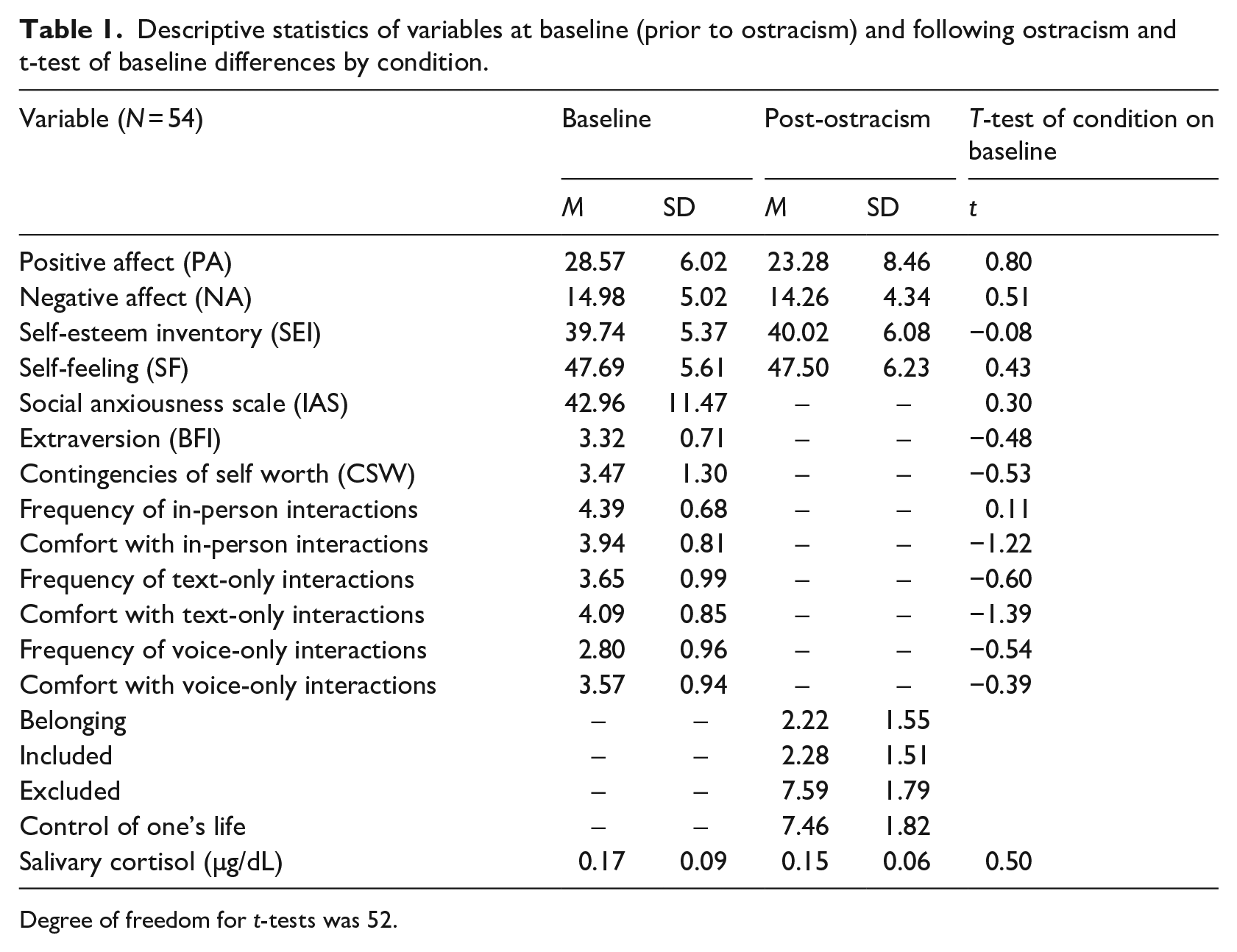
Degree of freedom for t-tests was 52.
Manipulation check
The experimental manipulation was successful with participants reporting feeling left out. Approximately 85% reported a three or less on belonging and inclusion, and about 83% reported a seven or higher on exclusion, indicating that confederates effectively ostracized participants. Participants reported that the ostracism had more to do with something about the others (M = 5.29; SD = 2.79), as opposed to something about themselves (M = 1.69; SD = 1.31); these attributions of the ostracism experience did not differ by ostracism medium (0.180 < p’s < 0.760).
Analytic strategy
Our goal was to directly compare ostracism during in-person verses online interactions; thus, a control comparison group was not included. Instead, differences between groups in within-group changes from baseline were examined. We first tested if ostracism, in general, influenced participants’ affect, self-regard and cortisol levels, regardless of the medium (i.e. main effect of ostracism). Paired t-tests were conducted to examine if changes between baseline and post-ostracism were significantly different from zero.
Our second objective, directly addressing our research question, was to examine the effects of ostracism medium (i.e. in-person/online) on psychological and physiological outcomes. Difference scores were created to assess change in dependent variables from baseline to post-ostracism (PA, NA, self-esteem, self-feelings, cortisol). Using PROC GLM in SAS, we conducted multiple regressions in which ostracism condition was a predictor of the residualized change score for each of our dependent variables (e.g. ostracism condition predicting the change score in PA, controlling for baseline PA). We included other covariates such as anxiousness and extraversion where appropriate, and as indicated with respect to each specific analysis. Although previous research suggests that despite knowing that ostracism is inevitable, fundamental psychological needs are still threatened (Williams et al., 2000a), it is plausible that knowledge about study goals may influence ostracism responsivity. Thus, models were first conducted with all participants, irrespective of ‘suspicion level’ coded during debriefing, and then again with the removal of suspicious individuals (i.e. excluding those with a ‘2’ from analyses).
As salivary cortisol assay values were positively skewed, we performed a logarithm transformation on both pre- and post-ostracism cortisol. A residualized cortisol change score (i.e. post-ostracism cortisol – baseline cortisol) was created from these transformed scores and was utilized in our analyses. Given that oral contraceptives have been shown to influence free cortisol in saliva (Kirschbaum and Hellhammer, 2000), we controlled for reported birth control use and sex in analyses examining effects on cortisol.
On a post-hoc basis, we examined sex differences on psychological and physiological outcomes. These results are available online (Supplemental Results, Supplemental Table S1, Supplemental Figures S1 and S2).
Main effect of ostracism on psychological and physiological factors
As expected, participants reported a significant decrease in PA following ostracism (t(53) = −5.95, p < 0.001). Contrary to expectations, there were no significant changes in negative affect (t(53) = −1.09, p = 0.281). Consistent with previous research (Filipkowski and Smyth, 2012), there were no changes in self-esteem (t(53) = 0.79, p = 0.434) or self-feelings (t(53) = −0.44, p = 0.665). Participants across both conditions exhibited significantly decreased cortisol levels following ostracism (t(53) = −2.69, p = 0.010). All analyses remained virtually unchanged when removing suspicious participants (Supplemental Table S1).
Effects of ostracism condition on psychological and physiological factors
Affect and self-regard
Ostracism condition significantly predicted the residualized change in PA (F (2,51) = 6.29, b = 4.31, SE = 1.72, p = 0.015, η2p = 0.11). Those in the online condition exhibited a greater decrease in PA (Mchange = −7.29) compared to those in the in-person condition (Mchange = −2.98). There was no significant effect of condition on NA response (F (2,51) = 1.50, b = −1.29, SE = 1.06, p = 0.226, η2p = 0.02); analyses were similar after the removal of suspicious individuals (Supplemental Table S1). Our baseline measures for interaction (anxiousness, extraversion, self-worth) were all significantly related to self-esteem and self-feelings following ostracism (see Table 2), thus, we ran our models both with and without these variables as covariates. Ostracism condition was not a significant predictor of residualized changes in self-esteem (F (2,51) = 0.28, b = 0.38, SE = 0.72, p = 0.599, η2p = 0.01), or self-feelings (F (2,51) = 0.60, SE = 0.86, b = 0.67, p = 0.441, η2p = 0.01). Models incorporating covariates exhibited similar patterns of results (p’s > 0.356).
Correlations among baseline and outcome measures.

Baseline measures: IAS: interaction anxiousness scale (interaction anxiousness); BFI: big five inventory (extraversion); CSW: contingencies of self-worth (approval from others). Outcome measures: Post PA: positive affect following exclusion; Post NA: negative affect following exclusion; Post SE: self-esteem following exclusion; Post SF: Self-feelings following exclusion. Cortisol reflects logged cortisol following exclusion.
p < 0.07. *p < 0.05. **p < 0.01
Cortisol
Ostracism condition did not predict the residualized change in cortisol (F (4,49) = 0.07, b = 0.02, SE = 0.08, p = 0.788, η2p = 0.002), when accounting for sex and birth control. This remained non-significant with the removal of suspicious participants and when controlling for outliers and time of day (F (6,38) = 0.17, SE = 0.07, b = 0.03, p = 0.686, η2p = 0.004).
Discussion
Ostracism and psychological factors
The aim of this study was to incorporate psychological and physiological reactivity to ostracism as it occurred via two different mediums: in-person or online. Consistent with previous research, our participants reported high levels of ostracism and a decrease in PA across both conditions (Filipkowski and Smyth, 2012; Williams et al., 2002); this decline in PA was more pronounced in the online condition. Interestingly, whereas other studies have found that online interactions may not restore affect as well as in-person interactions (e.g. Sacco and Ismail, 2014), our study suggests that online interactions do seem to diminish PA as much as (or possibly more than) in-person ostracism experiences. The findings of the current study imply that virtual ostracism is impactful, at least among college-aged populations. Previous work has suggested that this age group may be more affected by online ostracism, when compared with older individuals (Hawkley et al., 2011). College-aged adults also perceive social media as more threatening to psychological well-being when compared to younger students (Smith et al., 2017). Perhaps this age group’s reliance on online communication, coupled with somewhat transitory social networks embedded in the college experience, make them particularly vulnerable to online ostracism experiences. Future studies are needed to substantiate these findings in more diverse samples, and replicate the results given our relatively small sample size.
Ostracism and cortisol
Previous work suggests that in-person social evaluation tends to be more potent in eliciting a cortisol response when compared to more remote or imagined evaluations (Kelly et al., 2007). Because the lack of a direct interpersonal interaction among participants in online ostracism paradigms may attenuate a cortisol response, we hypothesized that in-person ostracism would be more likely to prompt a cortisol response (Seidel et al., 2013). Indeed, prior research is consistent with these expectations – studies with in-person paradigms report increased cortisol responses (e.g. Blackhart et al., 2007; Stroud et al., 2000), whereas studies reporting no change or decreases in cortisol in response to ostracism tended to use online paradigms (Bass et al., 2014; Gaffey and Wirth, 2014; Jaremka and Collins, 2017; Jobst et al., 2015; Seidel et al., 2013; Zoller et al., 2010; Zwolinski, 2012). Contrary to our expectations, there were no effects of ostracism condition on cortisol response in our study; that is, we observed that cortisol declined in response to both in-person and online mediums. That ostracism (particularly in-person) did not produce an elevated cortisol response our study may reflect the convergence of competing influences. That is, although increased cortisol responses are more likely in stressors that are threatening to the self (Dickerson and Kemeny, 2004), an increased need for affiliation has been associated with decreased cortisol responses (Helpman et al., 2017; Wegner et al., 2014), which is thought to be linked with freezing behavior and disengagement from the threat (Wesselmann et al., 2015; Williams, 2007). Although potentially self-protective in the short-term (Leitner et al., 2014), prolonged disengagement and withdrawal can lead to increased loneliness, helplessness and depression (Williams, 2009).
That we saw overall decrements in cortisol may also be due, in part, to the perception and attribution of our ostracism paradigms by participants. According to the social self-preservation model (Dickerson et al., 2004, 2008), negative self-evaluation and threats to self-esteem elicit specific physiological responses such as the release of cortisol. We expected that ostracism would be interpreted as self-threat, particularly in the in-person condition; in this study, however, neither self-esteem nor self-feelings were affected by ostracism. This may be due to participants attributing the ostracism as due to something about the other person, as opposed to the self (as suggested by the manipulation check).
Our observation that cortisol declined in both mediums of ostracism may also be due to an increased need to belong. It is possible that both ostracism conditions decreased feelings of belonging, increasing participants’ need for affiliation. Although our manipulation check is consistent with this premise, in the present study we do not have measures of pre-test belonging to determine the extent to which ostracism decreased belonging, nor do we have a true control condition with a set of participants who were not ostracized. The lack of non-excluded control group in the present study limits the interpretations that can be made regarding the extent to which ostracism in general is linked with declines in cortisol. Other studies have found that ostracism leads to decreases in cortisol (Bass et al., 2014; Gaffey and Wirth, 2014; Jobst et al., 2015) and our results are consistent with this finding. Future research should continue to assess under which circumstances ostracism increases a need to belong and whether decreased cortisol responses are only elicited under those conditions.
Limitations and future research
Although our participants reported feeling excluded by confederates, we did not find support for several expected responses to ostracism, notably that associations with ostracism differed by medium. Although we did find decreases in cortisol for both conditions, we cannot rule out the possibility that these may be due to habituation because we did not have a non-ostracism control condition. Additionally, our sample size lacked sufficient statistical power to detect small effects; it is possible that there are small differences by ostracism medium that were not able to be detected in the present study. Given the limitations, future work is needed to substantiate the results seen here. In addition to these limitations, another limitation may be that this study was conducted at a small, religiously affiliated, liberal-arts university in the United States. Results may differ in a more diverse sample; for example, ostracism may be more potent among those from more collectivistic cultures where greater attention and meaning is paid to social ties. Moreover, ostracism from confederates compared to known peers, friends or family members may be less threatening to the self and may elicit different patterns of psychological and cortisol responses. Future research might examine such possibilities in moderating the effects of ostracism.
Online interactions have changed substantially over the past decade. The online paradigm used in this study used text-based (e.g. chat room) interactions, which may produce less personally salient manipulations/experiences than current online interactions (e.g. video interactions). Paradigms such as Ostracism Online incorporate video and are thus truer to modern online interactions. Early findings suggest enriched online interactions (e.g. video interaction) may have slightly stronger psychological effects than older online ostracism paradigms (Schneider et al., 2017; Wolf et al., 2015), although differences in physiological reactions to ostracism are unknown at this time and could be explored in future work.
Conclusion
This study utilized in-person and online interactions to examine psychological and physiological responses to ostracism. Despite our potent manipulation of perceived ostracism, and participants’ decrease in PA, our manipulation did not produce reliable effects on other self-reported outcomes (e.g. NA/self-esteem). Moreover, we hypothesized that in-person ostracism would lead to an elevated cortisol response compared to the online ostracism condition; in contrast to this prediction but consistent with work suggesting that ostracism is sometimes associated with decreased cortisol response, participants’ cortisol levels in both conditions declined from baseline. Our results add to the growing literature exploring the contexts and methods under which ostracism elicits psychological and physiological (e.g. cortisol) responses, raising some interesting questions for future research.
Research Data
sj-docx-1-hpq-10.1177_13591053211001411 – for Stress-responses to ostracism: Examining cortisol and affective reactivity to in-person and online exclusion
sj-docx-1-hpq-10.1177_13591053211001411 for Stress-responses to ostracism: Examining cortisol and affective reactivity to in-person and online exclusion by Kelly B Filipkowski, Dusti R Jones, Michael J Bernstein and Joshua M Smyth in Journal of Health Psychology
Research Data
sj-docx-4-hpq-10.1177_13591053211001411 – for Stress-responses to ostracism: Examining cortisol and affective reactivity to in-person and online exclusion
sj-docx-4-hpq-10.1177_13591053211001411 for Stress-responses to ostracism: Examining cortisol and affective reactivity to in-person and online exclusion by Kelly B Filipkowski, Dusti R Jones, Michael J Bernstein and Joshua M Smyth in Journal of Health Psychology
Research Data
sj-pdf-3-hpq-10.1177_13591053211001411 – for Stress-responses to ostracism: Examining cortisol and affective reactivity to in-person and online exclusion
sj-pdf-3-hpq-10.1177_13591053211001411 for Stress-responses to ostracism: Examining cortisol and affective reactivity to in-person and online exclusion by Kelly B Filipkowski, Dusti R Jones, Michael J Bernstein and Joshua M Smyth in Journal of Health Psychology
Research Data
sj-pdf-6-hpq-10.1177_13591053211001411 – for Stress-responses to ostracism: Examining cortisol and affective reactivity to in-person and online exclusion
sj-pdf-6-hpq-10.1177_13591053211001411 for Stress-responses to ostracism: Examining cortisol and affective reactivity to in-person and online exclusion by Kelly B Filipkowski, Dusti R Jones, Michael J Bernstein and Joshua M Smyth in Journal of Health Psychology
Research Data
sj-sas-2-hpq-10.1177_13591053211001411 – for Stress-responses to ostracism: Examining cortisol and affective reactivity to in-person and online exclusion
sj-sas-2-hpq-10.1177_13591053211001411 for Stress-responses to ostracism: Examining cortisol and affective reactivity to in-person and online exclusion by Kelly B Filipkowski, Dusti R Jones, Michael J Bernstein and Joshua M Smyth in Journal of Health Psychology
Research Data
sj-sas7bdat-5-hpq-10.1177_13591053211001411 – for Stress-responses to ostracism: Examining cortisol and affective reactivity to in-person and online exclusion
sj-sas7bdat-5-hpq-10.1177_13591053211001411 for Stress-responses to ostracism: Examining cortisol and affective reactivity to in-person and online exclusion by Kelly B Filipkowski, Dusti R Jones, Michael J Bernstein and Joshua M Smyth in Journal of Health Psychology
Supplemental Material
sj-zip-7-hpq-10.1177_13591053211001411 – Supplemental material for Stress-responses to ostracism: Examining cortisol and affective reactivity to in-person and online exclusion
Supplemental material, sj-zip-7-hpq-10.1177_13591053211001411 for Stress-responses to ostracism: Examining cortisol and affective reactivity to in-person and online exclusion by Kelly B Filipkowski, Dusti R Jones, Michael J Bernstein and Joshua M Smyth in Journal of Health Psychology
Footnotes
Declaration of conflicting interests
The author(s) declared no potential conflicts of interest with respect to the research, authorship, and/or publication of this article.
Funding
The author(s) disclosed receipt of the following financial support for the research, authorship, and/or publication of this article: This research was supported by a Misericordia University Faculty Research Grant.
Human subjects statement
The Institutional Review Board at Misericordia University provided approval for data collection.

Supplemental material
Supplemental material for this article is available online.
References
Supplementary Material
Please find the following supplemental material available below.
For Open Access articles published under a Creative Commons License, all supplemental material carries the same license as the article it is associated with.
For non-Open Access articles published, all supplemental material carries a non-exclusive license, and permission requests for re-use of supplemental material or any part of supplemental material shall be sent directly to the copyright owner as specified in the copyright notice associated with the article.
