



Abstract
Since the first case of human SARS-CoV-2 infection late in 2019 workers across multiple disciplines have been strenuously engaged in attempting to prevent the spread of the virus and to provide care to patients. Never in history has so much human effort been concentrated on a single health trauma. Much of the new research is empirical in nature with relatively few strands of theory. This article focuses on two recent theories relevant to COVID-19 protective behaviours, the COM-B and the General Theory of Behaviour. New empirical findings on the means, motives and opportunities for COVID-19 protective behaviours improve our knowledge and capacity to cope with pandemics using psychological homeostasis.
Since the beginning of the SARS-CoV-2 pandemic late in 2019, more than 4 million scholarly publications about ‘COVID-19’ have been produced. Within this huge body of work, psychological research has been making a contribution, but much of this psychological research is purely empirical in nature with relatively few strands of theory. It has been said that advances in science come not from empiricism but from new theories. Fragmentation has been a longstanding problem for Psychology and I suspect the majority of psychologists would agree that more integration is necessary. For more than a century, fragmentation in Psychology has been called a ‘crisis’ (Willy, 1899). The ‘crisis’ is evident in all areas of Psychology, including Health Psychology.
An earlier Editorial discussed human needs in COVID-19 isolation (Matias et al., 2020). This Editorial introduces new empirical findings on COVID-19 protective behaviours through the lens of the General Theory of Behaviour (Marks, 2018). Before presenting the findings, I discuss a theoretical approach to behaviour change called the ‘Capability, Opportunity, Motivation, Behaviour’ or ‘COM-B’ model of Michie et al. (2011) and follow this with a description of the General Theory.
The COM-B model
The COM-B approach has been influential in the research literature and in policy with the Scientific Advisory Group for Emergencies (SAGE) to the UK government’s efforts to reduce COVID-19 transmission in the population (Scientific evidence supporting the government response to coronavirus, 2022). The COM-B model aims to explain the ultimate causes of all behaviour and health protective behaviours in particular. Some context is necessary to understand the assumptions of the COM-B.
The COM-B mirrors the ‘Means, Motive, Opportunity’ (MMO) approach of situational crime investigations used in the US and elsewhere (Clarke, 1997; Cornish and Clarke, 2003). ‘Motive’ is the reason for committing the crime, ‘means’ are the methods used to commit the crime, and ‘opportunity’ is the occasion that allows the crime to take place. For someone to be convicted in court, all three must be established. The authors of COM-B explain: ‘We have built on [the MMO] to add nonvolitional mechanisms involved in motivation (e.g., habits) and to conceptualise causal associations between the components in an interacting system’ (Michie et al., 2011).
The COM-B is intended to serve as a general model for all behaviour, not only that of convicted felons. One wonders if a framework found useful in proving the innocence or guilt of alleged criminals is an appropriate causal model of the everyday behavioural choices of the non-criminal population. Proof of guilt in a murder case, which relies on the finding of a motive (e.g. jealousy), the means (e.g. possession of a murder weapon) and the opportunity (e.g. lacking an alibi), does not include information about the beliefs, morality or character of the alleged perpetrator so innocent persons can be falsely convicted, do jail time or suffer wrongful execution – so-called ‘false positives’ (Huff et al., 1986; Unnever and Cullen, 2005). Equally many criminals who do have the MMO and commit crimes escape conviction (Keel et al., 2009). The advocates of the MMO and COM-B systems need to acknowledge that many individuals who are judged to have motive, means and opportunity do not behave as the formula indicates for perfectly legitimate reasons.
Human behaviour is motivated by beliefs, wants and moral codes as much as by needs (Marks, 2020). The MMO offers the highest level of evidential proof necessary in court room decisions and remains imperfect. However, the ‘scientific’ version of the approach, the COM-B, produces only the most minimal level of evidential proof that can be accepted in psychological science (Table 1).
Levels of evidential proof offered by the MMO and COM-B.

A recent evaluation of the COM-B model for COVID-19 preventive behaviour indicates that all is not well with the model (Gibson Miller et al., 2020). The level of empirical support is weak, with only two of six factors showing the predicted positive association with hygienic practices. Also, the measure of the most significant factor, ‘reflective motivation’, included items referring to ‘habits’ and ‘intentions’, making it difficult to interpret the findings. The article by Gibson-Miller et al. triggers a series of red flags:
Four of six predictions of the COM-B model were disconfirmed. Two COM-B variables were negatively associated with hygienic behaviours (opportunity – physical and motivation – automatic) and one COM-B variable (capability-physical) was not significantly associated with hygienic behaviours.
The measures were self-reported capabilities, opportunities and behaviours with no objective evidence that any of the COM-B variables were associated with actual behaviour change.
The study was cross-sectional in design so inferences about causality are impossible.
Measurement of the psychological constructs was heterogeneous. The measures need to be simplified and more cohesive.
As noted, measurement of motivation should include wants as well as needs (Marks, 2020) and include feelings as well as cognitive judgment to improve the prediction of behaviour (Weinstein et al., 2007).
The study’s reliance on self-reports opens the possibility of reporting bias from socially desirability (Nederhof, 1985).
Self-report measures of hand-washing practices have poor validity (Curtis et al., 1993, 2009).
The use of intention is limited by the ‘intention–behaviour gap’ such that reported intentions may not translate into actual behaviour in the pandemic (Orbell and Sheeran, 1998).
The COM-B model accounted for only 17% of the variance in self-reported hygienic practices leaving 83% of the variance unexplained.
The items used to define reflective motivation included both intentions and habits, which themselves are problematic, and only partly correlate with motivation.
According to the authors ‘reflective processes were driving hygienic practices’ – making plans to enact the behaviour and supporting the belief that the behaviour is a good thing to do. However ‘reflective processes’ are cognitive not motivational processes and these have been mislabelled by the investigators as ‘motivational’.
There is no evidence of a causal connection between self-reported reflective processes and hygienic practices, only a statistical association. Therefore words such as ‘driving’ are inappropriate and misleading.
A truly motivational process – fear – is omitted from the COM-B model yet multiple studies indicate that functional fear is of primary importance in motivating hygienic and other protective behaviours.
Indoor air quality and improved ventilation are key requirements in the fight to reduce SARS-CoV-2 infections, neglected factors in a neo-liberal policy of placing responsibility on citizens who are expec-ted to conform to mandates and programmes of vaccination.
The COM-B appears to be limited in scope with a number of major gaps. One suspects that the gaps in the COM-B to be addressed in the next section have led to missed opportunities for preventing infections during the pandemic to date.
In the next section I provide a sketch of the General Theory of Behaviour.
The General Theory of Behaviour
In the General Theory of Behaviour (GTB) it is claimed that human thriving is dependent upon an intrinsic homeostasis system with purpose, desire and intentionality striving to maintain equilibrium (Marks, 2018; Matias et al., 2020). The GTB is founded on 20 principles with 80 ancillary propositions which are empirical and refer to the human need for equilibrium. ‘Principle I (Agency)’ states: ‘The voluntary behaviour of conscious organisms is guided by a universal striving for equilibrium, a striving with purpose, desire and intentionality’ (Marks, 2018: 11).
The GTB is intended to be universally applicable to all conscious beings. The principal construct of the theory is that of ‘psychologi-cal homeostasis’, the psychological equivalent of physiological homeostasis for behaviour. Psychological homeostasis is a drive towards stability, security and adaptation to change. It is an inbuilt function with the sole purpose of striving for equilibrium. For the motivational mechanisms relevant to psychological homeostasis, the GTB employs Maslow’s hierarchy of needs (Maslow, 1943) as modified by Kenrick et al. (2010). A partially similar homeostasis theory of life satisfaction was described by Cummins and Nistico (2002). The GTB also has significant overlap with Hobfoll’s (1989) Conservation of Resources Theory.
One early application of the GTB was an effort to explain the causes of obesity (Annunziato and Grossman, 2016; DiClemente and Delahanty, 2016; Marks, 2015, 2016). Czepczor-Bernat et al. (2020) provide an empirical verification of the theory with their study of restrained and uncontrolled eating among children and adolescents. Guided by the GTB, a study by Liu et al. (2022) observed an inverted U-shaped relationship between BMI and happiness in China. Obesity was found to be associated with happiness through physical appearance, health and income.
In the GTB it is assumed that psychological homeostasis strives to improve safety and well-being by attempting to stabilise the influence of trauma caused by events such as abuse, war or pandemics. Threats to security of basic needs and restrictions of social interaction produce negative affect in the form of anxiety, depression and other forms of distress, as widely observed during the current pandemic. Adjustments in the needs hierarchy are triggered by ‘lockdowns’, ‘shielding’ and ‘social distancing’ using semi-automatic processes of psychological homeostasis in which a variety of coping resources and protective behaviours spring into action. For example, when individuals are placed in social isolation, the needs hierarchy produces adaptations and behavioural alterations that include the stockpiling of basic food and other essential items, as well as an increased desire for self-protection and social contact. Individuals improve coping with feelings of isolation and distress using a variety of ‘self-help’ methods such as exercising, watching news and going online (Matias et al., 2020). The beneficial rebalancing role of exercise in COVID-19 distress has been confirmed in an eight-country study finding lower physical and mental health in individuals with the highest decrease in physical activity (PA) and a significantly higher increase in sleep and a lower weight gain in individuals with the lowest decreases in PA (Ruiz et al., 2020). Psychological homeostasis also has been suggested as a rebalancing mechanism in COVID-19 disruptions in people with eating disorders (McCombie et al., 2020). An integrative review indicated that the homeostatic response to childhood trauma triggers a defensive type of dissociative experience including beliefs in the paranormal (Marks, 2021).
An illustration of psychological homeostasis in rebalancing and resetting the negative affect caused by traumatic events is shown in Figure 1. The theory is applicable to all kinds of trauma including abuse, war and pandemics.
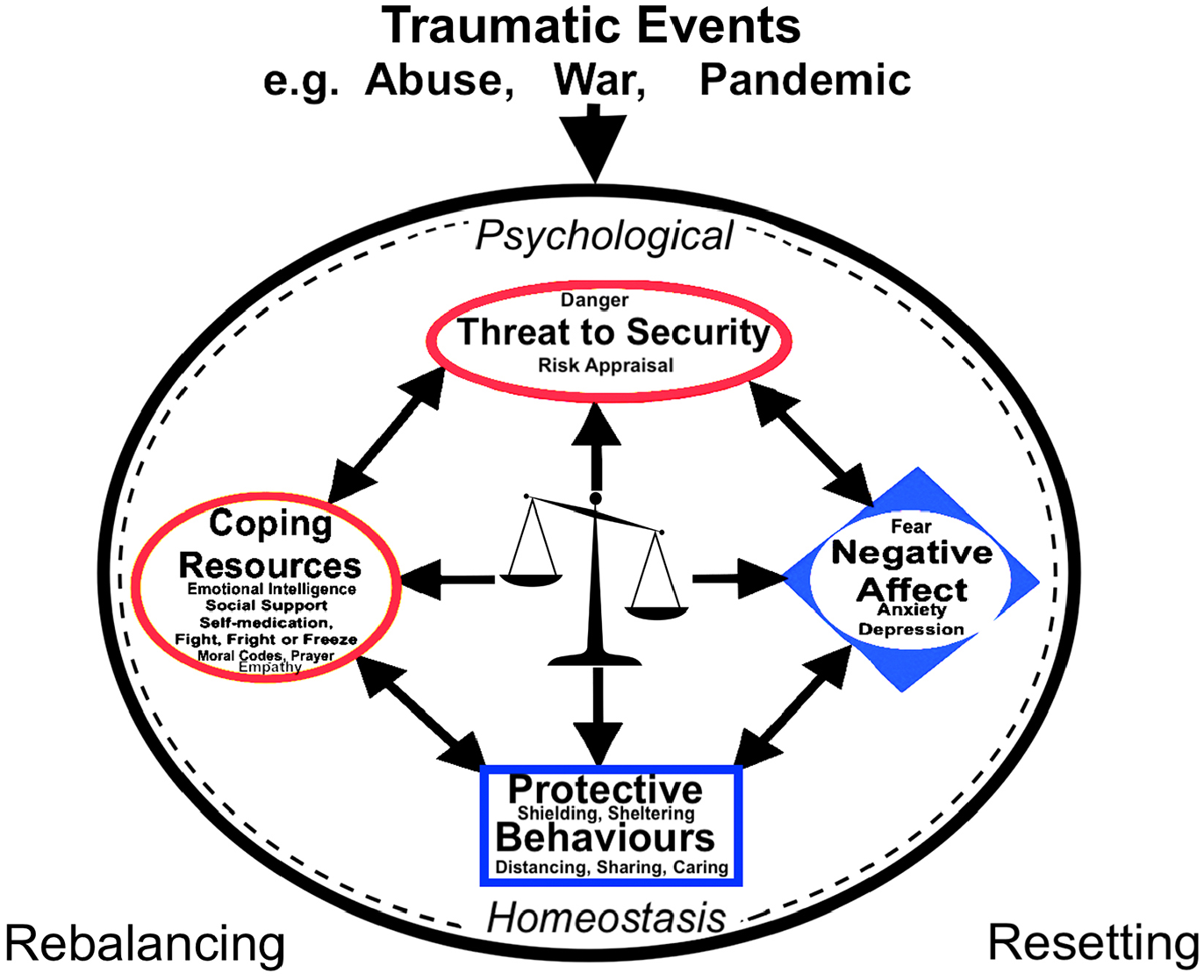
Psychological homeostasis in the context of profound adversity.
Social support is key coping resource in normalising an individual’s sense of wellbeing. According to the GTB: ‘Conscious organisms strive to achieve their goals while maximizing cohesion and cooperation with both kith and kin and, at the same time, strive to take away or to minimize the suffering and pain of others’ (Marks, 2018: 8). Moral codes to be decent, kind and understanding with empathy and acts of altruism are the foundation of thriving and social coherence. Psychological homeostasis occurs in an infinite variety of circumstances using purposeful behavioural regulation for example, cooperating, communicating, sharing, working, eating, drinking, activities of varying intensity and intimacy.
New findings contributed by the articles in this Special Issue are introduced here through the lens of the GTB.
New findings on COVID-19 protective behaviours
The disequilibrium caused by the COVID-19 pandemic and associated public health measures require a multitude of re-adjustments to psychological functioning. One of the most prevalent changes brought by the pandemic is increased anxiety as evidenced in a systematic review by Da Silva et al. (2021). As suggested by Matias et al. (2020), the vast majority of individuals in social isolation have no access to mental healthcare for which the only resources are self-help, self-medication and self-care and the in-built system of homeostasis to rebalance activity, thought and feeling.
Wood et al. (2021) investigated the potential benefits of PA in a cross-sectional study of PA behaviour which found associations with wellbeing during the UK coronavirus lockdown. A sample of 315 adults reported their PA in the previous week. The participants’ perception of PA importance was assessed by asking participants to indicate how important PA was during the coronavirus lockdown compared to before the pandemic, either more important, of the same importance or of less importance. Their levels of wellbeing, depression, anxiety and stress were also assessed. The ‘less’ importance group reported less PA than the ‘more’ and ‘same’ importance groups and reported lower wellbeing than the ‘same’ importance group. The ‘less’ importance group also had worse wellbeing, depression and anxiety than the ‘more’ importance group. These findings of Wood et al. (2021) corroborate those of Ruiz et al. (2020) in supporting the claim of the GTB that PA is a beneficial homeostatic resource in the pandemic.
Another significant stabilising factor is an individual’s or family’s moral codes. In spite of their relevance, relatively few studies have explored the moral aspects of COVID-19-related behaviours. In this issue, Christner et al. (2020) consider whether self-focussed, egotistical motives or altruistic concerns for other’s welfare act as the primary driver of behaviour in the pandemic. Christner et al.’s study employed an online questionnaire to find that moral judgement, moral identity, empathy in general and for loved ones and fear of infection were positively related to social distancing. The findings of this study cast COVID-19 behaviour in a new light in suggesting that ‘moral judgment and empathy for loved ones remained the dominant factors while controlling for all aspects’. In-depth qualitative research is needed to confirm these intriguing findings.
For individuals strongly connected to their families, friends and communities, fear of infection is also not all about one’s personal wellbeing. Motivation to adopt COVID-19 protective behaviours can be increased by persuasion, information, demonstration and forms of messaging designed to enhance risk perceptions especially among those who are complacent, hesitant or sceptical about the need to act. Fear messages tend to be the most motivating that is, strong severity and susceptibility messages (Tannenbaum et al., 2015; Witte and Allen, 2000). ‘Functional’ fear has been reliably found to be an adaptive response to COVID-19 associated with preventive behaviours and the only predictor of positive behaviour change (e.g. social distancing, improved hand hygiene) is fear of COVID-19 (Harper et al., 2021). This finding has been confirmed in multiple recent studies of COVID-19 preventive behaviours. Knowing the level of fear about COVID-19 among different socio-demographic groups is important in designing and targetting education and prevention programmes (Pakpour and Griffiths, 2020). A delicate balance has to be struck between motivating ‘COVID-19 deniers’ and risking the mental health of vulnerable people.
Giordani et al. (2021) report significantly higher fear levels among people practicing protective measures against COVID-19 (facial mask, alcohol gel and hand hygiene) and among those respecting social distancing. Giordani et al. used the Brazilian version of the Ahorsu et al. (2020) Fear of COVID-19 Scale. People who perceived themselves to have high susceptibility to COVID-19 infection were: participants aged less than 60 years, living outside the capital cities, cohabiting with individuals in high-risk groups for COVID-19, having family members or friends diagnosed or with death confirmed by COVID-19, cohabiting with health professionals, using public transport, and having to leave home to go to work. Thus an individual’s risk perceptions are prosocial because remaining safe oneself is essential for the safety of close others.
Risk appraisal is another crucial process in COVID-19 preventive behaviour that is overlooked by the COM-B. A new COVID-19 Own Risk Appraisal Scale (CORAS) by Jaspal et al. (2022) was used by the same group of investigators to explore COVID-19 preventive behaviours among White British and Black, Asian and Minority Ethnic people in the UK (Breakwell et al., 2021). The authors found that a structural equation model was a good fit for survey data from 478 White British and Black, Asian and Minority Ethnic people. Ethnicity had a direct effect on COVID preventive behaviour and an indirect effect on it through political trust, ingroup power, COVID-19 risk and trust in science. Breakwell et al. did not find that ethnicity is significantly related to COVID-19 fear. However COVID-19 fear and trust in science were both positively associated with COVID preventive behaviour.
Cummings et al. (2021) looked at the role of COVID-19 fears and related behaviours in understanding daily adolescent health behaviours during the pandemic. They examined the prospective associations of COVID-19 fears and behaviour, daily physical activity and dysregulated eating in 31 adolescents aged 11–17 who completed selected subscales of the Fear of Illness and Virus Evaluation and a 7-day health behaviour diary. As expected, Cummings et al. found that adolescents with a greater fear of contamination also reported lower daily physical activity but greater COVID-19 precautionary behaviour was associated with greater daily physical activity.
Fear appeals can have unanticipated effects across areas not originally targetted. Bowling et al. (2021) describe a study of risk perceptions related to sexuality using qualitative analyses of a survey of 333 adults in the United States. The authors report that social distancing through the COVID-19 pandemic has impacted sexuality and relationships quite widely, going beyond traditional fears of sexually transmitted infections and pregnancy. Within risky sexual behaviour, definitions include: (1) COVID-19-related, (2) STI/pregnancy, (3) relationship-related, (4) physical boundaries, (5) drug or alcohol and (6) multiple risks. The researchers indicated that there are limited sexual risk messages tailored for the pandemic, leaving individuals guessing about ways to keep their sexual partners and themselves safe requiring a new approach to tailored safer sexual practices campaigns to avoid ‘risky’ sex. Fearing infection can be the cause of multiple anxieties which spread across any individual’s life domains.
According to the GTB: ‘Psychological homeostasis occurs in response to the infinite variety of circumstances that can affect well-being using purposeful behavioural regulation e.g. cooperating, communicating, sharing, working, eating, drinking, activities of varying intensity and intimacy’ (Marks, 2018:123). It is predicted that there will be a broad range of psychological changes to behaviour during an adverse event such as the COVID-19 pandemic, not only changes of a protective nature. In an earlier issue, Arora et al. (2022) describe a systematic review and meta-analysis of observational studies on the prevalence of psychological consequences of COVID-19. The outcomes measured in their meta-analysis are potential manifestations of psychological homeostasis in response to COVID-19. These could include changes in self-esteem, potentially affected by the rising levels of unemployment, poverty and their likely impact on social status. Using seven databases the pooled prevalence of primary psychological outcomes was 26% (95% CI: 21–32) with a pooled prevalence for symptoms of PTSD at 33% (0–86), anxiety at 28% (21–36), stress at 27% (14–43), and depression at 22% (13–33). Arora et al. observed that the prevalence of psychological outcomes was similar in healthcare workers to those in the general population (34% (24–44) and 33% (27–40) respectively).
The coping resources available for an individual to make adaptations to traumatic events are finite and limited and may often require external interventions by caring others, whether informal or professional. Many studies have investigated the high prevalence of pandemic-related negative psychological outcomes among healthcare workers. Bizri et al. (2021) examined psychological distress among 150 healthcare workers in a tertiary care medical centre in Lebanon. Using an online questionnaire, more than half of the workers showed a high risk of acute distress (58.7%) while most (89.3%) scored low/moderate stress. The findings indicated a need for concern regarding a high level of post-traumatic stress in one-third of participants, significantly in nurses and those living with vulnerable individuals. These findings highlight the need for early targetted interventions for health care workers during the pandemic.
As noted, a major homeostatic balancing mechanism is provided by family support. In an earlier issue, Li and Xu (2022) investigated family support as a protective factor for social distancing and positive mental health during the COVID-19 pandemic among 1547 Chinese people. The results showed that after the effects of demographic variables had been controlled, perceived support from family members made ‘unique contributions to their attitudes about social distancing and positive mental health both directly and indirectly (via buffering loneliness)’.
Kowalski et al. (2021) explored the ‘silver lining’ to the aversive experiences of to the pandemic via benefit-finding in post-traumatic growth (PTG). One hundred seventy-nine MTurk workers reported ‘dips’ in their satisfaction with work, leisure, fitness, mental health and finances in the pandemic relative to the previous 6 months and in the future. COVID-19 benefit-finding was found to be significantly related to PTG, coping, gratitude and mental health. The most common benefits included spending more time with family and friends, the slower pace of life, and improvements to their physical health, all of which are evidence of homeostasis.
In a qualitative study, Carney et al. (2021) used thematic analysis to assess 13 parents’ perspectives on the resources necessary to foster their family’s wellbeing. Five themes emerged from the analysis: Information Deficits, Need for More Instrumental Supports, Frustration and Worry, Resources Promoting Resilience and Positive Perspective Shift. The importance of information and expanded access to community resources was highlighted to ‘scaffold resilience in the face of ongoing mass stressors’. Individual coping resources can become burned out and intervention by external support services may often be required.
Trust in the government, science and the media has been observed to have significant influence on health protective behaviour during the pandemic. Lack of trust is likely to be greater in more unequal societies. According to the GTB: ‘Social problems, including mental illness, violence, imprisonment, lack of trust, teenage births, obesity, drug abuse, and poor educational performance are more common in more unequal societies’ (Marks, 2018: 122). Wu and Shen (2021) explored the impacts of media use and trust on people’s compliance with health behaviours during the COVID-19 pandemic in China with 3000 adults using online questionnaires and quota sampling. Their results showed that use of central government media and use of WeChat are positively related to compliance with health behaviours, while use of local media and use of Weibo are negatively related to the levels of compliance. A study published elsewhere found a relationship between a country’s equality score, lack of trust and non-compliance to COVID-19 protective behaviours, as predicted by the GTB (Dang et al., 2020). Dang et al. found that: ‘poorer individuals are less supportive of government responses, and that poorest individuals are least supportive. Furthermore, poorer individuals residing in more economically unequal countries offer even less government support’.
Trust in science and governmental policies can be influenced by the slant placed on events in the media. Choi and Fox (2021) examined the slant of media consumption in polarising compliance with and undermining confidence in public health recommendations. They carried out an online survey of 1128 respondents and found that among the more avid viewers there was a ‘strong convergence in anxiety and health-protective behaviours’ but a divergence in attitudes towards specific mitigation strategies. As the authors suggest, caution is necessary in interpreting the results which are based on self-reported data and cannot be interpreted causally.
Zhang and Kou (2021) investigated how implicit theories of health such as ‘Wearing a face mask while going out’ and ‘Washing hands with soap or hand sanitizers’, and also immediate versus future influence correlate with engagement in health-protective behaviours with 15 items in 390 Chinese participants. The authors compared an ‘entity theory’ with an ‘incremental theory’ of health with six items. For example, the entity theory was represented by ‘I can’t change whether I’m in good health or bad health’ and the incremental theory of health by ‘I can change even my basic level of health considerably’. They found that gender, education level, implicit theories and consideration of future consequences were significant correlates of people’s engagement in health-protective behaviours. Consideration of future consequences mediated the effect of implicit (incremental) theories of health on people’s engagement in health-protective behaviours. Again, caution is necessary for these correlational data.
Vaccination roll-outs have been met with varying levels of compliance in different countries. Sprengholz et al. (2021) investigated public reactance to mandating of vaccination as a strategy to increase uptake. In cross-sectional quota-representative surveys and two preregistered experiments in Germany and the US (total N = 4629), they investigated (i) correlates of individual preferences for mandatory (vs voluntary) COVID-19 vaccination policies; (ii) potential detrimental effects of mandatory policies; and (iii) interventions potentially counteracting them. Between mid-April and the end of October 2020 support for a mandatory COVID-19 vaccination policy declined from 73% to 41%. Sprengholtz et al. found that that mandate reactance can cause detrimental effects, such as decreasing the intention to vaccinate against influenza and non-adherence to COVID-19 protective measures.
Van Prooijen et al. (2021) investigated how people’s acceptance of conspiracy theories, which tend to be associated with detrimental health beliefs and behaviours (e.g. reduced physical distancing; decreased vaccination intentions) were related to self-perceived likelihood to already have experienced a COVID-19 infection. Results from a sample of 9033 Dutch adults revealed that self-perceived infections actually mediated the link between conspiracy beliefs, health beliefs and behaviours. The findings were controlled for institutional distrust, and actual infections as indicated by a positive medical test. Again, with cross-sectional data, there has to be caution in interpreting the findings but the authors propose that ‘conspiracy beliefs shape people’s interpretation of the physical signals of their own body’.
Throughout the pandemic health authorities have prioritised the needs of older and more vulnerable people. On the other hand, health care resources have concentrated on the needs of COVID-19 patients and moved away from other categories of patients such as patients with cancer and mental health issues. Those with pre-existing conditions need to deal with new physical and mental stressors and may be at a greater risk for mental health problems compared to healthy individuals. Individuals with physical disabilities may be particularly affected by disruptions to their daily activities. Tyson et al. (2021) explored how social distancing and self-isolation affected the wellbeing and physical activity levels among 27 adults diagnosed with asthma in four online focus groups using thematic analysis. Participants reported becoming more health conscious due to being labelled as ‘vulnerable’. The participants reported making changes to increase their physical activity levels and suggested ‘a window of opportunity’ to engage with people diagnosed with asthma to promote beneficial lifestyle changes.
Theme two was concerned with ‘New ways of being physically active while social distancing and self-isolating’. Participants who were conscious of improving their health had been making an effort to increase their PA levels, but they were also concerned about ‘pushing themselves’ too much in fear of triggering their asthma symptoms. Increasing their PA levels appeared to benefit them both mentally and physically, but lack of social support and opportunity affected their motivation to be active.
Individuals with pain and PTSD and the combined effect of comorbid illnesses would be expected to show a reduced ability to manage the novel stressors brought by the COVID-19 pandemic. Koliouli et al. (2021) looked at the lived experiences in the COVID-19 pandemic of 10 patients with idiopathic Inflammatory Bowel Disease (IBD). The study explored how the patients managed psycho-emotional, social, and professional issues using thematic analysis of semi-structured interviews during the first COVID-19 lockdown in Greece during June 2020. Koliouli et al.’s participants acknowledged the importance of their ‘personal strength . . . empowerment and resilience’ and how they search for more meaningful and intimate relationships with others. Several mentioned that the lockdown created opportunities for self-improvement, adopting healthier behaviours, reframing their disease, adhering to their medication, and engaging in enjoyable activities, new interests and hobbies, all of which are consistent with the capability of psychological homeostasis to rebalance the individual’s life space.
Reed et al. (2021) conducted a quasi-experimental study before and during the active phase of the COVID-19 pandemic with 169 patients with pain and PTSD. The two time periods were: January 14–February 12, 2020 (Time 1) and May 5–May 13, 2020 (Time 2). The individuals were mostly White with ‘significant levels of education’ and completed study checklists online so were not representative of the general population.
The authors hypothesised that individuals with comorbid chronic pain and PTSD would endorse more negative mood changes between Time 1 and Time 2 compared to those with chronic pain only, PTSD only, and the control group (1: unsupported); individuals with chronic pain only or PTSD only would endorse more negative changes in mood between Time 1 and Time 2 compared to the control group (2: unsupported because these patients actually showed improvements); individuals with comorbid chronic pain and PTSD would endorse a more severe increase in pain-related disability between Time 1 and Time 2 compared to those with chronic pain only (3: unsupported); individuals with comorbid chronic pain and PTSD would endorse a more severe increase in PTSD symptoms between Time 1 and Time 2 compared to those with PTSD only (unsupported).
How can the observed absence of changes and mood improvements in the study participants be explained? Reed et al. suggest that it is possible the sample were less impacted by COVID-19-induced changes than the controls because they had been buffered to the full impact of the pandemic felt by commuters travelling to work. Perhaps there had already been sufficient time for psychological homoeostasis to ‘kick in’. Only in-depth studies with representative samples will permit any definite conclusions.
As must always be the conclusion, more research is necessary. This author remains hopeful that the General Theory of Behaviour will bear fruit in future research on protective responses to adverse events like the COVID-19 pandemic.
Footnotes
Declaration of conflicting interests
The author declared no potential conflicts of interest with respect to the research, authorship, and/or publication of this article.
Funding
The author received no financial support for the research, authorship, and/or publication of this article.