



Abstract
Two online experiments investigated whether hypothetical physicians’ use of an identity-safety cue acknowledging systemic injustice (a Black Lives Matter pin) improves Black Americans’ evaluations of the physician and feelings of identity-safety. Across studies, findings showed that when a White physician employed the identity-safety cue, Black Americans reported stronger perceptions of physician allyship and increased identity-safety (e.g. trust). As predicted, use of the identity-safety cue produced smaller or non-significant effects when employed by a Black physician. These benefits emerged regardless of physicians’ perceived motivation for employing the cue (e.g. whether the physician was personally motivated to employ the cue or his medical practice encouraged use of the cue; Study 2). Furthermore, analyses revealed that exposure to the identity-safety cue promoted a greater sense of identity-safety for Black Americans due to increased perceptions that the physician is an ally for Black individuals. Implications of identity-safety cues for racially discordant medical interactions are discussed.
Within the United States, Black Americans experience worse physical and mental health than White Americans (Lavizzo-Mourey and Williams, 2016; McKnight-Eily et al., 2021). Although a myriad of factors contribute to these disparities, one key factor is low-quality interactions between physicians and patients. Because less than 6% of active physicians in the U.S. identify as Black (American Association of Medical Colleges [AAMC], 2019b), Black Americans most typically receive medical care from physicians who do not share their racial identity. However, despite the prevalence of racially discordant medical interactions (e.g. interactions between Black patients and non-Black physicians), the quality of these encounters is particularly suboptimal; extensive research shows that racially discordant medical interactions are generally characterized as having less positive affect, lower-quality communication, and fewer attempts at relationship-building than racially concordant interactions (Hagiwara et al., 2017; Johnson et al., 2004; Shen et al., 2018; Siminoff et al., 2006). These negative dynamics emerge, at least in part, because Black Americans can detect racial biases within physician communication and clinical treatment that diminishes their sense of trust and comfort when interacting with non-Black physicians (Hausmann et al., 2013; Penner et al., 2010). Consequently, Black Americans may exhibit negative behavioral responses, such as reduced adherence to treatment recommendations and decreased utilization of healthcare services, which can facilitate poorer health outcomes (Greer, 2010; Penner et al., 2017). Therefore, given extensive literature documenting the negative characteristics of racially discordant clinical encounters that undermine trust and promote worse health outcomes for Black Americans, it is critical to identify strategies that physicians can use to foster inclusivity and improve the quality of these encounters.
In the current work, we theorize that one way to promote inclusivity is using identity-safety cues—context cues that signal a lower likelihood of identity-based mistreatment (Avery et al., 2013; Davies et al., 2005; Walton et al., 2015). Specifically, we posit that acknowledging the systemic injustices faced by minoritized individuals is a cue which can signal that one values individuals who possess marginalized identities (Ostrove and Brown, 2018); however, research examining identity-safety cues within medical settings has yet to test whether expressed support for social justice movements might act as an effective identity-safety cue. This type of cue has become particularly salient in the wake of recent social events (e.g. the murders of George Floyd and Breonna Taylor), as individuals and organizations increasingly expressed support for the ongoing Black Lives Matter movement (Livingston, 2020). Despite the growing utilization of this cue, it is unclear if such expressions can foster a sense of inclusivity for Black individuals, especially in interpersonal encounters. To address this gap, the current work investigates whether exposure to hypothetical physicians who employ identity-safety cues (e.g. expressing support for the Black Lives Matter movement by wearing a Black Lives Matter pin) fosters a stronger sense of identity-safety for Black Americans.
The effectiveness of identity-safety cues
Black Americans routinely experience racial discrimination, which can prompt concerns about the likelihood that their racial identity will be devalued in the future. These concerns may be particularly pronounced in settings, such as healthcare, that have been marked by anti-Black racism (Olayiwola, 2016; Yearby, 2021). To mitigate these concerns, extant research promotes the use of identity-safety cues for cultivating trust and attenuating feelings of threat among minoritized groups (Avery et al., 2013; Cipollina and Sanchez 2020; Emerson and Murphy, 2014; Lewis et al., 2016, 2017; Pietri et al., 2018; Purdie-Vaughns et al., 2008). Identity-safety cues, which can take on varied formats, generally convey that an individual’s social identities are valued in a particular setting (Davies et al., 2005) by signaling that one’s ingroup is represented (Pietri et al., 2018) and/or that members of a marginalized group will be treated fairly (Chaney et al., 2016, 2018). For example, several investigations have found that exposure to a successful ingroup member—such as an employee with a shared racial identity— can act as an effective identity-safety cue for Black individuals (Avery et al., 2013; Johnson et al., 2019; Pietri et al., 2018). Research has also examined whether organizational policies and procedures, as well as individual behavior, serve as effective identity-safety cues for minoritized persons (Johnson et al., 2021; Plaut et al., 2009; Purdie-Vaughns and Walton, 2011). In particular, past work has shown that exposure to organizational statements promoting diversity (Purdie-Vaughns et al., 2008), as well as learning about an employee confronting discrimination (Hildebrand et al., 2020) both act as identity-safety cues and can enhance identity-safety among various marginalized groups.
Of relevance to the present work, identity-safety cues can also shape perceptions that an individual or organization is an ally—a person who acknowledges the challenges faced by marginalized social groups and acts to combat systemic inequities encountered by the group (Ashburn-Nardo, 2018; Droogendyk et al., 2016; Ostrove and Brown, 2018). For instance, individuals and organizations that use identity-safety cues are more likely to be viewed as activists or allies (Matsick et al., 2020), are perceived to have more equitable policies (Chaney and Sanchez, 2018), and are identified as more attractive places to work (Johnson et al., 2021). As one example, acknowledging the challenges Black women face in science, technology, engineering, and mathematics (STEM) settings and acting to combat those challenges (e.g. by recruiting Black women into one’s STEM research group) has been found to promote perceptions that White individuals are allies for Black women (Johnson and Pietri, 2022; Pietri et al., 2018). More subtle behaviors, such as the inclusion of gender pronouns in employee biographies, can also signal that employees and managers are allies for LGBT+ persons (Johnson et al., 2021). Critically, extensive research demonstrates that perceptions of allyship can mediate the effect of identity-safety cues on marginalized individuals’ sense of identity-safety (Johnson and Pietri, 2022; Johnson et al., 2021; Pietri et al., 2018). However, despite evidence documenting the effectiveness of identity-safety cues to promote allyship perceptions and the benefits of perceived allyship for identity-safety within organizations and academic settings, few studies have explored allyship cues in health contexts.
Existing literature offers initial evidence that use of identity-safety cues broadly can yield benefits in health settings. Indeed, as mentioned earlier, Black patients may express greater comfort interacting with a Black doctor, who themselves can act as identity-safety cues (Avery et al., 2013; Johnson et al., 2019; Pietri et al., 2018). Moreover, identity-safety cues can also be signaled by healthcare providers who do not share patients’ minoritized identities. For example, Cipollina and Sanchez (2021) found that when sexual minority adults see patient reviews for a hypothetical healthcare provider suggesting that the provider is supportive of the LGBTQ community (versus reviews without documented LGBTQ support), they perceive the provider to have greater cultural competence, be less biased, and provide higher treatment quality. Moreover, sexual minority adults who see the pro-LGBTQ reviews report stronger intentions to disclose their sexual orientation to the provider (Cipollina and Sanchez, 2021). Related research with other minoritized groups shows a similar pattern of findings; when Black and Latinx adults see information about a hypothetical White healthcare provider who has racially diverse (versus homogenous) patients, they perceive the provider to have greater cultural competency and lower levels of racial bias (Cipollina and Sanchez, 2020). Taken together, the available research examining identity-safety cues in healthcare settings suggests that such cues can also be beneficial for Black individuals. To build upon prior work, we explore whether use of identity-safety cues signals physician allyship and examine the extent to which allyship perceptions promote identity-safety in healthcare settings.
Despite extensive research documenting the effectiveness of employing identity-safety cues, burgeoning literature suggests that there are contexts in which exposure to identity-safety cues may produce heterogeneous effects or backfire. For example, although Black and Latinx adults view a White healthcare provider who has racially diverse patients more favorably, the provider’s use of a pro-diversity statement did not improve Black and Latinx adults’ perceptions of the provider (Cipollina and Sanchez, 2020). Moreover, past research finds that identity-safety cues are unlikely to yield positive psychological benefits when they are perceived to be dishonest or insincere. For instance, gender non-diverse organizations that exaggerate their gender diversity can prompt social identity threat and reduce women’s interest in the organization (Kroeper et al., 2022). Other research demonstrates that despite the presence of pro-diversity expressions, members of minoritized groups are particularly sensitive to cues regarding the legitimacy of these efforts. For example, Black and Latinx individuals who perceive an organization’s pro-diversity statements and images to be dishonest (e.g. after viewing information depicting the organization’s lack of racial diversity) report lower expectations for their work performance, a decreased sense of fit at the organization, and a reduced ability to be themselves in the organization (Wilton et al., 2020). Therefore, previous research indicates that although identity-safety cues are generally effective, exposure to contexts which signal that these cues might be disingenuous can promote worse outcomes for target groups. For instance, having an organizational policy which dictates that all employees are encouraged to show solidarity with Black Americans (e.g. by wearing a Black Lives Matter pin) may undermine the cue’s effectiveness and increase perceptions that the gesture is disingenuous. At the same time, policies at the organization level may promote identity-safety by indicating that the organization is serious about its pro-diversity efforts (Hall et al., 2018).
Overview of the current studies
Although past research demonstrates that use of identity-safety cues is largely beneficial across several domains, with a few exceptions (Cipollina and Sanchez, 2020, 2021), few studies have tested the effectiveness of these cues in health contexts or explored whether these cues can convey physician allyship. Across two online experiments, we investigate how Black Americans respond to identity-safety cues employed by a Black or White primary care physician when they imagine interacting with the physician for an initial healthcare visit. Specifically, we test whether (a) use of an identity-safety cue—a Black Lives Matter pin on the physician’s jacket lapel—promotes more favorable evaluations of, and a stronger sense of identity-safety with, the physician (Studies 1–2), (b) the relationship between exposure to the identity-safety cue and feelings of identity-safety is mediated through perceptions that the physician is an ally for Black individuals (Studies 1–2), and (c) a situational context change (e.g. physicians’ perceived motivation for employing the identity-safety cue) amplifies or mitigates the effects of the identity-safety cue (Study 2). We explore these questions with Black Americans in the context of health settings given longstanding racial disparities that undermine Black Americans’ physical and mental health outcomes (Byrd and Clayton 2003). Additionally, we evaluate the effects of these identity-safety cues on a set of outcomes that are critical for the development of high-quality clinical encounters and that serve as robust predictors for important health outcomes: evaluations of the physician (e.g. beliefs that the physician is an ally; Hall et al., 2002) and a sense of identity-safety (e.g. trust and comfort with the physician and intentions to comply with physician recommendations; Berry et al., 2008; Lee and Lin, 2009; Thom et al., 2004).
Study 1 tested whether use of an identity-safety cue would improve Black Americans’ responses to, and evaluations of, a hypothetical physician. We expected that although the presence of an identity-safety cue would not significantly affect evaluations of the Black physician (because his shared racial identity would already act as a strong identity-safety cue; Pietri et al., 2018), the cue would improve evaluations of the White physician. In particular, we theorized that seeing a White physician with the identity-safety cue (relative to a White physician without the cue) would produce stronger beliefs that the physician was an ally for Black individuals and an increased sense of identity-safety (e.g. trust and comfort with the physician). Moreover, we hypothesized that the presence of the identity-safety cue would promote a stronger sense of identity-safety for Black Americans via increased perceptions that the physician is an ally.
Study 2 aimed to replicate and extend Study 1 by testing a possible boundary condition for the effectiveness of this identity-safety cue. Specifically, this study examined whether viewing one physician who is personally motivated to employ the cue (versus multiple physicians whose medical practice encourages use of the cue), impacts the cue’s effectiveness. We developed competing hypotheses about the role of identity-safety cues for the White physician in this context. We theorized that on one hand, seeing multiple physicians who are encouraged to employ the cue could signal that the medical practice values Black individuals, further increasing feelings of identity-safety (Hall et al., 2018). Conversely, seeing multiple physicians who are encouraged to employ the cue could increase concerns about the personal motivations underlying this behavior and be perceived as an inauthentic display of advocacy, subsequently undermining feelings of identity-safety (Wilton et al., 2020).
Study 1
Method
Participants
A priori power analyses in G*Power V. 3.1 (Faul et al., 2007) recommended a minimum sample size of 245 participants for a 2 × 2 ANOVA when expecting a small-to-medium effect size (f = 0.18), with 80% power and α = 0.05. We over-recruited participants to ensure sufficient power and account for exclusions (e.g. participants who failed to correctly identify the identity-safety cue).
This study was approved by the Indiana University Institutional Review Board, and all participants provided electronic consent. We recruited Black Americans using Prolific Academic and obtained a sample of 444 participants. Before data analysis, we excluded 130 participants who did not pass the attention checks (e.g. incorrectly identifying the identity-safety cue) or who did not identify as Black. Participant exclusions significantly differed across conditions such that participants were more likely to be excluded when they saw the White (versus Black) physician, X2(3) = 27.24, p < 0.001. Importantly, participant exclusions did not differ across the White physician conditions (identity-safety cue versus control), X2(1) = 0.36, p = 0.548, or Black physician conditions (identity-safety cue versus control), X2(1) = 0.37, p = 0.546. . After removing these participants, we retained 314 participants in our sample (3.2% biracial or multiracial; 56.7% female, 0.3% gender non-binary; Mage = 31.94; SDage = 11.77).
Procedure
Participants were randomly assigned to one of four conditions in a 2 (physician race: Black, White) × 2 (identity-safety cue: identity-safety cue, control) between-subjects design.
In this experiment, participants were told that the researchers were interested in understanding people’s initial impressions of physicians. Next, they were asked to imagine that they were meeting with a physician for an initial health visit because they were having chest pain. To manipulate physician race, participants were told that they would be seeing Anthony Williams (a Black physician) or Luke Williams (a White physician), and these instructions were accompanied by an image of the respective physician. The images were piloted to ensure that they were well-matched on various attributes, such as competence and warmth (see online supplement for additional details). The image also included the experimental manipulation for the identity-safety cue. In the “identity-safety cue” condition, the physician was wearing a “Black Lives Matter” pin on his jacket lapel. In the control condition, the physician was not wearing a pin.
Measures
Following the experimental manipulations, participants responded to survey items measuring their (a) perceptions that the physician is an ally for Black individuals, (b) compliance with the physician’s recommendations, (c) interest in the physician, and (d) trust and comfort with the physician. 1 Example items from each measure are provided below, and complete wording for all measures is provided in the online supplement. For the following measures, we calculated the mean of the items, with higher scores indicating more of each construct.
Perceived allyship of the physician
We measured participants’ perceptions that the physician is an ally for Black individuals using four items on a Likert scale ranging from 1 (strongly disagree) to 5 (strongly agree) (e.g. “Most likely, this doctor cares about issues related to Black people”; α = 0.96; M = 4.10, SD = 0.85). Items were adapted from previous research (Pietri et al., 2018).
Physician identity-safety
Our measure of physician identity-safety was comprised of three subscales. Specifically, participants responded to three items on a Likert-type scale ranging from 1 (not at all likely) to 7 (very likely) assessing their compliance with the physician’s recommendations (e.g. “How likely would you be to follow the doctor’s treatment plan?”; α = 0.91; M = 5.70, SD = 1.20), four items assessing their interest in the physician on a Likert-type scale ranging from 1 to 7 using response labels (definitely not to definitely yes) that varied as a function of the question stem (e.g. “Would you want this person as your doctor?”; α = 0.93; M = 5.74, SD = 1.24; adapted from Howe and Monin, 2017), and five items measuring their trust and comfort with the physician on a Likert-type scale ranging from 1 (strongly disagree) to 7 (strongly agree) (e.g. “I think I could be myself with this doctor.”; α = 0.94; M = 5.48, SD = 1.37; adapted from Purdie-Vaughns et al., 2008).
Our measures for compliance with physician recommendations, interest in the physician, and trust and comfort with the physician were strongly correlated, and an exploratory principal factor analysis using varimax rotation on the 12 survey items revealed that the items measured a single factor. Specifically, the analysis revealed one factor with an Eigenvalue = 9.14, which accounted for 76.13% of the variance. Given statistical support and to streamline the presentation of results, these 12 items were aggregated into an index for physician identity-safety (α = 0.97; M = 5.62, SD = 1.23).
Analytic strategy
Analyses were conducted in SPSS v.27.0 using univariate analysis of variance (ANOVA). To test our hypotheses, we examined the main effects of physician race and identity-safety cue, as well as the two-way interaction, on the primary study outcomes. Significant interactions were further probed by examining the simple effects.
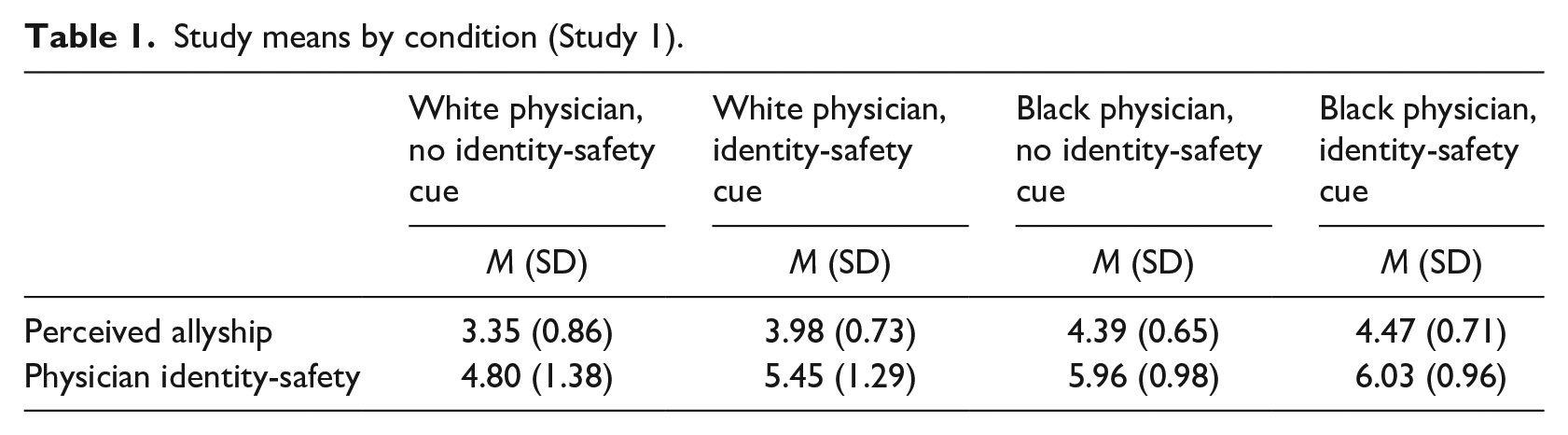
Statistical means and standard deviations for significant main effects are presented below, and all means and standard deviations for the two-way interaction are reported in Table 1.
Study means by condition (Study 1).
Results
Perceived Allyship of the Physician
A significant main effect of physician race, F(1, 310) = 83.82, p < 0.001, d = 1.04, showed that participants were more likely to perceive the Black physician as an ally (M = 4.43, SD = 0.68) than the White physician (M = 3.65, SD = 0.85). Moreover, a significant main effect of identity-safety cue, F(1, 310) = 18.12, p < 0.001, d = 0.48, showed that participants were more likely to perceive the physician as an ally in the identity-safety cue condition (M = 4.27, SD = 0.75) relative to the control condition (M = 3.94, SD = 0.91). These main effects were qualified by a significant Physician Race × Identity Safety Cue interaction, F(1, 310) = 10.94, p = 0.001, ηp2 = 0.034. Simple effects revealed that although participants were more likely to perceive the White physician as an ally when he employed the identity-safety cue (versus not), F(1, 310) = 24.81, p < 0.001, d = 0.57, employing the identity-safety cue did not impact the perceived allyship of the Black physician, F(1, 310) = 0.53, p = 0.466, d = 0.08. Moreover, participants were more likely to perceive that the Black (versus White) physician was an ally regardless of whether the identity-safety cue was present, F(1, 310) = 16.69, p < 0.001, d = 0.46, or absent, F(1, 310) = 79.58, p < 0.001, d = 1.01.
Physician Identity-Safety
A significant main effect of physician race, F(1, 310) = 44.38, p < 0.001, d = 0.76, showed that participants reported stronger perceptions of physician identity-safety when they saw the Black physician (M = 5.99, SD = 0.97), relative to the White physician (M = 5.11, SD = 1.37). Moreover, a significant main effect of identity-safety cue, F(1, 310) = 7.59, p = 0.006, d = 0.31, demonstrated that participants reported stronger physician identity-safety in the identity-safety cue condition (M = 5.79, SD = 1.14), versus the control condition (M = 5.46, SD = 1.30). These main effects were qualified by a significant Physician Race × Identity-Safety Cue interaction, F(1, 310) = 4.95, p = 0.027, ηp2 = 0.016. Simple effects revealed that participants reported stronger physician identity-safety with the White physician when he employed the identity-safety cue (compared to when he did not), F(1, 310) = 10.75, p = 0.001, d = 0.37. However, employing the identity-safety cue did not impact feelings of identity-safety with the Black physician, F(1, 310) = 0.17, p = 0.684, d = 0.05. Moreover, participants reported stronger feelings of identity-safety with the Black (versus White) physician, regardless of whether the identity-safety cue was present, F(1, 310) = 9.61, p = 0.002, d = 0.35, or absent, F(1, 310) = 40.46, p < 0.001, d = 0.72.
Testing the proposed mechanism: Perceived allyship of the physician
Our model examined the mechanism underlying the relationship between exposure to the identity-safety cue and increased identity-safety: perceived allyship of the physician. We tested this model using Model 8 in Hayes (2018) PROCESS macro v. 3.0 with 10,000 bootstrap samples. The model examined whether (a) the physician race and identity-safety cue interaction predicted increased perceptions that the physician is an ally, and (b) increased perceptions of allyship predicted stronger feelings of physician identity-safety.
As observed in the ANOVA, analyses revealed a significant Physician Race × Identity-Safety Cue interaction on perceived allyship of the physician, b = 0.55, SE = 0.17, p = 0.001, 95% CI = [0.22, 0.88], such that the presence of the identity-safety cue increased perceptions that the White physician was an ally, but did not significantly impact perceived allyship of the Black physician. Increased perceptions of allyship predicted a stronger sense of physician identity-safety, b = 1.17, SE = 0.06, p < 0.001, 95% CI = [1.05, 1.28]. After accounting for the indirect effect, the direct effect of the Physician Race × Identity-Safety Cue interaction on physician identity-safety was no longer significant, b = −0.07, SE = 0.18, p = 0.709, 95% CI = [−0.41, 0.28].
The indirect effect was significant for the White physician, b = 0.74, SE = 0.16, 95% CI = [0.42, 1.07], but not the Black physician, b = 0.09, SE = 0.12, 95% CI = [−0.13, 0.33]. Moreover, the index of moderated mediation was significant, b = 0.64, SE = 0.20, 95% CI = [0.25, 1.03].
Discussion
Study 1 demonstrated that use of an identity-safety cue which signaled solidarity with the Black community (e.g. a Black Lives Matter pin) elicited positive responses from Black Americans across study outcomes. In particular, this cue was associated with increased perceptions that the physician was an ally and a stronger sense of physician identity-safety (e.g. trust and comfort with the physician). Consistent with our hypotheses, findings also indicated that the benefits of the identity-safety cue were particularly strong in response to the White physician. That is, when the White physician employed the identity-safety cue, Black Americans reported increased perceptions that the physician is an ally and stronger perceptions of physician identity-safety (relative to a White physician who did not employ the identity-safety cue). However, the use of an identity-safety cue did not significantly impact outcomes in response to the Black physician. This pattern of findings is consistent with our predictions that the Black physician’s racial identity would already serve as a strong identity-safety cue, and consequently, presence of the pin would not afford additional benefits. In support of this notion, a main effect of physician race revealed that the Black physician received more favorable ratings than the White physician across study outcomes.
Furthermore, mediation analyses indicated that participants’ beliefs that the (White) physician is an ally for Black individuals served as a mechanism underlying the relationship between exposure to the identity-safety cue and increased physician identity-safety. Specifically, modeling the indirect effect demonstrated that the presence of the identity-safety cue increased perceptions that the White physician is an ally, and perceptions of allyship predicted a stronger sense of identity-safety. Therefore, findings show that the use of an identity-safety cue can be particularly effective for a White physician because it increases Black Americans’ perceptions that he is an ally.
Study 2
Study 2 sought to replicate and extend Study 1 by testing a potential boundary condition of employing identity-safety cues in a health context. Specifically, Study 2 investigated whether the benefits resulting from the presence of an identity-safety cue are enhanced (versus mitigated) depending on Black Americans’ beliefs about the physician’s motivation for employing the cue. First, we manipulated whether participants learned that the medical practice encouraged employees to employ the cue (or had no such policy). Additionally, we sought to enhance the motivation manipulation by also changing the number of physicians who employed the cue. We expected that when multiple physicians are wearing the Black Lives Matter pin, it might further impact beliefs about the physician’s motivation for incorporating the pin. That is, seeing multiple physicians employ the cue may strengthen perceptions that the physician is wearing the pin because he was encouraged to do so by others at his medical practice, instead of purely personal reasons. Therefore, Study 2 focused on examining Black Americans’ feelings of identity-safety when the identity-safety cue is employed by (a) one physician who has his practice’s permission to express his support for social justice movements, versus (b) several physicians who have been encouraged to employ the identity-safety cue by their medical practice.
We had two competing hypotheses about how Black Americans might respond to the identity-safety cue in a context where multiple physicians are wearing the Black Lives Matter pin and the physician’s motivation is manipulated. On one hand, we expected that this context could increase the effectiveness of the identity-safety cue because encouraging its usage among everyone at the medical practice can signal that the entire practice (and not just one physician) values Black individuals. In support of this idea, previous research documents the effectiveness of implementing identity-safety cues, such as pro-diversity policies, at the organization level (Hall et al., 2018). Alternatively, we theorized that this context might reduce the effectiveness of the identity-safety cue because Black individuals may perceive that the physicians are employing the identity-safety cue because they are being compelled by the practice and therefore, the cue is not reflective of genuine support for the Black community (Wilton et al., 2020).
Method
Participants
Because we did not have an a priori effect size for our novel identity-safety cue manipulation, we used the parameters from Study 1. Therefore, a priori power analyses in G*Power V. 3.1 recommended a minimum sample size of 301 participants for a 2 × 3 ANOVA when expecting a small-to-medium effect size (f = 0.18), with 80% power and α = 0.05. As in Study 1, we sought to recruit approximately 100-110 participants per cell to ensure sufficient power and account for exclusions. Post-hoc sensitivity analyses suggested that we were able to detect an effect size of f = 0.13.
We recruited Black Americans using Prolific Academic and obtained a sample of 667 participants. Before data analysis, we excluded 127 participants who did not pass the attention checks (e.g. incorrectly identifying the identity-safety cue) or who did not identify as Black. Because participants in the control condition were not asked about the identity-safety cue (given that they did not encounter this cue), we examined participant exclusions as a function of the identity-safety cue conditions. Participant exclusions did not significantly differ across the single and multiple cue conditions (White physician in a practice where a single physician employs the cue, White physician in a practice where multiple physicians employ the cue, Black physician in a practice where a single physician employs the cue, Black physician in a practice where multiple physicians employ the cue), X2(3) = 5.46, p = 141 or across the control conditions (White versus Black physician), X2(1) = 1.14, p = 0.285. After removing these participants, we retained a sample of 540 participants (2.2% biracial or multiracial; 54.3% female, 1.7% gender non-binary; Mage = 31.60; SDage = 10.79).
Procedure
Participants were randomly assigned to one of six conditions in a 2 (physician race: Black, White) × 3 (identity-safety cue: control, single cue, multiple cue) between-subjects design.
The instructions were identical to Study 1. However, we made a few changes to the procedure to test our new identity-safety cue manipulation. In this study, participants saw a website for a medical practice, Axis Health Group, which depicted 4 White male physicians, 1 Latina physician, and 1 Black male physician. In the “control” condition, participants were told to imagine that they would be meeting with one of the physicians from Axis Health Group, a group practice that was established in 2006. None of the pictured physicians employed the identity-safety cue (i.e. Black Lives Matter pin). Participants in the “single cue” condition were told that, “A recent initiative implemented by Axis Health Group gives their healthcare providers the freedom to express their support for current social issues, such as the Black Lives Matter movement.” Additionally, only one physician was pictured wearing the identity-safety cue (i.e. the physician participants imagined they would be interacting with). Participants in the “multiple cue” condition were told that, “A recent initiative implemented by Axis Health Group has encouraged all of their healthcare providers to show their support for current social issues, such as the Black Lives Matter movement.” As such, all of the physicians were pictured wearing the identity-safety cue (including the physician participants imagined they would be interacting with).
Following the description and image of the physicians at the practice, participants saw the images of the Black or White physician used in Study 1 and were told to imagine that they would be interacting with this physician, using the same instructions from Study 1. The physician depicted in the control condition did not employ a Black Lives Matter pin, whereas the physician depicted in both the single and multiple cue conditions wore a Black Lives Matter pin. Study materials are available in the online supplement.
Measures
Participants responded to the same survey items from Study 1 measuring perceived allyship of the physician (α = 0.94; M = 3.99, SD = 0.83) and perceptions of physician identity-safety (α = 0.96; M = 5.46, SD = 1.23). 2 Furthermore, we included an additional measure to determine whether our single, versus multiple, cue manipulation effectively impacted participants’ perceptions about the physician’s motivation for employing the identity-safety cue.
Manipulation check
We measured participants’ perceptions about the physician’s motivation for employing the identity-safety cue using one item on a Likert-type scale ranging from 1 (genuinely motivated to wear it) to 7 (Axis Health Group encouraged him to wear it; e.g. “To what extent was the doctor wearing the message on his/her jacket because he/she was genuinely motivated to wear it [versus Axis Health Group encouraging him/her wear it]?”). Participants only saw this item if they were in the “single cue” or “multiple cue” conditions.
Results
Manipulation check
A significant main effect of identity-safety cue, F(1, 320) = 7.53, p = 0.006, d = −0.31, indicated that our experimental manipulation was effective; participants were more likely to perceive that the physician was genuinely motivated to wear the identity-safety cue in the single cue condition (M = 3.47, SD = 1.75) than in the multiple cue condition (M = 4.03, SD = 1.86). Of note, the mean for the physician in the multiple cue condition was right at the midpoint of the scale, suggesting that participants viewed the physician as equally motivated by personal/genuine reasons and encouragement from the medical practice. Moreover, a significant main effect of physician race, F(1, 320) = 49.62, p < 0.001, d = −0.79, revealed that participants were more likely to perceive that the Black physician was genuinely motivated to wear the identity-safety cue (M = 3.10, SD = 1.86) than the White physician (M = 4.44, SD = 1.54). The Physician Race × Identity-Safety Cue interaction was not significant, F(1, 320) = 0.13, p = 0.716, ηp2 = 0.000.
Preliminary analyses and analytic strategy
Study 2 sought to replicate Study 1’s findings demonstrating that the presence of an identity-safety cue improved Black Americans’ evaluations of, and sense of identity-safety with, the (White) physician. Moreover, Study 2 assessed whether responses to the “single cue” condition significantly diverged from the “multiple cue” condition (e.g. whether seeing one physician who is personally motivated to employ the identity-safety cue produces significantly different outcomes than seeing multiple physicians whose practice encourages use of the identity-safety cue). To test these aims, we conducted ANOVA and examined the main effects of physician race and identity-safety cue, as well as the two-way interaction, on the study outcomes. Findings revealed that the 2 × 3 ANOVA was not significant across the primary study outcomes (all p-values >0.138; see online supplement for additional details). Moreover, examining the pattern of means indicated that responses to the single cue condition were not significantly different from responses to the multiple cue condition. Therefore, although the single cue versus multiple cue manipulation impacted perceptions regarding the physician’s motivation for wearing the pin, the manipulation did not influence other downstream consequences (e.g. perceived allyship of the physician or physician identity-safety). Given these non-significant effects, we collapsed across these two identity-safety cue conditions for our subsequent ANOVA analyses in an effort to replicate Study 1. Therefore, our analyses tested whether the presence of an identity-safety cue (across the single and multiple cue conditions) improved evaluations of, and feelings of identity-safety with, the physician (relative to the absence of an identity-safety cue). Statistical means and standard deviations are presented below or in Table 2.
Study means by condition (Study 2).

Perceived allyship of the physician
Replicating Study 1, a significant main effect of physician race, F(1, 536) = 218.74, p < 0.001, d = 1.28, showed that participants were more likely to identify the Black physician as an ally for Black individuals (M = 4.43, SD = 0.60) than the White physician (M = 3.55, SD = 0.79). Moreover, a significant main effect of identity-safety cue, F(1, 536) = 7.19, p = 0.008, d = 0.23, revealed that participants were more likely to identify the physician as an ally when he employed the identity-safety cue (M = 4.05, SD = 0.81) compared to when he did not (M = 3.89, SD = 0.84). In contrast to Study 1, the Physician Race × Identity-Safety Cue interaction was not significant, F(1, 536) = 1.59, p = 0.208, ηp2 = 0.003.
Physician identity-safety
As in Study 1, findings revealed a significant main effect of physician race, F(1, 536) = 131.26, p < 0.001, d = 0.99, indicating that participants reported a stronger sense of physician identity-safety with the Black physician (M = 6.00, SD = 0.84), relative to the White physician (M = 4.93, SD = 1.31). Further replicating Study 1, a significant Physician Race × Identity-Safety Cue interaction emerged, F(1, 536) = 3.93, p = 0.048, ηp2 = 0.007. Simple effects revealed that participants reported a stronger sense of physician identity-safety with the White physician when the identity-safety cue was present (versus absent), F(1, 536) = 5.73, p = 0.017, d = 0.21. However, employing the identity-safety cue did not impact feelings of identity-safety with the Black physician, F(1, 536) = 0.17, p = 0.677, d = −0.04. Moreover, participants reported a stronger sense of identity-safety with the Black (versus White) physician regardless of whether the identity-safety cue was present, F(1, 536) = 56.10, p < 0.001, d = 0.65, or absent, F(1, 536) = 75.26, p < 0.001, d = 0.75. In contrast to Study 1, the main effect of identity-safety cue was not significant, F(1, 536) = 1.94, p = 0.165, d = 0.12. Thus, participants reported equal levels of physician identity-safety regardless of whether the identity-safety cue was present (M = 5.52, SD = 1.18) or absent (M = 5.38, SD = 1.30).
Testing the proposed mechanism: Perceived allyship of the physician 3
We sought to replicate Study 1 by examining perceived allyship of the physician as the mechanism underlying the relationship between exposure to the identity-safety cue and increased physician identity-safety. Although Study 1 revealed a significant Physician Race × Identity-Safety Cue interaction on perceived allyship, Study 2 only found a main effect of identity-safety cue. Therefore, we tested the mediating role of perceived allyship using Model 4 in the PROCESS macro with 10,000 bootstrap samples and controlled for physician race. Analyses assessed whether (a) presence of an identity-safety cue (collapsed across the single and multiple cue conditions) predicted increased perceptions that the physician is an ally for Black individuals, and (b) increased perceptions of allyship predicted a stronger sense of physician identity-safety.
As observed in the ANOVA, analyses revealed a significant effect of identity-safety cue on perceived allyship of the physician, b = 0.16, SE = 0.06, p = 0.007, 95% CI = [0.04, 0.28], such that the presence of the identity-safety cue increased perceptions that the physician is an ally for Black individuals. Increased perceptions of allyship, in turn, predicted stronger perceptions of physician identity-safety, b = 1.16, SE = 0.05, p < 0.001, 95% CI = [1.07, 1.25]. The direct effect of identity-safety cue on perceptions of physician identity-safety was not significant, b = −0.05, SE = 0.07, p = 0.415, 95% CI = [−0.19, 0.08]. However, the indirect effect via perceived allyship was significant, b = 0.19, SE = 0.07, 95% CI = [0.05, 0.33].
Discussion
Study 2 sought to replicate and extend Study 1 by investigating whether use of an identity-safety cue would be more (versus less) effective in a context where it was employed by multiple physicians in a hypothetical medical practice that encouraged its use (relative to a context with one physician who was personally motivated to employ the cue). Although we had competing hypotheses about how Black Americans would respond to these contexts, findings revealed non-significant effects of condition. However, the null findings between conditions were not caused by a failed manipulation; means obtained from our manipulation check demonstrated that the manipulation of the physician’s motivation was effective. Given the non-significant differences between the single and multiple cue conditions, we collapsed across these conditions in an effort to replicate the findings observed in Study 1.
Many of the findings observed in Study 1 replicated in Study 2. For instance, Study 2 demonstrated that when Black Americans saw a White physician who employed an identity-safety cue, they reported a stronger sense of physician identity-safety (relative to when the White physician did not employ an identity-safety cue). The identity-safety cue produced non-significant effects on physician identity-safety in response to the Black physician. In contrast to Study 1, however, Study 2 showed that the presence of an identity-safety cue increased perceptions that the physician is an ally regardless of the physician’s race. This finding diverges from Study 1, where this observed effect only emerged in response to the White physician. Beyond perceptions of allyship, the study results further replicated Study 1 by demonstrating that Black participants reported more favorable evaluations of the Black (versus White) physician across study outcomes.
Consistent with Study 1, mediation analyses offered supportive evidence for perceived allyship of the physician as a mechanism underlying physician identity-safety. Specifically, findings revealed that the presence of an identity-safety cue increased beliefs that the physician is an ally for Black individuals, and these beliefs predicted a stronger sense of physician identity-safety. Thus, these results further demonstrate that the presence of an identity-safety cue fosters identity-safety for Black Americans by increasing perceptions that the physician is an ally.
General discussion
Although the effectiveness of identity-safety cues is well-documented across several domains, limited research has assessed whether these cues can successfully increase feelings of identity-safety in encounters between Black patients and non-Black physicians. Therefore, to extend our knowledge about the utilization of identity-safety cues in health contexts, two experiments tested (a) whether the use of an identity-safety cue (e.g. a Black Lives Matter pin) improves Black Americans’ evaluations of, and feelings of identity-safety with, a hypothetical (White) physician, (b) whether the presence of this cue improves identity-safety via increased perceptions that the physician is an ally for Black individuals, and (c) the extent to which beliefs about the physician’s motivation for employing this cue enhances (versus undermines) its effectiveness.
Across studies, findings demonstrated that the presence of an identity-safety cue did, in fact, improve Black Americans’ evaluations of, and sense of identity-safety with, the physician. Further, the effects of the identity-safety cue were especially strong when participants imagined that they would be interacting with a White (versus Black) physician; specifically, analyses showed that the presence of an identity-safety cue increased perceptions that the White physician is an ally (Study 1) and facilitated a stronger sense of physician identity-safety. Of note, findings also revealed that exposure to the Black (versus White) physician generated more positive responses across outcomes for Black Americans. As predicted, the presence of the identity-safety cue generally did not enhance these effects. Lastly, modeling the indirect effect revealed that the presence of an identity-safety cue improved Black Americans’ sense of identity-safety due to increased perceptions that the physician is an ally for Black individuals.
Study 2 examined a potential boundary condition of employing identity-safety cues in health contexts by manipulating physicians’ perceived motivation for employing the cue. Despite our competing predictions that seeing multiple physicians whose practice encouraged the identity-safety cue might enhance Black Americans’ feelings of identity-safety (e.g. due to beliefs that the medical practice supports Black individuals) or undermine Black Americans’ sense of identity-safety (e.g. due to beliefs that use of the pin is being compelled by the medical practice), we found non-significant differences across these conditions. Thus, Study 2 demonstrated that exposure to an identity-safety cue promotes psychological benefits for Black individuals, and this effect emerges regardless of whether the practice encourages use of the cue or the physician is personally motivated to employ the cue. This null finding is consistent with previous research showing that identity-safety cues can yield positive outcomes for minoritized groups regardless of whether they have been mandated by an organization (Johnson et al., 2021). Importantly, these findings do not suggest that physician motivation is unimportant for cue effectiveness. Rather, it is possible that Black Americans still make positive inferences about physicians who work at a practice which encourages support for social justice movements. This notion is supported by study means showing that participants in the multiple cue condition believed that the physician employed the pin due to both genuine motivation and encouragement from the medical practice equally (i.e. the mean for the multiple cue condition was at the scale midpoint between believing the physician wore the pin for genuine reasons versus because Axis Health Group encouraged him to wear it). Thus, this work has important implications for understanding the conditions under which identity-safety cues yield psychological benefits for Black Americans. Specifically, these studies suggest that there may be benefits of implementing pro-diversity policies for individual actors in an organization when these policies set guidelines for individual behavior. Future research should continue to investigate how identity-safety cues that are linked to individual actors within an organization (versus the organization broadly) affects feelings of identity-safety among minoritized groups.
This work contributes to past research on allyship by identifying another type of identity-safety cue, acknowledgment of the systemic injustices faced by minoritized individuals, which can enhance perceptions that an individual is an ally. This finding is particularly significant because previous research suggests that due to experiences with racial discrimination, Black Americans frequently report suspicions about the motives underlying White individuals’ positive feedback or behavior, especially in settings where racism is pervasive (Major et al., 2016). Perceiving allyship is critical because it is a robust predictor of psychological benefits for minoritized groups, including increased trust and comfort (Johnson and Pietri, 2022; Johnson et al., 2019), which has important implications for the quality of physician-patient encounters (Petrocchi et al., 2019). Therefore, the present findings offer evidence of a novel way in which physical symbols can be used as identity-safety cues to increase perceptions that White physicians are allies.
The present investigation also contributes to our understanding of the different types of identity-safety cues that may be most effective for minoritized groups in health settings. Across studies, we found evidence that despite use of an identity-safety cue, evaluations and feelings of identity-safety in response to the White physician were lower (relative to the Black physician). As such, these data suggest that certain identity-safety cues (e.g. a shared marginalized identity) may be a particularly strong predictor of identity-safety compared to other types of identity-safety cues (e.g. physical symbols). Therefore, in addition to implementing interventions that improve the quality of clinical encounters between Black patients and non-Black physicians, efforts to mitigate racial health disparities should also pursue interventions that focus on increasing the representation of Black physicians in healthcare settings.
Implications, limitations, and future directions
Although these studies demonstrate that the presence of identity-safety cues can improve first impressions of physicians, which may generate more positive expectations at the beginning of the encounter, we do not believe that employing these cues will offset racially biased clinical behavior. Therefore, we do not encourage medical practices or physicians to utilize identity-safety cues without also making efforts to ensure that clinicians are trained and motivated to provide high-quality, culturally responsive care. Employing identity-safety cues while also exhibiting behavior that is perceived to be racially biased may cause Black patients to view these pro-diversity efforts as disingenuous and further undermine trust (Wilton et al., 2020; Windscheid et al., 2016).
One limitation of the present work is that we examined our primary research questions using a hypothetical scenario, as opposed to in the context of an actual clinical encounter. Of note, the effect sizes observed in response to the identity-safety cue manipulation were relatively small across studies, likely due to the utilization of a hypothetical encounter. Although identification of cues that improve one’s sense of inclusion is practically significant and may shape interpretations of other social cues in these environments (e.g. interpreting physicians’ behaviors as well-intentioned), future research should test the effectiveness of identity-safety cues in actual clinic settings to determine how the presence of these cues impacts the quality of clinical encounters. For example, future studies should assess the extent to which presence of identity-safety cues affects adherence to clinical recommendations, the quality of physician-patient communication, and Black Americans’ vigilance for stigma cues during the encounter (e.g. interpretations of ambiguous statements or behaviors). Importantly, although the present work utilized a self-report measure for identity-safety, these findings are notable because several past investigations have found that the constructs comprising our identity-safety index (i.e. trust and comfort, interest in the physician, and compliance with physician recommendations) are notable predictors of actual behavior during clinical encounters, such as communication quality and adherence to treatment recommendations (Garber et al., 2004; Maue et al., 2004).
Furthermore, the current work focused on a specific context: the ways in which Black Americans respond to a specific identity-safety cue employed by a White or Black male physician. The current studies focused on male physicians given that men comprise nearly 59% of general practice physicians in the United States (AAMC, 2019a) and tend to be viewed as prototypical of their race (and consequently, may show stronger effects of our manipulation; Schug et al., 2015; Zarate and Smith, 1990). Moreover, although extensive research documents expectations of racism between Black and White individuals, there is evidence that clinical interactions between Black patients and other non-Black physicians are also characterized by racial bias (Ibilibor and Moses, 2020; Onyeador et al., 2020; Sabin et al., 2009). Future research should examine whether the current findings generalize to female physicians and to other racial/ethnic groups (e.g. whether Black Americans report greater physician identity-safety when these cues are employed by physicians from other racial and/or ethnic backgrounds). Additionally, future studies should consider whether physicians who employ other identity-relevant physical symbols (e.g. a rainbow flag pin) signal identity-safety for other target groups (e.g. individuals who identify as LGBTQ+), and if the effectiveness of these cues transfers to other minoritized persons (e.g. Latinx individuals; Chaney et al., 2016).
Another limitation of this work is that although we intended for the experimental manipulation used in Study 2 to manipulate physicians’ motivation for employing the identity-safety cue, our manipulation also changed the number of physicians employing the cue. As such, it is difficult to know whether (a) motivation for using the cue and/or (b) the number of cues impacted Black Americans’ responses. Given this confound in the study design, future research should test whether Black Americans’ responses to identity-safety cues are most likely driven by the motivation underlying these cues (versus the number of cues present). For example, past work has found that identity-safety cues at the organization level (e.g. inclusion of gender pronouns in employee biographies) can also shape perceptions of specific individuals employed in the setting (Johnson et al., 2021), suggesting that perceptions of individual motivations are shaped by multiple entities. Thus, future work should address this limitation by manipulating both the number of cues and whether the medical practice required (versus recommended) that physicians adopt the cue.
Future research should also consider additional cues that may cultivate identity-safety in health contexts. To date, research examining the effects of identity-safety cues has focused primarily on organization-level cues, such as organizational diversity statements and demographic representation of employees and/or patient populations. These studies utilize a novel identity-based cue—a Black Lives Matter pin conveying support for social justice movements—that expands the types of cues used in existing research. Future studies should continue to examine the effectiveness of other types of identity-safety cues in this environment (e.g. other images or objects that can be found within medical offices, such as a Black Lives Matter sticker on a mug or computer; Cipollina and Sanchez, 2019). Furthermore, given previous research showing the importance of representation for signaling identity-safety (Avery, 2003), future work should consider how the demographic representation of physicians in a medical practice impact effectiveness of the cue (e.g. whether employing the cue in a practice with all-White physicians is less effective than employing the cue in a racially diverse practice).
Conclusion
Given the negative dynamics of clinical encounters between Black patients and non-Black physicians that can perpetuate racial disparities in health outcomes, the current work investigated how identity-safety cues employed in hypothetical health contexts are evaluated by Black Americans. Findings demonstrated that the presence of an identity-safety cue which acknowledges the social injustices faced by Black individuals facilitated greater feelings of inclusion for Black Americans and produced more positive evaluations of (White) physicians who employ these cues. Understanding the effectiveness of these cues in health contexts offers important insight into strategies that can enhance Black Americans’ sense of identity-safety in these settings and have downstream consequences for the quality of clinical encounters. Future research should consider additional ways that identity-safety cues can be employed in health settings, as well as the benefits of these cues for health outcomes, to more fully elucidate their role as an intervention to mitigate racial health disparities.
Supplemental Material
sj-docx-1-hpq-10.1177_13591053221090850 – Supplemental material for Black (patients’) lives matter: Exploring the role of identity-safety cues in healthcare settings among Black Americans
Supplemental material, sj-docx-1-hpq-10.1177_13591053221090850 for Black (patients’) lives matter: Exploring the role of identity-safety cues in healthcare settings among Black Americans by Veronica Derricks, India R Johnson and Evava S Pietri in Journal of Health Psychology
Supplemental Material
sj-docx-5-hpq-10.1177_13591053221090850 – Supplemental material for Black (patients’) lives matter: Exploring the role of identity-safety cues in healthcare settings among Black Americans
Supplemental material, sj-docx-5-hpq-10.1177_13591053221090850 for Black (patients’) lives matter: Exploring the role of identity-safety cues in healthcare settings among Black Americans by Veronica Derricks, India R Johnson and Evava S Pietri in Journal of Health Psychology
Research Data
sj-docx-9-hpq-10.1177_13591053221090850 – for Black (patients’) lives matter: Exploring the role of identity-safety cues in healthcare settings among Black Americans
sj-docx-9-hpq-10.1177_13591053221090850 for Black (patients’) lives matter: Exploring the role of identity-safety cues in healthcare settings among Black Americans by Veronica Derricks, India R Johnson and Evava S Pietri in Journal of Health Psychology
Research Data
sj-sav-2-hpq-10.1177_13591053221090850 – for Black (patients’) lives matter: Exploring the role of identity-safety cues in healthcare settings among Black Americans
sj-sav-2-hpq-10.1177_13591053221090850 for Black (patients’) lives matter: Exploring the role of identity-safety cues in healthcare settings among Black Americans by Veronica Derricks, India R Johnson and Evava S Pietri in Journal of Health Psychology
Research Data
sj-sav-6-hpq-10.1177_13591053221090850 – for Black (patients’) lives matter: Exploring the role of identity-safety cues in healthcare settings among Black Americans
sj-sav-6-hpq-10.1177_13591053221090850 for Black (patients’) lives matter: Exploring the role of identity-safety cues in healthcare settings among Black Americans by Veronica Derricks, India R Johnson and Evava S Pietri in Journal of Health Psychology
Research Data
sj-sps-3-hpq-10.1177_13591053221090850 – for Black (patients’) lives matter: Exploring the role of identity-safety cues in healthcare settings among Black Americans
sj-sps-3-hpq-10.1177_13591053221090850 for Black (patients’) lives matter: Exploring the role of identity-safety cues in healthcare settings among Black Americans by Veronica Derricks, India R Johnson and Evava S Pietri in Journal of Health Psychology
Research Data
sj-sps-4-hpq-10.1177_13591053221090850 – for Black (patients’) lives matter: Exploring the role of identity-safety cues in healthcare settings among Black Americans
sj-sps-4-hpq-10.1177_13591053221090850 for Black (patients’) lives matter: Exploring the role of identity-safety cues in healthcare settings among Black Americans by Veronica Derricks, India R Johnson and Evava S Pietri in Journal of Health Psychology
Research Data
sj-spv-7-hpq-10.1177_13591053221090850 – for Black (patients’) lives matter: Exploring the role of identity-safety cues in healthcare settings among Black Americans
sj-spv-7-hpq-10.1177_13591053221090850 for Black (patients’) lives matter: Exploring the role of identity-safety cues in healthcare settings among Black Americans by Veronica Derricks, India R Johnson and Evava S Pietri in Journal of Health Psychology
Research Data
sj-spv-8-hpq-10.1177_13591053221090850 – for Black (patients’) lives matter: Exploring the role of identity-safety cues in healthcare settings among Black Americans
sj-spv-8-hpq-10.1177_13591053221090850 for Black (patients’) lives matter: Exploring the role of identity-safety cues in healthcare settings among Black Americans by Veronica Derricks, India R Johnson and Evava S Pietri in Journal of Health Psychology
Footnotes
Data sharing statement
The current article is accompanied by the relevant raw data generated during and/or analysed during the study, including files detailing the analyses and either the complete database or other relevant raw data. These files are available in the Figshare repository and accessible as Supplemental Material via the SAGE Journals platform. Ethics approval, participant permissions, and all other relevant approvals were granted for this data sharing.
Declaration of conflicting interests
The authors declared no potential conflicts of interest with respect to the research, authorship, and/or publication of this article.
Funding
The authors disclosed receipt of the following financial support for the research, authorship, and/or publication of this article: This publication was made possible with support from Grant Numbers, KL2TR002530 (Sheri Robb, PI), and UL1TR002529 (Sarah Wiehe and Sharon Moe, co-PIs) from the National Institutes of Health, National Center for Advancing Translational Sciences, Clinical and Translational Sciences Award awarded to the first author. The content is solely the responsibility of the authors and does not necessarily represent the official views of the National Institutes of Health.

Notes
References
Supplementary Material
Please find the following supplemental material available below.
For Open Access articles published under a Creative Commons License, all supplemental material carries the same license as the article it is associated with.
For non-Open Access articles published, all supplemental material carries a non-exclusive license, and permission requests for re-use of supplemental material or any part of supplemental material shall be sent directly to the copyright owner as specified in the copyright notice associated with the article.
