




Abstract
Vaccine rumors on social media endanger public health. This study examined how evidence types influenced perceived persuasiveness and relevance and engagement intentions of vaccine rumors. We conducted a 2 (evidence type: anecdotes vs. anecdotal statistics) × 2 (stance: pro-vaccine rumor vs. anti-vaccine rumor) online experiment (N = 551) and surveyed participants’ health literacy and vaccine knowledge. Anecdotal statistics were perceived as more relevant than anecdotes and indirectly influenced perceived persuasiveness and behavior intentions. This finding was confirmed when vaccine rumors were pro-attitudinal. Health literacy positively predicted perceived persuasiveness; health knowledge negatively predicted relevance and behavior intentions. Practical implications and future research directions are discussed.
Social media have become a source of health information and a platform for health information exchange (Sommariva et al., 2018). Individuals produce and distribute health information in real-time on social media, often with a measure of anonymity and without information gatekeepers (Qazvinian et al., 2011). Researchers have identified the lingering harm of misinformation on social media (Walter and Tukachinsky, 2020), although health rumors–regardless of information veracity–can be as just dangerous to health beliefs and behaviors of the public (Oh and Lee, 2019).
Rumors are unverified or unverifiable information with unknown intentions or unidentified sources (Qazvinian et al., 2011). Without instant fact-checking by institutions and media platforms, audiences may not have sufficient knowledge or skills to discern information veracity before sharing it with a wider social network. Social media, however, accelerate the diffusion of rumors by enabling a collective behavior of information sharing among groups of people (Oh et al., 2010). Although rumors may not be created with the intent to persuade, they nevertheless often exert persuasive effects. Even when health rumors are demonstrated to be false and corrected, the effects on attitudes and behaviors often linger (Thorson, 2016), as human memory is susceptible to the influence of false information with complete awareness of its falsity (Ayers and Reder, 1998).
The dangers posed by health rumors make it necessary to investigate when people trust, share, or check the veracity of health rumors on social media. Allport and Postman (1947) identified importance and ambiguity as predictors of rumor transmission. When a situation is perceived as ambiguous and relevant, rumors emerge to resolve this ambiguity and alleviate the fear evoked by uncertainty. Rumor studies have identified various individual and contextual factors that affect perceived importance and ambiguity, such as psychological control and source credibility (Difonzo and Bordia, 2007), but very few studies have examined the message characteristics of rumors, which are a major source for people to determine the level of importance and ambiguity. It remains unclear how message characteristics affect rumor transmission.
This study investigates how anecdotes and anecdotal statistics in health rumors influence rumor believability and transmission. Anecdotal evidence refers to the use of individual instances as proof of a claim (Hornikx, 2005). Anecdotal statistics are distinctive given the unverified nature of rumors. We define anecdotal statistics as the numeric summary of a group of individual instances from unpublic sources. “My cousin fell into a well,” is an anecdote; “My cousin told me more than 100 kids fall into wells every year,” is an anecdotal statistic. These two evidence types are the focus of this study because stories (anecdotes) and science (statistics) are commonly adopted in health rumors and misinformation with extensive use of narrations (Shelby and Ernst, 2013). In the context of rumors, we focus on anecdotal statistics instead of statistical evidence because statistical evidence adopted in health rumors can be unverified or unverifiable from unknown sources. The use of numbers from unverifiable sources makes anecdotal statistical evidence different from statistical evidence. Statistical evidence is public and verifiable, produced by credible sources without an anecdotal background, and different from a simple combination of stories and numbers. Anecdotal statistics are distinctive to the context of rumors and may be more detrimental for individuals in a state of uncertainty and anxiety. It is necessary to examine which type of evidence exerts a larger impact on the audience.
Specifically, we are interested in the impacts of evidence types in health rumors on the perceived relevance and persuasiveness of those rumors, the intention to seek further information related to the rumor or its subject, and the intention to share the rumor. First, the perceived relevance of a message is the premise of interest and rumor transmission (Allport and Postman, 1947); irrelevant information is unlikely to be transmitted. Second, perceived persuasiveness, the perception that a message will cause people to embrace a particular point of view or engage in certain behaviors, represents attitudes toward a message, which further determines behavioral intentions (Ajzen and Fishbein, 1977). The intention to seek information suggests involvement in a message and the intention to fact-check or verify message veracity; such behaviors are important to restrain misinformation transmission. The intention to share is an important indicator of the behavioral impact of a rumor and the likelihood of viral transmission of a rumor to a wider audience (Kim, 2018).
This study relied on a between-subject experiment (N = 551) to examine the effects of anecdotes and anecdotal statistics on the perceived relevance and persuasiveness and the intention to seek information and share for vaccine rumors on social media. For the sake of generalizability, we examined these processes for two different vaccines, namely vaccines for influenza and Hepatitis B. Because the perceptions and behavior intentions elicited by messages tend to be influenced by individual differences, and to minimize the possibility of confounding variables and maximize internal validity, we explored individual characteristics, such as health literacy and knowledge. Also, given the trend of polarization in the discussion of vaccination (Schmidt et al., 2018), we investigated the effect of evidence types in light of motivated reasoning. Theoretically, we provide a new perspective to understanding message effect factors that contribute to rumor believability and transmission by examining evidence types in rumors and misinformation. Practically, the study offers insights for media and health practitioners for improving health literacy and countering health misinformation on social media.
Anecdotal evidence and anecdotal statistical evidence
Although researchers have not explicitly explored the effects of anecdotal statistics, the extensive literature on the impact of anecdotes, statistics, and a combination of both can serve as a reference. Empirical studies suggest a mix of effects of anecdotes and statistics; however, two meta-analyses suggested statistics are generally more influential than anecdotes (Allen and Preiss, 1997; Hornikx, 2005). Baesler and Burgoon (1994) arrived at the same conclusion but pointed out that some studies did not control for vividness between anecdotes and statistics, which resulted in a stronger impression and persuasiveness of anecdotes.
Anecdotes and statistics may produce different effects on attitudes and behaviors. Statistics are more persuasive in terms of attitudes since statistics imply a generalizable phenomenon that can be highly relatable to most of the audience; anecdotes are more persuasive regarding behavior intentions because anecdotes are affectively arousing, and affect creates a sense of readiness for behavior (Zebregs et al., 2015). However, the affective arousal of anecdotes might arise from the vividness of narration. When narrative vividness is controlled, anecdotal evidence may not be more powerful than anecdotal statistical evidence in terms of persuasion and even behavior intentions (Greene et al., 2010). Therefore,
H1. Readers of a vaccine rumor with anecdotal statistics will perceive that rumor to be more persuasive and relevant than a similar rumor employing anecdotal evidence.
RQ1. What effect will evidence type (anecdotal vs. anecdotal statistics) have on readers’ likelihood to share the rumor or to seek additional information?
In addition to narrative vividness, anecdotes can be superior to statistics when they are more emotionally engaging and relevant to the audience (Freling et al., 2020). Relevance refers to the extent to which content personally affects someone; in contexts that involve severe threats and health issues, anecdotes are more persuasive than statistics (Freling et al., 2020). The effect of perceived relevance is explained by the heuristic-systematic processing model; people are more likely to process information systematically when a context is perceived as relevant (Chaiken and Ledgerwood, 2012). The effects of perceived relevance on information processing styles may consequently affect attitude and behavior intentions. Perceived relevance may mediate the effects of evidence types on perceived persuasiveness and behavior intentions: for people who perceive vaccines as more relevant and vaccine-preventable diseases more severe than others, anecdotal evidence might exert a stronger impact, though it is unclear if this would apply to anecdotes versus anecdotal statistics.
RQ2. Does perceived relevance mediate the effect of evidence type on perceived persuasiveness, and the intention to share and seek information?
Health literacy and health knowledge
Health literacy refers to “the degree to which individuals can obtain, process, understand, and communicate about health-related information needed to make informed health decisions” (Berkman et al., 2010). According to the health literacy conceptual model, health literacy represents one’s cognitive and literacy skills used for critically evaluating and seeking health information (Nutbeam, 2008). Health literacy is related to the perception of, evaluation of, and intention to share health information (Diviani et al., 2015). People with low levels of health literacy tend to possess lower cognitive skills and trust and share information on social media without critical evaluation (Diviani et al., 2015), but they are less likely to engage in information-seeking behavior (Ellis et al., 2012). On the contrary, people with higher levels of health literacy are more likely to evaluate and verify the information and are less likely to trust and share (Crook et al., 2016). However, health literacy has not proven to be a significant factor in the intention to verify or share information in the context of vaccine rumors, though health literacy moderates the relationship between perceived importance and the intention to verify or share (Oh and Lee, 2019). Therefore,
H2. Higher levels of health literacy will be associated with higher levels of perceived persuasiveness and relevance of health rumors as well as the intention to share those rumors and to seek further information.
Though health literacy is concerned with health-related self-efficacy, it is not the same as health knowledge (Baker, 2006); health knowledge captures the “health-related cognitive structures” in a more objective manner (Moorman and Matulich, 1993). This objectivity may suggest a positive link between knowledge and the ability to discern misinformation and a different impact of health knowledge on perceptions and behavioral intentions. Knowledge of COVID-19 positively predicted news discernment, which suggests that people with more knowledge are less likely to trust and are more likely to verify (Calvillo et al., 2020). Crook et al. (2016) found that health knowledge negatively predicted the intention to share. Therefore, in the case of rumors, individuals with higher levels of knowledge might be able to detect the suspiciousness of rumors and have lower levels of the intention to share. We argue that
H3. Higher levels of health knowledge will be associated with lower levels of perceived persuasiveness and relevance, and the intention to share, and higher levels of the intention to seek information regarding health rumors.
Effects of motivated reasoning
Individual motives affect the perception and evaluation of new information (Chaiken and Ledgerwood, 2012; Kunda, 1990); people are inclined to be more critical of information that disconfirms existing beliefs and worldviews than attitude-congruent information (Walter and Tukachinsky, 2020). Motivated reasoning arises because humans have innate biases—confirmation bias and disconfirmation bias in the information processing (Strickland et al., 2011). Motivated reasoning occurs regardless of information truthfulness and accuracy. Individuals with disconfirmation bias tend to have negative evaluations of counter-attitudinal information (Edwards and Smith, 1996), whereas, with confirmation bias, individuals are likely to have favorable perceptions of pro-attitudinal information (Nickerson, 1998) and share such information (Difonzo and Bordia, 2007). Empirical studies have confirmed these phenomena in the contexts of political misinformation (Thorson, 2016), climate change (Hart and Nisbet, 2012), and emerging technologies (Druckman and Bolsen, 2011). Motivated reasoning can be applied to the context of vaccines as well, given the trend of polarization and ideologization in the discussion of vaccination (Schmidt et al., 2018).
Motivated reasoning may lead to more extreme opinions when misinformed individuals are unwilling to change their minds (Hart and Nisbet, 2012). It might also have an interaction effect with evidence type such that individuals may show a preference for one evidence type when it comes to pro-attitudinal messages but show a different preference when it comes to counter-attitudinal messages. The literature on evidence type has not considered the influence of motivated reasoning, and it is necessary to examine how individuals evaluate the effects of evidence types under the influence of motivated reasoning. Though statistical evidence tends to have a larger impact than anecdotal evidence, it is unclear which evidence type would be more effective in belief updating when it comes to counter-attitudinal information.
RQ3a. When vaccine rumors are counter-attitudinal, how does evidence type influence perceived persuasiveness and relevance, and the intention to share and seek information?
RQ3b. When vaccine rumors are pro-attitudinal, how does evidence type influence perceived persuasiveness and relevance, and the intention to share and seek information?
Methods
Study design
To investigate the influence of evidence types and individual characteristics on perceptions and behavioral intentions of health rumors on social media, we conducted an online experiment with a between-subjects design: evidence types (anecdote, anecdotal statistics) × message stance (pro-vaccine, anti-vaccine) × vaccine type (Hepatitis B vaccine, influenza vaccine). Two different vaccine types were included to increase the generalizability of this study. Health literacy, health knowledge, vaccine behavior, and exposure to vaccine information were included as within-subject variables. This study was approved by the authors’ Institutional Review Board.
Sample
In August 2020, we recruited American participants (N = 551) from Amazon Mechanical Turk with a compensation of $1. Participants were redirected to a Qualtrics survey once they accepted the task (N = 733); in violation of the recruitment, several non-American participants participated, but were subsequently excluded (N = 168). Another 14 respondents answered no questions and were removed. Hence, the final sample was reduced to N = 551 (317 males, 189 females, 36 unspecified; Table S1). Participants were aged from 21 to 71 (M = 37.26, SD = 10.74); most possessed a college degree (N = 420). Participants’ median annual income fell in the $35,000 to $49,999 range. There was no significant difference in age, gender, education, or race across conditions, though participants who read rumors on influenza vaccines had significantly higher levels of income (M = 5.20) than those who read Hepatitis B vaccine rumors (M = 4.60; p < 0.001). Since vaccine types were not the focus of this study, adjustments were not made.
After participants answered questions about their attitudes, behaviors, and knowledge regarding vaccines, participants were told to imagine a scenario in which they searched the hashtag #flushot/#HepatitisBvaccine on Twitter for information related to the influenza vaccine or Hepatitis B vaccine. Participants then read two mockup Tweets conveying vaccine rumors (e.g. Figure S1) and one distracting message. For all mockup Tweets, profile images and other identifiers were all blurred. Participants then answered questions about their perceptions and behavioral intentions regarding each Tweet they read. The survey ended with demographic questions and the correct answers to the vaccine knowledge quiz.
Stimuli
In total, 16 vaccine rumors in the format of Tweets were fabricated based on real posts on social media with vaccine misinformation. Each message was framed to be narrated from a first-person perspective and had the same degree of separation to simulate the same level of informational ambiguity and ensure internal validity, such as “my neighbor told me a friend in her hometown. . .”, and “I saw a video on TikTok about a woman. . .”. Two messages in each condition revolved around vaccine safety and effectiveness. This was done in part to make findings more generalizable, but primarily because these are two distinct aspects of vaccines that affect decision-making. Essentially, there were four different messages across vaccine type (Hepatitis B vaccine/influenza vaccine) × vaccine aspect (safety/effectiveness) that were revised to fit different conditions. For example, in the pro-vaccine × anecdotal evidence condition, one Tweet was about a teenager with anti-vaccine parents who chose to receive the influenza vaccine after turning 18; in the pro-vaccine × anecdotal statistical evidence condition, the Tweet was about a poll of 400 teens with anti-vaccine parents, 80% of which wished to receive the influenza vaccine after turning 18. In the anti-vaccine conditions, the teens’ background and intentions were inverted; a teenager or group of teens with pro-vaccine parents chose not to receive the influenza vaccine after turning 18.
All 16 messages were first pretested by an independent sample, and each was perceived to be of the intended message evidence type. We conducted two pretests with 53 and 46 undergraduate students in a public university on the west coast in August 2020. Participants were assigned to read eight messages in the condition of either influenza vaccine or Hepatitis B vaccine and evaluate whether a message uses personal stories or statistics to convey a point. Participants were reminded that statistics can be used in personal stories as well. Results of two pretests combined suggested that messages with anecdotal statistical evidence (M = 4.67) were rated as more statistical than messages with anecdotal evidence (M = 4.07; p = 0.013).
Measures
Perceived persuasiveness and relevance
Perceived persuasiveness and relevance of health rumors were operationalized on a 7-point bipolar scale (e.g., 1 = not persuasive, 7 = persuasive). Perceived persuasiveness included three items to measure to what extent a message was persuasive, convincing, and compelling to a person (M = 4.35, SD = 1.58, McDonald’s ω = 0.93; Chen et al., 2017). Perceived relevance contained two items on how relevant and important a message is (M = 4.74, SD = 1.50, McDonald’s ω = 0.90; Oh and Lee, 2019). See Table S2 for detailed descriptive statistics.
Intention to share
The intention to share was measured by two items on a 7-point scale (1 = extremely unlikely, 7 = extremely likely): intention to retweet and intention to share with close families and friends (M = 4.68, SD = 1.76, 1 = extremely unlikely, 7 = extremely likely = 0.94 (Edgerly et al., 2020; Oh and Lee, 2019).
Intention to seek information
The intention to seek information was measured by one item “How likely are you to find more information about Hepatitis B vaccine/influenza vaccine?” after participants had read all three Tweets (M = 5.16, SD = 1.52).
Health literacy
Health literacy (M = 4.54, SD = 1.54, McDonald’s ω = 0.98) was measured by 18 items from the Transactional eHealth Literacy Instrument (TeHLI; (Paige et al., 2019) on a 7-point scale (1 = strongly agree, 7 = strongly disagree). This scale specifically focused on e-health (Paige et al., 2019). Sample items were “I know how to access basic health information on the Internet” and “I can tell when an Internet user is a credible source of health information.”
Vaccine knowledge
Vaccine knowledge (Min = 0, Max = 10, M = 4.95, SD = 2.21) was measured by 10 multiple-choice questions about the functions of different kinds of vaccines and the mechanism of vaccines, such as “To the best of your knowledge, which vaccine prevents a form of cancer?” and “Immunity means resistant to what?”. These items were chosen from Vaccine Trivia Game (Children’s Hospital of Philadelphia, 2015).
Vaccination behavior
Vaccination behavior (Min = 0, Max = 1, M = 0.63, SD = 0.33) was measured by three binary items on the vaccination history of a participant and three binary items on the participants’ children, if any. Sample items were “Have you received a flu shot in the last year?” and “Did you vaccinate your kids on schedule?”. Only three items were averaged for responses from people without children, and six items were averaged for responses from people with children (N = 420).
Exposure to vaccine information
On a 5-point scale (1 = always, 7 = never), exposure to vaccine information was measured by two items on the frequency of reading vaccine-related information and anti-vaccine information (Min = 1, Max = 5, M = 2.97, SD = 0.96, McDonald’s ω = 0.65). This variable was included as a covariate; it was expected that variation in vaccine knowledge may be associated with both readers interpreted, understood, and intended to act upon vaccine rumors; controlling for vaccine information allows for greater confidence in study results.
Prior attitude on vaccines
Prior attitude on vaccines (M = 5.14, SD = 1.31, McDonald’s ω = 0.88) included three items on general attitude and two items on hypothetical vaccines, measured on a 7-point scale (1 = extremely unlikely, 7 = extremely likely). Three items on general attitude, safety, and effectiveness of vaccine were used to measure prior attitude on the vaccine (M = 5.17, SD = 1.37). Two items were used to measure attitudes toward hypothetical vaccines for COVID-19 and cancer (M = 5.11, SD = 1.45).
Motivated reasoning
To answer RQ2, a binary variable was created to indicate whether a message was consistent with one’s prior attitude on the vaccine. It was considered pro-attitudinal when participants with an anti-vaccine prior attitude (prior attitude <4) read anti-vaccine messages (n = 41) and when participants with a pro-vaccine prior attitude (prior attitude >4) read pro-vaccine messages (n = 210). It was considered counter-attitudinal when pro-vaccine participants read anti-vaccine messages (n = 218) and anti-vaccine participants read pro-vaccine messages (n = 45). Those who neither agreed nor disagreed (prior attitude = 4; n = 26) were excluded from the analysis.
Demographics
For analysis, gender and race were converted to binary variables (gender: 1—male, 0—non-male; race: 1—white, 0—non-white); education and income were converted to continuous variables.
Statistical analyses
Multiple linear regressions were conducted to test H1 to H3 and answer RQ1 and RQ3 Tables 1 and 2). Independent variables included two factors (evidence type and vaccine stance), covariates (prior attitude, health literacy, vaccine knowledge, vaccination behavior, and exposure to vaccine information), and demographic controls (age, gender, race, education, and income). p-values reported in regression models were not adjusted for multiple comparisons because adjustments do not increase the disjunctive power significantly but may increase Type II error when four dependent variables were moderately correlated (average r = 0.59; Table S4) (Vickerstaff et al., 2019).
Linear regression models on perceived persuasiveness and perceived relevance.
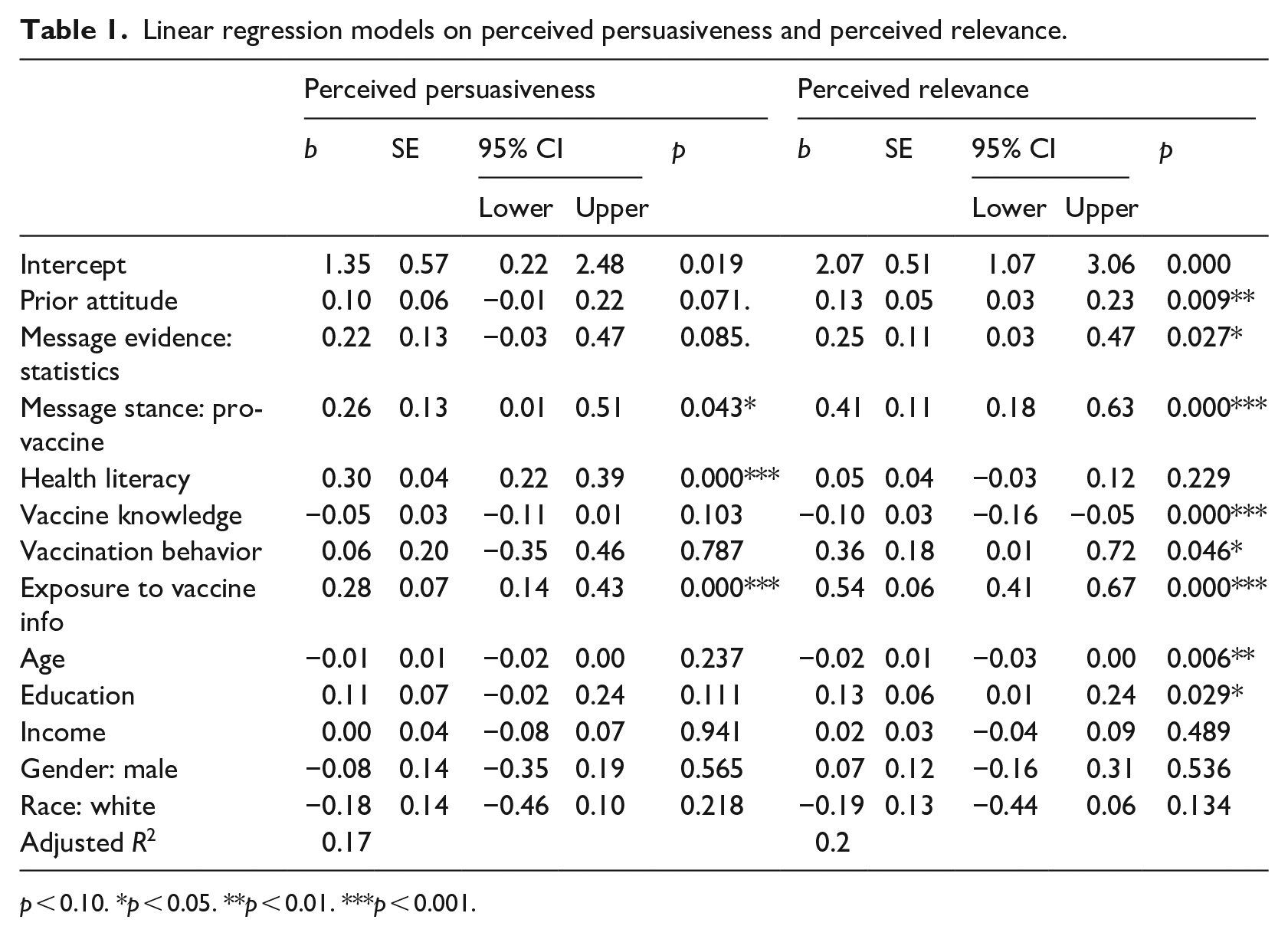
p < 0.10. *p < 0.05. **p < 0.01. ***p < 0.001.
Linear regression models on the intention to share and the intention to seek information.

p < 0.10. *p < 0.05. **p < 0.01. ***p < 0.001.
To answer RQ2, the mediation package in R was used to test the mediation effects of perceived relevance (Tingley et al., 2014). Since mediation does not handle missing values, two partial responses were removed to analyze the indirect effect on perceived persuasiveness, and four partial responses were removed to analyze the indirect effect on the intention to share, which resulted in slight differences in regression coefficients reported in regression models that accept missing values.
Results
H1 hypothesized that participants perceive vaccine rumors with anecdotal statistics as more persuasive and relevant than those with anecdotes only, and RQ1 revolved around the effects of evidence types on the intention to share and seek information. Linear regression models suggested that participants perceived vaccine rumors with anecdotal statistics as significantly more relevant than rumors with anecdotes (Table 1), but the preference over anecdotal statistics regarding perceived persuasiveness and the intention to share was marginally significant, and participants’ intentions to seek information was not influenced by evidence types (Table 2). H1 was partially supported. Overall, participants perceived vaccine rumors with anecdotal statistics as more relevant only; evidence types did not significantly impact persuasiveness or behavior intentions.
RQ2 asked about a potential mediating role of perceived relevance between evidence types and three other dependent variables (Figure S5). Compared with anecdotes, anecdotal statistics had an indirect positive effect on perceived persuasiveness (b = 0.15, p = 0.036), as anecdotal statistics positively predicted perceived relevance (b = 0.26, p = 0.026, SE = 0.12, 95% CI [0.03, 0.48]) and perceived relevance positively predicted perceived persuasiveness (b = 0.60, p < 0.001, SE = 0.04, 95% CI [0.52, 0.69]). Anecdotal statistics also had a significant indirect effect on the intention to share (b = 0.21, p = 0.034): perceived relevance positively predicted intention to share (b = 0.92, p < 0.001, SE = 0.03, 95% CI [0.87, 0.98]). Lastly, anecdotal statistics had a significant indirect effect on the intention to seek information (b = 0.13, p = 0.036): perceived relevance positively predicted intention to share (b = 0.51, p < 0.001, SE = 0.04, 95% CI [0.43, 0.59]). Therefore, though evidence types directly affected perceived relevance only, evidence types indirectly influenced perceived persuasiveness and the intention to share and seek information, mediated by perceived relevance.
H2 predicted a positive effect of health literacy on dependent variables; H3 predicted a negative effect of vaccine knowledge on perceived persuasiveness, relevance, and the intention to share, and a positive effect on the intention to seek information. Results of regression models suggested that health literacy positively indicated perceived persuasiveness but had no significant effect on other dependent variables. Vaccine knowledge was negatively associated with perceived relevance and the intention to share and seek information, though it did not affect perceived persuasiveness. Hence, participants with higher levels of health literacy tended to perceive vaccine rumors as more persuasive, while participants with higher levels of vaccine knowledge tended to perceive vaccine rumors as less relevant and were less likely to share them or seek related information. H2 and H3 were partially supported.
RQ2 revolved around how motivated reasoning may influence the effects of evidence types (Tables S4–S7). When vaccine rumors were counter-attitudinal (n = 263), the evidence type did not impact any of the dependent variables. When vaccine rumors were pro-attitudinal (n = 251), participants perceived vaccine rumors with anecdotal statistics as more persuasive and were more likely to share them, compared with vaccine rumors with anecdotal evidence. This preference over anecdotal statistics was marginally significant for perceived relevance. It suggested that anecdotal statistics were more persuasive and were more likely to be shared than anecdotes when vaccine rumors were pro-attitudinal, though a null effect was found for anti-vaccine participants who read anti-vaccine rumors, which might be due to small sample size. Therefore, the evidence type exerted an impact when it came to pro-attitudinal messages, but not counter-attitudinal ones.
Discussion
This study investigated the effects of anecdotes and anecdotal statistics in vaccine rumors on perceived persuasiveness and relevance and the intentions to seek information and share. It revealed that rumors with anecdotal statistics were perceived as more relevant than rumors with anecdotes; evidence types affected perceived persuasiveness and the intentions to seek information and share indirectly through perceived relevance. This finding extended the preference for statistical evidence beyond objective statistics (Hoeken and Hustinx, 2009) to contexts in which information veracity is low. This preference for statistics can be explained by heuristic processing (Chaiken and Ledgerwood, 2012). When narratives and vividness were controlled, participants might process statistics as heuristic cues to higher levels of importance as the number of people involved suggested a high level of severity, which can be associated with higher levels of relevance. The indirect effects of evidence types were consistent with the notion that attitudes guide behaviors (Ajzen and Fishbein, 1977); people were more likely to trust, share and seek information when a rumor was perceived as relevant.
We further investigated how motivated reasoning may influence the effects of evidence types. Results suggested that anecdotal statistics were perceived as more persuasive and were more likely to be shared when vaccine rumors were pro-attitudinal, specifically, when pro-vaccine participants read pro-vaccine rumors. Null effects were found when vaccine rumors were counter-attitudinal and when anti-vaccine participants read anti-vaccine rumors. Evidence used in counter-attitudinal arguments may not lead to belief updating; people process evidence carefully when messages are consistent with prior attitudes. The null effects when anti-vaccine participants read anti-vaccine rumors might result from the small sample size of this group of participants (n = 41); a significant p-value is much less likely with this underpowered sample size.
Our last findings revolved around individual differences in health literacy and vaccine knowledge. We found that health literacy positively indicated perceived persuasiveness, while vaccine knowledge negatively predicted perceived relevance and the intentions to share and seek information. The results were consistent with previous studies that individual characteristics were important predictors of perceptions and behavior intentions (Schaewitz et al., 2020; Shen et al., 2019). Superficially, this finding is different from the previously observed positive link between health literacy and misinformation discernment (Diviani et al., 2015). This discrepancy might be explained by two factors. First, although self-report measures of health literacy are extremely common (Diviani et al., 2015), participants might not be able to accurately assess their abilities related to health information. If such is the case, then the health literacy measure might instead be understood as a measure of health literacy self-efficacy. Given that conceptualization, the Dunning-Kruger effect (Kruger and Dunning, 1999) may apply; those who express the greatest confidence in their literacy may be among the least health literate. Alternately, it is worth acknowledging that rumor is distinct from misinformation. Rumors in our study were presented in personal stories shared by ordinary social media users, which could be more relatable than misinformation in news format. Therefore, health literacy might not be a good predictor of rumor discernment.
A clear negative relationship between objective vaccine knowledge and perceived relevance and intentions to share and seek information was observed. Participants who knew more about vaccines found vaccine rumors less relevant than participants who knew less. This is consistent with previous findings that people who know more are less likely to share (Crook et al., 2016). One explanation is that people tend to share rumors to verify the veracity through their social network (Difonzo and Bordia, 2007); it is unnecessary for people who already know the truth to share or seek information.
Knowledge provides an internal reference for people to make judgments about new information, including rumors spread through social media. However, we cannot definitively conclude that knowledge is a better predictor of rumor discernment than health literacy, largely because vaccine knowledge was measured objectively with quiz questions, whereas health literacy was self-reported with more subjectivity involved. Our contribution to the literature on health literacy is that perceived health literacy is not a good predictor of rumor discernment, although actual health literacy may be.
This study has implications for health and social media practitioners. First, it underscores the importance for health communication professionals to monitor viral information on social media, especially those that involve anecdotal statistics. Such viral information should be quickly verified and responded to before it reaches a larger audience. In addition, health practitioners and organizations should not only focus on delivering accurate health information to patients and caregivers but should introduce health fact-checking skills during meetings with patients and caregivers in order to increase the public’s health literacy, which in turn determines misinformation discernment (Guess et al., 2020).
This study has several limitations. First, we did not compare the effect of vaccine rumors with and without anecdotes; rumors can also take the form of a single claim (e.g. Oh and Lee, 2019). Second, this study was placed in the context of text-based vaccine rumors on social media, which may limit the generalizability of the findings. Multimedia content on social media might exert a different impact than text-based stimuli, since video and audio content has been proven to be more persuasive than text alone (Mohammadi et al., 2013; Shen et al., 2019). Lastly, this study might not be representative enough due to the use of MTurk samples. MTurk samples are more educated than the general population. Online recruitment suggests a higher level of technology literacy, which is likely associated with e-health literacy. Additionally, self-reported data might be influenced by social desirability bias (Antin and Shaw, 2012). Recruitment of a more representative sample from multiple channels could improve this limitation. Finally, attention check questions (ACQs) should be included to improve the data quality.
This study provides initial evidence on the effects of evidence types in vaccine rumors. Future studies may further investigate evidence types in multimedia formats across different online spaces to replicate the current finding. Besides, researchers may further examine the factors behind the discrepancy between health knowledge and health literacy, how we can improve the overall health literacy among the public, and how we can develop a more reliable scale of health literacy.
Research Data
sj-csv-4-hpq-10.1177_13591053221125992 – for When do people believe, check, and share health rumors on social media? Effects of evidence type, health literacy, and health knowledge
sj-csv-4-hpq-10.1177_13591053221125992 for When do people believe, check, and share health rumors on social media? Effects of evidence type, health literacy, and health knowledge by Haoning Xue and Laramie Taylor in Journal of Health Psychology
Research Data
sj-csv-5-hpq-10.1177_13591053221125992 – for When do people believe, check, and share health rumors on social media? Effects of evidence type, health literacy, and health knowledge
sj-csv-5-hpq-10.1177_13591053221125992 for When do people believe, check, and share health rumors on social media? Effects of evidence type, health literacy, and health knowledge by Haoning Xue and Laramie Taylor in Journal of Health Psychology
Research Data
sj-docx-1-hpq-10.1177_13591053221125992 – for When do people believe, check, and share health rumors on social media? Effects of evidence type, health literacy, and health knowledge
sj-docx-1-hpq-10.1177_13591053221125992 for When do people believe, check, and share health rumors on social media? Effects of evidence type, health literacy, and health knowledge by Haoning Xue and Laramie Taylor in Journal of Health Psychology
Supplemental Material
sj-docx-6-hpq-10.1177_13591053221125992 – Supplemental material for When do people believe, check, and share health rumors on social media? Effects of evidence type, health literacy, and health knowledge
Supplemental material, sj-docx-6-hpq-10.1177_13591053221125992 for When do people believe, check, and share health rumors on social media? Effects of evidence type, health literacy, and health knowledge by Haoning Xue and Laramie Taylor in Journal of Health Psychology
Research Data
sj-pdf-2-hpq-10.1177_13591053221125992 – for When do people believe, check, and share health rumors on social media? Effects of evidence type, health literacy, and health knowledge
sj-pdf-2-hpq-10.1177_13591053221125992 for When do people believe, check, and share health rumors on social media? Effects of evidence type, health literacy, and health knowledge by Haoning Xue and Laramie Taylor in Journal of Health Psychology
Research Data
sj-Rmd-3-hpq-10.1177_13591053221125992 – for When do people believe, check, and share health rumors on social media? Effects of evidence type, health literacy, and health knowledge
sj-Rmd-3-hpq-10.1177_13591053221125992 for When do people believe, check, and share health rumors on social media? Effects of evidence type, health literacy, and health knowledge by Haoning Xue and Laramie Taylor in Journal of Health Psychology
Footnotes
Data sharing statement
The current article is accompanied by the relevant raw data generated during and/or analysed during the study, including files detailing the analyses and either the complete database or other relevant raw data. These files are available in the Figshare repository and accessible as Supplemental Material via the Sage Journals platform. Ethics approval, participant permissions, and all other relevant approvals were granted for this data sharing.
Declaration of conflicting interests
The authors declared no potential conflicts of interest with respect to the research, authorship, and/or publication of this article.
Funding
The authors disclosed receipt of the following financial support for the research, authorship, and/or publication of this article: This work was supported by the Department of Communication of the University of California, Davis.

References
Supplementary Material
Please find the following supplemental material available below.
For Open Access articles published under a Creative Commons License, all supplemental material carries the same license as the article it is associated with.
For non-Open Access articles published, all supplemental material carries a non-exclusive license, and permission requests for re-use of supplemental material or any part of supplemental material shall be sent directly to the copyright owner as specified in the copyright notice associated with the article.
