



Abstract
The COVID-19 pandemic provides a naturalistic test of whether pandemic-related disruptions weaken habits and undermine behavior stability. We hypothesized that better capacity to effortfully guide behavior (self-regulation) would buffer this effect and be associated with behavior stability and development of new habits to accomplish daily behaviors. A cross-sectional study of 416 MTurk workers recruited in April 2020 (Mage = 34.60, SD = 11.51) indicated that pandemic-related disruptions generally exceeded people’s capacity to effortfully modify their behavior. Self-regulation related to the development of new habits and to lower likelihood that work productivity decreased. Self-regulation also protected against the effect of disruption on the likelihood that substance use increased. Besides these associations, self-regulation was largely unrelated to health-related behaviors and, in some instances, associated with poorer outcomes. These findings underscore the need to appreciate the impact of contextual disruptions in interpreting and promoting change in health-related behaviors.
The COVID-19 outbreak and policies to reduce the spread of the virus brought many changes to the lives of people living in the United States. In addition to working or attending classes from home, many people faced uncertain job prospects or limited income, reduced work or school hours, limited or unavailable childcare, limited access to food, and poorer mental health (Cénat et al., 2021). These disruptions resulted in numerous lifestyle changes, constraining people’s ability to behave as they did prior to the pandemic (Nikolaidis et al., 2021). Some affected behaviors were directly or indirectly related to physical and mental health, including physical activity, eating, sleep practices, substance use, and social relationships (Flanagan et al., 2021; Hisler and Twenge, 2021; Philpot et al., 2021). Some studies suggest negative pandemic-related changes in health-related behaviors, including decreases in sleep quality (Hisler and Twenge, 2021), healthy eating, and physical activity (Flanagan et al., 2021). However, other studies suggest the opposite, including increases in sleep duration (Rezaei and Grandner, 2021), healthy eating, and physical activity, as well as decreases in substance use (Zhang et al., 2021).
Daily life disruptions and habits
One potential explanation for these discrepancies is the degree to which people’s lives were affected by pandemic-related disruptions. To limit population movement and contain the spread of the virus, lockdowns and stay-at-home orders in early 2020 led to closures of workplaces, fitness facilities, schools, colleges and universities, childcare facilities, and public spaces. Essential businesses such as grocery stores and public transport operated under limited hours, limiting access to food and to locations in which people typically performed everyday behaviors (Cénat et al., 2021; Jacobsen & Jacobsen, 2020; Nikolaidis et al., 2021). These efforts introduced multiple contextual disruptions that subverted everyday routines. Disruptions that directly or indirectly changed routines, such as those engendered by the pandemic, are especially relevant because they potentially undermine habits that support automaticity in everyday behaviors.
Specifically, research on habits indicates that although behaviors often rely on effortful processes and conscious intentions, behaviors sometimes require minimal thought or effort to occur, reflecting habits (Wood et al., 2002). Habits are well-learned, intention-independent associations that rely on situational cues, including external factors such as time or location, and internal factors such as memories or emotional states, rather than intentional efforts or control. As described in dual-process frameworks, when the context is well-known and all cues are in place (e.g., people, situations, specific times), habits take precedence over effortful processes and people tend to follow the same routines. However, because habits rely on stable contexts, disruptions that change such contexts may lead to behavior changes (Wood et al., 2005). For instance, students experiencing changes in their contexts when transferring to a new university also experience greater changes in everyday behaviors such as watching television and exercising (Wood et al., 2005). Likewise, transitions typical of young adulthood introduce contextual changes (e.g., moving in with someone) that shift drinking and eating habits (Maggs and Schulenberg, 2004; Winpenny et al., 2018).
Self-regulation
When stable contexts that support habits are disrupted, effortful processes are required to maintain behavior stability (Wood et al., 2005). In addition to “picking up the slack” when habits are disrupted, effortful processes have been proposed to aid habit formation because they support repeated conscious actions that, when well-learned, become habits (Carden and Wood, 2018; Galla and Duckworth, 2015). This means that disruptions such as those produced by the pandemic should both weaken habits and render behaviors primarily dependent on effortful processes, including one’s “natural mode of operation.” This includes the capacity and skills to effortfully regulate their own behaviors—also termed self-regulation (Caspi and Moffitt, 1993).
Self-regulation is the umbrella term for a set of capacities, skills, and strategies that enable pursuit of desired behaviors over time and across changing contexts (Karoly, 1993). Self-control and conscientiousness are two contributors to self-regulation especially likely to protect against pandemic-related disruptions, as conscientiousness aids the maintenance of desired behaviors when circumstances are changing or unknown (Conner et al., 2007), and self-control enables the pursuit of desired behaviors when conditions are unfavorable for their enactment (e.g., via inhibition of temptations; Davisson and Hoyle, 2016). As such, higher levels of self-control and conscientiousness should favor the strength and development of new pandemic-era habits and promote behavior stability.
Recent studies on the impact of the COVID-19 pandemic provide initial support for this contention, showing that better self-regulation is associated with healthier practices and greater use of strategies for continued goal pursuit. For example, a study of college students in China showed that higher self-control was associated with lower disinhibited eating behavior (Li et al., 2021). Likewise, a study of Portuguese adults found that higher self-regulation was associated with healthier behaviors (Sousa et al., 2021). More germane to our study, a survey of European undergraduate students showed that those higher in trait self-control reported better ability to pursue their goals and develop new goal-pursuit strategies during the COVID-19 lockdown (Kokkoris and Stavrova, 2021). Yet to be examined is the role of self-regulation as a potential moderator of the impact of pandemic-related disruptions on the strength of existing habits, the formation of new habits, and behavior stability.
The present research
With the naturalistic changes in everyday behaviors brought by the COVID-19 pandemic, we are uniquely positioned to investigate whether self-regulation contributes to habit strength and development, and stability of everyday behaviors when pandemic-related disruptions are high. We focused on ten behaviors theoretically relevant to adults’ mental and physical health: overeating, physical activity, sleep duration and quality, substance use (Flanagan et al., 2021; Hisler and Twenge, 2021; Philpot et al., 2021), duration and quality of time spent with family and friends (Holt-Lunstad et al., 2010), screen time and social media use (Fang et al., 2019; Huang, 2017), time spent on hobbies and leisure (Zawadzki et al., 2015), and work productivity (Schulte and Vainio, 2010). Prior work indicates that these behaviors frequently operate as habits (Wood et al., 2002) and should, therefore, be vulnerable to change upon pandemic-related disruptions. We examined these processes in a sample of adults, who likely experienced more pandemic-related disruptions than student samples due to obligations such as full-time work and family support.
In a cross-sectional study, we adopted the framework that everyday habit strength and behaviors are vulnerable to change when contexts change, and that self-regulation may be an asset to guide behavior and support new habit development and strength (Wood et al., 2002, 2005). First, we examined how pandemic-related disruptions predict changes in health-related behaviors. We predicted that context changes in the form of pandemic-related disruptions would relate to greater changes in health-related behaviors, weaker pandemic-era habit strength, and poorer development of new everyday habit. We operationalized disruptions as pandemic-related negative emotionality, schedule changes, and life stability changes. New habit was defined in the context of habit development as a consequence of the pandemic.
Second, we predicted that self-regulation would favor greater pandemic-era habit development, stronger pandemic-era habit, and greater health-related behavior stability. Finally, we tested if self-regulation moderates the associations between disruptions and each pandemic-era habit strength, new habit development, and health-related behavior change. We hypothesized that these associations would be weaker for better self-regulators.
In light of evidence that women, people of color, and people with children have borne a disproportionate burden of the pandemic (Yavorsky et al., 2021) and experienced more lifestyle changes than their counterparts (e.g., by having to provide child support), we treated age, gender, race, and having children as covariates when testing hypotheses. Given the cross-sectional design, we did not investigate potentially mediating effects of pandemic-era habit development and pandemic-era habit strength on the associations between self-regulation and likelihood of health-related behavior change. Instead, we treated pandemic-era habit development, pandemic-era habit strength, and health-behavior behaviors as dependent variables, and present the correlations between these variables in Supplemental Table S7.
Method
Participants
This study was preregistered at osf.io/v2ksg. Five hundred US residents were recruited from Amazon Mechanical Turk via CloudResearch on April 23 and 24 of 2020. Eligible participants were US residents aged 18 years or older who provided electronic consent to participate in the study. Participants were compensated $3.00 for their time (~20 minutes). Of the 500 participants recruited, 68 were excluded due to low data quality (details in Supplement), and another 16 due to missing data on variables of interest. The final sample included N = 416 with complete data on variables of interest. Participants resided across 46 US states and ranged in age from 18 to 74 years (M = 34.60, SD = 11.51), with 59.38% female, 33.89% non-White, and 40.63% with children. Most participants were employed at the time of the survey (n = 197 full-time, n = 96 part-time), 66 were students (28 of those were employed), and 91 were unemployed 1 .
Measures and procedure
Dependent variables
Pandemic-era habit strength and habit development
Pandemic-era habit strength was assessed using a 10-item measure (ωu = .85) adapted from the Creature of Habit Scale (COHS; Ersche et al., 2017). Participants indicated to what extent they agreed that they engaged in routine and habitual activities at the time of the survey (1 = Strongly disagree, 5 = Strongly agree; e.g., “I tend to do things in the same order every morning”). Scores were averaged so that higher values indicate stronger pandemic-era habit, M = 3.49 (SD = 0.80). We assessed pandemic-era habit development with a 10-item measure developed for this study (ωu = .89). Participants reported the extent to which they had established new routines, schedules, and strategies to perform daily activities (1 = Not at all true of me, 5 = Very true of me; e.g., “I have created a new schedule and have kept it somewhat consistently”). Higher averaged scores indicate greater development of pandemic-era habits, M = 3.25 (SD = 0.92).
Perceived behavior change
Participants indicated to what extent their behaviors had changed by thinking of their lives “right now in comparison to what it was before the outbreak” (1 = Decreased a lot, 4 = Stayed the same, 7 = Increased a lot, 8 = Did not do/Did not start). Behaviors were physical activity (five items; e.g., “How long my exercise or physical activity sessions last”; ωu-cat = .93), overeating (six items; e.g., “The amount of food I eat at each meal”; ωu-cat = .86), sleep duration and quality (two items; “How long I sleep”; ωu-cat = .69), substance use (alcohol and cigarettes; six items, “How much alcohol I drink in one sitting”; ωu-cat = .88), hobbies and leisure time activities (four items; e.g., “How often I get to do the things I enjoy”; ωu-cat = .80), family interactions (four items; “How much time I spend with family”; ωu-cat = .82), friend interactions (four items; “How much time I spend with friends”; ωu-cat = .78), screen time (six items; “How long I spend watching television, streaming or browsing the internet”; ωu-cat = .60), social media use (four items; “How long I spend on social media”; ωu-cat = 0.82), and school or work productivity (five items; “How much work I accomplish in a day”; ωu-cat = .74). We rescored items so that 0 indicated no change (i.e., 4 = Stayed the same and 8 = Did not do/Did not start), 1 indicated increase and −1 indicated decrease in behavior. For analyses, we categorized averaged scores so that values of 0 were coded as 0 to indicate no change (the reference category), values below 0 were coded as 1 to indicate decrease, and values above 0 were coded as 2 to indicate increase in behavior.
Primary independent variables
Disruption
Disruption due to the outbreak was indexed as the average of participants’ mean scores on measures of negative affectivity and schedule and lifestyle changes due to and associated with the outbreak. 2 Negative affectivity was measured with eight items obtained from an ongoing longitudinal study (Rivenbark et al. 2019). Items gauged the extent to which participants experienced more negative emotions and thoughts due to the outbreak (ωu = .89; e.g., “I’m worried about the outbreak”; 1 = Not at all true of me, to 5 = Very true of me; M = 3.26, SD = 0.94). Schedule and lifestyle changes were assessed with nine items developed by the study team, and gauged how much participants believed that the outbreak had disrupted their school, work, living arrangements, schedules, and lifestyles (1 = Not at all true of me, to 5 = Very true of me; ωu = .81; M = 3.21, SD = 0.95).
Self-regulation
We operationalized self-regulation as the average composite of conscientiousness and self-control 3 . We measured self-control with the average of the nine-item Capacity for Self-Control Scale (Davisson and Hoyle, 2016; ωu = .82), which assesses self-control by initiation (e.g., “I get started on new projects right away), continuation (e.g., “When I decide to do something hard, I see it through to the end), and inhibition (e.g., “I am able to resist temptations). We measured conscientiousness with the 12-item Conscientiousness Subscale of the Big Five Inventory-2 (Soto and John, 2017; “I am someone who . . . tends to be disorganized”; ωu = .90). Responses were on a five-point scale (1 = Strongly disagree, 5 = Strongly agree) and were averaged after reverse scoring as appropriate (M = 3.86, SD = 0.71).
Covariates
Demographic differences
Participants reported their age, race/ethnicity (dichotomized into White = 1 and Non-White = 0, due to low frequencies of Non-White groups), gender (0 = Male, 1 = Female), and whether they had children (0 = No Child, 1 = Child).
Pre-pandemic habit strength
Pre-pandemic habit strength items were the same as pandemic-era habit items but worded with reference to the time “before the COVID-19/coronavirus outbreak” (ωu = .82).
Analysis strategy
We performed all analyses in R (R Core Team, 2021). We computed descriptive statistics to characterize the sample and a t-test to compare pre-pandemic and pandemic-era habit strength. We computed McDonald’s omega using the lavaan package (Rosseel, 2012). We performed multinomial logistic regressions with the nnet package (Venables and Ripley, 2002) to test whether disruptions and self-regulation (primary independent variables) related to behavioral change (dependent variables), and whether the relationship between disruption and behavior change was attenuated among better self-regulators. Behavioral measures were modeled as categorical (reference level = “no change”). To probe interactions, we used binomial logistic regressions with dummy variables for the outcomes (e.g., “no change” vs. “increased”).
We used ordinary least squares (OLS) regressions to test whether disruptions and self-regulation (primary independent variables) predicted pandemic-era habit strength and pandemic-era habit development (dependent variables), and whether the relationships between disruption and each pandemic-era habit strength and pandemic-era habit development were attenuated among better self-regulators. We entered variables sequentially in all models. The first step included demographic variables (age, gender, race, having children) and pre-pandemic habit strength (Model 1: covariates-only), the second step added pandemic-related disruptions and self-regulation (Model 2: covariates and primary independent variables), and the last step added the product of mean-centered pandemic-related disruptions and self-regulation (Model 3: covariates, primary independent variables, and interaction effect). To examine whether decreasingly-constrained models explained additional variance in the dependent variables, we used F-change tests for the OLS models and χ2-change statistics for logistic models. We report 95% confidence intervals for all regression parameter estimates.
Results
Descriptive findings
Bivariate correlations are displayed in Supplemental Tables S6 to S7. Participants’ behavioral performance changed more frequently than not, regardless of direction (Table 1). The majority of participants reported increases in overeating, engagement in hobbies and leisure activities, time and quality of interactions with family, screen time, and social media use compared to the same time before the pandemic. The majority of participants also reported decreases in time and quality of interactions with friends, and in work productivity.
Self-reported change in behavior performance.
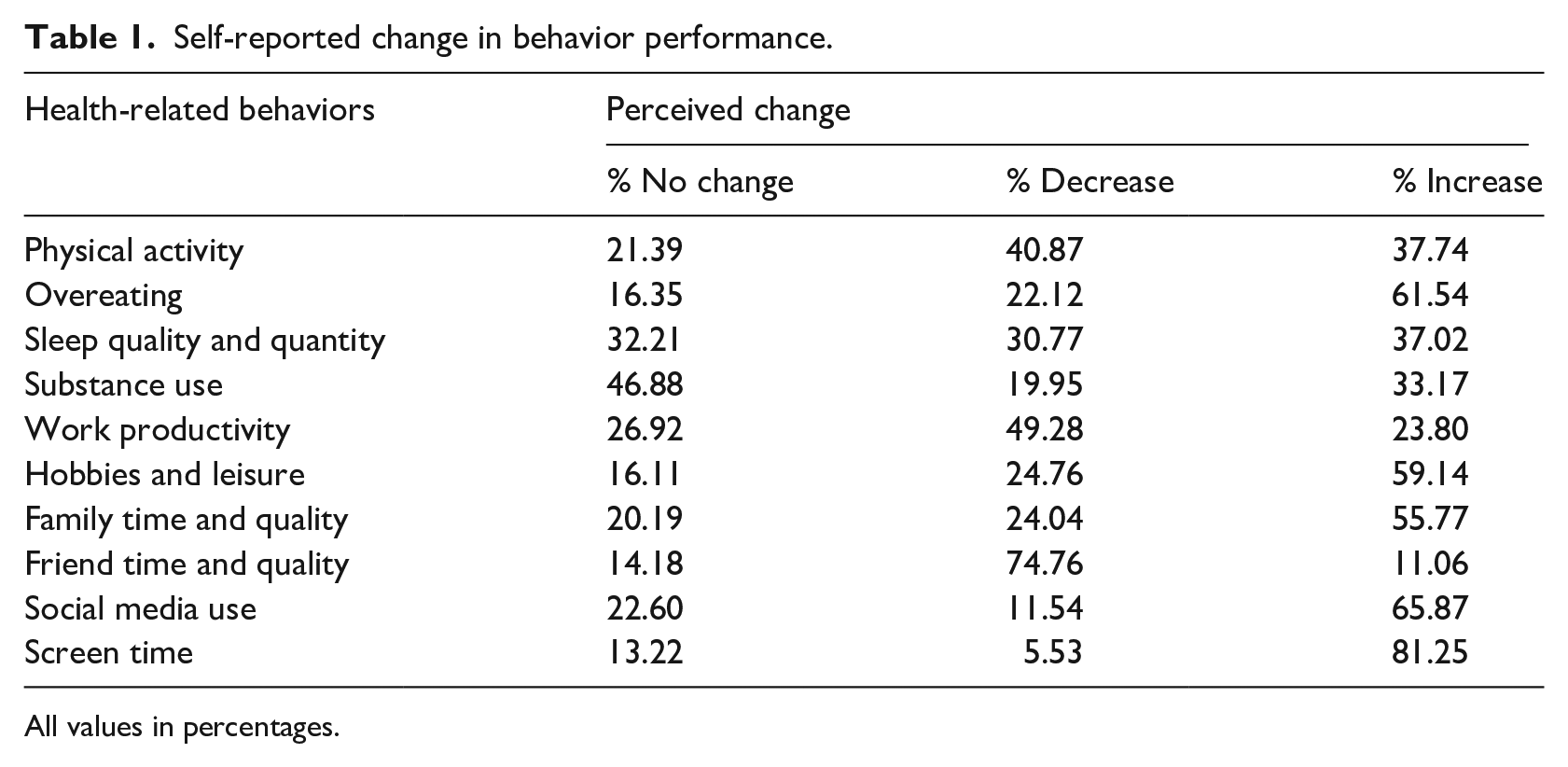
All values in percentages.
Aim 1: Pandemic-related disruptions, pandemic-era habits, and behavioral change
Pre-pandemic habit strength related to pandemic-era habit strength, b = 0.56 [0.46, 0.67], β = 0.47, p < .001, and to pandemic-era habit development, b = 0.33 [0.20, 0.46], β = 0.24, p < .001. On average, participants’ pandemic-era habit (M = 3.49, SD = 0.80) was weaker than pre-pandemic habit (M = 4.06, SD = 0.67), t(415) = 15.23, p < .001, Cohen’s d = 0.75.
As seen in Table 2, greater disruption was associated with weaker pandemic-era habit strength. This suggests that not only was behavior less reliant on routines and automaticity during the pandemic (compared to prior to the pandemic), but that disruptions displaced cues and contexts that once sustained pre-pandemic habit. Indeed, as seen in Table 3, perceived disruption was associated with greater likelihood of perceived change in overeating, physical activity, sleep quality and quantity, substance use, hobbies and leisure, screen time, social media use, work productivity, and duration and quality of time with friends. Only duration and quality of time with family did not relate to disruptions.
Regression analysis predicting pandemic-era habit strength and pandemic-era habit development from pandemic-related disruption, self-reported self-regulation, and their interaction.

Significant associations in bold. Variables were entered in three subsequent models: Model 1: covariates; Model 2: covariates and primary independent variables; Model 3: covariates, primary independent variables, and interaction term. Model 1 variables were omitted from the table. The full table, including parameters for all variables in Models 1 through 3 and change in model fit, can be found in the Supplement (Table S8).
Regression analysis predicting health-related behaviors from pandemic-related disruption, self-reported self-regulation, and their interaction.
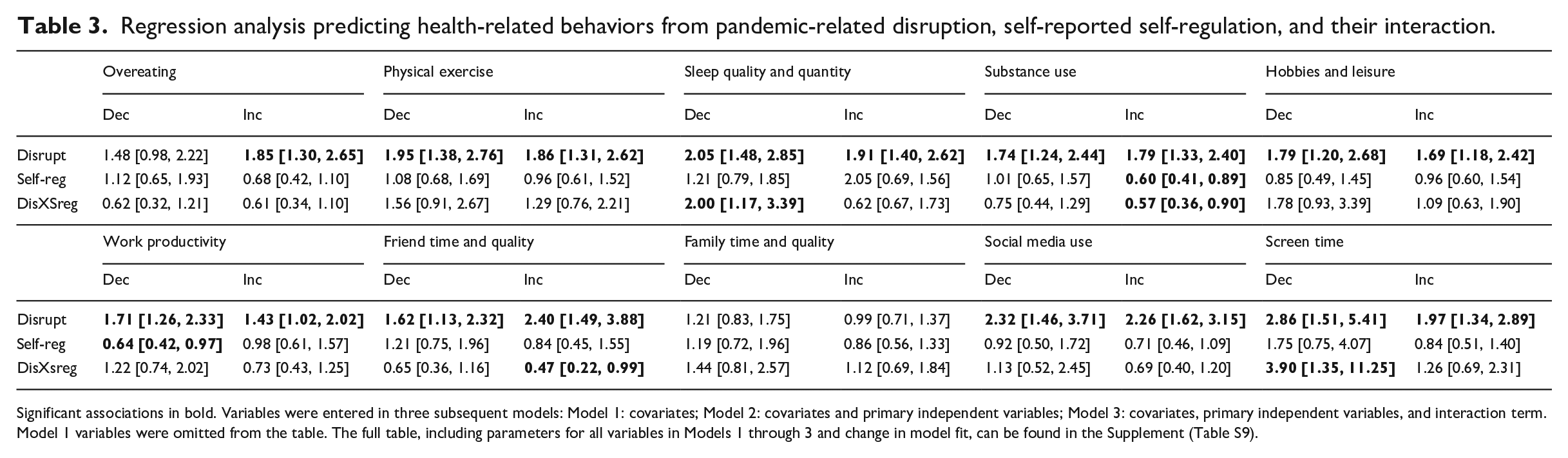
Significant associations in bold. Variables were entered in three subsequent models: Model 1: covariates; Model 2: covariates and primary independent variables; Model 3: covariates, primary independent variables, and interaction term.
Model 1 variables were omitted from the table. The full table, including parameters for all variables in Models 1 through 3 and change in model fit, can be found in the Supplement (Table S9).
Aim 2: Role of self-regulation
As seen in Table 3, self-regulation was associated only with lower likelihood that substance use increased (vs. no change) and lower likelihood that work productivity decreased. Self-regulation moderated the association between disruption and sleep quality and quantity, substance use, screen time, and duration and quality of time with friends. Tests of simple slopes indicated that better self-regulators (+1 SD) were more likely to report decreased screen time and decreased sleep duration and quality (b = 0.99 [0.56, 1.47], p < .001) relative to no change (b = 1.48 [0.58, 2.71], p = .006), and no more or less likely to report increased substance use (b = 0.22 [−0.19, 0.63], p = .290) or interactions with friends (b = .29 [−0.40, 0.99], p = .405) as disruption increased.
Conversely, as disruption increased, poorer self-regulators (−1 SD) were more likely to report increased substance use (b = 1.05 [0.58, 1.56], p < .001) and increased interactions with friends (b = 1.07 [0.42, 1.82], p = .002), and no more or less likely to report decreased screen time (b = −0.52 [−1.84, 0.70], p = .415) relative to no change. Poorer self-regulators were also less likely to report decreased sleep duration and quality (b = 0.27 [−0.19, 0.73], p = .253) as disruption increased.
General discussion
The daily life changes produced by the COVID-19 pandemic offer an opportunity to examine how such disruptions and people’s capacity to self-regulate relate to changes in health-related behaviors. This study examined these associations from the perspective that pandemic-related disruptions challenge behavior stability, pandemic-era habit strength and pandemic-era habit development, and considered the potentially protective role of self-regulation.
Pandemic-related disruptions, pandemic-era habits, and behavioral change
Pandemic-era habit strength was perceived to be weaker compared to pre-pandemic habit strength, suggesting that changes brought by the pandemic undermined everyday habit. Indeed, greater pandemic-related disruption was associated with weaker pandemic-era habit strength after controlling for pre-pandemic habit strength. These results are consistent with findings that health behaviors are vulnerable to change when the environment changes, potentially due to disruption of cues and practices that once automatically activated routine activities (Carden and Wood, 2018).
Overall, participants perceived changes in all health-related behaviors—in the directions of both better and poorer practices. These seemingly contradictory patterns are consistent with a large body of work on the effects of the pandemic on health behavior, some in the direction of healthier (e.g., Rezaei and Grandner, 2021; Zhang et al., 2021) and others in the direction of unhealthier practices (e.g., Flanagan et al., 2021; Hisler and Twenge, 2021). However, taken together, the present patterns indicate a clear increase in activities characterized by socialization and leisure (hobbies, family time, screen time, social media time), and a decrease in activities challenged by measures to contain the spread of the virus, such as social distancing and business closures (time with friends, work productivity). There was no consistent pattern of changes in traditional health-related behaviors (physical exercise, sleep, overeating, substance use) though the majority of participants reported increased overeating. It is possible that the direction of change depended on non-measured factors that characterized participants’ pre-pandemic behaviors, such as whether activities occurred at home or in designated spaces. For instance, pandemic-related disruptions likely decreased physical activity among those who exercised at gyms but potentially increased physical activity among those who previously devoted significant time commuting to work.
Direction of change aside, pandemic-related disruptions were associated with greater likelihood of change in 9 out of 10 health-related domains. These robust associations suggest that pandemic-related lifestyle restrictions and stressors contributed to disruption and affected participants’ routine engagement in the behaviors assessed. Indeed, by the time of the survey, most US states were under stay-at-home orders, as evidenced by participants’ responses and supported by public data (Jacobsen and Jacobsen, 2020).
Role of self-regulation
Better self-regulation was associated with the development of pandemic-era habits but not with pandemic-era habit strength, suggesting that better self-regulators may have had an advantage in adapting to disruptions by effortfully adjusting their everyday behaviors. Better self-regulators also had reduced odds of reporting increased substance use and decreased work productivity, suggesting some protective aspect of better self-regulation. That is, better self-regulators may have been better able to adjust their work environment and schedules to sustain pre-pandemic levels of work productivity, whereas poorer self-regulators may have given in to temptations that challenged their performance.
Besides these associations, self-regulation was surprisingly not robustly linked to changes in health-related behaviors. This pattern is contrary to other work (Kokkoris and Stavrova, 2021; Li et al., 2021; Sousa et al., 2021), potentially due to differences in samples (i.e., college students versus adult Mturk workers) and location (i.e., US versus China, Portugal, Netherlands). The lack of consistent evidence could be because stay-at-home orders were in place for approximately 3 weeks at the time of data collection. This period may have been too short for self-regulation to contribute to an effortful adjustment to pre-pandemic levels across all measured domains regardless of disruption. Rather, disruptions may have been so impactful that even the best self-regulators encountered difficulties in preventing changes in most behaviors.
Consistent with prior findings that contextual disruptions shift behavior and effortful processes help sustain stability (Wood et al., 2005), there was evidence that self-regulation interacted with pandemic-related disruptions to predict changes in four domains. Relative to no change, better self-regulators were more likely to report decreased screen time and were no more or less likely to report increased substance use or interactions with friends as disruptions increased. Poorer self-regulators were more likely to report increases in both substance use and interactions with friends. Because our assessment of disruptions also gauged negative emotionality, findings could reflect strategies that better and poorer self-regulators utilized to manage affective experiences. For instance, better self-regulators may have managed their affect by reducing exposure to screen content that exacerbated negative feelings (e.g., doomscrolling; Price et al., 2022), whereas poorer self-regulators may have favored substance use and time with friends. Indeed, the association between poorer self-regulation and greater use of substances such as alcohol is well-established (e.g., Dvorak et al., 2011). Interestingly, better self-regulators were more likely to report decreased sleep duration and quality as disruptions increased, whereas poorer self-regulators were less likely to do so. It is unclear what drove these associations, as we expected that better self-regulators would have enhanced ability to adapt to stressors accompanying pandemic-related disruptions and a reduced chance of sleep impairment. Perhaps poorer self-regulators slept more hours than typically recommended (i.e., oversleeping), whereas better self-regulators denied themselves hours of sleep to manage pandemic-related challenges (also termed ego-overcontrol; Block and Block, 1980). Alternatively, because poorer self-regulators are more likely to engage in sleep-impairing behaviors, such as bedtime procrastination (Kroese et al., 2016), their sleep duration and quality may have increased as pandemic-related disruptions increased the number of hours available to sleep.
The contribution of self-regulation to these domains, but not others, suggests that self-regulation may have been an asset only when managing modifiable domains that had been impacted by pandemic-related measures and disruptions (e.g., business closures) by the time of the survey. However, self-regulation may not have been necessary or related to behavior when circumstances were not changeable nor disrupted in ways that warranted effortful regulation of behavior (Carden and Wood, 2018). For instance, self-regulation may have been unnecessary to maintain pre-pandemic levels of desirable behaviors, such as physical activity or engagement in hobbies, if disruptions allowed more frequent performance. Self-regulation may also have been unnecessary—or unhelpful—when behaviors were so strongly determined by disruptions (e.g., time with family) that disruptions precluded any benefit of self-regulation. Conversely better self-regulation may have been beneficial for avoiding behaviors that pulled participants in generally undesirable directions given the circumstances (e.g., social distancing, increased demands, working from home), favoring shorter screen times, shorter sleep duration, less substance use, and unchanged time with friends.
Implications, limitations, and conclusions
The COVID-19 pandemic challenged US adults’ everyday habits and health-related behaviors. Greater pandemic-related disruption was associated with weaker pandemic-era habits and greater perceived change in numerous health-related behaviors. The absence of clear patterns of change in health-related behaviors suggests that the direction of change may have depended on people’s situations and personality traits. Self-regulation is a reasonable candidate based on prior work; however, we found limited evidence indicating that self-regulatory ability reduced the likelihood of changes, or buffered the association between perceived pandemic-related disruptions on these changes—at least during the earlier weeks of the pandemic.
Although daily life disruptions were in the context of the COVID-19 pandemic, these results have implications for other situations that challenge emotional states, income, housing, and job security. Notably, self-regulation may not be adaptive or protective for all health-related domains, and, in some instances, associated with poorer outcomes. Such findings have implications for health care, public policies, and interventions to address health disparities in the United States. For instance, the evidence that poorer self-regulators were more likely to report increased substance use as disruptions increased suggests that poorer self-regulators who experience challenges to their emotional states, income, housing, and job security are at greater risk of increased substance use and poorer job outcomes (Henkel, 2011). Because removing temptations precludes the deployment of self-regulation skills like self-control (Galla and Duckworth, 2015), reducing the availability of substances at home and providing other means to cope could help reduce substance use risk under such circumstances.
Findings must be considered in light of several limitations. First, changes in health-related behaviors relied on participants’ reflections on the extent to which their current and past behaviors differed, which may have been inaccurate. Additionally, participants’ occupations may have incurred strikingly different challenges depending on how their industries were affected by the pandemic, ultimately influencing the direction of behavior change (e.g., Cénat et al., 2021). For example, a teacher who previously commuted to work but whose classes were moved online likely had ampler time to cook healthier meals and sleep longer hours than an ER nurse who had to work longer shifts, even if both nurse and teacher reported the same degree of schedule and lifestyle change. Though our study was not equipped to capture this distinction, participants’ occupations may explain the contradictory associations between disruption and health-related behavior change.
We also cannot rule out the possibility that behavior change was intentional, and a consequence of goal adjustment rather than poor self-regulation (Wood et al., 2005). For instance, better self-regulators may report decreases in a subset of desired activities coupled with intentional increases in other relevant domains whereas poorer self-regulators may experience fewer intentional changes in their behaviors. Future studies should investigate concurrent changes and assess features of a larger set of behaviors (e.g., where and when they are performed), as it is possible that apparent poor self-regulation is a function of unmeasured variables, rather than actual capacity to behave as intended. It would also be valuable to gauge participants’ goals (i.e., intentions) and goal strength, as intentions are powerful predictors of behavior (Sheeran et al., 2002).
Overall, the COVID-19 pandemic in the US introduced limits and demands that disrupted habits and shifted the performance of health-related behaviors. These associations were evident despite some people’s capacity to effortfully modify their own behaviors. The present findings underscore the need to appreciate the impact of pandemic-related disruptions in interpreting—and promoting change in—health-related behaviors since the pandemic started, and in circumstances that mirror those introduced by the pandemic. In such cases, it may be wise to aim prevention and intervention efforts toward the situational factors that relate to undesirable changes in behaviors, at least during the earlier stages of disruption. As people work to adjust to each “new normal” imposed by cycling waves of outbreaks, life as we eventually emerge from the pandemic may look very different from what was once deemed normal.
Research Data
sj-csv-1-hpq-10.1177_13591053221144440 – for Adjusting to the COVID-19 outbreak in the United States: The impact of disruptions on habits and changes in health behaviors
sj-csv-1-hpq-10.1177_13591053221144440 for Adjusting to the COVID-19 outbreak in the United States: The impact of disruptions on habits and changes in health behaviors by Fernanda C Andrade, Rick H Hoyle and Kaitlyn Burnell in Journal of Health Psychology
Supplemental Material
sj-docx-2-hpq-10.1177_13591053221144440 – Supplemental material for Adjusting to the COVID-19 outbreak in the United States: The impact of disruptions on habits and changes in health behaviors
Supplemental material, sj-docx-2-hpq-10.1177_13591053221144440 for Adjusting to the COVID-19 outbreak in the United States: The impact of disruptions on habits and changes in health behaviors by Fernanda C Andrade, Rick H Hoyle and Kaitlyn Burnell in Journal of Health Psychology
Supplemental Material
sj-docx-3-hpq-10.1177_13591053221144440 – Supplemental material for Adjusting to the COVID-19 outbreak in the United States: The impact of disruptions on habits and changes in health behaviors
Supplemental material, sj-docx-3-hpq-10.1177_13591053221144440 for Adjusting to the COVID-19 outbreak in the United States: The impact of disruptions on habits and changes in health behaviors by Fernanda C Andrade, Rick H Hoyle and Kaitlyn Burnell in Journal of Health Psychology
Supplemental Material
sj-inp-4-hpq-10.1177_13591053221144440 – Supplemental material for Adjusting to the COVID-19 outbreak in the United States: The impact of disruptions on habits and changes in health behaviors
Supplemental material, sj-inp-4-hpq-10.1177_13591053221144440 for Adjusting to the COVID-19 outbreak in the United States: The impact of disruptions on habits and changes in health behaviors by Fernanda C Andrade, Rick H Hoyle and Kaitlyn Burnell in Journal of Health Psychology
Supplemental Material
sj-out-5-hpq-10.1177_13591053221144440 – Supplemental material for Adjusting to the COVID-19 outbreak in the United States: The impact of disruptions on habits and changes in health behaviors
Supplemental material, sj-out-5-hpq-10.1177_13591053221144440 for Adjusting to the COVID-19 outbreak in the United States: The impact of disruptions on habits and changes in health behaviors by Fernanda C Andrade, Rick H Hoyle and Kaitlyn Burnell in Journal of Health Psychology
Supplemental Material
sj-pdf-6-hpq-10.1177_13591053221144440 – Supplemental material for Adjusting to the COVID-19 outbreak in the United States: The impact of disruptions on habits and changes in health behaviors
Supplemental material, sj-pdf-6-hpq-10.1177_13591053221144440 for Adjusting to the COVID-19 outbreak in the United States: The impact of disruptions on habits and changes in health behaviors by Fernanda C Andrade, Rick H Hoyle and Kaitlyn Burnell in Journal of Health Psychology
Supplemental Material
sj-pdf-7-hpq-10.1177_13591053221144440 – Supplemental material for Adjusting to the COVID-19 outbreak in the United States: The impact of disruptions on habits and changes in health behaviors
Supplemental material, sj-pdf-7-hpq-10.1177_13591053221144440 for Adjusting to the COVID-19 outbreak in the United States: The impact of disruptions on habits and changes in health behaviors by Fernanda C Andrade, Rick H Hoyle and Kaitlyn Burnell in Journal of Health Psychology
Supplemental Material
sj-Rmd-8-hpq-10.1177_13591053221144440 – Supplemental material for Adjusting to the COVID-19 outbreak in the United States: The impact of disruptions on habits and changes in health behaviors
Supplemental material, sj-Rmd-8-hpq-10.1177_13591053221144440 for Adjusting to the COVID-19 outbreak in the United States: The impact of disruptions on habits and changes in health behaviors by Fernanda C Andrade, Rick H Hoyle and Kaitlyn Burnell in Journal of Health Psychology
Footnotes
Acknowledgements
Sarah Kwiatek and Sonia He provided helpful feedback on an earlier draft of this manuscript. Erin Davisson, Sarah Kwiatek, Sonia He, Courtney Lee, and Sabrina Sain assisted with survey design and programming, initial cleaning and organization of the data. The Authors are grateful for the support from the Graduate Grant Award sponsored by the Charles Lafitte Foundation Program for Research in Psychology & Neuroscience.
Data sharing statement
The current article is accompanied by the relevant raw data generated during and/or analysed during the study, including files detailing the analyses and either the complete database or other relevant raw data. These files are available in the Figshare repository and accessible as Supplemental Material via the Sage Journals platform. Ethics approval, participant permissions, and all other relevant approvals were granted for this data sharing.
Declaration of conflicting interests
The authors declared no potential conflicts of interest with respect to the research, authorship, and/or publication of this article.
Funding
The authors received no financial support for the research, authorship, and/or publication of this article.
Ethics Approval
All participants provided electronic consent to participate in the study. This study and all procedures were approved by the Duke University Campus Institutional Review Board (protocol #2020-0442).

Notes
References
Supplementary Material
Please find the following supplemental material available below.
For Open Access articles published under a Creative Commons License, all supplemental material carries the same license as the article it is associated with.
For non-Open Access articles published, all supplemental material carries a non-exclusive license, and permission requests for re-use of supplemental material or any part of supplemental material shall be sent directly to the copyright owner as specified in the copyright notice associated with the article.
