



Abstract
This study explored pandemic-related social support profiles and investigated their relationships with depressive symptoms among Chinese parents during the COVID-19 pandemic. The hypotheses were evaluated in an online cross-sectional survey of 1286 parents. Latent profile analysis identified two profiles of received social support (isolated and integrated support). Three convergent profiles (high, moderate, and low support) and one divergent profile were found in perceived social support. The results revealed that the distribution of age, region, income and educational level varied across these profiles. Only the “high” (β = −0.11, p < 0.01) and “divergent” (β = −0.12, p < 0.01) profiles of perceived social support were negatively associated with parents’ depressive symptoms. These findings highlight the importance of developing better-targeted intervention programs aimed at optimizing the allocation and improving the quantity and quality of supportive resources for parents.
Introduction
The COVID-19 pandemic, which the World Health Organization designated a public health emergency of international concern, has brought heavy psychological and emotional burdens to the general population (World Health Organization, 2020; Xiong et al., 2020). A nationwide survey of psychological distress among Chinese adults in the COVID-19 epidemic found that the prevalence of depressive symptoms was 48.3% (Gao et al., 2020), which was higher than the data indicating 24.3% in a multi-country study (Cénat et al., 2021), as well as the data from a national household survey before the pandemic in China (Xu et al., 2021a). Recent studies identified that compared with adults without children, parents with young children had much more serious negative mental health consequences during the pandemic (Griffith, 2022; Russell et al., 2020). In particular, parents with young children may have experienced extra pressures from childcare tasks and newly acquired family issues (i.e., financial losses and material and health care needs) with limited external support, relying on nursery or after-school training institutions and grandparents that can help with the education and caring of their young children (Johnson et al., 2022). In addition, it was revealed that social support was correlated with a caregiver’s mental health, while the influences of different social support patterns on mental health could be varied (Yang and Jiang, 2020). Therefore, it is important to better understand the characteristics of social support patterns among Chinese parents and how social support relates to depressive symptoms during the COVID-19 epidemic.
Social support patterns
Social support has been defined as “information leading the subject to believe that he is cared for and loved, esteemed, and a member of a network of mutual obligations” (Cobb, 1976). Haber et al. hold that social support in general can be divided into two subconstructs: (1) objective and visible support, known as received social support, that is, material support and financial support, which is not dependent on an individual’s perception; and (2) subjective support, known as perceived social support, including emotional support and feelings of understanding and respect from a variety of sources (Haber et al., 2007). In a Confucian heritage cultural context, people in China primarily seek support from primary groups such as family, relatives, and friends (Lee et al., 2005). During the pandemic lockdown, however, secondary groups, such as voluntary associations, professionals, and government agencies, emerged as one of the major sources of support, with their efforts focusing on community-based material and life care support and financial and healthcare policy (Ao et al., 2020). Therefore, considering both cultural factors and the specific context of COVID-19, the types and sources of support parents receive or perceive from their social networks might be heterogeneous. Formal support (i.e., communities, organizations, and government) and informal support (i.e., family, relatives, and friends), as well as various types of support such as finance, food, and physical and mental health care, could coexist among parents. Thus, in the current study, we measured those support reflecting what the individual received and subjectively perceived to better highlight the different relative levels of these patterns of support that parents experienced during the COVID-19 pandemic.
The different types and sources of social support coexist within individuals and combine into different configural profiles (Caesens et al., 2020). For example, certain types of social support may tend to be convergent, that is, consistently high or low across types. Alternatively, some social support types may show divergence across types, that is, high support from some sources but low support from others. To date, most studies have used traditional variable-centered methods to investigate each form and source of social support independently or cumulatively. New methods, such as person-centered approaches (i.e., latent profile analysis (LPA)), have attracted growing attention in the analysis of patterns of social support (Caesens et al., 2020; Lau et al., 2019). Compared to the traditional clustering method, LPA is more reasonable for testing the results of individual clustering by directly estimating the membership probability from the model, making it particularly useful for the identification of naturally occurring subpopulations of parents with different patterns of social support (Meyer and Morin, 2016). Therefore, the current study conducted LPA to examine social support profiles based on several types and sources of social support that parents received and perceived during the COVID-19 epidemic.
Social support and parents’ depressive symptoms
Social support may be associated with depressive symptoms in adults, yet evidence for this association is mixed. A wealth of research revealed that social support acted as an important environmental resource alleviating pressure on an individual and was closely related to the prevention of depressive symptoms (Kelly and Malecki, 2022; Li et al., 2021). However, reverse causality may exist between social support and depressive symptoms, as demonstrated in previous research (Guo et al., 2018). Social support might be activated in cases where individuals experience increasing loss of autonomy, which is typically correlated with an increased risk of depression (Holden et al., 2014). To summarize, social support could play a protective role and negatively associated with depressive symptoms, while the positive association between them has also been demonstrated in the reverse causality that greater depressive symptoms correlated with a higher level of social support (Guo et al., 2018; Kelly and Malecki, 2022). Therefore, whether social support positively or negatively correlates with depressive symptoms remains relatively unclear, and more evidence should be provided.
Moreover, the various sources and types of social support may be differently associated with psychological symptoms. Researchers have indicated that social support profiles show various patterns of associations with mental health outcomes (Lau et al., 2019). Specifically, individuals with a high level of social support experienced the least amount of loneliness, while those with low support were the most vulnerable to anxiety and depressive symptoms (McConnell et al., 2015). Ciarrochi et al. revealed that people whose profile showed low parent support but high peer support reported better psychological well-being than average support profiles (Ciarrochi et al., 2017). Therefore, studying social support profiles may help us understand how support types and sources interact and how their different combinations relate to depressive symptoms. By adopting LPA, this study aimed to explore the possibility that different levels of coexisting support across types and sources relate to parents’ depressive symptoms.
Aims and hypothesis
The purpose of this study was to explore perceived and received social support profiles among Chinese parents and to examine social support profiles’ associations with parents’ depressive symptoms in the COVID-19 context. We first hypothesize the existence of social support profiles across several support types (i.e., childcare, food, and physical and mental health care) and sources (i.e., family, friends, neighbors, communities, and government). Second, we hypothesize that these social support profiles correlate with parents’ depressive symptoms. This hypothesis is exploratory, assuming that parents within different social support profiles might show different relationships with depressive symptoms.
Methods
Study design and participants
We conducted an online questionnaire survey (a web-based platform, https://www.wjx.cn/app/survey.aspx) from April 21st to April 28th, 2020, during the COVID-19 lockdown in China. This study focused on parents of children aged below 10 years. We selected regions in order to increase the diversity of the sample on demographic characteristics more generally: Hubei Province (the province most affected by the epidemic), its neighboring province Henan, and Guangdong Province in southern China, other provinces. Convenient and cluster sampling methods were used to choose participants from the selected sites. The convenience sampling method was used to choose primary schools. Participants were chosen from those schools through the cluster sampling method. Then, all students and their parents in each grade of the selected schools contributed to a survey pool. Headteachers helped to distribute the online questionnaires to all parents of students. Participants were apprised of the anonymity and voluntary nature of the self-report survey. After learning the study’s objectives and contents at the first page of online questionnaires, they could choose to complete this survey voluntarily and quit at any time. Participants received a small gift (i.e., 1–3 RMB) as a token of appreciation after the questionnaire was completed. All participants joined the study voluntarily and gave consent electronically after being informed about the aim of the survey. The study was approved by the Ethics Committee of Peking University Medical Center.
Measures
Parental depressive symptoms were assessed by the 10-item Center for Epidemiological Studies Depression Scale (CESD-10), derived from the original version of the 20-item CESD (Radloff, 1977). All the questions applied to the one preceding week and were rated as 0 = “Rarely,” 1 = “some,” 2 = “occasionally,” 3 = “most.” Seven positive affect questions amidst the other items querying depressive symptoms were reverse scored (i.e., 3 = “Rarely” and 0 = “Most”). The responses were then converted to a 0–30 score, with higher values representing higher levels of depressive symptoms. The Cronbach’s α estimate of reliability was 0.75.
Received social support and perceived social support were measured with a subset of items from the questionnaire of the COVID-19 Supporting Parents, Adolescents, and Children in Epidemics survey (Co-SPACE, http://cospaceoxford.org/) led by experts at the University of Oxford. Five items were included in received social support measures, which were designed to capture the amount of practical help and advice received from family, neighbors, government, and so on concerning types of normal supportive activities (i.e., childcare, financial support, food support, and physical and mental healthcare support) during the COVID-19 epidemic. Perceived social support measures included nine items and asked participants about the degree of support and assistance they perceived from different sources, including couple, family, relative, friend, neighbor, net friend, volunteer, charity, and government, during the COVID-19 pandemic. The extent of support was measured on a 5-point scale, ranging from 1 (none) to 5 (a great many). The items of this scale had adequate levels of internal consistency in the present sample, with a Cronbach’s α of 0.91 for received social support and 0.90 for perceived social support.
Socioeconomic and demographic variables: Based upon related literature (Guo et al., 2021; Yue et al., 2022), the covariates included in the current study covered the following socioeconomic and demographic characteristics: parent age, parent gender (male/female), marital status (living with a partner/other), province (Hubei/Henan/Guangdong/other), education level (high school and below/college/undergraduate/master’s and above), occupation (manager/professional staff/individual/other), annual income (<100,000 ¥/100,000~200,000 ¥/>200,000 ¥), and number of children (one/two/more than two).
Statistical analysis
Descriptive statistics and bivariate relationships were calculated for the main variables in the present study. We conducted LPA to identify profiles of received and perceived social support. The LPA of received social support was conducted with the scores of specific types of supportive activities as extrinsic variables. In the same way, LPA of perceived social support used the scores of the nine items about support and assistance that participants perceived from different sources. We started with one class, suggesting one integration type for all participants, and then successively added more integration classes to determine the best-fitting model. A series of models with progressively increasing numbers of classes were estimated and compared to determine the optimal model solution based on lower Akaike information criterion (AIC) values, lower Bayesian information criterion (BIC) values and sample size-adjusted BIC (aBIC), and a significant p value for the bootstrap likelihood ratio test (BLRT) (Nylund et al., 2007). We also examined classification accuracy (an entropy level >0.80 is generally considered appropriate) and the size of each profile (a priori, profiles containing <1% of the sample were considered too small to be meaningful). After identifying the profiles, we conducted Pearson’s chi-square test, t test, and one-way analysis of variance to compare the sociodemographic characteristics of each profile. Finally, multivariable linear regressions were used to examine the associations between social support profiles and parents’ depressive symptoms. The following socioeconomic and demographic characteristics were entered together as covariates: parent gender, age, marital status, province, education level, occupation, annual income, and number of children. The CESD-10 scores were included as outcome variables in each model. In Model 1, the received social support profiles (reference category: “isolated” support profile) were included as independent variables, while perceived social support profiles (reference category: “low” support profile) were included as independent variables in Model 2. Data in this study were analyzed via SPSS software version 24.0 and R version 4.0.2.
Results
In total, 1286 questionnaires were collected. See Table 1 for sample characteristics and Tables S1 and S2 for bivariate correlations among the study variables. Among the 1286 surveyed parents, 74.2% were female. The average age was 36.09 years (SD = 5.13). Regarding province, 22.4% of the participants were from Hubei, 14.6% were from Henan, and 42.0% were from Guangdong. Less than 30% reported high school and below as their highest educational level. The average CESD-10 score was 3.79 (SD = 3.95), and 9.40% of parents had depressive symptoms, with a CESD-10 score ⩾10 as the cut-off point. More details are listed in Table 1.
Descriptive analysis of the sample (N = 1286).
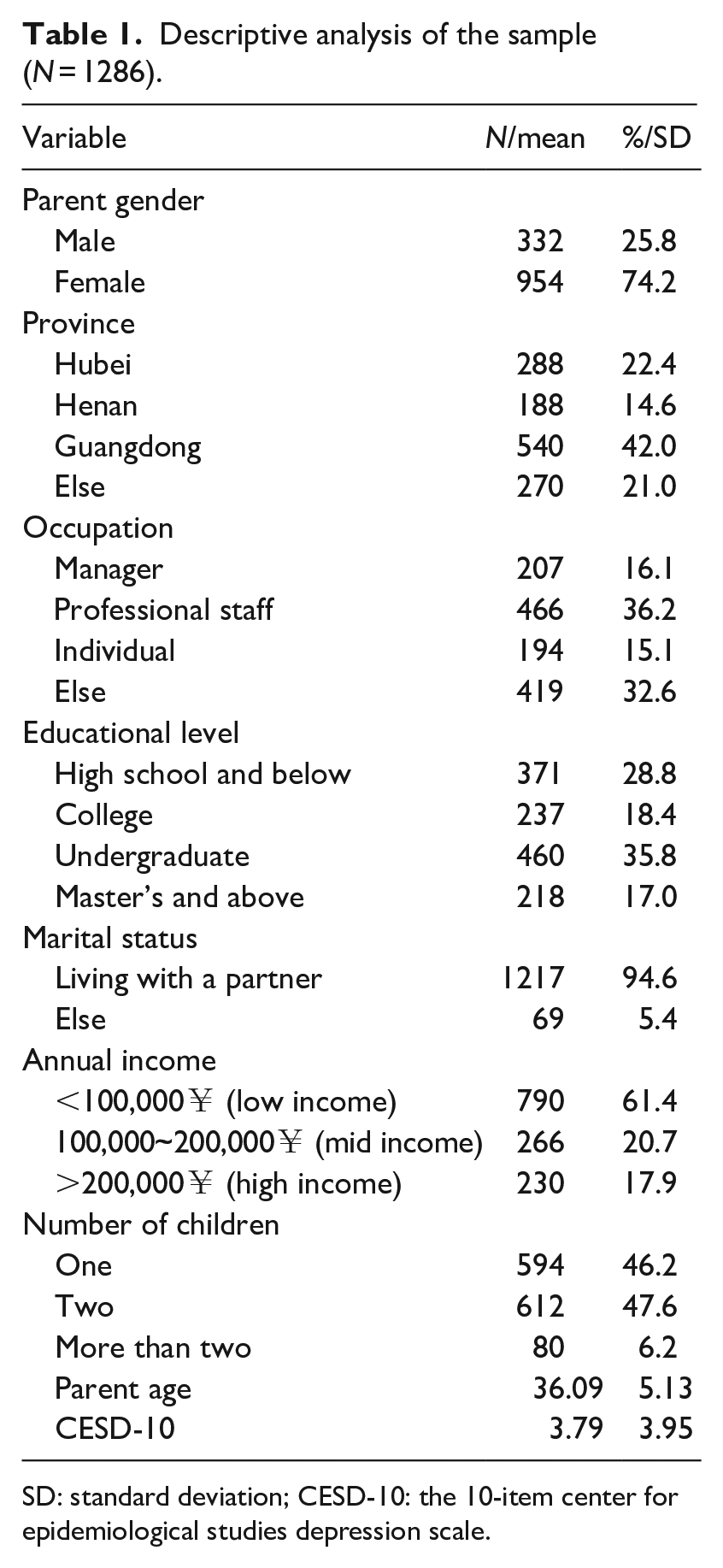
SD: standard deviation; CESD-10: the 10-item center for epidemiological studies depression scale.
We performed LPA on both received social support and perceived social support in the total sample. The model fit indices are shown in Table 2. In the received social support group, AIC, BIC, and aBIC values continued to decline from 1-profile to 4-profile, while a group with a potential profile classification rate less than 1% was identified in the 3- and 4- profile solutions. Although the 3-profile solution had a higher entropy value than the 2-profile solution, the 2-profile solution highlighted the “convergent” groups, consistent with the view that support from one source is associated with support from others and thus that profiles will tend to “converge” or be consistently high or low across types of support (Jager, 2011). Therefore, considering theoretical parsimony and the smallest class proportion, we selected the 2-profile solution as the optimal model for received social support. In terms of the perceived social support group, the AIC and aBIC values continued to decline from 1-profile to 5-profile, while 4-profile had the lowest BIC value. Although the BLRT for the 5-profile model indicated that adding the fifth profile had improved model fit, the additional class contained only 4% of the sample. Therefore, the 4-profile instead of 5-profile solution was selected as the best solution for perceived social support.
Fit statistics for latent profile analyses.

AIC: Akaike’s information criterion; BIC: Bayesian information criterion; aBIC: sample size-adjusted Bayesian information criterion; BLRT-p: bootstrap likelihood ratio test.
The scores of received social support and perceived social support for the two models are shown in Figure 1. The optimal model for receiving social support included two profiles (Figure 1(a)). Profile 1 scored higher on all types of received social support, and we named profile 1 the “integrated” support profile, characterizing 13.1% of the parents. Profile 2 described parents with low levels of received social support in all dimensions and was thus named the “isolated” support profile, characterizing 86.9% of the parents.

(a) two profiles of received social support and (b) four profiles of perceived social support as determined through latent profile analysis.
Regarding perceived social support, parents were classified into four profiles (Figure 1(b)). Profile 1 was named the “low” perceived social support profile (13.7%), in which the parents reported the lowest support from all nine resources. Profile 2 was named the “moderate” perceived social support profile (29.6%). For this profile, the nine resources of perceived support scores were generally shown to be average. Profile 3 was named the “high” perceived support profile (25.4%). This group consisted of parents who perceived relatively higher support than the previous two profiles. The scores for parents in profile 4 were higher on perceived natural support (e.g., family and friends) but lower on perceived formal support (e.g., organizations and government). Therefore, we named profile 4 the “divergent” perceived social support profile (31.3%).
Supplementary Figure S1 and Table S3 further examine the distribution of sociodemographic characteristics across the identified social support profiles. Older parents showed a relatively large distribution in the “isolated,” “low,” and “divergent” profiles. Compared with other provinces, parents in Henan and Guangdong most frequently belonged to the “isolated” and “low” profiles. In relation to education level, parents who were high school graduates or below were relatively more frequently distributed in the “divergent” profile, while those with master’s degrees and above showed relatively large distributions in the “high” profile. Regarding annual income, parents reporting high income were very strongly represented in the “high” profile compared with the parents who reported low income.
In Table 3, the relationships between social support profiles and parents’ depressive symptoms are presented. The same demographic and socioeconomic characteristics (parent gender, age, marital status, province, education level, occupation, annual income, and number of children) were controlled in Models 1 and 2. Only the “high” profile (β = −0.11, p < 0.01) and the “divergent” profile (size β = −0.12, p < 0.01) in perceived social support were significantly negatively correlated with parents’ depressive symptoms. Parents within the “high” and “divergent” profiles experienced a lower level of depressive symptoms than those in the “low” perceived social support profile. No significant association was found between the “integrated” profile of received social support and depressive symptoms.
Linear regression of the relationships between RSS types, PSS types, and parental depression symptoms.

B: coefficient; SE: standard error; RSS: received social support; PSS: perceived social support; Ref: reference category.
p < 0.05. **p < 0.01. ***p < 0.001.
Discussion
This study explored social support profiles and assessed their associations with depressive symptoms among Chinese parents in the context of COVID-19. The results of our study highlight the importance of separating types and sources of social support from a whole profile, recognizing that varying combinations of this support could coexist among parents during the COVID-19 epidemic. By examining elements of social support across several support types (i.e., childcare, food, and physical and mental health care) and sources (i.e., family, friends, neighbors, communities, and government), we demonstrated per our first hypothesis the existence of different configurations across received and perceived social support among parents.
In our study, the prevalence of depressive symptoms among Chinese parents was 9.4%. This result also parallels those of recent research, which found that the prevalence of depressive symptoms among Chinese adults was 11.3%, and in India and Singapore was 12.4 and 9.0%, respectively (Bareeqa et al., 2020; Xu et al., 2021b). Furthermore, the prevalence of depressive symptoms among Chinese parents was higher than the data indicating 3.1% before the COVID-19 epidemic (Wang, 2018). A systematic review found that depressive and anxiety disorders increased during 2020 due to the COVID-19 pandemic (Santomauro et al., 2021). This could be explained as follows: First, strict quarantine measures, uncertainty about virus infection, and altered daily routines all bring many challenges to individuals’ lives and stimulate psychological distress, including the emergence of depressive symptoms (Huang and Zhao, 2020). Second, parents were confined at home and were dealing with many stressors, including financial loss, basic supply needs and concerns over the health of their family members, all of which could lead to an increased incidence of mental health problems (Yue et al., 2022). Thus, this study supports the need for further action and attention to protect parents from depressive symptoms.
Similar to previous research on social support profiles (Ciarrochi et al., 2017), both convergent and divergent patterns emerged in social support: received social support profiles showed convergence, while one divergent profile was found in perceived social support. Regarding received social support, the participants demonstrated two profiles: “integrated” and “isolated.” A small percentage of parents (“integrated,” 13.1%) reported receiving substantial support in all types of supportive activities, while a considerably larger group (“isolated,” 86.9%) reported low levels of received social support in all dimensions. Reasons for this extreme difference in distribution may be traced to the pandemic context. With self-isolation and social distancing measures, people might have received more online support from their network members, while external practical support was limited and less available.
Regarding perceived social support, however, the “divergent” profile, at 31.3% the largest perceived support profile group, comprised higher scores from family, relatives, and friends but lower scores from other sources (e.g., communities, organizations, and government). The largest perceived support profile group may be explained by the hierarchical compensation model suggesting that, for a substantial number of people, family members and friends are the preferred sources of support in the order, with formal networks least likely to be asked support (Okabayashi et al., 2004), which also corresponds with traditional Chinese Confucian culture (Lee et al., 2005).
In our second hypothesis, we proposed that the distribution of sociodemographic characteristics would vary across identified latent profiles. In accordance with a previous study (Li et al., 2021), we found a decline in parents’ social support as they aged. This finding supports the socioemotional selectivity theory (SST) that older adults are more likely to spend time with emotionally close relationships and narrow the size of their social network due to the perspective that time is limited (Carstensen, 1995). The results of regional differences between profiles suggested that parents who lived in Hubei Province showed a relatively large distribution in the “integrated” and “high” support profiles compared with parents located in Henan and Guangdong. As it happened, large amounts of goods and materials, volunteers, and medical personnel from other provinces in China rushed to Hubei after the first peak of the COVID-19 outbreak, as Hubei Province was the major epidemic area with the most confirmed cases. Additionally, our results supported that parents with higher education and income were relatively more frequently distributed in the “high” support profile. The associations between income, educational level and social support reflected the social network composition of socioeconomic status (SES). Higher socioeconomic status promotes interpersonal connection and broadens social network size, thus increasing the likelihood of receiving various types of social support and resources (Schafer and Vargas, 2016).
Finally, our study revealed that perceived social support profiles were significantly associated with parents’ depressive symptoms, but received social support profiles presented no significant relationship with symptoms of depression. These findings are in accord with past research suggesting that perceived social support has a strong negative effect on depressive symptoms, while received social support has a nonsignificant association (Taylor and Lynch, 2004). As suggested by Krause’s work on anticipated and received support, perceived support had the anticipated effect, which may act to promote personal feelings of autonomy or problem solving, but received support did not (Krause, 1997). Furthermore, our study found that parents with “high” and “divergent” perceived social support experienced a lower level of depressive symptoms than those who reported generally low support in all resources. This finding supports the notion that perceived social support is an important protective factor against depressive symptoms (Shih et al., 2020). More specifically, perceptions of social support are known to reduce the negative evaluation of events and facilitate cognitive and emotional adjustment when individuals are under stress, according to relational regulation theory (RRT) (Lakey and Orehek, 2011). Therefore, a consistently high level of social support across types, namely, the “high” perceived social support profile, may decrease the depressive symptoms among parents. In addition, it is well known that family and intimate friends are the most essential sources of support, outweighing other sources (Gear, 2014). A good perceived social network within family and friends could provide material support and emotional comfort for individuals, which may alleviate symptoms of depression (Gariépy et al., 2016). Thus, our “divergent” support profile, which scored higher on informal support (i.e., from couple, family, and friends), might play a more important role in alleviating depressive symptoms among parents.
Limitations and implications
Several limitations of this study should be acknowledged. First, all scales were self-reported, which may constrain the reliability of the results because of personal bias and social desirability effects. Future research might consider clinical records or in-depth interviews to minimize self-report biases. Second, we recruited a convenience sample for which the nonresponse rate could not be established because of anonymity requirements. The convenience and cluster sampling methods used in this study are nonprobability sampling processes. Third, the data were collected by a web-based survey. Thus, there could be a selection bias restricting the generalizability of our findings. Fourth, the cross-sectional data set limited the causal inference. Future research using longitudinal or experimental methods to clarify the temporal order of the relationships is strongly encouraged.
Finally, using a latent profile analysis model has a limitation: the ambiguity surrounding the best practice in interpreting the best fitting model. The current study excluded the three-profile model and five-profile model for received social support, although there were lower AIC/BIC/aBIC values. Because those two models had imbalanced distribution (with a class proportion <1%) and low entropy, while the literature provided theoretical support for the emergence of “convergent” profiles, the two-profile model was determined to be the best solution for received social support. Future investigations similar to the current study are encouraged to use different samples, which may be beneficial to further understand parents’ social support.
Despite these limitations, this study also yields some significant implications for both theory and practice. First, this study used LPA to explore patterns of both received and perceived social support among parents during the COVID-19 epidemic. We identified two latent profiles of received social support and four of perceived social support and found that only profiles of perceived social support were negatively associated with parents’ depressive symptoms. These results generate new insights into the nature of the varying combinations of these supports and further the dialog on the relationship between social support and depressive symptoms, thus assisting in the theoretical development of this field. Second, the imbalanced distribution of sociodemographic characteristics (i.e., age, region, income, and educational level) in social support profiles revealed by our analyses highlight the importance of optimizing the allocation of supportive resources for policy makers and practitioners. For instance, documenting the outcome implications of these profiles will help to decide which should be prioritized from an intervention perspective. Finally, our findings support the idea that perceived social support plays a protective role in parents’ psychological health. Thus, some social work services, such as community care, timely detection and professional consulting services should be offered to reduce depressive symptoms of parents during this pandemic.
Conclusion
In summary, the current study showed that parents presented two patterns of received social support and four patterns of perceived support during the COVID-19 epidemic. The distribution of age, region, income and educational level varied across these profiles. The “high” and “divergent” profiles of perceived social support were negatively associated with the degree of depressive symptoms among parents. These findings highlight the importance of developing targeted intervention programs aimed at optimizing the allocation and improving supportive resources for parents. More specifically, the government should place more emphasis on equity in social support and welfare and focus on older parents and those with lower SES. Meanwhile, nongovernmental organizations (NGOs) and communities need to be aware of the potential psychological risks of parents’ situations (i.e., home confinement, parenting young children, and lack of external support), being prepared to quickly detect possible mental health problems and provide prompt social support to effectively address these issues.
Research Data
sj-docx-1-hpq-10.1177_13591053221144442 – for Social support profiles correlate with depressive symptoms among Chinese parents during the COVID-19 pandemic: A latent profile analysis
sj-docx-1-hpq-10.1177_13591053221144442 for Social support profiles correlate with depressive symptoms among Chinese parents during the COVID-19 pandemic: A latent profile analysis by Yashuang Bai, Fan Yang, Minglong Chen, Bo Zhang, Xiaohan Liu, Ning Huang, Madelon ME Riem and Jing Guo in Journal of Health Psychology
Supplemental Material
sj-docx-9-hpq-10.1177_13591053221144442 – Supplemental material for Social support profiles correlate with depressive symptoms among Chinese parents during the COVID-19 pandemic: A latent profile analysis
Supplemental material, sj-docx-9-hpq-10.1177_13591053221144442 for Social support profiles correlate with depressive symptoms among Chinese parents during the COVID-19 pandemic: A latent profile analysis by Yashuang Bai, Fan Yang, Minglong Chen, Bo Zhang, Xiaohan Liu, Ning Huang, Madelon ME Riem and Jing Guo in Journal of Health Psychology
Research Data
sj-pdf-2-hpq-10.1177_13591053221144442 – for Social support profiles correlate with depressive symptoms among Chinese parents during the COVID-19 pandemic: A latent profile analysis
sj-pdf-2-hpq-10.1177_13591053221144442 for Social support profiles correlate with depressive symptoms among Chinese parents during the COVID-19 pandemic: A latent profile analysis by Yashuang Bai, Fan Yang, Minglong Chen, Bo Zhang, Xiaohan Liu, Ning Huang, Madelon ME Riem and Jing Guo in Journal of Health Psychology
Research Data
sj-Rmd-4-hpq-10.1177_13591053221144442 – for Social support profiles correlate with depressive symptoms among Chinese parents during the COVID-19 pandemic: A latent profile analysis
sj-Rmd-4-hpq-10.1177_13591053221144442 for Social support profiles correlate with depressive symptoms among Chinese parents during the COVID-19 pandemic: A latent profile analysis by Yashuang Bai, Fan Yang, Minglong Chen, Bo Zhang, Xiaohan Liu, Ning Huang, Madelon ME Riem and Jing Guo in Journal of Health Psychology
Research Data
sj-sav-5-hpq-10.1177_13591053221144442 – for Social support profiles correlate with depressive symptoms among Chinese parents during the COVID-19 pandemic: A latent profile analysis
sj-sav-5-hpq-10.1177_13591053221144442 for Social support profiles correlate with depressive symptoms among Chinese parents during the COVID-19 pandemic: A latent profile analysis by Yashuang Bai, Fan Yang, Minglong Chen, Bo Zhang, Xiaohan Liu, Ning Huang, Madelon ME Riem and Jing Guo in Journal of Health Psychology
Research Data
sj-sps-3-hpq-10.1177_13591053221144442 – for Social support profiles correlate with depressive symptoms among Chinese parents during the COVID-19 pandemic: A latent profile analysis
sj-sps-3-hpq-10.1177_13591053221144442 for Social support profiles correlate with depressive symptoms among Chinese parents during the COVID-19 pandemic: A latent profile analysis by Yashuang Bai, Fan Yang, Minglong Chen, Bo Zhang, Xiaohan Liu, Ning Huang, Madelon ME Riem and Jing Guo in Journal of Health Psychology
Research Data
sj-spv-6-hpq-10.1177_13591053221144442 – for Social support profiles correlate with depressive symptoms among Chinese parents during the COVID-19 pandemic: A latent profile analysis
sj-spv-6-hpq-10.1177_13591053221144442 for Social support profiles correlate with depressive symptoms among Chinese parents during the COVID-19 pandemic: A latent profile analysis by Yashuang Bai, Fan Yang, Minglong Chen, Bo Zhang, Xiaohan Liu, Ning Huang, Madelon ME Riem and Jing Guo in Journal of Health Psychology
Research Data
sj-xlsx-7-hpq-10.1177_13591053221144442 – for Social support profiles correlate with depressive symptoms among Chinese parents during the COVID-19 pandemic: A latent profile analysis
sj-xlsx-7-hpq-10.1177_13591053221144442 for Social support profiles correlate with depressive symptoms among Chinese parents during the COVID-19 pandemic: A latent profile analysis by Yashuang Bai, Fan Yang, Minglong Chen, Bo Zhang, Xiaohan Liu, Ning Huang, Madelon ME Riem and Jing Guo in Journal of Health Psychology
Research Data
sj-xlsx-8-hpq-10.1177_13591053221144442 – for Social support profiles correlate with depressive symptoms among Chinese parents during the COVID-19 pandemic: A latent profile analysis
sj-xlsx-8-hpq-10.1177_13591053221144442 for Social support profiles correlate with depressive symptoms among Chinese parents during the COVID-19 pandemic: A latent profile analysis by Yashuang Bai, Fan Yang, Minglong Chen, Bo Zhang, Xiaohan Liu, Ning Huang, Madelon ME Riem and Jing Guo in Journal of Health Psychology
Footnotes
Acknowledgements
The authors wish to thank all those who kindly volunteered to participate in the study.
Author contributions
JG designed the study. YB drafted the manuscript and analyzed the data. FY, MC, BZ, XL, NH, and MR were involved in revising the manuscript. All authors were involved in writing the manuscript and approve of its final version.
Data sharing statement
The current article is accompanied by the relevant raw data generated during and/or analysed during the study, including files detailing the analyses and either the complete database or other relevant raw data. These files are available in the Figshare repository and accessible as Supplemental Material via the Sage Journals platform. Ethics approval, participant permissions, and all other relevant approvals were granted for this data sharing.
Declaration of conflicting interests
The authors declared no potential conflicts of interest with respect to the research, authorship, and/or publication of this article.
Funding
The authors disclosed receipt of the following financial support for the research, authorship, and/or publication of this article: This work was supported by the National Natural Science Foundation of China [grant number 82173636].
Ethics approval
The study was approved by the Ethics Committee of Peking University. After being informed about the survey’s aims, all participants gave informed consent and joined the study voluntarily. For children, informed consent was obtained from their parents/legally authorized representatives. Relevant guidelines and regulations carried out all methods.

References
Supplementary Material
Please find the following supplemental material available below.
For Open Access articles published under a Creative Commons License, all supplemental material carries the same license as the article it is associated with.
For non-Open Access articles published, all supplemental material carries a non-exclusive license, and permission requests for re-use of supplemental material or any part of supplemental material shall be sent directly to the copyright owner as specified in the copyright notice associated with the article.
