



Abstract
Social media serves as one of the primary outlets for self-presentation and receiving social support. Even when individuals portray themselves negatively, it might not necessarily be intended for social disapproval. Conversely, positive self-presentation doesn’t always guarantee social support. This study examined the relationship between positive and negative fitness self-presentations on social media and the reception of supportive feedback. Additionally, it investigated how social support might influence individuals’ self-efficacy, motivation, and participation in physical activities (PA). Participants were fitness app users recruited from a crowdsourcing internet marketplace who had shared their fitness experiences on social media. The results indicated that both types of self-presentation received social support: presenters receiving more social support showed higher self-efficacy for PA. Moreover, fitness posters with higher self-efficacy in PA showed greater motivation for PA. This research suggests that fitness self-presentation allows users to receive social support, fostering confidence and motivation for engaging in PA.
Introduction
Fitness-related content, including performance statistics, exercise scenes, and self-body pictures, is one of the most common categories among social media posts. Fitness app users, in particular, tend to share their physiological fitness parameters (e.g. heart and respiratory rates) and biomechanical fitness achievements (e.g. steps taken, distances traveled, and calories burned) with others on social media (Kim, 2022). Posting fitness-related accomplishments on social media serves as a means of presenting an ideal self to others and is closely tied to impression management. Fitness posters may want to present their physical achievements to others to be seen as attractive or diligent in exercise regularly, promoting a healthy lifestyle. Indeed, those who focus on individual influence, control, and mastery try to impress others by demonstrating their fitness abilities, such as muscular strength or endurance (Howle et al., 2015b). Nevertheless, impression management does not exclusively entail positive self-presentation. Individuals who share challenges and difficulties encountered in physical activities may also seek advocates and encouragement from others through their social media posts. As such, fitness posters often present their fitness information in either a positive or negative manner, seeking social support from their online networks (Oh et al., 2013). In light of this, fitness posters have motivations for obtaining social approval (acquisitive-agentic) or avoiding social disapproval (protective-agentic) (Howle et al., 2015a, 2015b).
In the current digital culture, the pursuit of social support represents a significant motivation underlying individuals’ use of social media (Davis et al., 2015). Users with health concerns actively seek supportive feedback through social media, receiving social support and experiencing an enhanced sense of belonging within their networks (Liu et al., 2020). Notably, even during the Covid-19 pandemic, social support provided via social media has demonstrated the potential to alleviate users’ anxiety levels (Qin et al., 2022). Consequently, social support through social media platforms has been found to yield positive effects on individuals’ well-being and health outcomes (Hale et al., 2020).
Previous studies examined self-presentations on social media and how the observers’ feedback influenced posters’ psychological well-being (Oeldorf-Hirsch et al., 2019; Wang et al., 2020). Some other studies explored social support via an online community (Liu et al., 2020) or social media (Zhang et al., 2015) and the impact on cancer patients’ health (Hale et al., 2020). However, there is a gap in the literature concerning fitness-related self-presentations and the influence of others’ supportive feedback types (i.e. types of social support) on fitness posters’ physical activities. Accordingly, the current study aims to fill the academic void by taking a broader perspective on social support for health and fitness promotion (i.e. physical activity), specifically examining the role of self-presentation through social media posts and its impact on fitness posters’ physical activity (hereafter PA). Specifically, the study will investigate (1) how different types of fitness self-presentations relate to the receipt of social support and how this support may encourage fitness posters’ (2) self-efficacy in PA, (3) motivation for PA, and (4) participation in PA. Furthermore, the study will explore the types of social support provided based on the manner in which fitness self-presentation is executed. The following section will delve into these variables and develop research hypotheses based on relevant theories and literature reviews.
Literature review
Self-presentation and impression management
Self-presentation is a goal-directed behavior aimed at making a favorable impression of oneself and avoiding potential social failures (Steinmetz et al., 2017). It involves the strategic presentation of an idealized self-image to obtain social acceptance and protect self-esteem (Tong et al., 2020). In the context of contemporary digital communication, social media have emerged as prominent avenues for individuals to exhibit themselves to others, enabling the construction of online identities and the dissemination of visually appealing content that contributes to an attractive self-image (Li and Zhang, 2021). Therefore, individuals seek to present a flawless version of themselves and project an idealized lifestyle, to validate and reinforce their self-views through social media posts (Bareket-Bojmel et al., 2016). They tend to curate and manage their social media profiles meticulously to create an idealized impression, enhance their self-esteem and facilitate self-development (Tong et al., 2020). Even when sharing negative experiences or challenges, the underlying objective is not to engage in self-derogation, but rather to employ strategies such as excusing or self-handicapping, in order to elicit support and promote self-enhancement (Bareket-Bojmel et al., 2016).
Social support
Social support communicates the message that a person is loved and esteemed and belongs to a mutually obligated network (Liu et al., 2020). According to Burleson and MacGeorge (2002), there are several types of social support: emotional support tells people that they are loved and cared for; esteem support reminds individuals that they are worthwhile; network support is efforts to bolster individuals’ social ties or offers to spend time together; informational support provides facts, advice, or perspective with which to remedy a problem; and tangible support offers practical aids to ease people’s daily burdens.
Social support retains crucial significance as a psychological function influencing one’s quality of life and healthy living (Albrecht and Goldsmith, 2003), despite the fact that there are individual differences (i.e. in personalities or in social interactions) in the perception of social support. Through verbal and nonverbal communication, social support recipients and providers manage uncertainty about the situation, the self, or the relationship; therefore, individuals enhance controllability in their life experiences through social support (Albrecht and Adelman, 1984). As such, social support plays a pivotal role in one’s health as it can buffer stress (Liu et al., 2020), manage uncertainty in health (Albrecht and Goldsmith, 2003), and provide positive health outcomes (Rains and Young, 2009). Supportive communication can assist the recovery from physical trauma or illness (Albrecht and Adelman, 1984), whereas a lack of supportive relationships may affect mortality rates from serious physical conditions (Zhang et al., 2015). In terms of health behaviors, an individual’s perceived social support might be more significant and influential than received social support (Eagle et al., 2019).
In the contemporary digital communication age, social media has become the most accessible outlet for self-presentation and receiving social support (Li and Zhang, 2021). Individuals utilize social media to construct and display their online identities, often aiming to create an idealized impression of themselves (Tong et al., 2020). Further, social media serves as an effective channel for forming social relationships and obtaining social support from networks (Davis et al., 2015; Li and Zhang, 2021). The number of likes received on posts is often regarded as an indicator of popularity, peer validation, and social legitimacy (Meeus et al., 2019). Therefore, some users voluntarily disclose personal information to create an ideal impression (Tong et al., 2020) in turn, seek supportive feedback (Meeus et al., 2019). For them, perceived social support through social media could act as a driving force, encouraging continued participation in PA.
Hypothesis development
Fitness posts and supportive feedback
Positive self-presentation often reflects a desire for self-enhancement and the seeking of positive regard from others (Bareket-Bojmel et al., 2016; Wang et al., 2020). People tend to overreport normative or positively viewed behaviors, such as physical activities (Scopelliti et al., 2015). Those who positively present their fitness status, such as by sharing successes and achievements, might want to verify their efforts and receive appreciative feedback from others. Although fitness posters who present their fitness in a positive light may receive positive emotional reactions from others, there may sometimes be negative social repercussions. On one hand, social media is commonly perceived as a platform where mutual support is expected, but on the other hand, it should be noted that not all social media users consistently provide supportive feedback (Li and Zhang, 2021). Observers on social media tend to respond positively to those who exhibit humility rather than those who boast about their accomplishments (Steinmetz et al., 2017). This preference arises from the perception that “hard work stories” are relatable and evoke warmth. Scopelliti et al. (2015) contended that engaging in positive self-presentation may cause others to view a poster as less likable and as a braggart. Positive fitness posters might be feeling happy and proud of themselves, but those who view the postings might be feeling annoyed. Thus, the first research hypothesis was as follows:
(H1) The more positively people present their fitness on social media, the less social support they will receive.
Some self-presenters intentionally misrepresent their health conditions. However, whether positively or negatively presented, all fitness postings tend to be designed to prompt members of the poster’s social network to give social support (Bareket-Bojmel et al., 2016). They may still want supportive feedback such as empathy and rapport. To be specific, when posters present themselves as sick, they may be constructing either a convenient excuse for possible failure (self-handicapping) or an excellent opportunity to receive attention and sympathy from others (Liu et al., 2020). Observers have even tended to provide more support for negative posters because they seemed to be longing more to receive support than positive posters (Li and Zhang, 2021). Thus, the study hypothesis was as follows:
(H2) The more negatively people present their fitness on social media, the more social support they will receive.
The benefits of social support for physical activities
While social cognitive theory suggests that one’s belief in control (i.e. self-efficacy) leads to behavior execution, the theory of planned behavior suggests that perceived behavioral control is one of the factors influencing individuals’ behavioral intention (Ajzen, 1991; Bandura, 1977).
Computer-mediated support has been found to lead to an increase in self-efficacy for health or fitness and a decrease in depression (Liu et al., 2020). In a similar vein, those who share tracked health information on social media receive social support, which in turn can positively perceive their health (Oeldorf-Hirsch et al., 2019). Drawing from the positive effects of social support on self-efficacy and mental health, it can be hypothesized that supportive feedback from social networks on fitness postings would contribute to greater PA self-efficacy for engaging in PA and potentially greater motivation to participate in PA. Conversely, the absence of social support may serve as a barrier to the practice of PA (Zhang et al., 2015). Furthermore, Kwok et al. (2021) demonstrated that those with more motives to increase fitness tended to participate more in PA. Therefore, positive relationships are expected between PA self-efficacy and PA motivation and, likewise, between PA motivation and PA participation (e.g. Kim et al., 2023a). The following hypotheses and research questions were proposed, based on the above literature reviews.
(H3) The more social support that people receive, the more self-efficacy for PA they will have.
(H4) The more social support that people receive, the more PA motivation they will have.
(H5) The more self-efficacy for PA people have, the more PA motivation they will have.
(H6) The more PA motivation people have, the more they will participate in PA.
In this study, social support indicates supportive feedback from others and consists of esteem, emotional, and informational support. Network support and tangible support were excluded because they were not central to the goals of this study.
Types of social support for positive and negative fitness posts
Previous studies demonstrated that members of the online community tended to provide social support based on the context of postings (Liu et al., 2020; Mo and Coulson, 2008; Oh et al., 2013). Even assuming that fitness posters primarily get supportive feedback from their social networks, the types of social support they receive may be different, depending on the types of presentations in fitness postings. Mo and Coulson (2008) demonstrated that group members gave esteem support, such as compliments, about individuals’ abilities or the attributes of those who shared positive perspectives on difficult life experiences. Based on that, only esteem support, such as providing validation and praise, seems likely to be associated with positive fitness presentations.
(H7) The more positively people present their fitness on social media, the more esteem support they will receive.
Esteem support can help restore a person’s self-concept when a person is struggling or can reduce negative self-feelings, such as guilt or shame (Liu et al., 2020). Those who have difficulties or are experiencing distressing events also receive more emotional support, such as expressions of empathy, care, or concern (Liu et al., 2020). Informational support may also be provided when people share troubles or challenges (Oh et al., 2013). When group members have inquiries, members of the group may offer informational support, such as suggestions and advice, including guidance for coping with difficulties or challenges. Moreover, they perform an educational role by explaining difficult language or concepts that group members did not understand (e.g. Mo and Coulson, 2008). Those who negatively present their fitness might share their frustration in engaging in PA, and therefore others may attempt to bolster their confidence, provide empathy and understanding, and offer information to help them get through their difficulties.
(H8) The more negatively people present their fitness on social media, the more (a) esteem support, (b) emotional support, and (c) informational support they will receive.
Methods
Study target and survey participants
Fitness app users were invited to participate in the study as they might have more resources for presenting their health and fitness records (Kim, 2022). For a survey, a crowdsourcing internet marketplace, Amazon Mechanical Turk (MTurk), was utilized to recruit fitness app users who had posted about their own fitness outcomes on social media. With its fast and cost-efficient data collection method, it has become a reliable option for social science research (Holden et al., 2013). To ensure high-quality data collection, only reliable workers who had an approval rating above 95% were recruited. To screen eligible participants, it was asked to report at least one fitness app they use. After the deletion of incomplete questionnaires and duplicated responses, a total of 283 completed surveys were included in the analysis (details are shown in Appendix A). All the data collecting process followed Institutional Review Board approval.
Measures
Positive and negative self-presentations in fitness postings
The aspects of self-presentation in fitness postings were asked using five items adapted from Yang et al. (2017) and one positive item from Yang and Brown (2016). The factorability of the six self-presentation items was examined: three items were included in each subscale. First, four of the six items were significantly correlated, and they suggested reasonable factorability. Second, the Kaiser‒Meyer‒Olkin measure of sampling adequacy was applied (the value was 0.72, above the recommended value of 0.6), and Bartlett’s test of sphericity was significant (χ2 (15) = 651.46, p < 0.05). Third, the communalities were all above 0.5, further confirming that each item shared some common variance with other items. Given the indicators, the factor analysis was deemed to be suitable with all six items.
All items were rated on a seven-point Likert scale (1 = strongly disagree to 7 = strongly agree), and composite scores were created for a positive self-presentation (M = 5.58, SD = 1.14, α = 0.74) and a negative self-presentation (M = 2.65, SD = 1.60, α = 0.86). The details are shown in Appendix D.
Social support
A total of 12 items were adapted from Freeman et al. (2011) and Oh et al. (2013). The scale included four items measuring each of three distinct types of social support, such as esteem, emotional, and informational support. All items were rated on a seven-point Likert scale.
First, all 12 items were significantly correlated and suggested reasonable factorability. Second, the Kaiser‒Meyer‒Olkin measure of sampling adequacy was 0.92 and Bartlett’s test of sphericity was significant (χ2 (66) = 2113.52, p < 0.01). Third, the communalities were all above 0.5, further confirming that each item shared some common variance with other items. Given the indicators, the factor analysis was deemed to be suitable with all 12 items.
To identify the factors underlying the supportive feedback on fitness postings, principal components analysis with varimax rotation was used. However, the total variance was explained by four dimensions instead of three, as had been designed. Although the esteem support items and informational support items loaded on distinct factors, the items for emotional support did not load on a single factor and either had low factor loadings or high cross-loadings. Thus, the principal components analysis was re-run without the four emotional support items. In this analysis, initial eigenvalues indicated that two supportive feedback dimensions accounted for 74.9% of the variance after varimax rotation: esteem support accounted for 36.0% of the variance and informational support accounted for 38.9% of the variance. The results of this factor analysis are presented in Appendix E.
Although the four items measuring emotional support did not load on a separate factor in the initial factor analysis of the 12 items, this subscale was retained because the items had face validity, formed a reliable scale, and may offer useful insights for the study. Therefore, the emotional support subscale was included in the study, along with the subscales for esteem support and informational support.
For analyses involving the overall level of supportive feedback, the scores on all 12 items were averaged to form a single measure of social support (M = 4.60, SD = 1.30, α = 0.92). Further, scores for each of the three types of social support were calculated by averaging the four items on each subscale: esteem support (M = 5.14, SD = 1.30, α = 0.87), informational support (M = 4.10, SD = 1.72, α = 0.91), and emotional support (M = 4.60, SD = 1.40, α = 0.80).
Self-efficacy for PA
Four items were adapted from Oh et al. (2013) to measure self-efficacy for PA. All items were rated on a seven-point Likert scale, and the items’ scores were averaged (M = 5.95, SD = 0.96, α = 0.88).
PA motivation
Five semantic differential scales were adapted from Lowe et al. (2002) to measure PA motivation. Based on Godin (1987) and the theory of planned behavior, they used the affective (i.e. emotion-laden) and instrumental (i.e. benefits and costs) attitude for exercise intention scales: “For me, taking part in physical activities regularly over the next month is (affective)” (1 = extremely dull to 7 = extremely stimulating) or “(instrumental)” (1 = extremely unimportant to 7 = extremely important). The five semantic differential scale scores were averaged, and the average showed they were reliable (M = 5.78, SD = 1.09, α = 0.88).
PA participation
Three items from Godin’s Leisure Time Physical Activity Questionnaire were used to measure respondents’ frequency of PA participation (Godin, 2011; Godin and Shephard, 1985). The questionnaire asked to what extent respondents participated in PA for more than 15 minutes in a week. Based on Godin’s formula, each frequency score was multiplied by a corresponding metabolic equivalent of task (MET) value, and the scores were summed: (frequency of strenuous PA × 9) + (frequency of moderate PA × 5) + (frequency of mild PA × 3) (Godin, 2011). The averaged PA participation score was (M = 84.63, SD = 56.26).
Overview of analysis
Survey data were converted into SPSS 22 for analysis. All the regression analyses included covariates of age, gender, body mass index (BMI), and feedback amount. The descriptive results are presented in Appendix B.
Results
In advance of the main analysis, the zero-order correlation analysis was conducted (Appendix C). A series of four hierarchical linear regression analyses was conducted to estimate the path coefficients: (1) social support from both types of self-presentation, (2) PA self-efficacy from social support, (3) PA motivation from PA self-efficacy or social support, and (4) PA participation from PA motivation.
(1) A regression analysis was conducted that regressed social support on the two types of self-presentation, R2Adj = 0.110, F(2, 242) = 7.079, p < 0.001. The two types of self-presentation accounted for a significant amount of variance in social support, Δ R2 = 0.089, p < 0.001. Regarding H1, positive self-presentation positively predicted social support (β = 0.251, p < 0.001). H2 was also supported because negative self-presentation positively predicted social support (β = 0.241, p < 0.001).
(2) A regression analysis was conducted that regressed PA self-efficacy on social support, R2Adj = 0.033, F(1, 246) = 3.133, p < 0.05. Social support accounted for a significant amount of variance in PA self-efficacy, Δ R2 = 0.035, p < 0.01. H3 was supported because social support positively predicted PA self-efficacy (β = 0.190, p < 0.01).
(3) A regression analysis was conducted that regressed PA motivation on the social support and PA self-efficacy, R2Adj = 0.172, F(2, 234) = 10.928, p < 0.001. Social support and PA self-efficacy accounted for a significant amount of variance in PA motivation, Δ R2 = 0.179, p < 0.001. Regarding H4, social support did not predict PA motivation (β = ‒0.035, p = 0.566). However, H5 was supported because PA self-efficacy positively predicted PA motivation (β = 0.431, p < 0.001).
(4) A regression analysis was conducted that regressed PA participation on PA motivation, R2Adj = 0.035, F(1, 246) = 3.281, p < 0.05. PA motivation did not account for a significant amount of variance in PA participation, Δ R2 = 0.000, p = 0.931. Since PA motivation could not predict PA participation, H6 was not supported (β = ‒0.005, p = 0.931) (Figure 1).

Regression path coefficients.
Although no predictions were made about the receipt of emotional and informational support in response to positive self-presentations, both types of self-presentation were included in the regression analyses predicting each type of social support. Regarding H7 and H8, results indicated that the full model was statistically significant, R2Adj = 0.302, F(2, 251) = 19.561, p < 0.001.
Positive and negative self-presentations accounted for a significant amount of variance in esteem support, Δ R2 = 0.065, p < 0.001. H7 was supported because positive self-presentation positively predicted esteem support (β = 0.237, p < 0.001). However, H8a was not supported because negative self-presentation did not predict esteem support (β = ‒0.053, p = 0.348).
The results indicated that the two types of self-presentation accounted for a significant amount of variance in emotional support, R2Adj = 0.250, F(2, 248) = 15.115, p < 0.001. Emotional support was predicted by both positive (β = 0.141, p < 0.05) and negative (β = 0.138, p < 0.05) self-presentations. Accordingly, H8b was supported.
The results indicated that positive and negative self-presentations accounted for a significant amount of variance in informational support, R2Adj = 0.310, F(2, 251) = 20.200, p < 0.001. H8c was supported as negative self-presentation positively predicted informational support (β = 0.156, p < 0.01). However, positive self-presentation did not predict informational support (β = 0.064, p = 0.247) (Figure 2).
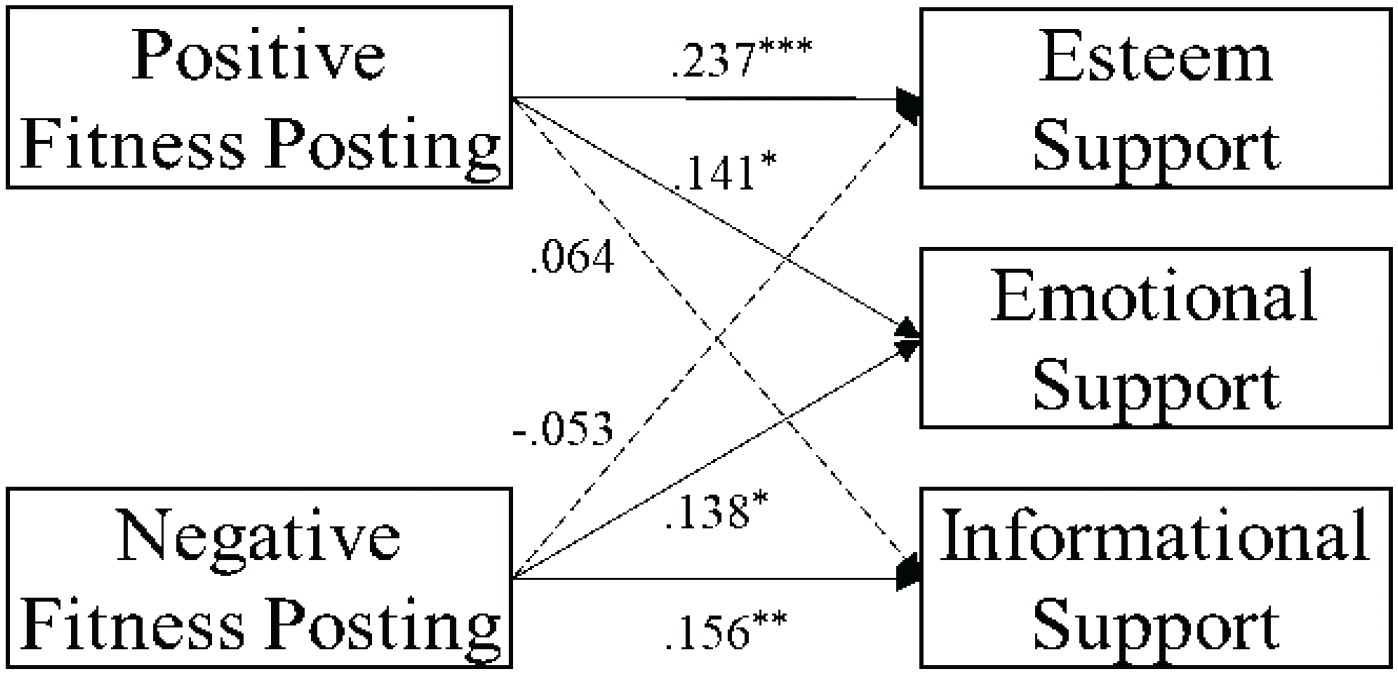
Regression coefficients for the two types of self-presentation predicting the three types of social support.
The results of a repeated-measure ANOVA demonstrated a significant difference between the three types of social support from others, F(2, 266) = 92.017, p < 0.001: esteem support (M = 5.12, SD = 0.08), emotional support (M = 4.59, SD = 0.09), and informational support (M = 4.07, SD = 0.11). Post hoc tests using the Bonferroni correction revealed that the amount of esteem support was significantly greater than the other types of support, whereas the amount of emotional support was significantly greater than the informational support (p < 0.001).
Discussion
The study objective was to explore the relationship between types of self-presentation (i.e. positive or negative) and the supportive feedback received from others, as well as the impact of social support on fitness posters’ PA. In addition, the study aimed to examine whether positive and negative fitness self-presenters received different types of social support (i.e. esteem, emotional, and informational support). The study model demonstrated that people generally provided supportive feedback irrespective of the type of fitness self-presentation, and this feedback subsequently enhanced fitness posters’ self-efficacy and motivation for engaging in PA. Furthermore, positive and negative fitness posters received different types of social support.
Fitness posters’ self-presentation and social support
The study results revealed that both positive and negative fitness posts received a moderate amount of social support from others. To be specific, they received considerably more positive or supportive feedback compared to negative or critical feedback. This outcome was consistent with expectations, considering that the majority of study participants used Facebook as their primary social media platform. Fitness posters may intentionally choose Facebook due to its effectiveness in delivering social support for health within personal network-based interactions (Oh et al., 2013). Indeed, Facebook is considered a platform central to relational identity and reinforcing existing offline connections, rather than fostering new networks (Ellison et al., 2007). Moreover, the mean age of the study participants was 35.45, and their first-ever experience with social media might have been on Facebook, considering its popularity during their youth.
It is worth noting that social media observers tended to provide greater social support to individuals with whom they had close relationships (Li and Zhang, 2021). Indeed, the study results indicated that feedback givers were predominantly individuals with strong ties to the fitness posters, such as friends and family. These strong social ties are characterized by close, multifaceted, and dense relationships that offer comfort, safety, and assistance (Albrecht and Goldsmith, 2003). Social support from individuals with strong social ties has been found to have a significant influence on initiating physical activity (van Stralen et al., 2009), as they typically provide mental support and encouragement to engage in the recommended behaviors (Granovetter, 1983).
Interestingly, about one in three fitness posters received feedback from individuals who shared common interests in PA. These individuals may not necessarily have strong ties to the posters. However, individuals with weak social ties can still be considered part of a supportive social network when it comes to providing social support for fitness-related posts (Bae et al., 2013). Granovetter (1983) suggests that weak social ties, although less developed and loosely connected, can provide useful information. Strong ties primarily contribute to encouraging, reinforcing, and regulating health behavior, while weak ties are known for providing novel information, goods, and services based on the diversity of social connections (Albrecht and Goldsmith, 2003).
The impacts of social support on engagement in physical activities
The study findings indicated that social support received on fitness postings had a positive impact on individuals’ confidence in engaging in PA (e.g. Warner et al., 2019). These findings build upon the previous research conducted by Burke and Rains (2019), who found that social support from other social media users with similar health interests enhanced self-efficacy for health. Moreover, the current study demonstrated that fitness posters with higher self-efficacy had a greater motivation for PA. The result aligns with the study conducted by Oeldorf-Hirsch et al. (2019), which indicated that individuals developed positive perceptions regarding their health through the supportive feedback received on social media.
However, it is important to note that the study did not establish a direct link between social support and PA motivation. This might suggest that various types of perceived supportive feedback (such as esteem, emotional, and informational support) could differently influence fitness posters’ PA motivation. For instance, while information support might not strongly impact one’s self-efficacy, it could serve as a stimulus for individuals to anticipate positive outcomes in PA, thereby encouraging PA motivation. Additionally, the study’s results did not predict the relationship between fitness posters’ PA motivation and their actual participation in PA. It is possible that individuals who posted about their fitness activities engaged in PA for reasons beyond those captured by the motivational measures used in the study. For example, social norms related to PA might exert pressure on individuals, prompting them to participate in PA regardless of their intrinsic motivation (e.g. Ajzen, 1991).
Positive and negative fitness self-presentations and types of social support
This study further explores the types of supportive feedback provided based on fitness posters’ types of self-presentation. The current study extends the research of Oeldorf-Hirsch et al. (2019) and Oh et al. (2013), who found that all dimensions of social support were provided on health- or fitness-related posts. The results reveal that fitness posters received more esteem support than emotional and informational support, regardless of their types of self-presentation. Scopelliti et al. (2015) argued that those engaging in positive self-presentation might be perceived as braggarts, leading others to be hesitant in providing supportive feedback. However, the current study found the opposite to be true. Not only did those who negatively presented their fitness receive social support, but the same was true for those who positively displayed their fitness.
The more posters presented their fitness positively, the more esteem support and emotional support they received from others. Feedback providers may have given compliments on the fitness posters’ abilities, instilling confidence, reinforcing the positives of their PA, or boosting their sense of competence in performing those activities (e.g. Wang et al., 2020; Warner et al., 2019). They may have also expressed devotion or concern for the fitness posters by showing empathy or providing encouragement. The study did not collect data on the types of social ties conveying specific kinds of social support. However, those showing affection for positive self-presenters were likely those with strong ties, as the study results revealed that most of the feedback providers were family and friends.
Negative self-presentation was associated with receiving more emotional support and informational support from others. For those who negatively displayed their fitness, feedback providers may have offered comfort and support, as well as suggestions or advice for overcoming their struggles. It is likely that people with common interests in fitness would provide more informational support, given their familiarity with fitness activities. This is consistent with Granovetter’s (1983) contention that weak ties provide more functional and informational knowledge than strong ties. Social media platforms provide novel opportunities to interact with experts in various fields, and weak ties play a role in bridging users’ social capital (Krämer et al., 2021). Therefore, users can acquire practical knowledge about fitness from individuals outside their inner circles, such as physical trainers, coaches, or even fitness YouTubers (Kim et al., 2023b). On the other hand, esteem support was not predicted because individuals might be concerned that offering such support could be a sensitive or delicate matter, potentially validating or perpetuating the negative self-presentation.
Interestingly, both positive and negative self-presentations received emotional support in the form of encouragement, empathy, and comfort. Emotional support allows fitness posters to feel loved and cared for by others. One possible reason for both positive and negative self-presenters receiving more emotional support is that they may interpret general reactions from others as emotionally supportive feedback. Davis et al. (2015) considered others’ reactions to social media posts about a family member’s surgery as emotional support. Some feedback providers may respond to fitness posts with emoticons as an alternative to comments, and fitness posters may perceive them as emotional support, regardless of the sender’s intention (Carr et al., 2016).
Theoretical and practical implications
The study demonstrated that posting fitness-related self-presentations on social media was a beneficial behavior for PA. This is because sharing fitness-related content on social media provided individuals with an opportunity to receive social support from their social networks. Supportive feedback was not only provided when fitness posters shared their PA accomplishments but also when they expressed their frustrations with PA. This suggests that fitness posters may have sought to enhance and protect their self-efficacy for PA through their fitness posts, even when they presented their fitness negatively. In other words, fitness posting appears to be a self-presentation behavior aimed at obtaining social support. These findings align with the fundamental principles of self-presentation theory, which propose that individuals strive to create a positive impression of themselves to gain social acceptance (Howle et al., 2015a, 2015b). These findings also suggest that social media serves as an effective platform for receiving social support related to fitness. Fitness posters utilize social media to showcase their abilities and receive social support, which in turn fosters confidence and motivation for PA. Thus, social media plays a crucial role in promoting PA through supportive digital communication.
Fitness app users seeking social support should consider posting about their PA on social media as an effective means to gain motivation, particularly during times when they require arousal. Fitness professionals should encourage individuals to share their fitness achievements or struggles on social media, as it provides a practical avenue for interaction with others (Kim, 2022) and the potential to receive social support. The descriptive results of this study indicate that personal network-based social media platforms, such as Facebook, are particularly beneficial for receiving supportive feedback from close friends and family (Davis et al., 2015).
Furthermore, this study explored descriptive information regarding the types of fitness posts and social media platforms. Among the three types of postings examined, fitness scenes were the most frequently shared. One possible explanation for this finding is that capturing photos is a more convenient process compared to extracting fitness outcomes from apps and then sharing them on social media. While some fitness apps offer features that allow users to directly post fitness data on social media, many others are not compatible with such platforms. Fitness app developers should consider creating an open forum within their apps to facilitate social support and designing user-friendly interfaces for direct uploading of fitness information on social media. It is worth noting that pre-installed fitness apps, such as Apple Health, Google Fit, or Samsung Health, are available on iOS or Android phones. However, it is important to recognize that not everyone, particularly older individuals, may be aware of the existence of these apps. Promoting the use of pre-installed fitness apps can be an additional strategy to encourage fitness postings for PA, especially for those who are hesitant to download additional apps or find it burdensome to do so.
Study limitations and future research
Although the current study endeavored to address certain topics, it still had limitations that should be considered in future research. Firstly, while some study participants received negative or critical responses from their social networks, the study did not measure the specific types of negative or critical feedback received by fitness posters. Additionally, the study did not account for the absence of feedback as unsupportive feedback. Fitness posters may perceive a lack of feedback as a lack of social support or even negative feedback (Zhang et al., 2015). Furthermore, individuals may feel dissatisfied if they receive less supportive feedback than expected. Future research should measure both negative and unsupportive feedback, as well as examine the perceived absence of feedback, to analyze their impact on fitness posters’ engagement in PA.
Another limitation of this study is the lack of examination of social support from different types of social ties. Social media networks encompass both strong ties and weak ties, which may provide varying forms of social support to fitness posters (Bae et al., 2013). Further research should consider the types of social support received from both strong and weak ties to better understand their effects on fitness posters.
Moreover, while this study demonstrated that fitness posters received social support regardless of their self-presentation techniques, it did not explore how each type of social support uniquely influenced fitness posters’ engagement in PA. For instance, receiving only emotional support may enhance fitness posters’ self-efficacy, motivation, and participation in physical activity, as emotional support plays a significant role in fostering self-efficacy among health-related posters (Oh et al., 2013). Future research should investigate the impact of each of the three different types of social support on fitness posters’ engagement in PA.
In terms of external validity, the generalizability of the study findings is limited due to the use of convenience sampling. The study sample, recruited from a crowdsourcing marketplace, may not perfectly represent all fitness app users who post their fitness presentations on social media. Additionally, the survey questions may not capture the full range of ways and circumstances in which individuals share their fitness information on various social media platforms. Supplementing the survey method with focus group interviews or content analysis on fitness postings could help address these limitations.
Footnotes
Appendix
Summary of the study hypotheses and results.

| H1 | Positive self-presentation → social support |
|
|
| H2 | Negative self-presentation → social support |
|
|
| H3 | Social support → self-efficacy for PA |
|
|
| H4 | Social support → PA motivation | −0.035 | |
| H5 | Self-efficacy for PA → PA motivation |
|
|
| H6 | PA motivation → PA participation | −0.005 | |
| H7 | Positive self-presentation | → esteem support |
|
| (→ emotional support) |
|
||
| H8 | Negative self-presentation | → (a)esteem | −0.053 |
| → (b)emotional |
|
||
| → (c)informational support |
|
||
Significance in bold.
p < 0.05. ** p < 0.01. *** p < 0.001.
Data sharing statement
The current article is accompanied by the relevant raw data generated during and/or analyzed during the study, including files detailing the analyses and either the complete database or other relevant raw data. These files are available in the Figshare repository and accessible as Supplemental Material via the Sage Journals platform. Ethics approval, participant permissions, and all other relevant approvals were granted for this data sharing.
Declaration of conflicting interests
The author declared no potential conflicts of interest with respect to the research, authorship, and/or publication of this article.
Funding
The author disclosed receipt of the following financial support for the research, authorship, and/or publication of this article: This work was supported by research fund of Chungnam National University.
Ethics approval
The author declares that the current study meets ethical standards and was approved by the Institutional Review Board of the author’s doctoral institution.
Informed consent
All participants agreed to informed consent prior to online survey participation.
