



Abstract
In this article, the authors relate brief stories of episodes spanning a period of 10 years when they worked with Australian Aboriginal groups and individuals as they incorporated digital technologies into their cultural practices. Their story telling is leavened with a dissonant working imaginary designed to interrupt both itself and the stories. As their stories of their digital lives proceed, however, the carefully contrived, resourceful dissonance unexpectedly recedes as the new and surprising digital lives that form part of their collectives evade the grasp of their interrupting tool.
Keywords
Introduction
In struggling to deal with, and go beyond, the practices of colonial archiving and its legacies, in our working with Yolngu Aboriginal communities in digital archiving projects, we seek to focus on specific practices and engagements, with the aim of respecting the orderings and framings implicit in collective memory making and knowledge generation. We investigate postcolonial digital lives. We want to think about how local knowledge making and archiving practice using digital objects operate within particular histories and logics; within pasts that amounted to unthinking appropriation of ‘other’ forms of knowledge. The materialities of colonial archiving practices are crucial in what could and could not be achieved in colonial archiving (see Hamilton et al., 2002, for an overview) but equally consequential are the working imaginaries within which they were and are embedded. Working imaginaries are narrative and image, metaphor and analogy. As stories and pictures that figure, pre-figure and re-figure relations, they frame and explain. As such, they carry with them the suggestion that the workings of knowledge traditions might be interrupted and subverted, leading to slowing down (Stengers, 2005). With slowing down, working imaginaries come better into view as metaphysical commitments and we can begin to think about the means of articulating such commitments. The unique assumptions that lie at the core of all knowledge traditions become felt as both limits and possibilities, and with the possibility of that recognition comes a chance for developing futures different from pasts. Adopting the notion of a working imaginary from Foucault (1998: 106), in this article we elaborate on engaging newly emergent digitising technologies, and the digital objects they generate, within a working imaginary that reflexively seeks to promote a postcolonial moment in on-the-ground going-on-together in the here-and-now (see Verran, 1998, 2002).
Working alongside Aboriginal knowledge authorities as co-researchers in northern Australia, we have begun to theorize together the increasing contribution of digital lives to contemporary Australian Indigenous knowledge and culture practices. We focus on Aboriginal theories and practices mobilizing digital lives to enliven and perform what we have come to call infra-ontological practices. Much of our work over 30 years has been with the Yolngu (north-east Arnhem Land) Aboriginal people who continue to live on ancestral land remote from Western cities, speak ancestral languages and practise traditional religion. Our work together began in the 1980s, within what came to be called ‘both-ways’ education – schooling that takes seriously both Indigenous and Western knowledge practices. From that experience we provide four object lessons given to us by Aboriginal elders as we struggled to understand a strange new epistemology. Taking these lessons seriously, we ask about the epistemo-cultural aspects of digital lives in contemporary Yolngu places, partially mobilizing CS Peirce’s typology of signs as our working imaginary. We make a limited and partial analogy between Peirce’s account of iconicity working as geometry and the lives of digital signs in contemporary Yolngu knowledge practices, to examine the workings of five projects where knowledge and culture practices centred around digital lives.
We see the digital lives enacted in these projects as postcolonial in the sense that they resist the colonizing impulses of much contemporary digital knowledge work in Aboriginal Australia (Verran and Christie, 2007), but more importantly in the sense of the post-foundational metaphysics they inspire and enable. What these projects have in common is that they resist the impulse to represent or store knowledge, and instead join in the always ongoing day-to-day work of negotiating what Kathryn Pyne Addelson (1994: 1) calls the philosopher’s question: ‘How should we live?’ We follow her slogan – the unit of meaning is the collective act – and assume that the social order, time, space and ourselves as knowers–researchers emerge in collective action (p. xi). We see the digital lives we examine as resisting and subverting a colonizing ontological separation of people and place.
At the start of her introduction to the articles that made up the 2012 special issue of this journal on ‘digital subjects, cultural objects’, Salmond (2012: 211–212) noted: Something is afoot in the world of networked digital systems … [many] separate projects are seeking to rewrite, in different ways, the ontological charter of Information and Communication Technologies (ICTs). These initiatives share a common, ambitious goal: to create digital resources with and for specific ‘communities’ that will allow them not only to author and own the content of custom-built digital repositories (and have a hand in designing their architecture) but also to somehow transcend or subvert the binary logic and philosophy of code itself – the basic building blocks from which computer software is made … The aim, in short, is to transform a single hegemonic system that dictates the universal forms that digital information must take, as well as the means of its circulation, into multiple systems or ontologies inflected with certain kinds of difference – especially the kinds we are accustomed to calling ‘cultural’.
Our work is clearly an example of this phenomenon, as noted for example by Van der Velden (2010, 2011, 2012) and in a particularly perceptive treatment by Povinelli (2011: 160). She notes that: what is at stake [in postcolonial databasing] is not merely a set of protocols for circulating knowledge, but also how knowledge is a way to create and maintain the cosubstantiality of forms of being … the point is not knowledge per se but the purpose of knowledge.
Yolngu philosophies of lives
Milngurr
One day, sitting around talking about teaching Yolngu languages at the university, Raymattja, a Yolngu educator and philosopher, told us a story about a sacred waterhole, an ancestral source of fresh water on the salt pans belonging to her Rirratjingu clanspeople. We had been looking at a painting and discussion of this waterhole called Milnurr in a local magazine (Marika, 1991: 22). Concentric circles indicate the traces in the mud left by the rising and falling water levels, and stylized pathways and footprints indicate its constant use. Taking care to be talking only about her own people, from her own clan group, Raymattja told us about the Milngurr water in a newborn baby’s head and we made a video recording which we transcribed and translated. Here are some excerpts from the translation: This water, this water is Milngurr water … in place … Fresh water created by those two sisters when they came piercing the ground as they went using their sacred digging sticks … As they went, they created the Milngurr water. It explains that Milngurr. The Milngurr shows that. That place, that land, is our bone place. Containing the foundations, the culture and the law. We will hold it and pass it on later for our children. Put in place and teach the laws to our young people. There far ahead we do not know how things will turn out in the future. So that they will know their country, culture, language, foundations, laws for the different groups, and paintings, yes paintings. Yes. It’s this [she points to the top of her head] that tells us, this water up here. When we feel this place on the child’s head, it is still a small child, on the child we feel this soft spot, you see. Okay, it is this that grows in us, in our heads, our thinking grows and develops in our head, this explains what we would call our cognitive development. But it’s the Milngurr water which reveals that, how we will develop our own heads for work and for living … Yes. It also explains our feelings, how we will sense and understand our feelings. And for our thinking, and feeling, our minds, yes. And also it will give us knowledge, this water. Our head will become full with water-knowledge. This means that it becomes filled with thoughts and ideas … This is also true for our thinking, our ideas, our development. Growing up, we will hold on to this water, in the proper way, we will grow up like this, our development will. Our heads will become skilful. Okay. And also, we think that when we are learning new things, new ways, hard things, it is our Milngurr water in our heads which will help us. That’s it. (Marika, 2005)
Raymattja was doing her best to help us to unthink the a priori dualisms of people and place, and of mind and matter: ‘When we talk of “both ways”, we do not have an idea of dualism’ (Marika, 1990: 43). She sensed how Western education assumes the tabula rasa – giving all children in school, and all students in our university, a sort of ‘epistemic equality’ (Addelson, 1994: 39) and the status of empty vessels, waiting to be filled.
In Raymattja’s Yolngu theory, children and their ancestral water-land are born complete. We can tell by the water in the child’s head. It has a special name just as each child has its own names, some sacred and secret, not even known to the child itself. Raymattja gently implied that the separation of people from their place reveals a crisis in Western metaphysics, and in Yolngu educational and ceremonial practice much work is done keeping place-beings together. How different from the Western person, a bounded, unique, more or less integrated motivational and cognitive universe, a dynamic centre of awareness, emotion, judgement and action organised into a distinctive whole and set contrastively both against other such wholes, and against its social and natural background! (Geertz, 1984: 126)
For Raymattja, the whole place-being in all its connectedness and complexity is the basis for ethical educational work. We take seriously this monist approach to people-places, and indeed to the digital lives which can work to invigorate them.
Gan ma
Another watery place, this one – hundreds of kilometres to the south of Raymattja’s Milngurr – was given to us as we struggled to understand a different problem: how these various ineluctably different watery people-place monads could interact to produce anything new or valuable. The context of our work was the mathematics curriculum at the Yolngu school at Yirrkala where we were working. Struggling to find ways in which English number use and Yolngu ways of mapping order and value on to the materialities of everyday life could be worked together, we were told of (and taken to visit) the Ga
Fresh water from the land, bubbling up in fresh water springs to make waterholes, and salt water from the sea are interacting with each other with the energy of the tide and the energy of the bubbling spring. When the tide is high the water rises to its full. When the tide goes out the water reduces its capacity … in this way, [Western] and Yolngu traditions can work together. There must be balance, if not either one will be stronger and will harm the other. (Marika-Mununggiritj, 1990: 48)
The juxtaposition of various watery people-places is the source of a vibrant productivity that we must nurture with care. As noted by the school principal, and traditional owner of the Ga This is the conceptual framework we are using to begin exploring that area where [non-Indigenous] and Yolngu meet. This is where our children live, this is where we must look for relevance … The Ganma curriculum emphasizes the interface of children’s situation in moving from one world to another. (Yunupingu, 1991: 101)
It was probably not unexpected that the non-Indigenous teachers would find this celebrated site of constant interaction and production to be smelly, muddy, eerily quiet in the mangroves, inaccessible and infested with biting insects and (probably) crocodiles. But we could see the point. We can find and use places where ineluctable differences come together and produce much more than either source can provide alone. The tricky question for our monist analytic is how, in the flux of an unpredictable world, do we participate productively ourselves? How should we live?
Garma
The answer we were given, (and the name of the ‘both ways’ curriculum we developed together), was derived from a ceremonial space and its practice. The Yolngu Garma is, in the first instance, an open ceremonial ground where different groups, always necessarily from different places and correspondingly different ancestral languages and lore, come together for negotiated performances. All Garma performances start off with an issue, be it a funeral or an initiation or maybe the return of a sacred object to its makers’ descendants – they all involve both the necessity and the opportunity for a claim for authority.
Here in a designated public space we see rhythmic ceremonial activity as metaphysical event. Through these performances/events, truth claims are made and assessed. While each group has a large repertoire of songs, dances, gestures, paintings and paraphernalia, which can be presented alongside others who share ancestral tropes (‘songlines’ or ‘dreaming tracks’), they collaborate to choose carefully which songs (dances, gestures, paintings, totemic objects) will be shared in this particular located Garma, and how, while playing out with other clans their collective history, they will also enact their own distinctive performance, constituting in effect a truth claim and a claim of authority to make these particular truth claims with these particular people dealing with this particular issue, here and now. Slight differences in body paint or the flexible parts of ancestral song texts or ways of dancing can be read by the literate as an articulation (and a celebration) of a truth claim. Having the right people in the right space under the right authority is always ontologically prior to the work of making truth. Someone always already owns the Garma site and gives it over for the work of a properly supervised, properly accredited process of knowledge work. Here, concepts, theories, and metaphysical commitments, as much as texts (irrespective of whether they use words, dance, melody, or image), are actively performed. This is a monist domain where minds, bodies and places are one, and ‘materiality’ and ‘symbolicity’ are ends of a continuum of means in re-performance. Knowledge and culture ‘clots’ or entities, which might equally be a human knower or a concept known, work this domain as participants in collectively choreographed events of re-composition. (Verran and Christie, 2011: 31)
This is difficult and often fraught work. People, places, traces, connections, designs, songs, steps and much else must all be carefully agreed upon, in place, by ceremonial leaders before the ceremony can manifest its abiding metaphysical event, ‘resisting the dualisms of time and space, then and now, people and land, Western and non-Western’ (pp. 27–28). The sign of this as event is revered as a ‘Galtha’. Galtha might be said of events as they happen in the present, of places known for past events, and in fact of people-places who effect a Galtha (Marika-Munuggiritj and Christie, 1995). A Galtha performs rightness and is the rightness performed.
As an epistemology, how different is the Garma and its Galtha from a conventional classroom understanding of a knowing teacher imparting knowledge to benighted students. Serious intellectual work is done here, using the raw material of the past and present, sameness and difference to agree on ways forward together. Resisting always the move towards a higher level of analysis, the Galtha allows us to participate in what we have come to call infra-ontological work, performances are juxtaposed and categories and divisions are celebrated as effects or outcomes of our work, allowing futures to be imagined and performed different from pasts.
Taking these object lessons seriously
We have proposed Milngurr, Ga The Imaginary is not formed in opposition to reality as its denial or compensation; it grows among signs, from book to book, in the interstice of repetitions and commentaries; it is born and takes shape in the interval between books. It is a phenomenon of the library. (p. 106)
Peirce’s vision understood as such a cultural form helps us see new significance embedded in familiar slogans repeated often by Yolngu Aboriginal Australians in the face of continuing incomprehension of their non-Indigenous compatriots. The first of these insists that Aboriginal place and person are not distinct metaphysical entities; the second insists that places (and hence the persons that are that place) are libraries or museums of themselves. In Yolngu Aboriginal Australia, knowledge of place is taken as embedded in and expressed by place itself. Thus we find a way to acknowledge the issue of cosubstantiality, identified by Povinelli (2011).
The American pragmatist philosopher CS Peirce (1839–1914) treated signs and their performances as central in philosophy. ‘Semeiotics’ permeated his work on logic; he took it as the medium for inquiry and the process of scientific discovery. As metaphysics he saw it as one possible means for ‘proving’ his pragmatism. For him a trichotomy of signs was central. The typology icon/index/symbol enabled his long attempt to develop what for him was simultaneously method in philosophy and a systematic metaphysics (Hoopes, 1991: 239). These three types of sign are distinguished by Peirce in terms of how they are organized in terms of the central unit of his investigation: the indissoluble metaphysically given triad of sign–object–interpretant. We want to engage Peirce’s ‘semeiotics’ quite partially, we appropriate only a very limited aspect of it, his treatment of iconicity, and we are partial, in the sense of self-interested, in the way we do that. We find Peirce’s account of the icon helpful in articulating digital lives in Yolngu Aboriginal life.
If we go back to our object lessons to justify this move, we could say that in Yolngu life a sign might be a particular routine of dance steps in a ceremonial performance, which is of course also metaphysical event, the object might be a place, or more precisely the sets of material routines in which the place does itself, and the ‘interpretant’ is the material practices of constituting the ‘reader of the sign’, the routines of a rationality. All three aspects of the Peircian triad are deeply implicated in the others and something that acts as ‘sign’ in one situation might act as ‘object’ in another, or what is ‘object’ here can become ‘interpretant’ there. For those of us who wish to use Peirce’s semiotics instrumentally, this triad effects a continuum of semiotic affordances. And in this article we confine ourselves to one end of that continuum. We are concerned with iconicity.
As we understand the object lessons we were subject to and of in our past involvements with Yolngu thinkers, everything is to be taken as simultaneously itself, its multiple forms and its (infinitely many) re-performances, that is, as iconic. The iconic form of truth claim is apposite for our purposes: it simultaneously performs truth and is the truth performed.
Taking the principles expressed in the object lessons of Milngurr, Ga
In brazenly appropriating Peirce’s icon and turning it to our own purposes, we suggest that in Yolngu life, all entities, including those whose performativities sometimes mobilize digital technologies, are icons. In what follows we mobilize in a limited and partial way this analogy between geometry and Yolngu thought, between how rightness is accomplished when the elements and forms of geometrical reasoning are correctly configured and the way rightness emerges in Yolngu knowledge practices in particularities of reasoned configuration of digital files. This partial analogy is a tool for telling stories about our stories of five projects involving Yolngu individuals, families and groups that we have been part of in the past 10 years.
In conventional academic terms, our stories about stories are a form of theorizing; the partial use we make of Peirce’s ‘semeiotics’ enables this theorizing. However, putting it that way almost certainly ensures that our stories about our stories using Peirce’s icon will be taken as a (re)framing device – a meta-epistemic move. That is exactly what we aim to avoid by announcing that we tell stories, and stories about those stories. As a tool, the analogy is not a (re)framing device in the sense of proposing a move to a meta-position, a move to the ‘outside’ of knowledge and the encounters in which it comes to life. On the contrary, we need to learn how to work with tools that can make the move in the other direction, towards an infra-level of practices. We need to go deeper ‘inside’ the encounter.
How to use this analogic tool as a form of burrowing device, insinuating our interpretations, and not incidentally our academic institutions (including this journal and its readers), ever more deeply into our encounters? We try to ensure that our stories about stories interrupt. With such awkwardness we aim that as writers and as readers we become aware of your own implication in the encounter; we avoid the elegance of seamless theorizing.
Digital lives in collective action
Making collective memory with computers
Telling stories about digital lives, we focus on the ways in which our Aboriginal co-researchers discovered the energetics of a range of digital configurations. Then telling stories about these stories we show the digital icons we found ourselves and our co-researchers engaging with (or in one case not engaging with) as themselves liable, in generating truth claims when properly configured by the right people at the right time in the right places. In our interpretations we resort to the ploy of imagining our engaging with digital lives in Yolngu places as if they were a form of doing geometry, where triangle, the figure of three intersecting lines, and the reasoning practices are one and the same entity. It is ‘Galtha’ as rightness that we see emerging in such configuration, and we see it both in geometry, and in Yolngu doings with digital files as sharing. In contrast with geometry’s lines, angles and arcs, however, in Yolngu knowledge practices digital files inevitably carry with them, and are ineluctably tied to, the events as places in which those files emerged.
Our first few stories came from a major research project called Indigenous Knowledge and Resource Management in Northern Australia (see www.cdu.edu.au/ik). Originally proposed to examine and develop digital technologies for the intergenerational transmission of traditional Aboriginal knowledge, the project, which we called Making Collective Memory with Computers, was slightly unstuck from the beginning. We found the ‘industry partners’ in the Australian Research Council project (the local herbarium and the local Aboriginal Land Council) wanting to develop further their own databasing ‘solutions’ (ethnobotany databases, resource mapping), and our Aboriginal co-researchers wanting to borrow (then buy) the project’s cameras, computers and expertise for the new opportunities they could see they afforded for their own personal purposes.
Unsure how to proceed, our work eventually amounted to following people around and watching the emerging uses of digital technologies as they borrowed cameras and cables, configured digital objects and their enabling soft- and hardwares, juxtaposing, obscuring, revealing, working digital Garmas, producing local solutions to local problems. We learnt to see the digital files not as containing knowledge (through the conventional practice of representation), but as artefacts of previous knowledge-making episodes that were being enlisted and configured for very lively conversations.
TAMI (Texts, Audio files, Movies and Images)
We became quickly aware that some of the fundamental assumptions underlying work going on around us were clearly being resisted by Aboriginal knowledge owners. Only later did we come to realise that that resistance was an effort on the part of the Aboriginal authorities to recoup, retain or suppress the political and cultural potency of official institutional digital lives.
The Collective Memory project came to life at a time of significant national and international funding for archives and remote Aboriginal community ‘Knowledge Centres’. Having been given around US$5m by the Gates Foundation, the NT Libraries were embarking on a program of developing Knowledge Centres in remote communities. They had long since given up trying to set up libraries in remote communities (‘Books’, Raymattja reminded us, ‘are like coffins’) and had turned to the idea of digital ‘keeping places’. One day, when NT Library staff had presented a seminar on Knowledge Centres at the University, Yingiya, the Yolngu Studies lecturer working with us, was asked to make some concluding comments. After saying positively and politely that he could see the potential for Knowledge Centres in remote communities, he concluded: Now one last thing. Please don’t anyone go away thinking that I want to have any official role in any of these Knowledge Centres. I’m happy to share some of my photos, videos and sound recordings for the whole community, but not to work in a Knowledge Centre.
In later discussions, it became clear that his worry was not so much other (wrong) people getting hold of his digital knowledge resources, but rather than he would be asked to take responsibility for managing the (always totemically significant) digital knowledge resources of others. That would be clearly out of the question, and he likened the Knowledge Centre databases to the mission cemetery (also a serious mistake), where lifeless but potent bodies of all different connections were amassed together unsupervised.
Working with Yingiya, the Yolngu lecturer, and his giant pelican case full of cameras and computers, we came the closest we ever came to designing an ontologically innocent database – really a file management system. Often when teaching, or when sitting in his office chatting, there would be a flurry of searching for files on his computer or memory sticks or maybe still on the camera. The work at hand was always bringing together unstable configurations for a particular collaborative performance, but without destroying their ability to fall apart, to return to their full potential for reconfiguration.
Clearly, a database was not what Yingiya needed. Databases are for large collections and for people who do not know what they might find. And insofar as any digital objects are formally ordered through archives and databases, they are controlled by a hierarchy and taxonomy that not only reflected and reproduced Western assumptions about the ordered world, but sequestered objects into foreign categories, and classes, compromising their potential to find an active place in knowledge work. Becoming conscious of the hidden Western bias in some databases, other developers did their best to enlist the distinctions between moieties, or the secular and sacred, or the complexities of the kinship system to design databases which reflected the ‘logic’ of Yolngu knowledge, but appeared as just another sort of a priori classification with its own consequences (Bowker and Star, 1999).
The TAMI database which we envisaged (but never found funding to develop) had in centre screen a Garma space in which digital files could be configured as resources for knowledge work – teaching, storytelling, collective remembering. Configurations could be kept and labelled in folders or on a map interface without compromising their ability to be freely reconfigured or relocated (see Figure 1). There are always possibilities of connection. But possibilities for total separation need also to be ensured in postcolonial databasing. So our lively software solution required an ontologically fluid data structure (Srinivasan and Huang, 2005). The only a priori distinctions we allowed were those between the different file types – texts, audio files, movies and images (Christie, 2005a, 2005b).
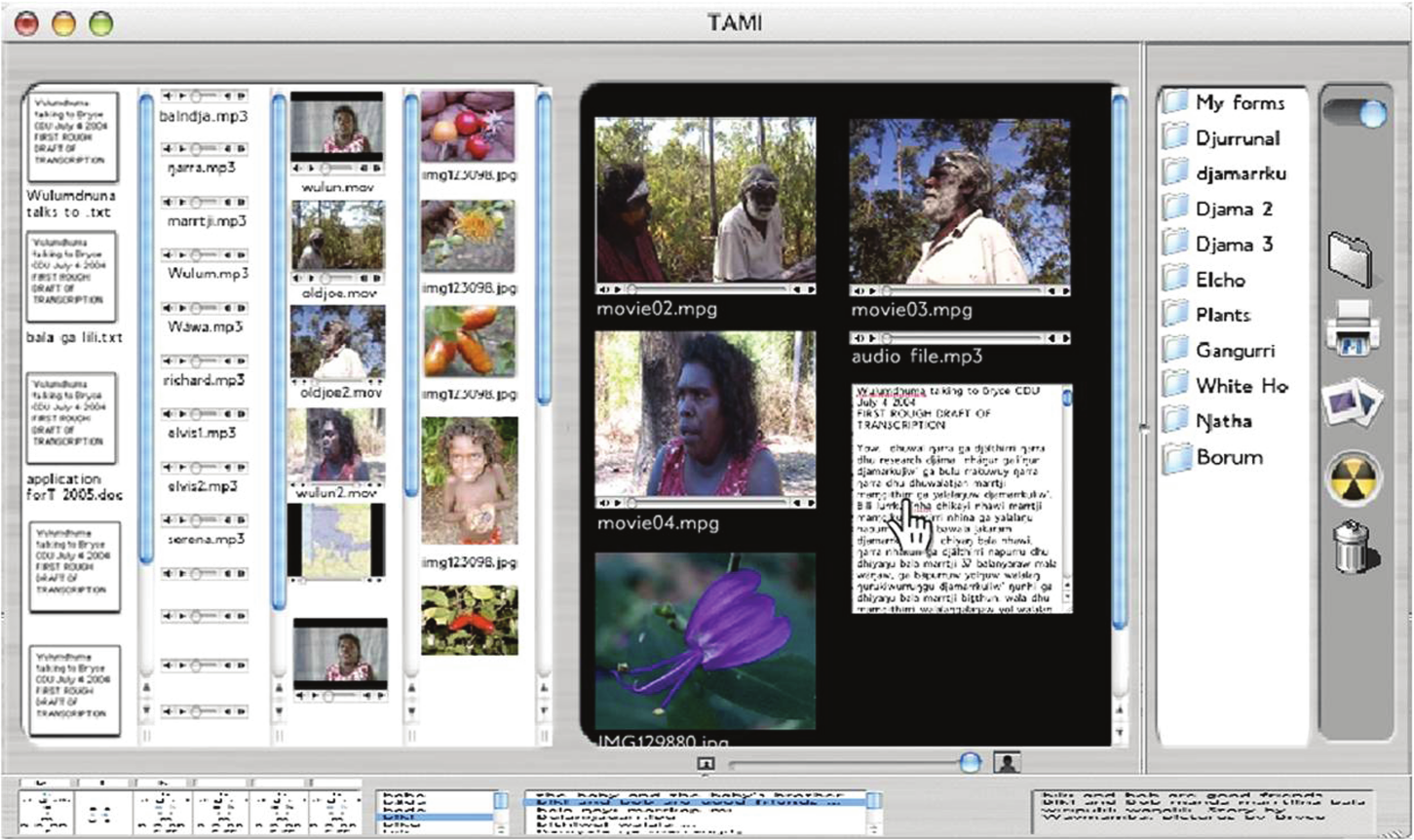
TAMI interface, collaboratively designed, proof of concept by Trevor van Weeren.
The liveliness of the collection, its potential for configuring interventions as in a Garma performance depends upon its smallness, its ‘ownedness’, its user’s knowledge of what is in there, his search for it because it was crying out to be configured alongside the others for this particular episode of collective action, sharing, claiming, counterclaiming, planning, reflecting, interrupting, making new possible worlds.
The digital files stored as file-type in TAMI (were it ever to be built) and their configurations as profoundly meaningful either in event- or place-focused folders or on map interfaces, might be imagined as the elements of Euclid’s geometry. Line segments, angles, arcs and so on wait quivering as a form of geometrical file types, there in the wings, so to speak, filled with potential for use in a geometrical proof. Mobilized by skilled geometers who know what is there in their ‘file management system’, configured in relation to each other they become brilliant and sometimes innovative proofs. So, too, the contents of the file types in TAMI wait there in the wings, quivering with potential to be mobilized as profound re-performance of Yolngu people–place–event. Banal digital files re-emerge with almost unimaginable potency when configured in the right way by the right person at the right time.
Gulumerrgin
The more digital configurations came to life alongside their Aboriginal owners, the more they seemed to take on an agency of their own. The unexpected potency of digital files is demonstrated in our next story. On this occasion, on glimpsing the surprising ‘proofs’ that sprang to life as files whose potency as digital files had up to that time been unimagined, our Aboriginal co-researcher quite properly recognized she had inadvertently exceeded her own capacities as a knowledge authority
One day, after a seminar on Making Collective Memory, a woman we will call Linda came to see us with a shoebox of old photos. These photos already had political significance – they had been active participants in a ‘Native Title’ claim. (Aboriginal people in Australia, since 1993, have been able to claim legal rights to land over which they have exercised ‘traditional laws and customs’ since colonisation.) Linda was Larrakia, a traditional owner of Darwin and surrounds, the home of the Charles Darwin university. Colonised since as far back as the arrival of the HMS Beagle in 1839, Larrakia Native Title claims are difficult to prove and often contested. Linda’s photos stretched back over many years, showing members of her extended family, usually sitting smiling on a beach somewhere surrounded by the evidence of a successful hunting expedition. Resisting the impulse to sort the photos into a database with links to dates, people and places, she soon decided upon what seemed like the relatively simple task of making a satellite map interface to store digital versions of the photos. Collective action in place-beings (Swain, 1993) (from which emerge selves and the social order) was to be the primary logic, unimpaired by the Western metaphysics of matter set in space-time. (At the seminar, Yingiya had stamped the ground rhetorically, and said with a flourish that the land is his database.) Each photo was linked only to the place and the other photos of that place, uploaded to their spots, eschewing other possible links (people, ancestral linkages or even dates), and using the technology to keep focusing always inwards, on place, rather than upwards to classification, order or telos, (re)performing the logic of the ‘abiding event’.
Linda watched the formal configurations and juxtapositions (photos with photos, photos with sites around the harbour) with increasing alarm as the digital objects took on an unexpected and somewhat dangerous life. Sitting with us looking at the photos against a giant printout of a satellite image of her land spread out on the table, and zooming back and forth on Google Earth, she saw a crowd of minor political crises the lively configurations showed potential to produce. She needed another meeting with her aunties, authority figures in the extended family, to deal with questions of access: how should we decide which photos could be included? How to agree upon representing the boundaries of our territory? How to represent the adjacent land of others? Is it blurry because we cannot claim to speak for it, or faint because it is beyond our experience? And areas on our own land for which we do not have close connections (other families have stronger ties to those places and we do not want to be seen as making a competing claim there)? Then who can decide who will be allowed access to the memory map and who denied? Eventually, in the face of imagined impending political dilemmas and even disasters, potentially unleashed in this loose configuration of digital images, she retired with her box of photos to reconsider and renegotiate a more careful way ahead with her aunts.
East of the Arafura
At around the same time that we were negotiating the fraught politics of disclosure in urban Aboriginal places, we were working with a man who fastened onto the idea of enlisting digital lives to address quite the opposite problem: the failure of traditional owners to remember, understand, engage and commit. Here, our analogy with geometry and its ‘file types’ begins to break down, for Mängay, our co-researcher, in a sense invents a new type of geometrical element, although the Galtha of rightness with proper configuration remains. Perhaps we might imagine the geometrical elements here as more like vector elements than as scalar; Mängay’s digital file elements are, in a sense, already ‘proofs’. We see that in various modes of configuration they have unexpected plasticity and multiplicity (Verran and Christie, 2007)
Out ‘on country’ near the centre of the huge Arnhem Land Aboriginal reserve on Australia’s north coast, lives Mängay and his extended family of around 40 people, keeping his sparsely populated ancestral land alive. One day, after hearing strange planes buzzing above his country (prospectors?) and seeing unknown tyre tracks (more prospectors?), Mängay had had enough. He asked his friend John Greatorex (the University’s Yolngu studies coordinator and a co-researcher on our project) to fly out and bring his video camera. He had a story to tell (see Figure 2).
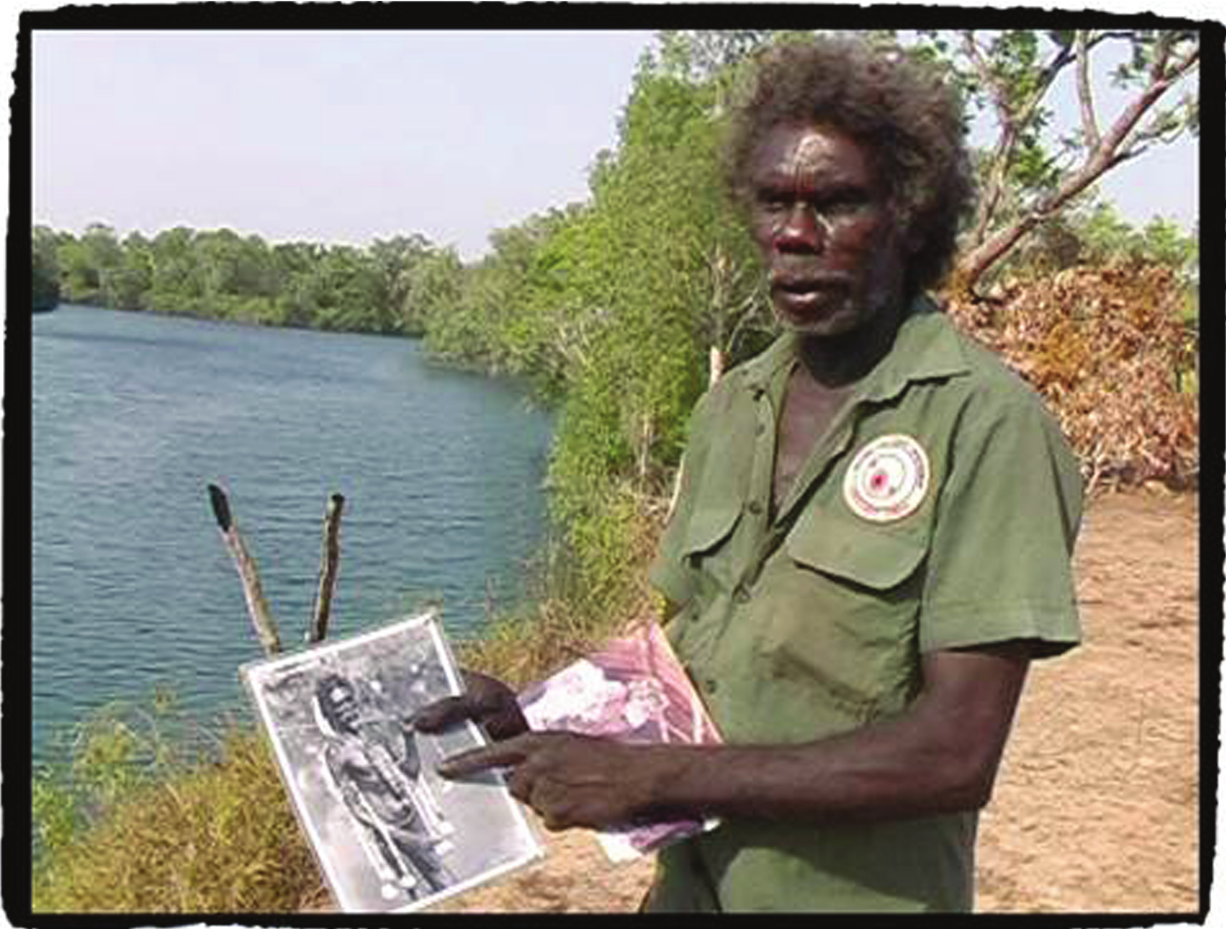
Mängay storytelling on country. Reproduced with permission.
Standing in his ranger’s Caring for Country uniform, holding up famous old photos of his ancestors taken by an early anthropologist in a dozen significant places where he now stood, pointing out and walking along ancestral dreaming tracks, he told his stories about the country, the people, the ancestors, their journeys and traces, and the kids back in the mission who belong here and don’t know the proper story. Mängay’s juxtapositioning of stories and images, statements and other performances brought the folding in of time and space back into place. Yolngu observers would be thrilled and touched by this digital Garma and enjoy the infra-ontological ruminations it provoked through its complex juxtapositions of times, places, stories and symbols. Viewers with a Western sensibility might see Mängay struggling against the grain of digital technologies designed to represent, and performing the remaking of an ancestral reality in what could be seen as a rather clunky video. (The wind whistling past the microphone would have been an irritation to the non-Yolngu observers and an agent of authenticity to the Yolngu, who may be less interested in what he actually had to say, having mostly heard it all before, but more interested in the sensations of doing country.) Some of the non-Yolngu observers (he asked for the video to be sent to the Land Council) would see Mängay as cannily exploiting the possibilities of representation that the technologies offered for achieving his political ends. But on reflection, they may also find their assumptions of embodiment, emplacement, time and representation unsettled.
Teaching from Country
This next story, too, in some sense exceeds our rather banal analogy between geometry and its elements and Yolngu knowledge practices with digital files; it shows the limitations of our analogy. Here, the capacities of digital icons as elements in knowledge practices are revealed with new and surprising generative capacities. We see how knowers are constituted through the agency of digitally mediated engagement in much the same way that what is known is constituted.
Some years after our experiences with Making Collective Memory with Computers, still working in collaboration with the same group of Yolngu knowledge authorities, we encountered digital lives in the work of academic teaching. The Teaching from Country program, funded by the Australian Learning and Teaching Council, provided us all with an opportunity to experiment with remote teaching using digital technologies and to reflect upon interactions between Yolngu and academic epistemologies and knowledge practices. Yolngu had often mentioned how frustrating it is trying to teach Yolngu languages and culture from Larrakia country (hundreds of miles from Yolngu country) and how important it is to enlist the authority of elders who insist upon staying on their own remote homeland centres much further east. Our funding made available laptops and cameras, internet connections and software configurations to allow elders on their own land to work with students in Darwin and around Australia, Japan and California (see Figure 3). One of our Yolngu colleagues, Dhänggal, taught for several months from her home in Melville Bay in east Arnhem Land (see Figure 4). Sometimes she would be standing on the beach pointing her camera out to sea, telling stories of the fire coming down to the distant rocks or the ancestral dog walking along the beach, sometimes introducing her family one by one, as they stood shyly in front of the iBook camera, sometimes she would be scooting around on Google Earth (transmitted through Skype), telling stories of the ancestral travels of the python and the quail on a landscape overlaid by a huge bauxite processing plant within two kilometres of her home, and one afternoon she talked us through the song and dance of the brolga crane as it was performed by a couple of kids in the front yard of her home under the authority of her elder brother.
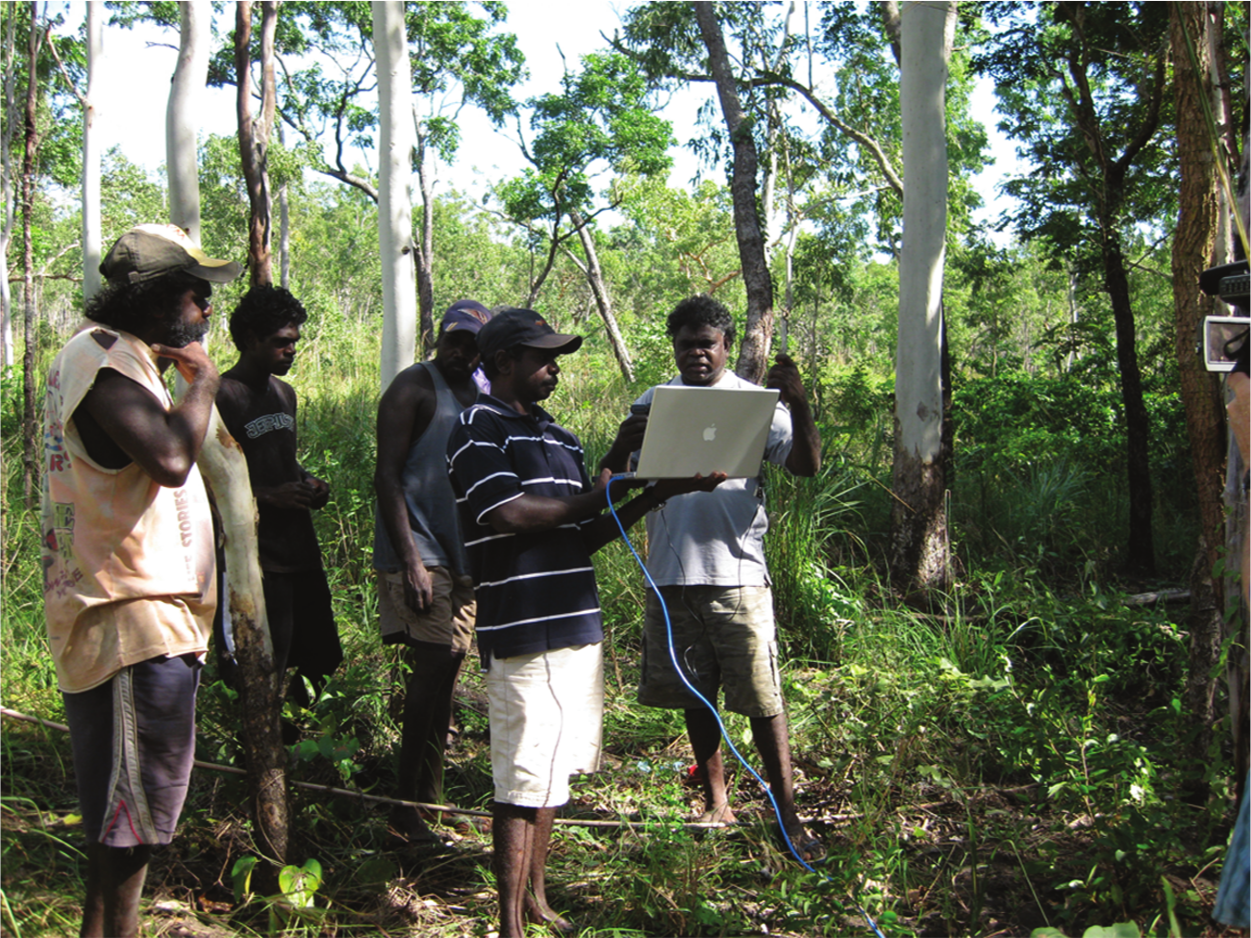
Yingiya teaching to California from Dhamiyaka, Arnhem Land. Reproduced with permission.
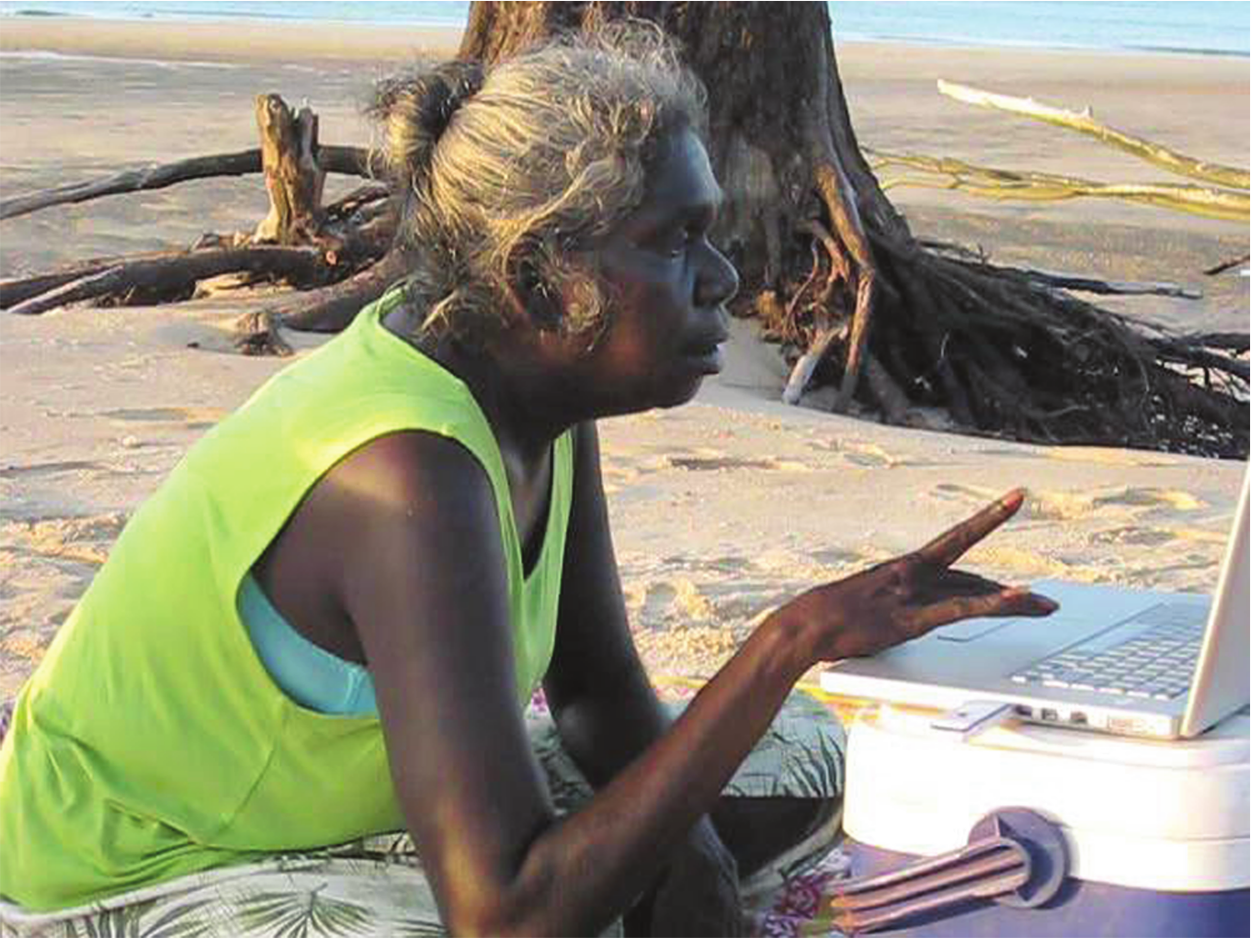
Dhänggal teaching from country. Reproduced with permission.
As we set out with some easy assumptions about what we were doing together, we soon found ourselves working hard to make agreement about apparently obvious things like the learner, or the land, or the teacher, or the screen. Having heard so much about the agency of the environment in teaching young Yolngu children to be themselves (Guyula, 2010), we were somewhat surprised when interviewing Dhänggal to hear her claim that teaching from her own country using Skype enabled her to
teach students to really know about themselves, who they are, and in way of explaining through the Yolngu side, to see things which are good about it, that is within themselves; to know who each person really is and what they can achieve from the teachings, from the Yolngu lecturers … That’s for Balanda (non-Yolngu) students as well. First of all, they have to find out for themselves who they really are. And my telling my story from [my country] will help them to do that … That’s right … Because I’ll be at home and feel that … what you would call that, power within … and Yolngu or any person that has the knowledge to pass things to other people [and do that]. [But] a lot of people miss out on it. Finding themselves, who they really are, what they should achieve. (Gurruwiwi, 2010: 24)
Dhänggal, at her place in remote Arnhem Land, can use digital technologies to teach other students around the world ‘who they really are’! Thinking back to Raymattja’s monad figured in her story of the Milngurr, Dhänggal first of all refuses to think about all those students out there (whom she will never meet) as epistemically equal. They must learn who they are (discerning the good, knowing what they ought to achieve), and as long as she is in place she can help them, whoever, wherever they are. Watching these digital encounters (and re-watching the screen captures), we could see the configurations of places, maps, stories, kin dancing or merely standing about as interrupting our own easy assumptions about the separations of people and place. Simply being in place performing a complex cultural life, beaming out through satellite technology around the world, is sufficient for the power of ‘Dhänggal in-place’ to unsettle any student’s comfortable assumptions of individuation, anywhere, while helping them to understand ‘who they really are’. And the new and surprising iconic digital lives in Yolngu collective life begin to escape our analogy with the iconic triangle, as digitized Yolngu place expresses the power to do itself in ‘the other’.
The ‘Touch Pad Body’
Our final story is of an imagined Aboriginal digital tool designed for the difficult work of agreement making about diagnosis and ways forward in health care. In this still nascent project we begin to engage with what we now begin to recognise as quite remarkable epistemological and cultural capacities of Yolngu digital icons. Mobilizing something of what we understand of these capacities, the ‘Touch Pad Body’ can be imagined as itself an infra-ontological burrowing tool. And our analogy, which began to dissolve as we muddled our way through Teaching from Country, becomes fully everted, turned inside out, and we lose sight of Peirce’s triad.
From its beginnings in researching miscommunication between health professionals and Aboriginal clients in an urban renal unit (Cass et al., 2002), our research has taken us first to evaluate and then to design digital resources for enhancing informed consent, and mutual understanding and agreement. There are many different health promotion resources available in remote Aboriginal communities, but we have identified the need for a new and different resource for helping health workers, medical staff, interpreters, patients and their families come to shared understandings and agreed ways forward for treatment.
Health literacy resources that contain health messages seldom elicit the sorts of conversations that promote a productive ongoing collaboration between health professionals, service users and their families. On the contrary, they usually entrench the received moral economies of Indigenous sickness and health that mobilize ‘top-down’ approaches and which blame the patients for irresponsible life choices and ways, and service providers for poor policy implementation. They also perpetuate the notion of health literacy as a function of the individual mind (separate from its body) rather than the functioning of an entire system where people have access to useful resources for building shared understandings with appropriate people in a timely and culturally appropriate manner. How might digital lives refocus agreement-making in health care onto the collective action of everyday encounters? How might they do so in such a way that received categories (sickness, health, the body, mind, the ailing individual, the grieving family, the nurturing environment) are emergent – relevant only as they are (re)negotiated carefully and respectfully in difficult conversations? We are working on a plan for an attractive and energetic digital life – the ‘Touch Pad Body’ (see Figure 5), an iPad or generic custom-designed touch screen application that displays an interactive 3D zoomable, semi-transparent body that might in conversation become an Aboriginal body. The device embeds an Aboriginal definition of communication as building shared understandings (subverting the received notion of communication as transfer of information)
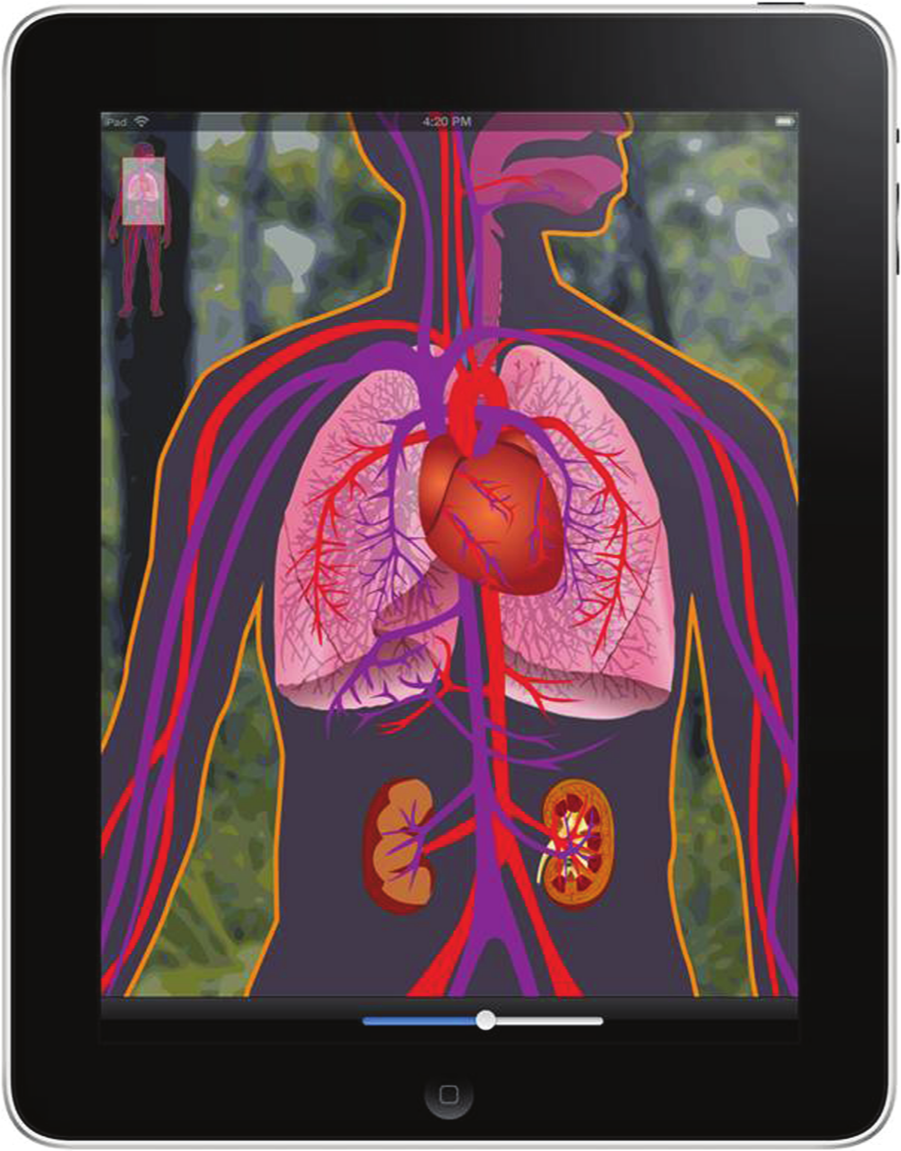
The ‘Touch Pad Body’, collaboratively designed, proof of concept by Trevor van Weeren.
This digital tool presumes neither biomedical certainties nor Aboriginal certainties about bodies, and in practice would be developed iteratively and gradually introduced into the communicative processes of remote Aboriginal health services, allowing the Aboriginal body to come to life in these encounters. As a somewhat ambiguous entity, the ‘Touch Pad Body’ would allow for the top-down and bottom-up practices to work together in new ways. Enabling ongoing situated ‘both-ways’ (re)negotiation of the categories and moral judgements through which health professionals and service users work together, the biomedical stories of physiology and nutrition, pathology and treatment, juxtaposed with Aboriginal stories of care and connectedness, would serve to unsettle and interrupt received notions of health, disease and treatment on both sides of the health delivery practice to create new understandings, engagements and moralities. The ‘Touch Pad Body’ is designed to elicit contributions to an ongoing negotiation about health as an aspect of the question ‘How should we live?’, posed as an empirical matter of the here and now.
Conclusion
Taking seriously some object lessons that we were subject to and that arose early on in our engagements with Yolngu individuals, families and groups as knowledge makers, we imagine digital files that have life in Yolngu knowledge practices as epistemically and culturally potent icons. We have told of gradually learning to appreciate the remarkable epistemic properties of icons where the right configuration simultaneously performs truth and is the truth performed. Beginning by making an analogy between Yolngu knowledge practices with digital files and the practices of geometry, which similarly articulates truth claims by mobilizing the peculiar epistemic capacities of icons, we style this analogy as a tool that allows us to burrow into the ontological work involved in such epistemic practice. As we proceed through our stories and our stories about those stories, that analogy dissolves. Somewhat perplexed at this turn of events, we conclude that this seeming failure performs our learning to work with Yolngu digital lives in more seamless postcolonial knowledge practices: our writing, the journal’s publishing and your reading are (re)enacting, just as configured digital lives are (re)enacting Yolngu people-places while evading the demands of elegant (colonising) theorising.
Footnotes
Funding
The research was supported by a 2003–2006 Australian Research Council Linkage Grant no. LP0349200.