




Abstract
In this article, we argue for a multi-dimensional research strategy incorporating material, social and phenomenological analysis in the study of figurines and other human effigies. We call this approach ‘following the material’. To illustrate, we examine two case studies: figurines from the Neolithic site of Çatalhöyük (Turkey) and human effigies from the Formative region of Moche (Peru). We look first at the material substances from which artifacts are made and the material contexts in which they were produced, circulated and deposited, before turning to analysis of the representation of the body. This enables us to see these objects as themselves bodies – not merely imperfect replicas of actual humans, but material objects made of substances that afford particular kinds of interactions between fleshly and artifactual bodies. This focus on the materiality of artifacts reveals tight connections between objects in human form, material culture, environment, landscape, and political economy.
Introduction
Objects in the shape of a human body are ubiquitous in the archaeological record and constitute a rich source of data about past societies. Figurines and other human effigies have been the subject of a large and increasingly sophisticated literature, especially on the topics of gender and the body (Joyce, 1998, 2005; Meskell, 2007; Nanoglou, 2008, 2009). But this fascination with objects that look like us is dangerously seductive. It can tempt archaeologists to abandon their usual methodological rigor and to fail to analyze these artifacts as artifacts; instead, they see them primarily or even exclusively as images or as texts. To do so is to look through or past the object itself, focusing instead on the vanished social and material worlds it appears to represent. Such an approach dematerializes objects and people alike, and relies upon and reproduces idealized categories of persons. This results in flat data sets that can be coded according to pre-existing categories of social life such as gender, age, or status. Figurines and effigies are more than this: they embody particular forms of engagement with the material world, and have material effects on that world through their social histories of production, use, exchange, and discard.
In this article, we adopt a different approach that we call ‘following the material’: we look, not at images or data sets, but at the thing itself in all its material, social and phenomenological aspects. This approach jettisons static, idealized and artificially complete images of the past in favor of a more realistic picture: a necessarily fragmentary but inherently dynamic reconstruction of the complex, imperfect mosaic of social and material interactions that constitute a human society. This form of analysis can also lead to similarly dynamic interpretations of gender, age, status, and species – the very categories that have been the focus of traditional figurine studies. The end result, we believe, is a better understanding of effigies and figurines, and of the people and the societies that produced them.
‘Following the material’ does not imply abandoning or neglecting information coded in representational form; instead, what we propose is a multi-dimensional strategy that expands the tool set used to study effigies and figurines. We suggest that archaeologists start with the kinds of analyses they do best: technical analyses of materials, and spatial analyses of sites and their surroundings. To illustrate, in the first two sections of this article we focus on the material substances from which artifacts are made and the material contexts in which they were produced, circulated and deposited. It is only in the third and final section that we directly address the question of the body.
For the purposes of this article, we explore substance and context using two very different examples of clay artifacts in human form: figurines from the Neolithic site of Çatalhöyük (Turkey) and human effigies from the Formative region of Moche (Peru). These cases differ in location, time, and the nature of the material record. Çatalhöyük is a Neolithic settlement (7400–6000 cal BC) in central Anatolia, whereas Moche refers to a series of sites (200–800 AD) on the North Coast of Peru. In the first case, we focus on clay – the substance that figurines are made of; and in the second case, on water – the substance that effigy vessels were made for.
These two examples allow us to demonstrate that a focus on substances provides a much-needed escape from pernicious, often unstated universalist assumptions about the nature of figurines and figurative art – and, by extension, of premodern societies. When it comes to prehistoric bodies, archaeologists’ fascination with figuration and representation has sometimes over-determined their interpretations, and contaminated the interpretation of data. At Çatalhöyük in the 1960s, for example, figurines were glossed as depictions of a mother goddess embedded within a matriarchal system. More recently, popular and scholarly depictions of Moche society feature lurid modern re-creations of ceremonies involving the drinking of human blood, based on fine-line paintings found on a small number of ceramic vessels. Despite their popularity, we consider both cases to be weakly substantiated, and to rest too heavily on selective readings of the available data. Our method guards against this temptation to reconstruct entire societies or specific events through overly literal readings of a few examples of representational imagery; instead, by using multiple, mutually reinforcing bodies of material, spatial, contextual, and iconographic data, we build slowly toward interpretation, producing solid substantiation for hypotheses of a quite different kind. ‘Following the material’ will not result in highly colored re-creations of specific deities or rites, nor is it designed to do so. What it produces instead is more akin to what cultural anthropologists call ‘thick description’ (Geertz, 1977): a rich immersion into the dense relations among social actors and their non-human and material worlds. This approach also allows us to better understand effigies themselves as something more than transparent records or copies of ‘real life’. The Çatalhöyük figurines demonstrate that the creation of an effigy is a mimetic act in which what matters is not only what is represented, but also how, when, and where; and the Moche effigy pots show that what matters is not only what an object is, but what it can do.
Our focus is on method: we have no interest in comparing the two societies, Anatolian and Pre-Columbian – an exercise of dubious intellectual value, given the temporal and geographical distance between the two. In fact, we did not select the most comparable artifact sets from these two contexts – for example, we do not compare the rare carved stone effigies from Çatalhöyük with Moche fine ceramics, or the quotidian clay figurines found in domestic settings at Huacas de Moche or other Moche sites with the ubiquitous Çatalhöyük figurines. We especially refrain from the latter comparison, which might suggest an ahistorical analogy between a Moche ‘underclass’ and the entirety of Çatalhöyük’s unstratified society, as though the poor in a stratified society are the ossified primitives of an earlier era – an analogy we emphatically reject. Our intent here is to demonstrate the work that our approach can do, regardless of the specific corpus of artifacts or spatio-temporal context.
We further demonstrate the flexibility of our approach by examining two very different kinds of data: Meskell is analyzing a data set from controlled excavations at a single site, where intensive excavation over the past 20 years offers a detailed picture, including information on the clay and plaster sources that provided raw materials for figurines, ceramics, and plastered wall features (Meskell, 2007). Meskell’s database includes some 2500 figurines (Nakamura and Meskell, 2013a: 201). In contrast, Weismantel (2004, 2011) has spent the last several years developing research methods for the study of decontextualized artifacts. Her project involves the examination of over 1000 ceramic effigies from museum collections in Lima, Chicago, New York, San Diego, Los Angeles, and Beloit; intensive study of 100 examples from the Field Museum of Natural History and the Art Institute of Chicago, Illinois and the examination of unpublished photographs from the Moche archive at UCLA and the Larco Hoyle collection in the Kinsey Institute in Indiana. This comparison of two strikingly different bodies of evidence from divergent regions, periods, and societies demonstrates the potential utility of ‘following the material’ in a wide range of research settings.
Following the substances: Clay and water
Figurine studies have conventionally paid little attention to the substances of artifacts and have only recently employed techniques like computed tomography scanning, X-ray fluorescence or spectrographic analysis (Clark, 2009; Forouzan et al., 2012; Insoll et al., 2012; Pitblado et al., 2013). The actual clay or stone has had significance only inasmuch as it allows us to imagine other substances that have vanished: flesh-and-blood bodies covered with textiles and adorned with beads. In this study, we ask what happens if we see these artifacts instead as what they literally are: not merely representations, but actual bodies made of clay or plaster or stone. In making a body out of a mineral substance, ancient actors did something more or different than just copy themselves: they created a body like but unlike their own, with different material properties, capacities, and scale (see also Bailey, 2005). By following the makers’ focus on the material substances of these artifactual bodies, we may be able to recover something of their original meanings. What was it that the people of Anatolia and Pre-Columbian Peru could do and say with modeled bodies made of clay, differently or more powerfully than with their own bodies made of flesh and blood? To answer this question, we must follow these substances back through the entire material life of the societies in question, looking at geography, ecology, production, and the distribution of resources.
This is very different from claims that the substances and production processes of ceramics give them universal meanings (Lévi-Strauss, 1996). Instead, we find that these substances and processes have meanings specific to the ecologies and political economies of their time and place. Ceramic production involves earth, water, fire, and human hands; clay pots may be compared to human bodies (as in English, where we speak of the vessel’s mouth, its body, and sometimes its feet), or their meaning may derive from their use as storage containers, drinking vessels or cooking pots. This diversity of materials and meanings requires researchers to ‘follow the material’ closely, looking for specific relationships between bodies, substances, processes, and their social and material contexts. In the two cases presented here, we find an especially tight connection between specific substances and the resource base of the larger society: between artifact and environment, meaning and making. The use of tanglegrams demonstrates these connections, through high concentration of links and strong points of dependency (Hodder, 2012a).
Anatolia: Clay
Material life at Çatalhöyük was dominated by a single substance – clay. Indeed, the site location was likely chosen because of its ready access to clay sources. The settlement is situated on a clay-rich lake bed (see Figure 1) and clay was used extensively for ceramics, clay balls, figurines, stamp seals, and geometric objects (Doherty, 2013), as well as for bricks and buildings that were later finished with whiter calcareous clays or marls. Clay objects as well as plaster occur from the earliest levels (around 7400 cal BC), and fired clay pottery starts at c. 7000–6900 cal BC (Hodder, 2012b: 169). As Doherty has shown, the volume and magnitude of clay extraction and use would have changed the natural drainage system, resulting in extraction pits that filled with water seasonally, as well as the subsidence of cultural materials such as midden from the mound that, in turn, was deposited in those same pits.

Site map of Çatalhöyük.
All of the clays used in making figurines – marl, black organic, lower and upper alluvial types – have been found in very close proximity to the site (Doherty, 2013; Meskell et al., 2008: 141). The figurines were manufactured from fine, naturally clean, highly malleable clays (see Figure 2). By choosing a high clay content fabric, the makers were able to craft small, well-smoothed, sturdy figural pieces expediently, expending minimal effort. Fabric with more inclusions or sand would have required more working, modeling, smoothing and heating. Çatalhöyük figurines were not subjected to high firing. The vast majority could be described as lightly or passively baked, whether by the sun, by proximity to ovens and hearths, or by burning in middens. This rapid process produced figurines that call attention to the clay that forms them, and to the process of making itself. Often we see the makers’ fingerprints or construction marks, and there are examples that were halted or maimed during manufacture.
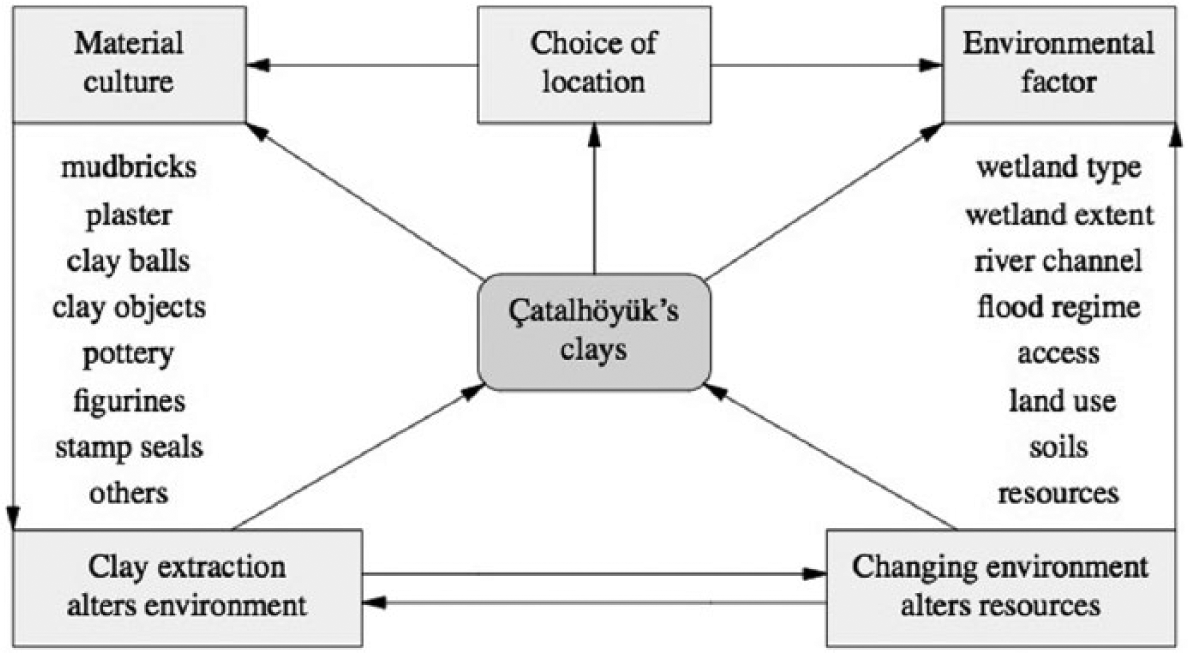
Clay at Çatalhöyük. Table courtesy of Chris Doherty.
This emphasis on clay is characteristic of the time: the Neolithic has often been called the ‘age of clay’ (Stevanović, 1997). From the pre-pottery Neolithic onwards there was a notable proliferation in the use of clay for houses, hearths, ovens, figurines, skull modeling, and later followed by pottery. People at Çatalhöyük lived in a world of clay and clayey soil and depended on it for protection, warmth, food, social identity, personal identity, as well as for the development of the senses and probably cognition; clay figurines were an intimate and ubiquitous part of this clayey world, readily made from materials close to hand.
Pre-Columbian Peru: Water
In moving from the Anatolian Neolithic to the North Coast of Peru, we move from a land of clay to a place ruled by water – its presence and its absence. In this notoriously arid environment, agricultural water is scarce and precious. Irrigation is the invaluable technology that transformed the North Coast from a marginal area into one of the most productive agricultural areas in all of Peru – a position it still holds today, using a system of irrigation canals initially constructed by Pre-Columbian farmers. But water is not always a benign force: the North Coast is frequently and unpredictably lashed with catastrophic flooding caused by ENSA (El Niño), the periodic warming of the waters of the Pacific that alter rainfall, temperature and climate patterns worldwide but with especially dramatic impact here. In this part of the world, water is and was all- important, and the human quest to control it, whether to create fertile land or to mitigate destruction, has been a driving force throughout the long millennia of the human presence there.
The sense of water as significant in the landscape and for human society was especially acute during the first millennium; if the Anatolian Neolithic was the ‘age of clay’, the Moche period on the North Coast of Peru could be called an ‘age of water’. Enormous irrigation projects were undertaken during the Middle Moche phase (400–800 AD), exponentially expanding the amount of land under cultivation (Billman, 2002: 383–384).
This driving theme in North Coast ecology, economy and society shaped Moche ceramic production. At Moche sites (as throughout much of the Pre-Columbian Americas), solid clay figurines are common in non-elite domestic contexts – but not in elite contexts, where almost all ceramics are hollow-bodied vessels. In contrast to Western artistic philosophies dating to the 18th century, which may denigrate functional design in comparison to ‘fine’ arts such as painting on canvas, in the Moche world some of the most beautifully made and highly prized objects were functional containers. The signature form of the North Coast is the stirrup spout bottle, one of the most elaborate spout forms ever designed. (And the spout, not the figures, often received the most attention on the part of the maker, see Wiersema, 2010). Other ceramics, such as the ‘joke pots’ (Larco, 1965) use clever structural design to play upon the movement of water in and out of the vessel. All bottles, jars, pitchers, and cups worldwide have a hollow body to contain liquid and an aperture to release it – but few other ceramic traditions emphasize and elaborate upon these characteristics to the same extent as on the water-obsessed North Coast.
In sum, by following the material substances in these two examples, we were immediately led to the resource base surrounding the sites where they were made and used. Moche ceramics emphasize their ability to hold and disburse fluids – an understandable preoccupation in a place where water is among the most precious and most powerful of substances, and the most difficult to control; at Çatalhöyük, it was clay itself, a substance valued for its very ubiquity, that was the focus of the makers’ attention. At each site, the significance of these artifacts would have been inseparable from the ecological significance of these two substances – and so too would the social, political and economic structures that were equally intrinsic to their meaning.
Following the contexts: The midden and the tomb
As we move from material substances to the material contexts in which artifacts were produced, circulated and deposited, our purview also moves from ecology and economy to the social and political – but not via analysis of figurines and effigies as models for different categories of people. Instead, contextual and spatial information allows us to partially reconstruct the social lives of objects – lives in which they were enmeshed in relations of power between people, and often acted as social agents themselves (Meskell, 2004; Nanoglou, 2005; Weismantel, 2011). We do not imply the full equivalence of material objects and living beings; ultimately, humans have agency in a way that things do not. But whenever people made figurines and effigies and put them into play within circuits of use, exchange, destruction or deposition, they created substantive agents with the potential to act upon the world in both intentional and unpredictable ways.
We explore these potentials through the sharp contrast between our two cases. At the socially egalitarian site of Çatalhöyük (Hodder, 2006), modes of figurine production, circulation and deposition reflect spontaneity, expedience and ubiquity: the social life of these artifacts was one widely shared across the site and among the entire population (Meskell et al., 2008). In contrast, fine ceramics from Moche sites were produced, circulated and deposited within sharply restricted circuits, where they embodied and enacted elite political, social and religious concerns, especially about control of reproduction and inheritance (Weismantel, 2004).
Anatolia: Impermanence
People throughout the history of Çatalhöyük fashioned thousands of clay figurines of humans and animals as part of their daily practices. There is no evidence for specialized production areas, and we do not find figurines sequestered in caches or buried with bodies, as we do other classes of material culture (Nakamura and Meskell, 2013b). They were objects of life that circulated widely, rather than being kept and guarded. Detailed spatial analysis demonstrates that most clay figurines are found in external areas such as middens rather than in buildings; exceptions are primarily from building fills rather than from features or floors (Meskell et al., 2008). One notable pattern that emerges in the comparison of building and non-building deposition is that the distribution of figurine types remains the same. (While there are a few carved stone figurines, some 30 human figures, the majority of these come from Mellaart’s 1960s excavations, see Mellaart, 1967, and lack verifiable contexts.) Moreover, there was no difference in treatment between whole and fragmentary figurines, animal or human forms, or even clay and stone examples. This pattern remains consistent throughout the life history of the site. Their short lifecycles suggest that fashioning clay bodies was highly transactional and practice-based.
This depositional evidence and range of subject matter suggest that these were mundane things, expediently and frequently fashioned. The malleability of clay, which requires an easier skill set than stone carving, also indicates that everyone could participate in the process of making. They were objects of use rather than duration: transitory, not meant to endure. The magic was in the making (Mauss, 2001). Rather than their rarity, their very frequency in the material record is what indicates that they were significant and central to daily life (Meskell et al., 2008: 141).
The transitory lives of figurines are echoed in the material biographies of clay and plaster elsewhere at the site, where these substances were employed to layer and enflesh human and animal bones, encase animal remains into walls, resurface walls seasonally, cover platforms that encased the dead, and fashion a myriad of object forms (Meskell, 2008; see also Figure 3). In Çatalhöyük houses such as Buildings 52 and 77, plastered bucrania and individual cattle horns were embedded into walls and platforms (Russell et al., 2009; Twiss and Russell, 2009) and repeatedly layered with plaster. Clays and plasters were also mediums for other connected figurative bodies such as those molded onto house walls, typically splayed creatures that combine human and animal features. In one example, probably representing a splayed bear, a round protruding stomach was constructed from a dense build-up of clay, smoothed and finished with white plaster. Plaster was also found covering the remains of an actual bear paw found in Building 24 (Russell and Meece, 2006: 221). Such molded wall plastering of skeletal remains reminds us too of the plastered human skull placed in a burial in Building 42.

Tanglegram of clay at Çatalhöyük, couresty of Claudia Engel.
Thus, the act of plastering is one of maintaining, building up, and indeed ‘enfleshing’. Plaster protects, transforms and fortifies an underlying substructure (Meskell, 2008). Evocative examples of clay’s potentials for transformation were not restricted to humans but equally revivified revered members of the animal world. Skeletal remains, teeth and claws represent the hard, enduring, and even dangerous elements of carnivorous animals (Hodder and Meskell, 2011) and yet they might be contrasted with the soft, wet, earthy qualities of clay and plaster that required regular attention and renewal. Enfleshing and improving on the body after death is at issue here and clay as flesh, plaster as skin, might be materialized as a means of overcoming decay and making permanent the memory of things.
But not forever. Across the site, clay was the vital fabric that made the buildings, the objects of life: it then degraded, fell apart and was reconstituted into new composite fabrics for the figurations of flesh. These processes operated at different scales, as small as an individual figurine, as large as the entire site, where the accumulated material from previous constructions was extracted in later times to make mud bricks and figurines from silty clays that show inclusions of charcoal and other organic materials from the settlement. Recycling this colluvium that once constituted the Neolithic mound into ready-to-hand material for making figurines of humans and animals has an obvious cyclicality.
Moche: Inheritance
Archaeologically, the Moche are known primarily through excavations at a number of large sites comprising monumental structures, plazas, residences, and workshops located in a series of river valleys. The ceramic effigies studied by Weismantel were a specialized class of high-status artifacts confined to tightly restricted circuits of production and distribution, and appear to have been deposited primarily or exclusively in elaborate burial contexts along with other precious grave goods. Ceramic production, like other forms of craft production, was the province of specialists, performed in workshops – and even the workshops were highly stratified, ranging from humble domestic contexts (Bawden, 1999) to mid-level workshops (Shimada, 2009) to the highly specialized workshops that produced the finest quality pieces discussed here. Although only one of the latter has been excavated (at the site of Huacas de Moche, see Uceda and Armas, 1997, 1998) typological and depositional evidence – not to mention the sheer quantity of surviving examples of fineware – overwhelmingly indicate that this was only one of multiple, competing fine workshops with distinctive styles, each associated with a regional elite (Wiersema, 2010).
This stratified ceramic production is in keeping with the increased stratification of Moche society. The exact political configuration (whether as single, two, or multiple states or a more heterarchical entity) is the subject of ongoing debate (Chapdelaine, 2011; Quilter, 2011). However, it is indisputable that the middle and late Moche periods witnessed accelerated economic and social stratification and the consolidation of political power in the hands of small groups of wealthy elites – a process closely coincident chronologically with the expansion of irrigated agriculture through massive canal-building campaigns (Billman, 2002). Great wealth and power awaited those who controlled these canals and the labor required to build and maintain them; small wonder, then, that this was a period when a water-obsessed elite emerged – an elite that was likewise preoccupied with the creation of elaborate graves enshrining clusters of bodies, presumably linked through kinship. It is in these graves that the fine ceramics studied by Weismantel are found.
This restricted depositional pattern does not mean that the ceramics were removed from social life; quite the reverse. Ethnohistoric, ethnographic and archaeological data overwhelmingly suggest that for Moche elites, as for other Andean peoples, tombs were not a realm of the dead, separated from everyday life; instead, they were important places for the living, who went there to revitalize their connection to their ancestors – and to publicly enact their right to inherit from them. In her classic study of North Coast political systems, Patricia Netherly (1984) describes polities ruled by powerful lineages whose political and economic power rested in the control of irrigation canals; the ideological source of this control lay in the ability to claim descent from ancestors (see also Ramirez, 1998). As objects in tombs, ceramic effigies thus belonged to a restricted but highly charged arena of social, political, and economic life.
There is a tight connection between these material contexts of deposition and circulation, and the substances that ceramics were designed to contain. The forms of these ceramics, primarily bottles and drinking bowls, indicate their use as containers of water, presumably both in its unadulterated form as well as in the form of fermented beverages, known in Andean studies as chicha (Weismantel, 2009; see also Jennings and Bowser, 2009). Scientific data does not exist to specifically demonstrate whether the elite ceramics found in Moche tombs contained liquids made through fermentation. However, an enormous quantity of ethnographic and archaeological data from across the Andes, and the North Coast in particular, detail the significance of chicha throughout the region’s long history (Jennings and Bowser, 2009; Weismantel, 2009); there is also archaeological evidence for chicha production at the Moche sites of Huacas de Moche (Chapdelaine, 1998) and San José de Moro (Prieto and Gabriel, 2011). In Andean religious and political thought, fermented beverages that combine water with the agricultural products of the irrigated fields were tremendously important: deities and mortals, lords and their subjects were linked through rituals in which these liquids were served from ceremonial vessels (Allen, 1988; Cummins, 2002).
Among the most important loci for such rites were the places of the dead. Within this religious and political economy, the ceramic vessel as a container for fluids is linked to the tomb as the container of political legitimacy and the system of irrigation canals as the container of irrigation waters. Small wonder, then, that the effigies placed in elite tombs were all vessels – vessels in the form of mountains, irrigated fields, and ancestors, but most of all in the form of biota: human, animal and vegetable bodies, all represented as hollow containers filled with life-giving liquid. An elite art form prized by a superordinate social group, whose political control over their society rested firmly upon their control of systems of irrigation, the tubular vessels created by Moche artists are an elegant and obsessive artistic meditation on the control and manipulation of water – and perhaps its sacred and politically powerful product, chicha.
In sum, then, the social lives of Çatalhöyük figurines and Moche effigies reveal strikingly different patterns. Material life at Çatalhöyük revolved around the ubiquity of clay, plaster, and similar materials; the making of figurines was a casual, constant activity in which human hands came into contact with a readily available lump of clay, molded it into a human or animal form, and then sometimes exposed it to informal firing. On the North Coast of Peru, water was a tightly controlled substance, and so too was the making, circulation and deposition of Moche fine ceramics – objects designed to mimic, but also to reproduce, the controlled movement of liquid through the landscape – and the body.
Back to the bodies
‘Following the material’ does not mean ignoring meanings conveyed through form and style, or turning away from the human body. Bodies still matter, but we approach them differently. We do not begin with pre-determined categories of gender, age, reproductive status (i.e. pregnancy and birth), social status (i.e. markers of elite status or leadership), or even species. Instead, we begin with substances and contexts, and try to let meanings emerge from our data, giving rise to categories we could not have initially envisioned (Weismantel, 2004). In the process, past humans begin to appear, not as isolated abstractions possessed of a collection of arbitrarily defined traits, but as engaged actors enmeshed in the material life of their societies.
Counter-intuitively, because we did not begin with the body, we ended by discovering aspects of ancient bodies that conventional figurine studies cannot: deeply embedded conceptualizations of physicality and social identity that were profoundly meaningful for the makers and users of these artifacts, but are not immediately apparent to modern viewers. These meanings arise from the evidence we presented in the first two sections of this article: from interactions between substances, persons and places, politics, ecology, and environment that were entirely specific to the time and place of their making, and that leave material traces that can be recovered archaeologically.
Anatolia: Flesh
At Çatalhöyük, the fabric of clay connects to concepts of flesh, fleshiness, vitality, and duration. The corpulence that clay affords, its fleshy and bodily qualities, was likely considered effective in making new bodies, incorporating elements of other species and domesticating them within the settlement by enfleshing and ultimately embodying them. Throughout the site, a concern for permanence is reflected in the repetitive practices of embedding, curating, and durability that traversed both human and non-human domains and moved between real individuals and object worlds. Such preoccupations traversed species taxonomies, as seen by shared bodily treatments in the remains of particular persons and certain animals. For instance, the skeletal and durable elements from certain boars, vultures, goats, and bulls were embedded into the very fabric of dwellings by being stuck into walls and reliefs that were then molded and coated in plaster; others were attached to pillars or other architectural forms. It should be said, however, that the majority of both people and animals were typically buried differently and expediently, suggesting there was a particular importance assigned to those selected out and rendered permanent fixtures.
It is tempting to view these as processes of translation between so-called natural remains (bone) and cultural embellishments (plaster, paint, labor) that, taken together, co-produce another type of thing altogether, one that endures over the generations with a restored efficacy. Both clay and plaster likely symbolized flesh, the former specifically for figurines and the latter for house installations and the walls or ‘skins’ of houses, as well as animal and human re-fleshing and revivifying. The color, texture, softness, sheen, plasticity and ability to layer and smooth must have made plaster an evocative material. Figurines were formed from very white, clean marls that are reminiscent of white, luminous plasters and look remarkably flesh-like. Çatalhöyük figurines also connect clay and flesh through the finger marks that evoke the makers’ hands, and through their fleshy colors and forms.
Figurine makers focused intimately on the torso – the breasts, stomach and buttocks – but not in order to emphasize femaleness, as previous authors believed. In fact, most of the human figurines are ungendered, but rather emphasize corporeality at the expense of primary sexual characteristics. Gender appears relatively unimportant; what matters is flesh. The conspicuous bodily features are those that are constituted purely of flesh. While breasts were the trait most commonly depicted (and both men and woman have them), the stomach and buttocks received the most emphasis or exaggeration. Disproportionately large buttocks and stomachs with navels were carefully and consistently executed rather than other features like limbs, hands, feet, and even facial features. These are obviously the fleshiest part of the body, where excess fat from the diet accumulates and where the body can manifest distinctive visual signs of aging or maturity (Pearson and Meskell, 2014). This underlines the non-generative emphasis of figuration that we see across the site in related media, including plasterings and wall paintings (Nakamura and Meskell, 2009: 226). If flesh is not a proxy for gender or fertility, it may instead reveal societal concerns about aging, maturity, survival, and accumulation.
Looking specifically at manufacture, these corpulent bodies reveal protruding, sagging, misshapen and often uneven corporeal features that are indicative of aging bodies rather than reproductive ones (see also Voigt, 2007). Clay bodies were not always symmetrical either: breasts were intentionally rendered uneven, voluminous stomachs blend into lower bodies often in spherical or triangular forms, and bottoms become blocky protuberances, underscoring a general lack of bodily specificity. We might posit that aging, maturity, and survival were prized qualities in Neolithic society and thus rendered materially in clay more often. Flesh, which can be captured evocatively in clay and plaster, was the signifier of such qualities and the object of desire.
Taken together, this predilection for embedding and re-fleshing of the remains of animals and ancestors was material preoccupation made manifest in the plastered forms, burial tradition, and the figurine corpus. By following the material, we are directed to the very concerns of the makers themselves – to co-produce and manage these nature-cultures, to instantiate permanence, and to restore and improve upon the fragilities of fleshed matter through manipulation and curation.
Moche: Fluids
Although Moche fine ceramicists created strikingly lifelike ‘portraits’ (Donnan, 2004), at other times they seem to distort the human form. For example, in an effigy of a woman breast-feeding a baby, the breast does not look soft and round; instead, it is an elongated, rather pointy protuberance (Donnan 1976, p. 21, Fig. 37). Similarly, although the sex acts depicted on some pots are so graphic that modern viewers call them ‘pornographic’, the small clay figures engaged in them look oddly asexual. They have unsmiling faces and ungendered bodies so similar in size and shape that their sex can only be identified by closely inspecting the tiny, carefully carved genitalia (Weismantel, 2004). A third example is still more striking: the masturbating figurines, some of them skeletons, who flourish a male member of absurdly enormous proportions (e.g. Bourget, 2006: 122, Fig. 2.74).
‘Following the material’ suggests possible answers to these puzzles by moving beyond the fragmentary approaches that separate form and content, art, and archaeology. Typically, archaeologists consult formal and stylistic characteristics only to construct chronologies; as a separate endeavor, they catalog what is depicted on effigies and paintings; iconographic analysis of this information, in turn, is not systematically integrated with archaeological data (Weismantel, 2014).
We suggest instead an analysis that begins by connecting artifacts, substances, and archaeological contacts, as in the tanglegram in Figure 4. Rather than considering them in isolation, look what happens if we place these clay effigies in the context of mutually reinforcing links between the material substances (water and chicha) involved in their production and use; the material contexts in which they are found (elite tombs); the stratified political economy of Moche society; and the ecology of the North Coast. In this context, the apparent distortions in the shape of a breast or the size of a penis no longer look like artistic failures or inaccuracies. Instead, they appear as selective emphases that made a particular kind of sense.
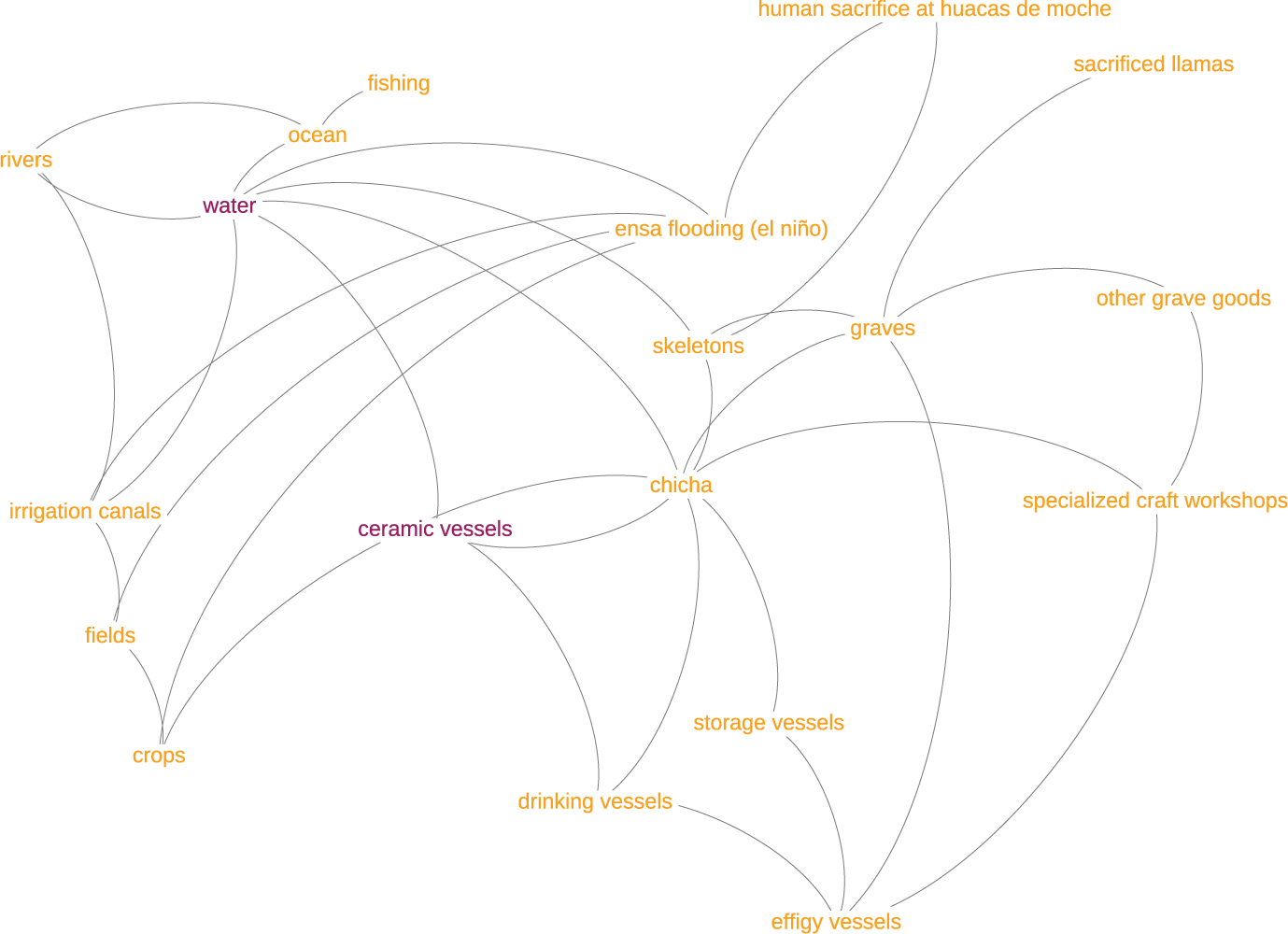
Tanglegram of water and ceramic vessels for Moche, courtesy of Claudia Engel.
The bodies on these pots seem unsexed and unsexy because they lack fleshiness. Buttocks, breasts and lips are flat instead of rounded; women’s bodies are blocky, not curvaceous; men’s chests and arms lack rippling muscles. The torsos and limbs of both sexes are elongated and tubular, even noodle-like. These tubular shapes emphasize not just what bodies look like, but what they can do. Their clay surfaces are thin shells that cover the hollow chamber within. These formal and material properties converge to convey a single fact, one that ‘following the material’ tells us the Moche considered crucial for all living bodies: their capacity to contain life-giving fluids.
And to release them. Rather than fleshy ‘tits and ass’, the body parts emphasized on these effigies are the orifices – mouth, penis, anus, vagina, and nipple; the focus is not on their capacity to deliver fleshy pleasures, but to receive and release fluids. This explains the pointy maternal breast, which looks like a siphon or a drinking straw; the huge vaginal opening on other pots, in the form of a chute or spout that releases floods of liquid (Weismantel, 2011: 313, Fig. 18.6) and the enormous penis on the masturbatory pots, which is nothing less than a beer mug waiting for a thirsty mouth.
These effigies do not simply depict the body as composed of orifices and tubes; they act to move liquid through those orifices and between bodies – ceramic and human. This circulation of fluids also involved the bodies of the dead. There are clay effigies of skeletonized bodies with active phalli, which Weismantel (2004) has interpreted as the figure of the fecund, lineage-founding ancestor. Furthermore, these artifacts are made meaningful through spatial context. Although the excellent state of preservation of these ceramics suggests limited use, taphonomic, archaeological and iconographic evidence indicates that the life of artifacts and bodies in Moche tombs was a long and active one, beginning with a lengthy series of funerary events and progressing through repeated re-openings in which the contents were manipulated, altered, visited and used (Millaire, 2004). Ethnohistoric documents place ceremonies in which living royalty drank with the mummies of their ancestors at the center of Inka imperial political life; at Moche tombs, too, drinking rituals involving ceramic effigies and the bodies of the dead would have carried enormous political and symbolic weight. Ritual use of these vessels would also encourage participants to see their own bodies as vessels and to create parallels between sacred chicha, water, and the body’s own fluids.
In sum, the material form and spatial context of Moche effigies embody and enact connections between biology, society, and ecology, and between the living and the dead. The key connection that animates these relationships is the human body: it is in the affordances between ceramic effigy and living form that the system finds its crucial animation. However, within the highly stratified world of Moche society, this circulation was a strictly limited one, restricted to those select few with the inherited right to hold, drink from, and inter these vessels.
By ‘following the material’, we have unpacked meanings embedded in the processes of making and using at both Çatalhöyük and Moche. Figurine makers and ceramicists did more than reflect the ways in which humans understood their own bodies – what those bodies look like, and what they can do. They actively shaped these understandings by making artifacts with particular affordances and capabilities that created particular kinds of bodily interactions with human actors. By partially recovering these interactions, our approach reveals deep-seated ontological thinking about bodies and bodily processes that differs profoundly in each case, and from our own beliefs today.
Conclusions
We have used two contrasting prehistoric case studies from Turkey and Peru to demonstrate the benefits of an approach we call ‘following the material’, which involves paying particular attention to material substances such as clay and water, and their associations and manifestations across media and through social relations. We began with two aspects of figurines that have often been neglected: the materials of which they are made, and the material contexts in which they were produced, circulated and deposited. This focus on the materiality of artifacts allows us to advance arguments about the material culture, environment and landscape, and political economy of the societies in which they were made.
Furthermore, ‘following the material’ allows us to see that the objects we study are themselves bodies: bodies that people made out of particular substances – not as imperfect replicas of an actual human but precisely because a body made from that particular substance could interact with fleshly bodies in particular ways. By studying the social and material histories of these substances and the particular kinds of interactions between human body and artifactual body that they afford, we have recovered a rich source of information about how bodies, societies and landscapes interacted in the ancient past. This attention to relationships between humans and non-humans provides a much fuller and more multi-dimensional picture of past societies than can be achieved through conventional figurine studies, which focus on individual, idealized categories of persons, rather than on the mosaic of social and material interactions that constitute a human society.
Footnotes
Acknowledgements
Mary Weismantel would like to thank the curatorial staff of the Field Museum of Natural History, the Art Institute of Chicago, the Kinsey Institute, and all the other institutions that provided her with access to their collections. Lynn Meskell would like to acknowledge her long-term collaboration with Carolyn Nakamura and Jessica Pearson and other members of the Çatalhöyük Research Project. Chris Doherty generously shared his doctoral research on the clays from Çatalhöyük while Claudia Engel helped us create the tanglegrams.
Funding
Both authors would like to thank the John Templeton Foundation for their support.
Author biographies
Professor