



Abstract
In the well-known story of how ‘primitive art’ came to be recognized as such, things once regarded as sacred or empowered circulate as art collected for reasons far removed from their original intention. In the case of Korean shaman paintings, the authors interpret this process as a kind of ‘purification’ in Bruno Latour’s sense, a translation and transformation of old practices (paintings as the seats of gods) into things that are deployed in acceptably modern ways (paintings as art commodities). The authors recognize, also following Latour, that this is necessarily an incomplete and unstable process. Their discussion assumes two parallel purifications, a discursive purification that recuperates the paintings as art market commodities and a more literal purification by shamans when, in particular circumstances, they deem it appropriate to release paintings to the art market. The authors are concerned with both thickening and broadening the discussion of art market circulation: thickening, by showing how, within a particular history in a particular place, at some distance from Paris or New York, things once sacred came to be revalued as ‘art’. They broaden the discussion by setting it among collectors and dealers in South Korea and thus outside the familiar dichotomy of the West and the rest that has heretofore organized discussions of the commodification and circulation of once sacred goods. A seemingly familiar story about art markets and the social life of things unfolds within the unfamiliar context of an alternative or Other modernity.
Korean shaman paintings convey a feeling of the primordial, but there is also something modern about them. I would buy the ones that looked to me like Picasso’s paintings. They’re not easy to find but there are some out there with human faces that look just as if they were painted by Picasso.
The collector who spoke these words seasoned his own Korean pride with a chuckle: ‘Although Picasso never saw our things he drew his inspiration from us.’ Another collector, on another occasion, brought out some cartoonish shamanic images rendered in bold black ink and, likewise chuckling, said that these could have been painted by ‘Uncle Picasso’ (Picasso Ajŏssi) (see Figures 1 and 2). 1 While not all Korean shaman paintings resemble Picasso portraits, and not all collectors of them make this association, these invocations recall a familiar-seeming transformation of things once regarded as sacred, embarrassingly superstitious, or even slightly dangerous, into serious art embraced by sophisticated collectors. To this degree, the object biography of the Korean shaman painting follows Kopytoff’s portrayal of the meaning-morphing potential of things as they circulate through different regimes of value (Kopytoff, 1986; Myers, 2001). Also following Kopytoff, culture makes signification a fluid and transportable cultural practice. Art-naming, the renaming and subsequent consumption of an object as art, is central to Kopytoff’s discussion. But the Korean goddess with a Picasso face does a spin on the history of (what we used to call) ‘primitive art’. Sally Price (2007: ix) describes, with tongue-in-cheek, the ‘opening scene’ – Picasso stands in front of an exhibition case in the Trocadéro Museum of Ethnography, an ‘encounter between artist and African masks in the dust and clutter of an anthropology museum’ that ‘triggers a decisive turn in the history of art as we know it’. With this ‘epiphany’ (Clifford, 1988: 147, likewise tongue-in-cheek), African forms inspire Cubist realizations and Western collectors and connoisseurs come to value African masks, Northwest Coast carvings, and Oceanic sculptures as ‘primitive art’, ‘tribal art’ or ‘arts premiers’. What was theretofore ‘ethnographic’ and before that likely ‘sacred’, falls into a Western art-conscious gaze – the object of a desire for communion with a more ‘natural’, less inhibited state of human existence (Errington, 1998: 16, 33; Price, 1989: 37–55; Torgovnick, 1990: 119–140).
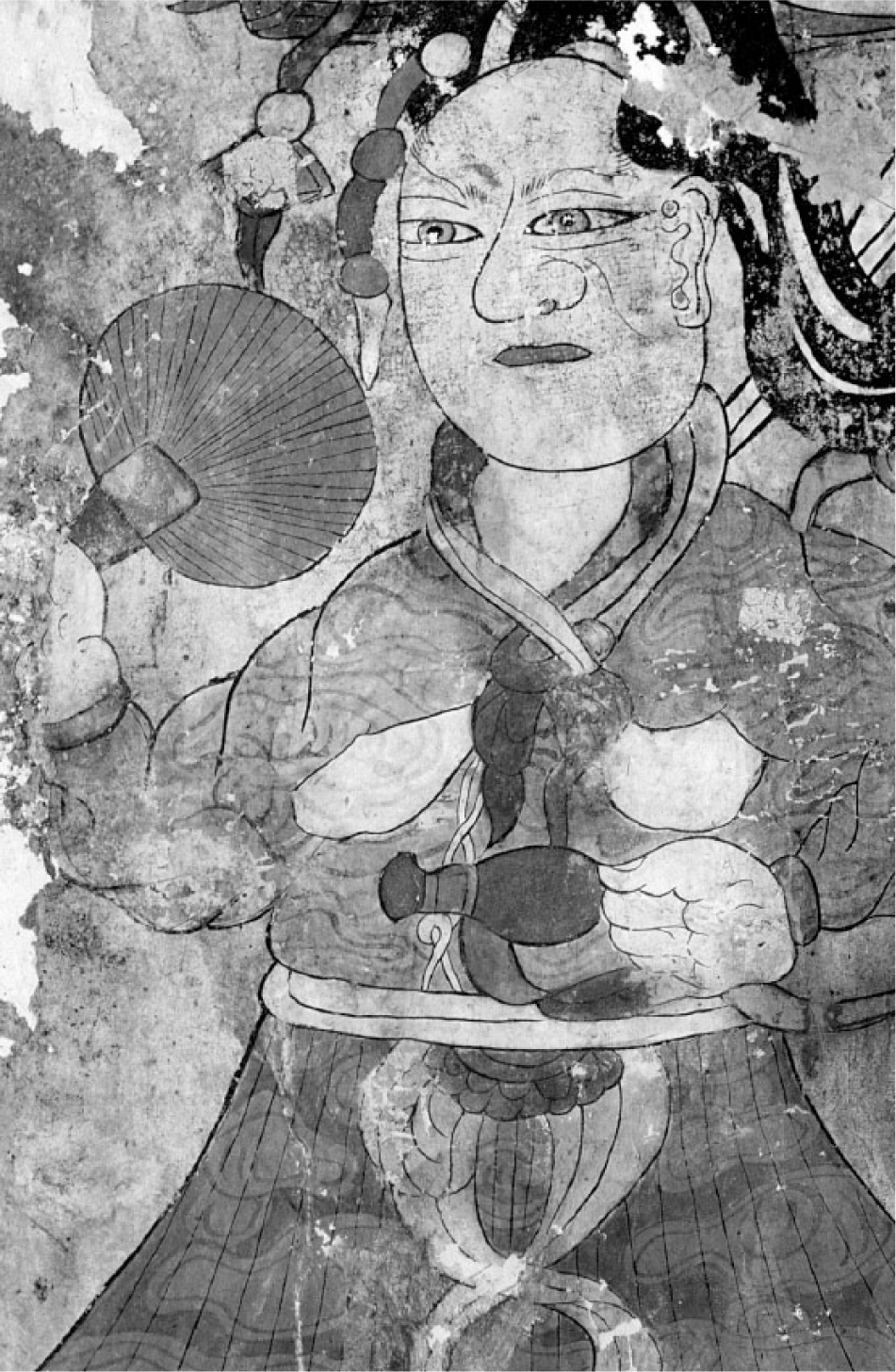
Shaman painting from Cheju Island, Cheju University Museum. Photograph courtesy of Mr Yoon Yul-soo.

Shaman painting from central Korea. Gahoe Museum collection. Courtesy of Mr Yoon Yul-soo.
But something else is going on with respect to a Korean goddess who bears a Picasso face. The collectors whose observations opened this discussion, keenly cognizant of modern art, recognize that their own ancestors, long before Picasso, were masters of the form. In this they are not unique: Northwest Coast artists claim similar satisfaction (see Clifford, 1988: 189–214), but with reference to a discourse not of their own making. By contrast, the primary collectors and commentators on Korean shaman paintings are themselves Korean; the shaman painting is a ‘Korean thing’ both before and after its naming as art. Unlike the African statues that have provoked so much commentary, it is not ‘neutralized’ as a part of ‘Western cultural history’ (Torgovnick, 1990: 122, emphasis added), although a kind of neutralization is most certainly intended. It eludes the dichotomization of Us/Other, the West and the rest, that has heretofore organized discussions of the circulation of different kinds of local goods, some of them sacred, and their appropriation by global markets as antiquities and ethnic art (Appadurai, 1986; Causey, 2003; Errington, 1998; Forshee, 2001; Kendall et al., 2013; Levi, 1992; Marcus and Myers, 1995; Myers, 2001; Phillips and Steiner, 1999; Schildkrout and Keim, 1998; Steiner, 1994; Taylor, 1994).
The paintings that once hung in Korean shaman shrines become another kind of thing when desired by South Korean collectors, but the transformation takes place inside South Korean history. It occurs in a place where shamans, dealers, and collectors inhabit coeval space, speak a common language, and sometimes interact with each other. We are concerned here with both thickening and broadening the discussion of art market circulation, thickening by showing how, within a particular history in a particular place some distance from Paris or New York, once sacred things came to be revalued as ‘art’. We broaden by setting our discussion among collectors and dealers in South Korea and thus outside the familiar dichotomy of the West and the rest that has heretofore organized discussions of the commodification of once-sacred goods. A seemingly familiar story about art markets and the social life of things now unfolds within the unfamiliar context of an alternative or Other modernity (Appadurai, 1996; Gaonkar, 2001; Rofel, 1999).
As we will show, the object biographies of Korean shaman paintings within a South Korean setting may differ from but are no less transformational than the object biographies that attend the journeys of other things into global art markets and distant museums (Kopytoff, 1986). Through such processes, art-naming can be understood as a ‘purification’ in Bruno Latour’s (1993[1991]) sense, a translation and transformation of old practices in ways that are recognized as ‘modern’. Latour calls this process the ‘Great Divide’, the intellectual operation whereby the moderns separate ‘natural mechanisms from human passions, interests, or ignorance’ (p. 35). Latour’s moderns regard things as fundamentally constituted by their material properties and mechanical operations, although they may also recognize them as ‘receptacles for human categories’ (p. 52). This is a self-conscious operation whereby the moderns distinguish themselves from ‘cultures’ that have not so emphatically set themselves apart from the natural world (p. 97). ‘Art’, we suggest, functions as one such category held by various ‘receptacles’, including shaman paintings. A modernist point of view also recognizes that a shaman painting once functioned as the ‘imagined’ container of a god. But Latour also posits a contradictory process within modernity, a work of translation or mediation (the sacred object becomes a work of art) that produces mixtures or hybrids (the prior identity of the painting leaves a trace, sometimes a frisson), insuring that purifications are seldom complete and modern identities far from absolute (Wiener, 2003: 140; see also Hill, 2007; Keane, 2006; Pels, 1998).
After a brief introduction to Korean shamans and the relationship of painted images to their practice, the first part of our discussion focuses on why and how shaman paintings came to be desired; the second describes the paths through which market desires intersected with the normative lives of painted images in shaman shrines. The first describes collectors, why they value shaman paintings, how they reconstruct the history of collecting, and how they embed this history in a larger South Korean story about the recent past. In the second part of our discussion, we flip the mirror and describe how shaman paintings have been understood by the shamans who install them in their shrines and transmit, inherit, conceal, or destroy them. Here, we follow Alfred Gell’s (1998: 17–18) suggestion that anthropologists study relationships between people and objects just as we might study other kinds of relationships; shamans’ protocols for dealing with the painted images of gods are closely linked to the terms of relationship that exist between a shaman and the gods she 2 serves. As in some other instances (Kendall et al., 2013; Küchler, 1997), we describe protocols of relationships that govern the proper disposal of once-sacred things and sometimes abet their being relinquished to new commodity markets. In a final discussion, bringing these two threads together, we use Peter Pels’ (2003) characterization of the animated object versus the fetish to underscore both the degree to which the shaman painting becomes a different kind of thing and, following Latour (1993[1991]), why its transformation into a neutralized art object is to some degree incomplete.
We have both conducted research among Korean shamans for more than three decades, but this is the first time that we have worked together. This study draws on our different fieldwork experiences over the long span, and from focused interviews on the subject of shaman paintings among shamans, collectors, and dealers in 2008, 2009, and 2010.
Painted gods and costumed shamans
On entering a shaman’s shrine, the visitor almost immediately encounters the bright portraits of deities affixed to the walls above her altar. The gods who empower shamans appear in the imagery of kings, queens, courtiers, warriors, Buddhas (see Figure 3), and ancestral shamans both in the paintings and in the costumed shaman herself when she manifests them during kut, her major ritual. Divine images (musindo, muhwa, t’aenghwa) and the shamans performing kut are brightly colored in a place where color marks, or once marked, an extraordinary condition (see Taussig, 2009). In dynastic times, primary colors were worn by king, court, and military ranks; by brides and grooms on their wedding day (mimicking official dress); by children on their first birthdays and holidays; and by shamans performing kut. Most of the rest of the population wore white or muted colors most of the time. In shaman paintings, color combines with bold – to some eyes crude – representations of human forms with disproportionately large faces and large, staring eyes. In a culture where eye contact is usually oblique, the gaze of a painted god, or of a shaman manifesting an imperious deity, can be unsettling. The shaman manifesting a deity during kut and the painted images staring down in the shrine do not ‘represent’ so much as indicate a presence (see Orsi, 2005: 55). In Alfred Gell’s terms, they are ‘co-present others (gods) in idol-form’ (Gell, 1998: 128). ‘We sense their power’, a university professor stated when we discussed the reluctance of many Koreans to hang shamans’ paintings in their own homes.

Frequently reproduced image of the ‘Three Buddhas’. American Museum of Natural History, 70.3/6719.
As in many other shamanic traditions, a Korean shaman (mudang, mansin, posal) is chosen by the gods (sin, sillyŏng) who afflict her with illness, madness, or misfortune until she agrees to accept her destiny and serve them. A successful shaman enjoys a relationship of mutual compatibility (habwi) with her own gods. The gods give the shaman inspiration (myŏnggi), enabling her to manifest their presence guided by visions, intuitions, and bodily signs, and to do their work: to divine, create auspiciousness and harmony for her clients, and cast misfortune from her clients’ path. For her part, the shaman must interpret the gods’ will, putting correct words to their intentions when she manifests them in kut. The painting, as a tangible site for the transmission of inspiration (from the gods) and devotion (from the shaman), is the primary material manifestation of the bond between a shaman and the gods she serves. Here, she makes daily offerings of pure water, lights candles, and burns incense and here she makes her petitions.
With the help of senior shamans, an initiate identifies a personal pantheon whose presences she has glimpsed in dreams and visions or proclaimed through her own inspired speech. In the Seoul region, the gods enter and activate paintings during the shaman’s initiation ritual. In the tradition of Hwanghae Province, a novice only installs the written names of her empowering gods, waiting until she is judged to be sufficiently experienced before installing the painted gods. 3 The gods of an individual shaman’s pantheon are a more or less basic set of recognizable god types, but – as in Chinese popular religion, where a virtuous official might be ‘appointed’ to serve as the city god of a particular place – the role of a particular god or goddess can be filled by a more intimate ancestral personage, someone from the shaman’s own near or genealogically distant family or from a lineage of shamanic teachers and disciples. Thus, although the images are fairly standard, each pantheon has a distinctive and often fluid character that might include such figures as siblings or children who died of smallpox or measles, shaman teachers or ancestors who become personal guardians, pious grandmothers who worshipped Buddha or made obeisance to the Seven Stars, and lineage ancestors who were high officials (Kendall, 1985, 1988; Walraven, 2009). In the pantheon of the shaman Yongsu’s Mother, Laurel Kendall has seen a distant shaman ancestress replaced by the family grandmother that the anthropologist knew in life. In the tradition of Hwanghae Province, as described by Boudewijn Walraven (2009) and also encountered by Jongsung Yang in his fieldwork, deities include a large number of ancestral spirits or sŏngsu, some who were the shaman’s teachers and senior colleagues in life or who were their teachers’ teachers, and some who were family ancestors. Shamans as well as a painter in this tradition recounted a critical interaction where the shaman describes either the remembered sŏngsu or a dream vision and the painter tries to capture it in his own mind’s eye. Two proprietors of shaman supply shops, primarily serving shamans in the Seoul tradition, described how a responsible proprietor carefully matches the client’s vision to options contained in a book of prototypes – was the Mountain God accompanied by a white or a yellow tiger? Was the General’s arm raised or lowered? An inappropriate painting or paintings, whose installations are followed by misfortune, go back to the shop (Petersen, 2008: 235). Some shamans claim that some other shamans operate a bogus practice with empty, uninhabited paintings in their shrines, either because the shaman was not sufficiently inspired to know the difference or because offended deities had departed on their own initiative.
Becoming art
As with the enthusiasms of early 20th-century collectors of ‘primitive art’, there is nothing inevitable in the passion that some South Korean collectors have invested in shaman paintings. Canonical presentations of Korean art include Buddhist sculpture and painting, celadon ceramics, blue and white porcelain, and ink paintings in muted colors that attest to the artist’s refined brushwork and elegant sense of style. Visitors find the sum of this inventory in the National Museum of Korea and in most Korean art galleries in foreign museums, places where they are not likely to find shaman paintings. Shamanic paraphernalia, including paintings, have been collected in Korea since the colonial period but as artifacts of folk belief (minsok sinang) (Akamatsu and Akiba, 1991[1938]). They were not collected as art until the late 20th century and they are by no means universally appreciated as art today. The National Museum of Korea does not display them in its exhibits of fine art and antiquities, regarding this work as the proper domain of the National Folk Museum. 4 At the time of writing, no shaman painting has yet been designated a national treasure (munhwaje) 5 and no living painter has yet been designated as a national ‘heritage bearer’ (poyuja), an honor bestowed on practitioners of several genres of traditional Korean art, performing art, and handicraft (Yang, 2003). It is not difficult to find a South Korean scholar of Korean art who considers these images ‘really awful paintings’. Even so, the market for shaman paintings has developed in ways unimaginable a few decades ago, with major collections, exhibitions, and several lavishly illustrated catalogues (e.g. Hong and Pak, 2008; Kangnŭngsi Ojukhŏn Sirip Pangmulgwan [KOSP], 2004). When the National Folk Museum of Korea recently enhanced its holdings in shaman paintings, artistic merit informed curatorial selections as much as did the paintings’ ethnographic or religious significance. The curatorial team dealt primarily not with individual shamans and rural communities – the most likely sources in the past – but with art dealers, private collectors, and, in one instance, with a shaman who was herself a collector. They found that the best old paintings had long since passed into private hands, and when paintings returned to the market it was with very high price tags. In 2008, Jongsung Yang was quoted 2,500,000 wŏn (approximately US$2,500) for an 80-year-old painting. During our research, 1,000,000 wŏn was the common price for an undistinguished painting, and some of the paintings on the market were fakes, produced according to older prototypes for the antique market.
The apotheosis of the goddess with the Picasso face as Korean art required a perceptual leap on the order of Picasso’s epiphany. In this instance, it was fueled not by the Western collector’s ‘imagined nostalgia’ for distant and much-fantasized places (Appadurai, 1996: 77) projected onto so-called primitive art (Errington, 1998; Price, 1989; Torgovnick, 1990) but a more intimate South Korean nostalgia for the recent past. If, for Picasso and his cohorts, African sculpture appeared exotic and strange, empowered by a sense of mystery, Korean shaman paintings are unsettling in their near familiarity, an association with the ambivalently regarded power of the shaman shrine. The paintings’ journey assumes not only a recalibration of attraction and taste on the part of South Korean collectors and dealers, but also a re-valuation of the mudang who used them in their own practice. It also assumes trajectories of sourcing and logics of use and disposal that removed painted images from shrine walls and into peddlers’ packs, dealers’ stock, or museums and private collections in a particular historic moment.
Shaman paintings began to appear on the South Korean art and antiquities market in the late 1960s and 1970s, but in the normal course of shamanic practice an old and tattered painting would have been de-animated and burnt as a ritually respectful means of disposal and a termination of any potentially dangerous forces associated with it. Very old paintings are thus vested with an aura of rarity (Yoon, 1994). Yoon Yul-soo, an enthusiastic collector and director of a private folk art museum describes how, as an impecunious student and an early collector of shaman paintings, he had made the acquaintance of a shaman on Kanghwa Island, near Seoul, and hoped one day to be able to buy the beautiful old paintings in her shrine. On a final visit, determined at last to purchase the paintings, he arrived to discover that the shaman had recently died and that the new owner of her house had cleared out her shrine only a few days previously, and burned the old paintings. Yoon tells this story with palpable pain (personal communication, 28 October 2010).
Some collectors and dealers, both Korean and Western, remember a ‘runner’ active in the 1970s who seemed to have connections to the shaman world because he was often well supplied with shaman paintings among his other stock.
6
In 1977, Laurel Kendall bought a painting from this same runner who would hawk folk art to the embassy compounds and the Fulbright House. Western interest may have lubricated the market in shaman paintings at a time when South Koreans were still reluctant to bring them into their homes and may have saved some old paintings from the flames, but it was Korean scholars, curators, and collectors who would create a specific discourse about them, causing shaman paintings to stand out as a distinctive and valued Korean thing. According to Yoon:
In the past they thought the paintings had something inauspicious (t’ari)
7
attached to them or that they were garish (kangnyŏlhada). These days, not just museums, but also artists collect. They have an eye (nuni itta) and within the past five or ten years the price has gone way up. (personal communication, 10 October 2008)
The Korean eye
What does this informed Korean ‘eye’ see when it gazes at a shaman painting? Here are some of the things we have heard: ‘Intellectuals feel intimate and close to [the paintings]. Even if they think what the shamans do is superstition, they see this as tradition, as something the ancestors valued’; ‘They are something that comes right from the center of people’s lives.’ Collectors describe their sense of these paintings as conveying a simple, naïve honesty – how country folk, or Koreans in general, behaved in the past when they were less worldly and more pure-hearted (sunsuhada). The paintings are simple, honest, naïve (sunbakhada). One collector described how early in the new millennium he saw an old painting in an antique shop with an unpainted face and large eyes. Its foolish, simple-minded look (pabosŭrŏpta), evoking people from another time, caught his attention and compelled him to buy it even though he could barely afford it. The naivety of the painted form is a doubling of ‘authenticity’ in both its rustic simplicity and in the possibility that the painter was a visionary, drawing from the mind’s eye rather than reproducing an outlined pattern (pon). Such works are now considered very precious since, for the last 40 years, most shaman paintings have been produced by commercial art studios. In these workshops, artists with no necessary connection to the shaman world, and heedless of the taboos and purifications that once attended production, 8 produce paintings according to established prototypes, sometimes allocating tasks in assembly-line fashion (Petersen, 2008: 232–233; Yoon, 1994: 22; Yoon Yul-soo, personal communication, 3 February 2014) and for at least this same span, shamans who could not afford real paintings have affixed cheap colored prints to the walls of their shrines. During Laurel Kendall’s 1970s fieldwork, shrines in villages outside of Seoul commonly had these commercial prints on the wall and this in no way diminished the shamans’ and clients’ sense of power resident in the shrine. In the new millennium, most shaman supply shops (manmulsang) commission paintings from Chinese nationals living in the Korean Autonomous Region of the People’s Republic of China (PRC) who can underprice South Korean painters. Acknowledging the skill manifest in these works, collectors claim that they find them ‘less interesting’ than idiosyncratic god pictures drawn by a naïve-seeming hand. Walter Benjamin (1969) would understand.
In an alternative modernity
Discussions with collectors about their own motivations or their speculations about others’ motivations almost inevitably turn on a palpable sense of ‘vanishing’ (see Ivy, 1995, for Japan) that has haunted South Korean intellectual discourse for the last several decades. Collectors mention the devaluing of Korean traditional culture under colonialism, an infatuation with Westernization after liberation, Christian opposition to shamanic rites, and massive development projects that transformed South Korea from an impoverished rural place into a technological giant and the world’s 13th largest economy (by GDP). This is a familiar litany commonly evoked with respect to the general denigration of shamanic practices in South Korea. The 20th-century characterization of shamans as purveyors of backward superstition was a modernist perception built upon older biases of class, gender, and propriety. In dynastic times, shamans were one among several professional outcast groups, women who dance in public and in the name of the gods, demand money, food and drink and exhibit a ribald sense of humor (Kendall, 1985, 2009: 1–33; Yang, 2010).
In the 1960s and 1970s, rapid industrialization under conditions of military dictatorship brought most of the South Korean population into an expanding urban core in the space of a few decades. In the 1970s, the New Community Movement targeted ‘superstitious practices’ and attacked village shrines and shamanic rituals as backward-seeming obstacles to development. Urban development projects wreaked havoc upon centuries-old shrines and the traditions enacted through them (Pak, 2001), a process that continues in the new millennium (Kendall, 2009: 177–204; Yang, 2008a, 2008b). Shrine demolitions sometimes removed old and exquisite paintings from contexts of veneration and into the hands of museums or private collectors. The tutelary portrait of King Sejo exhibited in the National Folk Museum of Korea came from a shrine in what is now Seoul’s Map’o ward, acquired by a private collector in exchange for the cost of a ceremony to de-sanctify the shrine before its demolition in 1978 (Yang, 2010). The fine set of paintings that hangs in the Kyonghee University Museum comes from another venerable Seoul shrine – the Wŏnhyoro Pugundang, which also disappeared in the 1970s. A dealer described his successful acquisition of many old paintings when several shaman shrines on Kyerŏng Mountain were demolished to accommodate a ‘new town’ development project. Others spoke of paintings left in desolate shrines where most of the village had gone to town; paintings vulnerable to theft or that might be carried away by a scholar or collector for a token contribution. Some fine old paintings are known to have been stolen (Yang, 2008b: 69). Such retellings link the destruction of sacred sites and the unmooring of old paintings to the South Korean experience of compressed modernity (Abelmann, 2003) – the sudden loss and denigration of a rural past subsequently romanticized as more intrinsically Korean than what replaced it. The displaced painting becomes an artifact not only of past time, but also of the palpable experience of the loss itself.
When a familiar Korean landscape and known material culture seemed to be melting into air, South Korean folklorists mounted a resistance to the destruction and denigration of Korean traditional culture – a campaign that resulted in the creation of South Korea’s system of Intangible Heritage recognition and preservation, a primary model for UNESCO’s World Heritage designations (Kendall, 2009: 1–33; Yang, 1994). In particular, the work of Yim Suk-jay, Lee Du-hyun, Chang Chu-gun, Choe Kil-sŏng, and Kim T’ae-gon called for an appreciation of Korea’s shamanic traditions as a source of indigenous Korean spirituality and performing arts. In tandem with the scholars’ activities, new and attractively illustrated journals were inculcating a visual sense of distinctively Korean things that could be broadly recognized and appreciated. 9 As a part of this 1970s moment, and of direct relevance to our story, the architect and passionate collector Cho Cha-yong (Zozayong, Cho Cha-ryong) encouraged Koreans to discern a distinctive Korean spirit in humbly whimsical paintings of tigers and magpies, to regard what had theretofore been seen as merely decorative, if not crude, as an innately Korean genre of ‘folk painting’ (minhwa) (Cho, 1971, 1972, 1974). 10 Like the work of once disdained French expressionist painters, these images would, in the fullness of time, appear on t-shirts, coffee mugs, and drink coasters. Cho called his signature tiger ‘the Picasso tiger’ (Carl and Jennifer Strom, personal communication, 16 October 2010). 11 Although Cho himself did not actively collect shaman paintings until the end of his career, several collectors cited his personal enthusiasm for the shaman tradition as a significant influence in turning their attention to folk forms.
The critical scaffolding was in place: a growing revaluation of shamans as a part of a Korean national story – first among scholars and intellectuals, and by the 1980s among larger segments of the population – and a visual appreciation of humble indigenous Korean folk forms of painting as distinct from elite productions of landscapes and calligraphy on a Chinese model. In the 1970s, the new Onyang Folk Museum gathered what may have been one of the first aesthetically conscious collections of Korean paintings, choosing not only what scholarly advisors recognized as a representative range of deities – the paintings as artifacts of folk belief – but also paintings that ‘looked good to them’ (choahage poinda), that ‘caught the eye’ (nunettŭinŭngŏt). In the early days, only a few Korean collectors sought shaman paintings and folk art, and the dealers brought them out from ‘under the floor’ (maru mit), an idiomatic expression for goods not sufficiently valued to be displayed at the front of the shop. In the 1980s, a major collecting project for the short-lived Kŏndŭlpau Museum in Taegu mobilized dealers and runners, and consequently brought more attention and inevitably higher prices to shaman paintings. One of the dealers who contributed to this project described his patron as motivated by concerns that the best shaman paintings were being snapped up by foreigners who frequented the antique shops around the US Army base in Taegu, investing his collecting efforts with a patriotic purpose.
In the 1980s, the dissident popular culture movement would build on this intellectual foundation – using shaman rituals in protest theater and broadly popularizing the Korean shaman tradition as an innate and powerful Korean thing. Explicit use of shamanic motifs in the festivities surrounding the 1988 Seoul Olympics made the association of Korean shamans and Korean culture commonsensical (Tangherlini, 1998). Folklorist Kim T’aegon, who had assembled a significant collection of shaman paintings during his fieldwork with shamans in the 1960s and 1970s, devoted a monograph to them in the late 1980s. Kim’s Han’gugŭi Musindo (Korean Shaman Paintings) (1989) followed by Yoon Yul-soo’s Kŭrimŭro ponŭn Han’gugŭi Musindo (Korean Shaman Paintings Seen as Paintings) (1994) introduced shaman paintings as objects of serious consideration in their own right. Yoon, who had worked for many years with Cho Cha-yong, had initially been a student of Buddhist painting but was encouraged by his mentor to appreciate folk painting, ultimately recognizing that neither Korean Buddhist paintings, nor folk paintings, nor shaman paintings could be understood independently of each other. Kim’s and Yoon’s volumes became dealers’ and collectors’ guides, and, as is true of such projects all over the world, both inflated the market price of old paintings and provided inadvertent prototypes for forgers.
Collecting seems to have peaked in the 1990s after the 1988 Seoul Olympics boosted both national pride and a related enthusiasm for folk forms, and when a still healthy economy provided the wherewithal for purchases. Shaman paintings circulated at reasonable prices and some collectors assembled collections in multiples of a hundred paintings, which were subsequently exhibited and published in catalogues (e.g. Hong and Pak, 2008; KOSP, 2004). The market changed again at the end of the 1990s when the Asian financial crisis undermined collecting and original sources of good, old paintings were generally assumed to have dried up. Dealers claim that many years have passed since runners from the countryside would appear bearing bundles of old shaman paintings – people whom they have not seen for years and assume to be long dead. Those shamans and shrine-keepers who do hold desirable paintings are aware of the value of what they have, perceptions underscored by their being courted by scholars, collectors, and museum curators; and the current market is defined by up-market re-sales from earlier collections. All of this contributes to the sense of rarity and value that surrounds good paintings while in collector talk, ‘commodification’ (sangp’umhwa) becomes a dyspeptic commentary on the present moment and the loss of an authentic rural Korean self as embodied in the naïve-style renderings of deities in shaman paintings and their evocation of a lost rural Korea. This is something of an elision since shamanic practices are alive and well in contemporary South Korea, in cities as well as the countryside, and access to this world permits an understanding of how shaman paintings became available to the market in the first instance.
The social lives of shaman paintings
Paintings are taken down from the shrine when they are old and tattered and need to be replaced with fresh images or when retiring shamans bestow their gods on successor shamans who install the paintings in their own shrines. Before the painting can be removed, the animating deity is petitioned to ‘Please rise up from this seat’ and vacate the painting so that it can either be burned and replaced or transmitted to a successor. Ideally, an aging shaman marks the end of her practice with a major ritual (hajik kut) where she feasts and entertains her guardian gods for one last time and sends them off. Speaking through the mouth of the shaman, the gods indicate their desire to accompany one or another of her successor spirit daughters (sinttal) and spirit sons (sinadŭl), the shamans she has either initiated or mentored. The world of master shamans and their disciples is a volatile and competitive place and within the micro-politics of a senior shaman’s practice, the outcome of such a ritual can be politically charged. In the words of one cynical male shaman, ‘the gods’ words are the shamans’ words.’ Appadurai (1986: 21) might describe these activities as ‘tournaments of value’, particularly among Hwanghae shamans whose bundles of paintings become a material measure of growing spiritual power.
Some shamans, because they lack disciples or because they have ruptured relationships with former disciples, end their practice by burying their paintings and other paraphernalia in a secret mountain site analogous to a mountain grave (see Figure 4). A potential shaman – tormented by the gods and driven to half-crazed wandering – can sometimes be drawn by mysterious but irresistible forces to the buried material, compulsively digging until she excavates the cache as one more sign of her calling. In these instances, the gods who have chosen her operate through the borrowed agency of paintings and other paraphernalia that she will subsequently use to serve them. Shamans associate these miraculous discoveries with a more enchanted past time, but cite rare recent instances. A potential shaman – a stranger caught in crazed wandering – might find herself drawn into a shrine where her manic prostrations in front of the altar testify that the moment of transition has arrived, as was described to us for a shrine on Kanghwa Island near Seoul. Or an initiate, drawn by unseen forces, stands in front of a seemingly blank wall, urgently shaking her bells in front of the paintings hidden under a layer of wallpaper. A painter of divine images described this as something he had seen with his own eyes.
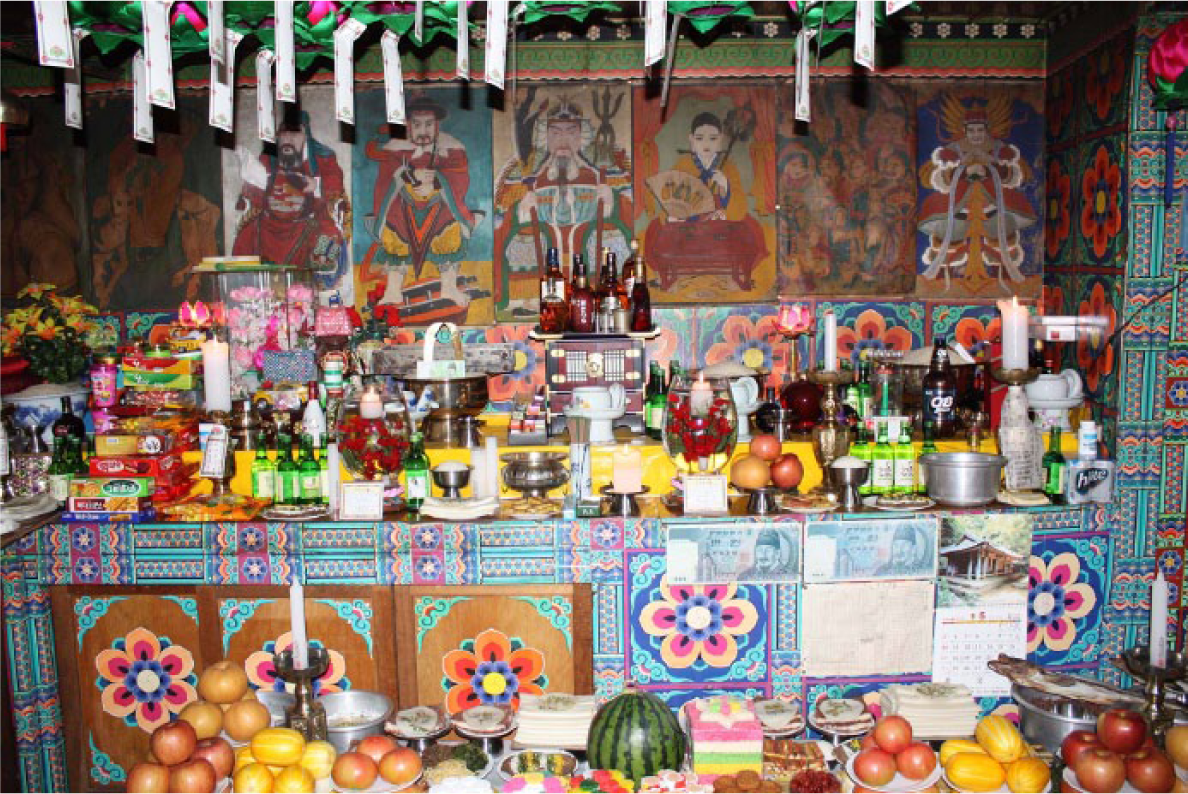
Paintings hanging in a shaman’s shrine . This shrine was taken down and the paintings buried when the shaman retired her practice in Fall 2013. © Photograph by Homer Williams.
These tales, even the most fantastic, are tales of normative transmission: the gods require shamans in order to be manifest in the world; they choose their shamans and sometimes use the tangible vehicle of paintings and paraphernalia either to mark their relocation in a successor shaman’s shrine or to draw a successor shaman into an established shrine. But ruptures are also common – not all shamans make adequate provisions for their own deaths and not all gods are comfortably accommodated in shrines already inhabited by the successor shaman’s own gods. In these circumstances, paintings, like unsettled gods, acquire a liminal and consequently problematic status.
The sudden death of a shaman or the death of a shaman so attached to her practice that she neither passed on her paintings and paraphernalia nor buried them creates a problematic situation. All of the material in the dead shaman’s shrine – her costumes, musical instruments, offering bowls, and particularly her paintings – is charged with the agency of untended and potentially restless gods. Family members are reluctant to touch, much less dispose of it. In shamans’ and dealers’ retellings of hypothetical cases, the children might be Christians who are not only ignorant of the care and feeding of gods but regard the paraphernalia as the instruments of Satan. Dealers described the rag and bone men, social marginals who, for a fee, could be prevailed upon to take these things away. Proprietors of shaman supply shops (manmulsang) described a special service that they could arrange when shamans died leaving still active shrines behind – the hiring of an ‘evacuation squad’ (ch’ŏlgŏban) to remove these potentially dangerous objects. 12 Shamans also mentioned that the shops would do this for a fee. Conversations with collectors suggest that it was through such paths, as ritually unclean discards, dangerous matter out of place (as per Douglas, 1966), that old shaman paintings first became items of commerce with other flotsam in flea markets where they caught the eye of discerning collectors looking for distinctive and inexpensive Korean things that seemed to be fast disappearing. With clear signs of a market in old paintings, ‘evacuated’ material found its way to the runners’ packs.
In some instances, shrines also hold inactive paintings. Even when all signs indicate that a shaman’s gods will follow her successor, divine politics can be problematic. Laurel Kendall first heard of the following incident in 1983, a tale vividly recounted in 2009. Chatterbox Mansin 13 retired from shamanship in an unsuccessful attempt to live with her married son who was embarrassed by her profession. She gave her paintings to her sister, Yongsu’s Mother, who was also a shaman. The two women had sharp tongues and strong personalities and so, too, did the different gods they served. Chatterbox claimed that in a dream, her deities had told her to ‘tie us up so that we won’t become separated’, and so she bundled them together, brought them to Yongsu’s Mother’s house and set them on the altar. Yongsu’s Mother had likewise dreamt that she saw her sister’s deities entering her shrine and agreed to install the paintings in her own shrine with appropriate ceremony, persuaded by her sister that ‘they have nowhere else to go’. She told Chatterbox that if any misfortune happened within three months, she would remove the paintings and throw them away. To accommodate all of the new images in the narrow space of her shrine room, Yongsu’s Mother placed Chatterbox’s paintings under her own gods’ pictures and waited. Business was bad, Yongsu’s Mother became ill, and then she twisted her ankle. Instead of receiving a clear flow of inspiration from her gods, it seemed to her as if the gods were grumbling, as if the compatibility she usually enjoyed with them was out of joint.
She had unsettling dreams, which for Yongsu’s Mother were a sign of divine displeasure. In one vivid dream, three women came to her shrine for a divination. The shaman brought out her divination tray covered with rice and coins. One of the women sat to have her fortune told while the other women stood off to the side to watch. Their insistence on standing made Yongsu’s Mother uncomfortable and she repeatedly invited them to sit down, but they refused. Yongsu’s Mother began to divine, tossing coins, scattering rice grains on the slick surface of the tray, and seeking visions in the resulting configurations when one of the women grabbed the divination rice and scattered it on the floor of the shrine. This was sacred rice, her guardian Great Spirit Grandmother’s rice, and Yongsu’s Mother awoke feeling a deep sorrow on the god’s behalf. When Yongsu’s Mother looked into the shrine, she saw that several of the pictures had fallen to the floor; ‘they had been fighting with each other’. The image of her own Great Spirit Grandmother was stuck to the portrait of the Jade Fairy, Chatterbox’s guardian god. This was probably the woman in the dream; the Jade Fairy had scattered the Great Spirit Grandmother’s rice. There was no compatibility between the shaman, her own gods, and these new gods; they would not help her in her work and she would not serve them. Yongsu’s Mother took down the images of Chatterbox’s gods, rolled them up, and stored them under her altar. She makes no offerings to them because she is not bonded to them; ‘they live like beggars’, she said with a chuckle. Similar images, rolled up and stored away, could become candidates for collecting, but not Chatterbox’s, which were inexpensive 1970s poster prints.
In all of these accounts, agency is abducted to gods who are asked to enter and leave paintings, who decide whether or not to cohabit with other gods, or who operate through paintings and paraphernalia to pull a prospective shaman into their service. Divine agency is also at work where dealers and collectors have negotiated with shamans over the purchase of old paintings from their shrines, as in the following dealer reminiscence.
Borderland encounter
As a bridge between the world of shamans, shrines, and gods and that of collectors and dealers let us describe the activities of Mr K, a dealer, and Professor P, a scholar, who worked together in the 1980s on a commission to secure a large collection of shaman paintings for a new private museum. They went to shops in provincial cities, put out the word to runners, and, like some of the other dealers and collectors interviewed for this study, they also cultivated relationships with shamans, hoping to acquire old paintings.
It was because we were making a museum; we asked them if they couldn’t compromise a bit … They would tell us they had to replace the paintings …When we thought they would concede we would offer some money. ‘How much?’ We would bargain a little …
We had to go through formalities. We set down money and made prostrations [he pantomimes payment not in the form of a payment being handed over, but as a cash offering on a low offering tray, makes a bow, and chuckles at the memory] …
But didn’t they think the paintings would carry something inauspicious (t’ari) if they were removed?
That was why they always set down offerings and petitioned with utmost sincerity. They couldn’t just give them away [without the gods’ consent] … they had to do some sort of ritual … so that nothing bad would happen when the painting went out from the shrine […] We did this work 30 years ago. There wasn’t anyone then who would just give their paintings to us. They would tell us we had to do something first or we couldn’t bring it off. We couldn’t just take them. They would set down our money and kowtow, and tell us to kowtow, and then they would wave their five-colored divination flags. If you pulled out a red one from the bundle of flags they would say ‘Well done! That’s good.’
And if you pulled an [inauspicious] yellow flag?
Well then it was just our tough luck! Isn’t this good data we’re giving you?
Although Mr K speaks of ‘bargaining’, the paintings’ commodity status is blurred by the far from straightforward transaction he describes – offerings and supplications are made, the gods give their consent, or possibly not (‘just our tough luck’). The shaman, the god, and the dealer are all present in the initial transaction over the painting. In a similarly hybrid, similarly tripartite encounter, one collector mentioned contacts in the shaman world who, knowing his interests, invited him to remove old paintings and equipment from the shrines of dead shamans. He did this after chanting a Buddhist sutra to release the gods and goddesses from the grief and resentments that had bound them to the world as active shamanic deities. These encounters occur in a borderland between religious practices and collecting, belief and expedience. The sutra-chanting collector seemed sincere in believing that his chanting would set troubled spirits to rest. The dealers who were made to bow in the shrine were primarily interested in acquiring paintings and one can only speculate as to whether their desires became something more prayerful in the moment of anticipation.
Discussion and conclusion
Peter Pels (1998: 94–95) makes a useful heuristic contrast between the animated object and the fetish (including the commodity fetish); the former are sacred and powerful because something – a god, a spirit, a soul – has been installed inside them, while the fetish intrudes upon human traffic by virtue of its own unusual material properties, an object that causes things to happen in occult ways. In this sense, we might contrast the animated image in the shrine with the collected painting that hangs on the gallery wall as fundamentally different kinds of things. The collected painting stands out by virtue of its material form. It operates as a commodity fetish in Marx’s (1992[1867]) sense, claiming value in a marketplace of shifting tastes and prices; it must be old and executed in an interesting way to be regarded as a valuable painting. In the shrine, by contrast, the animating deity is far more consequential than his temporary seat, possibly a cheap paper print that has absolutely no value in the art market. That the painting as animated object and the painting as commodity fetish both operate, but in very different ways may best be illuminated by revisiting the story of Mr K and Professor P through Alfred Gell’s discussion of object abduction.
Gell offers the radical suggestion that people commonly abduct agency to things, that not just pre-modern ‘animists’, but all of us, tend sometimes to ‘see things [including cars and computers] as initiating causal sequences of a particular type, that is, events caused by acts of mind or will or intention rather than the mere concatenation of physical events’ (Gell, 1998: 13–18). Gell invokes Peirce’s philosophical notion of ‘abduction’, the common mental operation whereby the subject imputes causation without immediate proof (I see smoke, I abduct fire as the cause). In the story told by Mr K and Professor P, the shamans were seeking the compliance of animating gods when they asked the dealers to make an offering, bow, and choose a divination flag. The color of the divination flag was an act of agency abducted by the shamans to the gods themselves; the gods indicated that the painting could be removed from the shrine, that they agreed to leave the painting and inhabit a new one. The painting itself was the most neutral medium in the transaction, but a medium nonetheless, enabling the gods’ presence in the shrine. 14 The dealers, on the other hand, bowed in compliance with the shamans’ instructions because they wanted the painting; in effect, the painting, as an object of desire, caused them to bow, choose flags, and otherwise be compliant with a ritual alien to their own daily practice, in other words, acts of agency abducted to the painting as an object of market desire, a commodity fetish. Agency operates here in different ways contingent upon how the same object might be understood as one or another fundamentally different kind of thing (Hoskins, 2006; Myers, 2001).
The shaman painting, then, is a hybrid form, with, as Webb Keane (2006: 201) has argued, ‘an unpredictable range of latent possibilities’. These unpredictable possibilities abet both the transformability of the painted image and its ultimate instability. From a shamanic worldview, the de-animated painting is a potentiality that could be re-inhabited by a once-resident god, as witnessed in tales of gods who draw prospective shamans to buried or concealed paintings and by the old practice of ending a painting’s career by burning it because it might have something inauspicious or dangerous attached to it or might confuse the god. 15 The painting turned commodity can still sometimes be regarded as a dangerous thing. In 2009, shamans mentioned the untimely deaths of other shamans who had begun to collect old paintings (as paintings). A shaman family that had traded paintings to the market in the past was likewise said to have experienced premature deaths. A shaman who had opened a gallery of paintings and costumes was anxious to sell her collection having discovered that the presence of multiple gods, however ambiguous, was troubling, a source of misfortune. She found their demands burdensome, ‘like serving one’s parents-in-law’. For the collector, purification involves a reinterpretation that makes a nostalgic association with a ritual past. The painting is not a powerful and imposing god but rather the portrait of someone from another time, unworldly, possibly a little bit foolish. The disproportionate faces, large, staring eyes and bold colors that contribute to the unsettling aura of a divine presence in shaman practice are neutralized when they become attributes of a naïve art from long ago. But this is only true to a point. The same bold stylistic qualities used to suggest the presence of powerful gods in shamanic practice cause these paintings to stand out and catch the collector’s eye, enabling Koreans far removed from the shaman world to ‘sense their power’. If this sense of presence were thoroughly neutralized, then the paintings would seem bland and trite, as innocuous as cartoons; they would not stand out on the wall. Traces of the painting’s past life remain for some of those who admire them as art. Some would-be collectors hesitate to hang shaman paintings on their own walls or claim that a wife will not let them bring a painting into the house, and some have wondered if personal misfortunes might somehow be associated with a painting. One collector donated a substantial number of paintings to a museum when they troubled her dreams. She did not give them all away, as she had too much appreciation for them, but she keeps her remaining paintings in a storage location separate from her home. Desirable, but also uncanny, worthy of appreciation but also capable of troubling one’s sleep, or worse, these qualities make an unstable bridge between the painting animated or potentially animated by a god and the old painting regarded as an art object. We arrive at Patricia Spyer’s (1998: 1) ‘deliberately oxymoronic’ characterization of the ‘border fetish’ as subject to ‘the unresolvable oscillations, the restless toing-and-froing, and the cultural, commercial, and political crossings that distinguish fetish formations’ and beyond fetishes to other kinds of once-empowered things. In the case of the Korean shaman paintings, this all takes place in an alternative modernity rather than the space Spyer characterizes as midway between ‘a Eurocentric and an Other dimension’ (p. 3). The ‘categorical boundary’ (Pels, 1998: 112) between animated painting and commodity fetish is here constructed by a self-consciously modern South Korean imaginary that posits shamans as internal Others, as with European peasants (Herzfeld, 1987), discounting their coeval presence even as collectors and dealers engage with living and active shamans in their quests for old paintings.
As a report from an alternative modernity, the social life of Korean shaman paintings breaks the pattern of a binary ‘West and the rest’ in a world that can no longer be accounted for in these terms. This collapse of the binary is already well advanced in other art world developments (Fiskesjö, 2010; Ong, 2012). 16 The journey of Korean shaman paintings that we have described here can be read together with a passing fashion for Mithila paintings among the Indian middle class (Szanton, 2011), or the enthusiasm for folk art in early 20th-century Japan (Brandt, 2007; Moeran, 1997) as examples of diverse ways that collected objects become meaningful within and beyond alternative modernities. It would be similarly useful to explore object biographies and art markets among other expanding middle-class populations both within and beyond Asia. We suggest, following Latour, that even where collectors, dealers and source communities inhabit coeval space and speak a common language, translations from one regime of value to another are both pronounced and to some degree unstable.
Footnotes
Acknowledgements
The authors are grateful to the shamans, painters, curators, collectors, and dealers who agreed to be interviewed for this project. We are grateful to Professor Yoon Yul-soo for sharing his abundant knowledge. Laurel Kendall would particularly like to thank Sungja Kim Sayers for enthusiastic fieldwork assistance, Professor Park Young-kyu for all manner of help, and Sungja Kim Sayers, Sun Yoo, and Soo-jin Yoon for transcribing field interviews. Katherine Skaggs, Division of Anthropology, AMNH, assisted in the preparation of this manuscript. Laurel Kendall’s research in Korea was supported by the Committee on Korean Studies, Northeast Asian Area Council, Association for Asian Studies and the Jane Belo-Tannenbaum Fund of the American Museum of Natural History. We alone are responsible for the shortcomings of this effort.
Notes
Author biographies
Address: Division of Anthropology, American Museum of Natural History, Central Park West at 79th St., New York, NY 10024, U.S.A.
Email:
Address: Museum of Shamanism, 45 Jeongneungno 6 gagil, Seoul 136-856, South Korea.
Email: