



Abstract
This article focuses on the beehive coal briquette in Vietnam. Although apparently an ordinary cooking fuel, the author argues that this briquette is a perfect object for exploring the unfolding and experiences of Đổi mới, the economic and social reform processes launched in 1986. The author takes a biographical approach as she traces the beehive coal briquette from its birth to its rise and demise as a cooking fuel in Vietnam. Along the way, the article explores the diverse interactions and relations between objects, humans and nature, and their unequal outcomes. The example of the beehive coal briquette shows how everyday things not only reflect social change and vice-versa but can also produce change.
Introduction
Beehive coal briquettes (than tổ ong) are omnipresent in Hanoi. They can be observed packed on the back of bicycles that vendors navigate through the dense traffic or burning in the stoves at food stalls and in households where they cook food for hungry urbanites – and, in the process, they add to the distinctive smells, air and colors of contemporary Hanoi. Although apparently just an ordinary household fuel, the beehive coal briquette is also a disputed thing. This became clear to me at the very beginning of my research when I was about to take a picture of three coal briquette stoves in a small alley in Hanoi and an elderly lady gesticulated wildly to stop me from doing so. She explained that she did not want pictures of the stoves to be shown abroad because it would paint a black picture of Vietnam and make the world think that Vietnam is poor, dirty and ugly.
So why focus on an everyday thing that Vietnamese themselves prefer to ignore? As Sidney Mintz (1985: xxvii) wrote in his influential study on sugar, studying such homely, everyday things can help us ‘clarify both how the world changes from what it was to what it may become, and how it manages at the same time to stay in certain regards very much the same’. Such understandings are in particular relevant for contemporary Vietnam. As has been repeated in many studies, one of the remarkable features of contemporary Vietnam is its rapid change and development. Since the introduction of the market-oriented reforms known as Đổi mới in 1986, the country experienced high economic growth and a significant reduction of poverty, along with new levels and practices of consumption, transformations in family life, but also environmental damage and disparities in income (Barbieri and Bélanger, 2009; Drummond and Thomas, 2003; Feuché, 2009; Kokko, 2004; McCargo, 2004; O’Rourke, 2004; World Bank, 2012). In this article, I argue that the beehive coal briquette not only offers an insightful window into these processes of change and (un)sustainable development, but is also part of and, to some extent, shapes the processes. The beehive coal briquette is therefore a perfect object for the analysis of the unfolding and the experiences of Đổi mới.
Object biography
Studies of ‘everyday things’ have been multiplying over the past decades. As a result, we know now that objects have histories, careers, social lives, that they are part of networks linking humans and non-humans, that they symbolize things, structure behavior and embody meanings that may change with time and space, and that they produce effects, act for the people who made and use them, and thus have agency too. Objects, in other words, are many things at the same time.
The question then is how to study all those things? In this article I propose to do so by adopting a biographical approach. The insight that things have ‘social lives’ or ‘biographies’ stems from the work of Appadurai (1986) and Kopytoff (1986). A biography of things can reveal that things have careers whereby the meanings of their use change with time. Following Kopytoff, I adopt a biographical approach to explore the birth, rise and demise of the beehive coal briquette in (particularly northern urban) Vietnam. Yet, whereas Kopytoff focused in particular on processes of commoditization, de-commoditization, re-commoditization and how these affect cultural value of things, I adopt the biographical approach to emphasize how ‘things-in-motion illuminate their human and social context’ (Appadurai, 1986: 5) and at the same time are part of and shape this context. Writing a biography of a thing like the beehive coal briquette involves exploring the social worlds in which it is created and which it creates as it moves through the different phases of fabrication, circulation and consumption. As, amongst others, Bourdieu (1977[1972], 1984[1979]) and Miller (1987, 2005) have shown, things make, mark, connect or disconnect people. Yet, the worlds of the coal briquette not only consist of the people who make, sell and use them, but also of other things. Indeed, we cannot know the coal briquette and its history, without referring to other cooking fuels, to the machines that make them, or the kitchens in which they are used.
This brings me to another question in this biography of the coal briquette, namely what does the thing do? The idea that objects are not simply functional things or passive recipients of meaning, but can also ‘modify a state of affairs by making a difference’ (Latour, 2005: 71) or be ‘the source, the origin, of causal events’ (Gell, 1998: 16), underlies much theorizing on the agency of objects. Extending a notion that is conventionally held to be an exclusive domain of human beings to things reminds us of the entanglement of humans and non-humans and that humans neither have absolute power over nor necessarily control things and their effects (Derks, 2015: 11; see also Bennett, 2009). Coal briquettes are made to do things, namely cooking or heating, but happen to do a lot of other things that are not necessarily intended by its makers and users. Thus, the question I am interested in is how the coal briquette affects as well as is affected by processes of change within Vietnamese society.
The aim of this biography of the beehive coal briquette is therefore not only to describe the origins, career and social worlds of this particular fuel, but also to map the diverse interactions and relations between objects, humans and nature and their unequal outcomes. In trying to tie all these elements together, I draw upon ethnographic, quantitative and other data collected between 2011 and 2013. Motivated by the idea to ‘follow-the-thing’ (Marcus, 1995), I have followed the coal briquette from its source – the coalmines in Quang Ninh – and transportation, to its production and distribution, and to its final consumption and waste product. On the way, I conducted over 100 interviews with coal miners and collectors, shippers, producers, vendors, users, waste collectors and local authorities; I observed informants as they collected coal from mines, made coal briquettes, prayed for profits, went on selling rounds, and cooked food; I engaged informants in pile sorting exercises; and I conducted a quantitative survey on cooking fuel use and cooking practices among 400 households. In addition to these primary data, I also collected textual, online and visual data in the form of expert reports, online news reports, blogs, and photographs. Based on this research, I will now turn to the history, the making and the changing uses of the beehive coal briquette and explore what it reveals about transformations in Vietnam in the Đổi mới era and their unequal outcomes.
The history of the beehive coal briquette
Viewing a black-stained pot simmering on a decrepit coal briquette stove in one of Hanoi’s many small back alleys (see Figure 1), one may easily get the impression that traditional ways of cooking persist in this quickly modernizing city. This impression is, however, misleading not only because many Hanoians use other fuels to cook their food, but also because the beehive coal briquette is a relatively modern fuel in Vietnam. While the use of coal as a fuel – in the form of raw coal rocks or handmade patties – has a longer history in northern Vietnam, the compressed beehive or honeycomb briquettes only came to Vietnam around the launch of the politics of renovation in 1986.
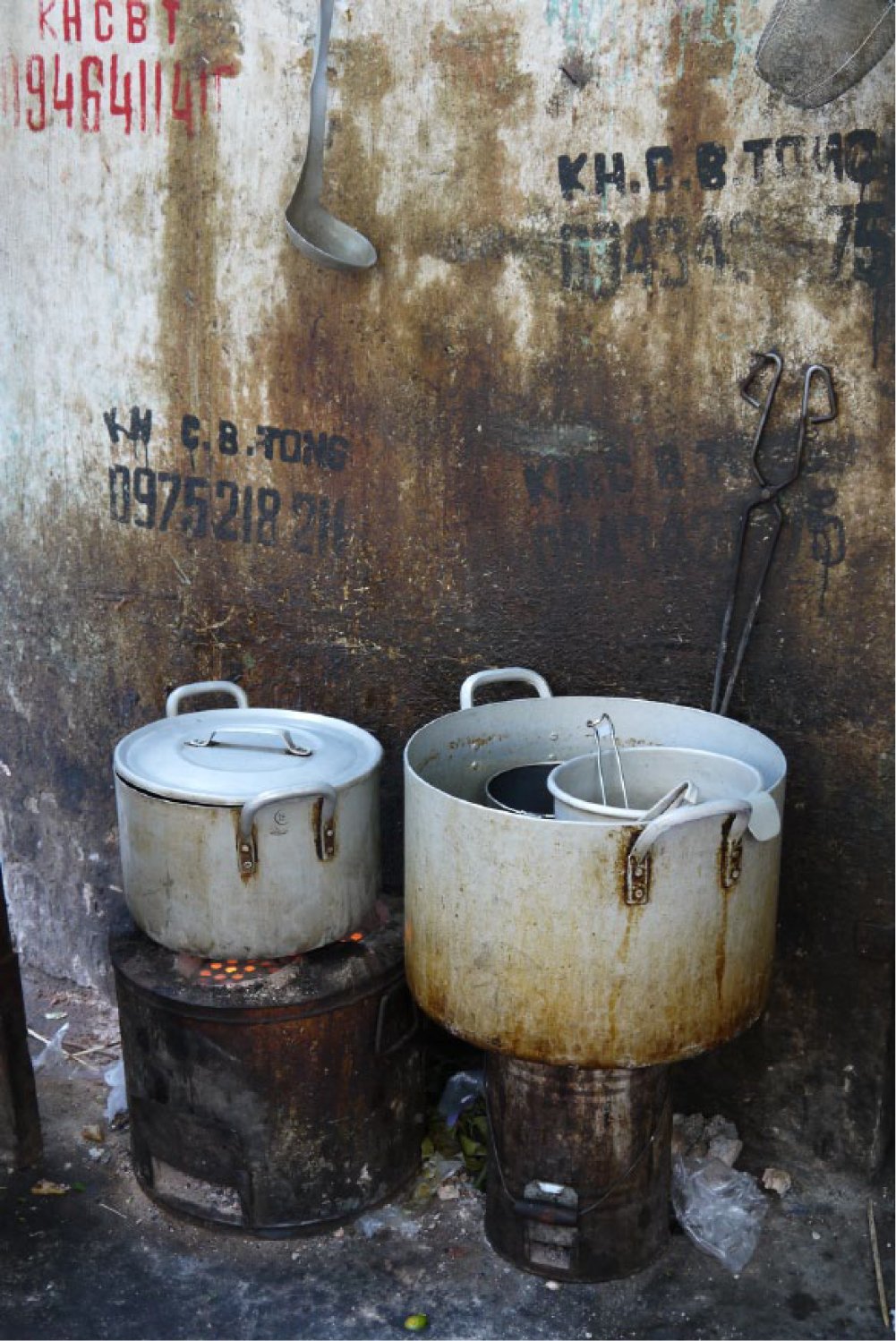
Cooking pots on beehive coal briquette stoves. © Photograph: Annuska Derks.
What is this beehive coal briquette? To begin answering this question, it makes sense to start looking at its materiality. The coal briquette is made of a mixture of coal sludge and dust coal. It is already in this mixture of materials that we can discern some of the associations that make the coal briquette. The coal sludge is a by-product of coal mining and processing, a mixture of coal refuse and water that is left after the washing of coal with water and chemicals prior to being exported. The coal dust is crushed coal of minor quality. The two types of coal (waste) are mixed with some clay soil as a binder and molded under pressure in a cylindrical shape perforated with 19 vertical holes 1 – hence the adjective beehive or honeycomb.
The specific shape of the briquette facilitates a steady and efficient burning process. It originates from late 19th- or early 20th-century Japan where the beehive-shaped coal briquette (ana-aki rentan in Japanese) was designed as a substitute for wood fuel (Kada and Kita, 1957). This specific type of briquette is relatively big and therefore especially useful in situations where the fuel also serves to heat houses. That is also why it became very popular in Korea. While first considered ‘an expensive luxury’, it became widely used for cooking and heating in the second half of the 20th century (Kim and Park, 2012; Lankov, 2007). In a poll held in 1970, Koreans chose the beehive coal briquette, or yeontan, as ‘the most important product of our time’ (Lankov, 2007). Yet, with economic growth, unrelenting accounts of carbon monoxide poisoning and the availability of alternative forms of heating in the form of gas and oil boilers, the use of the yeontan has decreased rapidly since the late 1980s.
The beehive coal briquette has by now almost disappeared as a cooking fuel in Japan and Korea, but is still widely used in China (e.g. Freese, 2003: 226; Zhi et al., 2009). Due to the relatively advanced technology for producing coal briquettes, Chinese machines and equipment have been exported to other countries in the region and beyond (ESMAP, 2001: 50). This is also how the coal briquette came to Vietnam (ESMAP, 1996: 18). Although disagreeing on the exact year and exact routes, producers and experts of the beehive coal briquette all situate the arrival of the coal briquette in Vietnam within the second half of the 1980s. Mr Toan,
2
a producer of coal briquettes, noted that, although the concept originally came from Japan, the technology that is currently used in Vietnam came from China. He remembered that a first Chinese briquetting machine was on show at the industrial machinery fair in 1988. However, Mr Hung, a retired official from a subsidiary of the Vietnam National Coal Corporation (Vinacoal),
3
thought that the beehive briquette and stove must have made their way to Vietnam a bit earlier. In the 1980s there were lots of technicians who went to the former Soviet Union to study mining. That is where they first saw the beehive coal briquette. Upon their return, they started experimenting with the production of the beehive coal briquette. As Mr Hung noted: When the coal briquette was introduced to Vietnam, people did not know if it was made by hand or machine. People looked at the shape of the coal briquette and thought about how to make it … It was maybe not successful during the first, second or third time, but with time it was.
The challenge was not how to make a mold for the typical beehive shape, but how to find the right mix of substances for a coal briquette that is easy to ignite, does not produce a lot of smoke and does not cost much. Due to the low price of coal dust, the beehive coal briquette had the potential to become an attractive cooking fuel for the masses, especially in northern Vietnam where coal resources are abundant, where wood fuel was becoming scarce and where alternatives like gas and kerosene were expensive. As a result, the coal briquette was viewed as a fuel that is ‘convenient and can save money’. Mr Binh, who has been making coal briquettes since the late 1980s, noted: When the coal briquette appeared, people liked it very much because when you cook with the coal briquette, you don’t have to sit next to it to take care of the food, boiled water or fish stew. After the food is well cooked, we can close the door of the coal briquette stove … At that time, the people saw it was a modern way of cooking.
This brief background to the beehive coal briquette illustrates how an everyday object like a cooking fuel moves across borders, how technologies are locally adopted, and how this can lead to new cooking styles. Yet, it is one thing to know where the coal briquette comes from, but it is another thing to understand why this thing came in the first place, why at that particular time – and where it is going now. Stuff, as O’Connor (2011: 3) writes, ‘doesn’t just happen’. The things that make up our material world get made, are marketed, consumed, become popular or are abandoned because of the interplay of complex and interchanging political, economic, ideological, technological, cultural, historical and, I would add, environmental factors and processes (p. xi). By looking at this interplay of different processes, we will be able to understand why and how the beehive coal briquette became popular and is now gradually disappearing as an everyday cooking fuel, as well as being able to recognize the intimate link between the career of the beehive coal briquette and the dynamics of Vietnamese society since Đổi mới.
Why is it that the beehive coal briquette came to Vietnam at a time when it was disappearing in certain other countries in the region? This question brings us back to the mid-1980s when the coal briquette made its entrée in Vietnam. This was a time of (1) rising energy needs, (2) a growing concern with deforestation, and (3) the process of renovation or transition from a centrally planned economy toward a market-oriented economy. Vietnam was counted among one of the poorest countries in the world and still carrying the legacy of a war that had destroyed houses, fields, infrastructure, industry and power plants. The centrally planned subsidized economy based on agricultural collectivization, state enterprises, economic output targets and ration coupons for food, goods and services had failed to bring about economic development and reconstruction. In 1986, the Vietnamese Communist Party officially launched a policy of economic reform and renovation, which also paved the way for the development of the private sector.
As a predominantly agricultural country with low levels of industrialization, Vietnam was at that time a small producer and consumer of energy (England and Kammen, 1993: 139; FAO, 1992: 6). Most of this energy was derived from biomass, which means crop residues and, in particular, wood fuel. Biomass made up around 90 percent of household energy consumption, but also the non-domestic sector, from food processing and pig feed preparation to brick and tile manufacturing, depended for 85 percent on biomass, of which 50 percent was on wood fuel (FAO, 1992: 12, 18).
With this rising demand for energy due to population growth and new impulses for economic development, the heavy reliance on wood fuel became a cause of concern, not only because of its perceived incompatibility with industrialization and modernization, but also because of its negative environmental effects. Fuel wood collection was connected with, and even seen as the prime cause, of deforestation (England and Kammen, 1993; Linde-Rahr, 2003: 217). Vietnam’s forest landscape had indeed changed dramatically, although not merely as a result of fuel wood collection but even more so as a result of war, widespread logging and conversion into agricultural land and other uses as a result of population growth and migration (FAO, 1992: xii; Meyfroidt and Lambin, 2008; World Bank, 2010). Forest cover was at its lowest in the late 1980s and early 1990s, when it covered around 25 percent of the territory (Meyfroidt and Lambin, 2008: 183). To counter this trend, in the early 1990s the government started several large-scale projects to rehabilitate existing forests and reforest ‘bare hills’ (McElwee, 2009; Meyfroidt and Lambin, 2008; World Bank, 2010).
At about the same time, the government started promoting the beehive coal briquette as a substitute cooking fuel. The Vietnamese government saw the promotion of the coal briquette as an important means to combat deforestation while ensuring that households had access to an affordable cooking fuel. It was seen an ideal substitute because it could be completely domestically made. Unlike other substitutes like kerosene or gas that had to be imported, coal was cheap and abundantly available in Quang Ninh province. Moreover, the production of these briquettes was something that the newly arising private sector could get involved in.
The making of the beehive coal briquette
While introduced by the state sector, the success of the beehive coal briquette is related to the rise of the private sector after the introduction of Đổi mới reforms. The state-owned Vietnamese Coal Trading Company (VCTC) started out as the prime motor behind the development and promotion of the coal briquette (ESMAP, 1996: 2). Owned by the leading state-owned coal company Vinacoal, VCTC was set up to trade coal, to carry out coal-related research and process coal for minor industries and household consumers (p. 10). It was the main company in charge of conducting research on the beehive coal briquette and its stove, importing technology for its production, and liaising with international development agencies advising the Vietnamese government on the development of the energy sector in general and household fuels in particular. The VCTC also owned coal briquette production plants. In 1996, there were 31 state-owned factories producing coal briquettes, 27 of which were owned by the VCTC and another 4 factories owned by another subsidiary of Vinacoal, the Domestic Coal Company (p. 13).
The successful promotion of the beehive coal briquette for household use soon attracted an increasing number of private entrepreneurs to engage in the production, transport and retail of coal briquettes. These were mostly small household enterprises. While the individual plant capacities of these private manufacturers were much smaller than those of the state-owned plants, their overall production was estimated to be seven times larger by the mid-1990s (ESMAP, 1996: 14). Several years later, state-owned briquetting plants had stopped their production, leaving the beehive coal briquettes business completely to the private sector.
The reasons why state-owned plants closed down whereas private manufacturing of beehive coal briquettes boomed, according to some producers I met, are indicative of the difference between the state and private sector. It was not the price, but a range of other factors that gave them the competitive advantage. Private manufacturers had been able to build up production and distribution networks that were much better tailored to the needs of customers. They were located closer to consumers, and delivered briquettes at any time of the day by means of bicycle transport, whereas state plants only sold during normal working hours and from their depots (ESMAP, 1996: 12). Moreover, as one producer noted, state-owned plants were not able to produce enough to meet demand. They received coal according to fixed amounts and produced coal briquettes based on a set plan rather than on demand. As a vendor of briquettes, he soon found that he could sell many more briquettes than the state-owned plant he worked for could provide. That is why he decided to start making and selling his own briquettes.
Considering the inflexibility, inefficiency and non-competitiveness of these state enterprises, it is not surprising that the private sector is often seen as the motor behind Vietnam’s rapid development (Feuché, 2009: 271; Murray, 1997). Yet, it is important to realize that the private sector did not develop overnight and neither did it develop independently from the state sector. What was crucial for the private sector in Vietnam was not merely a state policy that formalized the existence of a private-sector economy – which had existed to some extent before. Even more important, Gainsborough (2004: 50–51) argues, was the accumulation of practical experience in areas such as how to run a business, including mobilizing capital through informal networks and learning how to negotiate tricky social relationships. These networks and relationships are all the more important in a context like Vietnam where formal institutions that provide credit and can safeguard the legal enforcement of contracts are lacking and where transactions are mostly carried out on the basis of trust, reputation and social pressure (Beresford, 2008: 234; Heberer, 2003; McMillan and Woodruff, 1999; Steer and Sen, 2010). The making of the beehive coal briquette is a good example of how the development of the private sector in the context of Đổi mới is intimately linked to networks and relationships that build upon people, expertise and materials that can be traced back to the ‘socialist past’ (Schwenkel and Leshkowich, 2012: 397).
This is well illustrated by the case of Ms Thuy, a coal briquette producer on the outskirts of Hanoi. Ms Thuy initially started producing coal briquettes for a state-owned coal briquette production plant, the Công Ty Than Ba. She was not a state-employee but a farmer who worked for the state-owned coal briquette plant in her spare time. The state-owned plant closed down in 1995 because, as Ms Thuy explained, ‘their briquettes did not sell well.’ She bought the coal that was left over at the site and started making and selling coal briquettes herself. Like many other producers, she started out as a small, family enterprise. She used a simple mold to make briquettes by hand. Working together with her husband, she produced about 2000 briquettes per day, which she sold to customers in the neighborhood. It was, as Ms Thuy formulated, a time of hard work and low profits.
By the time I met her in 2012, Ms Thuy had become one of the biggest coal briquette manufacturers in the Hanoi area. She now owns a total of 12 briquetting presses (two of which were for her daughter to set up production sites), two production sites (one on the outskirts of Hanoi and one in Bac Giang). She employs more than 30 workers, has more than 20 vendors selling her briquettes, owns 5 trucks for transporting coal and coal briquettes to northern provinces and keeps her own site for storing coal. To explore this development from a small, informal family enterprise to a formal, licensed coal briquette production company, I began tracing the networks of people, raw materials and machines that make these briquettes.
The first thing to consider in the network is coal. Access to coal was an important precondition for producers to start making briquettes in the first place. This access was facilitated by the liberalization of the coal trade in the early 1990s, which broke up the monopoly of the state-owned coal corporation and made it possible to buy coal from private coal traders. Coal thus had become a tradable commodity, triggering a run on the abundantly available ‘black gold’. In the 1990s, Quang Ninh province, where most coalmines are located, saw a boom in ‘uncontrolled outcrop mining’ and ‘bandit mines’ (Greenfield, 1997). Private producers in the informal sector, among which were also beehive coal briquette producers, often got their coal at lower prices from these (illegal) private mines (than thổ phỉ) or from the illegal sale of coal by mine staff and managers (ESMAP, 1996: 14; Nguyen, 1997: 202).
Mr Dung also used to get his coal from this black market in coal when he started transporting and trading coal in the early 1990s. He used to work for a state company, transporting coal, but the company closed. Since he already had the necessary experience and contacts, most importantly his brother who is a coal trader in Quang Ninh, he decided to build a small boat and continue transporting coal. Mr Dung now delivers coal to diverse coal briquette producers in the Hanoi area, among which is also Ms Thuy. Mr Dung remarked, however, that the trade and transport of coal has changed a lot over the past years. The government has taken drastic measures to curb illegal coal mining and trading. In order to be able to continue transporting and trading coal, Mr Dung has had to register as a formal coal company. Also, the coal he transports has to come with official papers from one of the subsidiary coal trading companies under the state-owned VINACOMIN. While coal trading has thus become increasingly – though not entirely – formalized, the importance of having access to coal through the right connections remains the same. Ms Thuy counts on these relationships to help her to ‘choose the good mud coal, which is the mud coal that comes from washing the exported coal as well as to buy good dust coal, not the cheap one’.
While good-quality coal, according to Ms Thuy, is crucial for her reputation as a coal briquette producer, she emphasized that making coal briquettes is not simply an issue of buying coal and pressing it into the beehive shaped briquette: Someone who has never worked as a coal briquette maker and carrier before doesn’t know how to make it, doesn’t know anything about the quality of the coal briquette and how to make it. It requires a special technique.
And this leads to another important thing in the development of her business, namely technology. After seven years producing coal briquettes by hand, Ms Thuy bought her first mechanized briquetting press in 2001 (see Figure 2 for a similar machine). This coal briquette machine can produce 10,000 pieces a day – instead of the 2000 she painstakingly made before by hand. Soon after buying the first one, other machines followed as she expanded her business. As a result, Ms Thuy became the best customer of Mr Long, the producer of the coal briquette machines.
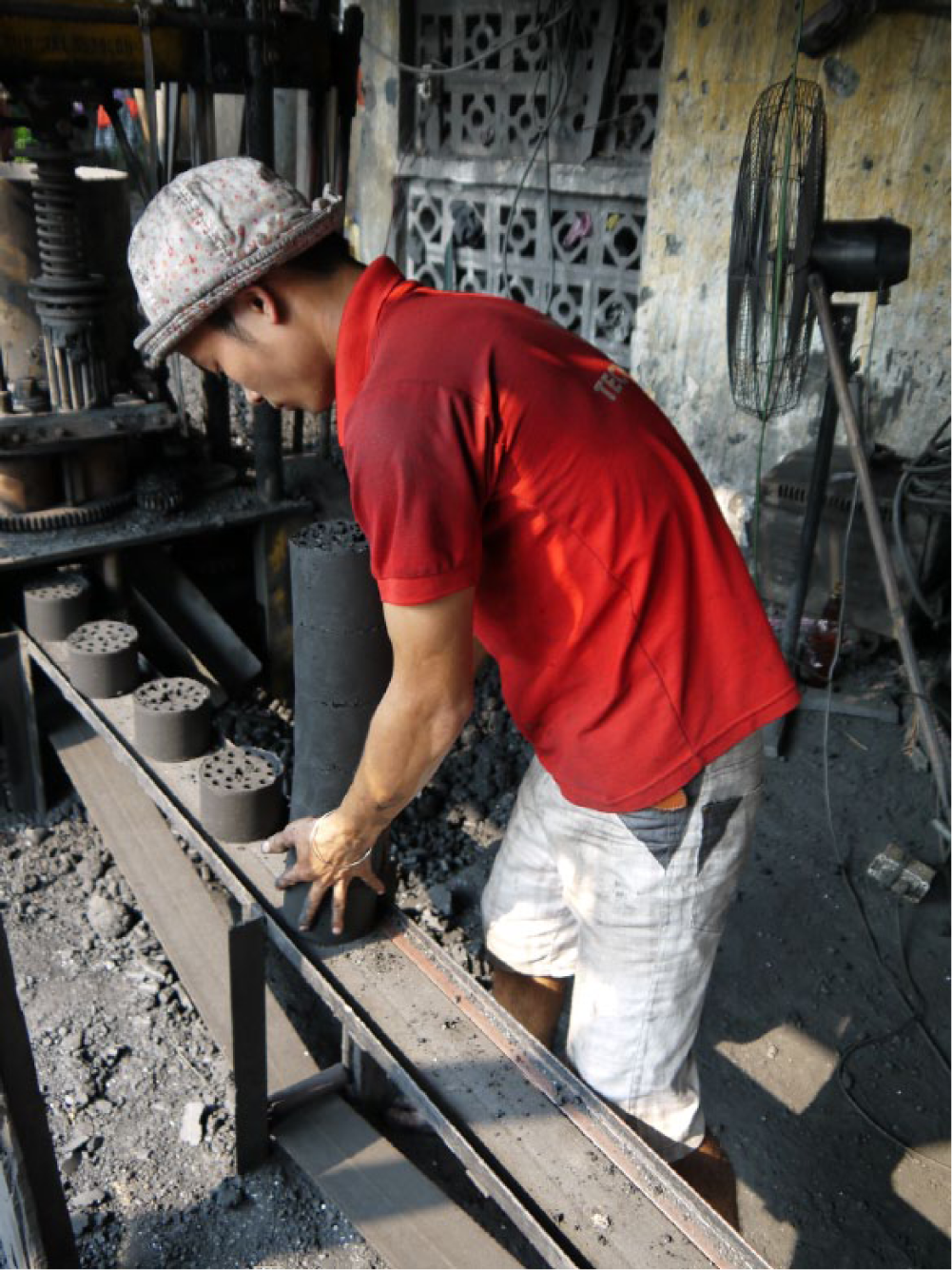
Making coal briquettes. © Photograph: Annuska Derks.
Mr Long used to be a technician of the state-owned Railway Company back in the 1980s. He became a leading expert in making beehive coal briquette presses since he was asked in 1989 to make a coal briquette machine for the Railway Company. His superior reasoned that many of the underemployed workers at the company could get involved in the production and sale of coal briquettes to boost the company’s revenues. It was, however, too expensive to import machines from China – let alone to buy the technologically more advanced machines from Japan. Mr Long designed a copy of a Chinese machine and adapted it to the working situation in the Vietnamese context. Soon after making his first briquetting press, he was asked to make one for the Vietnamese National Coal Corporation – and many private producers followed afterwards. During the past 25 years, he has made more than 500 briquetting machines for briquetting plants located throughout the country.
Ms Thuy spoke with much fondness about Mr Long, with whom she has become good friends, helping each other to acquire new customers and inviting each other to the weddings of their children. When talking about how important this relationship with Mr Long was for the development of her business, Ms Thuy noted, ‘The most important thing in life is trust (lòng tin).’ It was due to this trust that Mr Long was willing to lend her money when she had the chance to buy a large quantity of mud coal for a low price. This made it possible for her to stock mud coal and make a profit on selling it to other informal coal briquette manufacturers.
Due to these expanding networks of relationships of coal providers, technicians, briquette manufacturers, distributors and consumers, Ms Thuy has become one of the most successful beehive coal briquette entrepreneurs in the Hanoi area. While private entrepreneurs like Ms Thuy – and not state factories – made the beehive coal briquette into a success, it was at the same time the coal briquette that made her an entrepreneur. Her story exemplifies how, as Miller (2005: 38) formulates, ‘the things that people make, make people.’ This gives some insight into the entangled relationships between things and people. Ms Thuy’s story illustrates well how the beehive coal briquette connects people, raw materials and machines, how these networks involve state-owned enterprises, private enterprises, informal manufacturers as well as retailers. Exploring these networks and how they build upon materials, experiences and relations from a socialist past is essential for an understanding of the making of Đổi mới in Vietnam and its particular configurations and juxtapositions of public–private, formal–informal, and legal–illegal ventures.
Coal in the city: The rise and demise of a cooking fuel
Whereas the rise of the beehive coal briquette tells us something about the rise of the private sector after the politics of Đổi mới, the decline of the briquette as a household fuel sheds light on some of the consequences of the transformations that have subsequently taken place. These transformations are typically described in abstract terms of economic growth, urbanization, modernization and environmental degradation. I will now explore how ordinary Vietnamese experience these transformations in their everyday cooking practices and choice of cooking fuel.
The popularity of the beehive coal briquette was initially restricted to urban areas, in particular Hanoi, whereas people in rural areas continued to rely on crop residues and wood to cook their meals. In the city, it was easier to set up production sites and distribution networks to provide for the masses. Moreover, urban residents were in need of an alternative fuel. In the late 1980s, when the coal briquette was introduced in the city of Hanoi, electricity – and to a lesser extent kerosene – was the main cooking fuel for urban residents (ESMAP, 1994: 9). Electricity had been highly subsidized in the 1980s, but when these subsidies fell away with the economic reforms, coal took over as the main cooking fuel for urban households in the 1990s. Nguyen and Lefevre (1996: 109s) found that coal, mostly in the form of briquettes, provided two-thirds of the energy consumption in urban Hanoi in the early 1990s. Yet, this popularity of the beehive coal briquette started to decline in the early 2000s. Findings from our household survey conducted among 400 households in four districts in Hanoi indicate that the use of the beehive coal briquette as a primary cooking fuel had dropped from 37 percent in 2002 to 16 percent in 2012. Although it remains the main cooking fuel at food stalls and street side restaurants, the coal briquette now only plays a secondary role in urban households that have increasingly turned to gas.
How can we explain the relatively short stint of popularity of the coal briquette as a household fuel? It may be easiest to conclude here that, after first going down the energy ladder as they moved from electricity to coal, Hanoians have with continuing economic development moved up the energy ladder (see Masera et al., 2000). One obvious explanation for this is the issue of price and availability – and how these are regulated by fuel policies of the state. The beehive coal briquette became a cheap alternative for electricity and widely available thanks to the supply chains set up by private producers in the 1990s (see Figure 3). Similarly, households increasingly turned to gas when it became more widely available and affordable in the 2000s. 4
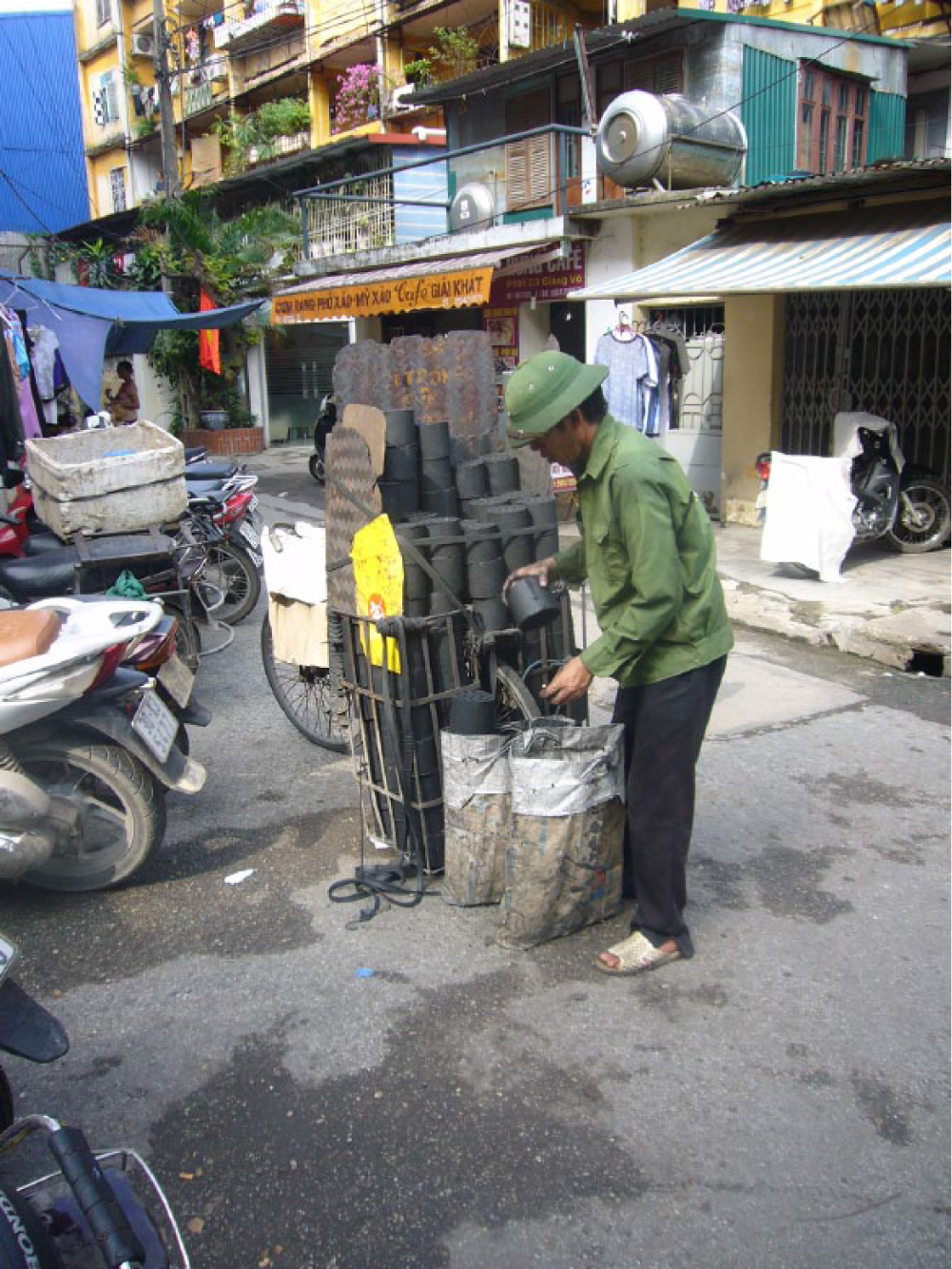
A vendor delivering coal briquettes. © Photograph: Annuska Derks.
According to this logic, those who are now still cooking with the beehive coal briquette are the poorer households for whom a canister of gas takes up a major part of their monthly income.
5
While this is true to some extent, during interviews with producers, vendors and users of coal briquettes, it became clear that, besides rising household income, other factors also play a role in the decline in use of the briquette. Ms Thuy explained in a nutshell what the decline of the use of the coal briquette tells us about changes in life styles of urban people: Before the people used [the coal briquette] a lot … Now they go to the supermarket to buy food, and use the gas cooker or electricity cooker. They don’t have much time, so they don’t use the coal briquette.
Her observation fits well with the findings of studies in other places, namely that the adoption of new domestic appliances should be understood in a context of broader societal change, in particular changing work patterns and household organization (e.g. Meintjes, 2001; Shove and Southerton, 2000).
The issues of time and space play an important role here. Cooking with the beehive coal briquette is a particular way of cooking. Igniting a coal briquette takes time and once it burns it cannot be simply turned off but has to burn completely, which may take 3–4 hours. This means that cooking with the coal briquette requires time and someone to stay at home to occasionally watch the stove. This makes the coal briquette hardly a suitable fuel for busy, modern urban families. Also, the coal briquette stove is used outside the house, either in the courtyard or on the street in front of the house, in order to prevent harmful emissions to enter the living area. In a way, this fits well with the design of traditional Vietnamese houses, in which the kitchen was located in a building separated from the main house. Yet, with increasing urbanization and ongoing construction, space is less and less available. Moreover, modern architecture has driven the kitchen increasingly into the house. This can be clearly observed in the new apartment blocks that have become an indispensable part of the urban landscape, containing apartments equipped with standard kitchens and issuing strict safety regulations prohibiting the use of the coal briquette stove on balconies and in corridors. While gas stoves have become a familiar item in the kitchens of urban residents, the most luxurious kitchens have in the meantime moved on to electric or induction ring cooker tops. This illustrates that, although most studies tend to highlight the connections between life style changes and new public spaces for consumption, traffic and leisure (Drummond, 2012: 90–91), a major change is actually happening right at the heart of the home.
Another factor in the decline of the coal briquette is environmental. More than two decades after the introduction of Đổi mới, there is an increasing awareness that in the quest for economic growth, industrialization and urbanization, the environment has too often been overlooked. Billboards all over the country tell people to keep the country xanh, sạch, đẹp (green, clean, beautiful; see Figure 4). The coal briquette does not fit well in this picture of a green, clean and beautiful country. In fact – as the elderly lady whom I mentioned at the beginning of this article also made clear – it has come to embody the very opposite, namely something that is black, dirty, and ugly.
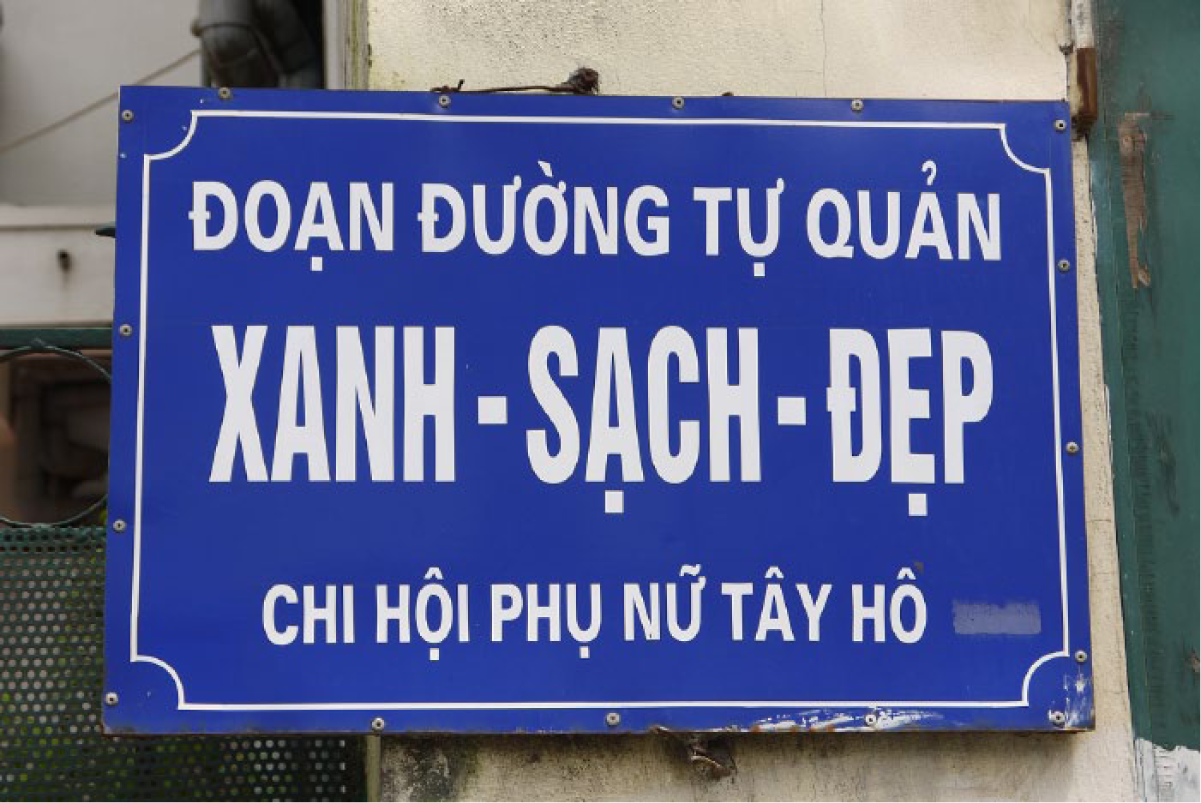
Keep the street ‘green – clean – beautiful’. © Photograph: Annuska Derks.
The harmful effects of the beehive coal briquette are now widely discussed in television programs, newspaper articles and online blogs. Depicted as an ‘environmental criminal’ (Bao Chau, 2009) and a looming cause of ‘black death’ (May Trinh, 2012), the coal briquette has become a personification of pollution in the household and on the street. This kind of denunciation of the coal briquette could also be observed in one episode of the television program of 24h sống xanh (24h green living), showing Miss Vietnam Ngoc Hân eating a bowl of bun cá (fish noodles) at a food stall and discussing the smells, harmful emissions and health hazards of the beehive coal briquette. After talking to food stall owners and a gas vendor, she concludes the short report with a message for all families to abandon the use of the coal briquette and switch to gas for the benefit of the health of the whole family and the environment.
In this context of promoting greener forms of living (Bennett, 2009), urban residents are thus made aware that, far from a passive thing, the coal briquette is an active agent, making changes to the natural environment and to the physical well-being of people. This awareness is widespread: in our survey of 400 households, 95 percent of the respondents thought that the beehive coal briquette pollutes the environment and over 70 percent thought that it negatively affects the health of the cook. An elderly user explained that the coal briquette: … is very toxic. For example, if we cook under the tree [pointing at the tree at the other side of the road] the branches near the stove will die. The leaves will turn yellow; the green leaves will fall down. We have to cook outside because it is better; the wind blows the smoke far away. But this also depends on the direction of the wind; sometimes, it blows right into my house. It is a terrible toxic smell.
The smell and smoke of the burning coal briquette have caused heated discussions among neighbors as well as in online blogs and news outlets. The beehive coal briquette and its stove are accused of causing respiratory illnesses to children, of blocking alleyways and of making public spaces into smoky and dangerous areas. In some of these areas, neighbors have successfully petitioned for a ban on the use of coal briquette stoves by street food stalls on the public square – although its implementation is not necessarily successful. As a result, cooking with coal, far from a simple household matter, has turned into a social, political, environmental and health concern. In this context, expert voices are increasingly sought after. As Ms Luon, the owner of a small coal briquette production plant in the outskirts of Hanoi, noted: ‘I think [the coal briquette] is harmful, toxic. But I don’t know how harmful it is. We are workers, we don’t know. Only the researcher knows if it is toxic or not.’
The problem is, however, that researchers do not necessarily agree on how harmful the honeycomb coal briquette actually is. While scientists and medical experts quoted in the media link the use of the coal briquette to air pollution in the city (Pham Manh, 2011) and to cancer, respiratory failure and even death (Hong Anh and Le Dung, 2010), there are hardly any systematic studies on the effects of the coal briquette on the health of its users and on the environment in Vietnam. And where they do exist, there are controversies about the nature of facts. One study, published in 1997, found that women using coal briquettes exhibited more cough symptoms, symptoms related to carbon monoxide exposure (dizziness, headaches, concentration difficulties) and eye irritations than electricity users (Ellgard, 1997). Yet, it also found that exposure to cooking fuel pollution varied considerably, indicating that other factors, such as location of the cooking place, ventilation of the kitchen and influence from other ambient pollution sources also play an important role (p. 412). Studies conducted in other countries, in particular China, have linked household coal use to increased lung cancer risk, respiratory illnesses, lung function impairment, a weakened immune system and carbon monoxide poisoning (Hosgood et al., 2011; Zhang and Smith, 2005: 2–6). Yet, interestingly, the beehive coal briquette emerges as an improved fuel as, due to its specific shape and fitting stove, it reaches higher combustion efficiency and with the addition of the right agents (lime, combustion-promoting, waterproofing and binding agents) produces fewer emissions than the untreated raw chunks of coal that are used in many rural Chinese households (Zhang and Smith, 2005: 14–15; Zhi et al., 2009). 6
What does all this mean for the future of the coal briquette? On the one hand, in view of the many appeals to modernization, development and greener living, the coal briquette is something that, according to some, should not be there anymore. On the other hand, it is still an everyday fuel. The coal briquette remains widely used, not only at food stalls or by those who cannot afford other fuels, but also by those who do not like to cook food inside the house as modern kitchens require them to do, or by those who claim that certain kinds of Vietnamese food taste better when cooked on a coal briquette stove. Hence, cooking preferences and taste also play a role. And this is why the coal briquette also stands for the wish for certain things – in particular cooking and food – to remain the same. But it also illustrates that Vietnamese people do not merely cook, but cook in very distinctive ways, and these distinctive ways change over time, carry specific associations but can also create distinctions between people and groups (adapted from Sahlins, 1976: 168). In other words, cooking fuels have become a marker of distinction in an increasingly stratified Vietnam.
Fuelling change
In this article, I have argued that the beehive coal briquette is a perfect object for analyzing the unfolding and experiences of the transformations and developments that have taken place in (urban) Vietnam since the market-oriented reforms in the late 1980s. The career of the beehive coal briquette shows how the meanings of this everyday cooking fuel have changed from a convenient cooking fuel introduced to help save the forests to a polluting cooking fuel for the poor. Not only the meanings, but also the making of the coal briquette has changed over time, illuminating the networks of people, machines and raw materials as well as the intersecting domains of the private sector and the state sector. Finally, the use of the coal briquette has changed, revealing how broader societal changes are experienced in the kitchen but also how the tensions and contentions related to the use of the coal briquette are intimately linked to a project of modernization that remains incomplete and produces inequalities between those with modern kitchens and those who continue to cook outside.
Other objects tell similar stories about the social transformations and rising inequalities in post-Đổi mới Vietnam. The motorbike, for example, has been called ‘the icon of renovation policy’ (Dormeier Freire, 2009: 67). Motorbikes, as Truitt (2008: 3, 15) formulates, are ‘symbols of purchasing power’ embodying ‘the autonomy and freedom of movement associated with trade liberalization’ as well as ‘critical agents in the emergence of a middle class’ in which differentiations take place in relation to model and, increasingly, other types of vehicles. In a very different example, Schwenkel (2013: 254) argues that ‘bricks matter’ as ‘symbolic cultural objects’ that ‘convey messages about cities and the people who build, manage, live in, and experience them’. On the basis of the example of the city of Vinh, she shows how the bricks that built the material formations of a socialist, model city have come to stand for ‘the dystopic ruins of a socialist past that today stand in the way of capitalist redevelopment’ (p. 256).
These examples show that objects can help us understand how Vietnam has changed from a socialist past in which material objects were meant to promote an egalitarian society to a ‘postsocialist’ or ‘neoliberal’ present in which material objects mark distinctions and inequalities, but at the same time reveal specific continuities in the relations of and between things and the people who make and use them (Mintz, 1985; Schwenkel and Leshkowich, 2012). What I have tried to show, however, is that the coal briquette is more than a mere frame for analyzing changes; it participates in these changes as it cooks food, makes, connects as well as divides people, and pollutes the air and causes people to get sick. A study of an everyday thing like the beehive coal briquette can thus show us, as Sahlins (1976) wrote, how social change is reflected in stuff and vice versa but also, as I made clear, how things produce change. And that is what makes it so interesting to bring everyday things into the analysis of social transformations processes.
Footnotes
Funding
Research for this article was conducted as part of a Fellowship for Advanced Researchers from the Swiss National Science Foundation under Grant no. PA00P1_134132. I wish to thank Ms Ngo Thuy Hanh for her research assistance and Professor Dr Nguyen Thi Kim Hoa and Dr Nguyen Tuan Anh from the Faculty of Sociology at the University of Social Sciences and Humanities, Vietnam National University, Hanoi, for their support. I am very grateful for comments on earlier versions of this paper from Alexis Drogoul, Ellen Hertz and two anonymous reviewers.