



Abstract
The aim of this article is to develop a different approach to the study of the material world, one that takes seriously the seemingly banal fact that things are constantly falling out of place. Taking this fact seriously, the article argues, requires us to think about the material world not in terms of ‘objects’, but ecologically, that is, in terms of the processes and conditions under which certain ‘things’ come to be differentiated and identified as particular kinds of ‘objects’ endowed with particular forms of meaning, value and power. The article demonstrates the purchase of this ecological approach through the example of the Mona Lisa. It does so by exploring the rather extraordinary processes of containment and maintenance that are required to keep the Mona Lisa legible as an art object over time.
Of objects and things
Twenty years ago, Alfred Gell published ‘Vogel’s Net’ in the inaugural issue of this journal, a beautiful essay that has since joined the pantheon of contemporary classics as one of the key texts that helped to open up a new way of understanding the social importance of objects. Departing from the dominant position in anthropology which saw objects as mere repositories of meaning, ‘Vogel’s Net’ effectively showed how objects can be ‘socially efficacious’ agents in the organization and constitution of the ‘social nexus’ (Gell, 1996: 29). This shift from the traditional view of ‘objects as repositories’ to the view of ‘objects as agents’ has been enormously productive in opening up a new approach to the study of material culture. At the heart of this approach lies the idea that objects are endowed with a distinct kind of ‘material’ agency, which is irreducible to human actions or relations (e.g. Gell, 1998; Latour, 1999). This is why, it has been argued, the question that should guide our inquiry should not be the traditional ‘What do objects represent or symbolize?’ but rather ‘What do objects do?’
The last 20 years of thinking around objects can be seen as a seemingly endless attempt to answer this question by showing how the ‘material agency’ of different objects, be they tampons (Ginsburg, 1996), speed-bumps (Latour, 1999), or archaeological relics (Knappett and Malafouris, 2008; Witmore, 2007), can play a constitutive role in shaping social relations. What I would like to argue in this article is that, in spite of all its undeniable benefits, this focus on the question of what objects do is misplaced.
One of the main problems with these approaches is that, much to our regret, we do not conduct our lives amongst the kinds of objects that are typically assumed by them. Objects tend to appear in these accounts as though they were self-evident and given, and our only task was simply to find out what they do. Yet, as I show in what follows, objects are anything but given or self-evident. One of the things these approaches tend to ignore is that objects are fragile and temporal realities (cf. DeSilvey, 2006; Ingold, 2007; Keane, 2009). Rarely, if ever, do these approaches take into account the fact that objects wear down and change, that they break, malfunction and have to be constantly mended, retrofitted and repurposed, or that they are routinely misused, misrecognized and disobeyed.
What I want to propose in this article is an approach that takes all these processes into account. In other words, an approach that takes seriously the seemingly banal fact that things are constantly falling out of place. Taking this fact seriously, I argue, opens up an entirely different approach, one that takes temporality, fragility and change as the starting points of our enquiry. This, I argue, requires us to think ecologically, that is, not in terms of objects, but in terms of the discursive and material conditions and practices – what I will call the oikos –, under which certain things can be rendered possible, effective and reproducible as objects endowed with particular kinds of value, meaning, and power. To start making this argument, let me return for a moment to Gell, and specifically to one of the objects he wrote about: the prow-boards that Trobrianders place in their Kula canoes.
The Trobriand prow-boards are stunningly beautiful artifacts, lavishly decorated with intricate carved patterns and vivid colors. However, Gell (1992: 164) warns us, we should not see them as merely decorative objects since they are meant to be powerful ‘weapons in psychological warfare’ designed to paralyze and instill fear. According to Gell, they achieve this through their mesmerizing carved patterns (see Figure 1), whose level of artistic sophistication is such that it is only explicable ‘in magical terms, as something that has been produced by magical means’ (p. 166). Thus, in the eyes of the opponents who see the Kula flotilla arrive from the shore, the prow-boards do not emerge as human-made vessels, but as powerful ‘enchanted objects’ produced by a supra-human magical agency: an image that, according to Gell, impels them to ‘take leave of their senses and offer more valuable shells or necklaces to the members of the expedition than they would otherwise be inclined to do’ (p. 164). With this example in mind, let me ask you to embark on a small thought experiment and imagine what has become of the marvelous and fear-inducing prow that Gell discusses.

Left: The fear inducing prow-board in its prime. Image courtesy of Brad Schram. Right: An example of a ‘crepuscular object’, a worn-down prow-board in an ethnographic museum. Hiart/CC-BY-SA-3.0.
Although we do not know exactly what happened to the particular 1977 canoe Gell uses to illustrate his argument, it seems reasonable to assume that, after all these years, it probably has worn out considerably. After all, we should remember, these magical objects do not merely exist in an enchanted social space. The magical relations and cognitive operations Gell describes unfold in and through one of the most corrosive climates on the planet, enjoying uncompromising high temperatures, high levels of humidity, and torrential rains throughout the year. So it does not seem improbable that, after years of sailing in this unforgiving climate, the original prow-board had deteriorated severely, losing some of its original detail as a result of weathering and the constant brushing with other artifacts. Thus, it seems plausible to assume that if we were to chance upon that 1977 prow-board again, we may be disappointed, perhaps even disenchanted, not to find the mighty and fear-inducing prow-board Gell describes, but to encounter, instead, something that is probably closer to the kind of ‘crepuscular objects’ we often find in ethnographic museums (see Figure 1). The question then is: Could this discolored and maimed prow-board instill the same kind of fear? Could it still daze Trobrianders to the point of making them take ‘leave of their senses’? In short, could we still consider this prow-board a socially efficacious ‘magical object’?
The point of this thought-experiment is not so much to criticize Gell’s conflation of material agency to a rudimentary cognitive mechanism (for that see Holbraad, 2011; Leach, 2007), as to illustrate how things can lose their status as objects. Now, the idea that a ‘thing’ can cease to be considered an ‘object’ may sound odd. After all, ‘objects’ and ‘things’ are terms we typically use interchangeably – although, and in my defense, the idea that objects and things are different realities is not a new one (Heidegger, 1968; Ingold, 2012; Latour, 2005a; Whitehead, 1978). Here, however, I would like to define these terms in a slightly different way.
As I understand them, things and objects are not only different but also discrepant realities. Things, I argue, should be understood as material processes that unfold over time, while objects are the positions to which those things are subsumed in order to participate in different regimes of value and meaning. Thus, when we talk about an ‘object’, we are not simply referring to some-thing sitting ‘out there’ sub specie aeternitatis; instead, we are referring to a particular moment, a position, in the life of some-thing. By position, I do not mean here an abstract location in a conceptual or mental scheme, but a physical and semiotic position that has to be achieved within the world of things. So what I am arguing is that, in order for some-thing to be recognized and count as a particular kind of object, it has to be able to occupy, and remain within, a given ‘object-position’ – something that, as we shall see in what follows, tends not to be a particularly easy feat. Let me illustrate what I mean by going back to our prow-board example.
Prow-boards are wooden things that can occupy the position of ‘magical objects’ within Trobriand cosmology – so long, of course, as they meet the peculiar formal requirements that distinguish in this cosmology ‘magical objects’ from other kind of objects, such as tools or decorative objects. At the beginning of our example, in 1977, there is a perfect match of identities between thing and object, which means that the wooden board effectively operates as a magical object. However, this match between things and objects is fragile and breaks down over time. The reason for this is that things, qua material processes, are always changing and, as they do, they undo objects as well as the social relations and meanings that are threaded through them. This is precisely what happens to the Trobriand prow-board in our example. As the prow-board changes and deteriorates over time, it grows out of its original object-position and gradually ceases to be legible as a magical object, thus losing its efficacy and agency.
Needless to say, there is nothing terribly exceptional about the case of the enchanted Trobriand prow-board. As a matter of fact, rarely – if ever – do we find a perfect alignment between objects and things. This is because objects and things are always parting ways thus creating a discrepancy between them. Sometimes, this discrepancy emerges because objects part ways with things. This type of discrepancy, which has been profusely analyzed by social scientists and historians (e.g. Appadurai, 1986; Bourdieu, 1984; Haskell and Penny, 1981), usually happens as a result of changing conceptions about a given category of objects, and the kinds of things that can be included in it. As a result of this type of discrepancy, things that were once considered members of a given category of objects cease to be considered part of it. The basement of museums, the backs of our wardrobes, or landfills are full of examples of this type of discrepancy.
In this article, however, my focus will be on the other way in which this discrepancy can emerge: when things part ways from objects. This is the discrepancy that results from what I will call the ‘relentlessness of things’. By this I mean the process whereby things, as physical processes, grow in and out of objects, sliding out of joint from their expected object-positions and creating, in so doing, a divergence between what these things actually are and the kind of objects they are supposed to be. Although this discrepancy unfolds for the most part silently and unnoticed, its traces are seen and felt everywhere. We feel them, for example, when we return home after being away for a while to notice that things are not exactly as we left them, and that, uncannily, every-thing has grown slightly out of place. We also see this discrepancy in how that old wooden door has outgrown its frame over the years; in those potholes and bumps through which roads and streets slowly become undone over time; or in that old family photograph where familiar faces are hardly discernible anymore.
Although ubiquitous and often vexatious, we usually tolerate this discrepancy so long as things continue to operate as the kinds of objects they are supposed to be. Sometimes, however, these discrepancies grow too wide, that is, sometimes things veer too far away from their designated object-positions. Like our imagined prow-board, which has reached a point in which it can no longer be seen as a magical object; or when that old computer finally stops working and ceases to be a powerful technological object to become a pile of garbage – a process that is increasingly common in the age of planned obsolescence, where control over the discrepancy between things and objects has become key in the reproduction of different circuits of profit and value.
Needless to say, this discrepancy between objects and things is not always seen as a tragedy. As a matter of fact, it is very often seen in positive terms for its capacity to generate new kinds of objects. This is what happens, for example, when wear and tear transform seemingly banal objects, like that old chair, into valuable ‘vintage objects’ – a process that is at the center of heritage and nostalgia industries, which use the discrepancy between things and object as their main source of revenue.
So, as we see, things can take different object-identities over the course of their lives, which means that rather than seeing the identity of some-thing as an object as a property that somehow inheres to its materiality (e.g. Gell, 1992), or as a matter of a definition established through some sort of overarching cultural (e.g. Appadurai, 1986) or ontological (e.g. Henare et al., 2007) framework, we should see this identity as a more or less stable position that has to be both achieved and constantly negotiated over time. Keeping the identity of things as objects, however, is not a light task. A great deal of our daily toil – and budgets! – is spent in trying to prevent things from veering too far away from their object-positions so that they can remain legible and effective ‘working objects’ capable of generating the kind of functional, semiotic, or magical work they are supposed to perform. This is why if the Trobriand prow-board is to behave as a magical object, it must be constantly repaired (Gell, 1996); a speed-bump has to be routinely repaved if it is to enforce civic behavior on reckless drivers (Latour, 1999); or the silver of well-heeled families has to be constantly polished if it is to keep working as an effective index of class distinction (Bourdieu, 1984).
Interestingly, despite how much the discrepancy between objects and things pervades our daily lives, the attention to this process has been, at best, scant. Most accounts have exclusively proceeded from the point of view of objects and have tended to forget that of things. This is certainly the case of Gell. When he discusses the Trobriand prow-board or the Azande fishing net, he is not describing any-thing; he is simply providing an abstract account of an object-position, that is, of how some-thing is supposed to operate and work. And something similar occurs with some of the object-centric approaches which have emerged over the last few years, and which describe objects as some sort of irreducible fundamentals (e.g. Harman, 2011), or as stable and unquestionable certainties operating within even more stable and unquestionable ontological frameworks (e.g. Holbraad, 2012). In other instances, as in studies inspired by actor-network-theory (e.g. Latour, 2005a; Law, 2002), objects are seen as effects of different ‘socio-technical’ networks, something that is certainly helpful to understand what it takes to produce an object, but does not help us much to understand what happens after those objects are done, when they start to deteriorate, malfunction, or fail into disrepair.
In sum, what seems to be missing in these contemporary explorations is an account of temporality and change, of the fact that the objects they describe are always being outgrown, betrayed and transformed by the constant unfolding of things. Thus while these approaches are certainly useful to understand, at an abstract level, the kind of effects, networks or ontologies these objects are supposed to generate, they are not very useful to understand what happens to those effects, networks and ontologies when the identity they presume between things and objects starts to break apart, the kind of processes and negotiations that are required to prevent this from happening, or the kind of new orders and possibilities that these processes and negotiations open up.
The ecological approach I want to develop in this article aims, precisely, at locating our enquiry at the level of the processes and negotiations through which different material and symbolic arrangements come into being and are constantly renegotiated within different regimes of value and meaning. Of course, this does not mean that we should do away with objects and restate the old Heraclitan idea of panta rhei and proclaim that all is process. Nor does it mean that we should denounce ‘object-based’ thinking because it prevents us from accessing a supposedly better and more authentic understanding of how ‘life’ really works (Anusas and Ingold, 2013; Ingold, 2012). Or that we should dissolve objects into some sort of pan-relationalism where every-thing is just a node in a seemingly endless networks or assemblages (e.g. Bennett, 2009; Latour, 2005b; cf. Strathern, 1996).
As I will define it here, the aim of an ecological approach is not to focus on process or relations, but on the material and semiotic conditions – the particular oikos – whereby certain things come to be differentiated and identified as particular kinds of objects, and the amount of work that is required to maintain, or change, this particular form of identity and differentiation over time. This is why, I will argue, we must not locate our enquiry at the level of ‘objects’ – i.e. positions – or at the level of ‘things’ – i.e. material processes – but rather in that space lying betwixt and between objects and things in which much of our lives take place. It is by focusing on this in-between that it is possible to understand how the identity of things qua objects is constantly negotiated and maintained to make possible the reproduction or change of different regimes of meaning, value and power. Thus, from an ecological perspective, the main questions we should ask are: Under what conditions can some-thing come to be differentiated and count as a particular kind of object? How are those conditions produced and maintained over time? What or who has the power to create those conditions? What kinds of manipulations and arrangements are necessary to keep those things as legible and effective objects? How do those objects circulate and become productive and generative within particular regimes of value, meaning and power? And under what conditions does something cease to count as an object to become something else?
In what follows, I will address these questions by focusing, like Gell, on one particular piece of wood. In my case, the piece of wood I will follow is the relatively small (77 cm x 53 cm) poplar panel that has become known as the Mona Lisa. The reason for selecting this particular piece of wood is that, like the prow-boards in the Trobriand cosmology, it too occupies a rather exceptional position, being widely revered and celebrated as ‘one of the few works of man [sic] that may properly be described as unique’ (Clark, 1973: 144). In this case, however, this position is not due to the fact that this piece of wood is considered to be a ‘magical object’ produced by some supra-human agency. The exceptionality of this poplar panel derives from the fact that it is considered to be a ‘fine arts object’, a category reserved in Western culture for objects that are seen as unique and irreplaceable products of human, rather than divine, creativity.
Yet, as I will show, the status of this particular piece of poplar wood as a unique ‘art object’ is not something that is given once and for all, but is a rather precarious achievement that is only possible under very specific conditions. What follows is an exploration of what it takes to keep the identity of this poplar panel as an art object over time. This will take us to the backstage of the art museum, a space that has been conveniently left out from the grand narratives of art history, but without which such narratives would be simply impossible (cf. Becker, 1982; Bunzl, 2014; Van Saaze, 2009; Yaneva, 2003a, 2003b). But before we enter this space, let me first begin by exploring why the discrepancy between objects and things matters in the case of art and the kind of problems it generates in the particular case of the Mona Lisa. Then, we will explore the largely invisible work that is required to create the peculiar oikos wherein this poplar panel can exist as an art object, and be seen as such, over time.
The Mona Lisa’s cracked smile
Although simple at first sight, the Mona Lisa is a very complex artifact. Like most oil paintings of its time, the painting is the result of an intricate material system made of interlocking layers of paint and varnish tied together by different binding agents. This system of layers is painted on an extremely thin poplar panel (16 mm thin), which has been fitted with two frames, an external ‘decorative’ frame, and an invisible frame hiding behind the poplar panel which was added later for additional support (see Figure 2).
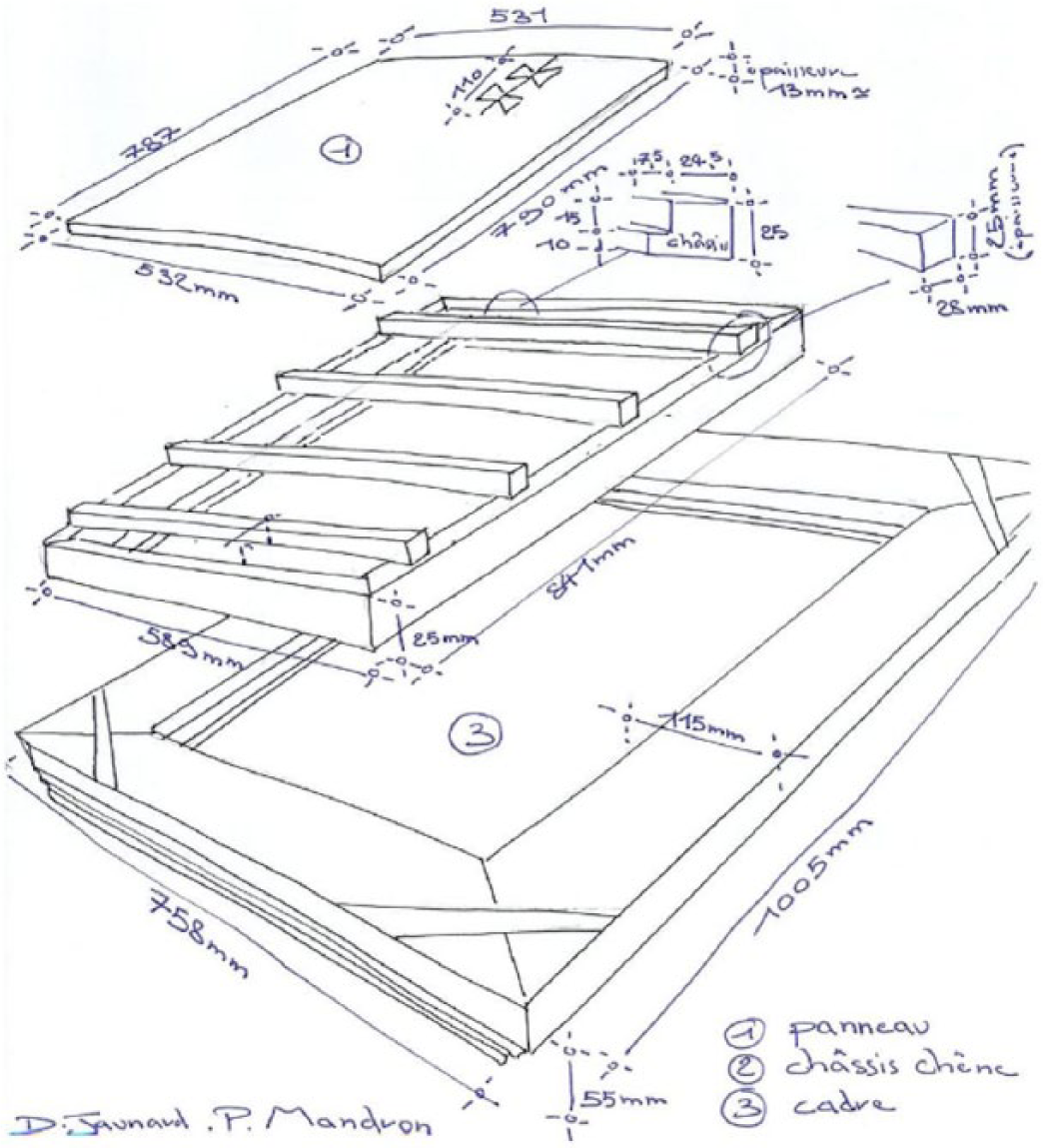
The different material components of the Mona Lisa. Image courtesy of Joseph Grill, after a drawing by Patrick Mandron and Daniel Jaunard.
What makes this material system even more complicated is that it is never at rest. All of its physical elements are constantly evolving and transforming as a result of different chemical and mechanical processes. The poplar panel on which the painting sits is a hygroscopic material that expands and contracts as a result of changes in temperature and relative humidity, creating an ongoing mechanical oscillation that is commonly referred to as ‘wood’s play’. And as wood ‘plays’, it constantly redefines the field of forces acting on the different layers of the painted canvas, weakening the binding agents holding these layers together, and creating an ongoing mechanical movement that slowly pulls apart the painted form and creates an intricate pattern of cracks known as ‘craquelure’. In the Mona Lisa’s case, the mechanical movement of the panel has not only created a conspicuous craquelure, but has also produced a 11 cm vertical crack above the Mona Lisa’s head, which has been threatening to split the canvas since at least the early 19th century (see Figure 3).
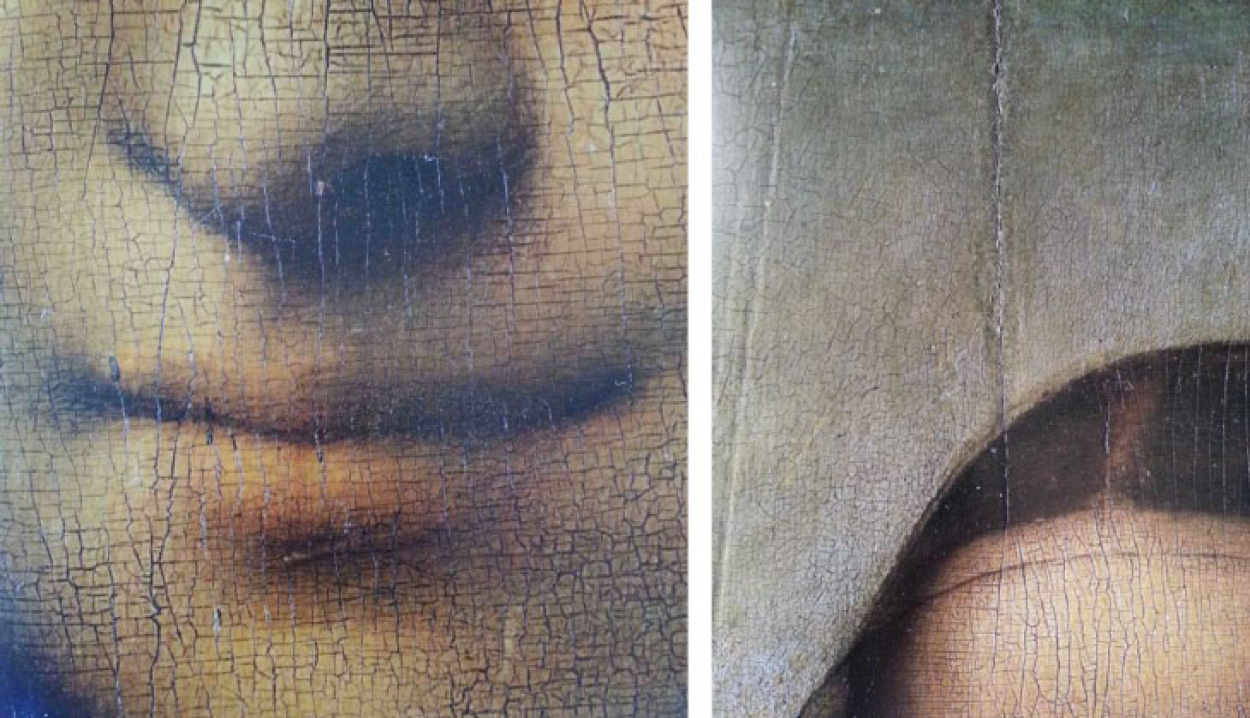
Left: Mona Lisa’s ‘cracked’ smile; right, detail of the 11 cm crack reaching the forehead of the Mona Lisa. Reproduced with permission of Art Resource, New York.
But the poplar panel is not the only thing that moves in the Mona Lisa. The painted layers themselves are continually changing. Indeed, although the beguiling awkwardness of the sitter’s smile remains nearly intact, almost everything else around it has changed dramatically. Some original colors, especially the browns, have almost completely vanished and are barely appreciable as a result of the reactivity of oil pigments to light. The cheeks and lips of the sitter have lost most of their original carmine pigments, obliterating the patina of juvenile joy the portrait once enjoyed. Thus, even if Kenneth Clark (1973: 147) praised Leonardo for having endowed the sitter with ‘a timeless costume’, the truth is that much of the costume and the veil are almost completely gone. The voluptuous translucent gauzes shrouding the sitter have disappeared, giving way to an uncompromising and austere, even somber, garment. Even the once deep-blue summer sky Leonardo painted with a secret combination of azurite and lapis lazuli has now become a mirthless sky casting a melancholic, if not tepid, atmosphere over the painting.
The Mona Lisa we see today, therefore, is not the same vivacious young woman that left Italy back in 1540. The recently restored copy at the Museo del Prado in Madrid (see Figure 4) provides us with a hint of how much the Mona Lisa has changed over the last five centuries, going from what was once the colorful portrait of a young woman into what now seems to be the portrait of a melancholic widow in her mourning dress.
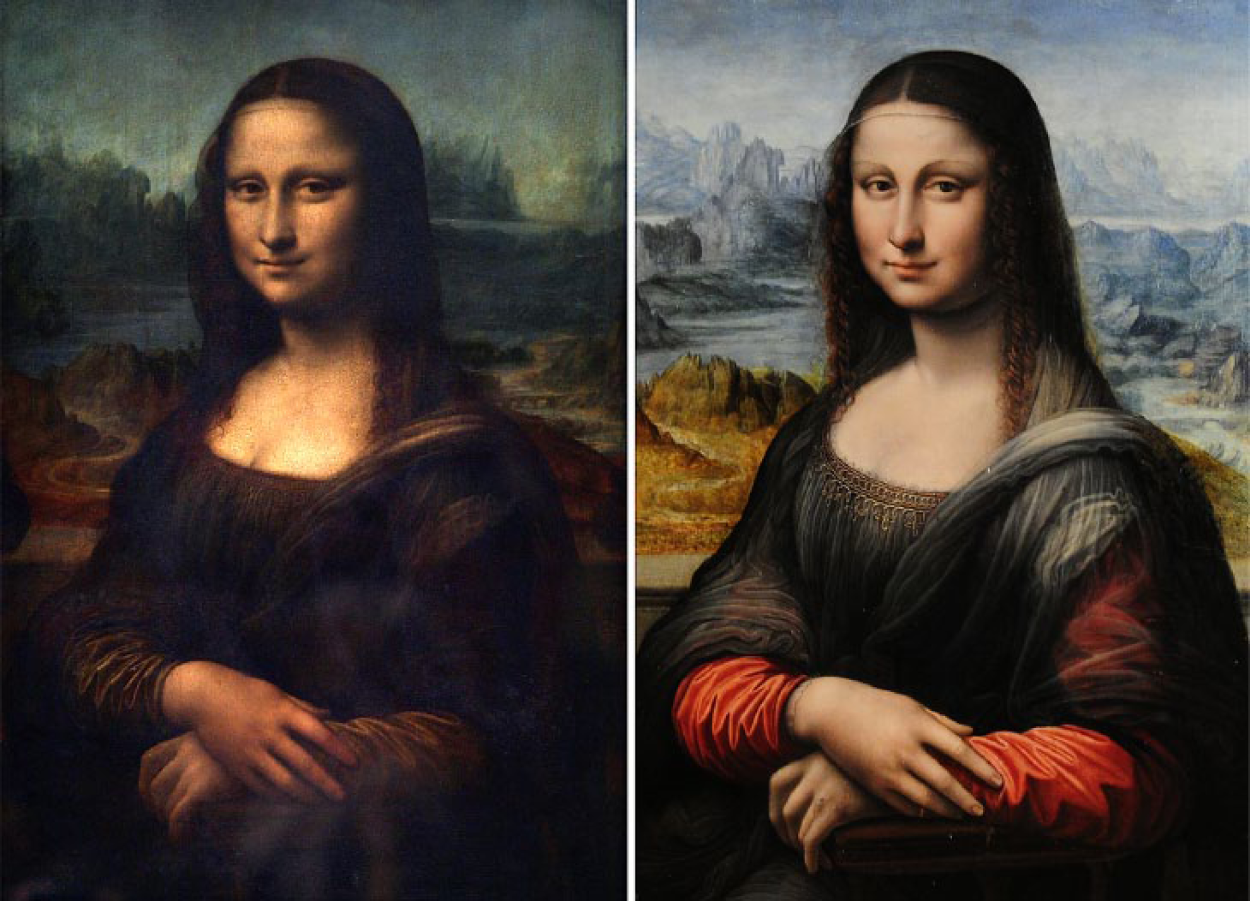
Left: the Mona Lisa at the Louvre (C2RMF/CC-BY-SA-3.0); right: the recently restored copy at El Prado. Reproduced with permission of Museo del Prado.
The reason for this change is none other than the eternal discrepancy between objects and things. The Mona Lisa is not an object made at one point in time (c. 1506, if historians got it right) but a slow event that continues to unfold through different chemical and mechanical processes. Thus, when we look at the Mona Lisa today we should remember that we are not looking at a completed event, but at a particular moment of an event that is still taking place. This raises an interesting problem. For as this process of material change unfolds, it can push the Mona Lisa too far away from Leonardo’s original gesture, even to the point of compromising its own status as an art object. This is precisely what is happening to another celebrated Leonardo drawing, his famous self-portrait (see Figure 5), which after 500 years of slow physical transformation is about to disappear in front of our eyes, leaving behind a meaningless piece of paper (Conte et al., 2014).

‘Portrait of a man in red chalk’ by Leonardo. Red chalk on paper. 33.3 cm x 21.3 cm/CC-BY-SA-3.0.
The question, then, is how we can prevent this from happening. That is, how can we prevent the collapse of art objects into meaningless things. One of the most powerful tools we have created to answer this question is the museum. Indeed, museums can be broadly defined as powerful machines designed to prevent this process of transformation from taking place, or at least to slow it down, by transforming these ever-evolving things into stable objects. The problem, of course, is that museums cannot transform these things into any object. This transformation must result in working art objects, that is, in the specific kinds of objects that support the forms of value, meaning and authorship that differentiate art objects from other kinds of objects.
The difficulty in producing these ‘working objects’ resides in the fact that modern Western art systems have come to be organized around an extremely narrow ‘regime of objecthood’. Although it is true that any-thing can be art within these systems, not every-thing can be an art object. One of the defining properties of these art systems is that the bond between author’s intention and material form is considered to be inviolable: it cannot be substituted, altered, or defaced. What this means is that in order for some-thing to be considered an art object it has to be and remain legible as the original, unique and authentic representation of the artist’s intention. In other words, it must always be true to its author. If this is not the case, if the bond between intention and material form is broken or significantly altered, the status of that thing as an art object can be compromised. 1 This is exactly what is happening to Leonardo’s self-portrait, mentioned above, or, to take another example, to Joseph Beuys’ sculpture Felt Suit (1970), a sculpture made of an actual felt suit, which in 1989 suffered a moth infestation. The extent of the physical damage was such that it raised the question of whether the suit could still be seen as an adequate material expression of the artist’s intention or whether the suit was effectively dead as an art object. Although the Tate spent several years trying to restore the link between intention and material form, in 1995 curators and conservators at the Tate finally declared that the bond was beyond repair and that, consequently, the Felt Suit had to be pronounced ‘dead’. Therefore, the suit was de-accessioned (and thus removed) from the category of art objects, and was relocated to the category of ‘archival objects’, where it now enjoys a second life as a valuable record of a deceased art object. 2
What this example shows is that if some-thing like the Mona Lisa is to retain its status as an art object it must not veer too far away from its original object-position to remain legible as an authentic physical register of Leonardo’s original intention. Fortunately for museums, oil paintings like the Mona Lisa are more stable than contemporary artworks; although this does not mean that keeping their status and legibility as ‘art objects’ is an easy task. For example, oil paintings can only be rendered stable, that is their deterioration is relatively slowed down, under a very narrow range of climatic conditions. The room temperature must oscillate between 18ºC and 24ºC, while humidity levels must range between 40 percent −55 percent. Additionally, oil paintings require a specific kind of light, which should not exceed 200 lx and 80 percent of incident UV radiation, as well as a rather particular form of air with very low levels of pollutants and oxygen – both of which oxidize varnishes and color layers (Thompson, 1986). Any change in these climatic conditions, however slight, can trigger different mechanical and chemical processes that can break the identity between material form and artist’s intention. This explains, for example, why museums refuse to loan their works to museums without an adequate HVAC system and stable climates. Or why the Washington Corcoran Gallery had to suddenly close one of its major 2010 exhibitions, ‘Turner to Cézanne’, after finding out that their new climate control equipment was malfunctioning and that their provider was about to suspend the steam system for 72 hours, which could have caused significant damages to the 53 loaned paintings comprising the exhibition.
So, as we see, the ability to transform some-thing like an oil painting into a ‘working’ art object depends greatly on the ability to engineer an artificial ‘object-sustaining environment’, that is, an environment within which things can be sustained as art objects. However, the production of these object-sustaining environments is a rather difficult task. One of the main difficulties is that they do not simply need to render these paintings stable, but must also render them exhibitable. And not only that: if they are to be fully working objects, these paintings must be exhibited in very specific ways so as to comply with the particular ideas about spectatorship, civic education, and public space that have come to define the modern art museum (Alpers, 1991; Bennett, 1995; Duncan, 1995). One of the practical difficulties to achieve such space is that the museum must be able to produce an environment that is good for both objects and people. The problem here is that humans and art objects tend not to be very compatible.
As it turns out, humans, for the most part, are quite toxic for most art objects. The air we produce and breathe out as well as the humidity our bodies produce is damaging for most art objects. The creation of a fully working object-sustaining environment compatible with both humans and art objects is a tricky accomplishment. The reason for this is that art objects and humans also tend to have slightly divergent, and sometimes opposing, climatic needs. International standards define the level of human comfort for indoor environments between 20–24ºC in winter and 23–26ºC in summer, while relative humidity must oscillate between 20 percent in winter and 60 percent in summer. Most artworks, however, tend to become unstable under these conditions, as they typically require cooler temperatures and narrower variations of humidity. Additionally, human-friendly environments trigger the oxidation of oils and also facilitate the presence of airborne particles as well as microbes and insects, which find in artworks a form of nutritional, rather than aesthetic, delectation. The case of Beuys’ Felt Suit is a good example of the danger that these iconoclastic species can cause, as is our own Mona Lisa, which has suffered several infestations over the years that have caused extensive damage to the back of the panel.
What all this means is that, contrary to popular wisdom, exhibition environments tend not to be the most ideal physical environment for artworks – which is why most artworks can only be exhibited for very limited amounts of time before their status as objects can get compromised. Textile-based artworks, for example, should not be on display for more than three months, while photographs should not be on view for more than a few weeks, and should always be under low light conditions. In the face of these divergent climatic needs, museums face an interesting dilemma: creating environments that privilege the comfort of people means sacrificing the physical well-being of art objects, while privileging the comfort of art objects means sacrificing the well-being of people. The solution to this dilemma is never easy or cheap, which is why it took the Louvre five years and €5.85m to create a space where the Mona Lisa could be rendered both stable and exhibitable. In what follows I will describe how this was achieved.
Containing and staging the Mona Lisa
In 1998, the Louvre decided it was time to remove the Mona Lisa from the Grande Galerie. The increasingly unmanageable number of visitors flocking around the painting had rendered the Grande Galerie unfit for the purpose. Not only was the Galerie too narrow to accommodate the swarming multitudes, but it also lacked adequate air-conditioning and lighting, which put the aging poplar panel under significant pressure. The decision was to relocate the Mona Lisa to the nearby Salle des États. The Louvre assembled a team of curators, conservators, and architects to this end. The task of this team was not easy, since moving the Mona Lisa did not simply imply moving some-thing from one room to the other; it implied moving an object, and a very particular one requiring a very specific environment to survive as such. More specifically, moving the Mona Lisa to the Salle des Ètats required crafting a rather unique type of ‘interior space’ (see Kelly and Lezaun, forthcoming), one in which the poplar panel could be physically stabilized as an art object, while at the same time allowing the peculiar mode of display and presentation that have come to define how we encounter things qua art objects in the modern art museum. Thus, the practical question was: how do you create a space which does not compromise the physical stability of the poplar panel while at the same time withstanding more than 16,000 visitors per day?
One of the main challenges to generate an adequate object-sustaining environment for the Mona Lisa is the fact that the Louvre, like most major museums, is located in a high-density urban environment with elevated levels of pollution. Most artworks, but especially oil paintings like the Mona Lisa, are highly reactive to air pollutants, which react with oil pigments and create a black layer that darkens painted surfaces. One of the challenges for any urban museum is therefore how to transform this toxic urban atmosphere into an art sustaining one. The Salle has been equipped with a powerful HVAC system that extracts unfiltered urban air, purifies it, and transforms it into what one may call ‘aesthetic air’, that is into the kind of air that art objects require to survive as such. The Salle also works like a greenhouse, generating stable hygrothermal conditions that are managed through 12 transducers programmed to automatically correct variations caused by seasonal variations or by the influx of people. Fortunately for the Louvre, the Mona Lisa happens to be an oil painting – the type of paintings that are amongst the most human-compatible artworks, which means that, in general, temperature and humidity levels that are good for the Mona Lisa tend also to be good for people.
Although important, these air-conditioning and hygrothermal conditions are not the most decisive elements in the creation of an adequate art-sustaining environment. Light is by far the most important element in this process. The problem with light is its paradoxical nature as both the condition of vision – and the sense around which the modern art museum is organized – and as one of the main culprits for the unsalvageable discrepancy between objects and things. Light is indeed one of the main agents behind the molecular reactions that render things unstable and restless. What makes light so problematic is that, unlike in the case of air or hygrothermal conditions, it is not possible to create optimum and harmless light levels. In other words, there is no such thing as ‘safe’ light. The only good light is no light. This is why most artworks have to alternate between being on view and ‘resting’ in storage facilities. This, however, is not possible in the case of iconic paintings like the Mona Lisa, which have to be permanently on display. In these cases, museums have to engineer an artificial form of light, an art-sustaining form of light or ‘aesthetic light’, which must not only be harmless (i.e. it does not damage the artwork) but also neutral (i.e. it does not taint or bias the viewing experience of the artwork) to comply with the ideals of authenticity and originality of the art object that organize the modern art museum. But just as there is no such a thing as a ‘harmless’ light, there is also no such thing as a ‘neutral’ light. Inevitably, any light modulates and shapes what we see and how we see it. What we typically associate with ‘neutral’ light is not some sort of impartial natural light, but a rather particular moment of light, which usually corresponds to the midday light of a sunny spring day (Fontoynont et al., 1999).
To produce this kind of aesthetic light, the new Salle has been equipped with a specially designed roof filled with halogens that produce an optimal blend between natural and artificial light (Figures 6 and 7). This blended light is then filtered through a diffusing glass, which distributes it evenly throughout the Salle. As the day descends, this zenithal natural light is gradually substituted by artificial light, which comes from light cannons distributed across the Salle to mimic the non-uniform distribution and wavelength of daylight. Additionally, and to further preserve the idea of an unmediated experience of the artwork, no light source is directly visible; even light itself is concealed by equaling the angles of reflection and incidence on the walls and through the especially designed parquet floors, which are designed to avoid making light visible through reflections and shadows. The result is a carefully engineered ‘natural light’ which produces the illusion of an unmediated and undisturbed contemplation of the painting.

Paris’s climatic conditions versus ideal object-sustaining conditions for oil-paintings.

Above: inside the ceiling, infrastructure designed to transform natural light into ‘aesthetic light’. Bottom left: zenithal aperture on top. Images courtesy of ETAP Lighting. Bottom right: cross-section of the full architecture of containment. Image courtesy of Lorenzo Piqueras & Louvre Museum.
While, in most museums, the kind of infrastructure of containment and display put in place in the Salle would be more than sufficient, this is not the case for the Mona Lisa. The reason for this is, once again, the incompatibility of humans and art objects. The Salle des États is perhaps the best example worldwide of the mounting pressure that global tourism is putting on these fragile object-sustaining environments. The Mona Lisa receives about six million visitors a year (see Figure 8). This massive activity disrupts any attempt to stabilize the climatic conditions required to guarantee the physical integrity of the painting by continually altering the mix of oxygen in the air and creating abrupt hygrothermal alterations, and last, but not least, by occasionally hurling stuff at it or attempting to steal it, as has happened on several occasions.

Crowds swarming the Salle des États in front of the Mona Lisa. Max Fercondini/CC-BY-SA-3.0.
This growing pressure of human toxicity on the Mona Lisa led the museum to create a second process of containment, which has been made possible through a newly designed case. This new custom-made case is not only designed to protect the Mona Lisa from toxic humans and iconoclastic insects, but also works as a highly sophisticated artificial life-support machine generating the particular micro-climatic conditions under which the painting’s vital signs can be stabilized. To achieve this, the case has been equipped with a twofold passive and active air-conditioning system that captures and filters air from the Salle and then distributes it through a hidden microclimate generator that keeps air-supply and hygrothermal conditions constant within the case.
The case, in this sense, supplies the additional conditions required to stabilize the poplar panel and to prevent the discrepancy between the current Mona Lisa and the original from growing any further. This, however, is not enough. For this discrepancy not only needs to be contained but also needs to be masked as much as possible to preserve the idea of original and authentic art object. To achieve this, the pedestal on which the case sits has been fitted with a specially designed projector equipped with 34 LEDs and three different self-adjusting optical systems that produce a carefully engineered blend of light that simulates the variability of natural light while at the same time ‘correcting’ and ‘enhancing’ color losses in an attempt to restore the authenticity of the original object (Fontoynont, 2013; see Figure 9). Light, in this sense, is not simply a means to illuminate an object sitting ‘out there’. Rather, it works as a powerful technological trompe l’oeil which, concealed under the guise of a natural light, makes it possible to elide the discrepancy that separates the current Mona Lisa and the one Leonardo painted, and thus creates the illusion of an identity between object and thing. As one of the engineers in charge of designing this lighting system put it, the result of this technological trompe l’oeil is that ‘the Mona Lisa no longer looks jaundiced or green about the gills, and the sky behind her is finally blue. Essentially, it’s like looking at a completely new painting’ (The Guardian, 2005). 3

Testing the new LED light. Image courtesy of Marc Fontoynont.
So, as we see, maintaining the identity of this poplar panel as an art object requires the creation of an artificial form of ‘interior space’, one that, as we have seen, is possible thanks to the invisible work of curators, architects, and conservators, who carefully curate light, temperature, humidity, and air, to produce the specific kind of physical environment that makes it possible to contain the physical change of the poplar panel, while at the same time allowing the particular forms of presentation and attention that organize the relationship between the viewer and the artwork in the modern art museum.
Unfortunately, even these artificially generated interior spaces cannot totally succeed in eliminating the discrepancy between things and objects. For these environments are, and can only be, imperfect stabilizers. Things, qua material processes, can be slowed down, but can never be fully contained within any given object-position. Indeed, despite the massive effort to create an interior space capable of containing the Mona Lisa, she keeps slowly unfolding, altering her form, losing some colors while gaining new ones, and thus moving away from the original position in which Leonardo placed her 500 years ago. This is why containment is never enough to maintain the identity between objects and things, and why it always needs to be supplemented by practices of care and repair.
Maintaining the Mona Lisa as the Mona Lisa: A history of seemingly minor acts
Whilst a lot has been written about how objects are produced, consumed or interpreted, not much writing has been devoted to the prosaic realities of how they are maintained and repaired, activities which, for the most part, have tended to be seen as merely derivative or auxiliary. In the rare moments when scholars have dwelled on the topic of maintenance and repair, they have tended to focus on those spectacular moments of breakdown and failure, when things fall outside their object-positions and systems go ‘out of order’ (Bennett, 2009: 20–38; Graham and Thrift, 2007; Latour, 1996). Here, however, I would like to focus on a different kind of repair, not the one that takes place when the link between things and objects has already broken down, but the kind of repair that goes on routinely in the form and maintenance to prevent the link between things and objects from breaking down.
Only recently has this type of maintenance and repair work begun to receive the attention it deserves, especially among science, technology and society (STS) scholars (e.g. Bellacasa, 2011; Denis and Pontille, 2014; Jackson, 2014; Star and Ruhleder, 1996), but also among geographers (DeSilvey and Edensor, 2013), sociologists (Dant, 2010) and anthropologists (Lea and Pholeros, 2010). One of the benefits of these new wave of studies is that they help us to move beyond traditional dichotomies opposing ‘working’ vs ‘not-working’ or ‘functioning’ vs ‘malfunctioning’ orders by showing how maintenance and repair are not exceptional practices emerging in those critical moments when the normal state of affairs is interrupted, but are indeed what makes any normal state of affairs possible in the first place. Indeed, and as I will show in what follows, it is these subtle and routine acts of maintenance that are responsible for the critical patchwork that renders objects, as well as the orders that emerge from them, viable on a daily basis.
The 500-year-old Mona Lisa is a perfect illustration of the importance of these practices of care and maintenance to keep things working as objects. In fact, if the Mona Lisa still exists at all today, it is not so much due to Leonardo’s ‘genius’, but due to a long trail of largely anonymous practices of care and maintenance that have kept the fragile poplar panel alive as an art object. Bringing these practices into view requires placing our enquiry not at the level of the art object, but in that in-between where the discrepancy between objects and things is constantly negotiated through a series of seemingly minor acts of maintenance and repair.
Like most artists of his time, Leonardo was acutely aware of the discrepancy between things and objects, and of the difficulties of overcoming, or at least controlling, it. Several of the manuscripts collected in his monumental Treatise on Painting (2005[1651]) are recipes on how to stitch together things like wood, animal, glue, or egg yolks to generate beautiful and durable art objects. Knowledge of, and mastery over, the rules of transforming these things into objects was considered one of the most precious and coveted secrets that an artist could possess; something that was especially true at a time when the emergence of oil as a new artistic medium in Flanders had disrupted the knowledge that had been accumulated since the Middle Ages about how to successfully move from the register of things to that of art objects.
One of the main problems with oil is that, unlike traditional egg tempera, oil takes a long time to dry – sometimes up to a century – which can result in unstable objects prone to flaking, cracking, and oxidation. Throughout the 15th century, Italian painters indefatigably struggled to decipher the secrets that had permitted an earlier generation of Flemish painters to transform some-thing as seemingly unstable as oil into some of the most beautiful and stable objects ever seen. Leonardo, who was one of the first adopters of oil, was a tireless experimenter of the new medium, concocting different emulsions and binding agents using all sorts of materials, including beeswax, animal glues, natural oils and different minerals. Unfortunately, most of these experimentations did not go entirely as planned, which partly explains why only 15 of his paintings have survived to our time. 4
The Mona Lisa was part of Leonardo’s many attempts to find a way of transforming oil into a stable art object. In this particular case, Leonardo attempted a new method consisting of creating an intermediate layer that enabled a quicker transition between the animal glue of the ground and the oil of the surface (Martin, 2006: 58). The experiment was only partially successful. Although Leonardo did succeed in creating a fast drying layer, the emulsion he concocted turned out to be very unstable, which caused the painted layer to deteriorate very rapidly and to develop a premature craquelure that probably was even visible during Leonardo’s lifetime (Mottin et al., 2006: 72).
Over the centuries, there have been many attempts by curators and conservators to stabilize the painted layer of the Mona Lisa. Different layers of varnish have been applied in an effort to mechanically secure the painted surface and protect it from the damaging effects of light. Unfortunately, the high reactivity of these varnishes has gradually enveloped the canvas in a thick veil, which bathes the painting in a dense yellow light that has buried many of the original details – like the gauzes – and deepens the lackluster atmosphere that characterizes the Mona Lisa today.
Preventing the Mona Lisa from sinking under this thickening yellow veil has been one of the main concerns for those taking care of her over the years.There have been many attempts at cleaning the yellowing varnish to restore the colors of the original object. In 1809, for example, Jean Marie Hooghstoel, a low-rank painter undertook a three-month restoration in which he removed some of the old varnish and ‘touched-up’ some colors. A century later, in 1906, another Louvre restorer, Eugène Denizard, was entrusted to add some watercolor retouches on the crack, and in 1914 he was entrusted again with touching-up the sky. In 1952, Jean-Gabriel Goulinat was asked to clean and ‘enliven’ the painting after a conservation commission was summoned to ‘investigate the possibilities of trying to improve the appearance of the work, compromised as it has been by varnishing and repainting’ (Volle et al., 2006: 26). In 1956, Goulinat’s services were required again, first after someone had severely damaged the canvas by throwing acid on it, and later in the same year when someone threw a rock at it, damaging part of the painting surrounding the elbow.
In addition to this work over the surface, there has also been an ongoing effort to stabilize the poplar panel in an attempt to control warping and avert further cracking of the painted layers. At some point in the 19th century, a wooden butterfly-shaped brace was inserted in the back of the poplar panel in an attempt to stop the 11-cm crack from growing further and splitting the painting into two (Figure 3). A few years later, someone tried to glue the crack in a somewhat desperate attempt to stabilize the painting without realizing that this could result in an excess of rigidity and brittleness that may end up fracturing the panel. In 1951, conservators corrected this by equipping the painting with a flexible oak frame designed to operate as an exoskeleton of sorts (see Figure 2) capable of providing the panel with some stability while allowing a controlled form of ‘wood play’ (Volle et al., 2006: 20).
If I have delved into the history of these practices of maintenance and repair of both the environment and the poplar panel in such detail it is because they help to reveal the amount of collective, and largely invisible, work required to negotiate the discrepancy between objects and things. These practices are part of that often neglected ‘history of minor acts’, which provide the invisible thread that sews things and objects together on a daily basis. I say ‘invisible’ because in the case of art, the effectiveness of this work of care and maintenance depends on the extent to which it remains unseen. So, just as the Trobrianders carvers had to disguise their agency to keep the prow-board legible as a magical object, conservators have to disguise theirs to preserve the appearance of the untouched and unaltered art object. Leaving traces of their work and their agency can break the spell that makes us see these things as unique and original art objects, and reveal them as collective objects. This is something that, for example, has recently happened with another of Leonardo’s paintings in the Louvre, The Virgin and Child With Saint Anne, where the conservation intervention became so visible that it raised the question of whether it had indeed created an entirely new object, rather than restoring the original one painted by Leonardo.
Of course, the kind of object that should be achieved through these material interventions is always a moving target. For artworks do not merely change as things, but also as objects. Indeed, as the hermeneutic tradition has amply shown, artworks, qua objects, are always subjected to an endless process of interpretation about their meaning, as well as about their position within larger narratives, institutional contexts, and historical moments. Even those seemingly indisputable masterpieces, like the Mona Lisa, are subjected to the historical fickleness of aesthetic taste. As a matter of fact, and in spite of her current position as one of the greatest works of all time, the Mona Lisa has lived for most of her life a relatively modest existence as an important, but by no means exceptional, art object. 5 It is not only the meaning or the value of a given artwork that are subject to change over time. Ideas about what constitutes a ‘working’ art object, about how they can be displayed or the kind of relationship they can entertain with their publics, or about the kind of transformations they can, or cannot, undergo are always subject to historical change. Hence, the critical importance of practices of maintenance and repair as the kind of material interventions that make it possible to update things so as to keep them in line with the particular ‘working objects’ required for each particular historical moment (Stanley-Price et al., 1996).
Yet, if attention to these practices shows us anything, it is that keeping things as objects is a process without end. For, even if the idea of the art object were to remain invariant over time, it would never be possible to accomplish a perfect identity between object and things. This is because, qua things, artworks are constantly veering away from the object-positions to which they are subsumed. The attempt to keep Mona Lisa as an original and authentic object is a perfect example of this. For, just like a Sisyphean curse, there is no point at which the Mona Lisa is finally done or finished. Keeping the Mona Lisa as the Mona Lisa requires an ongoing, and never-ending, attempt to keep the ever-changing surface of the Mona Lisa in line with Leonardo’s original gesture. Something that requires a constant process of monitoring to make sure that the discrepancy between the current Mona Lisa and the original one does not grow too wide. This is why, since the early 1920s, the panel has undergone different scientific tests that have tried to render this discrepancy quantifiable by attempting to reveal the invisible boundaries of the original object and measuring how much the current painting has deviated from them. This is also why, since 1974, the panel has undergone an annual check-up in which it is taken out of the case to measure physical changes over the year and make sure that it remains within the boundaries of the original object. And this is also why, in 2007, conservators attached a prosthetic measuring device to the back panel of the painting equipped with displacement transducers and data-loggers that record the daily behavior of the painting and transmit it through a Bluetooth antenna – thus effectively transforming the 15th-century Florentine sitter into a veritable 21st-century cyborg (see Figures 10 and 11).

Left: Mona Lisa under ultraviolet light: the pink spots show some of the retouches made to the painting over the years; right: back of the poplar panel, with brace inserted. Images courtesy of C2RMF.

Map of forces acting on the panel and their resulting movements. Image courtesy of Joseph Gril; bottom left: measuring variation with an especially designed device called the ‘Jocondometer’ Image courtesy of C2RMF; bottom right: new Bluetooth-equipped crosspiece. Image courtesy of Luca Uzielli.
Delving into the history of these practices of maintenance and repair thus helps us to reveal the history of things that hides behind the façades of objects. This is important because the history of art, like many other narratives, is invariably told as a history of objects in which things have no place. Yet, if the case of the Mona Lisa teaches us anything, it is that there is no individual history of objects without the collective history of things. Artworks are always trapped within the double indeterminacy that results from their condition of being, on the one hand, things that change over time, and on the other, objects subjected to a never-ending process of interpretation., What this means is that when we see an artwork like the Mona Lisa what we are seeing is the physical result of an ongoing negotiation between changing narratives and ideas about art, and the work of largely anonymous hands performing the silent acts of care and maintenance that have made it possible for some-thing as fragile as this poplar panel to travel over five centuries as a working art object.
And yet, although the Mona Lisa we see today is still a perfectly working art object, it is an increasingly fragile and fatigued one, which can hardly move outside the artificial life support machine to which she is connected – which is why the Louvre has systematically denied all requests to loan it. She is also too weak to undergo any significant treatment. The layers of varnish have grown so deep into the painted layer that they have become like ivy that grows in the façades of buildings and that cannot be removed without causing significant aesthetic and material damage. Although the museum cannot halt the movements of things, it can at least aspire to slow it down to sustain, for as long as possible, the illusion of a timeless art object. For that is, after all, what an object is: an identity that has to be negotiated and maintained through change – until the discrepancy between objects and things makes that identity no longer possible. But that should not worry us too much because the death of any object is always the birth of some-thing else – sometimes of even more meaningful, valuable, and powerful objects (see Riegl, 1982).
Ecology, ontography, and the relentlessness of things
I began this article by arguing for the need to develop a different approach to the study of the material world, one that takes seriously the seemingly banal fact that things are constantly falling out of place. Taking this fact seriously, I have argued, requires us to think differently about the material world, it requires us to think ecologically, which means not to think in terms of objects but in terms of processes and conditions under which certain things are rendered possible as particular kinds of objects.
The case of the Mona Lisa was intended to be an exercise in ecological thinking aimed at showing what it takes to make a very particular kind of object, an art object, possible – something that, as we have seen, is by no means an easy feat. Keeping some-thing like a poplar panel as an art object requires a lot of work, especially if you intend to keep this identity for over 500 years. It takes an extraordinary set of infrastructures of containment and display as well as intensive forms of care and maintenance to first produce and then sustain the rather particular oikos under which some-thing like this poplar panel can preserve its identity as an art object. Hence, the first lesson we can extract from the Mona Lisa case is that the identity between things and objects is not given, but has to be continually achieved and sustained over time. And that, consequently, when we say that some-thing, such as our poplar panel, is an art object, this ‘is’ should not be understood as describing some sort of stable or inherent identity, but should be understood ecologically, which means that it should be understood as a precarious achievement that has to be constantly negotiated over time.
Needless to say, the processes of containment, staging, and maintenance I have described here may seem rather extraordinary ones. After all, we do not need to keep most things in €5 million rooms and inside bulletproof cases at a constant temperature of 18Cº to make them viable as objects. If the museum requires such exceptional forms of containment and maintenance this is just because it is in charge of producing one of the most exceptional kinds of objects there is. Yet, although it is certainly true that most things do not require museums around them, and that some objects do not even require any form of containment and maintenance whatsoever, 6 it is nonetheless true that most things do indeed require some form of containment and maintenance to keep them working as particular kinds of objects. Just think about the humble tomato that you just bought from the supermarket and the different processes of standardization, containment and maintenance that it has undergone to become the particular kind of object that can travel in global value chains (Lampland and Star, 2009), the work required to keep a sacred object sacred (Wharton, 2011), to keep a scientific object scientific (Daston and Galison, 2007), or more mundanely, about the work required to keep your car as a car (Sclar, 2008) or to keep it as something more than ‘just a car’ (Chappell, 2013). The museum, therefore, is simply one of the many sites, and one of the particular modes, in which we negotiate the unnegotiable relentlessness of things to generate the particular kinds of objects around which we organize our lives.
The second lesson we can extract from the Mona Lisa is that, in spite of this massive work, the identity between things and objects is never fully accomplished. If I have chosen the Mona Lisa and the Salle des États as a guiding example for this article, it is precisely to underline this point more forcefully, for there are very few places in the world where more resources and effort are devoted to keeping one single thing as an object. And yet, as we have seen, even in this case, even with a formidable machine like the museum, things can never be fully made into objects. What the example of the Mona Lisa shows is that the unnegotiable relentlessness of things prevents any object, as well as any order imagined around them, from ever being fully completed and finished. In other words, it shows that the discrepancy between objects and things can be slowed down, but it can never, ever, be overcome. The fact the Mona Lisa is still in existence after 500 years does not mean that the difference between object and thing has been finally overcome, and much less that it is irrelevant. It simply means that some-things can be more easily brought into object-positions than others. Thus, while oil panting can indeed be rendered viable as an art object for five centuries, if not more, some-thing made of latex or digital bits can only uphold that same object-position for just a few decades, if not less. This is the difference between what I have called elsewhere ‘docile’ and ‘unruly objects’, that is, between those things that can be easily retained in object-positions and those that cannot (Domínguez Rubio, 2014).
This takes us to the third and final lesson we can extract from the Mona Lisa, which is perhaps the most important one, and this is the need to take seriously the temporality and fragility of the material orders we study. Taking these things seriously means accepting that we cannot take any object for granted, even the seemingly unassailable ones. Indeed, as we are now beginning to learn (the hard way), it merely takes a variation of +0.9ºC in average global ambient temperature over a few decades to collapse a one million year object, like Greenland’s ice sheet (Robinson et al., 2012), just as it only takes a few years of absence of care and maintenance to collapse a city of one million, like Detroit (see Marchand et al., 2010 for some arresting visual evidence). This is why, rather than looking at objects, we should be looking at the mold, rust, or cracks that grow on them. For, as the example of the Mona Lisa shows, it is there where those objects, and the material and symbolic orders they support, are at stake and are materially reproduced or changed. Taking fragility and temporality seriously also means displacing our attention from the kind of heroic producers of objects that have usually fascinated social scientists – e.g. artists, engineers, designers, scientists or architects – and paying attention to a group of actors which, exceptions aside (e.g. Becker, 1982; Shapin, 1989), have not featured much in social theory, such as cleaners, plumbers, mechanics or conservators, who are responsible for the critical work through which objects are sustained on a daily basis, and without which these objects, as well as the systems of meanings and value that are woven through them, would simply collapse in front of our eyes.
In sum, what an ecological approach shows is that, rather than constructing our enquiry from the point of view of objects, or from that of things, we should focus on the ongoing attempt to negotiate the discrepancy between them. And that, consequently, rather than constructing our enquiry as an exploration into the ontology of the world, we should construct it as an exploration of its ontography, that is, as an exploration of the different processes whereby the world comes to be differentiated and organized into the particular kinds of objects that make possible different forms of meaning, value and power … amidst the relentlessness of things.
Footnotes
Acknowledgements
I have been immensely fortunate to have a large and supportive community of friends and colleagues who have read and commented on this paper as it has grown over the last year. Many thanks to Angela Booker; Casper Bruun Jensen; Blanca Callén; Paloma Checa Gismero; Thomas Conner; Matilde Córdoba Azcárate; Alberto Corsín Jiménez; Liana Chua; Florentia Dalla; Carlos de Castro; Jérôme Denis; Uriel Fogué; Emma Greeson; Yelena Guzman; Jacob Hellman; Kregg Hetherington; Poyao Huang; Tim Ingold; Lilly Irani; Javier Lezaun; Daniel López; Haley McInnis; Harvey Molotch; Chandra Mukerji; Erika Ostrander; Juan Pablo Pardo-Guerra; Ned Randolph; Juan Rojo-Solis; Natalia Roudakova; Amiria Salmond; David Serlin; Katie Simpson; Christo Sims; and Nicole Starosielski; and, of course, to the two reviewers and the editors of this journal, whose comments have been invaluable to (hopefully) improve the argument of this article.
Funding
This research received no specific grant from any funding agency in the public, commercial, or not-for-profit sectors.