



Abstract
This article explores pearls as an allegorical device for thinking about British colonial art and economy in the later 19th century in South Asia. It takes as its focus elite and subaltern attempts to utilise pearls as a form of ‘armature’ and mode of resistance through an analysis of south Indian fisheries, the use of pearls in coercive portraiture and their ‘blind spot’ appearance in a well-publicised legal case for treason. The article argues that pearlescence – the sheen and light associated with pearls – was central to modes of understanding and representing the British colonial economy more broadly defined. Associated with both scarcity and waste, the pearl and the pearl shell came to define the shape of a globalizing modernity whose primary aesthetic was that of kitsch.
The pearl diver and aqueous depth
In Part III of her essay assessing Walter Benjamin’s Illuminations, Hannah Arendt (1970) imagines Benjamin as ‘the pearl diver’, taking as her inspiration Shakespeare’s The Tempest: Of his bones are coral made, Those are pearls that were his eyes. Nothing of him that doth fade But doth suffer a sea-change Into something rich and strange. (The Tempest, 1611: I, 2)
For Arendt, Benjamin, like the pearl diver, is an extraordinary transmitter of the past. Like the pearl diver, he is concerned with tiny objects that are in inverse ratio to their significance: ‘the smaller the object, the more likely it seemed that it could contain within it the most concentrated form of everything else’ (p. 12). The search for pearls entails perspicuous, life-threatening gathering.
The pearl diver descends to the bottom of the sea ‘not to excavate the bottom and bring it to light but to pry loose the rich and the strange, the pearls in the depths had to carry them to the surface’ (p. 15). The pearl diver delves into the past not to resuscitate it but to think about a process of crystallization – and its ‘reversal’ where things suffer a sea change in order to survive in defamiliarized forms (p. 16). 1
This article is concerned with collecting a series of layers focused on pearls in the contexts of both subaltern South Asian diving and British imperial coercion of Indian maharajahs and their global legacies. Here I take inspiration from Michael Taussig’s (2008) work on indigo in terms of its obscenity and redemptive qualities. Taussig’s scholarly method views indigo through the lenses of both luxury and labour to fashion a ‘dazzling fusion of the human with the thing-world’ (p. 13). He argues that the 19th-century production of indigo in eastern India must be viewed as a series of layers ‘with each layer written across the one before so that the earlier layers continue to be visible in a smudged out and sometimes surprising way’ (p. 1). According to Taussig, indigo is like an ocean.
My own investigation explores the magical aspects of labour and elite consumption in relation to the contested status of pearls as part of an emergent British colonial visual economy which dealt more literally with the ocean. At around the same time that indigo (and its major cash crop rival opium) were being propagated in eastern India, the British began to accelerate their attempts to harvest oysters in southern India driven by their economic (and aesthetic) search for elusive pearls. Just like indigo, pearls (as Taussig would have it) could offer the possibility of transforming the magic of their thingness into a commodity (p. 12). At least as materially, perhaps more so than Taussig’s case of indigo as a series of layers, the pearl offers itself as a mysterious substance often perceived to be scientifically constituted by an unknown number of nacreous overlaps – overlaps which potentially jostle and flow into one another. Given millennia of fascination with the origin and formation of pearls, layers are taken here as overlapping and sometimes ‘concretions’; after all pearls are calciate concretions whose coming into being is still largely a scientific mystery.
Deeply engaged with the varied oeuvre of Walter Benjamin, Taussig’s emphasis on magic as a kind of ‘surrealist ethnography’ picks up on Benjamin’s allegorical musings on the notion of the collector and the collection as a method to accompany his emphasis on subaltern labour. Taussig’s slightly earlier book My Cocaine Museum (2004) articulated subaltern labour in regard to the mining for gold and its grave, even deadly, repercussions for the trafficking of cocaine in Colombia. Such writing resuscitated Benjamin’s idea of the collector – here thought of urgently and eccentrically as an alternative museum arranged as bricolage. This alternative museum has organized Taussig’s style of research and writing. Certainly, for Benjamin to deal with History is to become a collector of the eccentric fragment and the minute – a collector also very much concerned with the media and technologies of what might now be termed obsolescent photography (Benjamin, 1970). Benjamin had a fascination with various conceptions of what constituted aqueous depth. Writing in ‘The Crisis of the Novel’ he concluded that modern existence is an ocean (Benjamin, 1927–1930a). A few years later in A Little History of Photography he ruminated on the emergence of photographic technologies (Benjamin, 1931). To dive into the depths of the photographic image is to become a collector charged with charting both the hazardous and potentially the obsolete or the entropic. 2
Although for Benjamin the underwater came to be associated with the tank, the aquarium that came to epitomize the Paris arcades, the world of underwater can be broadened out further to question aqueous depth qua modernity. This can be seen in how early underwater photography as ‘an aquatic medium’ might test modernity’s ideas of vision and technology (Eigen, 2001a, 2001b; Martinez, 2014). The ‘dark space’ of the ocean of Benjamin’s generation and his predecessors seemed to produce ‘a pathology of orientation which finally ends in the loss of all distinction between the self and its milieu’ (Eigen, 2001a: 107). While for Edward Eigen in his astute analysis of early underwater photography, this may have been the case for European photographers and mostly bourgeois visitors to the Paris World Fair of 1900, it romanticizes and mystifies underwater immersion especially when we consider the dangerous labour of the pearl diver. For Benjamin and Taussig, being underwater (either taken materially or metaphorically) and the varied forms of light associated with the commodity and its production are central to the obscenity and the obsolescence of modernity –whether in a western European context or in more globalizing forms which encompass eastern India (Bengal and Bihar), Guatemala, Colombia or Bolivia (Benjamin, 1931, 1970; Taussig, 1980).
My investigation of pearlescence addresses nacreous layers in relation to the artistic, material and economic value status of pearls in South Asia. Pearlescence – whether associated with pearls, mother of pearl or pearl shells and how these implicate the pearl diver – became an important anthropological trope for working out notions of the ‘modern’ globalized economy (Frow, 1998; Malinowski, 2001[1935]; Wagner, 1978; Weiner, 1988). As well as providing the ‘very shape’ for western understandings of a huge variety of cultural practices in Melanesia and Australia, pearlescence was also central (if less well explored) to colonial power politics in South Asia; it can provide us with numerous case studies of regimes of value based around the power of singularity (Hallward, 2001; Kopytoff, 1986). Arendt no doubt chose the allegory of the pearl diver because of the intense risks involved: pearl diving challenges modern conceptions of the potentially redemptive aspects of labour through the incessant demands placed on the body – the threat of drowning, the bends, sea snakes, monsoon, hurricanes, pirates, shark attacks – to name but a few. As opposed to the industrialization of factory labour, more ‘archaic’ pearl diving appears if not anachronistic at least replete with the obsolete. Given Benjamin’s long-term fascination with obsolescence (for instance with older but prescient photographic technologies exemplified by the dusty, empty Parisian arcades of Atget) perhaps it’s not surprising that Arendt chose the pearl diver as her most sustained characterization of his scholarly practice.
Introduction: What did pearls want? Colony and the xeno-figure
The removal of the object from its shell, the fragmentation of the aura is the signature of a perception whose sensitivity for similarity has so grown that by means of reproduction it defeats even the unique. (Walter Benjamin. Little History of Photography, 1931)
With Arendt’s take on Walter Benjamin’s idea of crystallized ‘thought fragments’ in mind, Benjamin’s own reflections on the intimacy of distance registered above and Taussig’s examination of subaltern labour, this article traces the visual, economic and cultural entanglements of pearls during the epoch of ‘High European Imperialism’ (c.1875–c.1911). Given the complex rivalries over pearls between Indian rulers and the British Raj, this necessarily involves an eccentric collector’s museum-like approach so as to encompass aesthetics, colonial history, material culture, kitsch and rubbish. 3 I will engage with two major themes: the first investigates how value can be turned into waste, how local culture becomes a heterotopia, how pearl dust turns into food, poison and excrement, and how South Indian oyster beds become an evil-smelling mess. The second discusses how pearls circulated as gifts, vehicles of prestige and ambiguous insignia of power. As cocaine and gold became entangled for Taussig in contemporary Colombia, there is a parallel, disjunctive narrative of British attempts to exploit the pearl resources of Indian elites. Regulation, speculation and coercion had a critical role to play in the formation of the economy of pearls. Pearls certainly are more than equivalent to indigo, gold, tin and cocaine which Taussig believes have a magical, polymorphous quality – a quality that raises the question in the light of recent material culture studies: what (if anything) did pearls want?
In order to introduce these themes which can be roughly configured as colonial attempts to regulate elite and subaltern practices and rituals in relation to the production and consumption of pearls, I first turn to what can be understood as the agency of pearls and what did/could they want. Even today pearls continue to fascinate. They can be said to circulate in ‘tournaments of value’ (Appadurai, 1986: 45–56). The rare Baroda pearl necklace recently sold for $4 million whilst the world’s largest known pearl – the Pearl of Allah is valued at $93 million. In certain elite circles pearls would seem to have remarkable economic and aesthetic value. This value is inextricably entangled with histories of colonialism. Aside from their singularity and lustre, pearls can be thought of in terms of what Christopher Pinney (2002) has termed ‘the xeno-figure’. The xeno- figure, as I shall explain below, encompasses the mysterious, sometimes threatening alter agency of exotic things in relation to empire. Aside from the artworks, magical practices, notions of rubbish and kitsch which I will elaborate on, pearls fascinated writers concerned with empire. Pearlescence became a principal allegory for writing about colonialism.
So how have pearls informed Art History and Anthropology? Apart from Robert A Carter’s (2012) close historical study of the pearl trade in the Persian Gulf, Friedrich Ohly’s beautiful and far reaching genealogies of pearl in (mostly medieval) Europe and Marcia Pointon’s ambitious and imaginative study of jewellery in western modernity, in terms of Art Historical studies pearls remained yoked to popular, celebratory histories that are enraptured by Coco Chanel, Jackie Onassis and other society women (Carter, 2012; Ohly, 2005; Pointon, 2009). Pearls may become part of the visceral language of the body (most infamously ingested by Cleopatra) but ultimately, I would argue, they are tainted with imperial coercion. As Taussig has pointed out, pearl divers proved to be important informants (even co-photographers) for early anthropologists such as Malinowski (Taussig, 1980: 18, 19). For Roy Wagner (1984: 64), pearl shells ‘epitomise a kind of cultural metamorphosis that has been central to our understanding and misunderstanding of Melanesian life’. From his perspective, pearl shells are either dismissed as emblems of vanity or else are too restricted to a utilitarian purpose. Pearl shells constituted a form of coercive currency, as can be seen in the case of pioneering prospectors who flew them over the Papua New Guinean Highlands in their thousands. But as Wagner’s study shows, kina (Melanesian pidgin for pearl shell) was used in complex patterns of ornament and exchange. Pearl shells could be said to be ‘good in themselves as Daribi say the sun and the moon are good in themselves’. Without them, the Sun Man’s gardens would not grow and the world would turn cold. The sun and the moon are deemed by the Daribi to be pearl shells (p. 65). As well-guarded secrets, pearl shells are something the Daribi believe to be frequently revealed in dreams; their origin is associated with an egg-laying creature not dissimilar to the crocodile. Pearl shells and pearls themselves constitute what Bataille (1990: 45) terms unstable matter. Strange tales of their acquisition are closely guarded as are shell spells and their association with birds with bright feathers. Whilst, for scholars of Papua New Guinea, pearl shells operated as an ambivalent form of currency – dumped in their thousands as an attempt to create and to isolate a pearl-shell driven economy that filtered out in the 1960s in part due to missionary coercion, the shape of the pearl economy in 19th-century South Asia is one of colonial anxiety, emulation and experimentation with camp building. Not just leading European jewellers’ attempts to mimic the designs and to appropriate the materials of Indian courts (Prior and Adamson, 2000) but also the very shape of the colonial economy can be said to be allegorically related to violence and waste embodied by the search for pearls.
Here my own research on pearlescence is concerned with entangling two micro-histories in the light of a few of the critical themes that have been so prescient in visual and material cultural studies in the last 20 years. The work of Thomas, Pinney and Gell on Vogel’s net, colonial things and misplaced ponchos have all demonstrated the importance of rethinking the agency of objects (Gell,1996; Pinney, 2002; Thomas, 1999); the Journal of Material Culture has pioneered articles on various cultural regimes of waste (Lucas, 2002); the quotidian and vernacular value of kitsch (Binkley, 2000; Mukhopadhyay, 2008) as well as promoting the up and coming field of visual culture in South Asia (Bailkin, 2005; Chattopadhyay, 2002; McGowan, 2005). I have also taken Walter Benjamin as seen through the lens of Michael Taussig to be an inspiring force because of their shared concern for historical materialism and emphases on the minute, the fragmented and the animated (Benjamin, 1927–1930a, 1927–1930b, 1931, 1970; Taussig, 1980, 2004, 2008). Respecting this mixed legacy, it is my aim here to engage specifically with how these issues can be brought together in relation to pearls in the Gulf of Manaar (between Ceylon and the Madras Presidency) and the Maratha state of Baroda. Strangely neglected by scholars of the visual, these two sites constitute the key cultural and geographical areas for studying the conflicts surrounding pearls, luxury and labour in late 19th-century South Asia; they also demonstrate the complex entanglements of colonial governance and elite and subaltern resistance to an increasingly tightened imperial regime. Perhaps more than any substance associated with European imperialism, pearls speak to luxury, a certain fetishization of scarcity and to the politics and aesthetics of kitsch. Being such a mysterious and ultimately a largely transient substance (very few ancient pearls survive) pearls can offer an important lens for a slight shift in focus away from conventional divisions between art and craft, labour and leisure, elite and subaltern, waste and kitsch. I would even go so far as to suggest that what I term pearlescence can be seen as one of the primary sources of light in colonial modernity. With these issues in mind, this is a pilot essay for a small book project concerned with the aesthetics and politics of illumination in the British Empire. 4
Pearls have long had a fascination because they are frequently believed to be ‘born’ with a natural sheen that unlike many other jewels does not require polishing or cutting. The words used to describe the ‘character’ of pearl incorporate iridescence, sheen, gloss, luminescence, brilliance, iridescence and shimmer (to name but a few) – all of which can be said to constitute pearlescence as an expansive phenomenological and political field. Bille and Sørensen (2007) have argued for the ‘active social role of luminosity’ –i.e. the ways in which light structures social experience and material culture. Their focus on phenomenology and affect complements Howard Morphy’s (1989) classic study of Yolngu aesthetics of light. Morphy argued for the ambiguity of language and the difficulties in thinking exactly about the Yolngu term bir’yun as brilliance and/or shimmering. The bir’yun is ‘that flash of light in which can be seen the likeness of an ancestral past (wangarr’)’ – most often associated with the Shark Ancestor (p. 28). Through the hatch lines of Aboriginal artworks, ancestral light and the Shark Ancestor can be glimpsed.
Concerning the presence of creole objects in imperial contexts (which I discuss in more detail below), Christopher Pinney, Roland Barthes and Benjamin Schmidt discuss the ‘stickiness’ and the sheen used by European artists of the late Enlightenment in their portrayal of still life objects – including the oyster and its shell (and by extension the pearl) – to suggest that western artists were wary of drawing the viewer too much into the seductive world of things (Barthes, 1983; Pinney, 2002; Schmidt, 2015). The employment of catchlights and heavy varnishes in early modern European oil painting seemed to allow for the creation of a dazzling, phantasmagoric distance – i.e. the sheen deployed in order to avoid being drawn into the seductive allure of (luxury) mercantile objects.
Whilst elsewhere Roland Barthes (2008: 49–52) argues for the subtle brilliance of the shimmer as nuanced gleaming akin to pearlescence, pearlescence also has its blind spots when considered in relation to taste and race. 5
Partially inspired by Benjamin’s work on the tiny spark of contingency in photography, in his slight, sentient reading of Harlem photographer James Van der Zee’s image of an African American family taken in a studio in 1926 (see Figure 1), Barthes (1980) famously identified several places where the punctum can be said to reside. The punctum, which for Barthes is that which pierces the viewer, is etymologically speaking a small, distinct point and/or the opening of a tear duct. Finally and most importantly for Barthes in relation to this specific photograph by Van der Zee shown here, the punctum sears through the slender ribbon of gold around both women’s necks. The punctum ‘could accelerate a certain latency (but never any scrutiny)’; as that ‘detail that is not there, the That-has-been never was’ (pp. 87–88; Olin, 2002: 112). So moved was he by the necklace that reminded him of his aunt’s – locked away in her lost jewellery case – that he failed to notice that both women in the photograph wear pearls. 6 Perhaps pearlescence – or pearls at least –can come to be lost in photographic exposure; perhaps pearlescence in relation to race is an imperial blind spot.
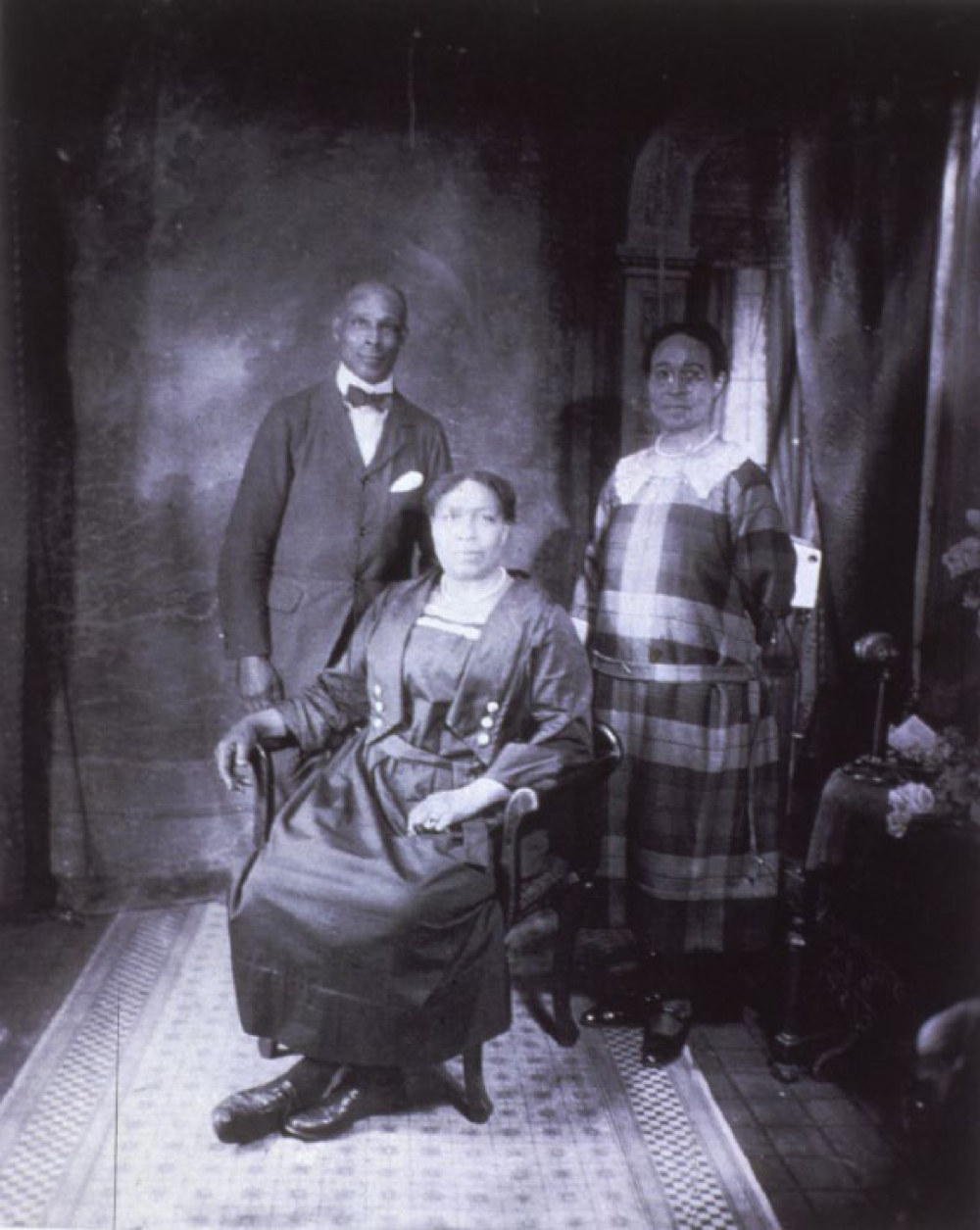
James Van der Zee, Group Family Portrait, in Barthes’ Camera Lucida (1980). Reproduced with permission.
So what did pearls want? Can they be world- or at least context-making? Can they escape from or do they create imperial blind spots? Certainly giant oysters did grasp onto and kill pearl divers. 7 Christopher Pinney (2002), Jonathan Lamb (2011) and Alexander Nemerov (2001) have variously addressed the entanglement of subject and object with an emphasis on still life painting. Lamb (2011: 123) differentiates between objects that serve humans and things that are ‘obstinately solitary, superficial and self referent, sometimes in flight not in our direction’ so that a thing can be ‘as full of itself as it is empty of everything else’. He points to the fact that at the heart of English common law lies an idea of the guilty thing (which might include the deodand) – a thing which is capable of creating great harm and consequently deserving punishment. But perhaps objects can negotiate these narratives of guilt without necessarily being turned into what Lamb terms ‘idols’. Pinney’s notion of the xeno-figure enables us to rethink European colonial modernity as a finely spun ‘cosmology of animate objects’ and as a ‘field of affective intensity’ whereby humans are entangled by objects (Pinney, 2002: 132, 147). As well as drawing upon colonial painting, porcelain fragments, chintz and aircraft insignia, Pinney examines 19th-century stories of things in relation to empire which I explore qua pearl below. Pinney’s search for the uncanny and haunting quality of things finds a parallel in Alexander Nemerov’s (2001: 27–30) discussion of what he terms ‘tactile still life’. Nemerov’s phenomenological excursus on the American painter Raphaelle Peele’s Blackberries argues for a projection of the viewer’s body onto the world of the picture: ‘in this world our bodies advance, sticking as it were to the surface of things and thus reversibly giving back to us a sense of our own embodiment’ (p. 32). This involves a peculiar kind of reflective luminosity: objects enable us to ‘catch a light from our space, which they throw back as the spark of an inward light that is both their own and that of the projector. The glow they receive is the glow they give back’ (p. 32). But rather than the glaucous luminosity of Peele’s painted blackberries, pearls invite a kind of light (pearlescence) which emanates and is enhanced by contact with the body from whence they partly receive their shine. As is well known, when worn against the skin, pearls take on as well as temper theirs and their wearers’ temperature and lustre.
This lustre made pearls the objects of fascination and international rivalry. Playing eccentrically with Walter Benjamin’s title for his essay on the artwork in the age of mechanical reproduction, perhaps the colonial artwork must be considered in/as the age of pearl. In the European cultural epochs preceding the one I discuss here, the Baroque-shaped irregular pearl gave its name to a whole cultural movement whereby irregularity came to be seen de rigueur and determined by embellished surfaces of proliferating ornamentation. The baroque pearl’s shape and peculiar luminescence inspired artworks and theatrical performances with multiple viewpoints whilst its light came to represent the world’s self-professed illegibility and excesses whether in the sheen of an anamorphic mirror or in relation to what Hal Foster (1993: 21) calls ‘the special shellac’ of 17th-century Dutch painting. For art historian Hanneke Grootenboer, such still life images show a painting’s ability to have a thought (Grootenboer, 2011). This thought can be embodied by a dew drop which she sees as optically and mythically linked with the pearl which draws our attention to the underneath and the intelligence of painting. Scientists at this time endeavoured to examine the inner core of pearl so as to make it compossible with Liebniz’s philosophical concept of the monad. The subsequent European cultural movement – the Rococo took its name from rocaille which while more focused on the minute and the fragmented also looked to pearl and its subtle, minute shimmer. For Friedrich Ohly (2005) the pearl became emblematic of the ardent melancholia of German Romanticism. Intent on re-evaluating pearl as worlding, Karl Marx in Volume One of Das Kapital declared that ‘no chemist has discovered exchange value in a pearl or a diamond. Rather if commodities could speak they would say this: our use value may interest men but it does not belong to us objects’ (Marx, 1992[1867]: 25). ‘Us objects’ also pertained to the gleam of the slave body – often set against both the whiteness of the society woman owner and a pearl necklace worn by the slave page (Figure 2). This gleam in the light of recent postcolonial readings can be seen to provide a critique of Marx’s theory of value. Fred Moten (2003) takes issue with Marx’s inability to engage with slaves as living commodities, that human breath and sound as well as light have potential agency – agency which Krista Thompson (2015) argues has become central to contemporary black self fashioning in art, photography, video and dance.
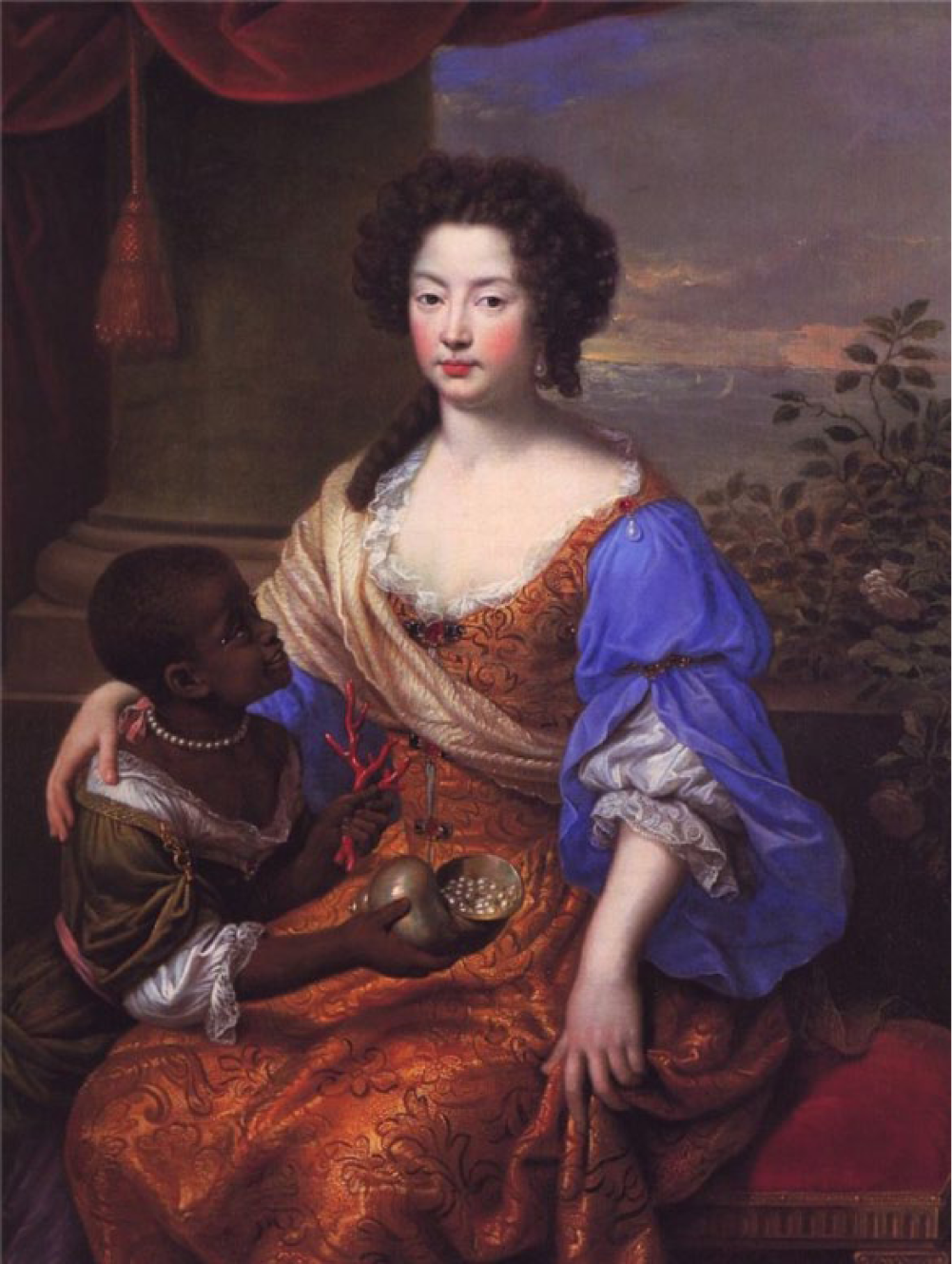
Hyacinthe Rigaud, Louise de Keroualle, Duchess of Portsmouth, 1682 National Portrait Gallery. Reproduced with permission.
Supplementing the Baroque, Rococo, German Romanticism and Marxist economics there is then a ‘creole’ aesthetic of colonial modernity that is also shaped by the pearl, and which extends from the Caribbean to India exemplified by the extensive published memoirs of JB Tavernier (the 17th-century French traveller and jeweller) to Malinowski and beyond. European modernity was in many ways shaped by Indian pearls and pearlescence. From the reign of Jahangir (c.1605–1627) pearls became central amulets as well as honorific currency in Mughal sovereignty. 8 Certainly the world of the Mughals glistened with pearls – in the chunam set off with pieces of mica in palace interiors; and the emperor Aurangzeb named his exquisite palace mosque in the Red Fort, Delhi, the Pearl Masjid. Pearls were literally ingested as part of a material continuum of art, imperial ceremonials and the body. This Mughal celebration of pearls and pearlescence kickstarted much anxiety for British colonial officials, who were anxious to partake in mimetic rivalry with elite India and to emulate its visual and material culture.
As part of this creole scape, or what Pinney terms a ‘reflection of a reflection’, pearls claimed a kind of doubled alterity in fictional writing. The popular pantomime ‘Harlequin and the Koh-i Noor or the Princess and the Pearl’ (Anon, 1852) was produced swiftly to capitalize on the sensational display of the caged Koh-i Noor diamond displayed at the Great Exhibition (Hyde Park, London, 1851). Throughout the pantomime, alternate choruses of male and female oysters call to an Indian prince and to one of the main characters Mother O’Pearl. The prince responds that he is desperate to find a ‘pearl of mighty size’ (p. 13). Mother O’Pearl is not pleased to be disturbed by human presence in her underwater terrain: We are very happy down here, I can assure you In pleasant converse here we pass our hours … We soundly sleep amidst the tempest’s shock. (p. 14)
The economy of the pearl here outplays the desire to capture the famed Koh-i Noor diamond – no doubt resonating with pearl’s more lurid association with the fictional murderous barber Sweeney Todd who was then hugely popular. 9 In Arthur Applin’s picaresque novel The Pearl Necklace (London, 1911), the theft of a pearl necklace leads to the breakup of friendships and the initiation of illicit love affairs. When the necklace appears around the neck of one of his lovers, the protagonist Michael ‘seemed paralyzed, standing quite still, staring’ – interpellated! (Applin, 1911: 287–288). Most famously John Steinbeck’s 1940s parable The Pearl shows how racism, greed and violence were all generated by one New Mexican diver’s find of an enormous pearl (Steinbeck, 1947). Not only is the pearl the context-making protagonist, but the very language of the novella is pearlescent, filled with a sense of a ‘ghostly gleam’ (p. 24). The diver Kino sees ‘in the surface of the great pearl’ ‘dream forms’ – dream forms which quickly turn into a nightmare (p. 25).
A focus on pearls allows us to think about the heterogeneous and contradictory ‘shape’ of imperial modernity – i.e. the need to make waste and its anxiety about and desire for scarcity (Bataille, 1990; Xenos, 1989). Visiting a private view of the exhibition dedicated to pearls at the Victoria & Albert Museum, London, in late 2013, I was struck by the heavy, imperial safes temporarily transformed into stalwart jewellery cabinets, the almost pitch black interiors with their spotlights intended to allow for the sheen, the projected aura of pearls made to shine forth, the hordes of women gazing at and wearing pearls, and the overflowing buckets of at least tens of thousands of cultured pearls that heralded the exit to the exhibit. Here was a certain disparity between the fascination with singular pearls – the earring of Charles I which he supposedly grasped tightly in his hand as he was executed – and an obscene illusion of material uniformity and excess.
Pearl, tear
Slavery of the elite and Orientalism’s sadness
Pearl/essential truth which is outside the shell of superficial existence. (Hafiz)
For the famed Islamic poet Hafiz to undertake the art of punning (gowhar) is to think about two meanings at once. This doubling treats ‘the tear’ as either the dew drop from the angels of Islam weeping, or tear as the lightning that tears across heaven and sears the ocean so as to fertilize the waiting shell. 10 This dual definition of ‘tear’ can serve as a device for thinking about the important conjunction between Islamic, Hindu and British colonial ideas surrounding the pearl. Pearls (by which I mean seawater pearls) had to some extent to be redeemed from lingering associations with classical decadence (Nero, et al.). Both lightning and the tear owe something to Hellenistic and neo-illuminist philosophy. 11 According to important Islamic mystics and poets, including Suhrawardi, Saadi, Hafiz, Rumi, Al-Ghazali and Nizami, tears are shed in Heaven. These might be the tears of angels but they are also the tears of Adam and Eve. Either way, they are conveyed through descending chains of angels. When tears are shed in heaven they then fall through the sky where they are transformed into dew which fertilizes the waiting shell in order to form pearls. 12 Dew and the pearl (as beautifully examined by Friedrich Ohly, 2005) share a lunar quality. Heavenly dew falls at night bestowing upon the pearl special luminous powers.
In pre-colonial India, pearl as the metaphor of both heavenly beauty and great sadness was taken up by numerous Islamic writers to describe intense love, longing and ethereal beauty. Nizami’s Layla and Majnun – one of the great love poems of the Islamic Middle Ages – conjures up the tragedy of the impossible love between the protagonists Majnun and Layla (Nizami, 1966). They tried ‘to mend the torn veil, to protect their naked love in the world’. Layla, who is frequently compared to the moon or as being a pearl cannot be united with her lover. After her death, Majnun weeps ‘pearls of sorrow’ which are followed swiftly by Layla’s own demise. According to Nizami, ‘the white shell, its pearl vanished is washed clean’ as now our ‘jewelled tears of mourning flow into it’: ‘hear what the deep sea diver sounding the ocean of the soul has to tell you!’ (Nizami, 1966: 77).
In his magisterial published lecture on dew and pearls, Friedrich Ohly (2005) places pearl at the heart of his philological inquiry into German 18th- and 19th-century Orientalist understandings of Islamic writers such as Nizami and Saadi. He exclaimed: ‘it is quite astonishing, that, as far as I can see, no philologist has ever tried to make a summa of all the metaphors for the origin of poetry’ (p. 238). Ohly employs what he calls a ‘mosaic’ of pearl metaphors in order to examine both Orientalism and western intellectual disaffection with pearlescence. While Goethe engaged enthusiastically with the poetry of Saadi and Sir William Jones’s translations of Persian classics so as to conjecture in verse pearl’s divine origin – to the point that the pearl is seen to bewail its own perfection – Johann Paul Friedrich Richter (perhaps taking a lead from Linnaeus who experimented by inserting grit into oyster shells in the hope of producing pearls) came to exemplify for Ohly, the emergence of a ‘pathogenesis of the arts’ (p. 244). Poetic creativity Ohly reviews as disfiguration: just as the oyster is wounded so is the artist. Such wounding read as intense self-introspection can with great agony fashion a pearl as artwork.
In Enlightenment/romantic Britain, pearls were not only the subject of a well-established Christian-inspired and/or a literature of (be)longing, but they also became material/artistic objects associated with melancholia, mourning and desire. It can be conjectured that this fashion for pearls and contemplation was partially informed by Mughal courtly practices. Just as Goethe borrowed extensively from Saadi, maybe the devotional focus that pearls inspired found a precedent in Mughal 17th-century court ritual and pictorial representation. Emperor Jahangir not only gifted his portrait in tiny bejewelled frames to his devoted followers but in several courtly miniatures he was frequently depicted touching his strings of pearls as if they were prayer beads, whilst contemplating icons of his father Akbar, the Virgin Mary or Isa (Jesus) (Figure 3). As brooches, keepsakes, lockets, pearl-framed miniatures now glimmer with lost stories of the eye – stories which have recently fascinated art historians. Central to her study of longing and melancholia vis-à-vis the European eye miniature, Hanneke Grootenboer (2006: 66) describes the diachronic constraints of the western gaze not through the etymological duality contained in the notion of the punctum but through the lens of a mise en abyme: ‘A mise en abyme is any aspect enclosed within a work that shows a similarity with the work that constrains it.’ The many tiny 18th- and 19th- century eye miniatures she analyses are often elusive and non-identifiable; if they do contain stories of the eye, they are at best intimate, conjectural, lost. Alongside tiny diamonds, the miniscule pearls that appear to be shed by the eye (such as in Figure 4) are English seed pearls which are set off by a frame of southern Indian pearls traded by the English East India Company in the Shia city of Hyderabad. The eye with its tiny pearl-like glint (possibly painted with pearl-infused pigment on Indian ivory,) attempts to hold and shape the viewer’s gaze. In spite of its small scale, the field of vision is open, potentially aggressive and elliptically reciprocal (Lacan, 1980). Marcia Pointon (2001) pushes this in a slightly different direction to think about the miniature as analogous with a relic. Eye miniatures she defines broadly as ‘portrait objects’: ‘the miniature replica – unlike convex mirrors in paintings – does not partially reflect the surroundings but later offers an accurate reflection of the subject of the work itself that is, it acts as a commentary on the work itself’ (p. 46). In light of these readings, the frame of pearls seen in the miniature not only enhances but also detracts from and usurps the powers of pictorial representation.
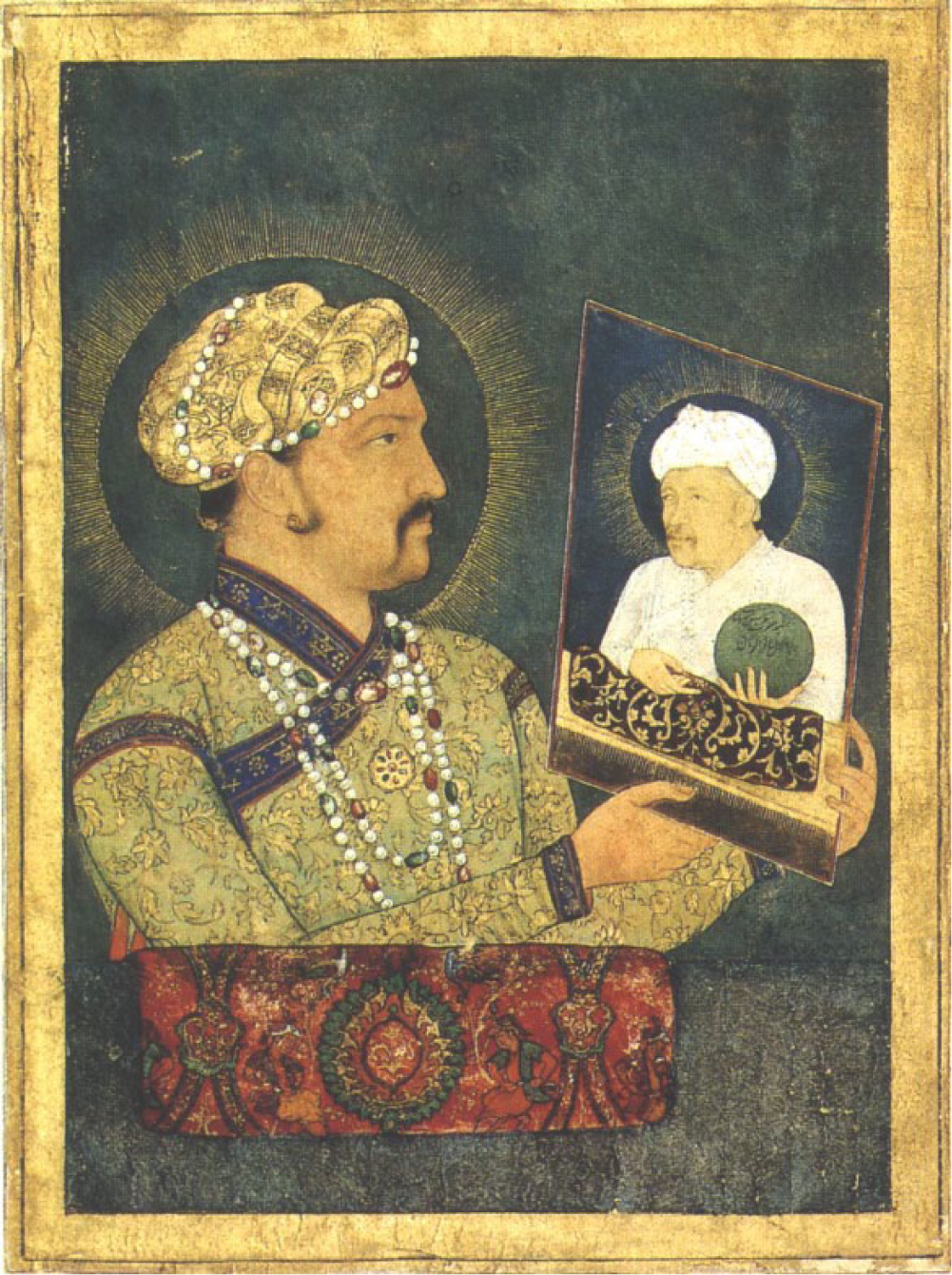
Abl’Hasan, Jahangir with a portrait of Akbar, c.1615, Chester Beatty Library, Dublin. Reproduced with permission.
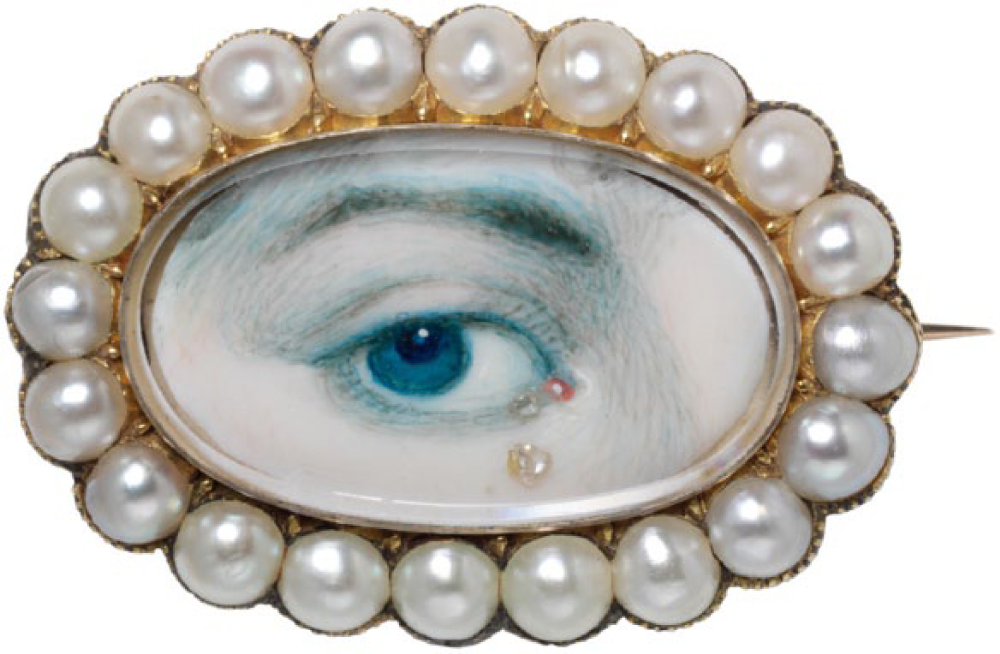
Anonymous artist, Eye miniature, c.1780s Victoria & Albert Museum. Reproduced with permission.
The miniature portrait set in an intricate pearl frame would soon be mobilized as part of the imperial cult of Queen Victoria’s sovereignty.
13
In George Beechey’s 1852 portrait of the 15-year- old prince Dalip Singh, the last ruler of the Sikh Empire, who had just been exiled to Mussoorie after losing his Punjabi territories to the English East India Company, the former maharajah was ordered to sit for his portrait at the request of Lord Dalhousie. As Romita Ray (2013) and Eaton (2013: 151–194) have argued, portraits by the mid-19th century constituted a form of aggressive colonial ‘currency’. Forced to pay for their likenesses, an ever increasing number of Indian princes were brought into the coercive visual economy of the colonial state. Dalip Singh’s many colonial portraits feature seven ropes of pearls (which soon became the standard number for those princes forced into theatre states under British rule). Beechey was specifically chosen as portraitist on this occasion due to his then status as Court Painter and former Comptroller of the Royal Household at the court of Lucknow where he had once assumed an authoritative, diplomatic presence. Beechey’s father had been trained by the well-known colonial artist Johann Zoffany and although he did not travel to India he portrayed the Persian envoy to George III – Ab’l Hasan.
14
When the portrait was dispatched to Lord Dalhousie in Calcutta, Dalhousie wrote to Dalip Singh: At last after a long delay upon the river, Your Highness’s portrait has arrived. It is in excellent condition, not all injured by the weather. It is very like you and does great credit to Mr Beechey as an artist. Your Highness has done me really a great favour in offering to me this likeness of yourself. If please God I should live till I am old, I shall look upon it with strong feelings long after my connection with this country should have been dissolved and always with the renewal of interest which I feel in yourself and in everything belonging to your fate and fortune. You have gratified me too by asking for my portrait in return – I shall have great pleasure in sending one to you as soon as I can get one worthy of our acceptance – but Mr Beechey won’t come to Calcutta and there is no good artist here. (Dalhousie in Z/84/1923, 1852)
Although seemingly civil, Dalhousie’s refusal to provide a portrait in return can be interpreted as a mark of colonialist sly civility. Certainly there were portraitists in Calcutta but, as had become the practice of colonial portraiture by this date, colonial officials refused to honour the return of a painted likeness. Even cheap prints of Queen Victoria were shown to Indian princes by colonial officials who insisted that they could not be kept (Eaton, 2013: 192–193). Dalip Singh’s portrait did not travel with Dalhousie to Britain but mysteriously ended up in the possession of the Maharana of Udaipur who was forced to gift it to the Prince of Wales during his tour of India in 1876. The pearls that Dalip Singh wears in Beechey’s likeness are probably not his own. His rich heritage of pearls was sold a year before the portrait in at least eight major auctions in Calcutta. The British allowed him to keep the famed Koh-i-Noor diamond which was listed as Article Three in the 1849 treaty drawn up to annex his kingdom. By deeming this to be his personal property, Dalip Singh would be coerced by the British into gifting the diamond to Queen Victoria who, as is well known, had it drastically reduced and recut; in its new form, she brought it out to taunt him on several occasions once he was forced into British exile.
Expanding on the work of Bindman and Gates (2010–2015), Delbourgo (2011), and Rosenthal and Lago-Ortiz (2013) in relation to the iconography of slavery, I would like to suggest that pearls perform in colonial pictorial representation as ersatz manacles. Enslavement was partially displaced in the age of abolition onto the Indian elite. There is a certain ‘similarity between divers tied by ropes and African laborers shackled by chains’ which can be said to link labour, aquatic commerce and ‘broader reflections on the submarine as a theatre in the history of slavery’ (Delbourgo, 2011: 162). Instead of wearing the miniature portrait of the Queen Empress across the heart (which was reserved for the Star of India), princes were made to brandish (at least in visual representation) her likeness, most usually painted by the portraitist William Ross, around their necks as an elite surrogate for a slave collar. After all, to be supposedly enslaved to luxury was by the mid 19th century a common Orientalist trope (Codell, 2012). But even these coercive likenesses could have further repercussions. Queen Victoria, via her colonial officials in India, ‘lent’ Indian princes, kings and nawabs her likeness – whether miniature paintings or prints. These had to be returned, thus putting the question of inalienability in flux (Eaton, 2013: 192–193). Flux though, as Taussig (1993: 249) would have it, can be a space from which to command even if, in the kingdom of Baroda, command meant to relinquish pearlescence.
‘Ornament’ and ‘crime’: The case of Baroda
Are there cases when ornamentation is needed? (Adolf Loos, 1950: 45)
A defender of Loos’ manifesto on the agency of ornament – its exigency, degeneracy and obsolescence in early 20th-century Europe, Walter Benjamin praised Loos’ ‘combatting [of] the aesthetics of imperialism of the last century’ (Benjamin in Loos, 1950: 45). Like pearls as ceremonial wear, ornament as an aesthetic and labour category emerges uncertainly in the colony. To be decked in jewels might be a form of ceremonial coercion but it could also be more accusatory and strategic. Predicting revolution in Baroda, Dinshah Ardeshir Talagarkhan published an inflammatory pamphlet which condemned both the Gaekwad Malhar Rao and colonial intervention into local politics (Talagarkhan, 1875). Arrested and forced to appear in the Supreme Court of Baroda in March 1875, Malhar Rao ‘looked pale and seemed rather nervous … His jewellery was in keeping – a necklace of pearls fringed with rubies and emeralds. He wore no rings but pearl pendants hung from his ears’ (Anon, 1875: Proceedings of the Baroda Commission, 3)
At the official judicial enquiry, Malhar Rao’s servant Rowjee was initially accused of attempting to poison the British Resident, Colonel Phayre. Phayre had recently been appointed by the Government of India to reform the Gaekwad’s affairs; his negative assessment was reported back to the Viceroy who, while in agreement with the need for reform, tried to have him removed from his post. Phayre’s endless complaints kickstarted the rumour and investigation into his own supposed poisoning. He directly accused Malhar Rao. The Commission Prosecution claimed that at least three attempts had been made to kill Phayre, one of which involved soaking arsenic into the dressing of Phayre’s infamous boil (one witness – a servant of the Gaekwad – gestured that the Britisher’s boil ‘affliction’ was the size of his own head). More intriguing for the case of jewels was the Resident’s sense of malaise after consuming his daily sherbet. According to the Prosecution, a gulp or two of the sherbet left a coppery taste in the colonel’s mouth, making him critically but not fatally unwell. On seeing the mysterious spilling of the sherbet on the verandah below, Phayre’s physician (Dr Seward) confiscated the sherbet tumbler and made a series of tests under his microscope. Questioned by the Prosecution was ‘there any other substance?’ he replied it was white, transparent and crystalline – a kind of pearlescent, glittering dust (Anon, 1875: Proceedings of the Baroda Commission: 47). Rubbing it with charcoal, placing it on a glass slide under a spirit lamp he found the substance not to be pearl after all but arsenic mixed with diamonds. Malhar Rao’s servants claimed that these were the ingredients of a medicine initially intended for the maharajah’s horse – a medicine which should also include ‘large ants, serpents and the urine of the black horse’ (Anon, 1875: Proceedings of the Baroda Commission: 101; Malhar Rao, 1874–1875, Ms Eur D870). The numerous commissions and judicial cases of princes treated by colonialists as scapegoats so common in 19th-century Indian courts of law (Chatterjee, 2002) and their Kafkaesque forensics here shifts down in scale to the molecular minutiae of the unidentifiable dust found in a sherbet. By the end of March 1875, the enquiry moved to a full blown trial: Malhar Rao was convicted by the British and forced into exile. He would never be allowed to re-enter Baroda. 15
Jewels, however, would have their ‘revenge’ as mass rioting broke out across Baroda a few days later (Talagarkhan, 1875). Shopkeepers refused to sell colonialists food in an attempt to induce a racial reversal of what was so common in colonial India – famine. Although colonial counter insurgency in the form of military intervention was swiftly put into force, at least in the case of pearls, the Gaekwads of Baroda continued to trouble the British. In Hindu mythology, the pearl is associated with the moon, Chandra and Krisna. Often taken as a more generic term for jewel (ratna), the pearl was frequently set in royal amulets alongside other planetary stones associated with Hinduism (ruby, sapphire, emerald, topaz, cat’s eye, coral and red zircon). Pearls carried a resonance of kingship which the British could not comprehend as they assumed a certain anxiety about pearls’ magical characterization in those closely guarded Sanskrit texts (The Anthasastra, The Ratnapariska, The Agastimata) – texts that proscribed the auspicious combination of nine precious stones (navaratha). While the ruby-as-sun should be at the centre of royal amulets in Baroda (as a life-giving force and an exceptionally efficacious means of harmonizing planetary energy), the pearl-as-moon also had an important magnetic attraction. As with the figure of the Shark Charmer which I discuss below, there is a magic at work that colonialism could control and did not understand. If maharajahs themselves were perceived to be celestial, they needed this energy to be contained in and radiated back in the form of pearls (Waghorne, 1994). Sometimes their energy was just too much: pearls had to be hidden in temples for the beautification of deities.
Aside from what are now called the Baroda pearls (two strands of which were recently auctioned at Christie’s where they fetched over $7 million) and infamously/defiantly worn at the commission by Malhar Rao where he did not testify directly, pearls continued to ‘wreak havoc’ in the colony. 16 Although not a Muslim, Malhar Rao’s predecessor as Gaekwad of Baroda, Khande Rao (r. 1856–1870) is rumoured to have held secret religious and political affiliations which led him to commission a sacred carpet. Exquisitely embroidered with well over one and a half million Persian Gulf ‘Basra’ seed pearls and embellished with numerous other jewels, this carpet was intended by Khande Rao to be donated to the tomb of the Prophet Muhammad at Medina. Unmatched in its beauty (it included 2,500 table and rose cut diamonds, gold, emeralds, sapphires, remains of which are now in the National Museum of Qatar, Doha), this was clearly the world’s most illustrious carpet (Figure 5). The choice of Persian Gulf seed pearls is politically significant. As the British sought to impose taxes on pearls fished in southern India, the rulers of Baroda asserted their cosmopolitan status and political affiliation with the Gulf. And of course there could be no more powerful honorific and holy site than the Prophet Muhammad’s tomb. Unfortunately, the carpet soon came onto the colonial radar and it never reached Medina. Even though the British forced Malhrao Rao’s successor Sayajirao Rao III (r. 1875–1939) to exhibit the carpet at the 1903 Coronation Delhi durbar, to Lord Curzon’s anger the Gaekwad ordered it to be cut into pieces and sold (Curzon Mss Eur F111, nd). At the next imperial durbar of 1911, Sayajirao Rao III refused to wear the famed Baroda pearls in addition to ignoring Queen Mary, much to the anger and embarrassment of Viceroy Hardinge and George V. As a proponent of swadeshi, the Gaekwad did not wish to play with the idea of sly duality of identity that Romita Ray associates with the Orientalist ornamentalism of the durbar (Ray, 2013: 145). His outright rejection of pearls demonstrates their nationalist obsolescence by way of their association with colonial spectacle.

Anonymous print maker, Malhar Rao, Illustrated London News, April 3, 1875, Bridgeman Library. Reproduced with permission.
In spite of British attempts to control the pearl trade in India this frequently failed to materialize. 17 Hyderabad and Bombay remained and still are leading pearl markets controlled largely by Indian merchants. To wear or not to wear pearls became an act of maharajah/maharani defiance. And this took on new resonances after Indian Independence. Maharajahs frequently hid their jewels to avoid the new state taxes imposed on them, as in the case of the very rare, moon-coloured pearls of Bhupinder Singh. Even when desperately short of money, certain families were precluded from selling their famed pearls, as in the case of the nizam of Hyderabad. In 1995, the Government of India won a legal battle to buy this collection which it did so for a pittance. The National Museum in Delhi has grandiose but as yet unrealized plans to build a gallery devoted to these pearls.
Nacreous waste: The Shark Charmer and colonial miasma
The diver must skim over the mud much as a swimmer uses his feet in the water to get to the dead oysters. (James Hornell, 1930: 88)
Working in Baroda supposedly at the invitation of the gaekwad during the 1920s (when there was a period of intense photographic surveillance of the region), Hornell made several tours of sea-beds and main estuaries in his investigation of the state of the fisheries. He concluded that two thirds of the oysters were dead with their ‘untold gems’ in soft mud (Hornell: 1930: 11). Here I would like to take a lead from Taussig’s My Cocaine Museum (2004) to think about the rhizomes fissuring and connecting commodities and hard-grafted resources. The central section of My Cocaine Museum is dedicated to what Taussig calls ‘Water in Water’ – diving, swamps, dredging for gold and how in Colombia this search for gold exacerbated the consumption of cocaine as the market for gold bling increased. In my case, I’m moving in the ‘reverse direction’, away from the elite and colonial coercion to the subaltern. In terms of diving techniques in India (divers worked in pairs with a diving stone and were not provided with nose clips as used in the Persian Gulf), colonial authorities made no attempt to introduce the newly patented diving suit, repeatedly concluding that Indian diving was dangerous but so archaic that it was not worth interfering with. 18
In 1885, the British colonial authorities in the Gulf of Manaar attempted to stamp out the presence of what they considered to be a dangerous, roguish, miasmic figure – the Shark Charmer. Known also as shark binders (kadal-kotti in Tamil; hai-banda in Hindustani) these shamans travelled for the seasonal pearl fishing. Perceived to have extraordinary powers, the Shark Charmers often worked in pairs at a distance: One goes out regularly in the head pilot’s boat. The other performs certain ceremonies on shore. He is stripped naked and shut up in a room, where no person sees him from the period of the sailing of the boats until their return. He has before him a brass basin full of water, containing one male and one female fish made of silver. If any accident should happen from a shark at sea, it is believed that one of these fishes is seen to bite the other. The divers likewise believe that, if the conjurer should be dissatisfied, he has the power of making the sharks attack them, on which account he is sure of receiving liberal presents from all quarters. (Cordiner, 1807: Vol. II: 52)
19
Associated with volt sorcery and sympathetic magic, the Shark Charmer had for centuries held an important place in Portuguese, Dutch and British territories in southern India. Edgar Thurston, Director of the Madras Museum (demonstrating his predilection for collecting omens) observed in his typically bricoleur manner: It is recorded by Marco Polo that South Indian pearl divers call in the services of an Abraiman (Brāhman?) to charm the sharks. ‘And their charm holds good for that day only; for at night they dissolve the charm, so that the fishes can work mischief at their will’ … Before the fishery of 1889, at which I was present, the divers of Kilakarai on the Madura coast, as a preliminary to starting for the scene thereof, performed a ceremony, at which prayers were offered for protection against the attacks of sharks. ‘The only precaution,’ Tennent writes, ‘to which the Ceylon diver devotedly resorts is the mystic ceremony of the shark-charmer, whose power is believed to be hereditary. Nor is it supposed that the value of his incantations is at all dependent upon the religious faith professed by the operator, for the present head of the family happens to be a Roman Catholic. At the time of our visit, this mysterious functionary was ill, and unable to attend; but he sent an accredited substitute, who assured me that, although he was himself ignorant of the grand and mystic secret, the fact of his presence, as a representative of the higher authority, would be recognised and respected by the sharks.’ At the Tuticorin fishery in 1890, a scare was produced by a diver being bitten by a shark, but subsided as soon as a ‘wise woman’ was employed. Her powers do not, however, seem to have been great, for more cases of shark-bite occurred, and the fishery had to be abandoned at a time when favourable breezes, clear water, plenty of boats, and oysters selling at a good price, indicated a successful financial result. (Thurston, 1912: 198)
Working with the divers who were mostly of the Parawa caste, the charmers encouraged these men to carry a charm made from a dried palmyra leaf on which were inscribed mystical characters (Stueart, 1843: 15). The British attempted to reduce their activities and rewards by stipulating that each shark charmer was only to receive one oyster a day from each diver before banning their presence at the fisheries altogether (Kunz and Stevenson, 1908: 116).
Although mosques and temples were initially allowed to control their own divers and to use profits for their upkeep, the colonial authorities swiftly put an end to this in 1855 – one year after they had introduced tight surveillance on the activities of the fisheries. 20 Annual reports on the fisheries as well as detailed monographs commissioned by the government explored the shifting status of the oyster beds, piracy, looting and water temperature as well as conjecturing on the origin of the pearl and whether it could be artificially manufactured (Herdman, 1903–1906; Hornell, 1906; Thurston, 1890). Looking back to Linnaeus, who had been reasonably successful in the propagation of artificial pearls, colonial officials, with the assistance of the microscope, sought to read the nacreous layers of the pearl in order to explain its makeup and origin. In more picaresque terms, they gathered lengthy genealogies of pearls including that of the Raganighantu of Narahari – a mid 13th-century Kashmiri physician who supposedly claimed that pearls came from bamboos, the heads of elephants, bears, serpents, whales and fish. 21 Given a microscope, an aquarium, glass globes and chatties by the Madras government – but not any camera equipment that we know of – Staff Surgeon EF Kelaart was charged with examining in as minute detail as possible the appearance, anatomy, habits and life cycle of the Manaar oyster. Conjecturing whether they were hermaphrodites, why they assumed a certain colour (habitat or disease?) and whether pearls being stemmed from nacre were in fact irritated by bits of grit, seaweed or their own eggs, Kelaart became entranced with oysters’ potential faciality: were blue spots on their shells in fact eyes? Ordered to establish an oyster colony, he found oysters to be ‘gregarious in their habits’: it seems there is a certain anthropomorphic, proto-ethnographic form of investigation at work here (Kelaart, 1857–1858: 7). Edgar Thurston was not only to collect pearls for the Madras Museum but also to record colonial experiments by rearing oysters near Dutch Bay. He noted that all the oysters raised or transplanted there swiftly died (Thurston, 1890). Far from unique, his account underlines colonial anxiety surrounding the repeated British inability to control local ecology, to read the formation and life styles of unruly or vulnerable sea life.
Shifting sands, migrating oysters, unpredictable currents, etc. allow us to characterize these colonial fishing grounds in terms of what Michael Taussig would call miasma – i.e. that unruly, ambiguous space of the abject commons that blurs land and sea. Not in Taussig’s case the morass, the sludge, like a ‘lunar zone of rot and decay’ that he identifies with the Atlantic coast of Colombia’s mangroves, but the stinking, shifting ‘fly coast’ of the Manaar shoals or the dead oyster beds of Okhamandal in Baroda (Taussig, 2009: 45, 173; Hornell, 1930).
This miasma of pearls extended to human habitation. The fisheries constituted veritable riotous seasonal heterotopias of up to 50,000 men, women and children who set up home and shop around the town of Marichchukkad. Living in makeshift huts they gathered en masse through word of mouth, rumour or after the colonial government posted annual advertisements in the press announcing the immanent opening of the fisheries. Travelling from Malabar, Ceylon, the Malay Archipelago, Canton and Madras, this cosmopolitan, subaltern crowd were for some supporters of British colonialism ‘the scum of the East and the riffraff of the Asiatic littoral’ (Kunz and Stevenson, 1908: 109). The camp-as-heterotopia soon came to be highly regulated by British colonial officials who regularly doused it with cheap disinfectant and provided a police court, jail, bank, post and telegraph offices, auction room, hospital and cemetery. Heterotopia according to Michel Foucault (1984) can be as much a counter or crisis space. From Foucault’s perspective, this was exemplified by beaches, ships, brothels, colonies and by many spaces associated with rites of passage. The camp population was counted as part of an attempt in the name of ‘public peace’ to avoid any potential sedition although regular riots and illicit trading took place (Ferguson and Ferguson, 1881: 172). Avoiding the purview of the colonial gaze, divers hid shells on their bodies and in the ships’ sails; they returned to shore to open shells when they knew the colonial supervisor and his attendants would not be present. 22 This way they could open as many oysters as possible without being forced into the colonial tanks where they were closely watched in the activity of shell chucking. Deemed to be looting if caught, the removal of shells without colonial sanction could lead to imprisonment.
From a colonial perspective the chucking of hundreds of thousands of shells per day on the shore line turned the camp into a stinking miasma: The lady who cherishes and adorns herself with a necklace of Ceylon pearls would be horrified to know how the gem is evolved. The great quantity of repulsive blue bottle flies is so essential to success in releasing the pearls from the flesh, that a scarcity of them is looked upon as a great misfortune. (Kunz and Stevenson, 1908: 122)
In an attempt to alleviate some of the stench of rotting oysters in this ‘black mass of flies’ brought to camp daily, the colonial government agreed to finance amateur inventor GG Dixon’s Washing Machine (1904–1905), see Ferguson and Ferguson (1881: 108). 23 Not particularly efficient, this arcane device became the source of controversy as, under pressure from the British government, colonial authorities in Ceylon and Madras had to agree to lease its fisheries out to the private Ceylon Company of Pearl Fisheries Limited in 1906 as well as to sell the machine to them. 24
Although yielding the south Indian and Ceylonese colonial authorities’ largest single source of income, the fisheries repeatedly failed to produce a regular harvest. Within three years of taking over the Manaar fishery from the Dutch, the British had succeeded in depleting the number of oysters entirely, which led to an anxious spate of articles, public addresses and reports on the rapid collapse of a potentially lucrative luxury monopoly (Cordiner, 1807; Le Beck, 1798; Percival, 1803). 25 In spite of this ‘archive fever’, during the 19th century, only 36 fisheries took place as colonial officials repeatedly concluded that ‘the pearl fishery is a branch of revenue too precious a nature to be comprehended at present’ (Colebrooke, 1831: 64). Manaar oysters were believed to generate the best pearls when seven years old – just one year before their anticipated death. Their shells being thin and brittle were not suitable for the mother of pearl market; rather they ended up as ‘camp filling’, chunam or they were ground up and digested along with betel nut (tiny pearls were also chewed, ingested and spat out in this way). Scarcity and waste come together in the formation of this imperial economy – an economy that can be read through the aesthetic of kitsch.
Kitsch: Interpellation, obsolescence
The future is but the obsolete in reverse. (Vladimir Nabokov)
Pearl-as-material, as has become apparent in the discussion above, is very much associated with colonial regulation, speculation and coercion. It can be said to be the material embodiment of obsolescence. Obsolescence is most usually defined as that which is discarded – even when still of value – whether Malhar Rao’s kingship or the oyster shells of Manaar. But pearls themselves also began to fall into the prime aesthetic associated with obsolescence – kitsch (Benjamin, 1927–1930b). Kitsch might be seen as a failed or all too successful commodity; it can also be a dialectical image, whereby to die or to be outmoded is to have relevance for the present in all its obsolescence. Kitsch then is ‘nothing if not an extended memory whose elusiveness is made even more keen by its extreme iconicity’ (Olalquaga, 1991: 27). Pearl is like kitsch in that it ‘is dead from the moment it is born’ (p. 67).
One of the most despicable characters in The Great Gatsby, Tom Buchanan, dismisses the object of Jay Gatsby’s longing and desire – his wife Daisy – as worth the same as a $350,000 pearl necklace (Fitzgerald, 1992[1925]: 32). Certainly by the later 1920s the wearing of long ropes of pearls – whether sea water or cultured – had become the height of European and north American fashion, assisted by the opening of new sources for fresh water pearls in the Pacific and Japanese experiments with freshwater pearl farming. Today only 0.5 per cent of pearls are natural. Over-fishing and the turn to oil exploration in the last 70 years, plus ecological disaster, has made pearl as a source of great wealth in India and the Persian Gulf largely redundant. Who knows how many thousands of divers lost their lives fishing for pearls. This involved a certain ‘tragedy of the commons’ as indentured labour and the notion of inexhaustible oceans necessarily led to the loss of southern Indian, Ceylonese, Torres Strait and Aboriginal lands as well as contributing to the destruction to parts of the Great Barrier Reef (Akerman with Stanton, 1994; Ganter, 1994). The British imperial pearl industry, which was increasingly directed from Queensland from the 1870s due to the conflicts and impoverishment of Manaar, brought thousands of Melanesians to the Torres Strait – many of whom were subsequently missionized. Images of their deities were removed to the London Missionary Society Museum – their eyes plucked out because they were made from mother of pearl. Perhaps the nacreous lining of shells which is of the same substance as pearls was too ‘lively’ a matter to be left intact.
By 1904, most shells from the Torres Strait (which counted for 85% of the world’s market) were processed in America. Following World War II, the US asserted jurisdiction over the resources of the continental shelf in its search for oil. 26 This was heavily disputed by Japan and Australia – the latter setting out what it deemed by its governmental legislature to be ‘proclaimed waters’. 27 Meanwhile in the US, the grinding of the shell to make pearl buttons produced factory dust of up to 90 per cent of the shell. Although some of this pearl waste went into chicken feed or road construction, local US authorities paid to have it removed and in some cases buried. 28
Martha Rosler’s The Gray Drape (from her series House Beautiful: Bringing the War Home, 2008) pulls back the synthetic nacre, the billowing, televisual smokescreen of ‘kitschy’ bourgeois living to reveal the US invasion and occupancy of Iraq (Figure 6). The floating grey fabric rises above flames; the two women’s hands are poised in a kind of uneasy mirroring pose that denies recognition. As the wounded Muslim woman weeps, the other smiles proudly out at the viewer, her forearms garbed in gloves that attempt to match the pink of her fake/cultured Pacific Islands-look pearls. Pearls as punctum – as prick, as wound, as blind spot explored by Barthes in the work of James Van der Zee now have to compete with the actual bloody wound on the Other woman’s hands in Rosler’s juxtaposition of the prescient and the obsolescent that constitutes her ironic take on kitsch.
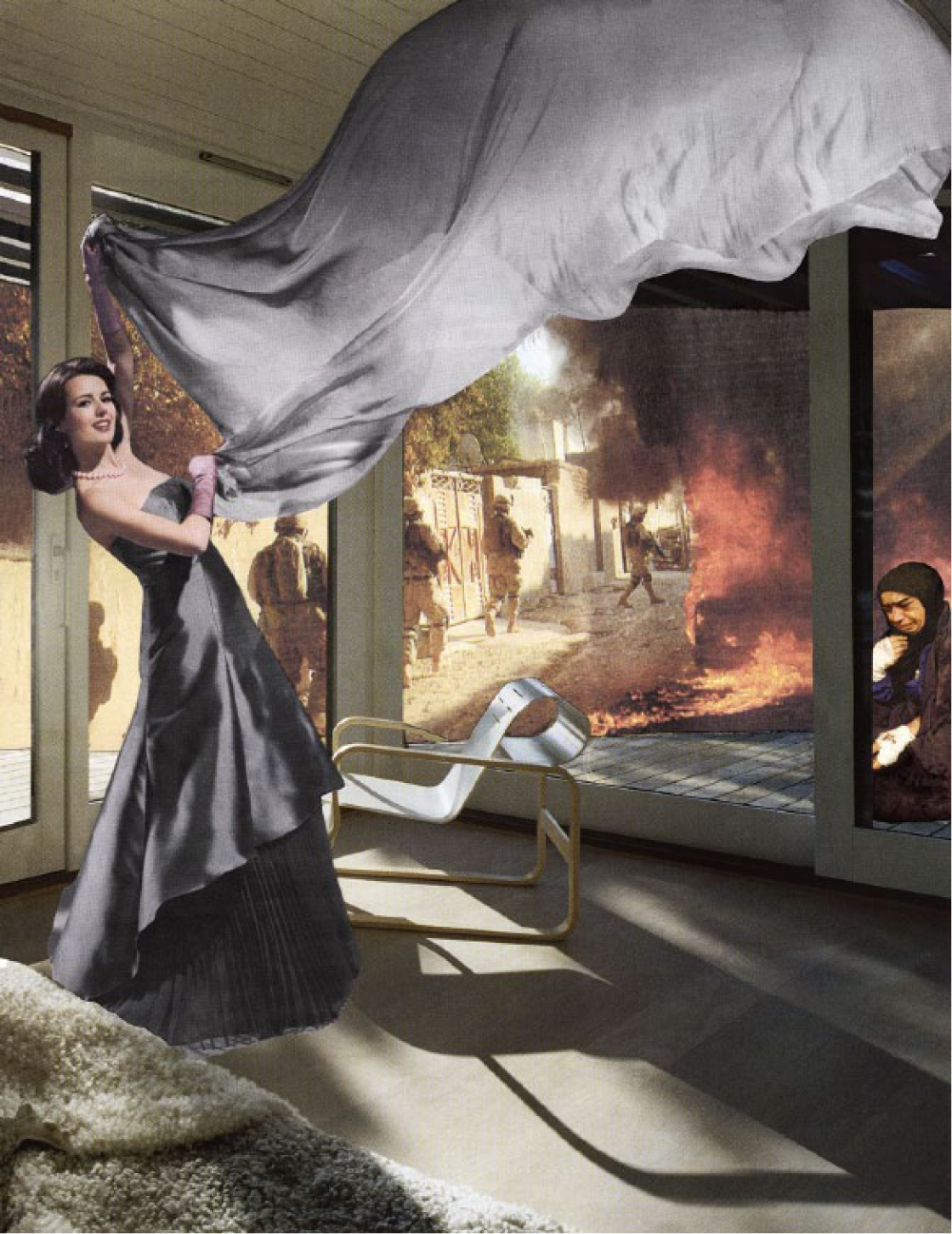
Martha Rosler’s The Gray Drape (from her series House Beautiful: Bringing the War Home, new series, 2008, photomontage ). Reproduced with permission.
Whilst Adorno and Horkheimer (1944) dismissed kitsch as a derivative, even as an anti-aesthetic, Sam Binkley (2000) has attempted to redeem its embeddedness in the everyday. Kitsch, Binkley believes, can function as a ‘tactic of social valorization between competing class elements’. Its banality and ability for transvaluation perhaps do open it up for ‘anti-elitist availability’ (p. 12). As instances of the extremity of the gaze, pearls (even in their garish tint in Rosler’s montage) wound are blind, not quite mirrors in a modern sense (Gasché, 1986). Pearls may embody excess but they draw in the eye as if to interpellate the subject: ‘the ambiguity of the jewel is that it both occludes and mirrors’ (Pointon, 2009: 48–49).
Conclusion: Redeeming pearl?
In a fleeting time I see a rigid arrow and in the water’s current I see crystal and pearls in a powerful tear. (Jorge Luis Borges, El tamaño de mi esperanza, 1994: 56)
As Jorge Luis Borges well knew, in medieval Islamic mystical poetry it was a compliment to compare a great writer with a noble pearl. Sometimes such writing was deemed so esoteric that it had to be placed back within the shell.
29
And perhaps as a final attempt to understand pearl as an expanded field, to think about Europe as Creole – and its frustrated attempt to be the reflection of other places – the High-to-Late Modern built environment can offer itself up to enclose us, if only rhetorically. Perhaps we can participate in this kind of thinking of pearl as one of a number of heterotopias to come: at least, this was the vision of one mid 20th-century architect. Frank Lloyd Wright designed the New York Guggenheim to look like a shell. He conveyed in his ‘Taliesin Lectures’ how architecture-as-shell might allow us to be like pearls – or divers? Here in these shells we see housing of the life of the sea. It is the housing of a lower order of life but it is housing with exactly what we lack – inspirational form. Here we see a quality which we call invention. The beauty of their variations is never finished … (Lloyd Wright, 2000: 45)
Perhaps too utopian in its distraction/avoidance of pearl’s strange combination of crystallization, entropy and obsolescence, Lloyd Wright’s underwater metaphor can return us to Arendt’s allegorical figure of Walter Benjamin as the Pearl Diver and to Benjamin’s own ambiguous observation on the emergence of modern photography: ‘The removal of the object from its shell, the fragmentation of the aura is the signature of a perception whose sensitivity for similarity has so grown that by means of reproduction it defeats even the unique’ (Benjamin, 1931: 6).
The aura might be the place where kitsch survives but it can also be the space for reevaluating western theories of capitalist-driven value. Patricia Spyer’s (1997) consideration of mythical, fetishized sea wives who assist pearl divers in eastern Indonesia analyses how these underseas sea spirits lead divers to pearls. But in return the sea wives demand store-bought goods which divers can ill afford. The sea wives’ presence is crucial to the workings of local and long distance commodity trade and debt. Turning this western-indigenous commodity trade on its head, Taussig (1980: 19) cites Malinowski’s contempt for pearl traders’ attempts to acquire the best pearls by manufacturing shoddy arm shells as a desperate ploy to participate in the Trobriand economy. Also with thought of pearl’s centrality to a critique of capitalism and its desires, Arendt and Taussig turn to Benjamin not merely as a diver-as-collector who extracts pearls of wisdom (which would position him within the genealogy of pearl metaphors stretching from Saadi to Goethe and beyond); they see Benjamin as insightful because he is partially made of pearls: ‘Those are pearls that were his eyes’ (Arendt, 1970:1, Taussig, 2004: 261). Read in this context, the frequent references to light in Benjamin’s writings (flash of recognition; spark; illumination) can be read eccentrically as being insight from eyes of pearl – vision which is surely then pearlescent. As the shape of creole modernity and as the source from where insight derives, perhaps pearls can from kitsch, slavery and exploitation still be magically redeemed. It is still worth searching for pearlescence.
Footnotes
Acknowledgements
I am extremely grateful to the editors and the anonymous readers of The Journal of Material Culture for their generosity, encouragement and insightful comments. I have learnt much from the work of Martha Rosler and Marcia Pointon. Many thankyous to Emilia Terracianno, Sonal Khullar, Achim Timmermann and the audiences at Vanderbilt University and the University of Leiden for their ideas and feedback. Any errors are my own.
Funding
Research for this article was funded by The Paul Mellon Centre for Studies in British Art and The Leverhulme Trust.