



Abstract
For over 100 years, Kuna Indian women and girls have sewn and worn the mola blouse as part of their dress ensemble. On the front and back of the blouses are mola panels, conceived and created as a pair. The pair of mola panels may be nearly identical or different. The relationship between a pair of mola panels is discussed in terms of the impact on the designs of Kuna culture and ethnoaesthetic criteria, especially layering, filler techniques, symmetry and colour preferences, as well as sewing techniques and material usage. Aspects of Kuna sociality, cosmology and verbal oratory are explored. In most cases it is possible to establish a thematic relationship between the back and front mola panels of a mola blouse. An object-based material culture approach contributes to an enhanced understanding of the complexities of mola making, including the technical skills required to design and manipulate layers of cloth. The importance of understanding mola panels as twinned pairs is highlighted by evaluating individual panels in pairs based on the examination of mola collections from six museums. This research also provides practical information for museum curators and others to establish which individual mola panels in collections may constitute a pair, originating from the same mola blouse.
Introduction
Mola blouses form part of the dress ensemble of Kuna women: the blouse is worn with a wrap skirt, a headscarf adorns the head, beads are wrapped around the lower arms and legs, and a form of flip flops are worn on the feet, often supplemented with jewellery such as a nose ring and necklaces. Both the blouse and the two rectangular panels on the front and back of the blouses are referred to as molas. 1 It is important when studying mola panels, which comprise the majority of public and private collections of molas, to understand that the panels originate as part of a blouse, an item of dress, and that the panels are sewn as a pair, with the same fabric generally used for the different layers of both panels in a pair.
When assembling a mola blouse, the shorter sides of two rectangular mola panels are first joined, then a yoke and sleeves are added above the panels. A band covers the outside seam joining the panels to the yoke. Sometimes additional fabric is also added below the panels. Figure 1 shows the front and back of a mola blouse.
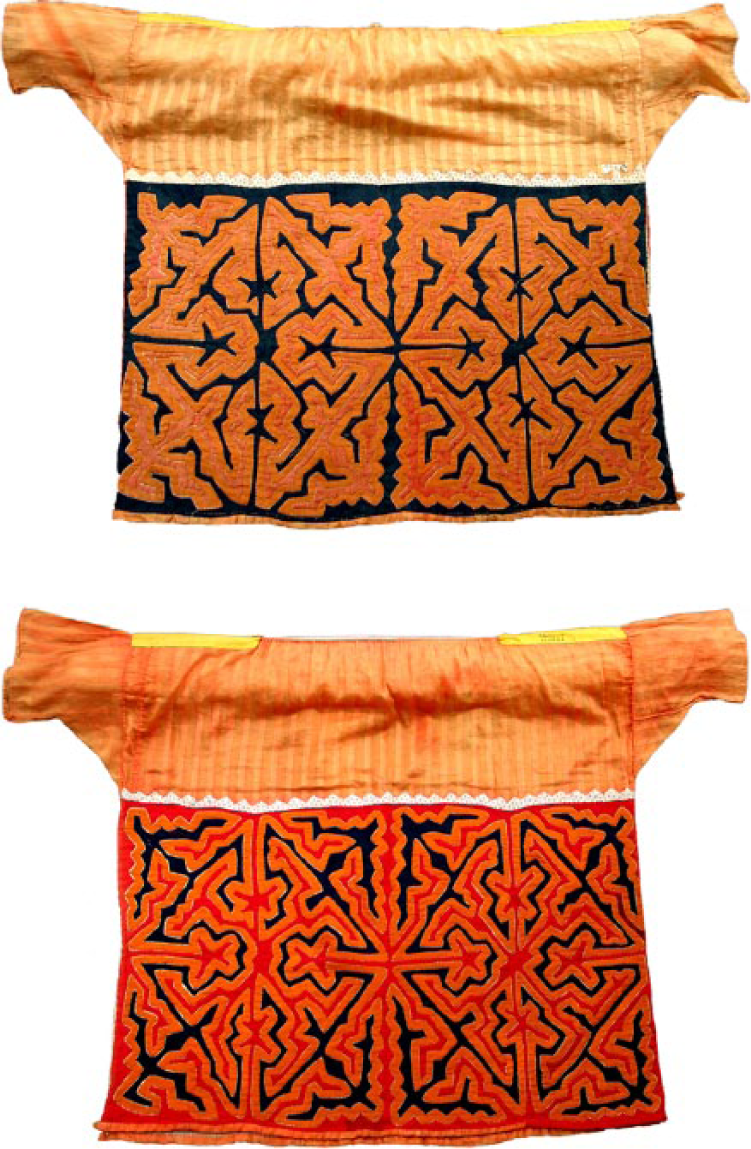
Mola blouse, 1906. Front of mola blouse on the top, back of mola blouse on the bottom. The oldest provenanced mola blouse found in a museum collection, showing evidence of the economic use of fabric and excellent workmanship in the very early development of the mola blouse. The mola panels exhibit bilateral symmetry and demonstrate the counterchange technique, where the red and navy layers appear to have been cut together and sections of each swapped between panels. The top layers appear to have been cut in one piece. Apart from colour reversals, there are very small variations between the two panels. The front layer has faded, most likely due to sun exposure during display in the museum, reducing the distinction between the red and orange layers. The yoke was originally pink. The narrow sleeves are indicative of the minimisation of fabric use in the yoke. National Museum of Natural History, Department of Anthropology, Smithsonian Institution (E263 359-0). Reproduced with permission.
I describe molas as ‘twinned pairs’ to emphasise the interrelatedness of each mola panel in a pair, not to imply that each panel in a pair is identical. 2 Indeed, the hand-sewing techniques employed do not allow exact replication. Depending on the layering and sewing techniques used for a pair of panels and the actual design, panels in a pair may be immediately recognisable as a pair, similar to recognising human monozygotic twins.
In order to gain an understanding of the development over time of the mola blouse, part of my earlier research has involved the investigation of molas in museum collections and the establishment of a reference collection of provenanced molas to provide a representative sample. 3 Collections of molas were studied at the National Museum of the American Indian, a Smithsonian Institution in Washington DC; the National Museum of Natural History, a Smithsonian Institution in Washington DC; the Field Museum of Natural History, Chicago; the Denison Museum, Denison University in Granville, Ohio; the Logan Museum of Anthropology, Beloit College, Beloit, Wisconsin; and the Ethnologisches Museum, Berlin, Germany. This museum research included a visual analysis, comparing contemporaneous photos with molas in the museum reference collection and found that the designs on mola panels are obscured when worn (Marks, 2012: 128–152). Mola blouses are washed, dried and stored with designs facing inside the blouse. 4 The complete designs on mola panels are not seen when worn or at other times. The importance of sewing and wearing mola blouses for Kuna women and Kuna communities was confirmed in my doctoral research, for reasons unrelated to the designs sewn onto the mola panels.
The earliest mola found in a museum was collected in 1906 and the sample covered a 100-year period. The reference collection included 162 mola blouses, which each include a pair of mola panels and 13 pairs of mola panels removed from blouses, a total of 175 pairs of mola panels. 5 As a result of the data collected from this museum research, the opportunity was available to make an assessment of the relationship between pairs of mola panels, one panel sewn onto the front of a mola blouse and the other panel sewn onto the back of a mola blouse. The objective of this article is to highlight the technical and design skills involved in sewing mola panels, not fully able to be appreciated without an understanding of the interrelatedness of the front and back panels. Reasons for this interrelatedness include the economic use of fabric, and may also be related to aspects of Kuna cosmology. There are similarities with Kuna oratory. I consider the Kuna concepts of the ‘double’, a balanced world, and living closely in harmony, with the characteristics of mola design.
Approach to studying molas
In this article, an object-based approach has been taken; however, this traditional museum approach has been expanded to encompass a contemporary material culture methodology, which includes consideration of the cultural, social, historic and global contexts of material culture objects. 6 Developed within a material culture methodology, the object-based approach can be broken down into steps or processes and a number of scholars, including Fleming (1982), Prown (1982) and Elliot (1994), have suggested processes applicable to specific classes of objects. Elliot (1994) proposes three steps: firstly observe the object, next compare it to other similar objects and lastly, consult other sources of information. For each of these steps, the object’s material composition, construction, function, provenance and value are considered and sources across relevant disciplines are consulted. 7
By the incorporation of analysis and interpretation steps, subsequent to the object-based examination of items of dress, material culture studies have successfully melded the divide between museum and academic research:
Object-based research used by historians, art/costume historians, and museum curators has gone through a transition, and there has been an attempt among the dress/fashion scholars in general to put it within the context of material culture studies so that a split between object-based research and the research focused on social and cultural symbols and meanings can be filled. Many object-based researchers combine the method with other methodological strategies while taking interdisciplinary approaches by incorporating other methods, such as oral narratives and archival materials. (Kawamura, 2011)
An enhanced material culture approach, to place the mola in the context of Kuna culture and society, includes an understanding of the relationship of molas to Kuna verbal art and cosmology, which are discussed later.
The term ‘ethnographic semiotics’ is used by Sherzer and Sherzer (1976a: 36) to articulate the way meaning may be derived from an object such as a mola, and the authors provide a number of interpretations including: the mola as clothing; the mola as cultural object; and the mola as an economic object (Sherzer and Sherzer, 1976b: 9–10). The ethnographic semiotic approach appears to have been subsumed in the 1990s into the then emerging field of cultural studies. An approach to the study of ‘dress history’ developed around this time also and can be viewed as encompassing both object-based material culture studies and cultural studies. Dress history research is not confined to Western fashion – non-Western fashion, such as the dress of Kuna women, is also relevant (Marks, 2012: 9–12). The mola performs many functions in Kuna society and I discuss its role in promoting cultural survival elsewhere. 8 The interpretation of the meaning of mola panels is discussed further below.
The examination of mola panels in detail in the museum setting has provided an understanding of the complexity of their design and construction across a 100-year period. For the pairs of molas in the reference collection, 63.5 per cent were nearly identical or alike and the remainder were different. The type of relationship between panels varied in different decades, though for each decade there were pairs of panels nearly identical and clearly different in design.
Kuna culture and aesthetics
A Kuna artist, Oswaldo DeLeon Kantule, whose paintings are influenced by mola designs, maintains that the four ‘pillars’ of Kuna aesthetics are abstraction, metaphor, duality and repetition, and multi-dimensionality (Carter, 2010: 273). 9 Repetition with variation is evident in most mola panels. There is scholarship to support the ideas that the background space of molas is filled with sewing, reminiscent of the closeness of houses in Kuna villages; and that the Kuna world is perceived as layered, balanced and harmonious, with different roles for men and women. These characteristics are explored here to develop an understanding of their potential relationship to the design characteristics of molas.
Verbal oratory
There are many parallels between the characteristics of the Kuna language used for chanting and mola panels. The Kuna Indians are not alone in this transfer of characteristics between art forms. Berlo (1992: 121) refers to the ‘correspondences between Maya verbal and woven genres’ as another example of the way the manipulation of fabric used for clothing has similar characteristics to oral literature. There are also similar parallels with Navajo chants and weaving (Webster, 2009: 144).
The parallelism evident in Kuna language has been explored in detail by Sherzer (1983, 1997, 2003). Kuna literature was primarily oral until recent times, with different vocabularies for verbal everyday and verbal ritual language. Sherzer (1983: 128) describes the language used for oral performances of moral tales and medical (shamanic) curing as characterized throughout by parallelism, which is defined as ‘the patterned repetition of sounds, forms, and meanings’ and he notes that:
Paying attention to repetition leads us to a central feature of Kuna literature, grammatical and semantic parallelism, that is also extremely common in oral and written ritual and poetic language around the world. Parallelism involves the interplay of invariants and variants, of recurrences and differences. There are many kinds of parallelism in Kuna literature, involving words, groups of words, meanings, and sentences. Extensive and pervasive parallelism is especially characteristic of ritual speaking and chanting, an important aspect of the poetry of ritual performance. (Sherzer, 1997: 108)
Special chants and songs are performed at Kuna lifecycle events, particularly those related to the various stages of the coming-of-age of a Kuna girl. At these ceremonies, Kuna women wear a mola, often specifically sewn for the event and an alcoholic beverage, called chicha, is prepared and consumed. An example of a chant sung by a Kuna Chief, a man with expertise in Kuna laws and traditions, at a Kuna girl’s puberty ceremony, has been recorded and translated by Sherzer (2003: 147–189).
10
In the chant, the movement within the room where the chicha is being fermented is often described in a pair of lines, with small variations such as:
They sway themselves along. They step themselves along.
Sometimes there is another variation: ‘They move themselves along’ or ‘They move themselves back and forth’ and sometimes three of these lines are used in the one stanza. The same actions are also used in lines beginning with the pronouns ‘she’ and ‘he’ at intervals throughout the long chant. The chant describes the action as it occurs, often in linked pairs of rhyming lines, with the same pairs repeated throughout. The variation in pronoun for the actions stepping along, moving back and forth, moving along, and swaying along, creates another layer of repetition, likely also reflecting the specific actions as they are carried out at the ceremony. These pairs of lines thus mirror the actions, which is important since the formal ritual language will be understood only by a few of those present.
A short song performed by a Kuna woman, also at a puberty ceremony, is also recorded by Sherzer (2003: 213–221). 11 This song displays similar characteristics to the chant. Since the words in ritual oratory are understood only by a few, it is posited that the sound of the words is important and the repetition of words, associated with the actions as they occur, would clarify meaning. In this song, words relate to actions carried out mostly whilst sitting, whereas in the Chief’s chant most of the actions appear to occur whilst standing. The phrase ‘the pretty woman sits down she does’ is repeated a number of times. Variations of this action include the lines ‘the woman is sitting swaying she is’ and ‘the woman lowered herself down there she did’. Other actions that occur at a chicha are also described, though since this is a short song it is not known if these actions would all be occurring as it is performed. The lines of the Kuna man’s chant and the Kuna woman’s song show instances of repetition, with variation, including the repetition of pairs of lines in the chant.
The characteristics of verbal parallelism also appear in mola design where ‘there is constant repetition with variation at every level of the mola’ (Sherzer and Sherzer, 1976b: 6) which includes between mola pairs in which each of the panels are nearly the same, and in most mola panels where there is the repetition, with variation of types of filler elements. The subtle variations between molas in many pairs is similar to the parallelism characteristics of Kuna verbal oratory.
Sherzer and Sherzer (1976a) stress that there are differences related to the way meaning is derived: molas are decorative, not conveying supernatural or other messages; verbal chants are interpreted and may relate to spirits, mythical beings and ancestors (Sherzer and Sherzer, 1976a: 27–32). Kuna chiefs chant using metaphoric language which is interpreted afterwards by other leaders for the Kuna audience.
There is a complementarity between the verbal oratory of Kuna men and the mola making of Kuna women according to Perrin (1999): the Kuna women’s sewing has ‘stimulated men’s oral art, which itself inspires the women’s oeuvre’ (p. 57). The division of spheres of creativity Perrin suggests were intentionally kept separate. This may link to the Kuna concept of a balanced world discussed later.
The immaterial double
The notion of the ‘double’ in Kuna cosmology relates to the idea of purpa (alternatively spelled burba), an invisible immaterial spirit, sometimes translated as soul. The concept does not equate to the Christian concept of soul, but is more complex, relating to the spirit world, as communicated by Kuna shaman. The notion of purpa is prevalent in the special Kuna language used by shamans in chants.
For the Kuna, all things may have a purpa – living animals, plants and humans, and inanimate natural objects such as rocks, clouds and stars (Severi, 1993: 167). Severi refers to purpa as ‘the immaterial double, or replica’ and ‘a man’s shadow, the echo of an animal’s cry in the forest, even the mirror image of someone’ (pp. 166–167). There may be an indirect link between this idea of the double and a pair of mola panels. The conduit between a person or object and its purpa has been reported as a kind of twin (tarpa) by Fortis (2012: 133–147) and this may also be related to the idea of a pair or a ‘double’ set of mola panels.
The interpretation of double relating to a mirror image and as a set of two may be seen in some mola panels. In Figure 1, each of the mola panels show a set of two near identical geometric shapes on the left- and right-hand sides of each panel; in Figure 6 the panels each show two images of similar but not identical designs; in Figure 7 the panels show (imperfect) mirror images.
Layers of meaning
The link between the concept of layers in Kuna ontology and layers of amniotic tissue is convincingly outlined by Fortis (2010: 480–495, 2014: 99–104). He describes the Kuna belief that a baby is born with designs displayed on the amniotic sac, which can be associated with the designs Kuna women sew on molas. Molas are related to the fertility of a woman. Producing children and sewing molas are related by the Kuna thus: ‘bodies and objects are equally the outcome of processes of making and growing’ (Fortis, 2014: 104).
The importance of layers as a concept may also be explained through the Kuna worldview whereby:
The two people, man and woman, stand on the earth plane. Above this there is heaven with its eight invisible layers. Round [sic] heaven the sun moves and goes down even under the earth, where there are the eight underworld layers. In the fourth one of these are the evil spirits’ chiefs and there one learns the best medicines. Beneath the eighth layer there is still another world. (Nordenskiold with R Perez Kantule, 1979[1938]: 357)
Research based on long-term fieldwork may in the future result in a strengthening of this possible link between the layering of mola panels and the layering of the Kuna cosmological system.
Interpreting meaning
Fortis (2008: 9) found that Kuna women attributed no meaning to specific designs on molas – the question of the meaning of designs was not considered to be of importance. Ancestral molas (referred to as sergan molas) may originally have had ontological dimensions (Martínez Mauri, 2012: 22) and my observations of the designs on molas collected in the early years of the 20th century suggest some mola designs may show mythical creatures, anthropomorphic natural objects and scenes from myths.
This lack of attribution of the meaning through the interpretation of the iconography on mola panels does not mean that the designs do not represent important themes from Kuna cosmology or daily life. Some designs clearly represent mythical creatures – part human and part animal or fish. Some designs depict Kuna lifecycle rituals and healing rituals; some appear to present supernatural or spiritual worlds on land, sea or in the sky, for example molas with demons and sanctuaries.
A balanced world
A duality concerning both the inanimate and living world prevails throughout Kuna life. The Kuna people believe in ‘balance, especially balance between pairs, of which the prime example is man and woman’ (Salvador, 2003: 71) and, as mentioned, this is related to their cosmology which inculcates the sociability of Kuna life, with men and women living together in close proximity. The Kuna concept of a spiritual double may also relate to the involvement in various Kuna daily and lifecycle rituals of pairs of men or pairs of women depending on the occasion (Perrin, 1999: 45). Also of note is a characteristic of the Kuna language where many words for pairs of objects are singular words, for example the Kuna word for pairs of eyes, feet and arms are considered to be one item, an ‘inseparable unit’ (Perrin, 1999: 45).
In Kuna cosmology there is a sense of balance between men and women, and between night and day, due to a creation of a sense of equilibrium in the world, which can be extended to an understanding of mola panels. For example, one mola in a pair may portray birds during the daytime, the other panel may portray birds at night (Perrin, 1999: 45). In a pair of mola panels depicting the Singer sewing machine logo, a commonly found design, one panel depicts the actual logo, with a woman in the centre, and in the other panel a man is in the centre of the logo. Figure 7 illustrates this.
The concept of duality applies also to other American Indian peoples. Salvador (2003: 47) states that ‘In the Kuna cosmos, everything in the world, whether natural, cultural, or spiritual, is divided by gender, and almost every specific kind of verbal or visual art belongs either to males or females, but not to both’. 12 In Kuna cosmology, men and women have different roles, and this applies to both oratory and creating objects of material culture, such as basket weaving (men) and mola making (women) (Fortis, 2010: 484; Salvador, 2003: 47).
Village life
There are parallels between the layout of Kuna villages and the density of mola designs. Sherzer and Sherzer (1976a: 35) suggest that the Kuna mola aesthetic is based on the density of villages, with many people living in close proximity. Margiotti (2010: 28) glosses this density as a form of ‘saturation’ and relates it to the sociality of the Kuna people.
The concept of sociality has various interpretations – here it is considered in order to describe social interactions and social relationships, living as part of a group. The islands where the Kuna people live, off the Atlantic coast of mainland Panama are small and the communities live in close proximity, with large families housed together in huts, with little space in between the huts. During her time living in a village on one of these small islands, Margiotti (2013) observed that Kuna women spent considerable time sewing molas – that it was an intergenerational social activity, shared in a peaceful, mostly quiet environment. Kuna women informed her of a relationship between the mola, a woman’s body and a house. Molas are sometimes sewn during the daytime with groups of women and they are also sewn at night with the whole community present at community meetings, while listening to the oratory of Kuna men (Howe, 1997: 137–138).
Margiotti (2013: 401) concludes that molas may be considered ‘relational garments’, part of the sociality of Kuna daily life and that:
A mola blouse, made of superimposed layers of fabric, may be used as a metaphor to talk about Kuna sociality, where the surface of a mola panel is the outward manifestation of the layers of fabrics superimposed, cut, shaped and sewn. The layers of fabric attached to one another recall the image of the never-ending regressive relation between inside and outside, at the basis of the creation of persons and Kuna sociality. (Margiotti, 2010: 269)
The research described in this section may be perceived to be at the intersection of the fields of anthropology, philosophy and psychoanalysis. There is emerging scholarly work around this intersection and future scholarship may be able to elucidate more fully the importance to the Kuna people of mola aesthetics, design and the interpretation of meaning.
An appreciation of the characteristics of verbal oratory, cosmology and village sociality contributes to an understanding of the ethnoaesthetic principles upon which mola panel design is based, which is discussed next.
Designing mola panels
A set of design principles for mola panels was first developed by Salvador (1978), based on fieldwork in the 1970s and reflects the designs of this decade, without a detailed assessment of other eras. Using more recent work by Salvador and Howe (1997), Salvador (1997) and Salvador (2003), as well as my museum research, the elements of mola panel design are discussed below in terms of symmetry, layering, filling space, colour and optical impact, and imperfections.
Symmetry
The reference collection data shows that, as indicated by Salvador (1978), in the 1970s most mola panels in a pair were nearly the same and were symmetrical; however, across the century molas are not universally symmetrical. One or both of the mola panels in the pairs in the reference collection were symmetrical, on one or more axes, in over 70 per cent of cases. Where the panels in a pair were nearly the same, 80 per cent of the panels were symmetrical and where the panels were different, 60 per cent were symmetrical. Subtle asymmetry is planned so that the design is not perfect (see later comments on planned imperfections).
Bilateral symmetry was most prevalent for panels which were nearly the same and mirror symmetry most prevalent for panels which were different in a pair. For all the decades, at least half the molas have some form of symmetry. Until 1941, the molas in this sample had more double axis symmetry than any other type of symmetry. Symmetrical design is becoming less popular.
Layering
Each mola panel is made up of a base layer with one or more layers sewn on top. Simple molas comprise two layers. More complex molas have successive layers applied on top, and shapes cut through each to reveal the layers beneath. Many mola panels have three to four layers; some were found with up to six to seven layers. Small pieces of fabric are sometimes inserted between layers. Sometimes the order of layers is reversed between pairs of mola panels. Sometimes two layers are cut out together and sections swapped between mola panels in a pair, with the two colours forming the top layer. Fabric pieces may also be appliquéd onto the top layer.
Filling space
Similar to many forms of folk art, filling the background with repeated shapes is important for Kuna molas. For a well-designed mola panel, no area is without some cutting and sewing with various small shapes repeated in the background. This enhances the complexity of the design and has a secondary benefit in making the layers of fabric more flexible and the mola more comfortable to wear.
Filler elements may be very small slits, circular, square or triangular shapes, of one layer or of many layers. This ‘aesthetic variation within repetition’ (Berlo, 1992: 121) often has to be closely observed to be fully appreciated. By comparing mola panels in a pair, the differences and complexity of design elements, especially elements surrounding central designs and used to fill the background spaces, become more apparent.
Filler shapes in earlier molas are generally larger and more sparsely spaced, for example long slits in the background of mola panels collected in the 1930s are up to 12 mm wide; by the 1980s most were 3 mm wide and closely spaced.
Colour and optical impact
A prime objective is to create mola panels which are visible both in terms of highlighting the central design image or the details of an overall design, as well as being visible from a distance. Whilst the optimal viewing distance is 1–2 metres, it is possible to identify the dress ensemble of a Kuna woman from more than 100 metres. Cloth colours are generally highly saturated to create this visibility and the order of layering is determined to create contrast. Colour choice is subject to fashion and has changed over time. 13 The central design is sometimes highlighted by surrounding it with one or more rows of saw-tooth stitching (for example in Figure 9), thus effectively encapsulating the design inside.
In addition, the other principles governing mola design from the Kuna woman’s point of view are the quality of workmanship and the selection of design motifs. These aspects are not explored in depth here; however, an assessment of workmanship between front and back panels showed that sometimes one panel was of inferior workmanship. It is possible that the most favoured panel, related to workmanship or the design is placed on the back of the blouse since this panel may be seen more completely when worn. Design motifs encompass the natural environment, Kuna daily life and lifecycle events, as well as motifs derived from outside cultures such as product logos and trademarks, and print material. 14
The next section describes techniques used to create a difference when sewing mola pairs. The section following explores the relationship of mola pairs where the panels have many similar designs, and the section after explores mola pairs where the designs are dissimilar.
Sewing techniques for creating visual difference
Some techniques used to create difference when sewing a pair of mola panels are quite simple, some are elaborate variations, but most create high visual interest using fabric in a very economic way. Economy may be the overriding reason for the manipulation of fabric between pairs, rather than an association with Kuna cosmology. Older molas have more complete layers and the distribution of parts of layers between panel pairs creates an illusion of more layers with less fabric. The limited resources available for the purchase of fabric is also seen in the re-use in molas of fabric from cloth skirts and headscarves, demonstrating that cost is a constraint surmounted by ingenious fabric use and placement in layers, between layers and the division of layers. The creation of visual difference between mola panels in a pair demonstrates an individual’s creative ability and level of sewing expertise. There is also strong evidence of the economic use of fabric for blouse yokes and sleeves (Marks, 2012: 80).
There may be some mathematical basis to the methods used in arranging layers in panels. Previsualisation is important is arranging layers to maximise visual impact. Mola panels are sewn using reverse appliqué, surface appliqué, embroidery and sometimes embellished with commercial braid. Some of the techniques used to create visual difference between mola pairs are:
reversing the order of layers – generally the same fabric is used for the base layer and top layer of a pair; however, it is common for the order of two of the middle layers to be reversed in order in each panel, with orange and green layers or red and yellow layers being popular combinations. The result is that the colour that outlines the central design, effectively encapsulating it, impacts on the focus of the eye on a particular section of the mola design. The reversal of two central layers often indicates that two panels were sewn together, especially when the designs are similar.
rotating a panel on the vertical axis – some panels, with the same colour, on the top layer appear to have been cut as a pair and then the layer on one of the panels is ‘flipped’, creating a mirror image of the design. Once sewn into a blouse, both these panels will show the image facing the same direction on the front and back of the wearer. This is another method used by the Kuna women to increase the diversity of the resulting mola panels with no extra cost, and very little extra effort, simply using their ingenuity.
counterchange technique – created when two contrasting fabric colours are cut together for the top layer and sections of each colour are divided between two molas. Whilst the design will be identical, depending on the colour choices, the appearance of each panel may appear to be different. Popular colours for the layers used for counterchange are black and red, and navy and red. In the reference collection of 175 pairs, the counterchange technique was found in 15 mola pairs, the first collected in 1906 and the last collected in 2006. Note that some pairs, where the order of the two central layers has been swapped, can appear to be counterchange due to the impact of the colour interactions.
patterned layers – placing a patterned layer in one panel or different patterned layers in each panel. Where wide channels are cut through to this layer, the patterned fabric will be observable and create distinction.
a combination of two or more of these techniques – for example counterchange and inversion of one panel; one layer of patterned fabric placed in a different layer order in each of the panels in a pair; and changing the order of two middle layers in combination with the counterchange technique.
Another method employed to create difference between panels may occur at the stage that the pair of panels are sewn together prior to joining them to the yoke of a blouse. One panel may be rotated on the horizontal axis, effectively turning it upside down. This inversion may make it difficult to determine that a pair consists of near identical panel designs. One inverted panel was found in 12 pairs of molas in the museum reference collection, between 1917 and 2003. Where printed fabric is used as a layer in only one of the panels in a pair, the resultant visual difference is increased if one panel has also been turned upside down. Where both panels in a pair are sewn into a blouse upside down, which may be apparent due to the design, this may be accidental or may be so that the wearer can look down and view the design when worn, an egocentric viewpoint. There were two instances in the reference collection in early mola blouses where both panels were inverted.
Some small variations may be unintentional due to the cutting, folding and sewing techniques integral to hand-sewn appliqué, and inherent in hand embroidery. Some layers appear to have been folded in half on the vertical axis and the design cut out, though on the sewn panel there will be subtle differences on the left and right sides. Similarly, vertical rotation may be accidental, at the time the fabric layer is placed on top of the base layer or subsequent panel layers. It is possible that some small variations, between the left and right sides of a panel, and especially in fillers, are intentional, referred to by one scholar as ‘planned imperfections’ (Agnew, 1956: 14) and may possibly be considered to convey the Kuna ‘idea of a visual expression of man’s imperfections’ (p. 81). Mola pairs with only a few small differences, and similar molas with a large number of differences within an identical encapsulated design, using the same fabric for layers and inserts, are considered in this research to be similar.
Both intentional techniques, such as ‘planned imperfections’ (if it is accepted that this is applicable), and unintentional techniques create visual interest, at the time of sewing each panel and also when assembling mola panels as part of blouses. Examples are now provided for some of these techniques, with a discussion of factors related to their designs and to their optical impact.
Mola panel pairs with similar designs
Curiously, it may not be immediately apparent that a mola is similar or nearly identical and part of a pair. Simple techniques can create significantly different optical impacts. For some pairs, one or more layers in each panel will be cut in duplicate and the small variations will result from the techniques inherent in any hand-sewn object.
Pairs identified as being sewn using the counterchange technique are essentially the same design. Most examples are symmetrical, as would be expected, to enhance the optical impact of the counterchange technique. Figures 1 and 2 illustrate this technique. Counterchange is a very effective technique: it exhibits the economic use of fabric and may result in a lighter weight blouse which is more comfortable to wear.
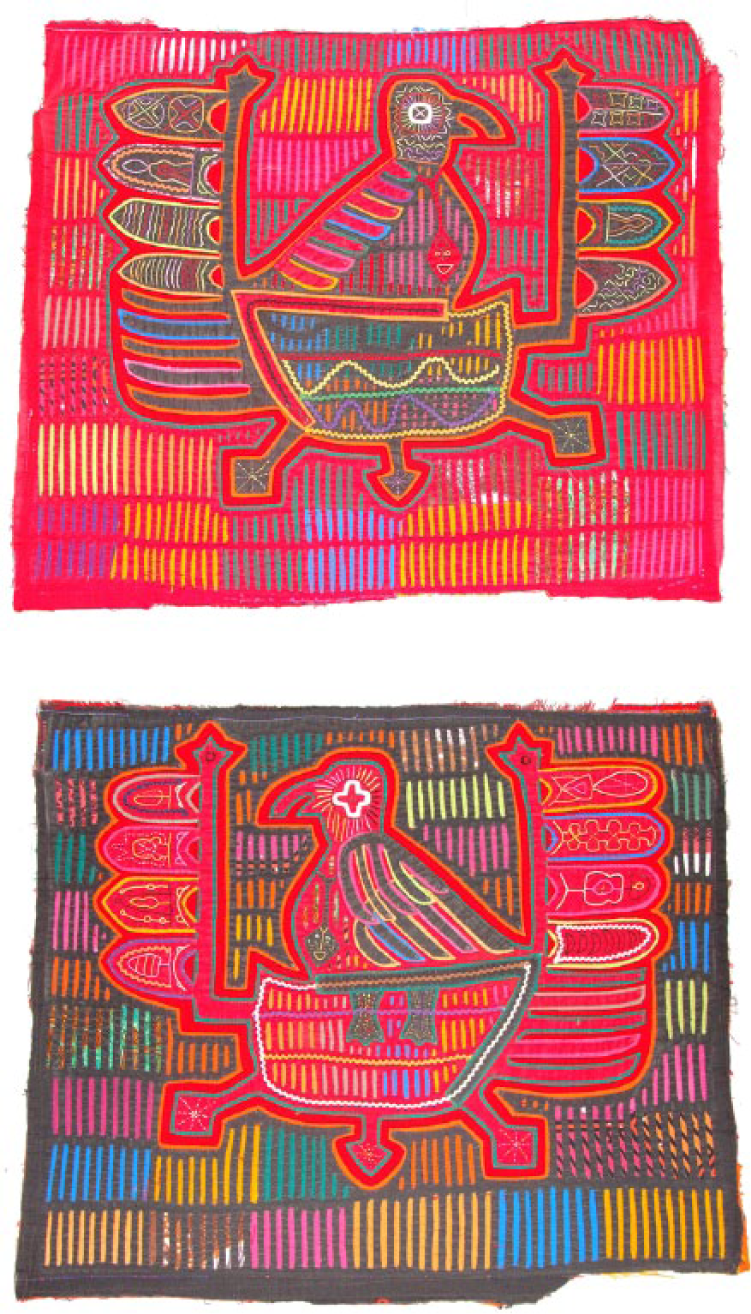
Pair of mola panels with mirror images and different background colours. Front mola panel on the top, back mola panel on the bottom. The black and red layers have been cut together, and then the central bird swapped. One of the resultant top layers has also been rotated on the vertical axis, so that the black bird is facing towards the right and the red bird is facing towards the left. When sewn into a blouse, the birds would face the same direction. Since the base layer is red, and this shows through to the top, the red bird on the back of the blouse appears larger than the black bird on the front. Rick-rack braid has been hand sewn onto both panels, and there is extensive embroidery embellishment. Subtle differences include the eyes of the birds, and the embroidery on the flags. This design relates to Kuna cosmology, with the bird transporting the soul of a dead person to a higher level of the world (Keeler, 1969: 36; Parker and Neal, 1977: 85). 1950s–1960s. Private collection. EHC 3416, EHC 3345. © Photographs: Diana Marks.
Other variations where panels are nearly the same include the reversal of the direction of designs, by rotation on the vertical axis, as seen in Figure 3, where the top layer is of one colour; a change in the direction of filler elements, for example in Figure 4, and the rotation of one panel laterally, inverting it, for example in Figure 5. The overall composition may be the same with variation in the details, as seen in Figure 4 and Figure 6. The Kuna view of a balanced world, in this instance related to the complementarity of men and women, is illustrated in Figure 7, where one panel shows two Singer sewing machine logos, each with a man, whereas the other panel (not shown) includes women.

Pair of mola panels with reversal of design of central image. Front mola panel on the top, back mola panel on the bottom. The central turtles face in different directions and there are small variations within the design for each of the panels, including the number of toes in each of the limbs for the dominant figure and the inside figure. The turtles would be facing the same direction on the mola blouse. The fabric on the back panel has faded more than the front panel. Rows with a saw-tooth design in the centre may indicate the shell of the turtle. Turtles are popular designs. In Kuna cosmology the turtle is related to the concept of birth and growth (Hartmann, 1986: 262; Parker and Neal, 1977: 94). c. 1950s. Private collection. EHC 3589, EHC 2985. © Photographs: Diana Marks.
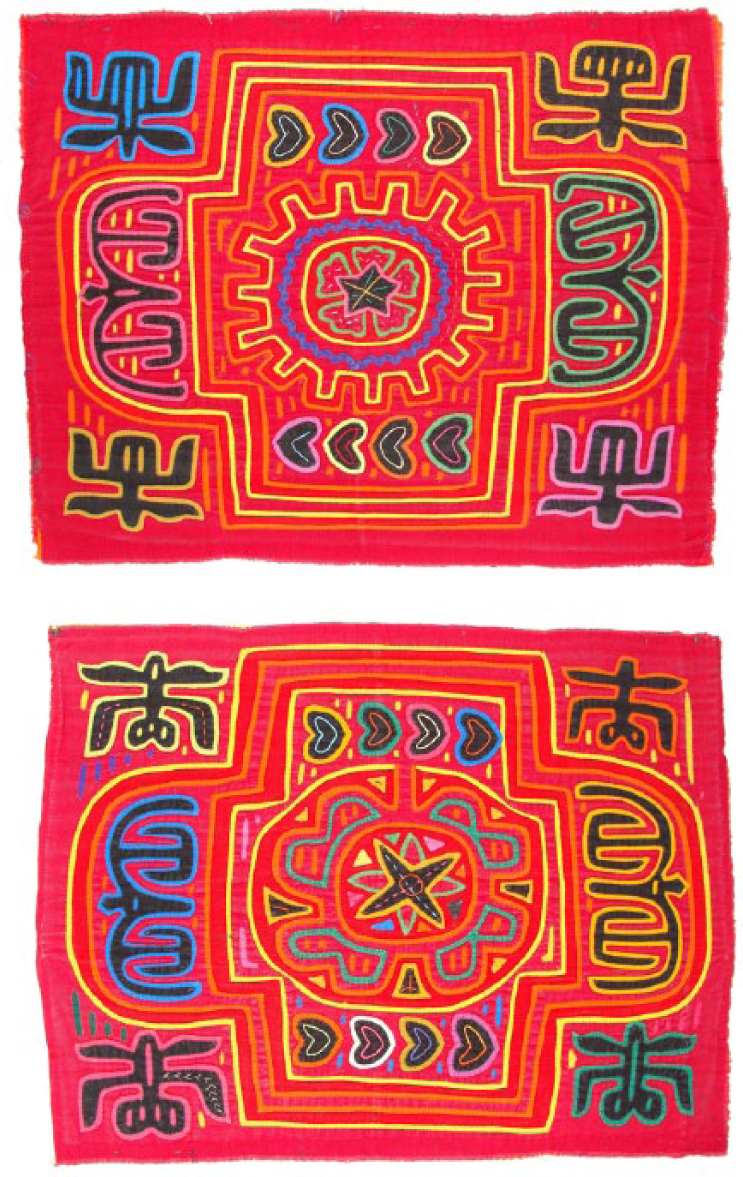
Pair of mola panels with variations in layering and composition. Front mola panel on the top, back mola panel on the bottom. There are small differences in the central design, within identical borders. Bilateral symmetry, with the order of the orange and yellow layers swapped, highlighting the outside border in the back panel and the smaller inside border around the wheel-like design in the front panel. The fillers in each corner are a similar design, with colour and orientation variations. There is also variation in the direction of the heart shapes. The iconography appears to be derived from the natural environment. c. late 1960s. Private collection. EHC 3233, EHC 3234. © Photographs: Diana Marks.
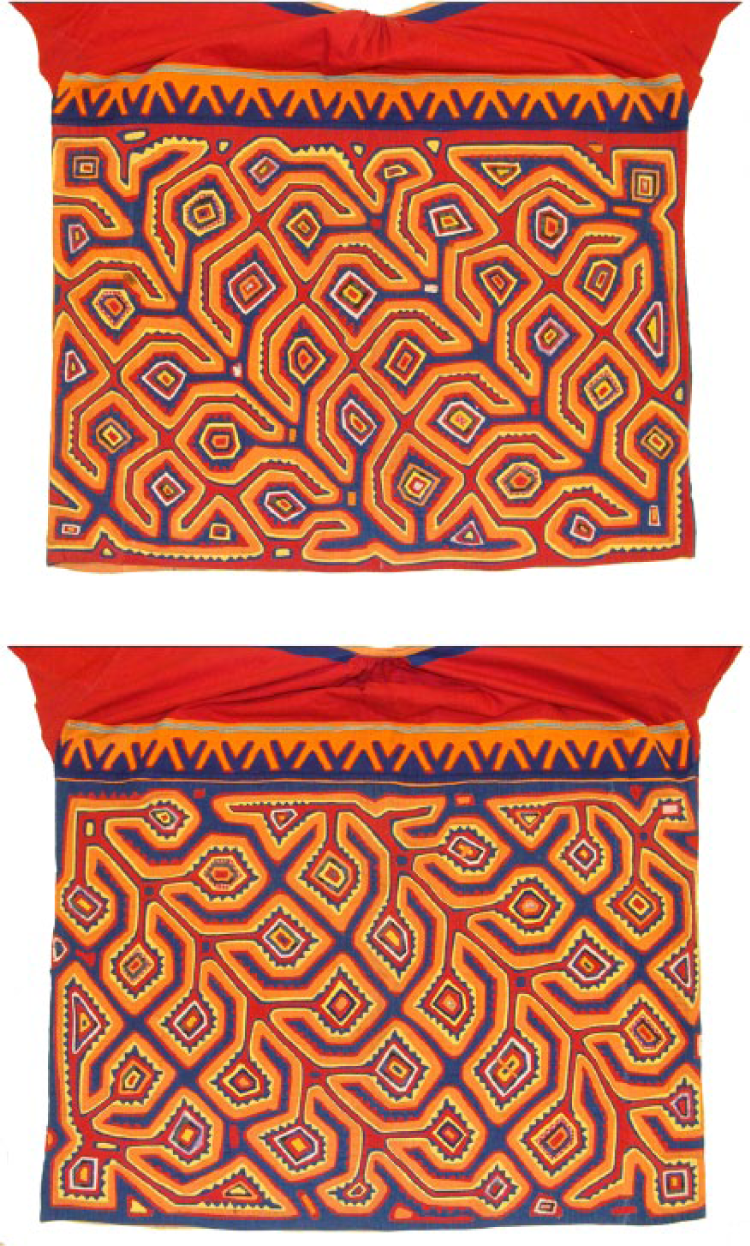
Variation created by inversion of one mola panel in a pair. Front of mola blouse on the top, back of mola blouse on the bottom. The order of the layers in the panels is different: for the front panel the base is orange, followed by yellow and navy layers, with red on top; for the back panel, the base is yellow, followed by orange and red layers, with navy on the top. The red and navy layers have been cut together and placed in alternate positions on each panel, a form of counterchange. The back panel has been turned upside down. The panels are nearly symmetrical on the diagonal axis. The design appears to be an abstracted plant. Small multi-layered shapes have been added as embellishments, some comprising seven layers, increasing visual interest and further distinction between the optical impact of the panels in this pair. Early use of commercial braid is seen stitched to the band, sewn over the join of the mola panels to the blouse yoke (partially shown). 1924–1925. Complete blouse in National Museum of the American Indian, Smithsonian Institution (252 503E). © Photographs: Diana Marks.
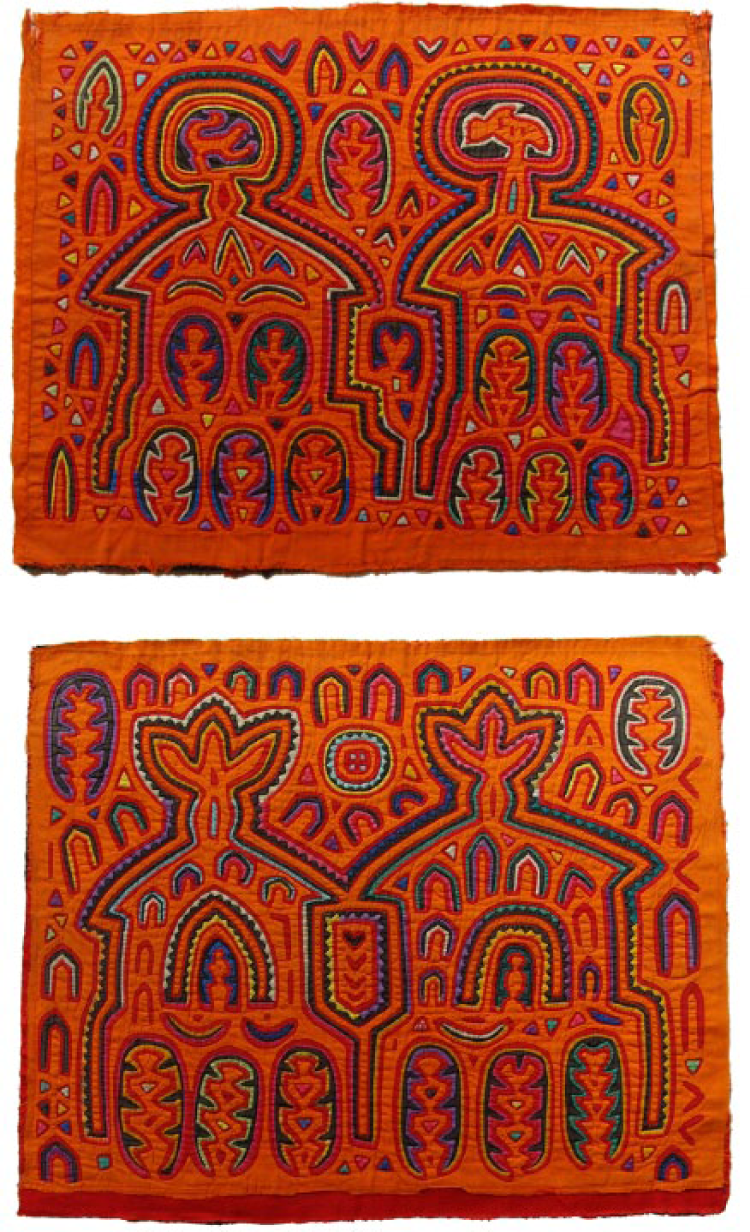
Pair of mola panels with variations within similar composition. Front mola panel on the top, back mola panel on the bottom. Whilst each panel has two houses, the roof decorations are different and the internal arrangements of the houses are different. The order of the layering of colours clearly links the two panels, with each panel having two red layers. The design has been identified as related to the Kuna spiritual world, showing a pair of spirit houses (Kalu) (Salvador, 1976: 94; Severi, 1997: 245). It may house Kuna mythical heroes (Salvador, 1976). 1940s–1950s. Private collection. EHC 4037, EHC 4038. © Photographs: Diana Marks.
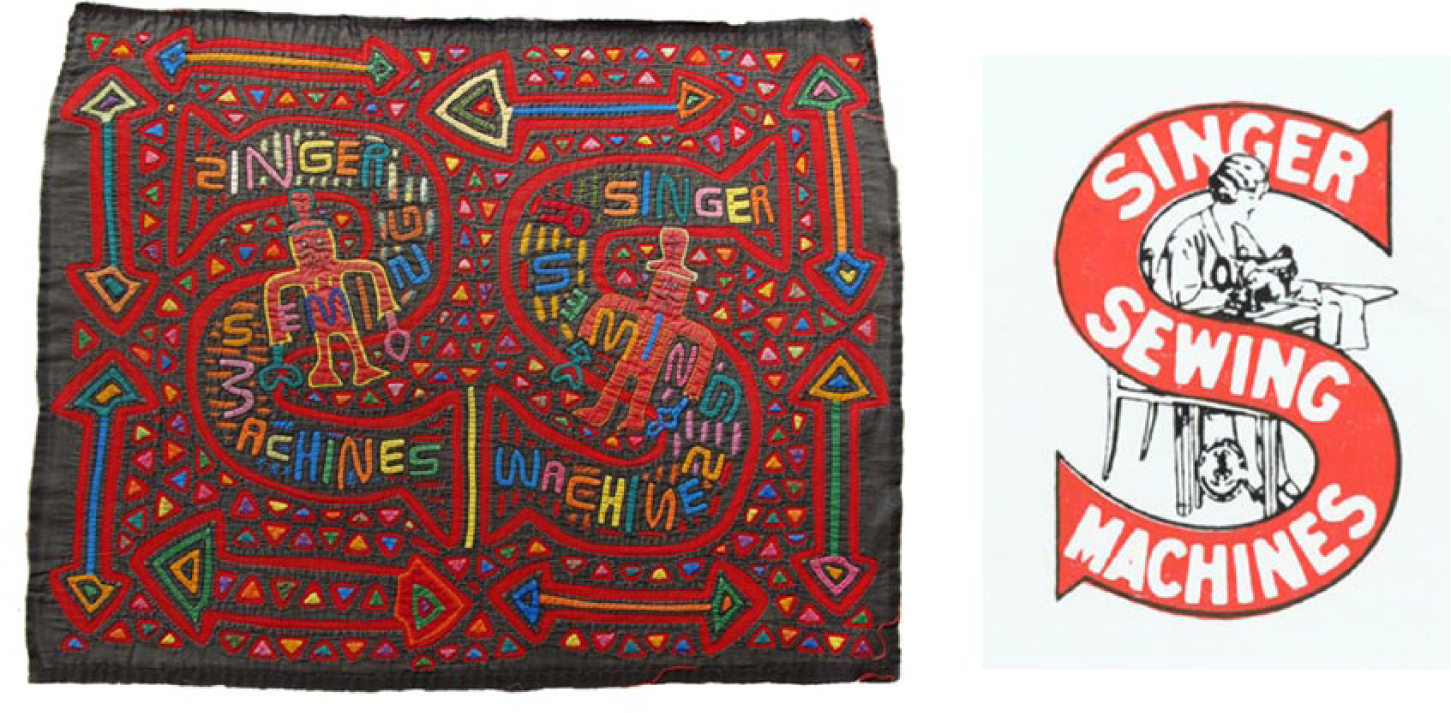
Gender balance between pair of mola panels. Both the front and back panels show the Singer sewing machine logo. The logo is shown in mirror image on the left side of the panel. Mirror symmetry within a panel is common, particularly with animals and birds. The front panel shows a Kuna man sewn on top of the letter ‘S’ and the back panel (not shown) replicates the logo with the women sewn underneath the letter ‘S’. The back panel shows significant fading. Kuna men are known to have worn shirts and pants prior to 1700 (Marks, 2012: 57). Kuna men made their own clothes, most likely from the time they worked for foreigners on boats or on the mainland, perhaps prior to Kuna women using a sewing machine to assemble their mola blouses. The earliest instance of machine sewing found on a mola blouse dates from 1917, on both a join in a layer of a panel and on the yoke. 1950s. Private collection. EHC 2991. © Photograph: Diana Marks.
For some Kuna lifecycle events, a group of Kuna women sew ‘uniform’ mola blouses, perhaps with the same yoke fabric or similar designs on mola panels, and in these instances special care is required to assess if individual panels constitute a pair, including considering individual stitching styles, more easily observed on the reverse sides of mola panels.
Figures 1 to 7 provide examples of pairs of mola panels that are close to identical or nearly the same.
Mola panel pairs with different designs
In some instances it can be a challenge to determine the thematic basis of the relationship between panels in a pair where the designs are different, though a relationship may generally be found. Sewing techniques used for similar pairs may also be used for pairs with different designs, particularly layering variation, where the order of two layers is swapped and also the inclusion of one or more patterned layers.
Even when mola panels in a pair have different designs, there will be similarities in some elements, such as filler type, layering, or the style of encapsulation of the central design, as well as similarities in the colours of the cloth used for layering. These similarities assist in matching up pairs of molas that have become separated in collections, especially for dissimilar pairs. Exploring the differences can focus on the relationship between panels based on different viewpoints of natural objects, sometimes a whole object and a cross-section of it, or the ground level view and an aerial view. There may be different perspectives of Kuna life, for example one panel showing men playing music with bamboo panpipes and the other panel with women playing music with gourd rattles. An example from Kuna cosmology and the journey of life shows two perspectives of a human heart, with the movement of blood indicated by the design. Another example shows a camel with one hump on one panel and a camel with two humps on the other panel of the pair. For these examples there is a visual logic linking the panels, as well as similar colours and filler elements to give reassurance that the panels constitute a pair. Figures 8 and 9 illustrate two different views of the same object, with one panel in each pair showing two central images and the other panel one central image, with a variation in orientation. In Figure 9, both panels are close to symmetrical, one on the horizontal axis and the other on the vertical axis.
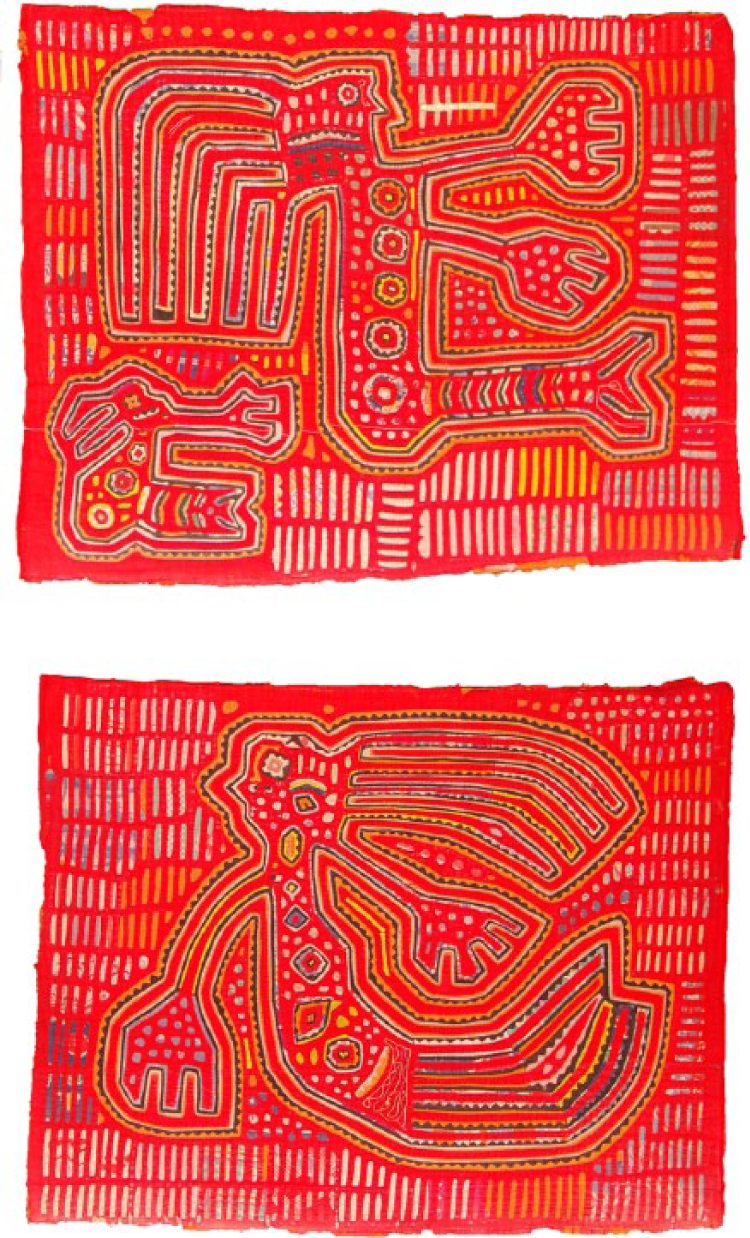
Pair of mola panels with similar designs with different orientation. Front mola panel on the top, back mola panel on the bottom. The front panel has been oriented vertically and the back panel has been oriented horizontally. These large early style mola panels exhibit no symmetry. The design may be a Kuna mythical figure, similar to a mermaid (Agnew, 1956: 209–210; Salvador, 1976: 96). c. 1920s–1930s. Private collection. EHC 3381, EHC 3382. © Photographs: Diana Marks.
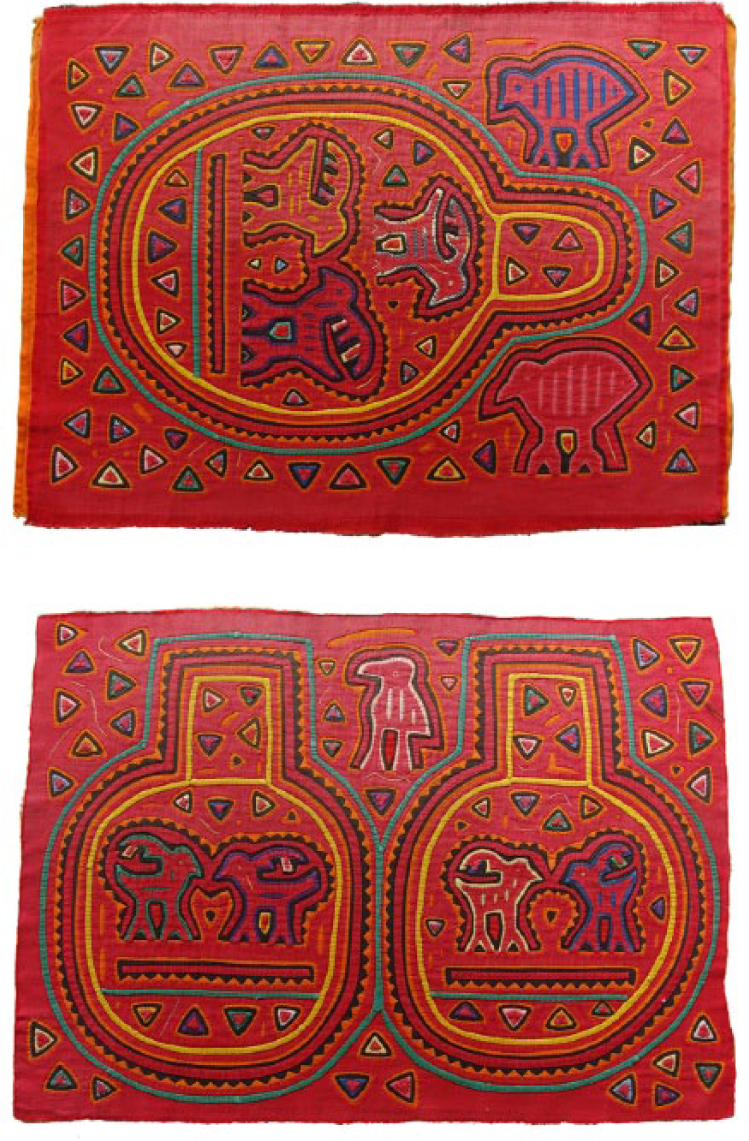
Pair of mola panels with different designs of similar objects. Front mola panel on the top, back mola panel on the bottom. Pots are sometimes covered during cooking over a fire and when fermenting alcoholic beverages with carved wooden lids (or possibly metal lids) similar in shape to the ones on these panels (Salvador, 1997: 77). Both panels have similar figures on the pot covers, possibly squirrels, however one panel shows one pot cover, oriented vertically, nearly symmetrical on the horizontal axis, and the other panel shows two potholders, side by side, nearly symmetrical on the vertical axis. Alternatively, the front panel could depict a gourd. Gourds are also used in the Kuna kitchen, to store water and as ladles. One panel is smaller because it has been trimmed with scissors on the perimeter, perhaps due to damage when it was removed from the blouse. Both panels have the same triangular fillers, which reveal the three layers – red, orange and black – which have been sewn with reverse appliqué, and two additional triangles have been added on top using surface appliqué. Thin strips of yellow and green fabric have been applied to the top layer, outlining the central designs on both mola panels, mimicking two additional layers. 1940s–1950s. Private collection. EHC 3701, EHC 3702. © Photographs: Diana Marks.
Another variation relates to print-derived images, often from Western popular culture. In these cases it can be more difficult to discover the thematic link between mola panels, when there is no common object or figure. 15 For example, when considering a mola blouse which has the image of an armadillo on the front panel and a farmer scattering seed on the back panel, it is difficult to determine the connection. This design has continued to be sewn since these two images appeared in 1950, as part of printed posters distributed throughout the San Blas islands, to promote participation in an Agricultural Census. Many collections have one or both of these panels and the design source is unknown. In Figures 8, 9 and 10 there is no difficulty in relating the panels to each other since the colours and the encapsulation of the central designs are similar in both panels of these pairs. The similarities of background treatment, for example the same filler shapes or inclusion of the same animals in the background, are additional clues that these panels are pairs.

Pair of mola panels with different depictions of a similar scene. Front mola panel on the top, back mola panel on the bottom. Different scenes of a bird (an eagle is suggested by the outsized claws) with snakes. On the front panel the bird is feeding a young bird with a snake approaching; on the back panel the bird has captured the snake. The appliquéd circles on the snake may indicate that this is a rattle snake, found on the mainland adjacent to the San Blas islands. There are snakes in the jungle close to the agricultural allotments farmed by the Kuna and a number of medicinal plants are harvested by Kuna medicine men to treat snakebite (Ventocilla et al., 1995: 85–94). Neon colours found in some of the background fabric are indicative of 1960s origin. 1960s. Private collection. EHC 3303, EHC 3304. © Photographs: Diana Marks.
Many early molas include one or more layers of patterned fabric. Often the base layer is patterned and the remaining layers are plain fabric. The juxtaposition of the patterned fabric, exposed when layers are cut creating a wide channel around a design, creates optical movement, especially evident when the patterned fabric has a white or light-coloured base and more than three colours in the patterns. The impact of a layer of patterned fabric is illustrated in Figure 11.

Pair of mola panels with layer of patterned fabric. Front mola panel on the top, back mola panel on the bottom. The front panel has a base layer with a widely spaced pattern which adds movement to the optical effect; the base layer of the back panel has a smaller pattern, with black designs, for the top third and the same widely spaced pattern for the remainder of the layer, illustrating the impact different patterns have on perception. Note the two snake-like heads, highlighted by the black patterned section of the layer underneath, at the top of the back panel. The design on both panels may relate to a plant form, the front panel showing the leaves ‘closed’ and the back panel showing the leaves ‘open’. Alternatively, the design could be a butterfly from different perspectives. 1940s to early 1950s. Private collection. EHC 4030, EHC 4031. © Photographs: Diana Marks.
Figures 8 to 11 provide examples of pairs of mola panels that are different.
Reflections
Whilst this article has focused on understanding the mola panels in a blouse as a twinned pair, it is important to also consider the view of these panels when worn as part of the dress ensemble of Kuna women and girls. The lower parts of each panel are obscured when worn, covered by the wrapped skirt. The portion of the panels tucked into the skirt has varied over time. The top of the front panel may be covered by necklaces and the headscarf may also drape over each side of the front of the blouse. Generally more of the panel on the back is seen when worn. A large part of the iconography of the pair of mola panels in a blouse is hidden from view when worn and mola blouses are laundered and stored with the blouse turned inside out. The display of the mola when worn does not enable the interpretation of the meaning of the iconography.
Kuna women derive inspiration for mola designs from old designs and from observing the molas worn by other women. For the past few decades, old designs have been copied from mola illustrations in books and from photographs of molas in museum collections, brought to the San Blas by visiting anthropologists (Patera, 1984: 122; Perrin, 1999: 16, 34; Salvador, 2003: 63). Kuna women and men also study mola collections in museums, and recognize that museums are able to ensure the preservation of Kuna material culture, which is not possible in the long term in the tropical climate of the San Blas.
The prevalence of mola pairs which are similar and which are different varies over time. Mola blouse designs, including both the designs on mola panels and the style of the blouse neckline and sleeves, are subject to fashion trends and reflect the availability of different types of cloth. The mola, an example of an item of non-Western dress, is impacted by cycles of fashion similar to Western dress, with the recurrence of the popularity of old designs and the introduction of new designs.
In some museum collections, individual mola panels form parts of pairs which have not been matched. It may be difficult to assess this based on measurements alone, since one panel in a pair may have been trimmed on four sides during the removal from a complete blouse, reducing the original seam allowance. Care needs to be taken when assessing potential pairs to study the order of layering, the designs filling the background, the colours, the cloth, and the quality of workmanship of each panel. Sometimes one panel in a pair may be 1–2 cm wider than the other, so, when considering whether two panels constitute a mola pair, it may be necessary to compare the stitch holes along the seam lines to assess whether the panels may have been joined. Panel orientation may be found in many cases by considering where the panels were joined to the sleeves, often indicated by a slight inwards curvature at the top for older panels and by incomplete or missing work in the top corners of recent panels where the sleeves intersect the panels at a sharper angle.
Another caution pertaining to similar designs relates to the propensity for Kuna women to copy appealing designs, from each other and from photographs, and also as a purposeful group enterprise. Near-identical mola blouses may be sewn for a special occasion such as Independence Day or by a kinship group to celebrate a young girl’s puberty ceremony, so that many individual panels may appear similar. Many private collections consist of single panels, and the majority of mola panels in museum collections are single panels. Complete blouses form a small part of many collections.
Individual mola panels are generally sought by tourists as souvenirs and mola panels sewn specifically for commercial sale are generally smaller. They may not be sewn as a pair, since the sewing techniques are in most cases simpler, with fewer layers and less fabric consumption overall, removing opportunities to swap layers between molas in a pair. Worn mola blouses are also sold to tourists and collectors, and it is considered likely that the majority of panels are removed from blouses and sold individually.
Mola blouses are an important part of Kuna material culture. Individual mola panels, even when separated from their blouse and their ‘twin’, are associated with both the Kuna Indians and the nation of Panama. The commercialisation of molas as souvenirs and collectibles has increased their popularity and appeal, and this in turn reinforces their role in cultural survival. 16 As a final point, museum collections of molas are important in understanding the mola blouse as part of the dress history and culture of the Kuna Indians.
Footnotes
Acknowledgements
I would like to thank very much the anonymous reviewers for their invaluable comments and advice.
Funding
The author(s) received no financial support for the research, authorship, and/or publication of this article.
Author’s Note
The images in this article appear in colour in the online version.