




Abstract
This article introduces the notion of sustainability objects as a label for objects that come with a claim of promoting a more sustainable mode of living. The purpose is to show that organizations that develop such objects construct a performative definition of sustainability. A case study of the development of a facility for the pre-treatment of food-waste-based biogas and biofertilizers serves as an empirical example of the development of sustainability objects. The analysis demonstrates that this development and concomitant defining of sustainability have involved the contextualizing of biogas and biofertilizers, entangling them in nets of relationships and endowing them with an agency of their own. With sustainability objects embodying definitions of sustainability, their success or failure as objects derive from the success or failure of the performative definitions that they embody, and vice versa. Asking why sustainability objects gain or lose ground is therefore suggested as a way of understanding the character and evolution of sustainability transition.
Introduction
A measure of the numerous efforts that are being made to promote a more sustainable capitalism (e.g. Epstein and Rejc Buhovac, 2014; Hawken et al., 1999) and a more sustainable consumption (e.g. Ekström, 2015; Jackson, 2006; Reisch and Thøgersen, 2015) is the ever-increasing development of objects to which are attached the qualifier ‘sustainable’. They range from mundane products such as pens to societal mainstays such as energy; from food, plastics, apparel, packaging, cellular phones and carpets; even to less tangible objects such as tourism destinations, urban renewal projects and commercial fishing policies. I call them all sustainability objects in order to underscore one of their key characteristics: their claim of promoting a more sustainable mode of living. The development of these objects calls for critical scrutiny.
In this article, I show that the development of sustainability objects involves more than a promise (Grosz, 2001) to reduce the negative impact of human activities on the environment. By offering substitutes to conventional objects and opening possibilities for more sustainable behaviors, sustainability objects also involve the pragmatic expression of local and ad hoc definitions of sustainability that stands for efforts to make the world amenable to our actions (Grosz, 2001).
There is no agreed-upon definition of sustainability and therefore no agreed-upon definition of sustainable actions. As Washington (2015) shows, the early understanding of sustainability in terms of caring and harmony has ramified into understandings of sustainability that range from weak to strong, pro- to anti-growth creeds, realistic to idea-driven programs, and encompass journey or destination. The debate in sustainability research is intense today among what Latour (1986) calls ostensive definitions of sustainability: definitions that are constructed in principle and according to a definitional reasoning. Ostensive definitions of sustainability range from an ethical responsibility for nature and the future of humankind (Jonas, 1984), through an obligation to invest so that we leave to the future the option or the capacity to be as well off as we are (Solow, 1993), to an imperative to respect the physical capacity of Planet Earth for human material and energy throughputs (Alaric, 2014; Daly and Farley, 2004; Wijkman and Rockström, 2012). Definitions in the Brundtland Report – that sustainability entails environmental, social and economic dimensions and that sustainable development meets the needs of the present without compromising the ability of future generations to meet their own needs (World Commission on Environment and Development, 1987) – have become standards but have also received massive criticism. Critics of the Brundtland definition claim that economy is not a dimension in itself but is nested in the social, which, in turn, is nested in the environmental (Giddings et al., 2002). Add to this a cultural dimension (Hawkes, 2001), stress instead the territorial, temporal and personal dimension of sustainability (Seghezzo, 2009), or build on a combination of global justice and a dependency on nature (Christen and Schmidt, 2012). Worldviews with radically different understandings of human, nature, ethics, economy and technology produce ostensive definitions of sustainability that are radically contradictory and irreconcilable. Critics even claim that one should move past the concept of sustainability and focus on resilience (Benson and Craig, 2014).
Focusing instead on practical contributions to sustainability (Faber et al., 2005), my claim is that, along with this theoretical debate on sustainability, another debate about ways of defining sustainability is occurring over performative definitions (Latour, 1986) of sustainability embodied in sustainability objects. The notion of a performative definition derives from the philosophy of ordinary language, especially Austin’s (1975) idea of performative statements – utterances with the power of establishing what they say. Performative definitions, Latour (1986) explains, are constructed in practice, when acting defines the act. And the development of a sustainability object is one such a definitional practice: developing a definition of sustainability through the development of an object to which a claim to be sustainable is attached. A self-referring loop is created in which social practices are considered sustainable because they pertain to an object that comes with a sustainability claim, this claim being grounded in turn in social practices claiming to be sustainable. The performative character of the definition of sustainability offered by sustainability objects resides in this self-referring loop between practice and definition.
To support the claim that the development of sustainability objects entails the development of performative definitions of sustainability, I present a case study of two sustainability objects: food-waste-based biogas and food-waste-based biofertilizers. Following the development process of a pre-treatment facility at a Swedish municipally owned waste-management company, I analyze how developers have turned food-waste-based biogas and biofertilizers into concrete expressions of sustainable waste management. The analysis identifies the fact that developers in the case company have positioned food-waste-based biogas and food-waste-based biofertilizers in supportive contexts, inserted them in dynamic networks of people, plans and practical imperatives, and exploited their material agency. This combination of contextualizing, networking and endowing with agency explains the birth of food-waste-based biogas and biofertilizers as sustainability objects and the corresponding construction of a performative definition of sustainable waste management.
Combining social network theory and narrative analysis, Lejano et al. (2013) show that environmental communities narrate themselves into existence in the sense that they produce the very narratives about the environment that define them as communities. In a similar symmetrical way of thinking, I combine object studies (e.g. Bennett, 2010; Law and Mol, 2008; Star, 2010; Suchman, 2005) and studies on the performativity of organizational practice (Callon et al., 2007; Gond et al., 2015; Muniesa, 2014) to show that the success or failure of sustainability objects is also the success or failure of performative definitions of sustainability, and vice versa. Therefore, an understanding of the development of sustainability objects and why they succeed or fail provides unique ways of understanding the actual state and dynamics of sustainability transition.
The case company in brief
Sysav is a waste management company owned by a consortium of 14 municipalities in Scania, the southernmost part of Sweden. These owner municipalities are also Sysav’s primary customers. Through them, the company serves a joint population of about 720,000, from which it collected 401,500 tonnes of household waste in 2014, 27,421 tonnes of which was food waste (Sysav, 2015). Like most municipally owned waste management companies in Sweden, Sysav is a dual company that enjoys a monopoly on household waste within the jurisdiction of its owners, but can also collect waste from companies or other municipalities on a commercial basis up to 20 per cent of its turnover. In 2014, the Sysav group received 8,580 tonnes of food waste from various companies – from restaurants and a local dairy plant, for example. From 2005 to 2011, food-waste activities were developed within a fully owned subsidiary, Sysav Biotec, which later merged with the mother company and was turned into an eponymous department.
The development of today’s capacity to process food waste for the production of biogas and biofertilizers has taken about 15 years. After a failed attempt in the late 1990s to develop a biogas plant for biowaste from industry and agriculture, Sysav ran a few pilot projects with schools and households in the early 2000s. It created Sysav Biotec as a subsidiary in 2005, and, after a series of tests and consultations with the municipalities it serves, a pre-treatment facility was opened in December 2008 and has been expanded three times in the past 7 years. This pre-treatment facility produces undigested slurry – a mixture of dung and water – as an input in the anaerobic digestion processes that produce biogas. This slurry is transported some 100 km away from the pre-treatment facility and outside the Sysav region for the actual production of biogas and biofertilizers. In 2011, Sysav even planned to build a biogas and biofertilizers production unit to complement its pre-treatment facility. But even after detailed plans were drawn up and the public procurement process had begun, the project was frozen in 2015 by Sysav’s top management in reaction to a collapse in demand for Swedish biogas, following increased competition from natural gas and imported biogas.
Thanks to the introduction of a separate collection of food waste in nearly all municipalities in the region, volumes of food waste increased rapidly: from 2,115 tonnes received in 2007 to 15,400 tonnes in 2010 and 36,000 tonnes in 2014. Four municipalities in the Sysav region reached the national objectives of a 50 per cent collection of food waste.
Developing a biogas and biofertilizers pre-treatment facility
The development of Sysav’s pre-treatment facility is analyzed in the next three subsections in terms of contextualizing food-waste-based biogas and biofertilizers in supportive contexts, inserting them in dynamic networks of people, plans and practical imperatives, and exploiting their material agency.
Contextualizing
Food-waste-based biogas and biofertilizers were first developed into sustainability objects thanks to a multi-faceted contextualization that allowed them to fit the objectives, concerns, demands and interests of the Swedish Parliament, farmers, biofertilizers experts, municipalities, householders or the mother company, for example. Instances of boundary objects (Star, 2010; Star and Griesemer, 1989), food-waste-based biogas and biofertilizers have demonstrated enough stability to be acknowledged as a recognizable identity, yet enough plasticity to be used and supported by stakeholders with differing interests. Thriving on indeterminacy, food-waste-based biogas and biofertilizers have been facilitating cooperation among heterogeneous groups (Lainer-Vos, 2013) and across communities of practice (Carlile, 2002). They have been reconstructed in and for new uses (Lindberg and Walter, 2013) – particularly as they met changes in contexts or were moved from one context to another. This section details the conditions of this multi-sided contextualization.
From the beginning, Sysav developers have placed their project of collecting food waste to the production of biogas and biofertilizers in the context of European and Swedish waste policy. The European Waste Directive (The European Parliament and the Council of the European Union, 2008/98/EC) recommends a separate collection and proper treatment of bio-waste to reduce greenhouse gas emissions, the composting and digestion of bio-waste and the use of environmentally safe materials produced from bio-waste. Similarly, the Swedish waste national plans (Swedish Environmental Protection Agency, 2005, 2012) identify the production of biogas and biofertilizers as a way of promoting more sustainable waste management. Developers used the European and national efforts to introduce a societal narrative on waste (Corvellec and Hultman, 2012), highlighting the environmental friendliness of biogas, and thereby creating an official background against which they could pitch their claim that turning food waste into biogas and biofertilizers is as a practical way for Sysav to contribute to sustainability. Sysav managers also used the national objectives for the collection and processing of food waste set by the Swedish parliament to legitimize their local project: [The national objectives] provided a legitimacy to work with the issue. They showed that not only the Sysav waste company discovered that it is good for the environment and made a decision. There was even a national goal involved in this environmental collaboration. (Interview with Sysav Biotec manager, 9 April 2013; all translations from interviews are mine)
National objectives created a waste-policy context that local actors could legitimately ‘green’ (Fuentes, 2014; Reijonen and Tryggestad, 2012) food waste by transforming it into biogas and biofertilizers. Developers used these objectives to convince politicians, civil servants and the public at large that developing a biogas plant was a local effort aimed at serving the national, European and global environmental objective of moving up the waste hierarchy.
At the same time, Sysav Biotec needed to learn more about ways of transforming food waste into biogas and biofertilizers. At the outset of the development process, they were epistemic objects (Knorr Cetina, 2001) – objects that entail a quest for knowledge about what they are and what they can serve as a purpose, in a state of flux, likely to be rapidly given different characters. There were many questions: How much food waste is there in household waste in our region? How many of the 14 municipalities in the Sysav area will join the project? How much food waste do restaurants, institutional catering and shops produce? Would revenues cover costs? Should the food waste be collected in holding tanks, disposal machines or conventional containers? Finding answers to these questions helped to outline the technical contours of Sysav’s food-waste-based biogas and biofertilizers progressively.
A working group was therefore created to assess the region’s food-waste potential and compare advances. A series of technical studies was commissioned to explore the efficiency of collection devices (Bernstad, 2010a, 2010b; Kärrman et al., 2005), and a minor consultancy study (Bisaillon, 2011) confirmed that biogas is an energy of better quality than incineration because it can be used as vehicle fuel, making it preferable from a climate change perspective. Bearing in mind an attempt in the late 1990s to develop a biogas production plant that failed because of local objections, the developers opted for locating the pre-treatment facility on Sysav’s main operations site, which has no close neighbors, thereby limiting the risk of seeing their plans appealed against and overruled. Anticipating possible obstacles to avoid landing one’s project in unfavorable contexts is a standard argumentative strategy in infrastructure development (Corvellec and Boholm, 2008). Contexts are spaces of action. To adapt to the evolution of the volume received and thereby reduce Sysav’s economic and operational risks, developers at Sysav opted for a two-step strategy of developing a pre-treatment unit rather than going directly to a production unit – again, in an effort to avoid landing their project in an unfavorable context.
With food-waste-based biogas and biofertilizers gaining technical characteristics, it was essential to take stakeholders into their fold to gain social acceptance for the development project. Municipalities were free to join the food-waste program, but needed to be convinced. Householders had to provide space for new containers, learn how to use the paper bag for sorting, and sometimes even pay higher waste-collection fees – something that surprisingly few resisted. Experts who certify biofertilizers, authorities who grant permits to use these fertilizers, and farmers who use them on their fields had to be convinced of the quality of the biofertilizers produced. And an internal acceptance had to be gained for large-scale biological treatment of waste within Sysav – a company with a long tradition in incinerating waste to produce heat and electricity. This proved to be an easy task, informants declared, especially when Sysav Biotec could show that food-waste volumes become large enough to secure positive economic returns. Political efforts, behavioral changes, institutionalized acceptance and green strategic choices joined to let two ‘objects multiple’ (Law and Mol, 2008; Mol, 2002) take form – i.e. objects that are understood in different, changing and not necessarily coherent versions by different publics. At the core of the strategic practice (Jarzabkowski, 2005) of the developers was an effort to find practical ways of bringing together the stakeholders’ different systems of ordering (Harvey and Knox, 2014) the strengths and weaknesses of food-waste-based biogas and biofertilizers.
It is noteworthy that the development of an infrastructure able to transform food waste into biogas and biofertilizers has met remarkably little external opposition. When two municipalities in the Sysav area introduced a scheme that required householders to separate food waste from other waste, one householder complained to the Ministry of Environment about nuisances such as blowflies and maggots; he was referred to the municipal sanitation department. Occasional protests by householders against the obligation to separate food waste were met in 2014 by promises not to fine householders who did not comply with waste separation. And objections of a neighboring municipality to having yet another waste installation on its territory forced Sysav to move the planned biogas and biofertilizers production unit a few hundred meters to the Municipality of Malmö, where the production of food-waste-based biogas was welcomed. The later decision to freeze the construction of this production unit came somewhat unexpectedly from Sysav’s top management, following serious concerns about the economic sustainability of the project.
Finally, an effective way of promoting the transformation of food waste into biogas and biofertilizers has been the creation of a positive semantic context. The choice of the Swedish term matavfall – literally ‘food waste’ – was decisive in this regard. Several terms were in competition: compostable waste, organic waste or biowaste. But Sysav Biotec and municipal representatives settled for food waste. As the head of Sysav Biotec explains: Food waste is food. Not houseplants, not cut flowers, not kitchen paper, but food. We thought this was easy to communicate. And we needed this because we were planning a pre-treatment plant, so we were forced to know exactly what kind of waste we were going to collect. What came immediately after that were waste-sorting instructions: what is food waste and maybe what is not food waste and why … At the beginning, we didn’t have coffee grounds as food waste, but after some investigation, we changed our minds, and now we have coffee grounds as food waste. (Interview, 9 October 2012)
The term ‘food waste’ enabled a clear distinction to be made between what was to be collected and what was not, creating a semantic clarity that proved to be a stepping-stone in providing food-waste-based biogas and biofertilizers with a material agency able to serve the development project.
When developers set food-waste-based biogas and biofertilizers in a waste-policy context – an epistemic process context, the contexts of numerous stakeholders’ interests – or in shifting semantic contexts, they do not simply defer to what Barad (2003) calls ‘representationalism’: a language-centered concern for representing pre-existing things. They engage in what Barad refers to as performativity, as they actually establish the materiality of what they are working with. Integrating material and discursive, social and scientific, human and non-human, and natural and cultural practices, they show, for example, that biogas is more than methane, an object that is both dependent and independent from its materiality. Food-waste-based biogas and biofertilizers are endowed with what Martinez-Reyes (2015) calls enviromateriality – a materiality rooted in the current global political ecology of producing and consuming – which is actively participating in the creation of a more sustainable world.
Contextualizations create historically situated characterizations of food-waste-based biogas and biofertilizers that participate in their coming into being as sustainability objects. This brings me to the point of describing how food-waste-based biogas and biofertilizers relate to other objects.
Introducing relationships
To bring sustainability objects into being also requires that they be inserted in strong networks of humans and non-humans (cf. Latour, 1996, 2005). For example, food-waste-based biogas and biofertilizers had to be brought into line with waste-collection trucks, climate-change mitigation, municipal-waste plans and sanitation contracts, together with all the people busy with these plans, machines and policies. For biogas and biofertilizers to become operational, interconnections had to be initiated and maintained to create continuity not only among objects, but even among bodies. This section describes how that process came to be.
Garbage trucks are central to waste collection and a realization of the project’s environmental ambitions goes through answers to operational questions: What types of truck are there? What kind of two-chamber truck is there [to collect food waste and unsorted waste at the same time]? Some trucks have four chambers [and can collect four different waste streams simultaneously], but can one also use trucks with only one chamber? What type of problems, technical problems, could one encounter? Trucks that collect food waste run a higher risk of leakage because food waste contains more water, and when you concentrate it, you get more water than with unsorted waste: how do you manage this? (Interview with Sysav Biotec manager, 9 April 2013)
Feasibility is a political argument that builds on a pragmatic ‘adaptation of the needs of life to the exigencies of matter’, to use Grosz’s (2001) terms. The pilot studies, the lack of problems met by pioneering municipalities and rapidly increasing volumes showed that the national objective of a 35 per cent collection of food waste was within reach. This helped to convince municipal representatives that a separate food-waste collection could serve their environmental policy, communication and image without alienating householders, and thus voters.
Likewise, an increased interest in climate change in the mid-2000s, following the Intergovernmental Panel on Climate Change (IPCC) reports (e.g. Metz, 2007 ), made it easier for Sysav Biotec representatives to put the project forward.
We produce a local fuel from our garbage, we reduce emissions from car transportation, and we reduce the impact of CO2 when we join this system of biological treatment of food waste. (Interview with Sysav Biotec manager, 9 April 2013)
A rising awareness of the effects of greenhouse gases among politicians and the public at large made it possible for developers to convince them all that biogas makes it possible to mitigate CO2 emissions and present the development of food-waste-based biogas and biofertilizers as positive for the environment.
Inscribing a separate collection of food waste in municipal waste plans was critical. These plans are obligatory passage points (Callon, 1986) that legally bind the municipality to organize the management of waste as outlined. In particular, waste plans lay the groundwork for the public procurement of collection services and thus sanitation contracts. Because municipal waste plans are renewed every 6 or 7 years, the pace of these renewals sets the pace of any change in waste collection. Synchronicity surfaces as a condition for the development of sustainability objects.
Developers noted that it was helpful for several municipal waste plans to be renewed just after Sysav’s own long-term plan; owner municipalities could then refer to Sysav’s plans to develop a biogas and biofertilizers transformation capacity. That more and more municipal waste plans mentioned a need for and a commitment to food-waste-based biogas and biofertilizers endowed them with an official character and made Sysav’s plans harder to stop. Objects gain momentum from being linked to texts with strong social status (Corvellec, 2007). In the case at hand, the development of food-waste-based biogas and biofertilizers was intertextually linked not only to the municipal waste plans of Sysav’s owners, but also to the An Inconvenient Truth documentary (Guggenheim et al., 2006), a work by the Intergovernmental Panel on Climate Change (e.g. Metz, 2007 ) and, as described in the previous section, the European waste directive (The European Parliament and the Council of the European Union, 2008/98/EC) and national waste plans (Swedish Environmental Protection Agency, 2005, 2012). This strong, encompassing inter-textuality created a situation in which questioning food-waste-based biogas and biofertilizers amounted to questioning all the texts and organizations to which food-waste-based biogas and biofertilizers were linked, making it more and more difficult to question Sysav’s development plans because they were connected to more and more texts with a strong social status.
Sysav Biotec managers were also keen to associate their project with the regional public transportation plans to rely entirely on biogas as bus fuel by 2020, and thus contribute to sustainable mobility and climate change mitigation. But they were also cautious that little importance be given to the fact that spores and worms can threaten the health of sanitation workers or that water in food waste corrodes truck chambers. Biogas was not to be associated with smell or biofertilizers to sewage sludge. Instead, Sysav humorously featured its slurry as a cocktail drink (see Figure 1), evoking luxury, pleasure and quality as opposed to waste, disgust and nausea.

Food-waste-based slurry as cocktail. Reproduced courtesy of Sysav AB.
The purpose of connecting food-waste-based biogas and biofertilizers to trucks, greenhouse gases, municipal waste plans, quality and sustainable mobility was to create conditions of possibility for a new social order (Preda, 1999) around food waste: artifacts participate in shaping and stabilizing the social practices from which they result, affecting cognition, knowledge, temporal and spatial structures, practicalities, power relationships and, more generally, human possibilities for action. Touching on hygiene and thus privacy, but also value and thus sociality (Lucas, 2002), waste management is material politics (Harvey, 2014) that reorganizes through a detailed mundane governance (Woolgar and Neyland, 2013) the relationships of producers, consumers and authorities to consumption, waste and energy. As Akrich et al. (2002) note, A ‘technical device distributes the forces which will support or resist it’, meaning that objects are the loci of conflicts and expressions of reigning relationships of power. Municipalities, households, private contractors and Sysav were faced with a moral and practical imperative to engage with the environmental consequences of food consumption. New individual and organizational behaviors were suggested. An expertise was developed for the design of waste plans, sorting food waste from non-food waste, organizing dual-waste collection systems, or preventing hazardous substances from finding their way into biofertilizers. A different map of energy production emerged.
Food-waste-based biogas and biofertilizers created novel entanglements among humans, among objects, and between humans and objects (Hodder, 2012), orienting how people in Sysav region envision their environmental responsibility, manage flows of domestic material, participate in the production and use of energy, and depend upon the things they use and produce. A new way of ordering people and waste was established without anyone knowing how long this order would last and what the consequences would be. The long-term challenge was to make food-waste-based biogas and biofertilizers independent objects (Meijers, 2000) that are as self-evident as waste bins or flushing toilets, thanks to their insertion in strong and established networks.
In the meantime, the associations and dissociations that turn food-waste-based biogas and biofertilizers into expressions of sustainability remain less than steady. Their stability is relative. For example, the Swedish combined biogas and biofertilizers production could be brought to an abrupt end at any time for many reasons: a reduction in the maximum allowed halt of cadmium or phosphor in biofertilizers, a social critique asserting that turning food waste into biogas and biofertilizers amounts to an ethically unacceptable normalization of food waste, or a collapse of demand for biogas, as illustrated by Sysav’s sudden freezing of its plans to develop a production unit to complement its pre-treatment unit.
The ‘affiliative powers’ of food-waste-based biogas and biofertilizers as sustainability objects, as Suchman (2005) calls the ways in which objects are fraught with significance for the relationships that materialize from them (Harvey et al., 2014), have remained contingent, ambivalent and changeable. They may be ‘objects’ but they are also in a flux of becoming immanent outcomes of slow transformations (Jullien, 2011) that are not amenable to a narrative closure (Harvey and Knox, 2014). Food-waste-based biogas and biofertilizers could, and still can, break down at any time if the connections that they have developed with other artifacts change character, or if they were to develop connections that evoke a lack of sustainability. Duineveld et al.’s (2013) observation was confirmed: objects may reach some level of stabilization, but they rarely reach complete and irreversible stability. The situatedness of food-waste-based biogas and biofertilizers was such that their multiplicity was in permanent need of coordination and their sustainable character needed to be permanently reproduced and renewed in order to be prolonged.
Using objectual agency
Finally, developers managed to provide materials related to food-waste-based biogas and biofertilizers with an agency – an objectual agency that mirrors human agency in the sense that the two are mutually constituted, each being transformed by the other in their conjunction (Knappett, 2008). Developers emphasized the fact that biowaste slurry is an extremely active product. Sysav Biotec showed politicians and householders small slurry-filled glass tubes that emitted a soft but slightly nauseating odor but let them experience through sight and smell the reality of Sysav’s plan to produce renewable energy from food waste.
The paper bag for separate food-waste collection (see Figure 2) was also to do more than ensure an actual presence in kitchens of Sysav’s plans for sustainability. Acting as a school for recycling, the bag was to provide guidance. The head of Sysav Biotec describes its texture as being of crucial importance: A plastic bag, but even a bag made of cornstarch, does not return as clean food waste [as a paper bag does]. A plastic bag says that it is okay to put other stuff in it and people do not understand that a bag is made of cornstarch when it looks like a plastic bag. (Interview with Head of Sysav Biotec, 9 October 2012)
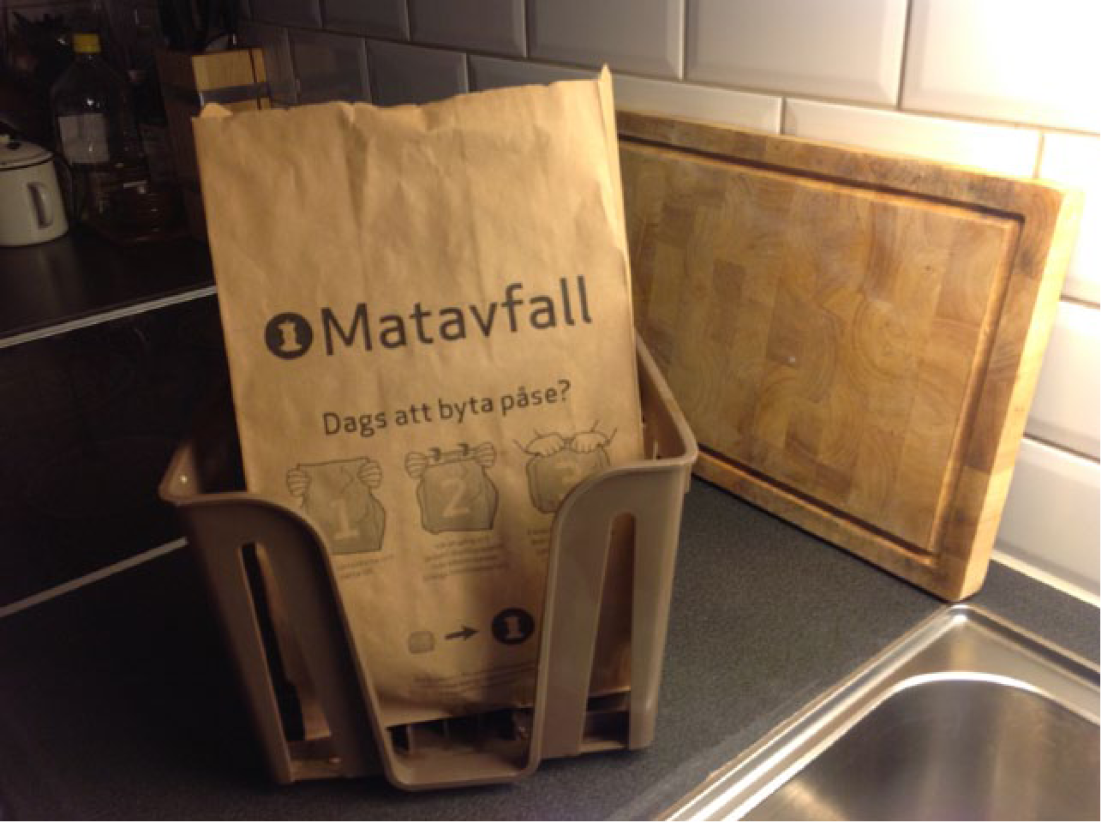
Paper bag for a separate collection of food waste. The plastic holder, which is to be placed under the sink, for example, enables a circulation of air under and around the bag to avoid moisture outside the bag and on the holder. © Photograph: Hervé Corvellec.
In words that are reminiscent of the vibrancy that, according to Bennett (2010), lays the groundwork for the agency of matter, the head of Sysav Biotec underscores the point that paper bags determined disposal behavior by signaling ‘food waste only’. Paper as material for the bags was considered as anything but dead material; it stood for a vital materiality with the ability to act on householders and lead them into adequate sorting behaviors. Sysav developers considered paper bags to be better able than plastic bags to convey the message that collecting food waste is a way of creating a closed loop between food and energy production. They saw a fit between their ambitions and the materiality of paper that led them to imagine that the paper bag could exert what Carlile et al. (2013) call a ‘moral agency’: the ability to distinguish between what is sustainable and thus right and what is not sustainable and thus wrong. The food-waste paper bag provides Douglas’s (2002[1966]) oft-cited claim that ‘dirt is matter out of place’ with a purposive illustration. Paper bags constituted not only a concrete pragmatic of engagement (Thévenot, 2002) with food-waste-based biogas and biofertilizers, but they were also meant to give consumers the opportunity to engage with green morality (Fuentes, 2014) and express a moral commitment to sustainability. As Norris (2012: 390) acutely observed about the global market for used clothing and textile fibers, when it comes to recycling, ‘moral is implicated in the material at every twist of the thread’.
The agency of things derives from their being assemblages (Bennett, 2010): it becomes effective when several elements operate in conjunction with one another. It is not possible to isolate any specific element that acts alone. Every element acts with the help of, together with, through, against or in other forms of interplay with others. In this interplay, every element depends and exerts control on the other elements in the whole. The ability of food-waste-based biogas and biofertilizers to become sustainability objects depends on a range of conditions – the ability of paper bags to lead people to sort their waste in accordance with the technical characteristics of the pre-treatment facility and current legislation on waste and waste collection contracts, for instance. As Law and Mol (2008) note, actors are always being acted upon, and they can act only if others act with them. The trucks, contracts, pumps and organizational routines have a collective but also bounded agency that results from but also conditions the organization of food-waste collection. For example, the ability of the pre-treatment facility to process cucumbers and other vegetables in individual plastic packaging enabled Sysav Biotec to collect food waste from retailers and restaurants, an ability deemed necessary early in the process when it was unclear whether enough food waste could be collected from households to reach the national objectives. Technical choices are made to orient future actions, creating even path dependences (Schreyögg and Sydow, 2010) and lock-ins (Corvellec et al., 2013; Unruh, 2000) that cement earlier choices beyond the relevance of these choices. The food-waste-based biogas and biofertilizers depend on sorting, collecting and processing activities but also orient the contracting, controlling and other organizational practices in the specific direction of its political and technical characteristics. They stand for a sustainable waste management promise that establishes a ‘pressing sense of the future’ (Harvey and Knox, 2014), indicates an effort to move up the waste hierarchy and establish a narrative standard (Corvellec and Hultman, 2012) against which other waste management alternatives can be assessed.
Moreover, objects develop a temporality of their own to which they subject other actors. Pilot projects and pioneering municipalities have a knock-on effect. But much learning was needed to handle the uncertainty of whether enough waste could be collected, how and when. Questions like ‘What steps do we have to take?’ and ‘In what order shall we take these steps?’ give a structuring role to bets on the future but also look into the past. And the renewal of municipal waste plans sets the pace of the project, as it was necessary that they contained plans for a separate food-waste collection. The frequent use by informants of terms such as ‘being ahead’ or ‘coming a long way’ underscores the need for developers and other stakeholders to think of sustainability objects in a processual manner, as something in a state of becoming rather than of being (Chia and Holt, 2009; Hernes, 2014). The agency of sustainability objects cannot be considered outside its temporal dimension.
Finally, the agency of food-waste-based biogas and biofertilizers fluctuates. Fluid technologies (De Laet and Mol, 2000) are adaptable, flexible and responsive to the local needs and conditions, while creating new possibilities for users – their ability to act nevertheless showing that objects do not need to reach stability to be able to do things as suggested by the ANT view (Law and Singleton, 2005). When it became clear that considering biogas as the main product, biofertilizers are implicitly defined as a bi-product, for example, Sysav Biotec developers started inverting the hierarchy of their outputs. ‘Today, we say that biofertilizers are our main products,’ explains the Head of Sysav Biotec (interview, 9 October 2012). Any association with sewage sludge needed to be avoided if the farmers were to accept biofertilizers, as farmers do not want to risk being accused of introducing potentially dangerous substances into the food chain. It was therefore necessary to clarify the fact that biofertilizers are not waste derivatives, but a product in their own right, carefully controlled and able to be used risk-free for food production. A new argumentative strategy was adopted, stressing that because the production of biofertilizers requires stricter quality control than the production of biogas, the primary focus should be on fertilizers rather than on biogas. Eventually, this new argumentative strategy closed the loop for nutrients between cities and the countryside before mitigating the climate change effects of transportation. A shift was made from a version of sustainability that gives priority to sustainable mobility to another version that gives priority to sustainable food production. New versions of food-waste-based biogas and biofertilizers were promoted, their nature multiple (Law and Mol, 2008; Mol, 2002) as sustainability objects orienting the development project in new directions.
Concluding discussion: Performative definitions of sustainability
Contextualizing food-waste-based biogas and biofertilizers, inserting them into strong networks and making use of their material agency have been Sysav Biotec developers’ ways of turning them into sustainability objects. They have also been ways of enacting a local definition of sustainable waste management – in Latour’s (1986) terminology, a performative definition of sustainable waste management.
Food-waste-based biogas and biofertilizers are performative expressions of sustainable waste management in the sense that they stand for a sustainable way of processing food waste: because biogas is a renewable fuel that can replace fossil fuels, it can mitigate climate change, and biofertilizers make it possible to return nutrients to the earth and close the agricultural loop. One could demur that biogas does not necessarily replace fossil fuels, that bio-fuels and fossil fuels are not engaged in a zero-sum game, that even biogas-driven cars are not a sustainable mode of transportation because cars consume many other resources, or that biofertilizers are only a second-best option to food-waste prevention. Also, the transformation of food waste into biogas and biofertilizers may fall apart, of course, if people stop separating their food waste from other waste, if legislation limits the use of biofertilizers, or if it becomes unprofitable to transform food waste into biogas and biofertilizers. The definition of sustainability in the context of transforming food waste into biogas and biofertilizers can lose its validity at any time and become, at best, just another failed effort at improving the environment. But for the time being, in the Sysav area, the specific assemblage of machines, policies, semantic creations, social innovations, existing infrastructures, argumentative practices, geographical maps, legally binding regulations, corporate strategies, local political traditions and managerial practices that characterize the transformation of food waste into biofertilizers and biogas stands for a de facto local definition of sustainable waste management.
The production of food-waste-based biogas and biofertilizers is thus not merely an objectual promise (Grosz, 2001) of contribution to sustainability transition. At least for those who accept the claim that turning food waste into biogas and biofertilizers contributes to sustainability, food-waste-based biogas and biofertilizers provide a local, temporary and incomplete but applied definition of sustainability that is a pragmatic intervention in the current order of things. I am not speaking here of theoretical (or ostensive in Latour’s, 1986, terminology) definitions, but of narrow, practical and transient definitions. Sustainability objects – and I opened this article by underscoring how many and diverse they are – come with their own definition of what a more sustainable mode of living entails. This definition may refer to recycling, bio-material, organic food, renewable energy, or sustainable tourism, depending on the sustainability objects under consideration. Each sustainability object offers a practice of sustainability that amounts to defining what it means to act sustainably within the object’s own domain or range of uses.
Emphasizing that sustainability objects create definitions of sustainability relates to the observation made in the new economic sociology (Callon, 1998, 2010; MacKenzie et al., 2007) and management and organization studies (Cochoy et al., 2010; Mason et al., 2014) that economic and management models shape reality rather than describe it. The ethnography of arbitrage shows that price is a social thing (Beunza et al., 2006), for example. The Black–Scholes–Merton model of option pricing proves to not simply represent the financial market for derivatives; it drives this market in the sense that market actors act according to the model, which therefore makes it prescriptive as much as descriptive (MacKenzie, 2006). And economic indicators of performance construct as much as measure organizational performance (Corvellec, 1997; Muniesa, 2014).
In a circular manner, sustainability objects and definitions prompt new ways of seeing, speaking or behaving and lay the groundwork for the new individual and collective practices upon which they rest. They induce new relationships among people, among objects and between people and objects (Hodder, 2012). They are political in the sense that they participate in establishing a social order, with material, moral, economic and practical consequences for organizations and the economy (Fuentes, 2015).
A performative approach to sustainability differs significantly therefore from the conventional efforts made at defining sustainability ostensibly (e.g. Alaric, 2014; Christen and Schmidt, 2012; Daly and Farley, 2004; Giddings et al., 2002; Hawkes, 2001; Jonas, 1984; Seghezzo, 2009; Solow, 1993; Wijkman and Rockström, 2012; World Commission on Environment and Development, 1987). Focusing on the development of a sustainability object makes it possible to address on its own terms the diversity of efforts that exist today for the promotion of sustainability. A performative approach views sustainability as plural and contentious. It invites researchers, consumers, business people and policy makers to follow which definitions and objects of sustainability come into being, gain visibility and become emblematic of ecological transition. It is a way to delve into the variety of actual sustainability practices, not to assess what is actually sustainable and what is not in quantified and objective terms, but to understand in qualitative terms which practices gain legitimacy and enforcement and why, both in critical or positive ways. Connecting to social studies on sustainability (e.g. Shove, 2010), it provides an entry into the social dynamics that shapes or retards a transition toward more sustainable social practices, providing along the way insights about what is held to be sustainable. Consumers are essential actors of these social dynamics, but so are the organizations that develop and offer sustainability objects. A performative approach to sustainability is not limited to a specific societal level or type of actor. Nor is it limited to a specific type of objects, opening unlimited possibilities for identifying green-washing or truly innovative initiatives. The contribution of a performative approach is to provide insights into the actual dynamic of sustainability transition, not as one may define it in theory or wish it politically, but as individual and organizational practices are actually forming it on an everyday basis. It provides an approach to sustainability transition as it happens in the social practices that take place here, there and elsewhere.
Footnotes
Acknowledgements
I am grateful to the Sysav managers who generously shared their knowledge and their time with me. And ‘tack’ to Nina Colwill for her invaluable editorial help.
Funding
The author(s) disclosed receipt of the following financial support for the research, authorship, and/or publication of this article: This study is part of two research projects: (a) Organizing Critical Infrastructure Services – A Case Study of Waste Management financed by Vinnova, the Swedish Governmental Agency for Innovation Systems; and (b) From Waste Management to Waste Prevention financed by The Swedish Research Council FORMAS.