



Abstract
The Mount Wuyi area of northern Fujian Province, China, is famous for having produced superior teas for over 1500 years, including rock tea, which is the focus of this article. Locals evaluate sites in the mountain area in terms of the material quality of their tea plants and tea. The skills and techniques of specialist tea workers, and not just the terrain, are also regarded as essential in producing quality teas. These two elements, human skill and environment, have combined over time as embodied cultural knowledge, including a special vocabulary to judge the taste and fragrance of teas. Recent government attempts to set up a national tea quality standard for commercial purposes, emphasizing human skill and technique over felicitous environment, have had to accommodate the cultural importance of the traditional embodied knowledge of the ecology and hierarchy of tea appreciation.
Introduction
While accepting that taste in such phenomena as art works, life styles, dress fashion and food is socially constructed (Stoller, 1989), we can recognize also that taste, once delineated, can itself in turn create social distinctions, whether of class, status or other groupings. The tastes of ruling or upper classes may be emulated by classes below them, but there are instances where the reverse imitation occurs. However, while in this way judgments of taste may sometimes deviate from otherwise predictable patterns, according to Bourdieu (1984: 351–371), they will, in the end, reflect and reproduce social hierarchy. On one hand, then, there is some degree of arbitrary or ‘free’ relationship between the objects of value and the terms and opinions by which they are identified and judged as either good or bad taste. On the other hand, taste eventually becomes tied to social ranking as its embodied expression. How does this work?
The process described in this article is of a long-term, historically recorded and yet fluid development of judgments of tea quality in a specific region of southeast China, the Wuyi mountains of Fujian Province. 1 The modes by which different tea products are evaluated in relation to each other follow a particular trajectory: in the Tang and Song dynasties, tea became the prestigious and authority-reinforcing preserve of the emperor and the nobility; later, the greater availability and affordability of tea differentiated ‘superior’ from ‘inferior’ teas as corresponding to higher and lower status groups; in the context of modern consumerism growers/producers compete commercially and for prestige by making claims for the irreducible quality of their tea and persuading consumers, and sometimes other growers/producers, to accept their claims. The puzzle is how an established hierarchy of tea qualities continues to be agreed upon in the face of challenges to it.
Tea appreciation in the region is nowadays based on two main sets of claims: one is through an historical narrative or discourse centred on the Wuyi Mountain which has given rise to a locally supported hierarchy of tea quality; the other is the result of modern government attempts since around 2000 to create a free and open market for the production of tea without regard to traditional territorial claims and not within a fixed hierarchy.
What is more important than the truth or otherwise of these claims is that it is their interrelationship that makes the tea the object of continuing appreciation and assessment. Local consumers and cultivators cite the specific growing and preparatory environment as determining the taste of the tea, identifying areas in the Wuyi Mountain area as especially favourable, much like the identification of specific terroirs in French viticulture (Black and Ulin, 2013: 11–84). Environmental stories, legends and beliefs reinforce this historically embedded emphasis on specific growing places as providing tea quality. At the same time, the modern government emphasis on entrepreneurial skills, rather than geographical history, in determining tea quality does not always square with such traditional claims. This capacity to mix and alternate between the two discourses sustains the mystique of tea quality as being beyond fixed and regular explanation and as ambivalently, yet also holistically, drawing on ecology, body, mind and spirit as elements in its creation. That said, it is the environmental history and embodied expression, or what Hsu calls the ‘body ecologic’ (Hsu, 2007; see also Rittersmith, 2009) of tea quality appreciation that endures and has the greatest effect, and it is therefore on this that the current article concentrates.
The variability of tea-making: Embodied technique and presentation of fragrance
The mountain region of northern Fujian province in China has been known as a productive and good tea growing area for than 1500 years, including the Tang (AD 618–907) and Song (AD 960–1279) dynasties. The imperial court of the Yuan Dynasty (AD 1271–1368) set up an official tea processing factory supervised by specialists dispatched there from different parts of the empire. During the Qing Dynasty (AD 1644–1912), the tea called Bohea was exported to Europe and America, being especially popular among the British and Russians, and so giving Mount Wuyi its status as the principal region for producing and exporting tea. 2
Bohea comprises many tea plant types and trade names. The teas have been differentiated and named according to such criteria as when the leaves are picked, the tea processing technique, type of tea plant, their location and their fragrance. Newcomers are bewildered by this complex classification. But we may divide Bohea into two categories: Wuyi rock tea which is a kind of Oolong tea, and Lapsang Souchong which is the ancestor of black tea. Underlying this dual classification is a geographical division of Mount Wuyi into two parts: east and west. The east is downstream of the Jiuqu River and mainly produces rock tea, set among reputedly scenic sites. The western part is upstream of the Jiuqu and is the main producing area of black tea. This article explores the spatial distribution of Wuyi rock tea in the east.
From the tea plants grown in the mountain to the tea itself in the tiny cup awaiting people’s appreciation of its fragrance, rock tea undergoes a long growth cycle and is subjected to a complicated production procedure. On one hand, soil, sunshine, orientation, temperature, humidity, density and rain together determine the quality of tea leaves. On the other hand, it is human skill and techniques which work within this ecology and turn fresh leaves into tea, the result of close human–environmental interaction.
The several stages in the primary processing of rock tea are known as: picking the tea leaves (caiqing採青), drying them (weidiao萎凋), making-green (zuoqing做青), killing-green (shaqing殺青), rolling (rounian揉撚) and baking (beihuo焙火).The tea leaves are sent to the tea processing factory to be dry-treated as soon as possible after being plucked. Each phase is carried out one after the other and coordinated as a single integral procedure. Ideally, the same tea worker should manage the processing and ensure stable continuity of the technical practices, so guaranteeing proper fragrance. However, a tea manufacturer normally appoints different workers to manage each of the stages in order to increase working efficiency. All tea workers emphasize the indispensable and irreplaceable role of each stage of the process, such that any deviation will influence the final fragrance. But they also prioritize zuoqing as a vitally important stage, with beihuo as also very important. Those having these key skills are called qingshifu (青師傅) and beishifu (焙師傅) and are paid much more than other workers.
There is no secrecy surrounding the zuoqing stage of this traditional handicraft of tea-making, for references to it are easily found in tea magazines and books. But successful application of this technique is not easy and is said to derive from embodied experience and knowledge, including long-term practice for its sensory integration into the person’s body and organs (see Geurts, 2002).
Local residents summarize the essence of zuoqing in a proverb of eight characters as follows: ‘making green upon looking at the sky, making green upon looking at the green leaves’ (kantianzuoqing, kanqingzuoqing看天做青,看青做青). 3 The proverb alludes to special ways of drying the leaves of particular plant types, by adopting different treatments according to the demands of the weather, tea plant types, their growing situation, and the distance between tea gardens and the processing factories. Thus plants with a high moisture content should be dried longer; the tenderness of tea leaves when drying them should be taken into account (the more delicate leaves should be dried longer); tea leaves should be dried according to when they are picked (tea leaves plucked in the morning should be dried heavily while tea leaves plucked at noon should be dried lightly); and tea leaves should be dried according to the seasons (the drying treatment in the spring should be longer than it is in summer and autumn) (Zhang 1978: 15–18).
The quality of tea leaves and their different material appearance depend not only on the distance between tea gardens and processing factories, but also their orientation as either towards or against sunshine, yearly precipitation, tea plant types, the picking season, date, exact time and weather on the picking day, and whether the tea leaves are moistened by dew or raindrop. People normally assume that perfect tea-making is ultimately based on this ecological understanding of tea by the Tea Master (qingshifu, literally ‘master making green’). His unique understanding and personality produce tea kinds of distinctive fragrance and taste.
This technique of ‘making-green’ is called jiyi (技藝) in Chinese and has two basic senses. On one hand, ji (技) refers to the application of technology to material according to scientific principles; on the other hand, yi (藝) means art in Chinese that is formed in the mind of the master shifu and reflects his recognition of the particular tea as part of his perception of life and the world (Huangyong, 2014). He processes tea leaves through the use of his ‘mindful’ hands and embodied techniques. This includes timed bodily posture, hand position and movement, touching, highlighting an aroma appropriate to each stage of the process while marginalizing others, and thus securing a final fragrance considered suited to particular tea leaves. Some connoisseurs tasting rock tea in Mount Wuyi prefer the aroma lingering in the lid (beigaixiang杯蓋香) 4 of tea just freshly made, others prefer the fragrance of the tea while brewing (chashuixiang 茶水香), while yet others favour the aroma at the bottom of a beaker after the brew has been drunk (beidixiang 杯底香). These three different fragrances mark steps in a typical tea-tasting ceremony.
Accurate control of fresh leaves depends on how the qingshifu understands the local environment, which is believed to depend on having lived many years in Mount Wuyi. This localized world of the handicraftsmen’s embodied experience is shared only among the community’s residents and does not extend to outsiders. This exclusivity is said to arise not because of the selfishness and conservatism of the qingshifu, but because it is believed that the terminology expressing the experience of rock tea treatment can only be communicated in the local dialect which is solely understood by local residents. For instance, different states of tea leaves can be described as ‘walking the water’ (zoushui走水), ‘return to life’ (huanyang 還陽), or ‘the back of the beverage spoon’ (tangshibei湯匙背). While not so-called standard or scientific language, these metaphors are easily understood by people living together in this common environment. The technique of rock tea processing is therefore regarded as a distinctive kind of personal knowledge and as a skill stored in a tea worker’s own body that cannot be extracted by external forces. It is further believed that, through common experience and sensory perceptions, this personal skill is also materially embedded in the local natural and social environment and becomes public knowledge only among members of a particular community. We shall see later that, while these personal skills of the grower/producer are rooted in the Wuyi historical narrative of tea cultivation, the government tries to demystify the belief that these skills are exclusive to Wuyi in its attempt to introduce new practices of tea appreciation and ranking as part of market competition. First, however, we must consider this historical–ecological narrative through the key concept of shanchang. 5
Shanchang (山場) and Yanyun (巖韻): Historical formation of spatial structure in the northern Fujian mountain area
As an historically formed local concept, shanchang is only one of a number used to explain tea’s different characteristics. But, alongside a rise in the market value of rock tea in recent years, the effect of shanchang has also been boosted and venerated, even to the extent that once people start talking about rock tea, questions about its shanchang will be asked. For those who believe in its efficacy, each shanchang (i.e. terroir) is regarded as having its own unique microclimate, so that teas from different shanchang are endowed with characteristics different from those of other tea plants. The market price of tea from a top-level shanchang is likely to be much higher than from ordinary shangchang. For instance, rougui (肉桂) 6 from the ‘horse head rock’ (matouyan 馬頭巖) and ‘cattle pen pit’ (niulankeng牛欄坑) are affectionately called marou (馬肉) and niuro (牛肉) by tea friends, with the latter sold for as much as £500 per kilogram. Shanchang can be understood as ‘a sense of place’. It is the sum of the effects that the local environment has on the product. The popularity of shanchang rests on the purity of yanyun. Yan (巖) is rock and yun (韻) is taste. Yanyun is roughly translated as ‘the lasting taste of the rock’. It is used to assess the quality of rock tea, despite not being objectively measurable. Teas from famous shanchang sites are supposed to have much better yanyun than other teas.
It is claimed that there are 36 peaks, 72 caverns and 99 rocks in Mount Wuyi, making up the area’s beautiful landscape. Shanchang is identified by the names of these rocks. While such numbers are estimates or imagined, they indicate ‘rock’ as key in understanding the local landscape and the special status of ‘rock tea’ as only produced in this mountain. Geologically, the hilly country surface of Mount Wuyi consists of glutenite, so that tea plants are rooted in rocky soil, with ‘rock’ in local parlance most used to describe the taste of tea, and closely associated with the concept of yanyun.
Locals say that any discussion of rock tea must include the concept of yun or taste, which is based on personal perception rather than so-called scientific judgment. Yet personal perception is shaped by cultural history. Written and oral sources describe the mountain as having its own taste, ‘Once you smell or taste the tea, you know its origin. This is what we call yun’ (Anonymous, 2014). Connoisseurs are said to be able to tell where it is produced once they have taken a sip. Any taste that is ‘loose’ or not ‘integral’ when it’s inside the mouth would be half-rock, or incomplete rock tea (banyancha半嚴茶). Also, fragrance that only stays around the front of the tongue but cannot reach into the throat cannot be authentic rock tea (zhengyancha正巖茶)’.
Explanations of yanyun as taste of the rock vary greatly and reflect personal characterizations with Wuyi rock tea. Yuan Mei of the Qing Dynasty first introduced the concept in his work, the ‘single’ (suiyuanshidan 隨園食單), comparing many famous teas with Wuyi rock tea such as longjing (龍井) and yangxian (陽羨). He claimed that ‘although yangxian is very good, its yun is a little inferior’ (Yuan, 1999: 568). His follower, Lin Fuquan in the Republic of China, had generalized the yun of Wuyi rock tea as having ‘rock bone and floral fragrance’ (yanguhuaxiang巖骨花香) (Lin Fuquan, 1943: 626), which means ‘bone of rock, aroma of flower’. While mysterious to outsiders, this local knowledge in Mount Wuyi is basic in communicating individual perceptions of tea.
Main characteristics of rock tea: Bone of rock (yangu巖骨)
However, on occasions when tea is actually tasted and evaluated, the expression, yangu (bone of rock) figures much more frequently than huaxiang (aroma of flower). It precedes use of yanyun.
The earliest historical record of yangu is by the famous poet Su Shi (蘇軾), in the Song Dynasty, who praised Wuyi tea as being ‘pure bone, greasy flesh, harmonious and authentic’ (Su Shi, 1982: 529) The successor Qianlong Emperor also wrote poetry in appreciation of royal tribute teas, asserting that ‘The nature of Wuyi tea is the best; the fragrance and the taste are just pure and harmonious, along with the fish bone’ (Qianlong, 1996). The expression, yangu, was first made explicit in an investigation by the tea expert, Lin Fuquan (1943), who recorded that ‘Wuyi rock tea is beloved by the essence of the mountain, and at the same time nourished by the bone of rock and the source of the pit.’ We may ask whether the predominant explanatory usage of ‘bone of rock’ over ‘aroma of flower’ during tea tasting in fact reproduces that of yang (male principle) over yin (female principle). For instance, according to the following legends, the authors personified rock tea leaves as upright masculinity, because they are rooted in the ‘bone’ (骨) of rock, while other legends emphasize the association of flowery fragrance with ‘fairy maidens’ (仙子). A local contact did suggest that bone of rock indicates yang while flowery fragrance connotes yin.
Moreover, texts support the idea of Wuyi tea appreciation as an embodied experience and knowledge, as in the Song Dynasty ‘The Biography of Ye Jia’ (葉嘉) by Su shi. Ye Jia, literally means ‘virtuous leaves’. In this text, Su Shi personified Wuyi tea, depicting it as an upright man called Ye Jia. On receiving Ye Jia, the emperor tested him horribly, saying ‘the axe is in front, meanwhile the cooking vessel is behind. By means of these, I am going to cook you. How do you feel?’ Ye Jia responded ‘I was born in the wild mountain and am fortunate to have been picked by your majesty to be here. If it can benefit your majesty, I won’t reject it, even if my body and bones are smashed to pieces’ (Su Shi, 1999).
Sun Qiao of the Tang dynasty personified Wuyi tea as a nobleman in his text. He wrote ‘Fifteen marquises of lingering sweetness (Wanganhou晚甘侯) await in the attic (see Liu Chaoran et al., 1944). These men are all plucked from thunder, mingled with water.’ A later text, ‘The biography of marquis-lingering sweetness’ in the Qing Dynasty, described the marquis’s life in more detail. It claimed that the Marquis’s lingering sweetness came from the Jian Xi (建溪) in Min. 7 For generations the Gan (sweetness) family lived in Wuyi Mountain enclosed by red hills and green rivers. They fed on dew and spring water, dispersed on the rock and cliff, enjoyed the exclusive enchantment of the mountain and river, with nature thus strict, fragrant and outstanding. There was a comment on the natural surroundings at the end of the text describing the hill and river around Chien Hsi as deep and thick with strong fermentation. The Gan family in the mountain was full of the bone of stone, with its soil tough and fertile. The pleasant flavor of the Gan family was rooted in the ‘qi of the earth’ (di qi地氣) (Jiang Heng, 1993: 15).
Almost any individual in Mount Wuyi has his or her own understanding of yanyun as key in assessing the quality of rock tea. Some people assert that it is the aroma extracted from parts of the environment such as earth/soil, rock/stone or moss, while others describe it as the taste of other sweet-scented things such as juicy peach, soybean milk, caramel, while yet others think of it as formed while processing the so-called fragrance of charcoal or the bottom of the cup. Alongside tea processing techniques, the hierarchy of tea taste implicit in yanyun depends on its geographical location, whose first-class, central shanchang rock area produces the authentic (zheng正) taste and unforgettable after-taste of yanyun.
By contrast, the further that tea plants grow from the central rock area, the less obvious and perhaps non-existent are their yanyun and therefore their lower market price. Thus, the status of yanyun as the core measure of quality and thence of market value, creates a ‘central/outside’ spatial hierarchy. Moving progressively out from this centre, teas are subdivided into authentic rock tea (zhengyancha正巖茶), big rock tea (dayancha大巖茶), half rock tea (banyancha半嚴茶), riverbank tea (zhoucha洲茶) and outside tea (waishancha外山茶), distributed over all the rocks of Mount Wuyi. A variety of local chronicles attest to this graded classification of tea plants on the basis of the natural environment where they have been grown since very early times. At the apex is the one word, zheng, that denotes the positive values of authenticity, high quality, good taste and the highest grade, with the best tea produced in the northern part of the stream, the next best in the south, and the least favourable in the stream bank (Lu Tingcan, 1999: 567).
We can outline the correspondence between grade of rock tea and shanchang as follows in Figure 1:
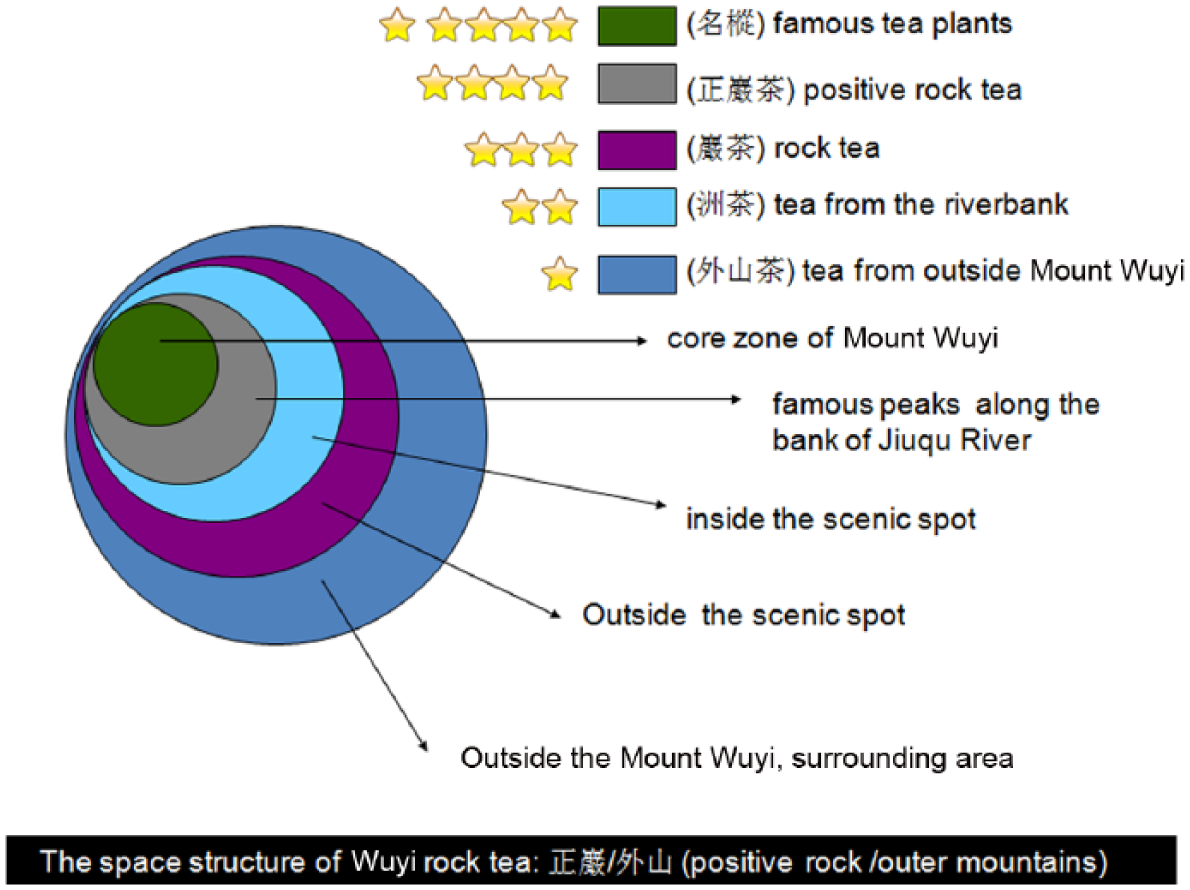
The spatial structure of Wuyi rock tea.
Tea connoisseurs believing in shanchang seek a special tea from a particular rock because it provides the right nourishment for it. They distinguish between the interior and outside of Mount Wuyi, with teas from inside the scenic site called Zhengyancha being superior to Yanyun and those from outside called waishancha and unblessed by yanyun.
As a commodity tea, it is sold as tangible tea leaves, but it is their intangible store of fragrance and taste that customers seek and consume. The official evaluation rests on the four sensations of vision, smell, taste and touch, and covers five aspects, namely tea leaf and brew colour, aroma, taste, shape and feeling of tea leaves after being brewed. As regards colour, generally a tea leaf should appear as what is called ‘fat-green-and-slim red’ (lvfeihongshou), i.e. that ideally 70 per cent of the leaf surface should be green surrounded by a 30 per cent edge of red (sanhongqilv). People normally talk mostly about aroma (xiang香) and taste (wei味), merging them as one expression, xiangwei (香味), or as qiwei (氣味). Yet aroma is not just smell isolated from other sensations, and taste is not just the chemical reaction of taste buds in contact with tea beverage. In the experiential world of tea tasting, people are expected to fully involve their eyes, ears, mouths, noses and tongues, all the bodily organs, in order to ‘feel’ the tea-material synthetically. This extends even to touching the tea leaves, by passing them through the hands after they have been brewed in order to discern how ‘alive’ they still are, and by weighing their moisture content in the hands. Although tea tasting is limited to a certain time and occasion, this fleeting sensation is inevitably influenced by the local culture and history imposed on the personal body.
The high reputation of Wuyi rock tea is closely associated with the compliments made about it by Confucianists in their handed-down works. There are three classic articles extracted from local gazetteers. These are ‘The gazetteers of Mount Wuyi’ (wuyishanzhi武夷山志) (1751), written by Dong Tiangong (董天公), ‘Return to the farmyard and the trifles of everyday life’ (guitiansuoji歸田瑣記) (1843), by Liang Zhangju (梁章鉅) and ‘The precious products in Fujian’ (minchanyilu閔產異錄) (1886), by Guo Bocang (郭柏蒼).
Their content suggests a common classification of tea based on ‘flower fragrance’ (huaxiang花香), ‘little seed’(xiaozhong小種), ‘rock tea/riverbank tea’, ‘inside the mountain/outside the mountain’, ‘southern mountain/northern mountain’, as well as first spring, second spring and third spring according to when the tea leaves were picked. The studies by Dong and Guo are almost identical in content, with subtle differences in word arrangement. Vocabulary repeatedly used in the three articles to assess the aroma and taste of tea includes aromatic-and-strong (nonglie濃烈), superficial-and-thin (qianbo淺薄), dense (nong濃), bland (dan淡), and thick (hou厚). The latter work, ‘The precious products in Fujian’, undoubtedly borrowed the description of tea tasting from the first. In these writings, the Neo-Confucian scholars each presented only their personal cognition, based on momentary information received by their own, individual sensory organs which had no collectively held meaning.
Similarly, in talking about their own understanding of tea, recent generations have been borrowing and creating a common vocabulary from the three classics, so enabling them to try and share their respective personal, bodily sensations with others, given that these cannot be directly transferred interpersonally. They communicate sympathetically with each other through the inherited vocabulary, and so thereby create a permanent collective representation of tea appreciation. Besides distinguishing between the central rock (zhengyan) and the outside area of the mountain, there are innumerable brands of Wuyi tea plants. Going back to the results of a survey in the 1940s, the brands of tea plants in the ‘Huiyuan gully (慧苑坑)’ rock tea factory alone comprised as many as 280 kinds. 8 Even limited to one rock, brands can be as many as this, but would the different brands of tea really taste different? Even the investigator, Master Lin Fuquan, seemed to be doubtful. He tended to regard the claims as a promotion strategy on the part of tea merchants.
Whenever the owner of the rock (Yanzhu巖主) tried to increase the tea prices, they always subtly created new items, so that each rock tea factory would have dozens to hundreds of ‘famous’ tea plants (mingcong名樅), the names of which were too many to count. As for the single tea plant (dancong丹樅) and the strange or unfamiliar seed (qizhong奇種), most popular practice was simply to add a name to the packaging, which was then called a brand, in order to bewilder the customers. (Lin Fuquan, 1943: 635).
Quality brands are thus culturally and commercially constructed in order to satisfy the market requirements of the upper class. Obviously, tea as beverage is not the product of an unaided natural process but, through the adoption and cultivation of the camellia, is the result of a long-term, lasting interaction between cultural participants and the material itself (tea) which has enabled the conversion of plant leaves into a social beverage and commodity (Yu Shunde, 2008: 375). But tea has very subtly come to present two Chinese cultural dimensions. It is venerated tea when set among what are known as the Confucianists’ ‘seven elegances’ of ‘Qin, chess, calligraphy, painting, poetry, wine, tea’. But it is an everyday drink when set among the collection known as ‘firewood, rice, oil, salt, soy, vinegar, tea’. Ming (茗), tu (荼) and cha (茶) are moreover different terms for tea, each associated with distinctive social characteristics. We are reminded of the ‘dual meaning of the word “taste”’ in French society and elsewhere as described by Bourdieu (1984: 99) which, in the guise of a common understanding of the word as simply meaning ‘flavour’, draws on a socially differentiating ‘aesthetic disposition’ and comes to denote appreciation as socially exclusive (e.g. ‘He has no taste’). Thus, the Confucianist differentiation of venerated and common tea corresponded with social class. Ming, taken by the upper class, was regarded as elegant, and the drinking process was ritualized. The tea brew would be held in a very delicate cup as tiny as a walnut, thus materially restricting the drinker to taking only a very small sip at a time. The typical way to taste was and is to use one’s tongue to suck up the tea brew into the mouth, letting it stay there for a while, and then breathing it into the throat along with a sucking sound. This particular way of tasting is believed also to discipline the drinker’s body. The standard posture requires only using one’s thumb, index finger and middle finger to hold the cup, and is called ‘three dragons defending the vessel’ (sanlonghuding三龍護鼎). This bodily practice and accompanying language take on the aura of a ritualized tea tasting. By contrast, working-class tea drinking lacks this aura and is regarded as an ordinary activity. Currently local peasants in Mount Wuyi use only a big rough bowl for tea drinking, ostensibly with the sole aim of quenching their thirst. It is true that tea, in its original, natural form as tea leaves, played no part in the distinction between genteel and ordinary expression. But, as different classes of people adopt their own tea-drinking practices, tea itself becomes graded on the basis of its perceived relationship to and interaction with its immediate physical environment and people’s use of their bodies when drinking. In other words, the distinction between genteel and ordinary tea tasting both results from and reflects the material representation of social classes.
As a special geographic and cultural space, Mount Wuyi is a renowned scenic landscape in southeastern China. At the same time, it has been at the headstream of Song-Ming Neo-Confucianism since the Song dynasties, during which Neo-Confucian scholars have constantly come and gone. The great Neo-Confucian scholar, Zhu Xi, had an academy here in which he wrote and gave lectures and so established Mount Wuyi as at the origin of Neo-Confucianism. Many scholars came there to live for a while or just for pleasure, writing copious travel notes and literature, including poems and other works about Wuyi tea. This had at least two influences on tea: on one hand, the repeated references in the scholars’ works to such landmarks as the Jiuqu (九曲) river and the names of 36 rocks established the spatial scale of the central rock area. On the other hand, their special vocabulary describing the amazing natural scenery, their sensory perceptions, and the delicacies of aroma, touch and appearance became metaphors and symbols. These metaphors thus referred to ‘famous tea plants’ in this beautiful natural environment and at the same time conveyed an idea of the inner world of scholars and hermits as being a ‘mindful environment’. Local government claimed that, while the geography of Mount Wuyi was an indication of its value, more important was how the physical landscape and human skills combined to enhance tea’s value through their interaction (Archive of the Wuyi County, 2001).
Therefore, the distinctions between the many brands of Wuyi rock tea are not really rooted in consistently identifiable, intrinsic differences of taste. As in the distinction between ‘elegant tea’ and ‘common tea’, they rest on social evaluations often supported by stories. For instance, the famous tea plants (mingcong 名樅), normally would be known by a legend, for instance that of the ‘big red robe’ (dahongpao大紅袍) in which a sick young scholar en route to sit imperial exams in Beijing is cured by rock tea given by a Wuyi temple abbot, and then applies this knowledge for the Emperor’s benefit who rewards him with the robe. While laymen might not consistently discern differences of taste between teas, once the tea plants are named as quality brands, they will assume them to have superior and distinctive taste and other qualities, a response found elsewhere when consumers evaluate the taste of foodstuffs highly when they are branded as having values which they share (Allen et al., 2008). So, the main effect of brands is in prompting consumers to make corresponding distinctions of fragrance. Thus, while teas do indeed have their own natural aromas and taste, further highlighted differentiation arises when local people name, describe and classify teas and so in effect construct fragrances.
Opposition to shanchang from the attempt at nationally unified standardization
However, as rock tea is not only a cultural object characterized by local knowledge, but also a commercial product circulating in the market, the government decided around the year 2000 that the evaluation of its quality had to be standardized at a national level, for which the standard, guobiao, was established. On one hand, the aim in establishing national standards (guobiao國標) was to dispel the confusion allegedly caused by the diversity of tea quality claims resulting from shanchang beliefs and to pursue commercially driven standardization and unification through an emphasis on the human skills involved in tea making rather than on a focus on the special ecological properties of Mount Wuyi cultivation. On the other hand, because of the historically embedded local characteristics and discourse around Mount Wuyi, the guobiao standard in that region has also adopted, incorporated and applied the concepts and vocabulary of the local people. For instance, local words are used to describe the aroma of dahongpao as being ‘sharp, thick and long, clear and far’, and its taste as ‘obvious yanyun (巖韵明显), mellow (醇厚), sweet and cool aftertaste (回味甘爽)’, and to describe the taste of famous tea plants as ‘obvious yanyun, mellow, quick aftertaste’ (AQSIQ, 2006). By specifying ‘the place of origin’, guobiao in fact reinforces the idea of shanchang as being made up of distinct places. Thus, although guobiao is supposed to classify teas in Wuyi mountain ‘scientifically’, the historical–cultural differentiation of tea taste continues. For instance, the distinction made by guobiao between ‘famous rock origin’ and ‘red rock origin’ gives a kind of ‘proof’ of the ‘interior/exterior’ distinction and therefore unintentionally reinforces belief in the effects of shanchang. 9
In conceding, so to speak, the existence of shanchang, this regional version of guobiao allows people to use it as the basis of discussions evaluating tea quality, especially during official tea competitions. In this way, they perpetuate the pre-existing language and believed provenances of tea appreciation. Their experience does not, then, simply reflect their perceptions but arranges them within a known culturally accepted schema, which people assume guides and is based on rational calculation and behavior. In fact, such a cultural schema of ‘perception’ and ‘taste’ is historically produced and is as much the result of personal preference and prejudice as it is of objectively measurable criteria. It is both part of people’s consciousness and part of a cultural discourse around evaluation of a product. Because classifications reflect fundamental social divisions (e.g. elite tea tasting and commoner perceptions of it), they are commonly understood by everyone in the society. They help produce a common, meaningful world, a common-sense world (Bourdieu, 1984: 468). Local people may accept the principle of a guobiao standard in assessing the quality of tea, but do so within old categories, which we know as the traditional representation of fragrance. Thus, the government attempts at founding a tea hierarchy independent of such traditional views and based instead on human skills and techniques of tea making, comes up against the power of beliefs in shanchang and yanyun. In recently reintroduced tea competitions using blind tasting, for instance, shanchang and yanyun predominate.
Government initiatives: Tea competitions and the distinction of taste
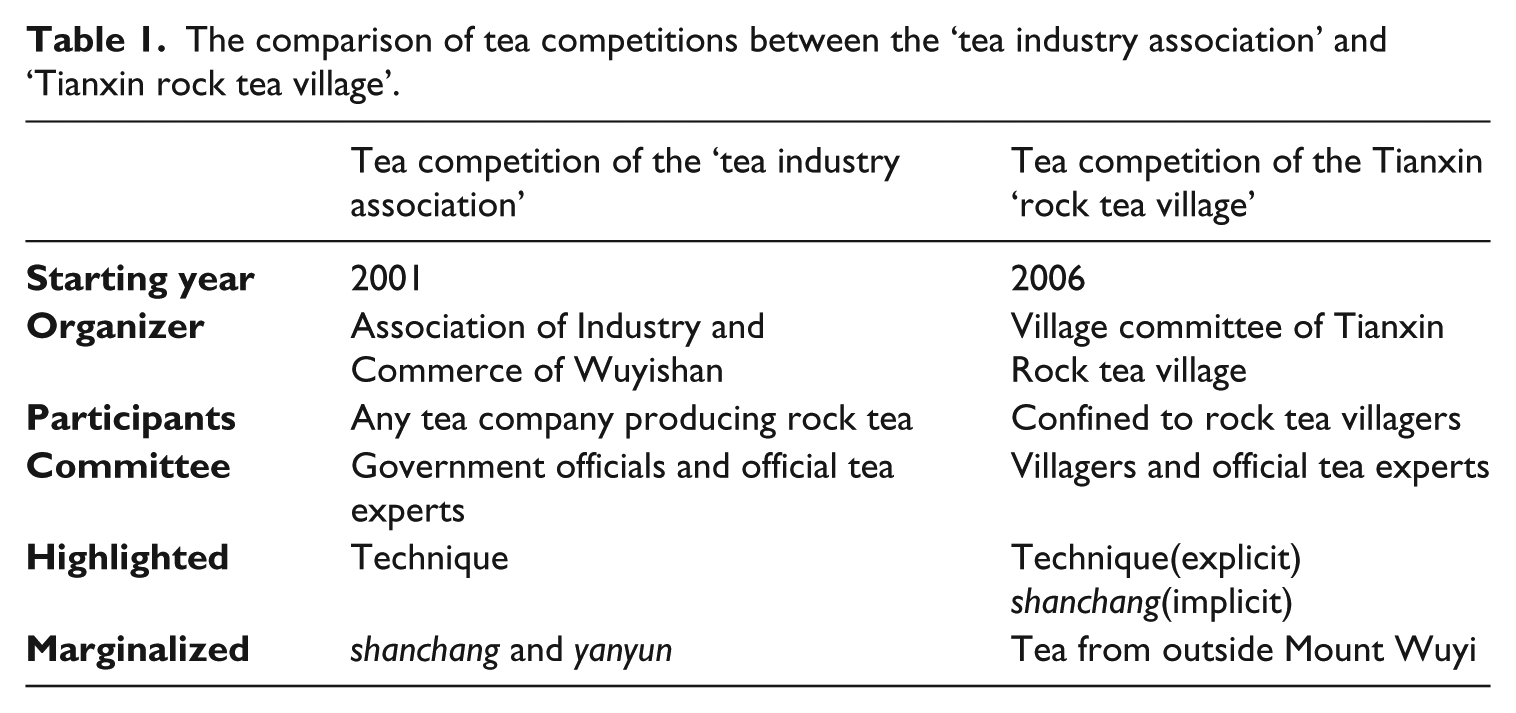
Although re-introduced to Mount Wuyi by government around 2000 and now a popular social activity, tea competitions originated in the Song Dynasty. They are a ‘reinvention of tradition’, given the differences these days in how tea is cultivated and made. There are numerous small and large tea competitions all year round in Mount Wuyi, but only two have influenced market tendencies in the product. The competitions involve ‘blind tasting’, in which tea samples are identifiable only by a code on each package kept secret by staff. The judges evaluate the teas by four criteria including brew colour, taste, fragrance and shape of tea leaves.
First, the ‘Wuyishan county folk tea competition’ was organized by the ‘Wuyishan tea industry association’ in 2001. This association is directly subordinate to the ‘Association of Industry and Commerce of Wuyishan’ and comes under the government of Mount Wuyi County. Its members include tea factories in Mount Wuyi County and it acts on behalf of local government to organize tea events. It pushes for the creation of a national standard of tea evaluation, arguing that, as a major commercial product, tea must be subject to official criteria of quality recognition and control. The aim in setting up the Wuyishan (武夷山) tea competition is to help tea companies and develop the tea industry, with participants belonging to any tea company provided they deal with rock tea and whether or not they come from Mount Wuyi. Hardly any come from the core producing areas of Mount Wuyi. Most in fact come from such surrounding areas in Wuyishan County as Jianyang (建陽), Jianou (建甌), Shaowu (邵武), Guangze (光澤), Songxi (松溪, Zhengh (政和) and Pucheng (蒲城). In bringing in teas from outside the mountain area, these companies are regarded generally as lacking the ‘gift’ of shanchang, and so their teas are seen as less ‘authentic’ and as having weak yanyun. The point of the government-inspired tea competitions is to encourage ‘fair play’ in the market and to focus instead on the tea workers’ techniques and skills rather than privileging the shanchang provenance of the tea.
The other tea competition was first held in 2006 and attests to the resurgent popularity of shanchang. It is organized by the Tianxin rock tea village committee, whose tea gardens cover about 90 per cent of good shanchang in Mount Wuyi. 10 Although confined to the village and small scale, the influence of this tea competition is larger than that of the tea industry association. This is because it aims to highlight the excellent Mount Wuyi teas and distinguish them from tea products from outside the mountain which are regarded as ‘ordinary’ because they lack the nourishment of shanchang and so also lack yanyun. The villagers have subsisted on tea-making for generations, which is why the name of their home is ‘rock tea village’. They are proud of their superb geographic site and ancestral technique and scorn the tea competition held by the ‘tea industry association’ in which Tianxin village would never participate.
However, the two tea competitions inevitably become mingled, since the leader of the local government-sponsored ‘tea industry association’ is also a villager from Tianxin rock tea village and most village tea companies are also members of the association. In the tea competition of a Tianxin village, there is a preliminary contest and then a final one. But the assessing experts are different in each case. The committee of judges for the preliminary contest comprises 10 elected villagers, who must exclude teas from outside the mountain because these are not supposed to be included, although this is not publicly talked about. 11 Government accepts that there should be a standard for the shanchang teas confined to the mountain and that this tea-tasting competition is therefore aimed at evaluating teas from within the mountain area. Nevertheless, some villagers secretly buy and use cheaper teas from outside the mountain area in the hope of receiving a high purportedly ‘shanchang’ award and so selling the prize-winning tea more expensively than would otherwise be the case.
At the final stage of the contest, most judges on the committee are tea experts chosen from outside the village in order to avoid villagers’ vested interests. They have official titles indicating the government wish to broaden the shanchang hierarchy of commercially viable teas.
The two tea competitions thus emphasize different interests involved in tea tasting. They marginalize some factors while highlighting others, but can never fully exclude any, since tea tasting is believed to require the full range of sensory experience. The two tea competitions may be compared as follows:
The comparison of tea competitions between the ‘tea industry association’ and ‘Tianxin rock tea village’.
Conclusion: The relationship between natural environment, bodily perception and the structuring of social space
This article explores a system of evaluating ‘tea fragrance’ from three perspectives: historical, multi-sensory understanding and social hierarchy. The aim is to show how two evaluative concepts, shanchang and yanyun, relate to each other as a field in which the spatial structure of Mount Wuyi is shaped by local history and people’s bodily perceptions. Local people see this spatial structure as a physical hierarchy of ‘central rock’ (zhengyan正嚴), ‘half rock’ (banyan半嚴), ‘riverbank tea’ (zhoucha洲茶) and ‘outside mountain tea’ (Waishancha外山茶). But anthropologically, it can be seen as an historical process in which relationships are symbolically and culturally ordered (Sahlins, 1985: 3).
Local people try to persuade outsiders that the hierarchical spatial structure of Mount Wuyi is based on its material qualities as terroir expressed locally as yanyun, which people have used to differentiate their sensory experience of taste and so to identify different grades of rock tea. However, this yanyun materiality is not in fact demonstrable and the tea-tasting sensations among individuals may be at variance with this traditional environmental hierarchy. The guobiao (national standard) has been set up by government in order to homogenize consumers’ different evaluations of taste by stressing the skills of tea growers/producers rather the spatial provenance of tea plants, for it is true that growers and consumers are aware that human technique as well as the quality of cultivation area are both needed for superior tea. But, while drawing on people’s preparedness to accept the importance of human skill, the national standard has not erased the importance of shanchang and yanyun, body ecological dimensions which therefore continue to affect/shape human tea-making.
The taste of rock tea undergoes two stages of representation. The first stage consists of shifu (tea workers) using the skill of their hands to turn natural plant leaves into man-made tea, an activity which brings together humans, environment and the thing itself, tea, as parts of a single process. The second stage goes further and adds to this holistic, body–environment interaction such factors as discussion and judgment about the tea’s aesthetic and market value, again within the cultural framework available. Thus, consumers and producers not only observe the Mount Wuyi spatial hierarchy, but also experience it bodily as a kind of internalized social structure.
People’s appreciation of tea taste in terms of the relationship between shanchang and yanyun appears to them, therefore, as demonstrated and as having a basis in both material and transmitted distinctions. In fact, it varies subtly among them, but becomes synthesized as a mutually understood phenomenon resulting from a long-lasting interplay in local history of technique, history, verbal concepts, practice, identity and market value, and from a mutually constructive process between humans and the thing itself, tea.
Footnotes
Acknowledgements
Thanks go to this project and to the tea companies of the Mount Wuyi area for information and cooperation. Thanks are due also to David Parkin and Elisabeth Hsu for comments and help in writing this article. The research satisfied ethical consent requirements and involves no conflict of interests.
Funding
The author(s) disclosed receipt of the following financial support for the research, authorship, and/ or publication of this article: The research was funded by the project on ‘Subject Contributions’ of Southwest University for Nationalities (西南民族大學學科建設項目), Chengdu, under Project No. 2015XWD-tS0304.