



Abstract
This article explores the enigmatic centrality of a seemingly unoccupied place located at the very heart of an Andean community in northern Chile. It investigates how the apparent emptiness of a ritual site paradoxically operates as an ineffable agent that articulates beings, things and landscapes. The author argues that the study of what happens in this place is of significance beyond regional studies. It goes beyond the usual cultural frameworks to consider theoretical concepts such as topology, materiality, vitality and relationality. In order to explore this, he investigates how the ‘empty’ heart of the ceremonial centre, Isluga Marka – the place that blurs borders and centres (taypi) – emerges as a theoretically challenging topological phenomenon. The ethnography underlying this article is problematized in order to contribute to the general understanding of how matter, place and meaning can become entangled and mutually constituted.
Unde erit machina mundi quasi habens undique centrum et nullibi circumferentiam (The world-machine will have its centre everywhere and its circumference nowhere). (Nicholas of Cusa, De docta ignorantia, 1966[1440], II: 161)
Meaning and matter are critical theoretical terrains of debate in anthropology, geography, cultural studies and gender studies, among other areas of analysis. In an important work of the ‘new materialism’, 1 Karen Barad (2007: 3) has argued that meaning is a key constituent in mattering. Indeed, ‘matter and meaning’, she writes, ‘are not separate elements.’ From this perspective, primarily textual accounts are insufficient for an adequate understanding of the complex and dynamic interplay of meaning and matter (Lemke, 2015). The reasoning that distinguishes new materialism from classical materialism lies in the conception and treatment of matter itself as active, forceful and plural rather than passive, inactive and unitary (see, e.g., Alaimo and Hekman, 2008; Bennett, 2004: 348–349; Colebrook, 2008; Coole and Frost, 2010b: 3–4). This article incorporates the inquiring gaze of such a perspective, but moves it toward a Latin American locus. This place is a ritual site, located in the centre of the Aymara locality of Isluga, which provides a paradigmatic case for contemporary attempts to reconceptualize the interrelations between humans and non-humans, as well as to rethink the categories of agency and subjectivity. The inquiry emanates from the ethnographic work I conducted in the community of Isluga and the Tarapacá region mainly from November 2005 to February 2008. 2 The ethnography underlying this article is theoretically problematized in order to contribute to the general understanding of how matter, place and meaning can become entangled and mutually constituted.
The concrete starting point for this inquiry lies in an ethnographic experience: the enigmatic centrality of a seemingly unoccupied site placed at the heart of an Andean community in northern Chile. This is the champial, a piece of unbuilt land slightly larger than a football pitch, which acts as a topological axis for the ceremonial centre of Isluga. 3 I argue that the study of what happens in this site has significance beyond regional studies since it leads to thinking – outside the usual cultural frameworks – about theoretical concepts such as topology, materiality, vitality and relationality. As such, the exploration of how the champial enacts different kinds of relationalities offers the possibility of expanding our understanding of what Karen Barad (2007: 141) describes as ‘the dynamic topological entanglements of the world’. Far from projecting the image of a metric geometry between stable points in space and well-defined temporal distances, the dynamic entanglements taking place in Isluga trace topological relations, nodes of interaction and passages between various temporalities. Such a phenomenon resonates closely with the topological understanding of Michel Serres of ‘the science of nearness and rifts or folds’ (see Serres with Latour, 1995: 60).
One of the salient features of the champial is the lack of care that the locals seem to demonstrate toward it in everyday life, which contrasts with the central position it occupies in the ritual geography of Isluga (Aedo, 2008). In this place, emptied of representations, the act of believing is paradoxically embodied by what is evidently absent. This is because the champial operates as a topological axis capable of folding the places around it. For the Aymara inhabitants of the area, the centrality of this site does not lie in a ‘supernatural’ essence that would hypothetically reside in its interior, but rather in its force to attract things and phenomena, human and non-human, affects and thoughts. Such a centrifugal dynamism of the champial is physically reinforced by the slight natural curvature of its surface, which operates as a topological axis of inflection, that is, as a central site where landscapes, things and beings are folded and unfolded. 4 It is in this sense that we argue that the material constitution of places such as the champial is indissoluble from the elasticity of the meanings that these places engender. Hence the need to look for categories and figures such as fold, which allow us to accurately and sensitively describe the complexity of landscapes in Isluga. We follow a non-Euclidean approach that has the potential to enrich our understanding of landscape dynamics. 5 Thus, we intend to avoid naturalizing a single form of space and time in order to analyse the plurality of forms in which the relations with the Isluga ceremonial centre express multiple spatialities and different temporalities.
Far from constituting a marginal aspect of senses of place, we explore how the processes of matter (what Barad, 2007, calls ‘mattering’) are entangled in semiosis (acquiring form and meaning) through different agential possibilities. Semiosis, strictly speaking, is the name given by Peirce (1992) to the action of signs. Beyond this simple definition there is a world of complexity. Semiosis operates at very different scales and in spheres where signs are not necessarily perceptible to humans. ‘Thus, physics, biology, psychology and sociology each embodies its own peculiar level of semiosis’ (Sebeok, 2001: 28). I approach semiosis as a simultaneous and indeterminate process of sense production within which things, human and non-human agents, different spatialities and temporalities are continually entangled with varied ways of perceiving, feeling and thinking. There is no semiosis without materiality, 6 and there is no experienceable (or intelligible) materiality without semiosis (Nakassis, 2013). Based on field research, this study investigates how the apparent paradox of the empty centre of Isluga – the ceremonial centre where everything comes together (taypi) – emerges as a challenging phenomenon of co-production of matter and meaning. 7
Materiality and landscape in Isluga
Nestled in the Andes in the north of Chile, the ceremonial centre of Isluga – called Isluga Marka – consists of a handful of houses, unoccupied for most of the year, 8 which form a semicircle around a large grassy space on which there are no buildings. In this area, roughly the size of a football pitch, short, thick grass grows in tufty clumps similar to – though on a smaller scale than – the patchy wet grasslands of the highland region (bofedales). 9 In the geography of Isluga, this place, commonly called the champial, gives material form to the heart of the ceremonial centre of the 12 villages that form the wider community (Figure 1). Here, location appears to be a phenomenon that extends beyond simply holding onto a specific piece of land because the action of being located in a place is always seen as the effect of other displacements. Mobility involves a relationship with others and it thus places people in very different situations and contexts as well as on different levels, such as the family home (uta), the secondary home (jant’a), the kitchen (phayawi), the central settlement (qutu marka), the satellite village (uta or utjäwi), the ‘neighbourhoods’ of Isluga (ayllus), the half community (saya), the whole community (marka masi) and the state. In Isluga, as in other Andean regions, the most visible irregularities of the earth’s surface are frequently distinguished by terms that operate as indices of their histories and spheres of action (Villagrán and Castro, 2004), constituting the subjectivity and cosmologies of its inhabitants through spatial and environmental experiences. Large geographic expanses, especially the lands of the semi-desert pampas in the highlands, are perceived by the people of Isluga as ‘recipient’ spaces containing properties that may sometimes be exhausted (ch’usa) and other times full of vitality (phuq’a). These patterns are mapped in textiles figuratively, revealing the topography of the Andean space and its boundaries, with their centripetal and centrifugal influences (Arnold, 1997; Cereceda, 1978).
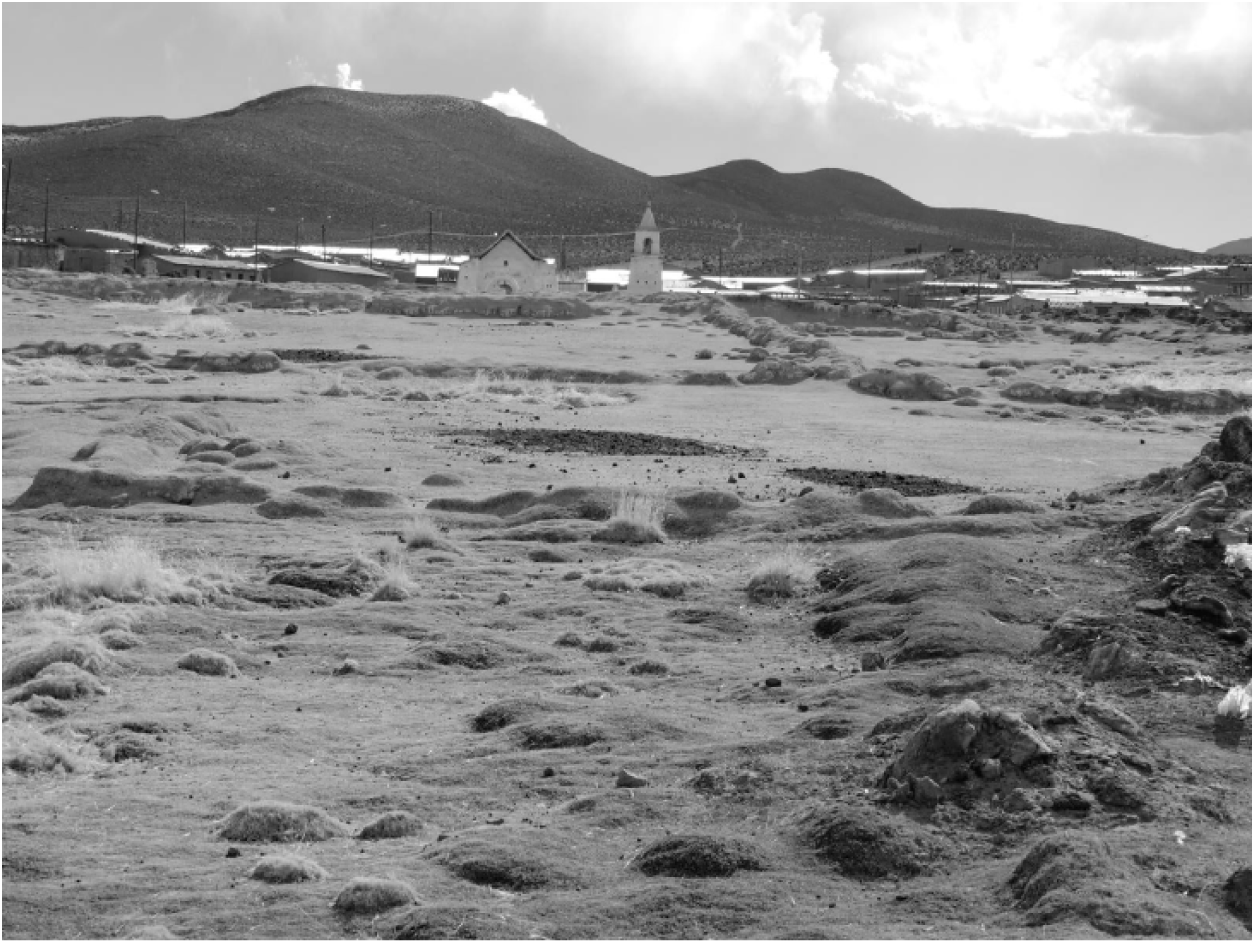
The champial of Isluga. © Photograph: Angel Aedo.
A paradigmatic figure concerning the sexualization of landscape forms is expressed through the pair of deities who guard the villages: the mallku, who is the owner of the Andean heights, and his wife, the t’alla, who inhabits the highland plains. Traces of these entities can be discerned in horizontal (t’alla) and vertical (mallku) shapes in landscapes. The people of Isluga use these basic figures to ‘weave’ (sawuña) chains of analogies (Descola, 2011), constituting and giving sense to the phenomena of the biosphere. But the action of these entities is not limited to shaping Andean landscapes; they also operate over the course of time, marking the alternation between day (uru) and night (aruma) as well as the rhythm of the seasons: season of rains (jallu pacha), season of frost (juyphi pacha), season of cold winds (thaya pacha). The fertilizing power generated by the interactions of mallku and t’alla animates the surrounding land and ensures vital continuity through the reproduction of specific places and the beings that live therein. In this sense, mallku and t’alla are the owners of the environment. They also watch over the means of subsistence and the actions of beings that inhabit their domains. The ties that bind the beings that inhabit Isluga to the tutelary deities (uywiri) are based on a logic that recalls the pastoral rationality of power (Foucault, 2005). In the same way that Isluga herders (awatiris) take care of their animals (Dransart, 2002), the mountain deities extend their protection over the whole of Isluga; this task authorizes them to dispose of the beings they maintain, creating a meaningful relationship between people and place.
Isluga’s population fluctuates throughout the year. Its ritual centre – Isluga Marka – is practically uninhabited during the periods that are not marked by the ritual calendar. To understand Isluga’s occupation, its villages and ceremonial centre, we must distinguish two different overlapping demographic phenomena. One corresponds to the double residence of young families, who alternate between the Isluga highlands and the coastal town of Alto Hospicio according to seasonal periods of work and education. This does not mean, however, that the Isluga localities that surround its ceremonial centre become completely depopulated places. Most of these villages remain inhabited, even in the periods of greatest displacement to the coastal lands. Usually when families move to the city, grandparents and grandmothers remain in Isluga. Although older people represent an undesirable population for the economy of coastal cities, they are a crucial part of community life for the Isluga people. The second phenomenon is related to a fundamental feature of Isluga’s ritual topology, which consists of the temporary emptying of its ceremonial centre: emptying of activities and residents. The villages and hamlets of Isluga are spatially distributed around its ceremonial centre, which acts as a topological point, establishing a division into two halves (saya) between its human and non-human inhabitants. On the one hand, the lands, beings, things and phenomena that come from west of the ceremonial centre belong to Araxsaya, the topographically higher half of the terrain. On the other hand, the inhabitants and phenomena coming from the east belong to the Manqhasaya, the least elevated and flattest part of Isluga land. This bipartition into saya is not only understood by the Isluga people as being merely based on the land contours, but it also distinguishes between the outer part and the inner part of its community.
Isluga Marka is thus the place where the outside and the inside fold. The transitory occupation of this ceremonial centre is organized by a ritual cycle marked by four main celebrations that take place in a period of agricultural and pastoral fertility. All Souls’ Day, at the beginning of November, announces the arrival of the rainy season and, with it, the return of the ancestors (condenados) to Isluga. This ritual is followed by the celebration of Saint Thomas the Apostle, patron of Isluga, which takes place on 21 December (the original feast day for the saint, although the feast has been moved by the Catholic Church to 3 July), at the summer solstice and at the climax of the rainy season. Two weeks later, between 4 and 6 January, the ceremonial centre is reactivated by the ritual process of Santo Reyi, which consecrates the change of traditional authorities (mallku) of Isluga. Finally, the celebration of Anata closes the rainy season and the cycle of ritual actions in Isluga Marka. This is a carnival festivity that begins on the Saturday before Ash Wednesday and lasts from five to six days. In the ceremonial houses that surround the champial, people from different Isluga villages set up altars (misa literally meaning ‘table’. This Aymara term coincides with the Spanish word misa, that is to say mass, the ceremony of the Eucharist) offered to the Pachamama, a telluric entity that is more often referred to as the Wirjin Tayka (‘Virgin Mother’) in Isluga. These altars usually consist of food, alcohol and vegetation samples from Isluga mountains and plains. An atmosphere of playful disorder, ‘mischief’ and excess of food, music and alcohol impregnates the interactions of people during this ‘other time’, also known as supay phista (the party of the devils). The end of the Carnival marks the passage to the cold and dry season, the ceremonial centre of Isluga thus enters a hibernation phase until the arrival of the next rainy season.
As we have seen, Isluga Marka not only folds the space, but the celebrations that take place there concentrate the ritual time to a period of three months, which coincide with phenomena of astronomical (summer solstice), atmospheric (the rainy season) and sociological (low labour demand on the coast and school holidays) order. If, during the rest of the year, an outsider were to go to Isluga Marka, especially during the cold season, it would feel like visiting a ghost town left behind by history and abandoned by its inhabitants. The sense of neglect that permeates the place in certain periods of the year is reproduced in its interior through the rustic space that constitutes the champial.
The role of this ceremonial centre as a point of conjunction of vectors of forces acting on Isluga topology, as well as the relevance of the ritual actions that take place there, might appear to an outside observer to be at odds with its demographic marginality. However, the characteristics, uses and location of the champial offer a ritual context that facilitates the generation of counterintuitive associations marked by the impossible representation of the ‘empty-full’ (ch’usa-phuqha). The influence of this place on the configuration of landscapes in Isluga contains a mystery, whose elucidation – if it is feasible – enables one to explore the work of paradox as a centre of meaning (Quine, 2009).
The surface of the champial is dotted with large rectangular figures, which are regarded as vestiges of corrals called churus. The champial is filled with such figures, which operate as indexical marks of the corrals of the achachis, the first inhabitants of Isluga (Keane, 2003; Kreinath, 2006). Not only do these signs hark back to the ancestors but they also reveal an agropastoral way of life that seems closely intertwined with the origins of the territory: the uywiri deity of the Isluga volcano (the Laram Qhawani) creates the churus through ch’allas, a term referring to the characteristic performative action of ritual libations. The physical material that serves as the target of these actions is a sample of the local volcanic earth which benefits from volcanic sand, also called ch’alla, and which is highly appreciated by the people of Isluga for creating the churus of the champial as well as for contributing to soil fertility in the surrounding landscape.
The people of Isluga use the term churu to distinguish a type of rectangular place that evokes a sense of enclosure and protection. For example, in the context of Andean daily life, this term is used to talk about areas enclosed by low stone walls. These spaces usually serve as workplaces, such as corrals for camelids (churu uyu) and small plots (churu yapu). The notion of churu is translated into the language of textile design through the use of sequences of rectangles that ‘box in’ motifs and/or chromatic variations (Cereceda, 1978; Dransart, 1988; Gavilán and Ulloa, 1992). The implications of this term are not limited to the fields of weaving and everyday activities; churu is also used in ritual language to refer to the ‘original’ small farms and corrals that, according to mythical accounts, were left to the inhabitants of Isluga by the first farmer and herder in the community. This deity (or deified ancestor), metamorphosed into the spirit of the mount named Pukar Qullu, 10 continues to perform for the people of Isluga in a pastoral mode – that is, as a breeder, protector, and ‘owner’ of everything around him. Today, one can find material traces of the original small corrals in the ritual centre of the community (Figure 2). This is the piece of land that the people of Isluga have carefully left ‘rough’: the champial, whose ritual name, ch’alla churu, hints at a fragment of its secret.

Traces of an ancient corral in the heart of Isluga. © Photograph: Angel Aedo.
The paradoxical centrality of a place
The empty site of the champial, the axis around which the houses of the Isluga ceremonial centre rise, imposes itself on the observer. Paradoxically, this central characteristic of the landscape is rarely a topic of conversation; it is even less frequently a subject that Isluga inhabitants care to explain. Over time, the population’s apparent lack of interest in the champial gave way to an attitude of denial that suggested the existence of something else. Understanding this situation led the ethnographic undertaking toward the perception of a phenomenon that did not want to reveal itself directly, but nevertheless sought other paths of expression.
Talking about the centre of a border territory like Isluga so far from the ‘real’ political and economic centres of the state might seem meaningless, not least because this ‘lost’ centre is associated with the enigmatic notion of ch’usa (emptiness). This place, which occupies a privileged position inside the ceremonial centre and yet is free of any kind of buildings, is a mainstay of the articulation of the landscape in the region. At the same time, the physical and material characteristics of the champial that invest this place with meaning also project the effect of neglect, which is emphasized by the state of abandonment of the ceremonial houses that surround it.
The champial arises as a torsion of the inner surface of the world. Landscapes fold around this site, leaving a void as a material trace, surrounded by ceremonial houses. This kind of torsion of the champial resonates with the monadic thinking of Leibniz since it takes the form of a fold that can be unwrapped in conformity with the condition of exposing the exterior of its own interiority: ‘a partition, a supple and adherent membrane coextensive with everything inside’ (Deleuze, 1993: 111). Such a feature, typical of a non-Euclidean topology, ripples through Isluga’s landscapes, both interindividually (as aggregates of parts) and at the level of the interaction of beings and places.
Our focus here is not on the contents of the Andean worldviews – on which there are excellent historical and ethnological works (Arnold et al., 2007; Bouysse-Cassagne, 1986; Harris, 1985) – but rather on the logical and perhaps paradoxical process of the semiosis of place (Sorensen, 2006). Positioning the ethnography within the complexity and indeterminacy of matter reveals the vitality of the champial, reimagining the relations between the material, the perceptual and the affectual (Anderson and Wylie, 2009). To pursue this approach effectively, intrinsic properties in beings become secondary, as these automatically fix meanings on entities themselves. Seen from this perspective, the ceremonial centre of Isluga appears to be supported by a network of correspondences among different places, a juxtaposition of heterogeneous practices and relational materialities performed together with the landscape.
As a way to explore the percolation of time in relation to landscape, Witmore (2007) outlines nine key aspects, in which two pairs, palimpsest/chiasmus and entropy/negentropy seem an appropriate approach to the way in which the champial works. The erosion of things left in disuse, and the superposition of events, give sustenance to the palimpsest that characterizes this empty lot. Moreover, its chiasmatic nature is endorsed by at least three factors: the pleating of different material pasts, the intersection of substantial vinculums 11 with the localities of the community, and the convergence of landscapes and ritual processes. The apparent abandonment of Isluga Marka, especially the ageing and deterioration of its church and plaza, the ruining of its ceremonial houses and the natural degradation of the champial’s humid surface, reveals part of its entropic character. Simultaneously, the inflection that this site produces in Isluga’s topology, results fundamentally from its vitality, that is, from its irreducible negentropy (Serres, 1982), 12 which takes shape, for instance, in the communal festivities held on this site and in the remnants of pasts that continue to pulsate – such as the churus of the champial and the archaeological remains of Pukar Qullu.
The question of what makes a site a centre in Isluga addresses the capacity of a place to fold spatial and temporal dimensions and act as a localized centripetal axis. Isluga Marka, as a ceremonial centre unoccupied during most of the year, replicates the characteristic void of the champial (the topological axis of Isluga) on a communal socio-territorial scale. The empty semicircle that delimits this ritual place opens to the east, following an implicit orientation rule present in several settlement patterns and ritual actions of Andean societies (Figure 3). At a time when the Chilean state is making memory the basis of numerous festivities, such as the celebrations of the Republic’s bicentennial, Isluga reveals a way in which memory can subvert the boundaries of chronological time through a lived space whose dynamism is barely glimpsed by observers from the outside.
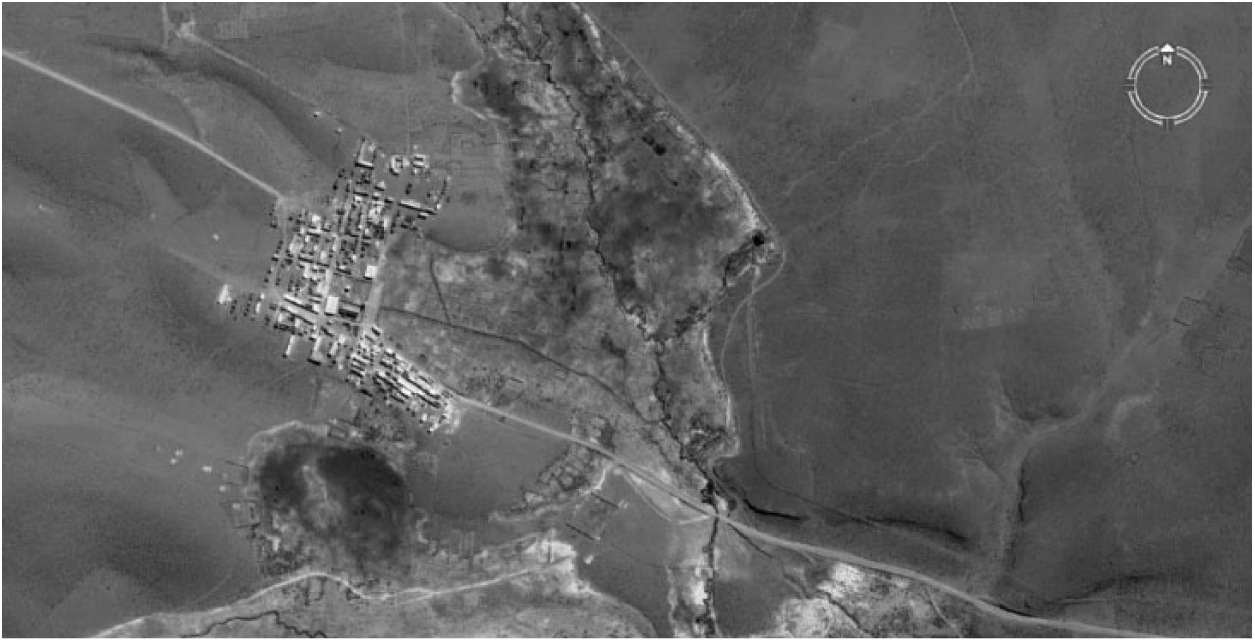
Isluga Marka (satellite view adapted from Google Earth, 2007).
The champial is not, however, a place that represents a fixed thing; rather, its dynamism is based on its ability to trigger semiotic events. The vacuum 13 of the champial is not a space without meanings; on the contrary, it appears to be a place charged with ambivalent vital powers (uywiris) capable of giving and devouring existences. Emptiness, silence, and absence imbue it with experiential qualities through their embeddedness in the physical world (Meyer, 2012), the senses and emotions of the world around the site allowing for it to constitute itself in corporeal experience. The slightly concave surface (p’ujru) of the champial communicates its role as a receptacle for beliefs in indexical terms. The performance of this place in the ritual geography of Isluga creates an interesting context in which to investigate how the operation of indexical signs precludes any absolute disjunction between meaningful and material worlds (Grossberg and Behrenshausen, 2016; Mertz, 2007). That is why these vestiges ‘dwell’ in the champial, the enigmatic fold where landscapes and memories of the community are entangled in material indices that have the potential to affect subjectivities and engender beliefs.
Enacting the champial
Like every material entity capable of unchaining abductive inferences (Peirce, 1998[1903]), the site of the champial never ceases to hold the attention and spark the imagination of the people of Isluga. By conserving the enigmatic emptiness that characterizes the champial as the topological axis of the community, the people of Isluga create the material conditions for the preservation of a form of memory composed of everyday encounters between the present and the past (Atkinson and Whitehouse, 2011). This restricted space seems to absorb – or to ‘eat up’ (manq’aña), as the Aymara say – beings and objects from different temporal regimes. In this perspective, the champial serves as a large reservoir of a multiplicity of voices and signs (Banti and Giannattasio, 2004), whose potentialities are activated by the people of Isluga in particular contexts of the annual ritual cycle. The dynamism of Isluga as a community rooted in a territory rests on the steady flow of ‘forces’ (ch’ama) that are taken from and returned to the environment. This explains the imperative activity carried out at the beginning of each agropastoral cycle, which involves ritual actions of compensation – at family and community level – aimed at encouraging the circulation (thaki) of gifts that keep a generalized ‘cosmic economy of persons’ alive.
Isluga people usually describe rituals as paths (thaki). Thereby the ceremonial roles as authorities (mallku) are considered to follow routes in which their properties gradually unfold (Rivière, 2008). The thaki of the mallku-authorities 14 start in January, when they are still ritually infants (wawa); the process of maturation begins at Carnival in February and comes to a head during the celebration of the Day of the Dead at the beginning of November. In January, the forces of ritual authorities are exhausted, requiring renewal in the ritual of Santo Reyi, which takes place at the foot of the champial. The last acts of the mallku connect them indexically to the ancestors, whom they will soon join (Orta, 2004: 168).
Rituals act as a privileged channel for cultural communication (Severi, 2006); they reinforce senses of places by activating their underlying properties (Feld and Basso, 1996). Isluga people mark this phenomenon by extracting small churus of champa (pieces of grass rooted in the land) from the champial, which are treated as agents of fertility, power and ancestrality. Some of these are placed at the base of the altar (misa) built to consecrate the annual change of community authorities. Others place small pieces of champa on the tombs of the leading families in the community (Figure 4), whose cemetery (usamaya) is also located in the ceremonial centre of Isluga. By means of this operation, the entanglement of matter and meaning between the champial and the ancestors of the community is shown. This is significant, given the total absence of such practices in the cemeteries of the surrounding villages. The churus form a network of ritual artefacts whose interconnection creates the conditions for the transfer of power to take place. Within this framework, the role played by pieces of the champial in structuring the altar gives material expression to its physical and symbolic position in the foundations of power (Figure 5).
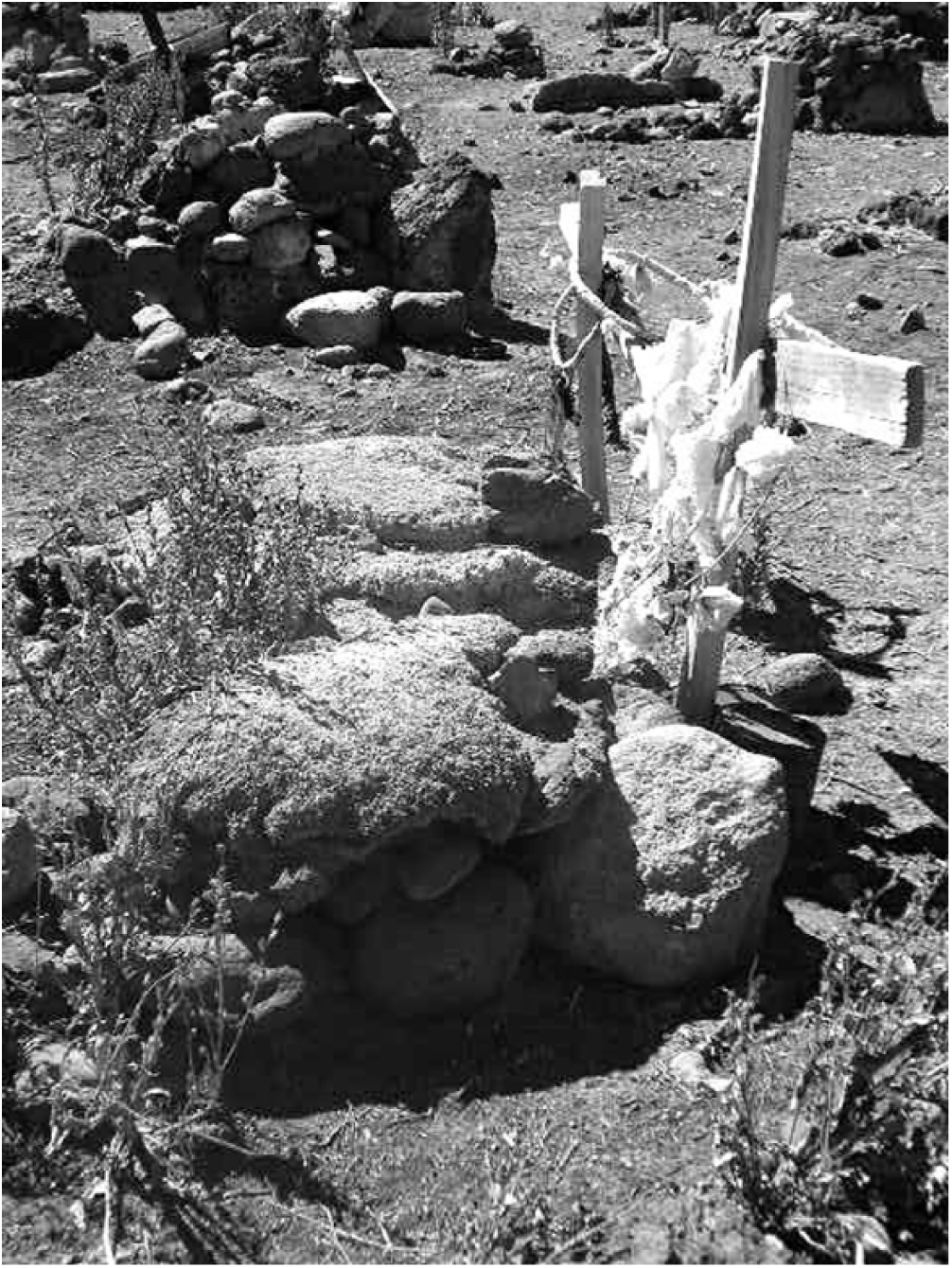
Pieces of the champial on tombs located in the heart of Isluga. © Photograph: Angel Aedo.
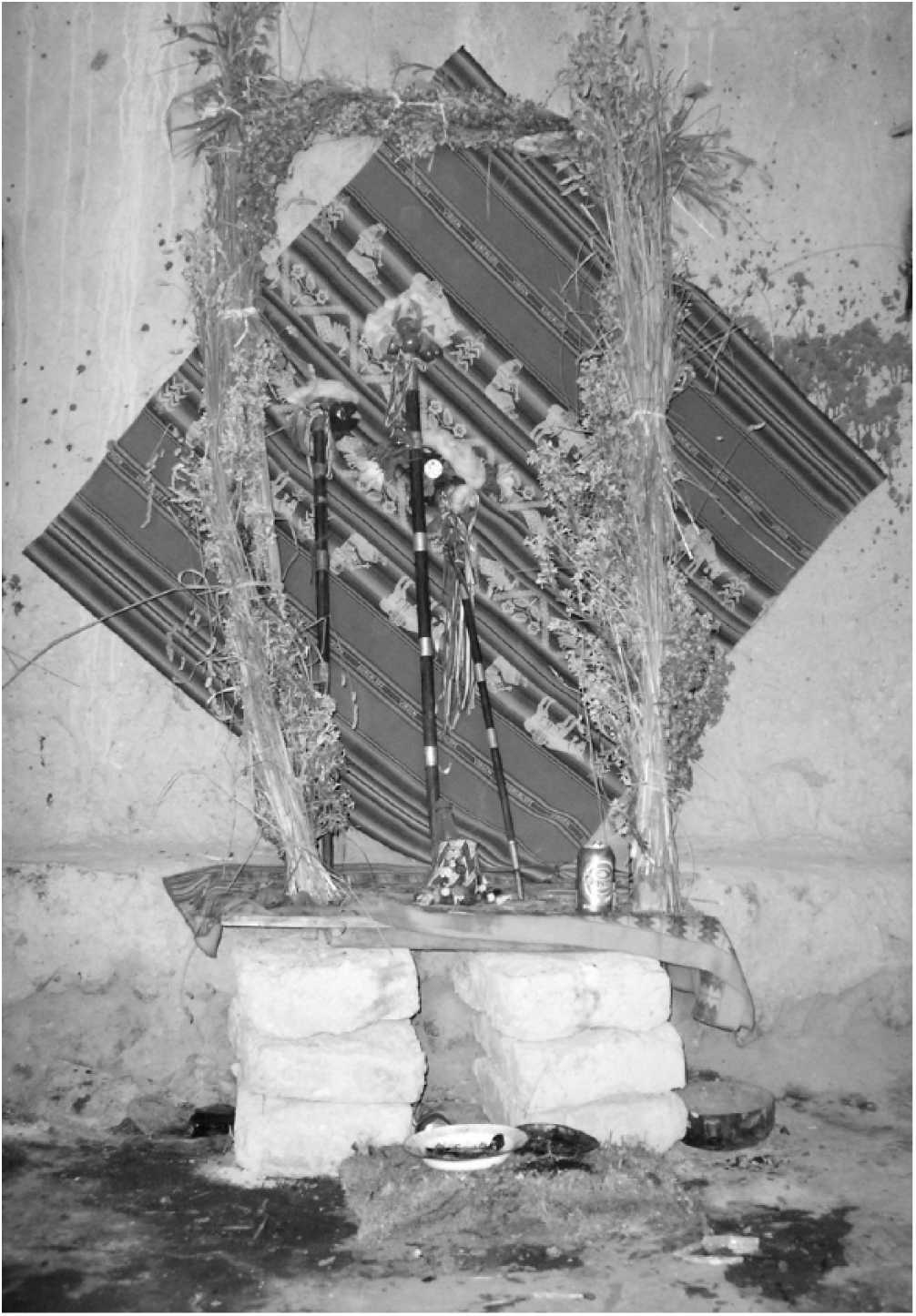
Pieces of champial arranged at the base of the altar. © Photograph: Angel Aedo.
The sense of power embodied by the communal mallku-authorities is closely linked to their fundamental mission: namely, guaranteeing the appropriate participation of the people of Isluga in the regeneration of beings and things, which explains the inextricable relationship between power and fertility. The testimony of an inhabitant of Sitani, an Isluga village, reveals the relationship between fertility and the origin of the champial: ‘[before] there was no champial there, it was ch’alla, sandy land [ch’alla churu is the ritual name of the champial], and all the families on it had a small piece of chacra [land to be farmed], a churu, marked off by walls of ch’ampa’ (Martínez, 1989).
The heuristic potential of this story arises from its synthetic nature and the different connections it establishes. The distribution of the right to use this limited land among all the families in the community reveals its strategic importance and symbolic value. Even today, the use of the champial is communal, and no family or socio-territorial section of kinship (ayllu or saya) in Isluga can claim absolute ownership. The shared right to use the champial and the prohibition on its exclusive possession recalls the imperative condition of the circulation and distribution of power among the political leaders and religious authorities (mallku). These elements reflect the effort of the people of Isluga to make this site look like an ordinary place without special features, ‘emptied’ of identity and devoid of signs of ownership or power. This is one of the enchantments of the champial that make it such a complex and distinctive cultural creation. In this manner, the Isluga Marka presents itself as a surplus of meaningful circulation through several ritual practices where absence is emphatically manifest as a condition of its presence, offering the pragmatic conditions for acts of belief to be materialized there.
Ritual songs accompanied by libations articulate the dialogue between humans, non-humans and places, which are thought of as overlapping actions that simultaneously make and reinforce paths (thaki). The intertwined actions of singing and spraying people and things with alcohol, although they may be directed toward different ends, flow together into a shared ‘genre’ of operations that fall under the term ch’alla (to spray), whose performative potential is demonstrated in different regions of the Andes. Language plays out a ritual performance, encompassing a range of practices, meanings and affects that associate the material character of discursive action with the materiality of ritual practice in its excess and enchantment.
By means of this mechanism, key in Andean rituals, the physical axis of the ritual landscape of Isluga breaks its silence. Indeed, the main rituals that take place in the centre of the community (e.g. the celebration of the change of mallku, called Santo Reyi; Carnival; and the feast of Santo Tomás, the patron saint of Isluga) activate networks of places, beings and things that awaken memories, strengthen relationships and sharpen the perceptions/projections of the subjects. The ch’alla hold the task of opening the paths that lead to the centre (taypi), the place where everything is tied up (ñach’aña) and can also be untied (ñach’araña) (Deza, 1992: 209; Mamani, 2002: 187). Just as the knots (chinu) of a weaving form a fabric, the words of the songs that accompany the ch’alla at once refer to and tie together significant sites to form mental images of Isluga’s landscapes. In fact, in the ritual of Santo Reyi, the pieces of the champial at the base of the altar and the plants that make up its arch are brought by the mallku-authority and his partner, the t’alla, from different ecological areas, thereby further entwining the diversity of landscapes knotted together through ritual memory in the centre of the community (Platt et al., 2006; Salomon, 2004). 15
Ritual actions structure the spatial sensibilities of Isluga’s inhabitants in various ways, connecting places of power through a heterogeneous network of ritual paths. Beliefs are performed through the production and propagation of mental and affective images where places, tropes and forms of non-verbal communication overlap. In this process, imagination tends to be captured by paradoxes that shake the conscience (Wagner, 1986). From this perspective, however, the mere production of counterintuitive images is not sufficient to construct a memorable representation. It is also necessary to include pragmatic elements of sense production or, as Severi (2013) notes, to explain not only the specific salience of certain religious or mythical notions that become embedded in people’s subjectivities, but also the concrete contexts in which those notions are communicated.
The rituals involving the champial and the churus are connected through ritual paths (thaki), in which everything tends to be tied (ñach’aña). The act of depositing pieces of the champial on tombs and at the base of the altar of the authorities triggers a semiosis aimed at connecting the physical axis of the ceremonial centre, the ancestors, the fertility of the corrals and primitive farms, the spirit of the Pukar Qullu and the ontological foundations of the power of the mallku. In such processes, we see matter and meaning entangled in concrete places and through multiple modes of relationality.
Toward a semiosis of matter and place
What role does the materiality of places play in ritual communication? Such a question needs to be explored in a situational and contextualized way and this is how we address this theoretical issue. The senses of the champial – the empty lot in the heart of Islua Marka – far from being subjected to verbal explanations from Isluga’s people, seem to lie in its silences, gaps and paradoxes. The communicative role of this place is not limited to the level of symbolic representations, it also operates as an index. In a way, the empty centre that the champial materializes is a (non)sign, which is manifested as both a central place-actor in Isluga and as one of its most ineffable aspects. What the champial says is expressed at the border of language, in the field of a kind of negative semiotics – in the nocturnal semiosis of matter and place.
The ritual libations that take place in the ceremonial centre of Isluga connect the champial with landscapes located in different places and times. The bonds created by the libations operate by mobilizing interpretative abilities. They reveal (imaraña), albeit momentarily, the hidden (imaña) presence of the centre: their chuyma, the wise old heart (chuymani) materialized in the champial. The annual change of authorities illustrates one way in which the champial – by means of its location, the ch’allas that are held there, their original corrals and the pieces of champa that make up the altar of the mallku – serves, in its purest materiality, to generate meaning. The ritual path of the mallku leads them finally to the ‘empty’ centre of Isluga, where they disappear in the champial.
In order to explore the entanglements of matter, meaning and place, and with the intention of decentring the way we think about enigmatic places like the champial and, more broadly, Isluga Marka, it is helpful to consider a feature of Chinese pictorial language. François Cheng (1991: 57), speaking of Chinese painting, has noted, ‘Everywhere, the Full makes the structure visible, but the Void structures the use.’ The champial is too burdened with meanings, histories and agents to take a definitive form; it therefore appears unoccupied. This site constitutes an inner boundary; it shares the ambiguity and ambivalence of border areas, being neither wholly within nor wholly without. Its ‘vacant’ status invites the passage of human and non-human persons (e.g. camelids, water spirits [sirinu], ancestors). Thus, the champial has a nature that could be described as paradoxical since it appears as an agent that acts by at once emptying (ch’usachaña) and capturing (kutuntaña) beings, objects, voices and memories.
The ritual actions that take place in Isluga are usually accompanied by words, whose ritual pronunciation recreates space–time paths (thaki), which operate as material fragments of a presence composed of pluralities. This form of presence dwells in the empty lot of Isluga Marka; invisible to the naked eye, it manifests itself through its indexical marks as a result of acts involving speech in the ritual libations, as well as acts involving gazing at the champial. As occurs during the playing of a game, there exists a tension here between being subject to the rules and the freedom of individuals to interpret the sense of the rules (Cavell, 1999[1979]). The salient aspect of this site – its paradoxical condition of taypi – swallows the centre and the borders in a dense void, producing an area of uncertainty and cognitive instability, and results in an abduction of their agency (Gell, 1998; Harries 2017). The infinite semiosis that takes place in Isluga reflects the dysfunctional character of the western ‘semiotic ideology’ to separate a priori the spoken words, activated materialities and intentionalities of subjects (Allerton, 2012; Keane, 2013; Kockelman, 2013). Here, the topological axis of Isluga that materializes in the champial traces a sort of fold, in the sense of Deleuze (1993), as it conveys a heterogeneous web of sense that is both deep and dense. These particular processes of creation of meaning lead to the understanding of this landscape as a processual and immanent topography of materialities and sensibilities (Wylie, 2006). 16
The networks of correspondences between apparently dissimilar spheres are expressed through the use of terms like pampa and taypi. The former denotes a fundamental geographic space, while the latter alludes to the central convergence of all kinds of places. The people of Isluga commonly refer to their ceremonial centre as a heart (chuyma) in order to emphasize its function as a receptacle for feelings, particularly its status as the producer of a place’s personality. This is a topological inflection point, an elastic point-fold connecting multiple sites and various material pasts. When the inhabitants of Isluga describe the ‘ancient’ places, such as Pukar Qullu mount, it is not unusual to hear conversations about the unpredictable personality of this site. Ancestry is a source of wisdom and power that occupies the topological heart (chuyma) of bodies and places. An index of such phenomena lies in the expression chuymani, which is still used by the people of Isluga to speak of an elderly and wise person.
The heart of a place constitutes a different entity from the organic heart, referred to as lluqu by the people of Isluga. The topological position of chuyma enables it to act as a hinge between interior and exterior spaces, on the border of visible and invisible worlds. The centre-heart also constitutes a source of understanding that builds the elders’ wisdom. The people of Isluga resort to this notion in order to describe individuals’ good sense; the lack of this attribute indicates poor judgment or dementia. The process of acquiring knowledge and judgment is captured by the expression chuyma-chasiña; conversely, chuyma-pisi connotes an individual’s lack of judgment. Literally, chuyma-pisi indicates something with little heart. 17 Therefore, madness, understood as a disorder of the spirit, cannot be located at the base of the ontological construction of a place. On the contrary, the entities that cause madness – such as the devil (supay), the spirits of the deceased (kukushi), the petrified ancestors (wak’a) and the spiritual beings associated with archaeological remains (jintili) – intervene to subvert the order of places and disorient subjects. In this context, it is clear why good sense – in other words, the order of the spirit – feeds the notion of centre (taypi/chuyma) and plays a part in sustaining the configuration of all kinds of places.
Likewise, any decentring of subjects and places involves a certain ‘emptying’ of meaning. One could say, based on evidence from Isluga, that radical centrality is also decentring since it is anchored in ancestrality. Places associated with the oldest ancestors (e.g. archaeological remains and landmarks) are deeply disturbing. The upsetting effect of such places is similar to the disquiet that people of Isluga experience in wild places on the border of everyday life, which are usually called sallqa. This notion, besides referring to unsafe landscapes, is used in Isluga to denote surly people and imposters. The sense of sallqa leads to a particular form of perceptual overlap between borders of geographical landscapes (the wild) and boundaries of social ties (the fake). This last dimension of boundaries is revealed through the act of cheating (sallqaña), which places its perpetrators in socially and morally marginal positions. This is why, in Isluga, people use the term sallqa to describe the untamed places located on the geographic, social and ontological boundaries of the living.
Conclusion
The properties of places derive from the particularities of their locations, their relations of proximity, their historicities and the point of view of the observer at a given time. The production of meaning is rooted in these concrete sites, in interconnections and in ways of relating that are constantly redefined by those involved. The relationship that the people of Isluga maintain with the champial binds them to the landscape in ways that are both explicit and implicit, through representable and non-representable paths, and through mobilizing thoughts, values and emotions.
Beyond Isluga Marka, the analysis of the champial provided clues for the more general study of places as phenomena constantly experiencing entanglement of matter and meaning. The dynamics observed in the champial – which can be generalized to other geographic and cultural contexts 18 – reveal that places not only actively participate in the life of landscapes, but they also have the potential to trigger (through the materialities themselves) complex and plural actions. The phenomena explored in this study also served to conceptualize the processes by which certain sites, such as the champial, act as centres where other places, things, humans, and non-humans undergo processes of folding and unfolding. It is in this sense that one of the primary functions of agential places, as we have seen through the champial, is the ability to capture experiences and spark the imagination of their habitants.
By exploring the champial we were able to address the important role played by the materialities of places. Thus, this study led us to examine how the apparent material abandonment of the champial and its absence of buildings, speech and representations, created the practical conditions for the act of believing to take place. Its apparent emptiness allows infinite possibilities of meaning to be created, a sort of pragmatic sense production in situ. Through the case of the champial, this article explored a general phenomenon of co-production of meaning and mattering that manifests itself with particular intensity in the Andes of northern Chile. We saw that ritual sites like the centre of Isluga have the capacity to act as topological folds where other places, beings, and things become entangled. The analysis of the champial as topological fold led us to grasp the act of believing as a ritual action. This was relevant both ethnographically and in epistemic terms because it allowed us to recognize the phenomenon of belief embedded in the very materiality of the place – before being stabilized in a uniform religious discourse of what is sacred. As a result, what materializes in topological folds like the champial is not faith in things, but the act of believing.
Taking seriously the agentic and sentient landscape – as the champial experience teaches us – matters politically. This is because the understanding of such phenomena entails a disruptive potential of the neoliberal extractivist order, in which landscapes exist as mere resources for economic exploitation (Veltmeyer, 2013). The ceremonial centre of Isluga, more particularly the analysis of the events taking place in the champial, offered significant data, which helped us to conceptualize phenomena as material entanglements enfolded in concrete places and moments. Following the events of the landscape in Isluga, we shifted the notion of space in anthropology from the univocal Euclidean plane to a broader space, which ‘is more appropriately thought of as a dynamic and ever-changing topology’ (Barad, 2007: 176–177). The inquiry provided material that enriched our understanding of how multiple spatialities, temporalities (rhythms and cycles) and material pasts are lived in Isluga in ways that undercut assumed divisions between present and past, humans and things (Shanks, 2007; Witmore, 2007). The conclusions of this article are not limited to the community under study; they also seek to provide analytical materials capable of expanding the epistemic bases of contemporary approaches that are rethinking the ontological foundations of human–nature interrelationships. It is from this perspective that exploring the performativity of the champial endeavours to shed light on our general understanding of the materiality of places, no longer as something given or as a mere effect of human agency, but as an active actor in the co-production of matter and meaning.
Footnotes
Acknowledgements
I presented versions of this article in research seminars at the Ecole des Hautes Etudes en Sciences Sociales. Many thanks to the audiences of these seminars for their questions and insights, especially Nathan Wachtel, Carlo Severi, Alain Musset and Gilles Rivière. I would like also to extend special thanks to Paulina Faba, Victoria Castro, Marie-Areti Hers, John Maher, Francesca Merlan and Alan Rumsey for their constructive insights and suggestions on the topics discussed in this article. This article was written during a visiting scholarship at the Institute for Advanced Study, Princeton. Finally, I thank the Journal of Material Culture editorial team and two anonymous reviewers for their insightful suggestions for revision.
Funding
The author(s) disclosed receipt of the following financial support for the research, authorship, and/or publication of this article: Research for this article was made possible by the Center for Intercultural and Indigenous Research (CONICYT/FONDAP/15110006), the Institute for Advanced Study, and CONICYT/FONDECYT (project 11170956). There is no conflict of interest.