




Abstract
Travelling fairgrounds embody the ephemeral. They arrive from elsewhere to occupy an everyday space, momentarily wrenching it from regular purpose and bringing in a bombardment of shimmering surfaces, magical spaces, affects, illusions, fleeting peaks of sensory excess. Utilizing historical resources, interviews with showpeople and gathered testimony, this article examines the material encounter of the British fairground through the prize, what might be considered as a making material of the ephemeral. The prize provides material reminders of the fairground when it has departed, to counterintuitively persist through time as meaningful keepsakes and souvenirs. The fairground prize is tracked as both object and concept, utilizing detailed ‘back-stage’ and ‘front-stage’ flows, Dant’s work around ‘objects in time’, spatial practices and complex crossovers to other cultural trends. Taking his research to the contemporary period, the author proposes a significant shift in the fairground prize that has a wider impact on the aesthetic engagement with the fair.
Introduction
Although the British travelling fairground emerged with a strong association to trade, coinciding with harvest festivals, hiring ceremonies and the specific selling of nominated goods or livestock (see Cameron, 1998), it now resides as an ephemeral, transient and travelling spectacle endowed with thrill, excess and a polysensory assault of sound, smell, light and taste. As Walden (1997: 126) suggests, fairgrounds and expositions ‘carried expectations of spectacle’, and the lasting material transaction was phased out in favour of affect and emotion, pangs of anticipation, short bursts of dizzying release, a heightened social milieu and relaxing of rules, and a bombardment of subcultural strands and popular culture iconography. Even the potential to dwell upon the material encounter of food is quashed, with culinary offerings oriented towards sweet and sickly mixtures alongside hot-dog and burger savouries, handed over in polyurethane trays and consumed ‘on the hoof’, to be tempted back out a few minutes later in the encounter with spinning and inverting contraptions. Within this ephemeral palace, a shard of the material exists with the fairground prize – hard-won on the darts stall or hoopla, ceremoniously clutched while finishing the circuit of the fairground and returning home, and strangely treasured well beyond its apparent shelf-life, much like urban-myth stories of fairground goldfish that unfeasibly live on for years.
Focusing on Britain, this article addresses the material encounter of the ephemeral fairground through the fairground prize, proposing a model for the flow of material culture on the fairground that includes the points where prizes and small gift type objects can be attained, aspects of display, and the actions and rituals attached to these acquisitions. The work emphasizes the context-specific spatial aspects of the fairground prize, proposing a back-stage (the objects in production and movement) and front-stage (the objects on display) and associated distinctions of affordance. Fairground display culture is documented and I develop parallels to modes of presentation in art, utilizing theories from art history to develop my arguments. Drawing on the work of Dant (1999), I track these objects through time, developing a narrative for both the shape and scope of the fairground prize in general (what I call the phylogenetic, or evolutionary tree, model) and the trajectory of a specific object (the ontogenetic, or lifecycle, model). Within Dant’s temporal schema, I emphasize the roles of novelty and ceremony of acquisition integral to the fairground prize. With these models in place, I propose a significant shift that has a wider impact on the aesthetic engagement with the fair.
The fairground prize is a slippery object that shares some common ground of outlet with seaside stalls and temporary shops that occupy vacant spaces on the high street during Christmas holidays, spaces and moments where, according to Cross and Walton (2005: 5), we are at leisure to ‘gaze and listen, to move and mingle’. These outlet realms are often overlooked but are of importance to researchers of material culture, although the fairground has persisted as mysterious and hard to approach. Goods for sale, often branded to ephemeral cultural themes from film and television, are known as ‘swag’ to the retailers, offering connotations of piracy and plundering. Whilst such a label might be applicable to the colonial narrative of the exhibition culture referred to by Walden (1997), the origins of the word in fairground and market-trading culture is less certain. Swag implies ill-gotten gains, perhaps won rather than earned, and this manner of acquisition is central to the fairground prize. Furthermore, the concept of winning rather than purchasing (with legitimate funds) introduces a more sensorial engagement with the object, demarcating it from a similar object purchased from a retail point.
The article embraces current research in the material culture of the seemingly trivial, overlooked, and taken-for-granted, investigating complex biographies in coming to be, circulation, and resilient meaningfulness. Examples include Gregson and Crewe (2003) and their investigation of second-hand cultures and Balthazar (2016), and the complex flows of charity shop objects donning character and affecting nostalgic impulses. From a distanced position, the fairground prize could be considered in the realm of gubbins or detritus, material that is lowly, belittled or downgraded and operating in a grey economy, thus making the investigation of its lifecycle an undertaking of minor importance. However, as Miller (2008) shows, such objects cannot be ignored, and his work in transforming a Perequian heteroclite of everyday possessions such as happy meal toys (p. 129) into a new ontological substrate asks questions about what matters as stuff. Turkle (2007) circumscribes a similar terrain of ‘evocative objects’, acquiring deeper meanings through their acquisition during ‘times of transition’ (p. 8), exemplifying what Dudley (2010: 2) describes as ‘the embeddedness of material objects in human social life and the meanings and values objects thereby acquire’.
Aims and research methods
The first aim of this article is to explore how the fairground prize arises, flows and functions as an example of material culture. This is undertaken with an initial review of written research on the fairground prize, identifying the sporadic discursive areas where fairground writing occurs and how discourse is structured. Whilst other testimonies of the fairground prize may lie intermittently in the corpus of ‘from below’ local and personal histories, it was felt that excavating such work was beyond the scope of the research. Instead, I move on to my own research undertaken at various British fairgrounds (observation and general public interviews), specific interviews with tradespeople and showpeople, and further interviews conducted with self-identifying fairground fans on an internet forum. Archival and contemporary photographs are used to illustrate testimonies and points made in the research, with nuances on elaborate modes of display (positioning, grouping and arranging).
The second aim is to investigate the fairground prize as a dynamic and responsive cultural object, combining further testimony with evidence from the World’s Fair newspaper, an ongoing weekly publication established in 1904 that serves key functions: reporting on fairgrounds, facilitating the organization of the industry, and acting as a communication vessel for a transient community. The newspaper incorporates a dedicated section of sales advertisements where swag wholesalers offer bulk purchases to showpeople, and this section is utilized as a primary resource or isometric mapping of the swag on the fairground at the time since all swag was purchased through this channel. I have taken samples from the years 1955, 1965, 1975 and 1985 as a spread to indicate a dynamic. There are two points to make here: firstly, it is very likely that key changes in the nature and cultural resonance of the prizes take place rapidly between the markers chosen at the middle of each decade; and secondly, the article is not a full history of the fairground prize. I am indicating the nature of the prize, its changing state, and its levels of embedded ephemerality as it is chained to fleeting cultural reference points.
The third aim is to support a persistence of meaningfulness of these objects, particularly their mnemonic function, by drawing on the testimonies. The overwhelming ephemerality of the fairground and the throwaway nature of the prize are resisted as objects are storied as being retained or recalled as important memories or conduits to a wider experience of the fairground. The article concludes by returning to the dynamic of change and bringing things into the current era. Two epiphenomenal observations are noted: firstly, the gradual erosion of the material object specific to the fairground and its replacement by franchised toys drawn from films and television that can be purchased in other places; secondly, the implications of the fairground prize linking itself wholly to cultural icons of alarming fleetingness.
Literature
As an academic or sociological enquiry, the fairground often remains off-limits, with connotations of the mysterious, secretive, disingenuous and shabby. In its place, the popular history and enthusiast-oriented market dominates the published output of fairground literature, producing books on specialist domains of named fairs, show-families, specific ride types and makes or types of transport. However, even within this body of work, the fairground prize and its methods of attainment evade description and reflection. The round stall and side stall, the principal modes of access to the prize, are covered in Braithwaite’s (1968) study of the architecture of the fairground, registered as ‘booths and joints that are called side and middle stuff’ (p. 28) as part of the wider architectural structure, and then given a short chapter (pp. 67–76) that concentrates primarily on the fairground show (a declining feature of the side-ground). Braithwaite is concerned with the topography of the attractions both within the wider fairground and within the attraction itself as a closed-off and functioning object. The topography of each stall is dependent upon the nature of the enclosed game, and the rudimentary features of decoration such as lettered prosceniums, striped awnings and embroidered side linings form the bulk of Braithwaite’s interest. He offers an important affinity with the market traders, and briefly documents a rationale as ‘more than just the garish display of swag (prizes), it is this quality of jostling for space, of being smarter than one’s neighbour’. Starsmore (1975: 33) echoes Braithwaite, stating that ‘the ‘joints’ and ‘hoop-las’ are the colourful and decorative fabric of the fair’, but not expanding upon their assumed minor role in a structural whole. He makes a single reference to the content of the stalls, suggesting ‘the adornments of ceramics, glass and toys which catch the eye with their allure can seem like treasure to the lucky winners’ (p. 34). Dallas (1971: 163) recognizes in the (then) contemporary fair, stalls as ‘poor relations on the fairground … in forlorn avenues marking the boundary of the fair, or clusters round the rides hoping for pickings’. However, his journalistic and human-interest approach to the subject leads him to query the fairground prize, and I expand upon his observations below, as I set out my own enquiry. Finally, of the major books covering the history of the British fairground, Weedon and Ward (1981) offer dedicated chapters to both the round stall and side stall, but are more concerned with decorative aspects and the interior workings of games and target systems such as the evocative lines of tinplate black alley-cat figures with a pock-marked patina of repeated shooting. The prize is described as an aspect of the visual lure of the stall, ‘the centre filled out with a mountain of “swag”, an assortment of frequently gaudy prizes, although amongst their number were more practical items such as carpet sweepers and alarm clocks’ (p. 221). Whilst this offers a brief insight into the distinct material culture of the prize, it serves Weedon and Ward as part of a greater gesamtkunstwerk where the material lure of prizes and consumer durables blends with lettered rounding boards listing the more prestigious prizes on offer, and interior gag-boards painted with phrases of joy and anticipation.
Ketchell (1999), in what is the first and only dedicated study of a fairground stall, documents a multitude of deep and precise memories of ‘Chicken Joe’, a character who operated a complex spinner style game, where three dials indicated random numbers that were matched by the punters. Whilst Ketchell’s work on Chicken Joe is useful in understanding the nature of the game within the fairground, his prize system (upon which he was named) veers away from the unique material object with a special attachment to the fairground. Chicken Joe offered food as prizes and in the depression years of the 1930s the winning of fancy groceries was both a thrill and a practicality. Ketchell gathers detailed memories of the seemingly slowed-down moment of winning the prize. For example, a respondent typically recalls: In 1933 when my dad had been out of work about four years we went to the fair. My mother bought a 2d ticket at Chicken Joe’s. I remember standing there watching the numbers go up and down. Suddenly it stopped and my mother had the winning ticket. It was wonderful: we thought we had won a fortune. There was a larger carrier bag full of groceries and a large plucked chicken complete with head and feet. I remember it so well because this was the first chicken we had ever had and we didn’t have another until some time during the war. (p. 11)
Alongside the novelty of chickens, Chicken Joe also offered household goods, and other respondents recall these glamorous prizes, topped off with a star prize such as a three-piece suite. This indicates another level of prize, the proliferation of household goods in terms of objects that are both practical and everyday, offering people a chance to win what they might not be able to afford in the normal shops. These prizes do not fall under the definition of fairground swag that I explore below, but it is interesting that they still evoke memories and responses relating to the longevity of use. For example, in my contemporary research, a respondent at Loughborough in her 60s recalled fairground prizes as ‘proper things like casserole dishes on the hoopla stall – we used ours for 20 years’. As Figure 1 shows, the domination of ceramics (practical items) was to the fore in the 1960s, and modes of display such as plinths and intricate doilies were regularly employed.
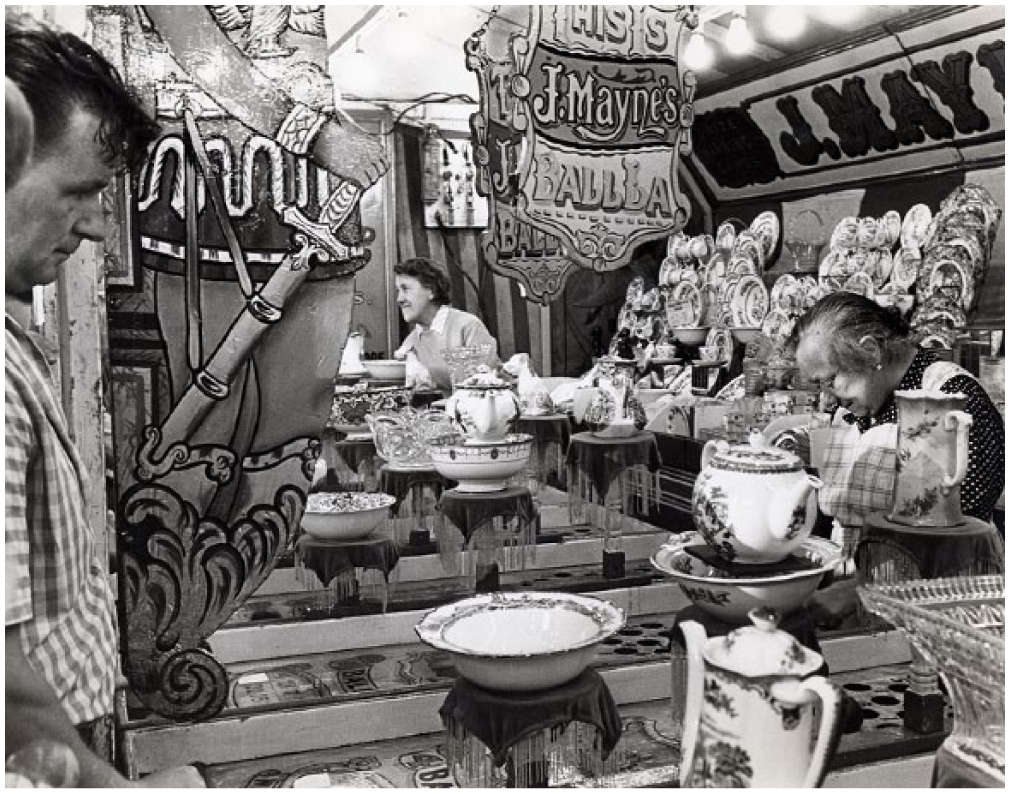
1960s prizes on fairground stall. Photograph David Braithwaite/National Fairground and Circus Archive.
Encountering and attaining the prizes
Material swag forms part of the allure of the fairground, brought in as some kind of strange booty by the showpeople and arranged in intricate displays for the benefit of the punters, to be either purchased or offered as prizes in fairground games. This is an instance as we see it, a juncture in its object flow forming the anticipation of its departure from the fairground (and custody of the showperson) into the ownership of the punter. Swag pervades the fairground as either prizes (larger items) from stalls, small items from ‘Autogift’ vending machines, toys and games as winnable from various unstaffed devices such as cranes and grabs, and a multitude of items sold from vendors who circumambulate the fair or strategically line the entrance and exit interstices of the larger events. There is a topographical logic to the arrangement, with round stalls forming short avenues within the body of the fairground, side stalls lining the edge of the fairground, vending machines filling in any available spaces, and vendors floating around. It is an evocative and impressionable environment, and minor details such as the vending machines are recalled by respondent Mike: You also used to see a sort of slot machine scattered through the fair, usually against the shutters of a ride, a bit like you see the punch bags now. These slot machines used to intrigue my sister. It was 6d a go, they were filled with small blue/grey boxes which contained a ‘mystery’ gift. This usually turned out to be a bracelet of plastic beads, which was why my sister liked them so much.
Whilst the mystery gift vending machines hid their booty, the modern-day grab games expose their prizes temptingly. Grabbing devices have a cavernous, mirror-backed and dazzlingly illuminated glass vitrine with a base of packing substance (polystyrene nuggets) and toys scattered, awaiting a lucky trier. Variations exist, but the basic system involves hastily positioning an open set of mechanical jaws using a joystick or button, watching the grabber descend, retract and hopefully grasp a prize rather than clasp at nothing or scattering nuggets. It then ascends and makes its way to the exit chute where it opens to dispense the prize. The customer is never certain that the prize is secure as the jaws seem to stutter and judder, often relinquishing its prey, making the winning of an object a tense occasion. A different version of this game, one that is more corybantic but less controllable, takes the form of a large rotating disc of swag and a steel stylus that is activated to move from the circumference to the centre where a void is positioned allowing prizes to descend into the dispenser. This game looks simple to profit from, and the stylus briefly seems to gather numerous objects in its momentum sweep, but these are then dislocated from its clutches as it nears the centre. These games are designed to attract a crowd of onlookers, giving a brief moment of excitement and optimism but ultimately proving fruitless. The mode of display of prizes matches arcade culture, where highly mirrored and brightly lit mechanical devices allow coins to be fed through chutes and launching platforms in an attempt to dislodge coins from a dense bed of loot.
Swag vendors are strategically bedecked in items that occupy various horizontal strata, with helium-inflated branded-balloons uppermost in huge clusters, stick toys and light sticks protruding at body level, and whistles, oversized dummies and felt animals limply hanging from waist belts. As Figure 2 illustrates, these resemble totemic or talismanic tribesmen, their bodies are totally submitted to swag by bearing its density and weight, and maximizing its exposure.
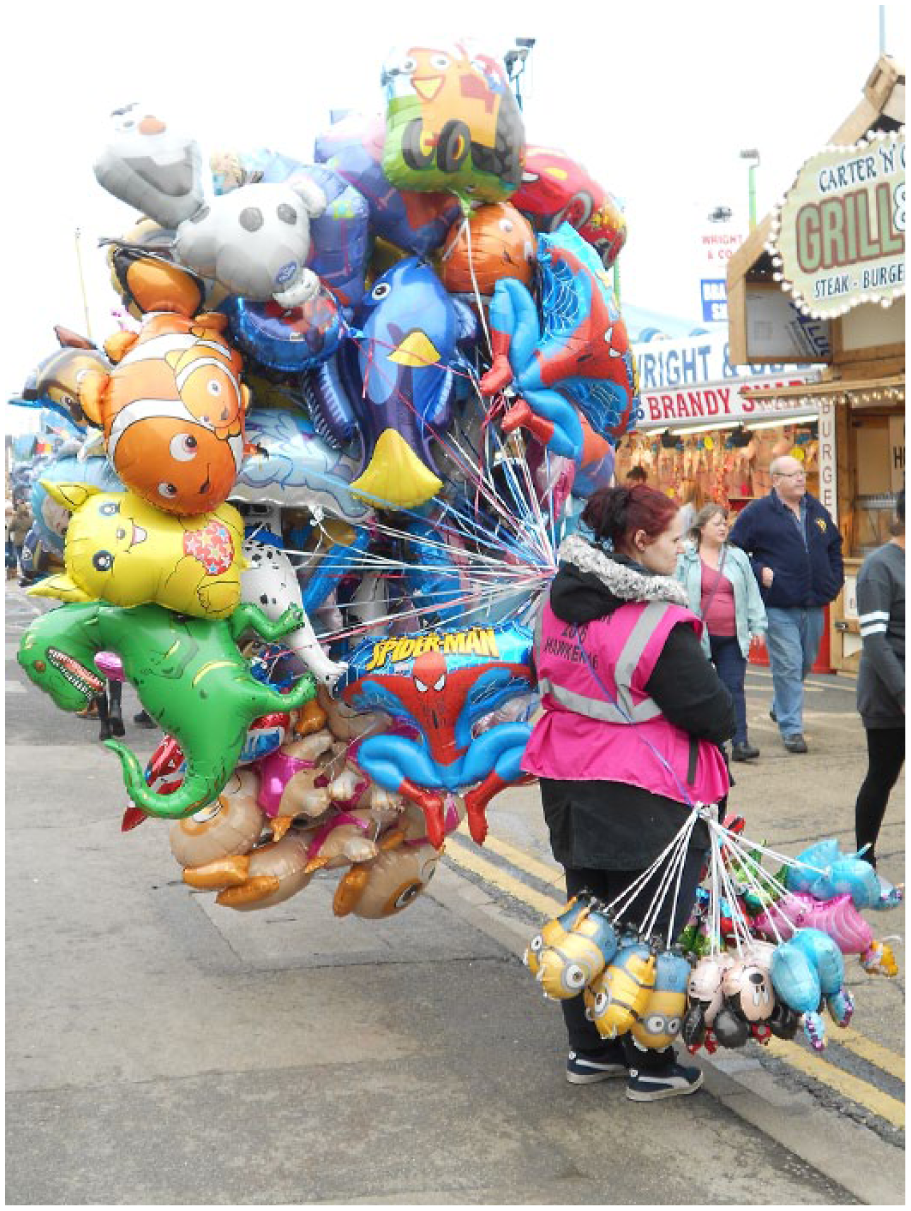
Balloon seller, Hull fair 2016. © Photograph: Ian Trowell.
Round and side stalls offer games where larger prizes can be won, although here the customer needs to be careful. Toys, figures and plush animals proliferate at all sizes, exhibiting what Orvell (1989: 43) calls polyisomorphism. Figure 3 shows a range of sizes of plush big cat prizes on display, and there are always even smaller examples stashed in boxes and hidden from immediate display. These smaller prizes, known as the ‘bottom shelf’, are most commonly won, giving rise to the phrase ‘anything off the bottom shelf’ and its connotations of disappointment. The scale of size maps to a scale of desire, with huge examples most sought after, and these are most prominently displayed in innovative stacks and arrangements hung from radial beams, pinned to uprights, and piled into a mountain in the centre (Figures 4a, b, c, d). Trowell (2016) suggests a counter-reading to formative British pop art with an unacknowledged debt to the fairground, and this continues into neo art through its utilization of fierce duplication and symmetry of lurid objects as championed by Jeff Koons in his Banality series (1988) and performance artist Paul McCarthy through his use of discount illusions and shoddy remnants of popular culture. Whilst these artists of the canon play with the seemingly kitsch readymade, creating a cultural enclave for an art-savvy audience to experience the common object, the real vernacular flourishes on the fairground where common objects are the building blocks of a craft of display. Showpeople take great pride in their arrangements of swag, assembling them as careful structures and often posing for photographs with the suspended toys proudly framing them as a mise-en-scène (see Trowell, 2017).
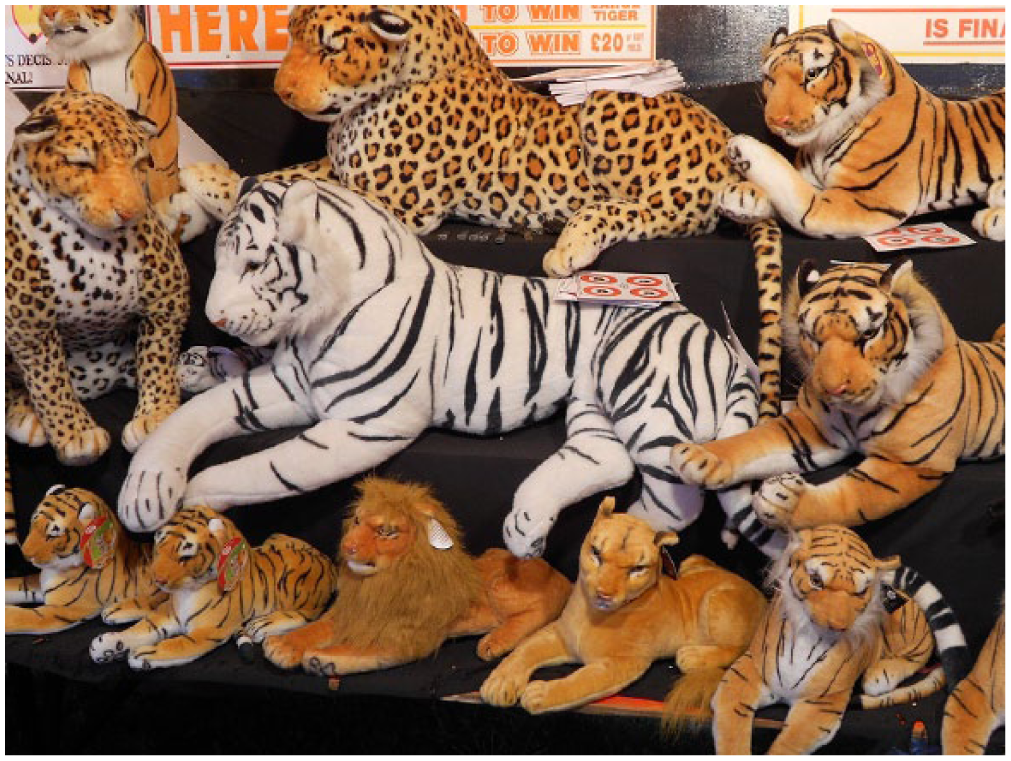
Plush animal prizes, Knutsford fair 2015. © Photograph: Ian Trowell.
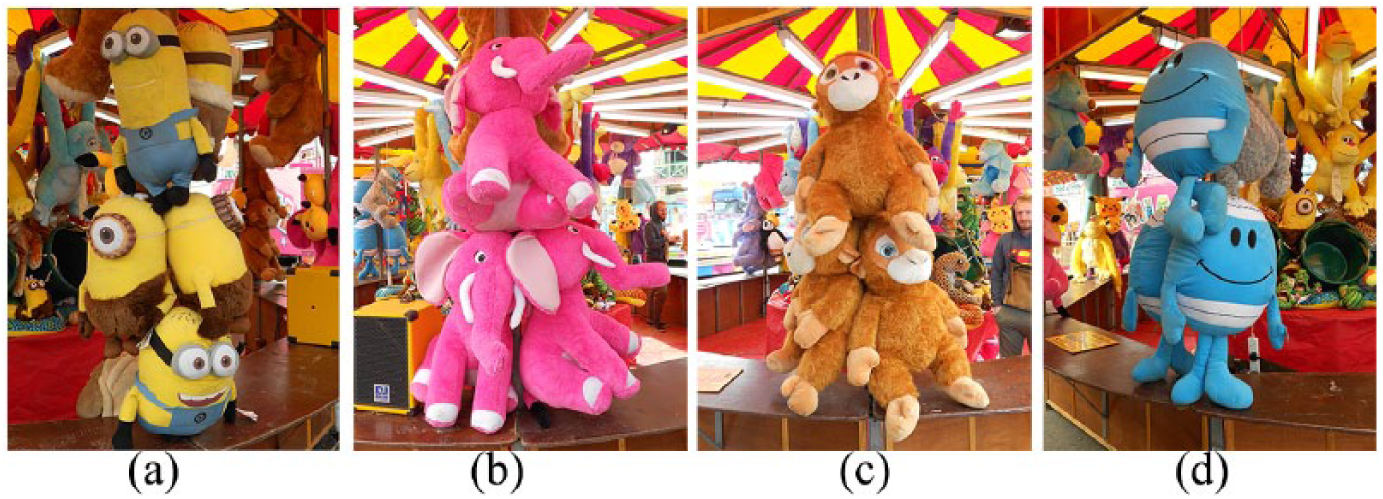
Stacked toys, Hull fair 2016. © Photograph: Ian Trowell.
These stalls have evolved as a hybrid of skill and chance games with modern-day forms that include rifles, darts, pick (lottery), bingo, roll-ups and tubes, and a multitude of throwing and projectile games involving rings, balls, bean-bag toys launched using a mallet and catapult. Each game type then develops syntagmatically, slightly changing conditions such as darts thrown at standard dart boards, specialist dart boards and playing cards, with rules for winning based upon a myriad of combinations of high, low, matching and non-duplication, and small-print rules stipulating how fallen darts count as scoring so-and-so (to make winning by achieving the desired figure very difficult). A litany of fanciful mythology has accrued around the fairground game; air rifles with crooked sights, blunted darts unable to spear stiff playing cards, too-small-hoops, glued down shooting targets, diaphanous but tensile ping-pong balls skittering across cellular arrangement of goldfish bowls. Competing and winning becomes a monumental experience, drawing in spectators, and forming a memorable occasion. This can be a bonding experience for families such as recalled by Anne Watson, quoted in Toulmin (2003: 34): I remember the first bingo stalls. I won and my prize was 20 Senior Service cigarettes and a pair of pink hand towels. Two different men came to ask my father to sell them the cigarettes as good brands were hard to come by, but I wanted my father to have them. The towels my mother saved for my bottom drawer and gave them to me when I got married.
A respondent at Loughborough (female, 70s) fondly recalled her father as a sure-fire way to win prizes: Dad always did the darts for a coconut – he was a brilliant player.
The coconut remains a fairground favourite although this is not an item of swag that persists beyond its almost immediate eating. It did, however, have a persisting cachet due to its exotic nature and originally unique association with the fairground, as recalled by Clare: As a young girl we won a coconut at the fairground. I remember it well; we were transfixed as my mother tried to attack it for whatever was inside. We sat watching as the milk was drained out. We drank that. Then we ate some of the fleshy inside. We had never seen or tasted anything like it, and you could only win them at the fairground.
Other edible prizes are offered as alternatives to material goods, although these also take on a surreal fairground character. Cork shooter stalls or throwing games are stacked with cheap sweets and drinks, urging the punter to dislodge them; their bright packaging made more striking by their assemblage into temptingly precarious structures resembling the 1950s British shop-fronts photographed by John Bulmer and Nigel Henderson (see Harrison, 1998).
Finally, as shown in Figure 5, there is a ritual of carrying home big prizes, celebrating being seen as a winner. As the fairground prize evolved towards the end of the last century, sizing of toys took on steroid proportions, and the sight of children or their parents grappling with huge snakes and tigers became a fairground spectacle in itself. Here the fairground prize momentarily takes on a new role between the bulk ‘stuff’ of the showperson and singularized object of the punter, acting as both an oversized trophy to indicate a successful achievement and an advertisement for the fairground prize.
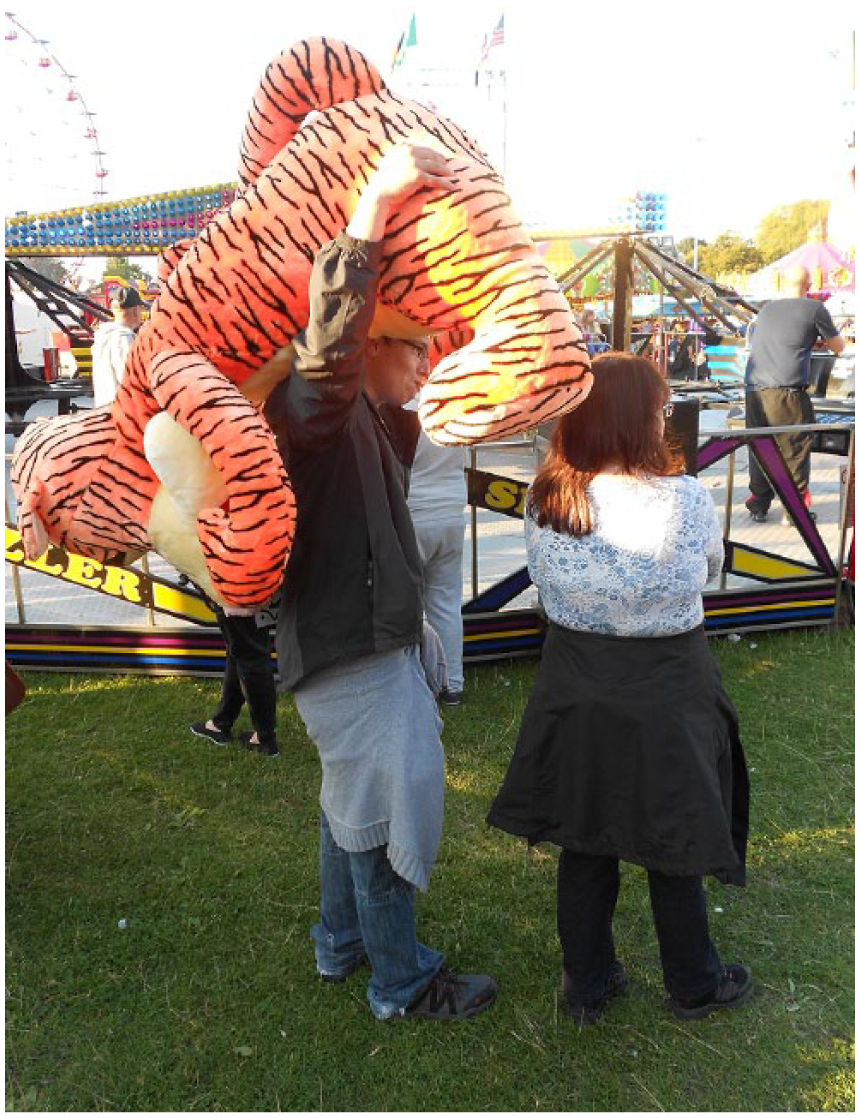
Carrying large tiger toy, Goose fair 2015. © Photograph: Ian Trowell.
Backstage
The flow of prizes extends prior to their display on stalls, although their production and possible further chains of trading – an extension of the ‘cultural biography’ (Kopytoff, 1986) – is not something that is either visible to, or considered by, punters. Dallas (1971: 168) sets this out in his consideration of the front and backstage of the fairground, stating that: The need for an instant and plentiful supply of swag has spawned a race of swagmen. These are the wholesale dealers, who at a moment’s notice are ready to produce a gross of anything, from vinyl snakes to crucifixes … It is difficult for him to predict when he will need it and where, as he might have a run of bad luck, meeting champion sharp-shooters or darts-throwers in one town.
Swagmen will arrive at a fairground well before it is open to the public to allow showpeople to stock up on prizes and see new lines, indicating the increasingly influential role they have in determining the fairground prize. Prizes are purchased in bulk, squashed into polythene bags such that, if glimpsed by the public, their appeal and worth may be challenged. As Figure 6 shows, they are grouped on the pavement and hastily transferred from bagged bulk to desirable prize in the hours prior to the fair opening. At larger fairs such as Newcastle (June), Hull (October) or Nottingham (October), the swagmen will spend the duration of the fair in situ behind the scenes alongside the lorries and living wagons associated with the fairground. Swagmen set up selling points with other backstage service providers such as lighting suppliers, signage equipment and electrical goods in an impromptu area known as ‘swag alley’. As can be seen in Figure 7, this is both out of sight for the public (behind the enclosed perimeter of the fairground), and also out of bounds to the public (behind a makeshift fence in cases where the public wander beyond the perimeter of the fairground). Increasingly there is a layer of production beyond the swagmen, as goods (or parts for goods), flow across the globe to exploit cheapest niches of production and operation. As the swagman at Newcastle explained when I enquired about the multitude of stuffed toys and their origins: ‘Skins come from China, we stuff them here, they are sold to fairs and markets.’ Distinctions and affordances of objects in this chain of selling are barely discernible; there is a trust from manufacturer, to wholesaler, to showperson that the product will come alive on the fairground, become part of the fabric and entice the punter. The risk of something proving unpopular dissipates throughout the chain.
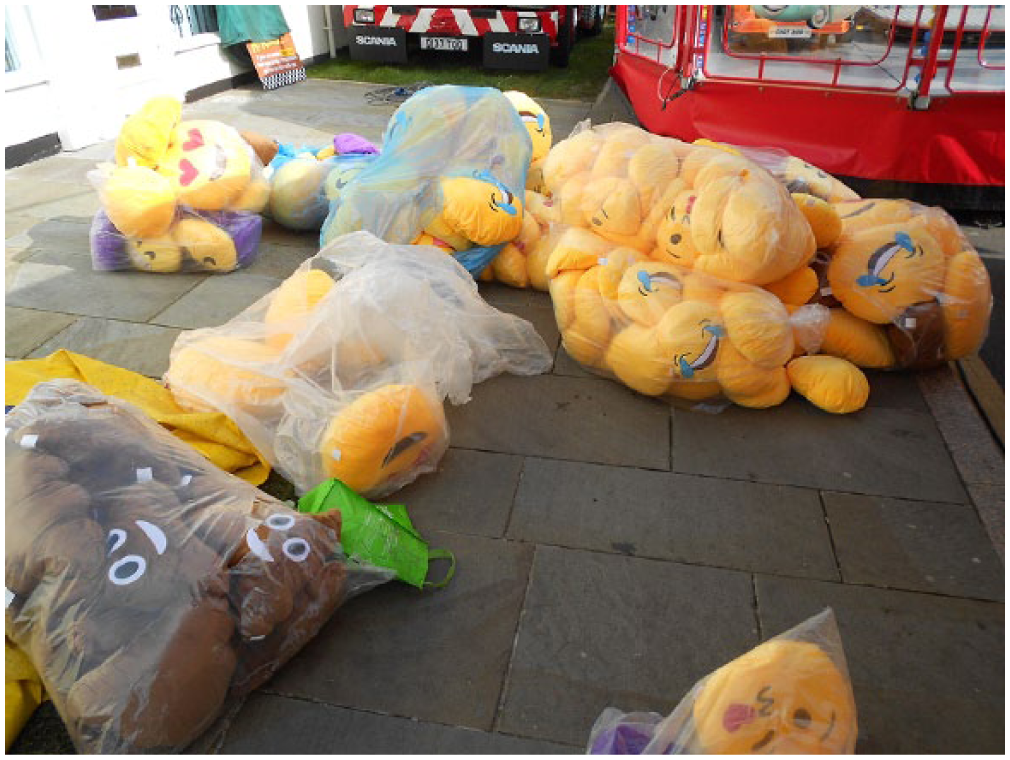
Bagged toys prior to opening, Kings Lynn Mart fair 2016. © Photograph: Ian Trowell.
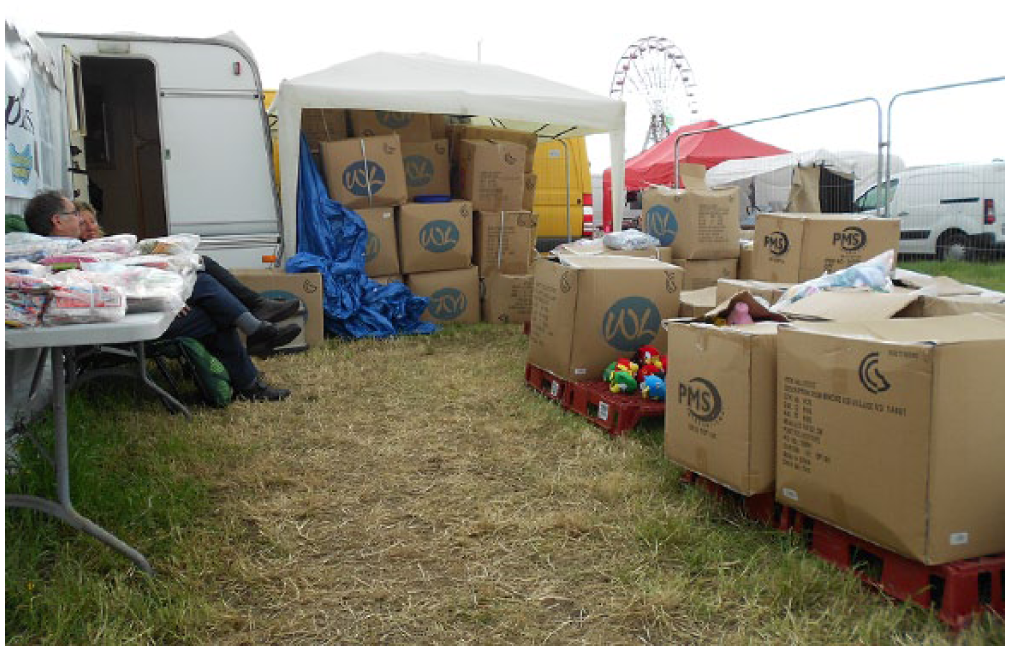
‘Swag Alley’, Newcastle Hoppings fair 2015. © Photograph: Ian Trowell.
Swagmen and wholesalers also offer goods through the pages of World’s Fair newspaper. The publication is principally distributed over the fairgrounds, with copies also available in high street newsagents. The inclusion within the newspaper of advertisements for services such as swag provision might well break the magic of the fair and its prize, as the newspaper hides in plain sight on the newsagent’s shelf, although it is unlikely that the public would ever venture backstage to read the newspaper, effectively making the content and knowledge a sectioned-off domain matching the physical swagman at the fairground.
Sample advertisements from this newspaper provide an insight into the changing nature of fairground swag in the post-war years, as it moved from the household goods depicted in Figure 1 towards strange novelties and cheap goods branded to fleeting cultural icons and fashions. An early advertisement from 1955 sets the scene offering: Charlie the Spiv – rubber novelty – squeeze him and watch his eyes and tongue pop out, rolls of gun-caps, books, pencils, giant giraffe novelty, plastic trumpets, Japanese coffee sets, alarm clocks, luncheon cruet sets, linen, American type comics.
Charlie the Spiv is a typical cheap and throwaway fairground gimmick that can cause a minor sensation, as such odd novelties and crazes do from time to time. This is followed by more mundane things such as gun-cap rolls and pencils, things sufficient to fulfil the role of bottom-shelf prizes to keep trade ticking over. A giant giraffe novelty may well be a more expensive prize, with the size of the item affording a higher status of winning (or, ideally, the need to have repeat attempts and collect win tickets). The advertisement then lists four household items in ‘Japanese coffee sets, alarm clocks, luncheon cruet sets and linen’, indicating the continuing role of the fairground prize in furnishing the house, before listing the curious item of an ‘American type comic’. This gives a useful insight on two levels: firstly, it shows the fascination with American culture that set the alarm bells ringing for Richard Hoggart and his 1957 landmark work The Uses of Literacy; and secondly, it indicates how the fairground prize is often made to appear as something other than the authentic item.
January 1965 contains an advertisement for goldfish, a stalwart fairground prize being offered in quantities of 50, 100 or 1000. There is a continuation of the household prize with ‘wholesale glass and china, electric blanket craze’ listed, indicating how the tactic of attributing a craze to a novelty toy also applied to the more practical prizes. An advertisement from Novelties Wholesale (Bristol) offers a plethora of cheap goods including ‘crazy aerosol sprays, rubber rattlesnakes, blinking specs, squirting specs, plastic disguise sets, Okito magic coin box, real fur mice with corn’, whilst a rival swagman – Syd Cross of Hampstead – lists ‘fur monkeys, twin dolls, marshal and cavalry badges, large bubble pipes, teddy boy rings’. These items capture a real slice of time and vivid sense of the fairground prize directed at younger boys and girls, and aspirational teenagers. The ‘teddy boy ring’ is interesting as a kind of subcultural wilderness object, with Knee (2015: 87) suggesting that the original movement had died out by 1959, and the first revival was not until 1968 with Bill Haley returning to tour the UK. It is either a case of the subculture stubbornly persisting in the geographical provinces to which styles are trickled down, or more likely a typical example of a cheap, pseudo-subversive fairground object that a teenager-to-be would relish as part of their time at the fairground.
By 1975 there is evidence of popular music and television influences, with an advertisement for ‘pop and tv stickers, screen-printed tee-shirts, wobbly wombles, toy components eyes and noses, jolly roger funny face balloons’. The ‘wobbly womble’ is, presumably, a fairground novelty that hybridizes the popularity of the Wombles (originally a book character from 1968, they were made into a British television series in 1973, and had a string of record hits produced by Mike Batt) and the popular wobbling weeble (an egg-shaped toy based upon a 1971 children’s television character), typifying surrealist exploration and improvisation transplanted onto the fairground. Equally important is the inclusion of toy components, indicating the tradition for showpeople to construct their own prizes in the form of ‘gonk’ figures, vaguely anthropomorphized shapes made from fur fabric and plastic eyes.
In 1985 the culturally branded concept was starting to dominate, although the fairground still presented a unique take on this through the prize. An advertisement for ‘balloons – Roland Rat, A-Team, Super Ted, Masters of the Universe, posters – Wham, Boy George, A Team, Michael Jackson dollar bills’ is a useful cultural barometer of the year, but the inclusion of the branded dollar bill (alongside the more ubiquitous balloon and poster) shows how the fairground offered something different and apparently banal. These dollar bills were super-sized, akin to a ceremonial cheque handed over at a televised charity function, and featured figures such as pop-stars and cartoon characters from the Muppets series.
Resilient meaningfulness
The examples above taken between 1955–1985 track a flow of time, of how a functional object changes and mirrors concurrent popular culture; however, these objects also gain traction when attained by punters and acquire a resilient meaningfulness to enter into a different flow of time. This resilience of a seemingly cheap item of swag emerges from a combination of the novelty status of the object and the mode of its acquisition on the fairground. Miller (1998: 131) argues for inalienability as outflanking the economic deterministic readings of Marxist consumption theories, occupying contiguous ground to the wider notions of objects embodying a contested agency (Appadurai, 1986; Latour, 1993). This turn is further supported by Potts (2018) and his study of the souvenir, situating it as a ‘museum of the personal’ (p. 41) and a way of recording ‘my own way of looking at, being in, and making sense of the world’ (p. 44).
Although both Harcup (2000) and Stallybrass and White (1986) urge caution in adopting a deterministic Bakhtinian reading of the fairground, there is something of a double articulation that gives the fairground a liminal edge, both an impetus and resistance to making sense in Potts’ schema of the souvenir. The fairground is often encountered during our teenage years, and thus the transitional nature of the self, combined with the polysensory fantasy space of the fairground – a world of nascent subcultures and furtive excursions into new sociability – imbibes the fairground experience with a magical essence. Meaningfulness is initiated with memorabilia intimately associated with a unique event (attaining the prize) and wider unique experience (the visit to the fairground). In addition to this, as the latter examples in the previous section support, there are indications above of the fairground prize being a novelty that is seemingly only available on the fairground, needing to be won through the fairground stalls. The testimonies below support this, relating how modes of acquisition are vividly remembered, and prizes that have dropped out of keeping are fondly recalled, alongside other seemingly trivial or shoddy items (an LP that is admitted as being not very good, a chalk cat and glass goldfish ornament): Round ball on a piece of elastic, if you pulled them apart they were full of saw dust, and Gonks. (John) Plastic combs with pictures of stars on them i.e. Elvis. (Adam) I remember winning a sort of pot dog ornament. It was made of a sort of chalky pottery and quite disappointing, and not at all like the fancy china stuff that was piled up as prizes on the bingo stalls. (Mark) Clackers, two heavy plastic balls on string joined at the top with a ring, you had to try and get the balls the smash together at the top of the swing and again at the bottom of the swing, breaking your knuckles in the process, lasted about a year before they got banned due to them disintegrating. I won a pair of bright orange clackers on a darts joint in about ’71–72. (Darren) Records, still got one LP by Rosetta Stone, all Egyptian graphics on the cover, still not that good I know, it’s over thirty years old. (Peter) Brother Dave got given a large chalk cat once as part of his pay package for pulling down a shooter, noticed when he got back one of its ears had been shot off. (Colin) I won several chalk figures on Proctors rifles at Stamford fair. I also remember the plastic bows, complete with arrows that had suckers on the ends. (Keith) Late 1970s, plastic heads on a spring and sucker that you pressed down and they popped up, Indian face balloons with a feather on top, and the plastic snakes that you wiggled side to side. (Frank) I still have two black chalk cats and two or three glass fish ornaments which I won on Basil and Elsie Jones beat the clock game at Barnstaple fair in the late 60s and early 70s. (Martin)
Dant (1999: 130–152) provides a way of conceptualizing the object bifurcating into parallel flows of time, drawing on Baudrillard’s System of Objects (2005[1968]) in which personal possession instigates singularization and a diachronic tension between use and collecting, and Benjamin’s study of cultural commodities moving to the height of display and instilling dialectics at a standstill. There are further complexities with the fairground prize, between the general concept of the type of object that evolves through fashions, models and versions, and an object singularized twice; as a thing on a stall and then as a treasured possession. Fairground swag sits in the overlap of two diachronic flows that can be understood as a symbiosis of the ontogenetic and phylogenetic. An item of swag has an ontogenetic lifecycle, moving from a ‘birth’ split between a skin constructed in China and stuffed in a UK warehouse, to a bulk bagged environment, to display on a stall, to ownership (and singularization) accrued through its winning. There is a contingent aspect, and an object may dwell longer than required at any point in the chain. In parallel with this, the shape and theme of the swag objects evolves through time in a phylogenetic model, increasingly drawing from other cultural phylogenetic themes that have strong iconographic components. The relationship between these flows becomes turbulent in the current era of accelerated culture, which is now investigated.
Accelerated culture
The uniqueness of the fairground swag object is integral to its character and function, and this is emphasized by some longer testimony gathered below. Firstly, a showman reflects on generations of the family operating side stalls in the Eastern counties. His memories connect with the 1975 advertisement for toy components, as something truly unique was manufactured by showpeople, as opposed to something manufactured elsewhere but uniquely available on the fairground: Things were made for the fairground, chalk figures, black cats used as targets to shoot the ears off. Kitchenware and cut-glass decanters and tea sets. My father carried 20 chests between fairs … you can see how it’s easier with a bag of soft toys. Crazy cans with exploded foam that has been hardened, bendy bottles, my father made his own with a blow torch in the back of the van, he trawled the pubs getting empties. Giant dollar bills with comedy figures. Gonks and spider soft toys, these were all home-made, my mother used to sit gluing and sewing them.
This corresponds with a detailed memory by fairground punter Luke who recalls these types of prizes: I remember in the late 1970s and throughout the 1980s seeing lots of framed picture mirrors of pop stars of the time and fluffy owls type toys that had a card tube middle wrapped in fluffy fabric with a card face on the front. I had one of these as a prize along with some empty fizzy drinks can of coke that had hard yellow foam set on top and over flowing down one side, it looked realistic too, I think I won it on a darts stall back in the early 1980s and you could choose any style drink can you wanted, early recycling and an ingenious showman. Think I sold the old card tube owl and the foam can at car boot sale, wish I had it on the shelf now at home.
Another showperson testimony supports this proto-recycling ingenuity, creating something unique out of dwindling opportunities and shrinking circumstances: Immediately after the war, swag of any sort was hard to come by. My parents had swag games, and I can remember my Dad coming home one day with several sacks of army gaiters, they were made of heavy canvas, and laced up round your ankles, we also had lots of ex-army mess tins and bootlaces. My mother had a pull-a-string stall, a bundle of strings out the front, went up over a pole and down the back of the stall, these were tied to a prize, which was hidden from view, you paid sixpence, and pulled a string of your choice and won whatever came up on your string. Needless to say, whatever swag you had a lot of was tied to most of the strings! I remember as a child the first time I heard my mother swear, when she shouted to my Dad ‘Tim, you’ve got to get more swag, they are sick of these bloody gaiters!’
It is evident here that the conceived and constructed fairground prize holds a distinctiveness to the showperson above and beyond an object that resides in a bulk of purchased swag, creating a bond of shared embeddedness with the victorious and thrilled punter. However, the unique fairground prize or the home-made swag object has gradually disappeared over the past two decades. Two new realms of prizes have taken over. Firstly, there is the small branded goods item for the increasingly digital and electronic world we inhabit. These prizes are driven by the strength of their brand in terms of a name and logo, and such branding has started to transfer itself into the fairground art that advertises the stall. Whilst this might be considered as a retrospective step back to the prizes of everyday, quasi-luxury goods such as tea-sets and wireless radios, there is a preoccupation here with the power of the brand and sign. The objects are not just offered as prizes, but incorporate themselves in the actual game as hoopla targets that brazenly expose their semiotic status and prowess. As Figure 8 shows, with hoopla targets made from lashed together i-pods, fivers and fizzy drinks bottles, these resemble critical practice post-conceptualist art constructions akin to Josephine Meckseper’s work. The fleeting uniqueness of the composite object is not cherished but hastily deconstructed; the drink quickly imbibed, the fiver spent for a spin on the Waltzer, and the i-pod put to use. The notion of the combinatorial-surreal, as I propose with the wobbly womble, is relegated to the once-been, enforcing the suggestion by Clemens and Pettman (2004: 182) that such surrealist encounters are now underwhelming for the ‘post-spam generation’.
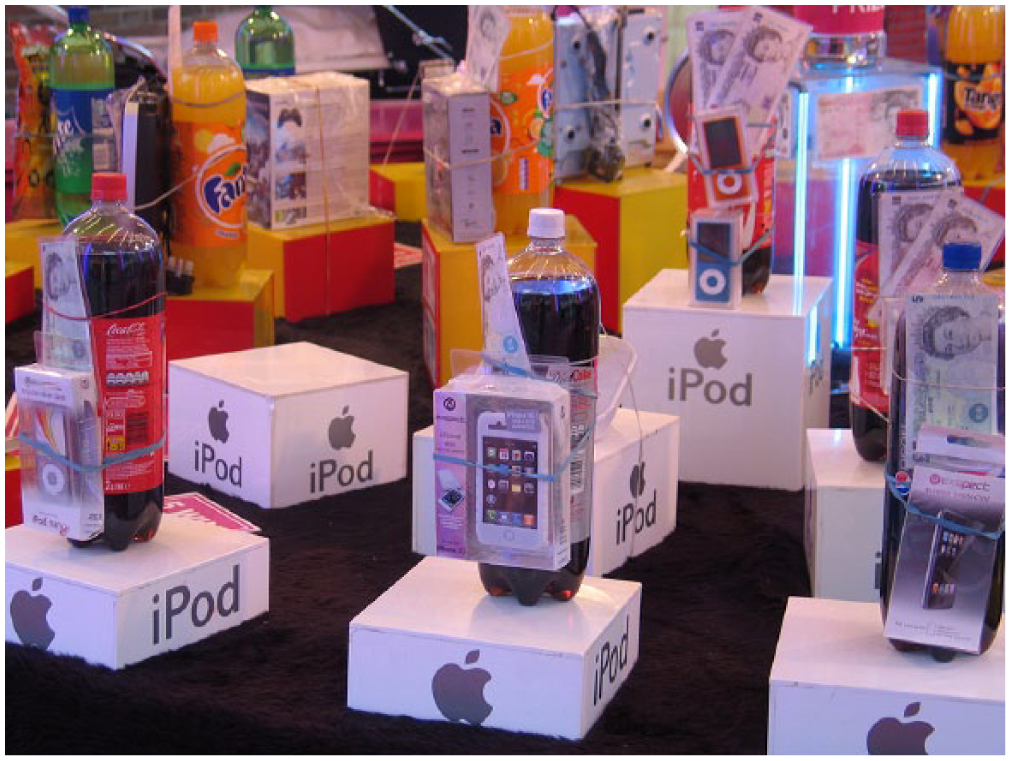
Branded goods composites, Ilkeston fair 2010. © Photograph: Ian Trowell.
The second popular prize is the franchised plush toy, seen most alarmingly with the rapidity of Minions totally monopolizing the fairground from 2015 onwards following the successful franchise of the film Minions (dir. Pierre Coffin and Kyle Balda, 2015). Figure 9 shows how stalls became homogeneously themed to this prize, here showing Minions as both theme (replacing the hook-a-duck) and prize. The post-1950s fairground, in terms of its visual decoration and prize theming, embraced the immediacy of cultural plundering (borrowing iconography from popular culture) and the anthropomorphized blobs of Minions creates an ideal prize, easy to manufacture and instantly recognizable. However, unlike the wobbly-womble, such toys are no longer unique to the fairground and can be purchased across toy shops and cheap gift shops in the high street or peppered across seaside resorts. The swagman must have a finger on the pulse of incoming cartoons and films, occasionally trying something out-of-the-blue and unconnected such as the ‘rasta-banana’ figures. A series of chronological short quotes from interviews conducted with swagmen give some insight, in answer to the question ‘what is popular?’: Branded franchises, one-offs (rasta-banana and noggin birds) and ‘real life’ animals – popular from around 2003. (swagman, Newcastle, June 2015) Nothing will ever compare to Minions – no one sure what will be next – Angry Birds, Paws Patrol, Secret Life of Pets, Ghostbusters – you need an intimate knowledge of films to come. (swagman, Kings Lynn, February 2016) Shopkins, Star Wars, Angry Birds, some Minion variations, but out of the blue, emoji – the turd is the best seller. (swagman, Newcastle, June 2016)
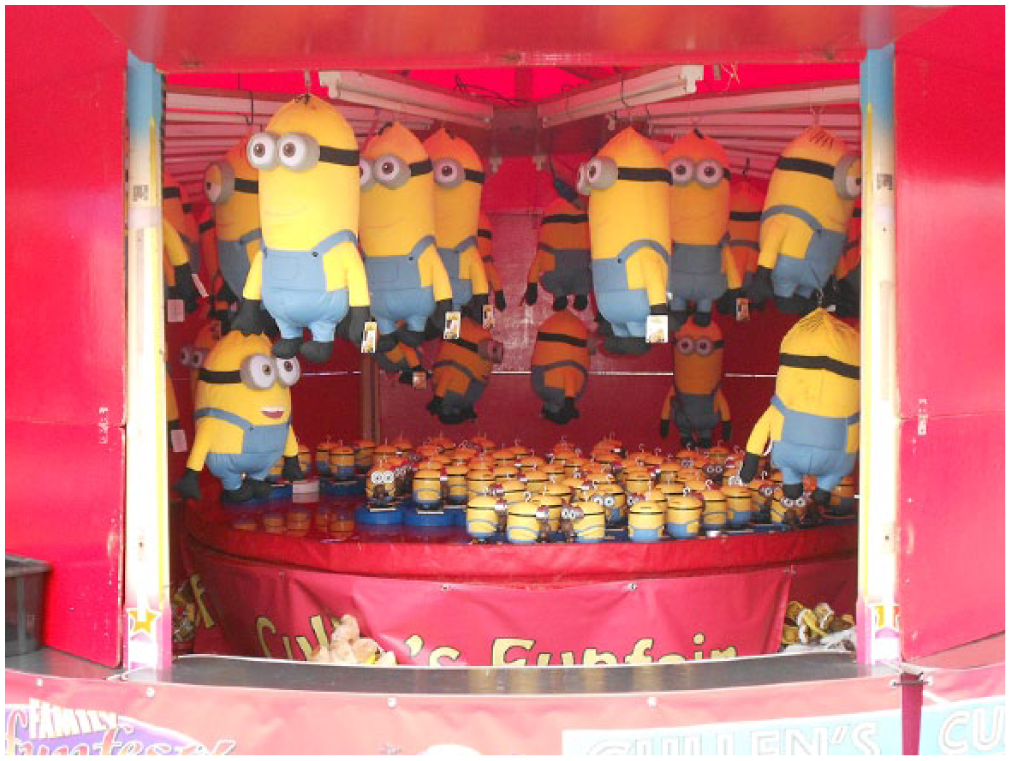
Minions game, 2016. © Photograph: Ian Trowell.
As the last quote states, the emoji figure as a plush toy prize took off in 2016 to challenge the Minions monopoly. These figures were part of the syntax of modern youth, replacements for speech segments that express feelings and opinions. As a final (visually prompted) thought, I include Figures 10a and b, exterior branding for the same stall in the years 2015 and 2016 to synchronize with the prizes. This indicates two important constructs: firstly, that the brand of the prize overpowers and hijacks the actual nature of the fairground game such that decoration totally submits to this brand and it loses parlance as (say) the hoopla stall and becomes the Minions stall, and secondly, the fleeting nature of the brand means that the stall must be effectively re-themed each year. The fairground responds to popular cultural pressures, with rides and stalls being re-themed every decade or so, indicated by Walker (2015: 325) with his study of the Waltzer. This re-theming is traditionally completed using a fairground artist, applying brushwork or airbrush work to build a new ‘skin’ on the ride; however, the new frequency of change of cultural cartoon icons necessitates a different strategy, and here digitally-printed vinyl skirting is produced and clipped onto the front of the stall.
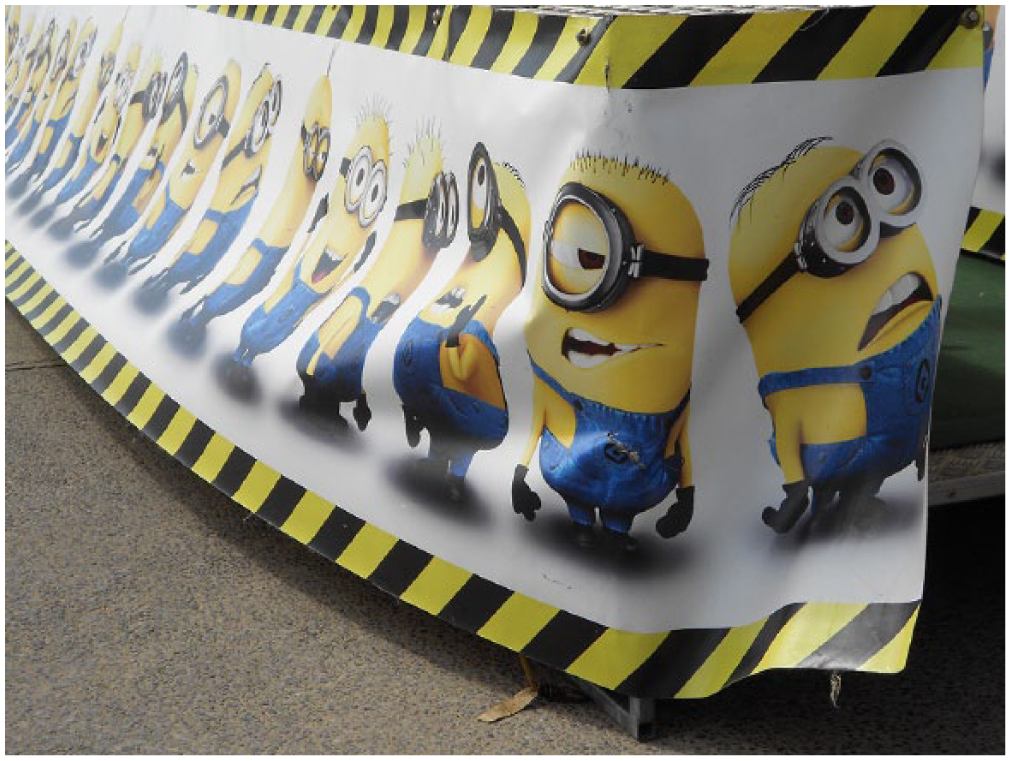
Branded stall as Minions, Whitby regatta 2015. © Photograph: Ian Trowell.
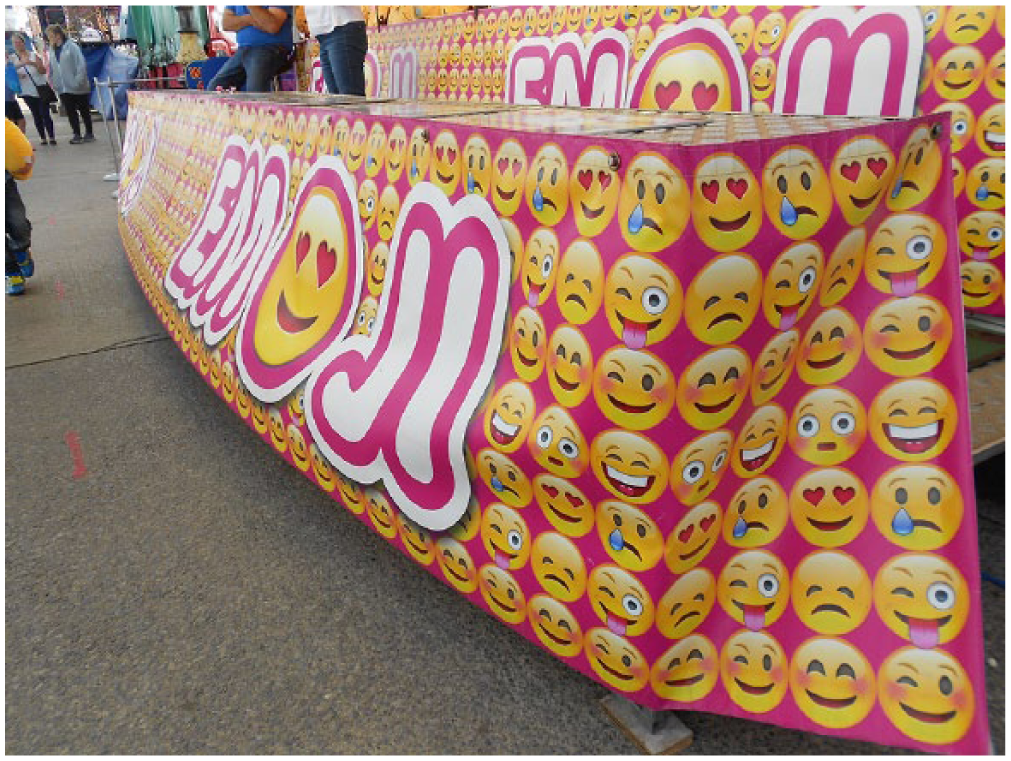
Branded stall as emojis, Whitby Regatta 2016.
Conclusion
This article examines the historical trajectory of the fairground prize, or swag, situating it within the discipline of material culture. Studying, or rescuing, such objects from within a critical wilderness is not a new venture, as the previously referenced works by Miller (1998, 2008) and Turkle (2007), along with Candlin and Guins (2009), amply demonstrate. Furthermore, in the contemporary era, the fairground prize forges a relationship with visual and material output of popular culture, and I offer here an extrication of this material as against a more default critical position as expressed by Stallabrass (1996: 231) who castigates such an environment as ‘hypertrophic commerce’. My argument is that this somewhat debased and déclassé family of objects has a wealth of biographical detail, and an ability to resiliently maintain meaningfulness and identity, setting it apart from King’s (2008) sombre Collections of Nothing comprising ‘objets refusés’ (p. 44). This resilient meaningfulness stems from its origin on the fairground: both the ritualized and festival-centred nature of its acquisition, and the slippery and grey nature of its coming-to-be. The early fairground swag object was both unique and invested with a meaning attached to its origin site, the uniqueness stemming from either a supply line that dealt obscure goods solely to the fairground, or the ingenuity and skills of showpeople creating obscure objects that emerge from the application of a blowtorch to a glass receptacle of a popular branded drink.
Employing Dant’s (1999) temporal schema of the material culture object, I propose phylogenetic and ontogenetic flows impacting upon each other. Under the pressure of a phylogenetic shift in the increasingly restless and relentless world of cultural branding, a manufactured fairground prize object will go into decline if it has not progressed along its own ontogenetic path towards ownership and is still sitting in a warehouse or on a showperson’s stall, migrating towards a ‘bottom shelf’ category. Testimony supports that an item of swag having progressed into unique ownership has been proofed against the pressure of redundancy of the flow of the general fairground swag object, although it is a question of how much this is associated with the ritual of winning or the unique fairground nature of the prize. The fairground prize is undergoing a radical change, a process underway over the past two decades and now beholden to the increasingly rapid fluctuations of popular culture. The fairground prize has become unmoored from its unique environment of conception and production, and is now subject to the rapid cycles of obsolescence associated with culturally branded goods. This proffers uncertainty, with the erosion of the special status of the fairground prize as either unique or resiliently treasured.
Footnotes
Funding
This research received no specific grant from any funding agency in the public, commercial, or not-for-profit sectors and there is no conflict of interest.
